
Introduction
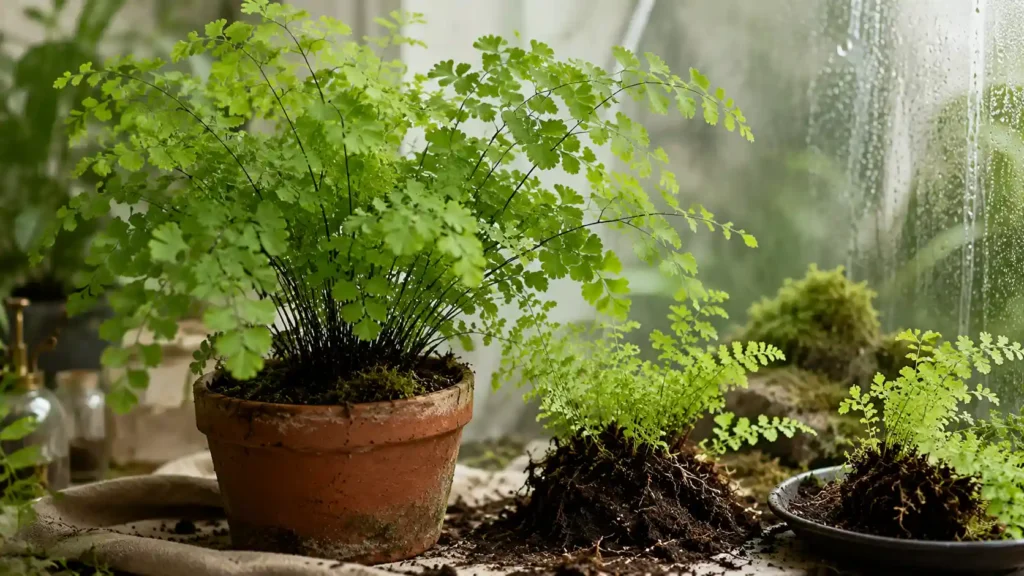
Learning how to propagate maidenhair fern starts with understanding that this delicate fern is not propagated like common houseplants with stem cuttings. Maidenhair ferns are usually multiplied through root division, where healthy sections of rhizomes and roots are separated into new plants. Spore propagation is also possible but requires more time and controlled conditions. Water can support temporary rooting of divided sections but is not a permanent growing method. The best approach depends on the grower’s experience, patience, and ability to maintain high humidity, indirect light, and consistently moist soil.
Maidenhair fern propagation is one part of successful indoor plant care, and understanding general plant requirements such as light, watering, and growth habits can help improve results across different houseplants.
Quick Summary
- Maidenhair ferns are best propagated by root division because they do not have traditional stems suitable for cuttings.
- Spore propagation is possible but is slower and requires more patience than dividing an established plant.
- Water rooting can temporarily support divided sections but is not recommended as a long-term growing method.
- Successful propagation depends on high humidity, indirect light, and evenly moist but well-draining soil.
- Root division during active growth is the easiest method for most indoor growers.
Can You Propagate Maidenhair Fern from Cuttings?
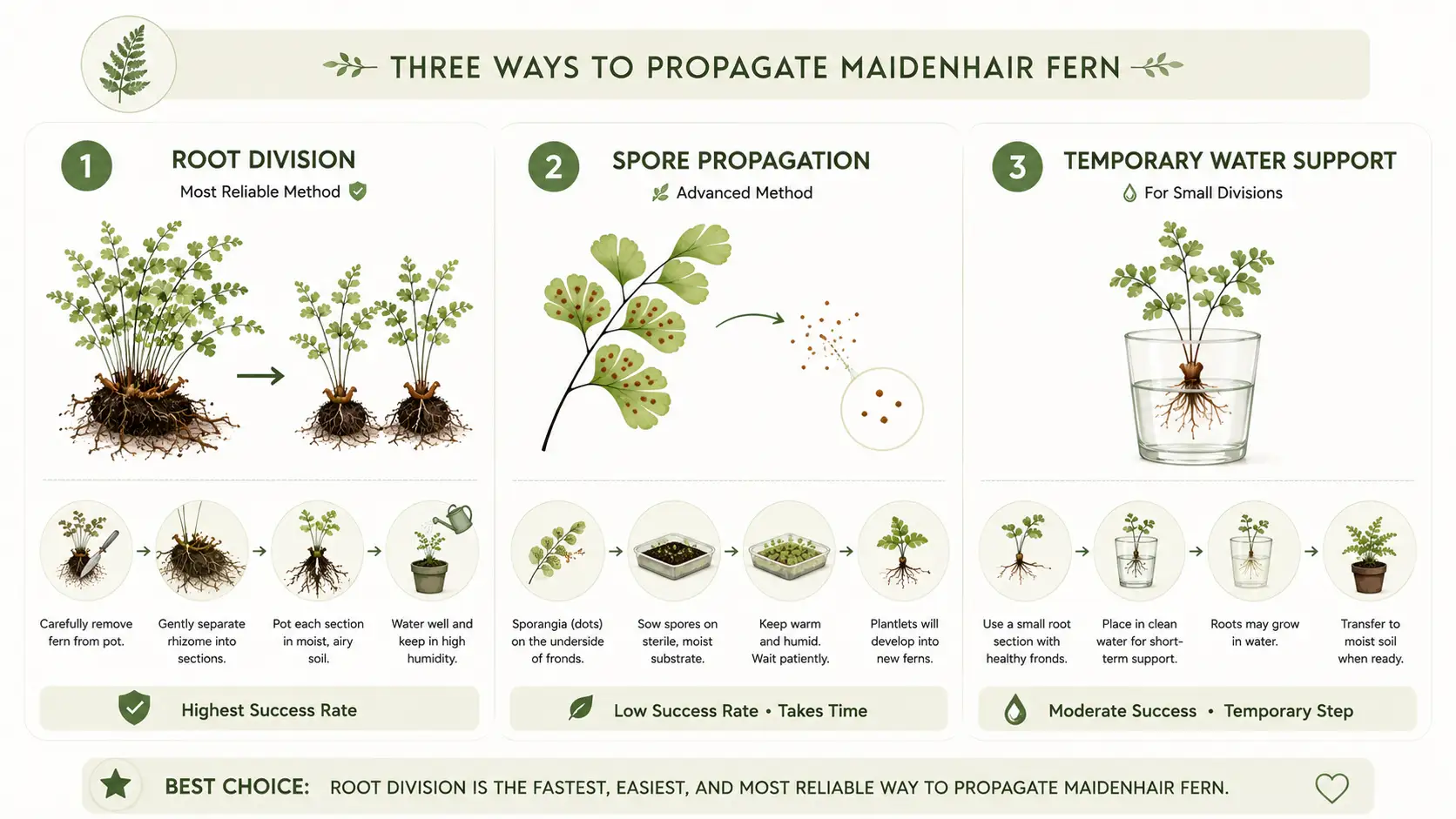
No, maidenhair ferns cannot be propagated from traditional stem cuttings because they do not have the nodes and woody stems that many houseplants use to produce new roots. Instead, the closest method to taking a cutting is dividing the plant’s underground rhizomes and root clumps. Different fern species can require different propagation techniques, and some varieties are propagated through methods other than root division depending on their growth structure.
Many beginners search for terms like “how to grow fern from cuttings,” “fern cuttings,” or “how to propagate ferns,” but maidenhair ferns belong to a different group of plants. They are true ferns from the genus Adiantum, and they reproduce through spores or vegetative division rather than stem cuttings.
Maidenhair ferns belong to the genus Adiantum, a group of ferns known for their delicate fronds and distinctive growth patterns.
The most reliable propagation methods are:
- Root division: The easiest and fastest method for home growers.
- Spore propagation: A natural but slow method requiring careful moisture and humidity control.
- Water rooting: Only a temporary technique for divided sections, not a complete propagation system.
Understanding fern structure is important because attempting to cut a frond and place it in water or soil will not create a new plant.
Why Traditional Stem Cuttings Don’t Work on Ferns
Traditional stem cuttings fail on maidenhair ferns because the plant does not have true stems with nodes that can produce new roots. The visible green parts are fronds, which function as leaves rather than propagation stems.
A maidenhair fern consists mainly of:
- Fronds: The delicate leaf-like structures that perform photosynthesis.
- Rhizomes: Underground horizontal stems that store energy and produce new growth.
- Roots: Structures that absorb water and nutrients.
Unlike pothos, philodendrons, or many other houseplants, maidenhair ferns do not create new plants from a single leaf or cut frond. The growing points are located on the rhizomes, making division the equivalent of taking a cutting.
A successful division contains:
- A healthy section of rhizome.
- Several attached roots.
- At least one active growth point or emerging frond.
This is why searches such as “can you propagate ferns from a cutting” often lead to confusion. The answer depends on the fern species and propagation method, but for maidenhair fern, dividing the root system is the practical approach.
How Long Do Fern Cuttings/Divisions Last Before Rooting?
Maidenhair fern divisions usually begin establishing new roots within several weeks, although visible new growth may take longer. Healthy divisions commonly show signs of recovery and growth within 4–8 weeks when provided with proper humidity, moisture, and light.
Signs of successful rooting include:
- New fronds emerging from the division.
- Firm, healthy rhizome sections.
- Stable moisture uptake without wilting.
- Gradual improvement in leaf color and structure.
Signs that propagation is failing include:
- Completely dry or crispy fronds.
- Soft, dark, or mushy roots.
- Persistent wilting despite moist soil.
- No signs of recovery after several months.
The term “fern cuttings” is often used broadly online, but for maidenhair ferns, these timelines apply mainly to divided root sections rather than actual stem cuttings. Newly divided plants may spend their first weeks adapting before producing noticeable growth.
How to Propagate Maidenhair Fern by Root Division
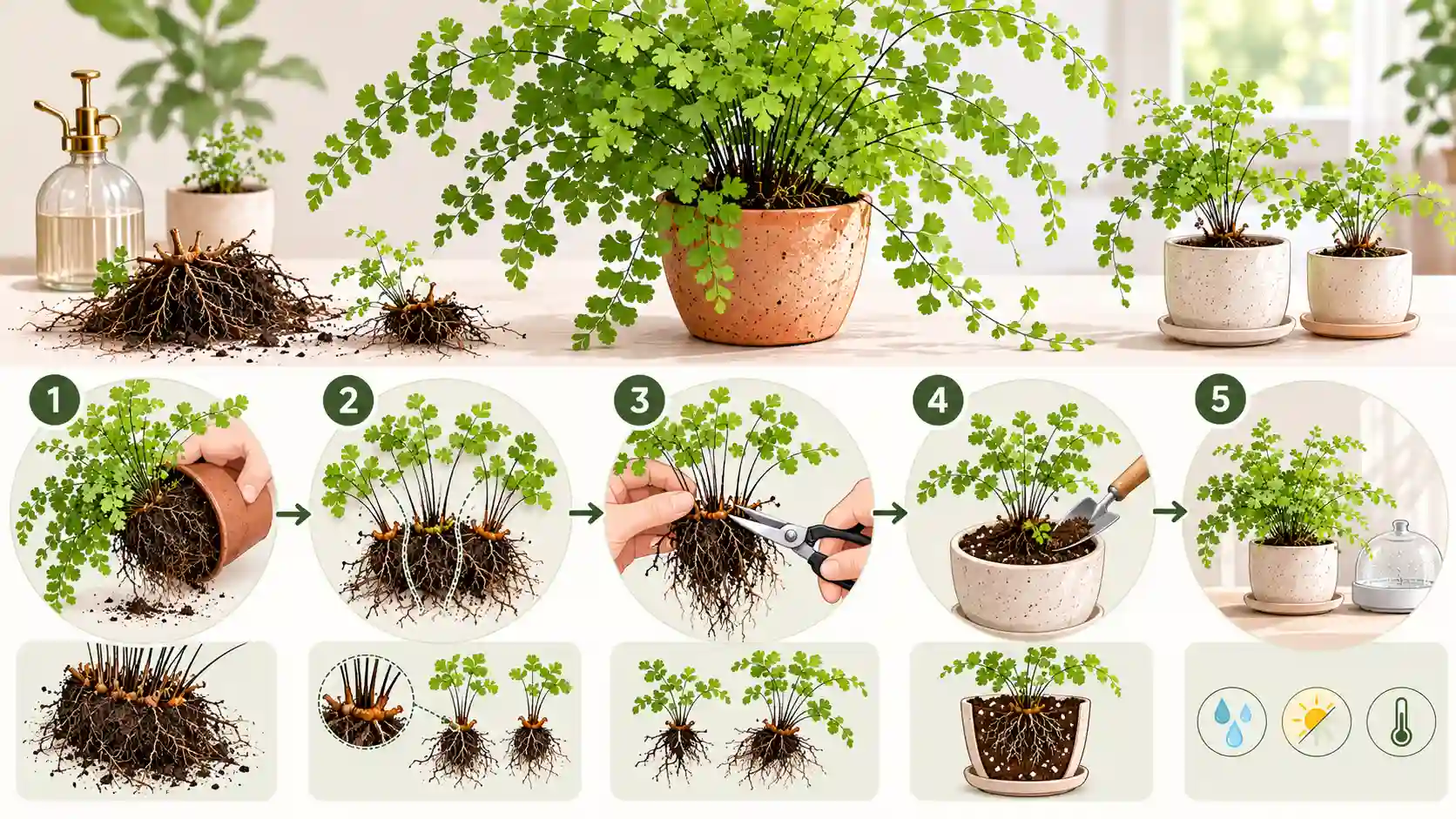
Root division is the most reliable answer for how to propagate maidenhair fern because it uses an established plant’s natural growth structure. This method creates new plants faster than spores and has a higher success rate for indoor growers.
The best time to divide maidenhair fern is during active growth, usually in spring or early summer. Dividing during this period allows the plant to recover more quickly because warmer temperatures and increased daylight support root development.
Follow these steps:
- Remove the maidenhair fern from its pot
- Gently loosen the plant from its container.
- Support the root ball carefully because maidenhair fern roots are delicate.
- Avoid pulling forcefully on fronds, as they can break easily.
- Identify natural root clump divisions
- Examine the underground rhizomes and root sections.
- Look for areas where the plant naturally separates into smaller clusters.
- Each section should have roots and healthy growing points.
- Separate divisions using clean tools
- Use sterilized scissors or a clean knife if the root mass is tightly connected.
- Make clean cuts to reduce damage and lower the risk of infection.
- Avoid creating divisions that are too small because weak sections recover slowly.
- Replant each division
- Place each section into a container with fresh, moisture-retentive soil.
- Keep the rhizome close to the soil surface rather than burying it deeply.
- Use a pot that allows drainage to prevent standing water.
- Provide initial aftercare
- Keep newly divided plants in bright, indirect light.
- Maintain high humidity around the foliage.
- Keep soil evenly moist but avoid waterlogged conditions.
- Remove damaged fronds if necessary to help the plant focus energy on recovery.
Root division is especially suitable for indoor propagation because it creates mature-looking plants faster than growing from spores. Root division is also a common propagation approach for several indoor plants, although each species has its own ideal timing and separation method.
Propagating Maidenhair Fern Indoors
Propagating maidenhair fern indoors requires stable environmental conditions because this species is sensitive to sudden changes in moisture and humidity. Indoor propagation is most successful when divisions are placed in a warm, humid area with filtered light.
Important indoor conditions include:
- Humidity: Maidenhair ferns prefer consistently humid environments, often performing well in bathrooms, kitchens, or near humidity trays.
- Light: Bright indirect light supports recovery, while direct sunlight can scorch delicate fronds.
- Temperature: Moderate indoor temperatures between approximately 60–75°F (16–24°C) are generally suitable.
- Timing: Spring and early summer are usually the best periods for division because the plant is actively growing.
A common beginner mistake is allowing newly divided plants to dry out. Maidenhair ferns have thin fronds that lose moisture quickly, so maintaining consistent humidity is essential during the recovery period. Maintaining proper humidity is one of the most important factors for sensitive indoor plants, especially after propagation when new roots and fronds are still developing.
Can You Propagate Maidenhair Fern in Water?
Maidenhair ferns can be placed in water temporarily after division, but they cannot be permanently propagated and grown as a true aquatic plant. Water may help maintain moisture around a divided root section while it develops new roots, but long-term growth requires a suitable soil-based environment.
Searches such as “can you grow maidenhair ferns in water,” “can maidenhair fern grow in water,” and “how to propagate maidenhair fern in water” often come from confusion between water propagation methods used for plants like pothos and the natural growth requirements of ferns.
Water propagation for maidenhair fern works only in specific situations:
- A divided section with existing roots may be placed in water temporarily.
- The water helps prevent dehydration while the division begins recovery.
- The plant should eventually be transferred into a moisture-retentive potting mix.
Long-term water growth is not recommended because maidenhair ferns require oxygen around their roots, nutrients from soil, and a balanced moisture environment. Constantly submerged roots can increase the risk of root damage and reduce plant health.
Water rooting is mainly useful as a short-term support method, not as a replacement for proper soil propagation.
Transitioning from Water to Soil
If a maidenhair fern division has been temporarily kept in water, it should be moved into soil once the roots are stable and the plant shows signs of recovery. Transitioning too quickly can stress the plant, while leaving it in water for too long can weaken root function.
To move a water-rooted division into soil:
- Choose a small pot with drainage holes.
- Use a light, moisture-retentive fern-friendly potting mix.
- Gently place roots into the soil without compacting them tightly.
- Keep the soil evenly moist after planting.
- Maintain higher humidity during the adjustment period.
A gradual transition helps the fern adapt from a water environment to soil conditions where roots must absorb both moisture and oxygen.
Water Propagation vs. Soil Division
| Feature | Water Propagation | Soil Division |
| Success rate | Lower because it depends on existing roots and careful transition | Higher because it uses established rhizomes and root systems |
| Speed | Usually slower and temporary | Faster for producing established new plants |
| Root development | Limited for long-term growth | Supports natural root expansion |
| Long-term plant health | Not recommended as a permanent method | Best option for healthy mature growth |
| Best use | Temporary hydration support for divisions | Main propagation method for maidenhair ferns |
How to Propagate Maidenhair Fern from Spores
Propagating maidenhair fern from spores is possible, but it is a slower and more advanced technique compared with root division. Ferns reproduce naturally through spores, which are tiny reproductive structures produced on mature fronds instead of seeds.
The process requires patience because spores must first develop into a small intermediate growth stage called a gametophyte before eventually producing a young fern plant.
To propagate maidenhair fern from spores:
- Identify spore-bearing fronds
- Mature maidenhair fern fronds may develop small brown clusters called sori on the underside of leaves.
- These contain the spores needed for reproduction.
- Collect fern spores
- Place a mature frond on clean paper or a suitable surface.
- Allow spores to naturally release from the underside.
- Collect the fine dust-like spores carefully.
- Prepare a sterile growing medium
- Sow spores on a clean, moisture-retaining medium.
- Avoid contaminated soil because young fern growth is highly sensitive to fungi and bacteria.
- Maintain humidity and temperature
- Cover the growing area to retain moisture.
- Keep conditions warm and consistently humid.
- Avoid letting the growing medium dry out.
- Wait for germination
- Fern spores may take several weeks or months to develop.
- The process requires patience because visible fern growth appears much later than division propagation.
Spore propagation is best suited for experienced growers who enjoy the complete fern life cycle. For most indoor gardeners, root division remains the practical choice.
Spores vs. Seeds — Why Ferns Don’t Produce True Seeds
Maidenhair ferns do not produce true seeds because ferns are non-flowering vascular plants that reproduce through spores. Terms such as “maidenhair fern seed,” “how to plant fern seeds,” and “growing ferns from seed” are common search phrases, but they describe a process that does not apply botanically.
The difference is:
| Reproduction Method | Ferns | Seed-Producing Plants |
| Reproductive structure | Spores | Seeds |
| Flowers produced | No | Usually yes |
| Fertilization process | Requires a gametophyte stage | Seed develops after fertilization |
| Propagation speed | Usually slower | Often faster depending on species |
Fern spores are microscopic and do not contain the same protective structures found in seeds. This makes fern propagation more dependent on moisture, humidity, and environmental stability.
Where Is the Best Place to Put a Maidenhair Fern?
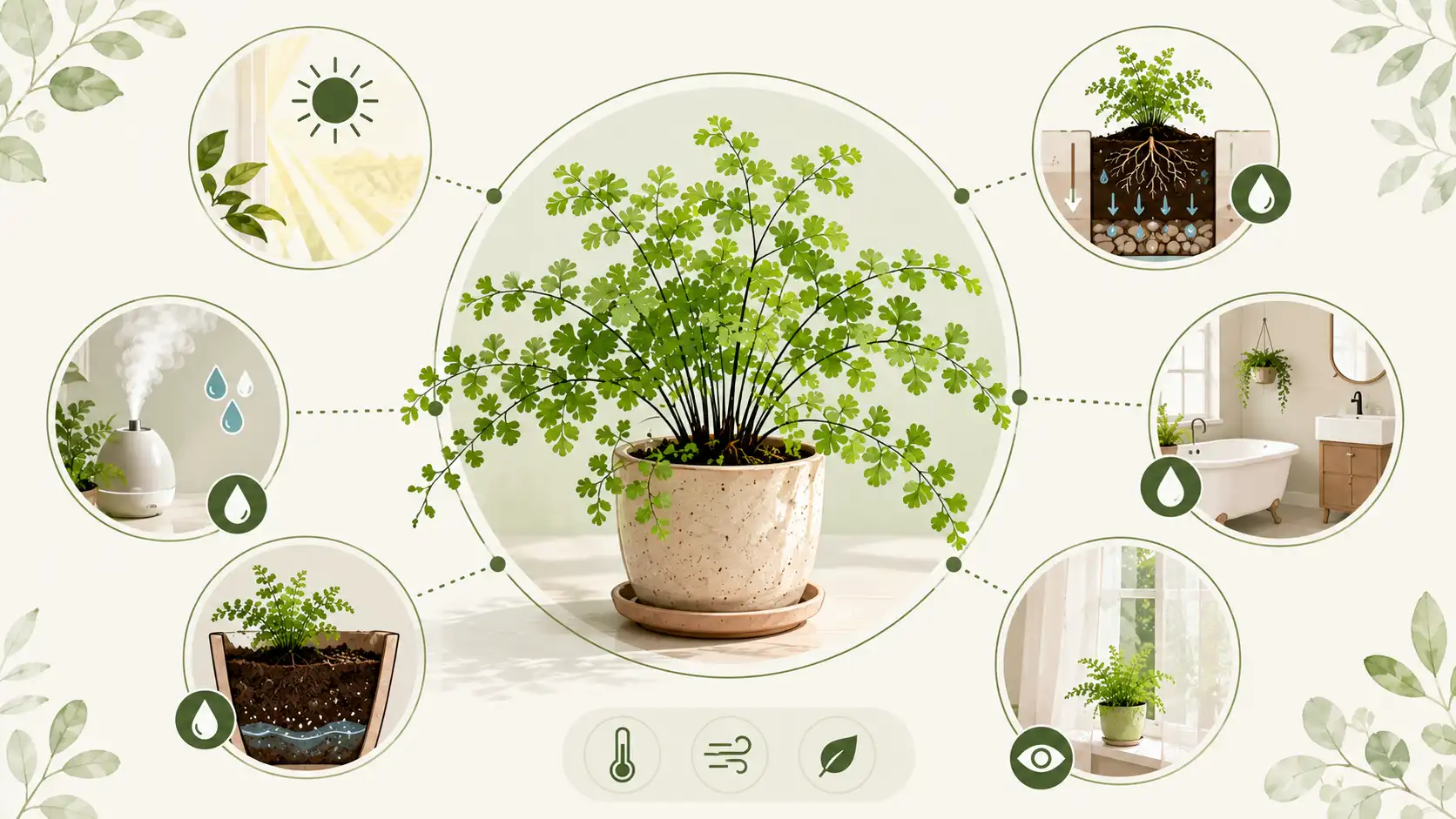
The best place to put a maidenhair fern is an area with bright indirect light, high humidity, and protection from direct sun. Maidenhair ferns grow naturally in moist woodland environments, so they perform best when indoor conditions imitate filtered light and consistent moisture.
Placement strongly affects propagation success because newly divided plants are especially sensitive to drying conditions.
Ideal placement conditions include:
- Indirect light: A location near an east-facing or north-facing window often works well.
- High humidity: Bathrooms, kitchens, and areas with humidity trays can provide better moisture levels.
- Stable temperature: Avoid areas with drafts, heating vents, or sudden temperature changes.
- Outdoor conditions: Maidenhair ferns can grow outdoors in suitable climates with shade and consistent moisture.
Do Maidenhair Ferns Like Sun or Shade?
Maidenhair ferns prefer filtered light or partial shade rather than direct sunlight. Strong sun exposure can damage delicate fronds by causing browning, dryness, and leaf scorch.
They need light for photosynthesis, but the light should be gentle and indirect. A common mistake is placing a maidenhair fern in a sunny window without protection, which can quickly dry the plant.
Signs of unsuitable lighting include:
- Brown or crispy fronds from excessive direct light.
- Slow growth from insufficient light.
- Pale or weak foliage from poor conditions.
The ideal balance is bright but indirect light combined with high humidity and evenly moist soil.
How Much Light Does a Maidenhair Fern Need?
A maidenhair fern typically needs several hours of bright indirect light each day. It does not require intense sunlight, but complete darkness or very low light can reduce growth and make propagation recovery slower.
For indoor plants:
- Place near filtered window light.
- Use sheer curtains if sunlight is strong.
- Rotate the plant occasionally for balanced growth.
- Avoid direct afternoon sun.
Proper lighting supports healthier fronds and improves the success rate of newly propagated divisions.
Maidenhair Fern Care After Propagation
After propagation, maidenhair fern care focuses on maintaining stable moisture, humidity, and gentle growing conditions. Newly divided plants are more vulnerable because their root systems are smaller and must rebuild their ability to absorb water efficiently.
For long-term fern health, understanding general fern care practices such as watering routines, humidity control, and maintenance techniques can help support successful growth after propagation.
The most important care factors after propagation include:
- Keeping the soil consistently moist but not saturated.
- Maintaining high humidity around the fronds.
- Providing bright indirect light.
- Avoiding unnecessary repotting or disturbance while roots establish.
- Delaying heavy fertilization until new growth appears.
A common beginner mistake is treating newly propagated maidenhair ferns like drought-tolerant houseplants. Unlike many popular indoor plants, maidenhair ferns have delicate foliage and shallow root systems that quickly respond to dry air or inconsistent watering.
Do You Water Maidenhair Ferns Top or Bottom?
Maidenhair ferns can be watered from the top or bottom, but bottom watering is often helpful because it encourages even moisture distribution while reducing the chance of disturbing delicate roots and soil structure. The goal is to keep the root zone evenly moist without creating waterlogged conditions.
Bottom watering method:
- Place the pot in a container of water.
- Allow the soil to absorb moisture through the drainage holes.
- Remove the pot once the upper soil layer feels slightly damp.
- Allow excess water to drain before returning the plant to its location.
Top watering is also acceptable when done carefully. Pour water slowly around the soil rather than directly onto delicate fronds or the center crown of the plant.
Avoid allowing maidenhair fern soil to dry completely because repeated drying cycles can cause:
- Brown, crispy fronds.
- Leaf drop.
- Slower recovery after propagation.
- Weak new growth.
Should You Fertilize Newly Propagated Ferns?
Newly propagated maidenhair ferns should not receive heavy fertilizer immediately because their recovering roots can be sensitive to concentrated nutrients. A diluted, balanced fern fertilizer can be introduced after the plant begins producing new growth.
Common fertilizer questions include “should you put Miracle-Gro on ferns” and “what does Epsom salt do to ferns.” The answer is that maidenhair ferns benefit from appropriate nutrients, but excessive fertilizer or unproven additives can damage roots.
Recommended fertilizing practices:
- Wait until new growth appears before feeding.
- Use a balanced liquid fertilizer diluted to half strength.
- Feed mainly during active growth periods.
- Reduce or stop fertilizing during slower winter growth.
Epsom salt is sometimes used by gardeners as a magnesium supplement, but it is not a required treatment for healthy maidenhair ferns. Unless a nutrient deficiency is confirmed, regular balanced fertilizer and proper soil conditions are usually sufficient.
Do Maidenhair Ferns Like Big Pots or Being Root Bound?
Maidenhair ferns generally prefer slightly snug pots rather than very large containers. A pot that is too large can hold excess moisture around the roots, increasing the risk of root problems.
A suitable pot should:
- Match the size of the root system.
- Have drainage holes.
- Allow some room for gradual growth.
- Avoid excessive unused soil space.
Maidenhair ferns do not need to become severely root bound to remain healthy. Mildly crowded roots may encourage stability, but extreme root restriction can limit water absorption and nutrient uptake.
Repotting is usually needed when:
- Roots begin growing through drainage holes.
- Water passes through the pot too quickly.
- Growth slows despite proper care.
- The root mass completely fills the container.
For propagation, starting divisions in appropriately sized pots helps prevent moisture problems while new roots develop.
Maidenhair Fern Care Requirements Table
| Requirement | Why It Matters for Propagation Success |
| Light | Bright indirect light supports healthy recovery without damaging delicate fronds. |
| Water | Consistent moisture helps roots establish, while avoiding soggy soil prevents root rot. |
| Humidity | High humidity reduces frond drying and supports successful adjustment after division. |
| Soil | Moisture-retentive but well-draining soil provides both water and oxygen to roots. |
| Fertilizer | Gentle feeding supports growth after roots become established without causing stress. |
| Pot Size | A slightly snug container prevents excess moisture and encourages healthy root development. |
Are Maidenhair Ferns Hard to Grow? (Difficulty & Realistic Expectations)
Maidenhair ferns are considered moderately challenging houseplants because they require more consistent moisture and humidity than many common indoor plants. They are not impossible to grow, but they respond quickly to environmental changes.
The main reason growers struggle with maidenhair ferns is not propagation itself but maintaining the conditions the plant naturally prefers. A healthy division can establish successfully when humidity, watering, and light are managed correctly.
Realistic expectations include:
- Growth may be gradual rather than rapid.
- Fronds may decline temporarily after division.
- Consistent care is more important than frequent intervention.
- Recovery can take weeks before visible improvement appears.
Understanding these requirements helps prevent beginners from abandoning healthy plants too early.
Maidenhair Fern Growth Rate and Lifespan
The maidenhair fern growth rate is generally moderate when the plant receives suitable conditions. Growth speed depends heavily on humidity, temperature, available light, soil quality, and watering consistency.
Healthy plants may produce new fronds throughout the active growing season, especially during spring and summer.
Factors affecting growth rate include:
- Higher humidity supports faster recovery.
- Stable moisture improves root function.
- Adequate indirect light encourages stronger foliage.
- Poor conditions can slow or stop new growth.
The lifespan of a maidenhair fern depends on care quality. With proper humidity, watering, and maintenance, an established maidenhair fern can live for many years indoors.
Will Maidenhair Fern Spread Over Time?
Yes, maidenhair ferns can spread gradually over time, but they are not invasive houseplants. They expand mainly through natural growth of rhizomes, creating larger clumps rather than aggressively taking over surrounding areas.
Indoors, spread is usually limited by:
- Container size.
- Available nutrients.
- Light conditions.
- Root space.
Outdoor maidenhair ferns may form wider colonies in suitable shaded, moist environments. Their spreading behavior is generally controlled and predictable compared with invasive garden plants.
Common Problems When Propagating or Growing Maidenhair Fern
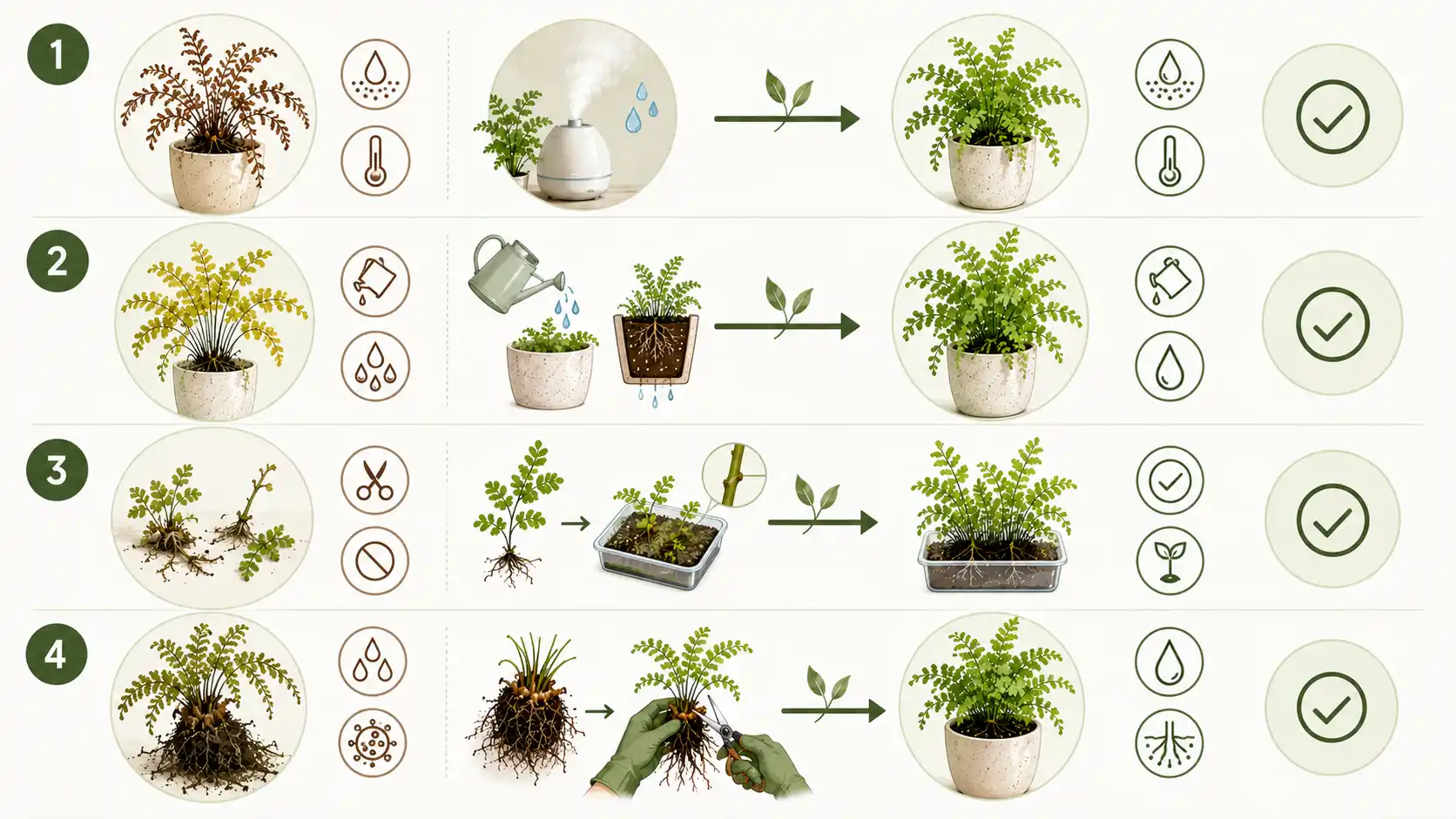
Maidenhair fern propagation problems usually happen because of incorrect moisture levels, low humidity, unsuitable light, or choosing the wrong propagation method. Identifying the cause early helps prevent permanent damage.
Common issues include:
- Fronds turning brown or crispy
- Why it happens: Low humidity, underwatering, dry air, or excessive direct sunlight.
- Fix: Increase humidity, maintain consistent soil moisture, and move the plant away from harsh sunlight.
- Prevention: Keep environmental conditions stable and avoid allowing the soil to completely dry.
- Yellowing leaves
- Why it happens: Overwatering, poor drainage, or stress from unsuitable lighting.
- Fix: Check soil moisture, improve drainage, and adjust light exposure.
- Prevention: Use a well-draining mix and water only when needed.
- Slow or failed propagation
- Why it happens: Using incorrect methods, dividing unhealthy sections, low humidity, or propagating during poor timing.
- Fix: Use healthy rhizome divisions and provide proper humidity and indirect light.
- Prevention: Propagate during active growth and select strong root sections.
- Root rot in divisions
- Why it happens: Excess water, compact soil, or poor drainage.
- Fix: Remove damaged roots, improve soil conditions, and reduce watering frequency.
- Prevention: Maintain moisture without creating constantly wet soil.
Healthy soil management also helps prevent common indoor plant issues, including pests and unwanted organisms that can affect root health.
What Makes Maidenhair Fern Worth Propagating?
Maidenhair ferns are worth propagating because they allow growers to expand their plant collection from an established specimen while preserving the unique appearance and characteristics of the original plant. Propagation also provides a practical way to replace damaged sections or create additional plants without purchasing new ones.
The benefits of having and propagating maidenhair ferns include:
- Air-quality contribution: Like many indoor plants, maidenhair ferns contribute to indoor greenery and support a healthier living environment through natural plant processes.
- Aesthetic and texture value: Their delicate, fan-shaped leaflets and thin dark stems add a soft, elegant texture that differs from many common houseplants.
- Low-cost plant expansion: Dividing an existing plant allows growers to create new specimens without buying additional plants.
- Preserving mature plants: Propagation provides a backup method for maintaining a favorite fern if the original plant becomes damaged or declines.
- Educational value: Growing maidenhair ferns through division or spores allows gardeners to understand fern biology and natural reproduction.
Unlike many fast-growing houseplants, maidenhair ferns are valued for their graceful appearance and unique growing requirements. Successfully propagating one creates a deeper understanding of how ferns develop and how environmental conditions influence plant health.
Conclusion
Learning how to propagate maidenhair fern begins with choosing the right method for the plant’s natural growth structure. Root division is the most reliable and practical method because it uses established rhizomes and roots to create new plants. Water propagation can only provide temporary support for divided sections, while spore propagation offers a slower, more advanced approach for patient growers.
Successful maidenhair fern propagation depends on maintaining high humidity, bright indirect light, and consistently moist but well-draining soil. The best method depends on the grower’s experience level, available time, and growing environment. By matching the propagation technique with proper care conditions, gardeners can successfully expand their maidenhair fern collection and maintain healthy plants for years.
FAQs
Can you propagate maidenhair fern in water?
Maidenhair fern can be placed in water temporarily after root division, but water is not a permanent propagation method. The plant requires soil, oxygen around its roots, and proper nutrients for long-term growth. Water is mainly useful for preventing divided sections from drying out before they are planted.
What is the lifespan of a maidenhair fern?
A maidenhair fern can live for many years when provided with suitable conditions, including high humidity, indirect light, consistent moisture, and proper soil drainage. Its lifespan depends mainly on environmental stability and ongoing care rather than a fixed number of years.
Do maidenhair ferns like to be root bound?
Maidenhair ferns prefer slightly snug pots but do not need to become severely root bound. A moderately filled container can support healthy growth, while an excessively crowded root system may reduce water and nutrient absorption. Repotting is needed when roots outgrow the container or drainage becomes poor.
How long do fern cuttings/divisions take to root?
Maidenhair fern divisions typically take about 4–8 weeks to establish roots under suitable conditions. Since maidenhair ferns do not grow from traditional stem cuttings, this timeline applies to divided root and rhizome sections. High humidity, proper moisture, and indirect light improve rooting success.
Do you water maidenhair ferns from the top or bottom?
Maidenhair ferns can be watered from either the top or bottom, but bottom watering can help provide even moisture while protecting delicate roots. Regardless of method, the goal is to keep the soil consistently moist without allowing it to become waterlogged.
Will a maidenhair fern spread on its own?
Yes, maidenhair ferns can spread gradually through rhizome growth, forming larger clumps over time. They do not typically spread aggressively or become invasive indoors. Their growth is naturally limited by available space, nutrients, and environmental conditions.