
Introduction
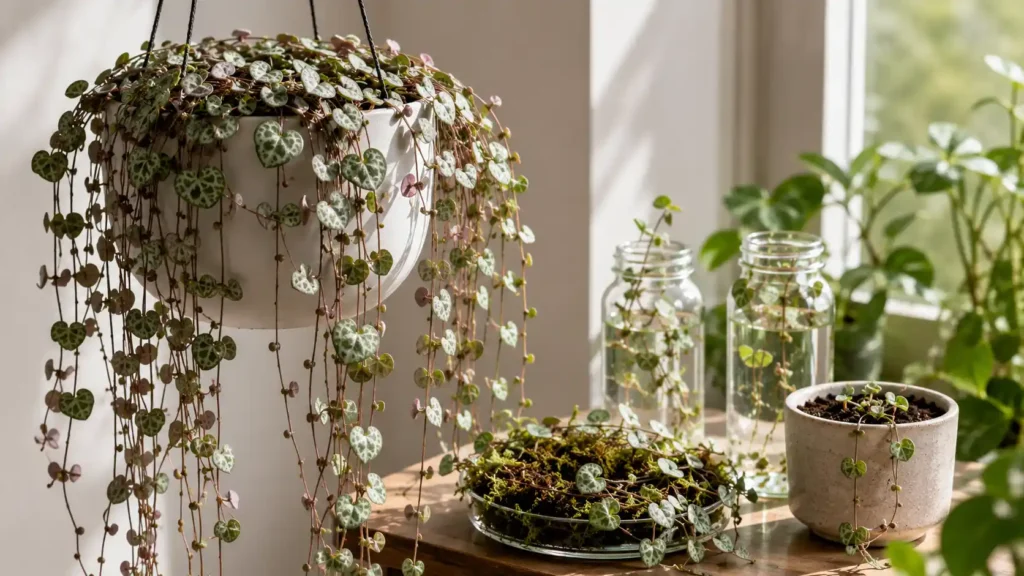
String of hearts propagation is the process of creating new plants from an existing string of hearts vine through stem cuttings, aerial tubers, or rarely through seeds. Scientifically known as Ceropegia woodii, this trailing succulent is popular because it can produce new growth quickly when propagated under suitable conditions. The plant’s natural ability to develop roots from vine nodes and tubers makes propagation accessible even for beginners. Whether using water, soil, moss, or the butterfly method, successful propagation depends on choosing healthy cuttings, providing proper moisture, and maintaining suitable light and temperature conditions. Learning proper propagation techniques is an important part of successful houseplant care, especially for indoor plants that can be multiplied through cuttings and other methods.
Quick Summary
- String of hearts propagates most reliably from stem cuttings placed in water, soil, or moss.
- Aerial tubers along the vine are natural rooting points that can help create new plants.
- The butterfly method maximizes new plants by using small sections around each node.
- Most cuttings develop initial roots within 2–4 weeks with proper care.
What Is String of Hearts Propagation?
String of hearts propagation is the horticultural process of creating new Ceropegia woodii plants from parts of a mature vine. Instead of growing an entirely new plant from seed, propagation usually involves using sections of the existing plant that contain nodes or aerial tubers capable of producing roots and new growth. String of hearts, scientifically classified as Ceropegia woodii, is a trailing succulent species known for its heart-shaped leaves and unique vine growth pattern.
Ceropegia woodii belongs to the Apocynaceae family and is commonly known by several names, including string of hearts, chain of hearts, and rosary vine. The plant naturally grows as a trailing succulent vine with heart-shaped leaves arranged along thin stems.
Propagation works because the vine contains growth points called nodes. These nodes are areas where leaves, roots, and new shoots can develop. Mature plants may also produce small bead-like structures called aerial tubers along the stems, which act as natural storage organs and rooting points. Before propagating, understanding the plant’s natural growing habits, watering needs, and light requirements can improve success rates, so proper Ceropegia woodii care is an important foundation.
Common propagation materials include:
- Healthy stem cuttings with at least one node
- Vine sections containing aerial tubers
- Butterfly method cuttings containing individual nodes
- Rarely, seeds produced under specific conditions
Unlike many houseplants that require complex propagation techniques, string of hearts can often be multiplied with simple cutting methods when the correct plant parts are used.
Why Propagate String of Hearts?
Propagating string of hearts allows growers to create additional plants while improving the appearance and health of an existing vine. Because the plant naturally produces long trailing stems, propagation is an effective way to manage growth and encourage fullness.
Common reasons to propagate string of hearts include:
- Filling out a sparse plant: New cuttings can be added back into the original pot to create a thicker, fuller vine.
- Sharing cuttings: Small propagated sections make it easy to share plants with other growers.
- Creating a backup plant: Propagation provides a replacement plant if the original suffers from root rot or environmental stress.
- Encouraging a bushier appearance: Adding rooted cuttings around the base helps create a denser hanging basket display.
Propagation is also useful when pruning long vines. Instead of discarding healthy sections, growers can turn trimmed pieces into new plants.
Methods of Propagating String of Hearts
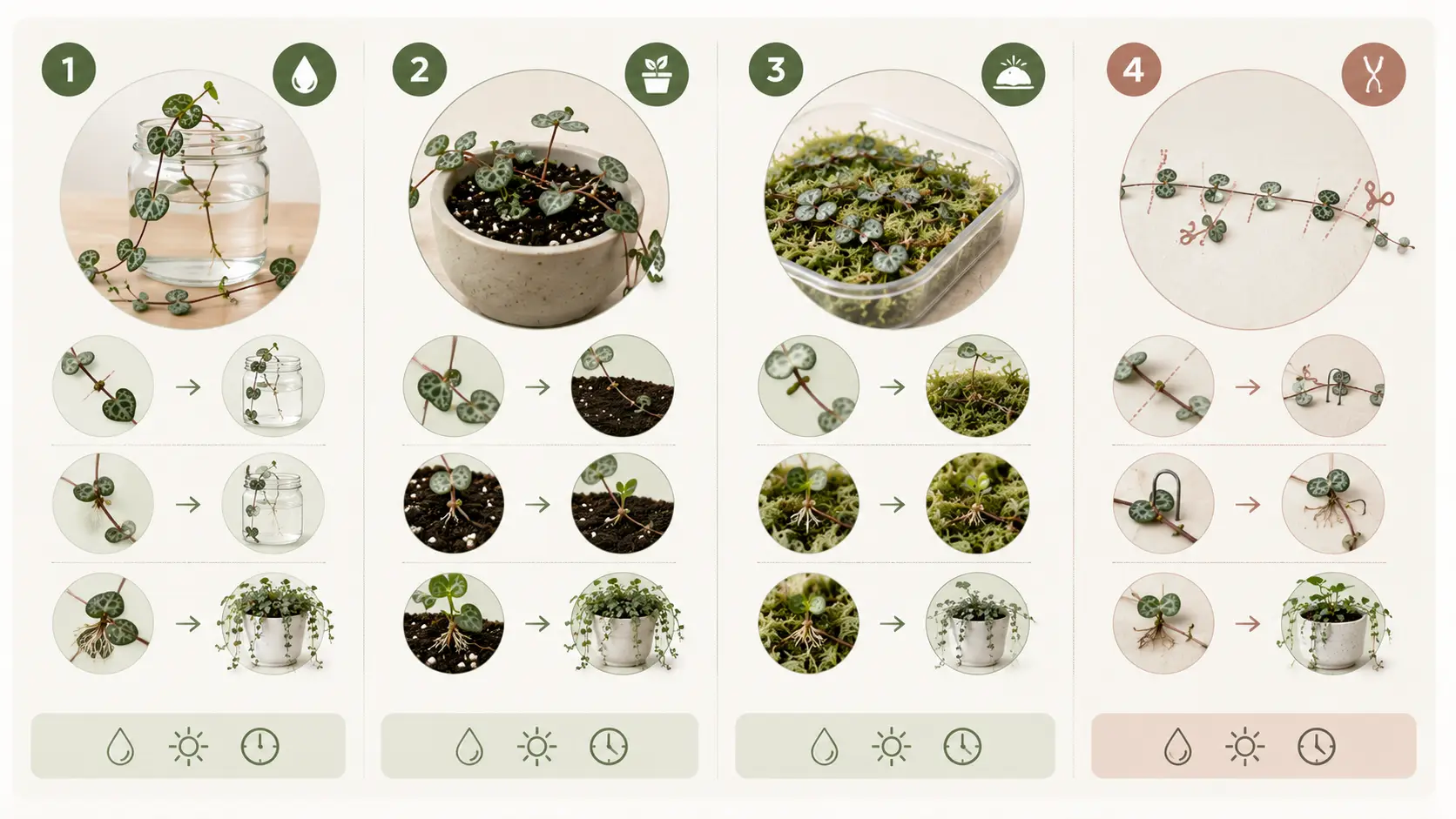
String of hearts propagation can be done through several methods, but the most common techniques use stem cuttings placed in water, soil, or moss. The best method depends on the grower’s experience, available materials, and desired outcome. Many popular houseplants can also be multiplied through similar cutting-based techniques, including other indoor favorites that rely on healthy stems and proper rooting conditions.
The main propagation techniques include:
- String of hearts propagation in water: A beginner-friendly method that allows visible root development.
- String of hearts soil propagation: A direct method where cuttings root in their final growing medium.
- Propagating string of hearts in moss: A moisture-controlled method that supports delicate cuttings.
- Butterfly method: A technique designed to maximize new plants from limited vine material.
- Aerial tuber propagation: Uses the plant’s natural rooting structures.
Healthy cuttings should always come from disease-free stems. Sections with firm leaves, visible nodes, and active growth points generally have the highest success rates.
Water Propagation
Water propagation is one of the easiest ways to start new string of hearts plants because it allows growers to observe root development. The method involves placing a healthy cutting in water until roots form before transferring it into soil. Water propagation is also widely used for other popular indoor vines, such as Heartleaf Philodendron, where stem cuttings develop roots before being transferred into soil.
Steps for water propagation:
- Select a healthy vine section with at least one or two nodes.
- Remove leaves from the lower portion of the cutting if they would sit underwater.
- Place the node area into a clean container filled with water.
- Keep the container in bright, indirect light.
- Change the water regularly to prevent bacterial growth.
Roots commonly begin appearing within 2–4 weeks, although timing depends on temperature, light, and cutting health. Once roots are several centimeters long and the plant shows signs of stability, the cutting can be moved into a well-draining succulent soil mix.
Advantages of water propagation:
- Root growth is easy to observe.
- Beginners can monitor progress without disturbing the cutting.
- Failed cuttings are easier to identify early.
Disadvantages include:
- Water-grown roots may require adjustment when moved into soil.
- Poor water hygiene can cause stem rot.
- Cuttings may experience transplant stress after rooting.
Soil Propagation
Soil propagation involves placing string of hearts cuttings directly into a growing medium instead of rooting them in water first. This method allows new roots to develop in the environment where the plant will continue growing.
For successful soil propagation:
- Cut a healthy vine section containing one or more nodes.
- Allow freshly cut ends to dry briefly to reduce rot risk.
- Place the node directly against or slightly into the soil surface.
- Keep the medium lightly moist but never saturated.
- Provide bright, indirect light and warm temperatures.
A succulent-appropriate soil mix is recommended because Ceropegia woodii has succulent characteristics and does not tolerate constantly wet conditions.
A suitable mix often includes:
- Well-draining potting soil
- Perlite or pumice
- Coarse material for improved airflow
Rooting hormone is optional but may help encourage faster root formation, especially with older or slower-growing cuttings.
The biggest mistake with soil propagation is excessive watering. The cutting needs moisture to develop roots but should not remain in wet soil, as this can quickly lead to stem rot.
Butterfly Method
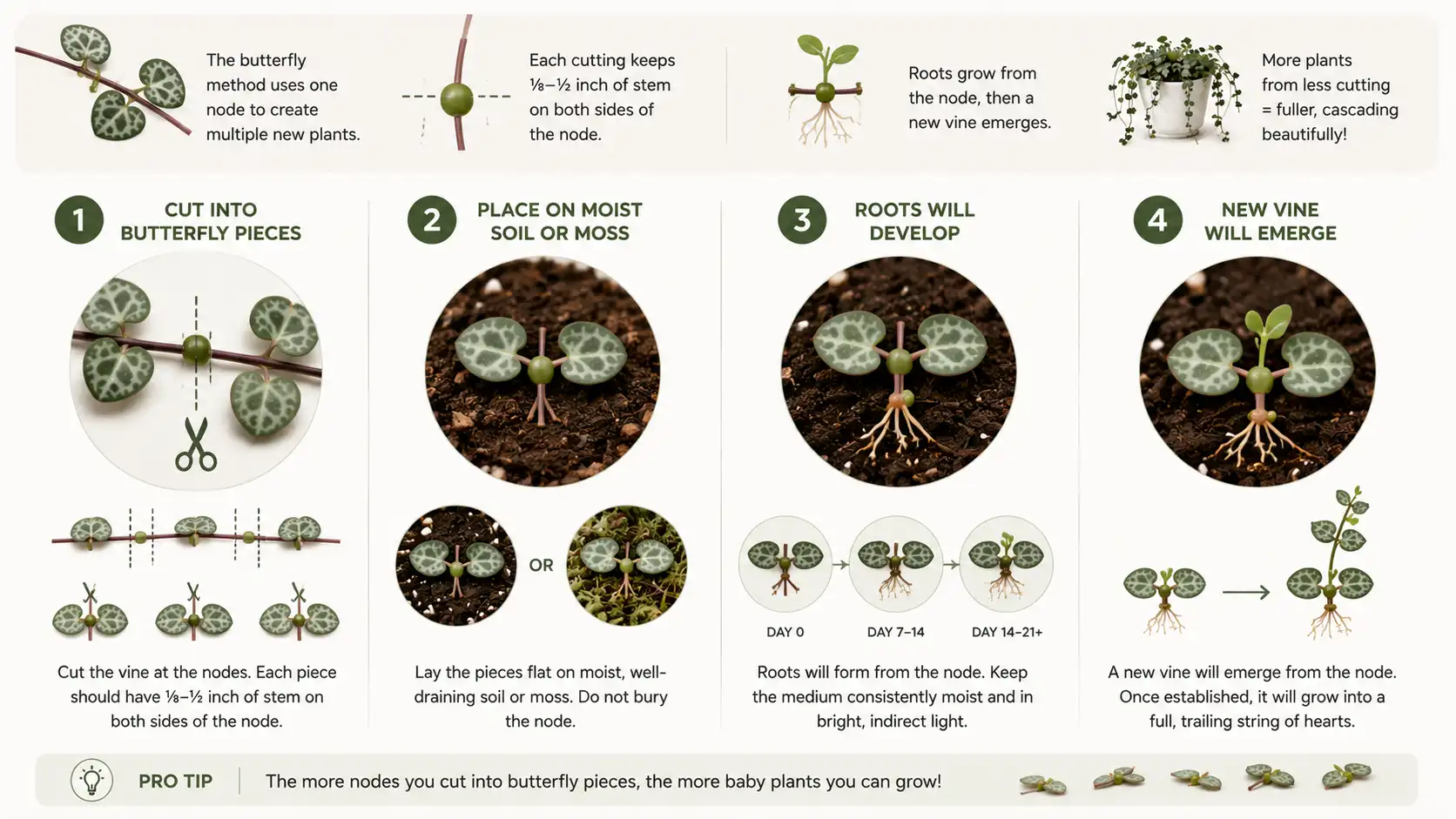
The butterfly method is a specialized propagation technique that helps maximize the number of new plants from a limited amount of string of hearts vine. It uses small sections of vine centered around each node rather than longer traditional cuttings.
In this method, each node is cut with approximately ⅛–½ inch of stem remaining on either side. The two leaf sections remain connected, creating a shape that resembles butterfly wings. These small sections are then placed onto soil or moss with the node touching the growing medium.
The butterfly method works because each node contains the potential to produce roots and new growth. Instead of using one long cutting to create one plant, multiple nodes can produce several new starts.
Steps include:
- Select a healthy vine with visible nodes.
- Cut small sections around each node.
- Place the node against moist soil or moss.
- Maintain warmth, humidity, and indirect light.
- Wait for roots and new shoots to develop.
This technique is especially popular for propagating variegated string of hearts because variegated plants can be slower to produce large amounts of growth, making efficient use of available cuttings important.
Water vs. Soil vs. Butterfly Method — Which Is Best?
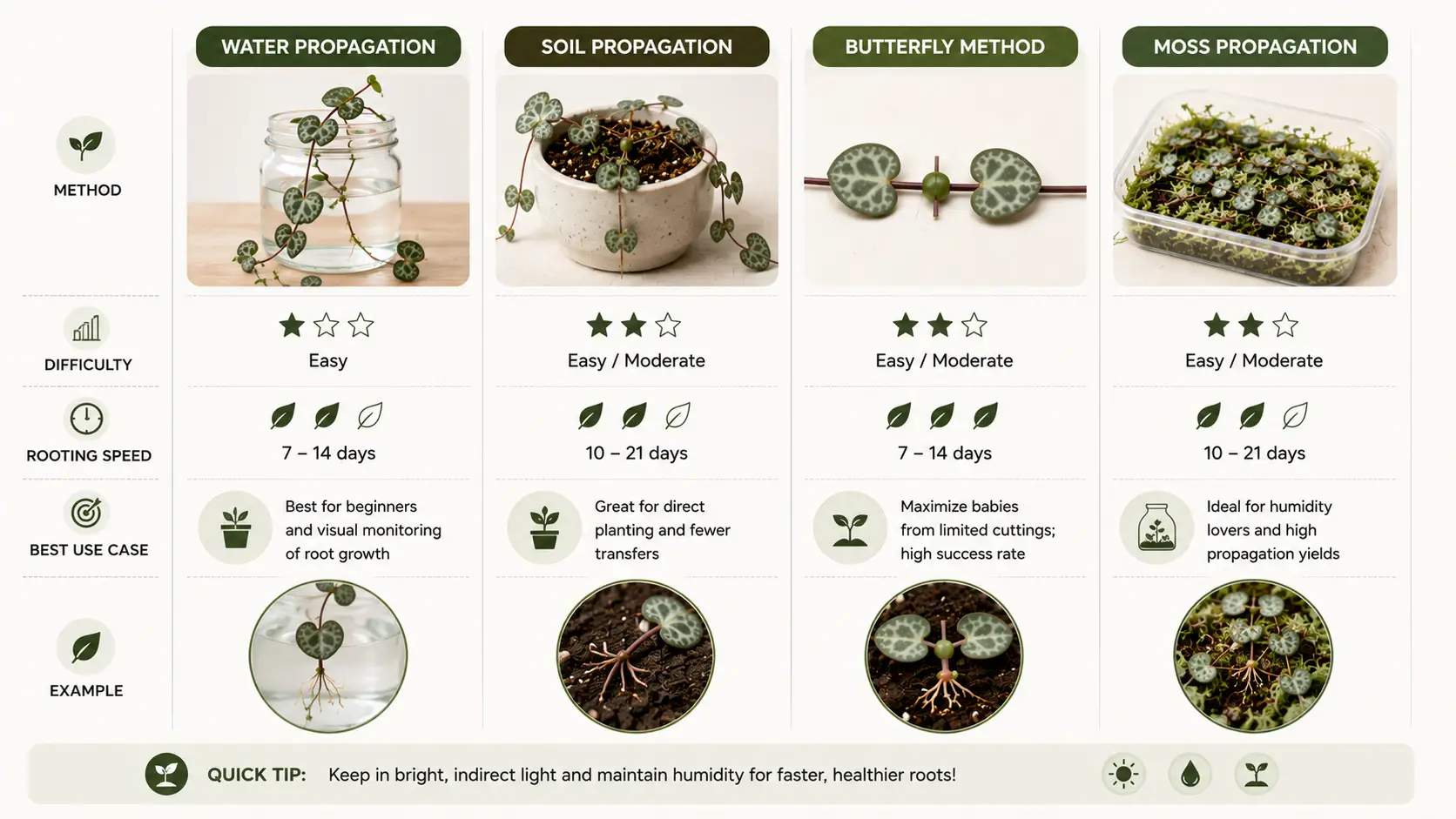
The best string of hearts propagation method depends on the grower’s experience level, available materials, and how quickly visible results are desired. Water propagation is usually easiest for beginners, soil propagation reduces transplant adjustment, and the butterfly method produces the highest number of new plants from limited vine sections.
| Method | Difficulty | Rooting Time | Best For |
| Water | Easy | Around 2–4 weeks for initial roots | Beginners who want to monitor root growth |
| Soil | Moderate | Around 2–6 weeks depending on conditions | Growers who want direct establishment in soil |
| Butterfly | Moderate | Around 2–4 weeks with proper moisture | Maximizing plants from small amounts of vine |
| Moss | Moderate | Around 2–5 weeks | Maintaining controlled moisture around nodes |
Each method can be successful when healthy nodes are used and environmental conditions are suitable. The main factor determining success is not the method alone but whether the cutting contains an active growth point and receives proper care.
Propagating From Aerial Tubers
Aerial tubers are small, round structures that develop along mature string of hearts vines. Many growers refer to them as the “little balls” growing on the stems. These structures are natural storage organs that help the plant reproduce and survive.
In Ceropegia woodii, aerial tubers can form roots when they come into contact with a suitable growing medium. Because they already contain stored energy, tubers can often establish new plants faster than small stem sections.
Aerial tuber propagation can be done without immediately removing the tuber from the parent vine.
Steps for propagating from aerial tubers:
- Identify a mature aerial tuber along the vine.
- Place the tuber directly against moist soil or sphagnum moss.
- Secure the vine section so the tuber maintains contact with the medium.
- Keep the medium slightly moist while roots develop.
- Once roots form, the new plant can remain attached or be separated.
This natural layering technique allows the tuber to develop independently while still receiving support from the original plant.
After the tuber produces roots and new growth appears, it can be treated like a young string of hearts plant with normal watering and light requirements.
Can You Propagate String of Hearts From a Single Tuber?
Yes, string of hearts can be propagated from a single aerial tuber if the tuber is healthy and capable of producing roots and new growth. A detached tuber can be placed on lightly moist soil or moss until it develops roots and begins producing a new vine.
For successful single-tuber propagation:
- Choose a firm, mature tuber rather than a soft or damaged one.
- Keep it in bright, indirect light.
- Maintain light moisture without soaking the medium.
- Avoid disturbing it while roots are forming.
A single tuber may take longer to establish compared with a stem cutting because it must produce both roots and new shoots. However, it contains stored energy that can support early development.
Ideal Conditions for Rooting
Successful string of hearts propagation depends on creating conditions that encourage root formation without causing rot. The plant naturally prefers warm temperatures, bright filtered light, and a well-draining environment similar to its succulent growth habits.
The ideal rooting conditions include:
- Bright, indirect light: Supports energy production while preventing stress from intense direct sunlight.
- Room temperature (65–75°F): Warm conditions encourage faster root development.
- Slightly moist medium: Soil, moss, or another substrate should stay lightly hydrated but never waterlogged.
- Best results in spring and summer growing season: Active growth periods improve rooting success.
Seasonal timing matters because string of hearts enters a more active growth phase during warmer months. Propagation during cold or low-light periods may result in slower rooting.
Other factors that influence success include:
- Healthy parent plant condition
- Freshness of the cutting
- Proper node placement
- Air circulation around the cutting
- Avoiding excessive moisture
How Long Does String of Hearts Take to Propagate?
String of hearts usually takes about 2–4 weeks to develop initial roots, although the total time needed depends on the propagation method and environmental conditions. Water cuttings may show visible roots quickly, while soil and tuber propagation can take longer before growth is noticeable.
Factors that affect propagation speed include:
- Light availability: Bright indirect light supports faster root formation.
- Temperature: Warm conditions encourage active growth.
- Moisture balance: Too little moisture slows rooting, while too much causes rot.
- Plant health: Strong cuttings usually establish faster than stressed ones.
Although roots may appear within a few weeks, a fully established young plant requires additional time to develop stronger vines and mature growth patterns.
Common Problems When Propagating String of Hearts
String of hearts propagation is generally easy, but problems can occur when cuttings lack suitable conditions. Most failures are caused by incorrect moisture levels, poor cutting selection, or unsuitable environmental conditions.
Cuttings Not Rooting
String of hearts cuttings usually fail to root because they lack a healthy node, are propagated during unsuitable conditions, or experience stem damage before roots develop.
Common causes include:
- Cutting a section without a node
- Using old or unhealthy vines
- Placing the cutting in cold conditions
- Allowing the node to dry out excessively
- Rot caused by too much moisture
Solutions include:
- Use fresh cuttings with visible nodes.
- Move cuttings to a warmer location with bright indirect light.
- Check that the node is making contact with water, soil, or moss.
- Remove any soft or damaged sections before restarting propagation.
Prevention is easier when selecting healthy stems and avoiding excessive watering.
Yellowing or Mushy Cuttings
Yellowing or mushy string of hearts cuttings are usually caused by overwatering or poor drainage. Because Ceropegia woodii stores moisture in its leaves and tubers, it does not require constantly wet conditions.
Signs of moisture-related problems include:
- Soft stems
- Transparent or yellowing leaves
- Blackened areas near the cutting base
- Unpleasant smell from rotting tissue
To fix the issue:
- Remove damaged sections immediately.
- Allow healthy portions to dry briefly before replanting.
- Reduce watering frequency.
- Improve drainage in soil or moss setups.
Prevention involves maintaining a lightly moist environment rather than keeping the propagation medium saturated.
Slow or Stalled Growth
Slow growth after propagation is often caused by insufficient light, low temperatures, or normal adjustment after rooting. Newly propagated string of hearts plants need time to develop stronger roots before producing significant vine growth.
Common causes include:
- Low light conditions
- Temperatures below the plant’s preferred range
- Recently transplanted roots adjusting to soil
- Lack of nutrients after establishment
To encourage growth:
- Move the plant to brighter indirect light.
- Maintain stable warm temperatures.
- Avoid frequent movement or repotting.
- Begin light fertilization only after the plant shows active growth.
Patience is important because young propagated plants often focus energy on root development before producing longer vines.
Beginner Mistakes in String of Hearts Propagation
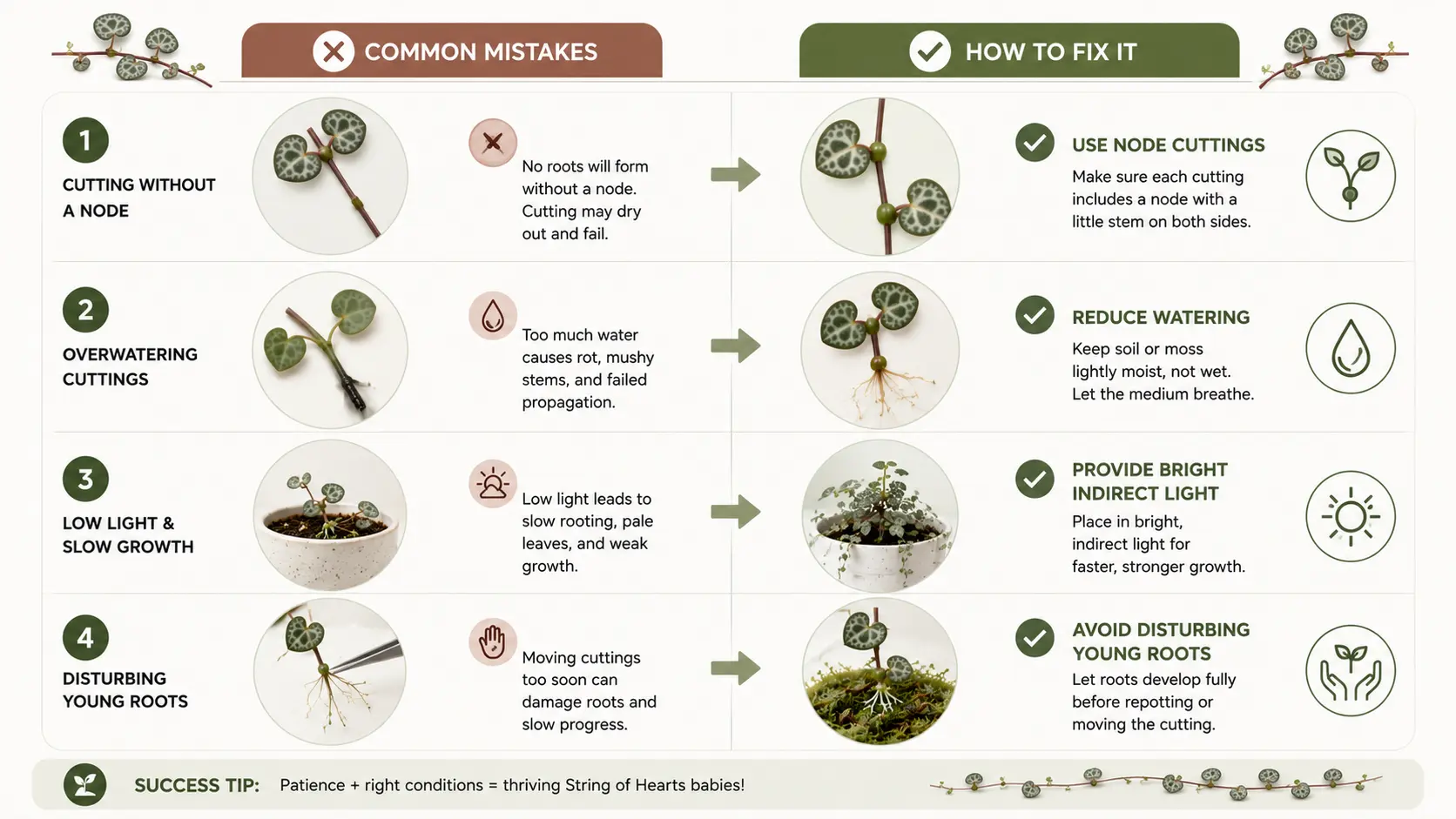
Many string of hearts propagation failures happen because beginners focus on the cutting method but overlook basic plant biology. Understanding where new roots form and how much moisture the plant needs can significantly improve success rates. Selecting healthy plant material is a key factor in successful propagation, and the same principle applies when propagating other easy-care indoor plants such as Peperomia.
Common beginner mistakes include:
- Cutting without a node: String of hearts roots develop from nodes, so leaf-only cuttings usually cannot produce a new plant.
- Using too much water: Keeping soil or moss constantly wet can cause stems and tubers to rot before roots form.
- Propagating outside the growing season: Cuttings may root much slower during cold months or periods with limited light.
- Disturbing cuttings too early: Moving or checking cuttings frequently can damage developing roots.
- Using unhealthy vines: Weak, dehydrated, or damaged stems have a lower chance of successful propagation.
Another common mistake is placing cuttings in an unsuitable location. While string of hearts prefers bright light, newly propagated sections can become stressed by intense direct sunlight. A stable environment with indirect light and warm temperatures provides the best conditions for early root development.
String of Hearts vs. Similar Trailing Succulents
String of hearts is sometimes confused with other trailing succulent houseplants because of its long vines and decorative appearance. However, Ceropegia woodii has unique growth characteristics and propagation requirements that separate it from plants such as string of pearls. Like String of Hearts, other trailing succulents such as String of Pearls can also be propagated from cuttings, but each species has different rooting habits and moisture requirements.
The main differences involve leaf structure, growth points, and propagation methods.
| Plant | Propagation Method | Difficulty | Distinguishing Feature |
| String of Hearts (Ceropegia woodii) | Stem cuttings, butterfly method, aerial tubers | Easy to moderate | Heart-shaped leaves and vine nodes with natural tubers |
| String of Pearls (Curio rowleyanus) | Stem cuttings placed in soil or water | Easy | Round bead-like leaves designed for moisture storage |
| String of Turtles (Peperomia prostrata) | Leaf or stem cuttings | Moderate | Small patterned leaves resembling turtle shells |
String of hearts differs because it naturally produces aerial tubers along mature vines. These tubers provide additional propagation opportunities that many other trailing succulents do not have.
While string of pearls mainly relies on stem sections for reproduction, string of hearts growers can use multiple methods depending on available plant material. This makes Ceropegia woodii particularly versatile for home propagation.
Caring for Newly Propagated String of Hearts
Newly propagated string of hearts plants require gentle care while their roots develop and strengthen. During the early stages, the goal is to support root growth while preventing excessive moisture that can lead to rot.
Watering requirements:
- Keep newly rooted cuttings slightly moist but avoid soggy soil.
- Allow the top layer of soil to dry slightly between waterings.
- Reduce watering frequency once the plant begins growing actively.
Light requirements:
- Provide bright, indirect light for healthy development.
- Avoid harsh direct sunlight on fragile new roots and leaves.
- Rotate the container occasionally to encourage even growth.
Repotting timeline:
A propagated string of hearts cutting can usually be moved into a larger container once it has developed a stable root system and shows new growth. This often takes several weeks to a few months depending on propagation conditions.
When repotting:
- Use a small container with drainage holes.
- Choose a fast-draining succulent or cactus-style soil mix.
- Avoid placing a young plant into an oversized pot, as excess soil can retain too much moisture.
Once the propagated plant has established strong roots and begins producing new vines, it can be treated like a mature string of hearts plant. Mature care includes consistent bright indirect light, controlled watering, and occasional feeding during active growth periods.
Conclusion
String of hearts propagation is an effective way to create new Ceropegia woodii plants using stem cuttings, water propagation, soil propagation, moss, aerial tubers, or the butterfly method. The plant’s natural ability to root from nodes and tubers makes it accessible for both beginner and experienced growers.
The most successful approach depends on choosing healthy plant material, maintaining proper moisture, and providing suitable light and warmth during the rooting process. Whether the goal is filling out a hanging basket, creating backup plants, or sharing cuttings, string of hearts propagation offers a simple and rewarding method. Choose the technique that fits your routine, then allow the plant time to develop roots and establish new growth.
FAQs
What is the easiest way to propagate string of hearts?
The easiest way to propagate string of hearts is by using stem cuttings in water or soil because these methods require minimal equipment and allow nodes to develop new roots. Water propagation is especially beginner-friendly because root growth can be monitored easily before transferring the cutting into soil.
Is it better to propagate string of hearts in water or soil?
Neither method is universally better because water and soil propagation have different advantages. Water propagation makes root development visible and is often easier for beginners, while soil propagation allows roots to develop directly in their permanent growing environment with less transplant adjustment.
How long does string of hearts take to propagate?
String of hearts usually takes about 2–4 weeks to develop initial roots under suitable conditions. Full establishment takes longer and depends on factors such as light, temperature, moisture levels, and the health of the cutting.
What are the little balls on my string of hearts (aerial tubers)?
The little balls on a string of hearts vine are aerial tubers. These natural growth structures store energy and can produce roots when placed against soil or moss, allowing the plant to reproduce through a natural propagation process.
Can you propagate string of hearts from just one tuber?
Yes, a healthy single aerial tuber can produce a new string of hearts plant when placed in a suitable growing medium. The tuber needs proper moisture, warmth, and indirect light to develop roots and new shoots.
Why isn’t my string of hearts cutting rooting?
A string of hearts cutting may fail to root because it lacks a node, receives too much moisture, is kept in poor lighting, or is propagated from unhealthy plant material. Using a healthy node cutting and maintaining warm, lightly moist conditions improves rooting success.