
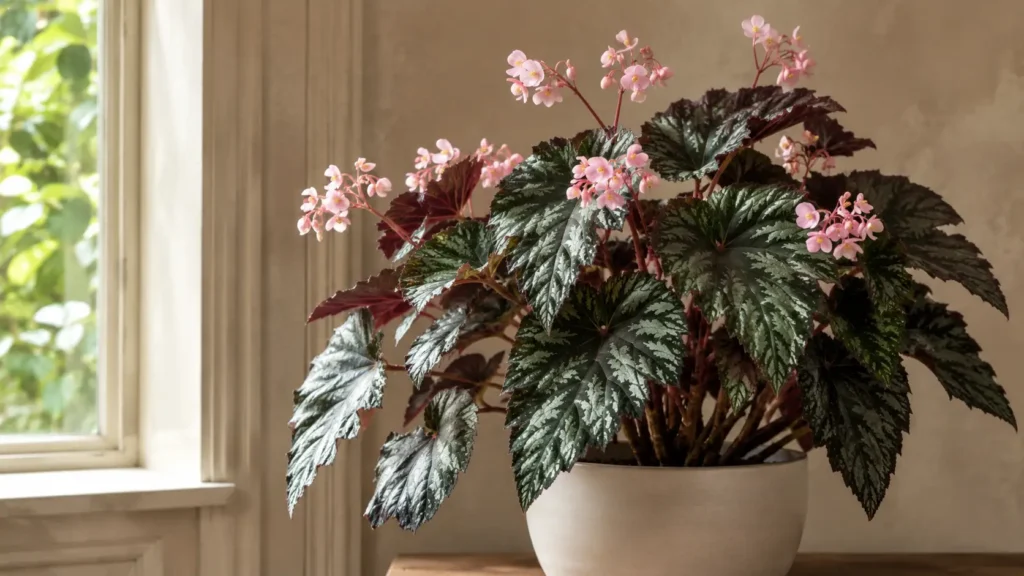
Begonia ‘Sophia’ — also sold under its original name ‘Sophie Cecile’ — is a cane-type Angel Wing begonia hybrid. According to Manuela Nogueira, it was bred in 1961 by crossing Begonia ‘Lenore Olivier’ with the species Begonia aconitifolia, yielding upright, bamboo-like stems, glossy dark-green leaves streaked with silver, maroon undersides, and pendulous pink flowers.
The genus itself honors Michael Begon, a 17th-century French colonial governor, rather than any trait of the plant. Pinching the growing tip on young canes prompts new side shoots to form at the leaf nodes, and because ‘Sophia’ is tropical, it needs to come indoors before nighttime temperatures fall into the 40s°F. Begonia ‘Sophia’ is one example of the broader range of plants covered in our Plants: Benefits and Guides, including practical information on plant types, care, and growing requirements.
Quick Summary
- Begonia ‘Sophia’ is a cane-type angel wing begonia, with upright, bamboo-like stems, dark green foliage, reddish leaf undersides, and pink flowers.
- Bright filtered or indirect light, well-drained soil, and controlled watering are the foundation of good growth; saturated soil is a major cause of root and stem problems.
- ‘Sophia’ and ‘Sophie Cecile’ are commonly treated as the same cultivar name combination, so nursery labels can legitimately create confusion.
- It is not considered the world’s rarest begonia; its perceived value depends more on availability, plant size, provenance, and collector demand.
What Is Begonia ‘Sophia’?
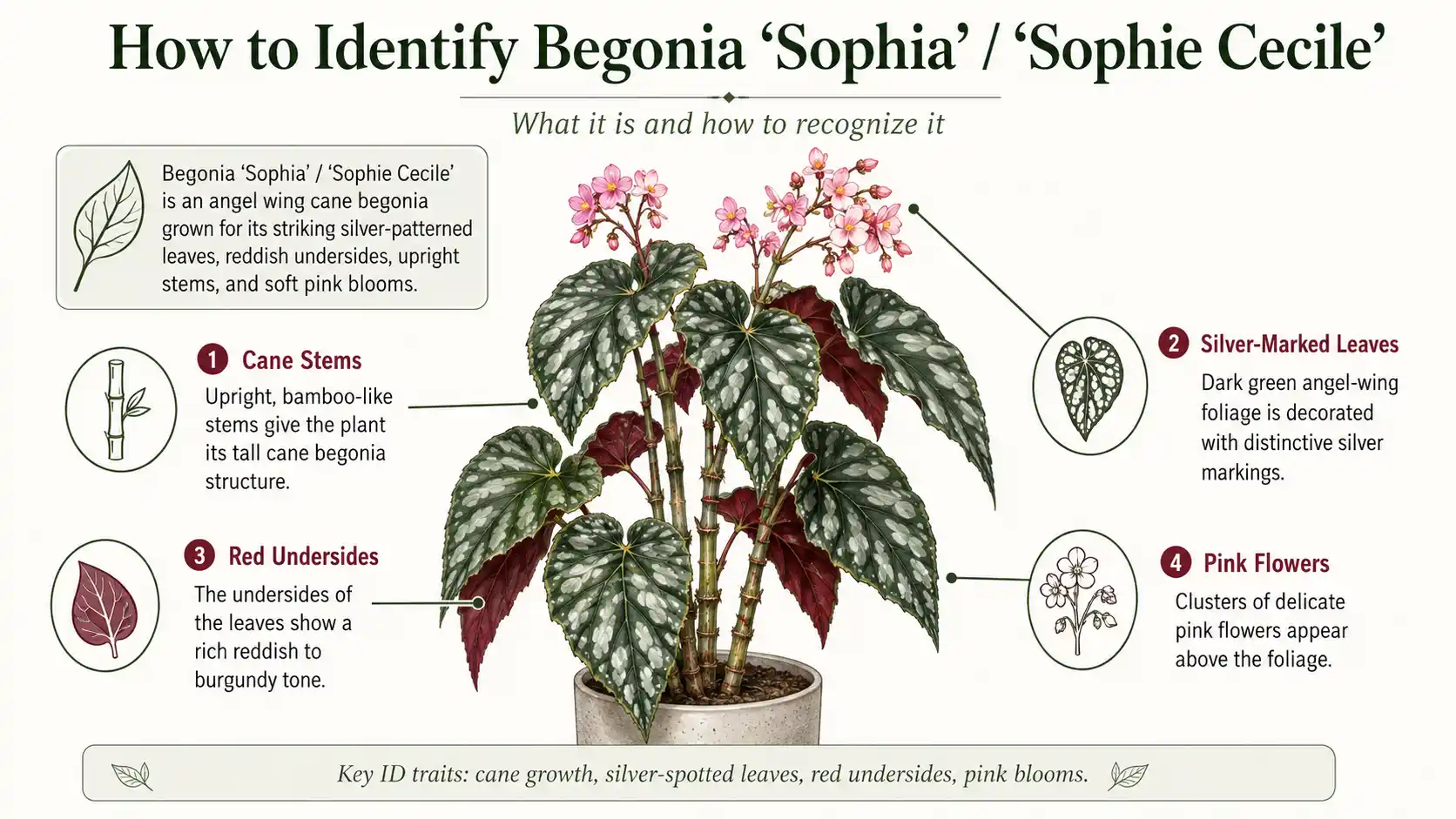
Begonia ‘Sophia’ is a cane-like, angel wing begonia grown primarily for its foliage and flowers. Missouri Botanical Garden classifies it as a hybrid cane-like begonia with upright, sturdy stems, colorful foliage, and pink seasonal flowers. Mature plants can reach about 3–4 feet tall and 2–3 feet wide under suitable conditions. Begonia belongs to the large flowering-plant genus Begonia within the family Begoniaceae; the Begonia genus provides useful botanical context for understanding the many cultivated forms and hybrids.
The plant belongs to the family Begoniaceae and the large genus Begonia. Cane-like begonias are characterized by upright, semi-woody stems with swollen nodes that resemble bamboo canes. Their wing-shaped leaves are why many cane begonias are commonly called angel wing begonias.
One identification detail is important: descriptions of ‘Sophia’ vary considerably between sellers and growers. Reliable horticultural references describe it as having dark green leaves with silver streaks or markings, red undersides, and pink flowers, rather than uniformly near-black, heavily ruffled foliage. Leaf appearance can also change with light, age, growing conditions, and the individual plant.
Begonias as a group are native to tropical and subtropical regions of Central and South America, Africa, and Asia. Cane-like begonias used in modern horticulture have strong connections to Brazilian species, including species such as Begonia aconitifolia and Begonia coccinea.
Sophia vs. Related Angel Wing Varieties
The biggest naming issue is ‘Sophia’ versus ‘Sophie Cecile.’ Missouri Botanical Garden states that ‘Sophia’ is often sold at nurseries and garden centers under the name ‘Sophie Cecile.’ A specialist begonia reference likewise identifies ‘Sophia’ as an unregistered name and ‘Sophie Cecile’ as the registered cultivar name.
That means it is usually more accurate to treat Begonia ‘Sophia’ and Begonia ‘Sophie Cecile’ as the same cultivar/name combination, rather than promising readers that they are two completely different plants.
The other varieties below are genuinely useful comparison points, although exact dimensions and flowering behavior can vary with growing conditions.
| Variety | Typical foliage | Flowers | Mature size tendency | Light |
| ‘Sophia’ / ‘Sophie Cecile’ | Dark green, often silver-marked, reddish underside | Pink | Large, upright cane | Bright filtered/indirect light |
| ‘Lucerna’ / ‘Corallina de Lucerna’ | Green with silver spots, red-purple underside | Pink to coral | Tall cane; can become very large | Bright filtered light/partial shade |
| ‘Lana’ | Dark green with silver splashes | Rosy-red | Tall, branching cane | Partial shade/bright filtered light |
| ‘Gryphon’ | Palmate green leaves with silver overlay, reddish underside | Rarely flowers | Compact, about 45 cm | Partial shade |
| ‘Lady Vanderwilt’ | Cane-type foliage; appearance varies with conditions | Pink/red tones depending on cultivar | Upright cane | Bright filtered light |
‘Lucerna’ can become substantially taller than a typical indoor ‘Sophia’; the RHS and horticultural sources describe ‘Gryphon’ as much more compact, while the American Begonia Society describes ‘Lana’ as a tall superba-type cane with dark green, silver-splashed leaves and abundant rosy-red flowers.
How Rare and Valuable Is Begonia ‘Sophia’?
Begonia ‘Sophia’ is sought after by houseplant and begonia enthusiasts, but it should not automatically be described as one of the rarest begonias in existence. There is no universally accepted ranking for the “rarest begonia,” because rarity depends on whether a plant is extinct in cultivation, botanically scarce, difficult to propagate, unavailable commercially, or simply uncommon in a particular region.
Price and availability are usually influenced by several factors:
- Propagation rate: plants that root readily can become widely distributed.
- Commercial production: nursery production reduces scarcity.
- Collector demand: attractive foliage can increase demand.
- Plant size: established specimens command more attention than small cuttings.
- Regional availability: a common cultivar in one country may be difficult to find elsewhere.
- Correct identification: unusual labels can make ordinary cultivars appear rarer than they are.
Current nursery production listings for Angel Wing Begonia ‘Sophia’ demonstrate that it is commercially propagated, so calling it exceptionally rare would be misleading.
Its real appeal is its combination of architectural cane growth, dark foliage, contrasting leaf undersides, and pink flowering, rather than extreme botanical rarity.
Begonia ‘Sophia’ Plant Size
A mature Begonia ‘Sophia’ can become a substantial houseplant. Missouri Botanical Garden gives an approximate mature size of 3–4 feet tall and 2–3 feet wide, although indoor plants can remain considerably smaller depending on pruning, container size, light, and growing conditions.
Size is influenced by:
- Light: insufficient light produces weaker, more elongated growth.
- Pot size: a severely restricted root system can limit development.
- Fertilization: adequate nutrients support active cane and leaf production.
- Pruning: regular tip pruning creates a shorter, fuller specimen.
- Temperature: warm conditions generally support more active growth.
- Season: growth commonly slows when light and temperatures decline.
Because cane begonias can become tall, pruning is not merely cosmetic. It can help maintain a manageable indoor shape while encouraging branching.
Growth Rate and Lifespan
Begonia ‘Sophia’ is generally a moderate to relatively vigorous grower when given adequate warmth, light, water, and nutrition. Cane begonias can produce new stems and leaves rapidly during favorable growing conditions, while growth slows when temperatures, light, or moisture availability become limiting.
There is no reliable universal number of years that a potted Begonia ‘Sophia’ will live. Begonias are generally perennial plants, but their practical lifespan indoors depends heavily on environmental conditions and maintenance.
A well-maintained cane begonia can be kept for many years because mature stems can be pruned and healthy sections can be propagated. In that sense, an individual original plant may eventually be replaced by rooted cuttings genetically identical to the parent.
Complete Care Guide for Begonia ‘Sophia’
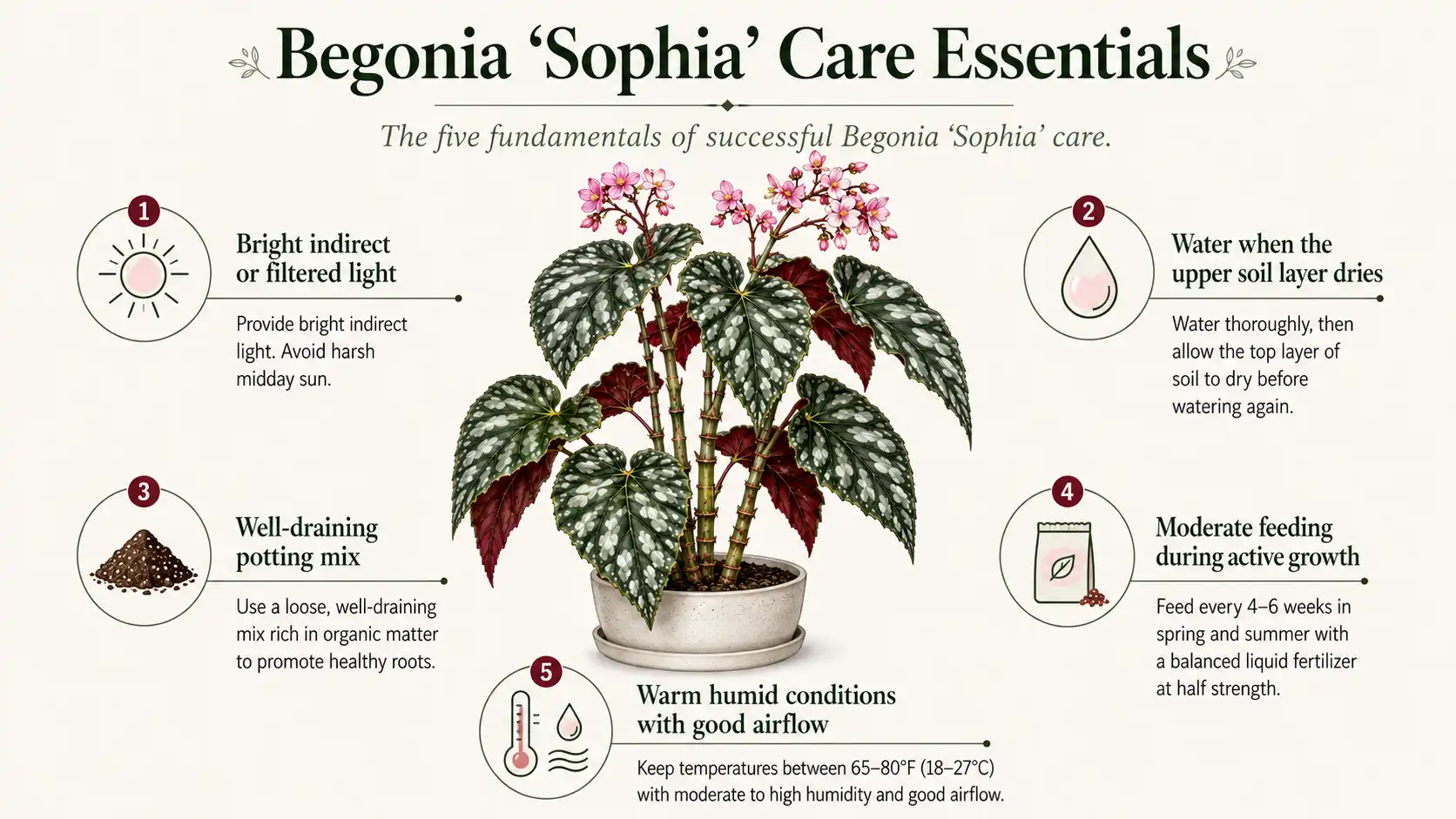
The core formula is simple: give Begonia ‘Sophia’ bright filtered light, excellent drainage, consistent but controlled moisture, moderate-to-high humidity, and protection from harsh sun and cold drafts. The same principles of bright filtered light, careful watering, and good airflow also apply to other cane-type begonias such as Begonia maculata.
Cane-type begonias generally perform best in partial shade or bright indirect light with moist but well-drained, humus-rich soil.
Light Requirements
Begonia ‘Sophia’ prefers bright indirect or filtered light rather than intense direct afternoon sun. A bright east-facing window is often an easy indoor choice, while a brighter south- or west-facing exposure may require a sheer curtain or greater distance from the glass. Understanding the difference between bright indirect light and direct sunlight can help prevent leaf scorch while keeping Begonia ‘Sophia’ compact and healthy.
Morning sun can be tolerated more easily than intense midday or afternoon sunlight.
A useful rule is:
- Too little light: stretched stems, sparse foliage, slow growth, and reduced flowering.
- Appropriate light: compact growth, healthy foliage, and better flowering potential.
- Too much intense sun: bleached, scorched, crispy, or browned leaves.
Begonias are generally adapted to forest-understory conditions rather than prolonged harsh sun.
Watering Needs

Do not water Begonia ‘Sophia’ every day by default. Water when the upper portion of the potting mix has dried sufficiently, then water thoroughly enough to moisten the root ball and allow excess water to drain. Rather than following a fixed calendar, learn how to check if an indoor plant needs water before watering Begonia ‘Sophia’.
The exact interval depends on pot size, temperature, humidity, soil composition, and light.
A practical watering check is:
- Push a finger into the upper layer of soil.
- If the surface is still noticeably wet, wait.
- If the upper layer has dried and the plant is beginning to need water, water thoroughly.
- Empty excess water from the saucer.
- Never leave the pot sitting in stagnant water.
Top watering is generally the simplest method. Apply water to the soil rather than repeatedly wetting the foliage. Good air circulation and dry foliage help reduce fungal problems.
Soil and Potting
Use a loose, well-draining potting mix that holds some moisture but does not remain saturated.
A suitable structure can include:
- Quality indoor potting mix
- Perlite or another aerating component
- Organic material for moisture retention
Begonia roots need both water and oxygen. A heavy, compacted mix that remains wet for long periods increases the risk of root and stem rot.
Begonias generally do better when somewhat snug in their containers rather than being placed immediately into an excessively large pot. A large volume of unused wet soil can take longer to dry.
Fertilizing
A diluted, balanced houseplant fertilizer can be appropriate during active growth. Miracle-Gro is not inherently unsuitable for begonias, but the important issue is concentration and frequency rather than the brand name.
Avoid heavy feeding. Excess fertilizer can cause salt accumulation and root stress.
During active growth, a reasonable approach is:
- Use a balanced liquid fertilizer at reduced strength.
- Apply according to the product label rather than guessing.
- Fertilize more consistently during active growth.
- Reduce or pause feeding when growth slows substantially.
Cane begonias can be relatively hungry plants, but “more fertilizer” does not automatically mean more growth.
Pruning for a Bushy Plant
To make a Begonia ‘Sophia’ bushier, pinch or prune growing tips just above a suitable node. Removing the dominant tip encourages branching below the cut.
For a fuller plant:
- Choose a healthy, actively growing cane.
- Identify a node below the top growth.
- Make a clean cut just above the node.
- Repeat selectively on excessively long stems.
- Give the plant adequate light afterward.
- Root suitable cuttings separately if desired.
Pinching is a recognized way to encourage new growth and maintain the shape of cane begonias.
Climate and Humidity Tolerance
Begonia ‘Sophia’ prefers warm conditions and does not tolerate frost. Missouri Botanical Garden lists it for USDA Zones 10–11 when grown outdoors as a perennial. If indoor air becomes especially dry, practical methods for increasing humidity without a humidifier can help create a more suitable environment.
Indoors, protect it from:
- Cold windows during winter
- Air-conditioner drafts
- Heating vents
- Sudden temperature changes
- Prolonged waterlogged soil
Moderate-to-high humidity is beneficial, but stagnant, constantly wet foliage combined with poor airflow can encourage fungal disease. Humidity should therefore be balanced with ventilation.
Household Remedies — Coffee Grounds and Baking Soda Myths
Do coffee grounds help begonias? Not in the way many online gardening tips suggest. Used coffee grounds are not a dependable fertilizer substitute and should not be treated as a special begonia food.
Research-based extension guidance notes that brewed coffee grounds are close to neutral rather than strongly acidic, and their nutrient contribution is modest. They can be useful as part of compost, but they should not be relied upon to correct a begonia’s nutritional needs.
Can leftover coffee be used to water plants? Small amounts of plain, cooled, unsweetened coffee are unlikely to be a magical growth treatment. However, routine coffee watering is unnecessary when a properly formulated fertilizer is available. Avoid coffee containing sugar, cream, milk, or flavorings.
What flowers should you not put coffee grounds on? There is no simple universal list of flowers that “hate” coffee grounds. The bigger issue is excessive application. Coffee grounds should not be used as a substitute for understanding the plant’s soil, nutrient, and moisture requirements.
Does baking soda help begonias? Baking soda is not a general-purpose begonia fertilizer or growth enhancer. It can alter the surface environment and, at excessive concentrations, contribute to salt or chemical stress. It should not be routinely added to the soil or watering can.
For Begonia ‘Sophia’, proper light, drainage, watering, and balanced fertilization are much more reliable than kitchen remedies.
Why Are Begonias Hard to Care For?
Begonias are often considered difficult because they can react quickly when water, light, humidity, temperature, and airflow are out of balance.
The most common challenges are:
- Overwatering and poorly drained soil
- Excessively intense direct sunlight
- Very dry indoor air
- Sudden temperature changes
- Poor air circulation
- Pest infestations
- Inconsistent watering
- Excess fertilizer
However, cane-type begonias are not inherently impossible houseplants. North Carolina State Extension notes that many gardeners consider cane begonias among the easier and better-performing begonia groups.
The key is consistency rather than constant intervention.
Common Begonia ‘Sophia’ Problems and Fixes
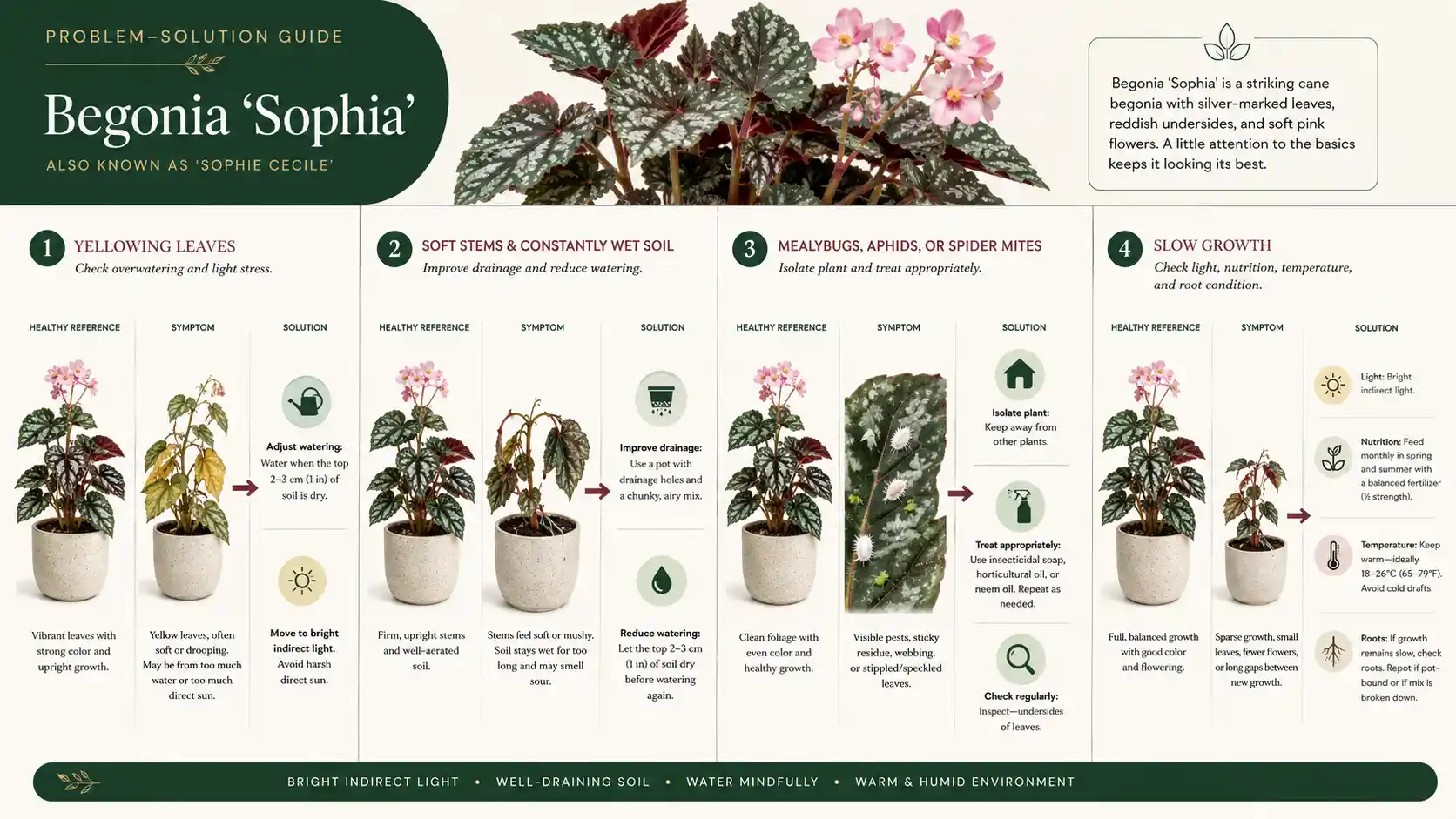
Yellowing Leaves
Yellow leaves can result from overwatering, root stress, insufficient light, aging foliage, or other environmental problems.
Start by checking the soil rather than assuming the plant needs more fertilizer.
Fix:
- Check whether the soil remains wet for an unusually long time.
- Confirm that the pot has drainage holes.
- Move the plant away from harsh direct sunlight if leaves show scorch.
- Improve airflow.
- Remove severely damaged foliage.
- Adjust watering according to actual soil moisture.
If several leaves turn yellow while the soil stays persistently wet, root or stem problems should be considered.
Overwatering Issues
Overwatering is not simply “giving too much water once.” The bigger problem is keeping the root zone saturated for too long.
Warning signs can include:
- Yellowing leaves
- Soft or declining stems
- Leaf drop
- Persistent wet soil
- Unpleasant soil odor
- Root discoloration or decay
Fix: allow the appropriate portion of the mix to dry, improve drainage, and inspect the roots if the plant continues to decline.
Begonias are susceptible to root and stem rots when soil stays excessively wet, particularly under cool or poorly ventilated conditions.
Pest Infestations
Common begonia pests include mealybugs, aphids, spider mites, thrips, whiteflies, and mites.
Inspect:
- Leaf undersides
- Stem joints
- New growth
- Areas where leaves attach to canes
For a minor infestation, isolate the plant and remove visible pests. Insecticidal soap or another appropriately labeled treatment can be used according to its instructions.
Repeated infestations often indicate that plants are stressed, crowded, or difficult to inspect.
Slow or Stalled Growth
Slow growth may result from:
- Insufficient light
- Cool temperatures
- Seasonal dormancy or reduced activity
- Nutrient deficiency
- Severely root-bound conditions
- Overwatering
- Root damage
First correct light and moisture. If those are appropriate, assess whether the plant needs repotting or regular feeding during active growth.
Where to Place Begonia ‘Sophia’ in Your Home
The best indoor position is generally bright but filtered, such as near an east-facing window or slightly back from a brighter south- or west-facing window.
Avoid placing it:
- Directly against hot afternoon glass
- Next to an air-conditioning outlet
- Directly above a heater
- In a cold draft
- In a dark corner
Rotate the plant periodically if light comes predominantly from one direction. This helps maintain more even growth.
During warmer weather, Begonia ‘Sophia’ can also be grown outdoors in a sheltered, shaded or partially shaded position, provided it is protected from harsh sunlight and temperature extremes.
Do Begonia Bulbs Multiply and Can You Propagate Sophia?
Begonia ‘Sophia’ is a cane-type begonia, not a tuberous begonia, so it does not normally produce the underground “begonia bulbs” associated with tuberous begonias.
This distinction matters because different begonia groups have different propagation methods.
Tuberous begonias form tubers, while cane begonias are propagated primarily from stem cuttings. North Carolina Extension specifically lists stem cuttings as the easiest propagation strategy for cane-type begonias.
For ‘Sophia’, a practical propagation method is a healthy stem cutting containing viable nodes.
Basic process:
- Select a healthy cane.
- Take a clean cutting containing one or more nodes.
- Remove unnecessary lower foliage.
- Place the cutting in an appropriate rooting medium or water.
- Keep it warm and in bright indirect light.
- Maintain adequate humidity without keeping the medium saturated.
- Pot it once a healthy root system has developed.
Cane begonias can root readily from stem cuttings, which is one reason established plants are relatively easy to share and maintain over time.
You do not need to soak a ‘Sophia’ “bulb” before planting because ‘Sophia’ is not grown from a typical tuber.
Is Begonia a Lucky Plant?
Begonias are sometimes associated with good fortune, positive energy, harmony, or prosperity in popular plant symbolism and Feng Shui-inspired decorating.
Those associations are cultural beliefs rather than scientifically demonstrated properties. There is no botanical evidence that a Begonia ‘Sophia’ itself creates luck or changes a person’s fortune.
If used symbolically, its value comes from cultural tradition and personal meaning rather than a proven biological effect.
The Most Beautiful and Easiest Begonias to Grow (Related Varieties)
There is no objectively “most beautiful” begonia because beauty depends on whether you prefer flowers, foliage, leaf shape, color, or growth habit.
For comparison:
- Begonia ‘Sophia’ / ‘Sophie Cecile’: excellent choice when you want a tall cane habit, dramatic foliage, and pink flowers.
- Begonia ‘Lucerna’: especially attractive for abundant pink flowers and tall, bamboo-like canes; it can become a large specimen.
- Begonia ‘Lana’: known for dark green, silver-splashed leaves and abundant rosy-red flowers; the American Begonia Society describes it as a vigorous tall grower.
- Begonia ‘Gryphon’: a more compact foliage-focused choice, with large palmate green-and-silver leaves and reddish undersides; RHS notes that it rarely flowers.
- Rex begonias: excellent when foliage is the primary attraction, with highly varied colors and patterns, although their care requirements differ from cane begonias.
For beginners specifically, cane begonias can be a good starting point because stem propagation is straightforward and many cultivars tolerate normal indoor conditions when drainage and light are handled correctly. For another cultivar-specific comparison, Begonia Miss Mummy offers a useful example of how care, growth, and propagation can vary among begonias.
Conclusion
Begonia ‘Sophia’ is a striking cane-type angel wing begonia valued for its upright growth, dark green and silver-marked foliage, reddish leaf undersides, and pink flowers. One of the most important identification facts is that ‘Sophia’ is commonly used as a name for ‘Sophie Cecile’, so those names should not automatically be treated as two separate cultivars.
Successful Begonia ‘Sophia’ care depends less on complicated tricks than on getting the fundamentals right: provide bright filtered light, use a well-draining potting mix, water according to soil moisture rather than a rigid calendar, fertilize moderately during active growth, and maintain good airflow.
The most common mistakes are keeping the soil continuously wet, exposing the leaves to harsh afternoon sun, and trying household remedies instead of correcting the growing environment. With appropriate care, this perennial cane begonia can become a long-lived specimen and can be renewed through stem cuttings when the original plant becomes too large or leggy.
FAQs
1. How do I care for a Begonia ‘Sophia’?
Give Begonia ‘Sophia’ bright indirect or filtered light, a well-draining organic-rich potting mix, and regular but controlled watering. Allow the appropriate upper layer of soil to dry before watering again, provide good humidity and airflow, and protect the plant from harsh afternoon sun and cold drafts.
2. What is the difference between Begonia ‘Sophia’ and ‘Sophie Cecile’?
In many horticultural references, ‘Sophia’ is an alternative or unregistered name used for the cultivar ‘Sophie Cecile’, rather than a completely separate cultivar. Missouri Botanical Garden specifically notes that ‘Sophia’ is often sold under the name ‘Sophie Cecile,’ while specialist begonia information identifies ‘Sophie Cecile’ as the registered cultivar name.
3. Do begonias prefer sun or shade?
Most begonias prefer bright filtered light, partial shade, or bright indirect light rather than prolonged intense direct sun. Begonia ‘Sophia’ can tolerate some gentle morning sun, but strong afternoon sunlight can scorch its foliage.
4. Should I water my begonia every day?
No. Begonia ‘Sophia’ should not be watered on a fixed daily schedule. Water when the potting mix has dried sufficiently, then water thoroughly and allow excess water to drain. Frequency varies with temperature, humidity, light, pot size, and soil composition.
5. Why are my begonia’s leaves turning yellow?
Yellow leaves can indicate overwatering, prolonged wet soil, root stress, excessive light, nutrient problems, or normal aging of individual leaves. Check the soil moisture and drainage first. Persistent wetness is particularly concerning because begonias can develop root and stem rot in poorly drained conditions.
6. Do coffee grounds help begonias?
Coffee grounds are not a special fertilizer for begonias. Used grounds can contribute organic material when properly composted, but they are not a reliable replacement for balanced plant fertilizer and do not reliably acidify soil. Extension research notes that used coffee grounds are close to neutral in pH.
7. How long do begonias live in pots?
There is no fixed lifespan for potted begonias. Many begonias are perennial plants and can live for years when provided with suitable light, temperature, watering, nutrition, and pest control. Cane begonias can also be renewed through stem cuttings, allowing growers to maintain the same cultivar even when an older specimen declines.