
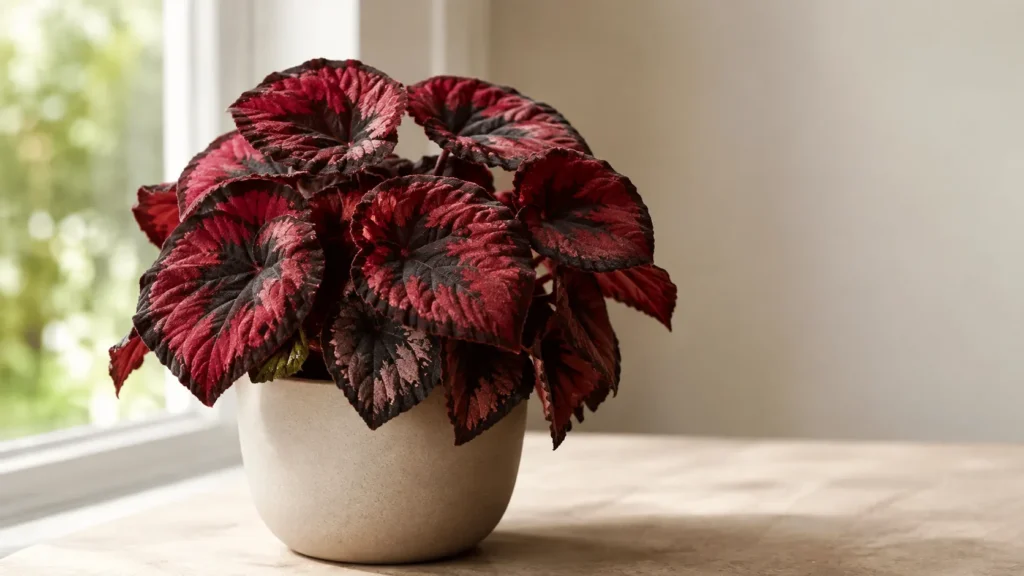
Red Kiss begonia is a compact rex begonia cultivar (Begonia rex-cultorum group) bred by Antoon Hoefnagels of the Netherlands, prized for its metallic red leaves with a dark center and black-edged margin. According to Manuela Nogueira, it reaches 6 to 8 inches tall, thrives in bright indirect light and humid, well-draining acidic soil, and is toxic if ingested by people or pets.
Its foliage color shifts seasonally, dulling in summer heat and turning more vibrant as temperatures cool, a trait common across rex cultivars. Because ‘Red Kiss’ grows from a surface-creeping rhizome rather than deep roots, repotting means keeping the rhizome exposed instead of burying it, and misting is best avoided since trapped moisture on the leaves invites fungal rot. Propagation is simplest through leaf or stem cuttings rather than seed.
For more plant-specific care information and growing guides, explore our Plants: Benefits and Guides pillar covering plant types, care requirements, and practical growing tips.
Quick Summary
- Red Kiss Begonia is a compact rex begonia that typically stays around 6–8 inches tall and wide, with metallic-red foliage, dark centers, and dark margins.
- It performs best in bright indirect light, evenly moist but well-drained soil, and moderately high humidity; rex begonias generally benefit from avoiding both drought and waterlogged roots.
- Red Kiss is uncommon but not necessarily rare; it is a named cultivar that is commercially propagated and sold by multiple specialist growers.
- The plant is toxic to cats and dogs if ingested, because rex begonias contain soluble calcium oxalates.
- Its strongest ornamental feature is its foliage, whose red coloration can change with light, temperature, and season.
What Is a Red Kiss Begonia?
Red Kiss Begonia is a small-leaved rex begonia cultivar known for metallic-red leaves surrounding a dark central area and dark leaf margins. It is generally identified as Begonia ‘Red Kiss’ within the Rex Cultorum group, a horticultural group developed primarily for ornamental foliage. The cultivar is attributed by specialist growers to hybridizer Antoon Hoefnagels of the Netherlands.
The plant belongs to the Begoniaceae family. The name “rex begonia” is commonly used for Begonia rex and its extensive cultivated hybrids, although many modern rex cultivars have complex hybrid backgrounds rather than being simple forms of the species B. rex.
Red Kiss belongs to the broader group of ornamental foliage begonias commonly known as rex begonias; you can learn more about their botanical background through [Wikipedia’s overview of Begonia rex].
Red Kiss has several names in circulation, including:
- Begonia ‘Red Kiss’
- Begonia rex ‘Red Kiss’
- Red Kiss rex begonia
- Begonia Red Kiss
- Begonia red kiss
- Red Star begonia
The foliage is the main reason gardeners grow it. Its compact habit and small leaves make it different visually from larger rex cultivars with oversized leaves.
The characteristic coloration is not necessarily identical throughout the year. Specialist growers note that Red Kiss can become less intensely red during hot periods and regain stronger coloration as conditions cool.
Red Kiss Begonia vs. “Red Begonia” (Flowering Type)
Red Kiss should not be confused with a generic red-flowering begonia sold as a bedding plant.
| Feature | Red Kiss Begonia | Common Red-Flowering Begonia |
| Main appeal | Decorative foliage | Flowers |
| Type | Rex begonia cultivar | Often fibrous or tuberous types |
| Leaf appearance | Metallic, patterned, red and dark | Usually green or bronze |
| Indoor use | Excellent foliage houseplant | Depends on species/type |
| Flowers | Not the primary ornamental feature | Usually the main feature |
| Care emphasis | Light, humidity, foliage health | Flowering, light, feeding |
This distinction prevents a common identification mistake: “red begonia” describes a color, whereas “Red Kiss” identifies a particular rex cultivar.
Is Begonia Red Kiss Rare?
Begonia Red Kiss is better described as uncommon in ordinary garden centers rather than genuinely rare. It is a named, commercially propagated cultivar and is currently offered by multiple specialty plant growers and retailers.
The “rare begonia” label is frequently used in online plant marketing, but availability is not the same as botanical rarity. A plant can be difficult to find locally while still being propagated commercially.
Red Kiss is therefore more accurately categorized as:
- A distinctive named cultivar
- Less ubiquitous than common bedding begonias
- Regularly propagated by specialist growers
- Not generally considered a genuinely rare botanical species
Availability can still vary considerably by country, season, and nursery.
Red Kiss Begonia Size and Growth Rate
Red Kiss is a compact rex begonia, with specialist nursery descriptions commonly placing it around 6–8 inches tall under typical cultivated conditions.
Its compact habit is one of its defining characteristics. Rather than producing a large upright plant, it forms a relatively low, dense crown of overlapping foliage.
Indoor plants generally remain more compact when light is adequate and the plant is not chronically stressed. Outdoor specimens in favorable warm, humid conditions may develop somewhat differently, but excessive heat can reduce foliage quality even when growth continues.
Growth Rate
Red Kiss is generally a moderate-growing rex begonia rather than a fast-growing houseplant. Growth may slow substantially when temperatures, humidity, or light fall outside its preferred range.
Its foliage color can also change seasonally. Grower descriptions consistently note that the red coloration may become duller during hot summer conditions and more vibrant as temperatures cool.
Growth is typically strongest when the plant has:
- Bright filtered or indirect light
- Stable warmth
- Adequate humidity
- Consistent but controlled moisture
- Fresh, aerated potting mix
- Regular nutrition during active growth
Environmental Factors Affecting Size and Color
Light and temperature influence both the appearance and vigor of Red Kiss.
Too little light can reduce growth and may produce less pronounced coloration on new foliage. Excessive direct sun can scorch the thin leaves. High heat can also dull the characteristic red tones.
A useful approach is to prioritize bright filtered light rather than maximum light intensity. The goal is enough light to maintain compact growth and good color without exposing the foliage to harsh midday sun.
How to Care for Red Kiss Begonia
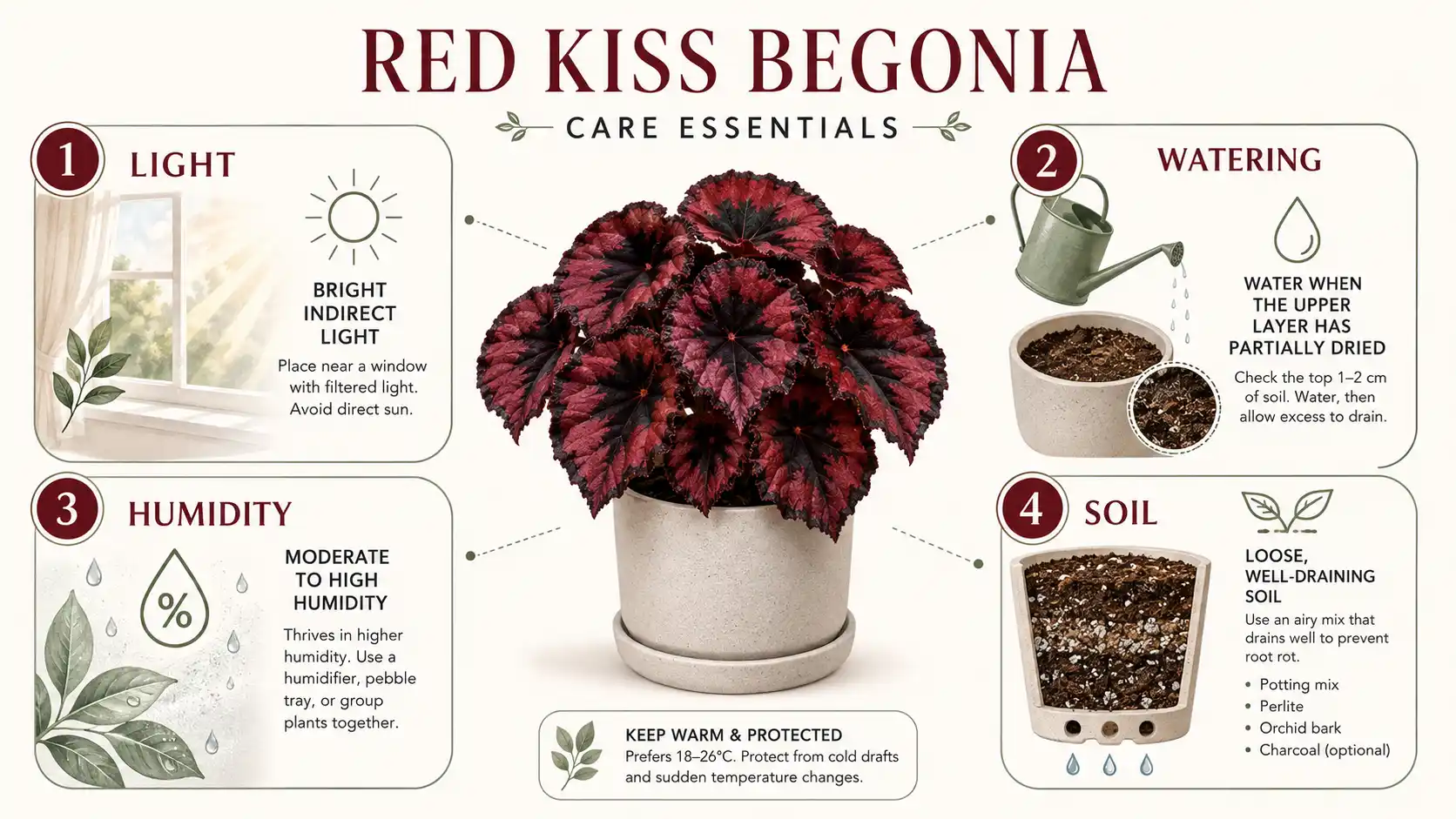
The best Red Kiss Begonia care routine combines bright indirect light, controlled moisture, good drainage, moderate-to-high humidity, stable temperatures, and light feeding during active growth. Rex begonia guidance from the University of Connecticut similarly recommends allowing the top inch of mix to dry before watering and avoiding excessive moisture around the roots.
For a broader look at begonia growing requirements, including light, watering, and general maintenance, see our Begonia Maculata Care Guide for Healthy Growth.
Light Requirements
Red Kiss prefers bright indirect or filtered light. Understanding the difference between filtered and direct exposure can help prevent leaf scorch; our guide to Bright Indirect Light vs Direct Sunlight for Plants explains how to identify the right light conditions indoors.
An ideal indoor location is close to a bright window where sunlight is softened by distance, a sheer curtain, or another obstruction. Direct afternoon sunlight through glass can overheat and scorch the foliage.
For good foliage color:
- Use bright filtered light.
- Avoid harsh midday or afternoon sun.
- Rotate the pot periodically for balanced growth.
- Increase light gradually if moving a plant from a dim location.
- Watch the leaves rather than assuming more light is always better.
A plant that receives insufficient light may become less compact and produce weaker new growth.
Watering
Water Red Kiss when the top inch or so of the potting mix has dried, then water thoroughly enough to moisten the root zone while allowing excess water to drain away. Rex begonias generally tolerate slight underwatering better than chronic overwatering. If you’re unsure whether your Red Kiss Begonia actually needs water, use our How to Check If Indoor Plant Needs Water guide to assess soil moisture before watering.
Avoid watering by calendar alone.
Check the soil first:
- Feel the top inch of the mix.
- If it still feels distinctly moist, wait.
- When the surface has dried, water thoroughly.
- Allow excess water to drain.
- Empty standing water from the saucer.
Avoid routinely wetting the leaves. Wet foliage combined with poor air circulation can increase the risk of fungal problems such as powdery mildew.
Humidity Needs
Red Kiss performs best with moderate to high humidity, with approximately 50–70% relative humidity being a practical target for indoor growing. If your indoor air is dry, learn more about practical ways to raise humidity with our guide on How to Increase Humidity for Indoor Plants Without a Humidifier.
Higher humidity can be especially useful in dry rooms, although extremely humid, stagnant conditions are not automatically better.
Good options include:
- A naturally humid bathroom with adequate light
- Grouping compatible plants
- A humidifier
- A well-ventilated plant cabinet
- A terrarium or enclosed growing environment when appropriately managed
The University of Connecticut specifically notes that rex begonias benefit from higher humidity and may do well in bright bathrooms or kitchens.
Soil and Potting Mix
Use a light, porous, well-draining potting mix that retains some moisture without becoming saturated.
A practical mix can include:
- Quality indoor potting mix or coco coir
- Perlite or another aerating component
- Fine orchid bark or similar material for additional structure
The most important property is not a specific recipe but air-filled pore space and reliable drainage.
Avoid oversized pots. A container that holds far more wet soil than the plant’s root system can use stays wet longer and increases the risk of root problems.
Temperature Tolerance
Red Kiss prefers stable indoor temperatures rather than sharp fluctuations. A practical target is roughly 60–80°F (16–27°C), while prolonged exposure to extreme heat or cold can cause stress.
Specialist information for Red Kiss lists a broad temperature tolerance, but that should not be interpreted as an ideal growing range.
Keep the plant away from:
- Cold drafts
- Air-conditioning outlets
- Radiators
- Hot windows
- Sudden temperature changes
Sustained temperatures above approximately 85–90°F (29–32°C) can become stressful, especially when combined with intense light or dry air.
Fertilizing
Feed during active growth with a diluted balanced fertilizer rather than applying concentrated fertilizer frequently.
A practical schedule is approximately every 3–6 weeks during active growth, depending on fertilizer strength and the condition of the potting mix.
The University of Connecticut gives a more frequent quarter-strength feeding recommendation for rex begonias, illustrating why fertilizer concentration matters as much as calendar frequency.
Reduce or stop routine feeding when growth naturally slows.
Can Red Begonias Take Full Sun?
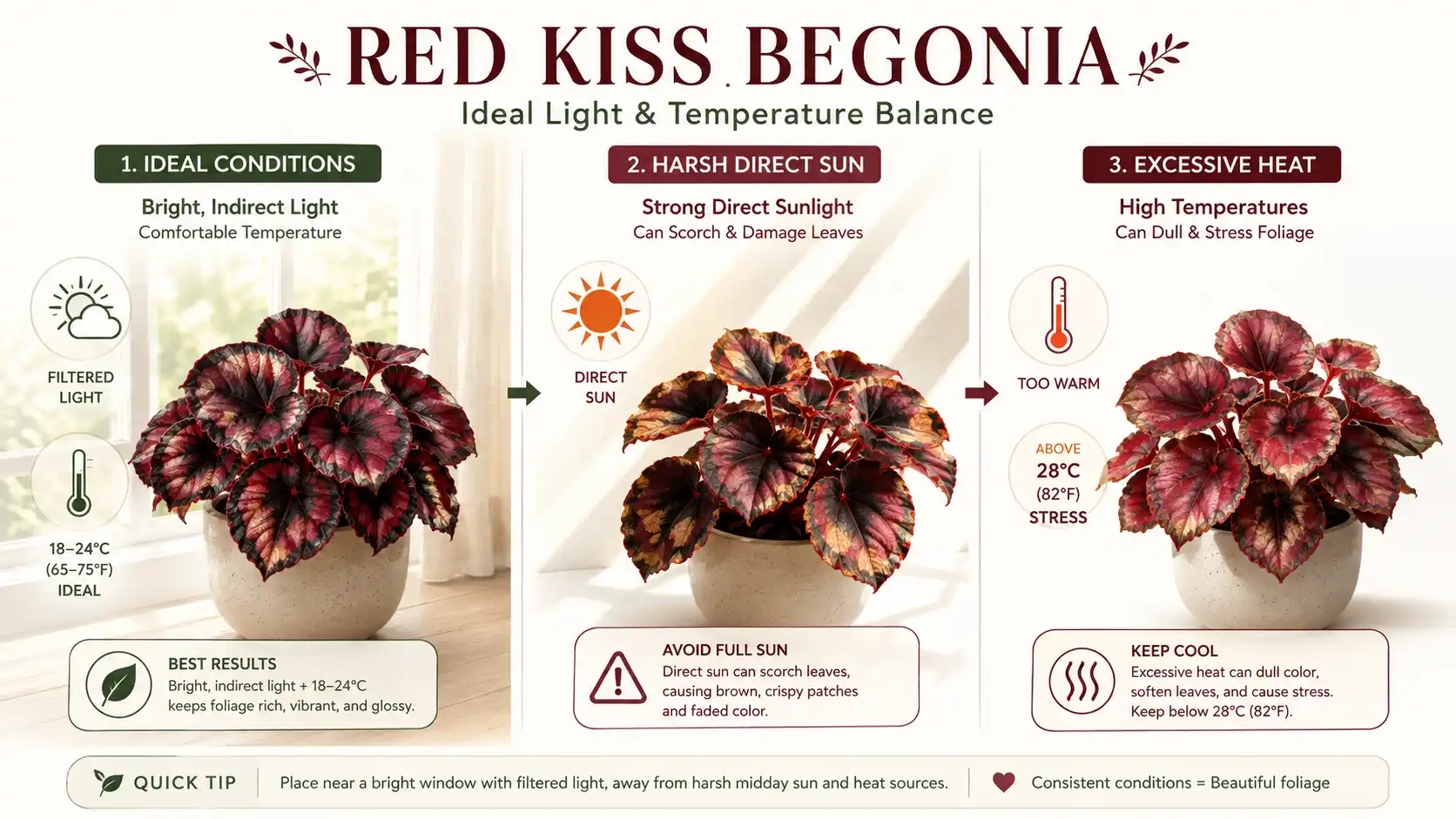
No. Red Kiss Begonia should not be grown in prolonged full sun because its delicate rex-begonia foliage can scorch, fade, or develop damaged patches. Bright indirect light is safer and usually provides enough energy for compact growth and strong foliage coloration.
“Bright indirect light” means the plant is close enough to a bright window to receive strong ambient daylight but is protected from intense direct rays for much of the day.
A few gentle morning rays may be tolerated in some settings, but strong afternoon sun is considerably more likely to cause leaf damage.
Best Placement for a Red Kiss Begonia
The best indoor placement is a bright room near an east- or north-facing window, or near a brighter window protected by a sheer curtain.
An east-facing window is especially useful because morning light is generally less intense than afternoon exposure.
Avoid placing Red Kiss:
- Directly against hot south- or west-facing glass
- Under a heating vent
- Directly beside an air conditioner
- In a cold draft
- In a consistently dark corner
A shaded outdoor patio can also work in a suitable climate. The key requirement is protection from harsh direct sunlight and temperature extremes.
Red Kiss Begonia vs. Other Popular Rex Begonia Varieties
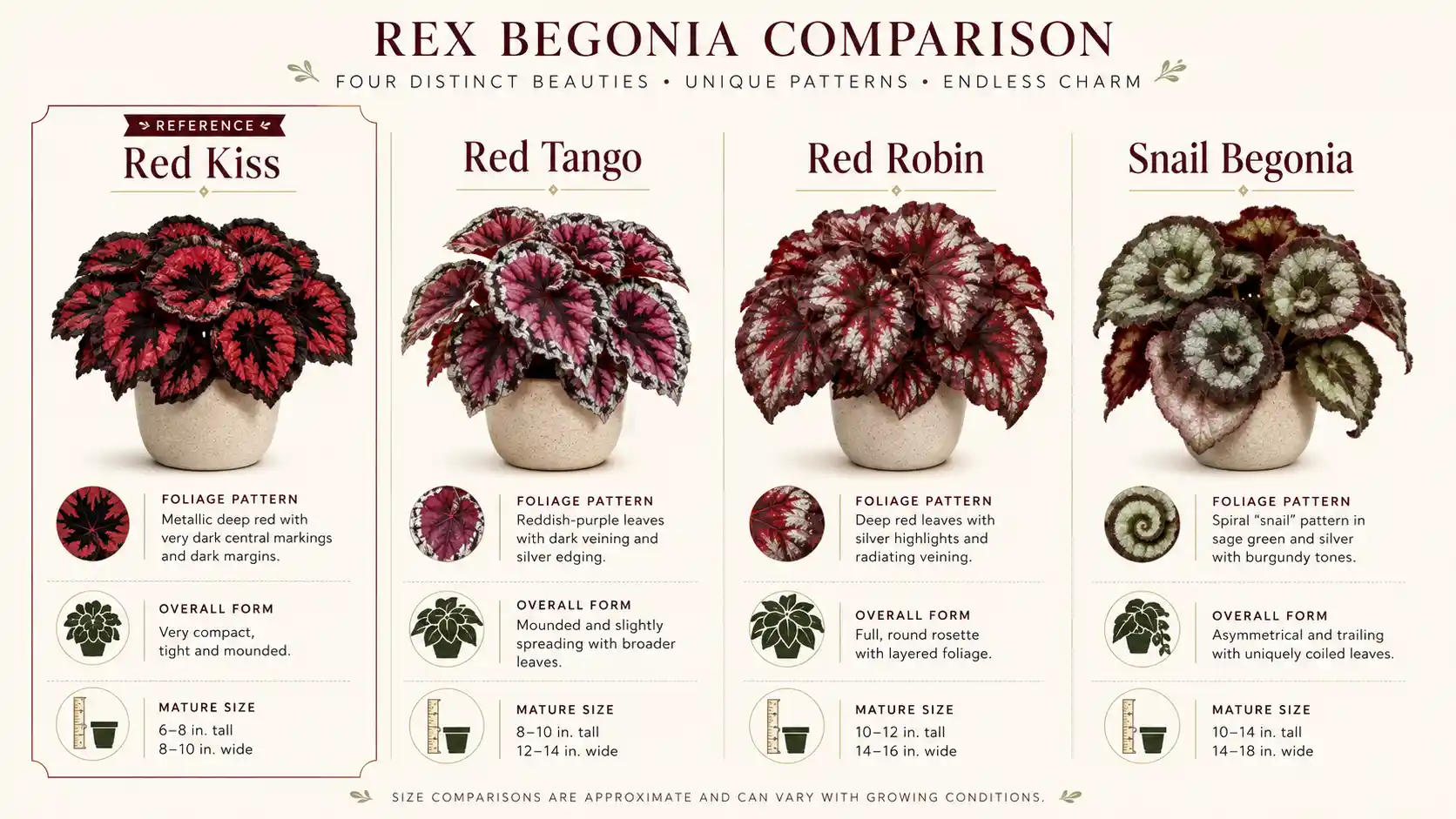
Red Kiss stands out mainly because of its compact size and concentrated metallic red-and-black foliage pattern. Other rex cultivars can be larger, more variegated, or dominated by silver, purple, or spiral patterns.
| Variety | Leaf Color/Pattern | Mature Size | Standout Trait |
| Red Kiss | Metallic red, black center/edge | 6–8 in. | Compact, dense color contrast |
| Red Tango | Reddish-purple, silver edges | ~8 in. | Larger leaf spread |
| Red Robin | Deep red with silver highlights | 8–10 in. | Bolder variegation |
| Snail Begonia | Spiral-patterned, muted tones | 10–12 in. | Distinct swirl shape, not red-toned |
Cultivar size can vary with growing conditions, pot size, and how individual nurseries measure mature dimensions, so these figures should be treated as practical comparisons rather than fixed botanical limits.
Common Red Begonia Problems and How to Fix Them
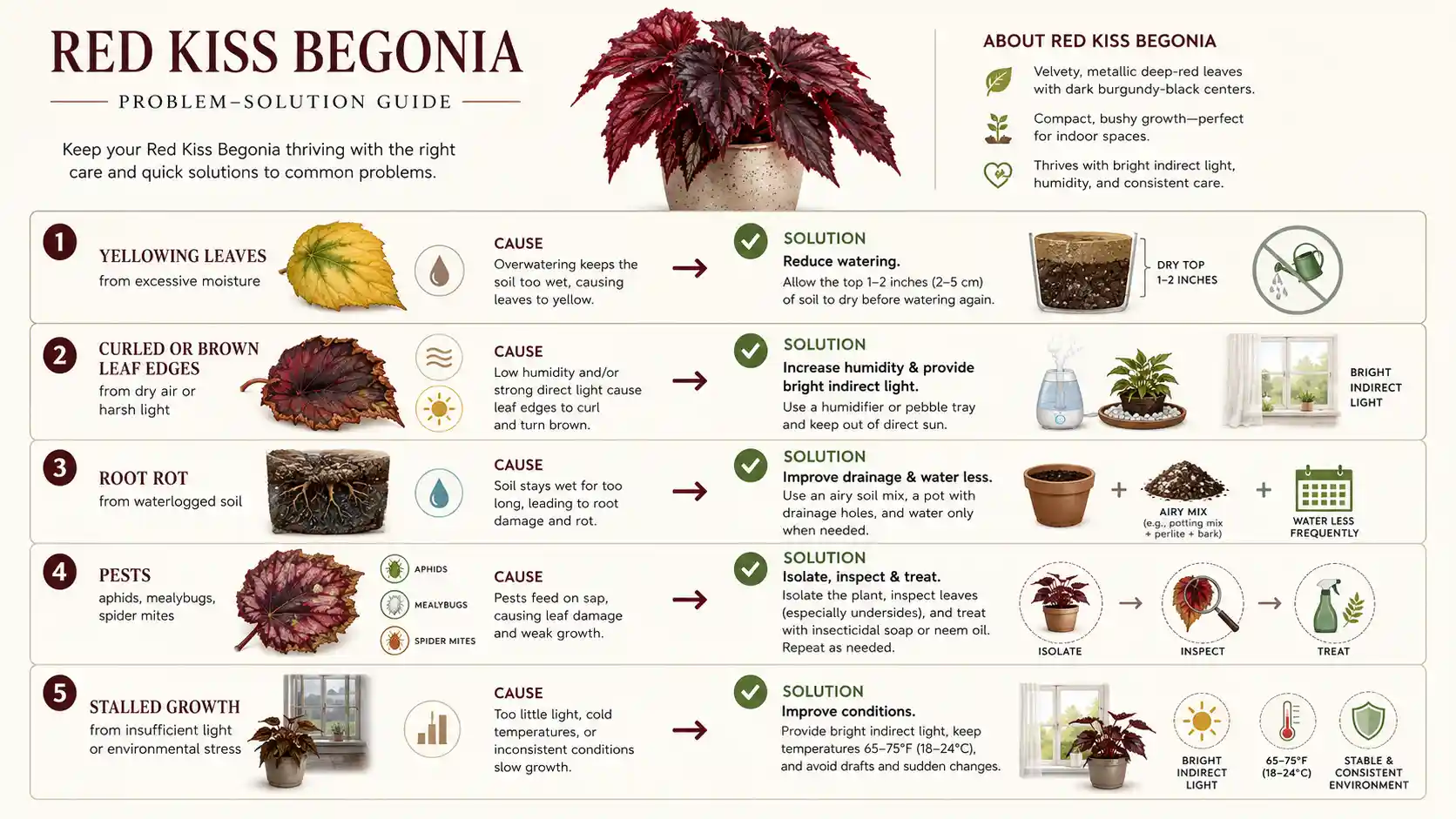
Most Red Kiss problems are connected to an imbalance between water, light, humidity, drainage, and temperature.
Yellowing Leaves
Yellow leaves commonly indicate excessive moisture, aging foliage, root stress, or nutritional problems.
Fix:
- Check soil moisture before watering again.
- Confirm that the pot has drainage holes.
- Inspect roots if the soil stays wet for extended periods.
- Fertilize only during active growth and at an appropriate dilution.
Do not assume every yellow leaf means the plant needs more fertilizer.
Leaf Curling or Browning Edges
Brown or curling margins are commonly associated with dry air, inconsistent moisture, excessive direct light, or heat stress.
Low humidity is a recognized cause of brown leaf tips in rex begonias.
Fix:
- Move the plant away from harsh sun.
- Check humidity.
- Maintain more consistent soil moisture.
- Keep it away from heating and cooling vents.
Root Rot
Root rot is strongly associated with persistently wet soil and inadequate drainage.
If roots are soft, brown, or deteriorating:
- Remove the plant carefully.
- Inspect the root system.
- Remove severely damaged roots with clean tools.
- Repot into fresh, airy mix.
- Use a container with drainage.
- Adjust watering so the mix does not remain saturated.
Prevention is much easier than recovery.
Pests
Common pests include aphids, mealybugs, and spider mites.
Inspect:
- Leaf undersides
- New growth
- Petiole joints
- Crowded foliage
Isolate an infested plant, physically remove visible pests where practical, and use an appropriate insecticidal soap or horticultural treatment according to its label. Neem oil is another commonly used option, but it should be applied carefully because sensitive foliage can react to some sprays.
Slow or Stalled Growth
Slow growth can result from:
- Insufficient light
- Cool temperatures
- Seasonal dormancy
- Root problems
- Severely depleted potting mix
- Watering stress
Before adding more fertilizer, check light and roots first. A nutrient problem cannot compensate for poor drainage or inadequate light.
What Eats Begonias in Pots?
Indoor potted begonias are most commonly damaged by small sap-feeding pests such as aphids, mealybugs, and spider mites, while outdoor plants can also be attacked by slugs and snails.
Look for the damage pattern:
- Aphids: clusters around tender new growth
- Mealybugs: white, cotton-like masses
- Spider mites: stippled leaves and fine webbing
- Slugs/snails: irregular holes or missing sections of foliage
Regularly checking the undersides of leaves is one of the simplest ways to catch infestations early.
Red Kiss Begonia Propagation
Red Kiss can be propagated through leaf cuttings and division methods, with leaf propagation particularly suited to rex begonias. Specialist sources list leaf cuttings and rhizome or division methods among the available propagation approaches. The same basic principles of keeping propagation material moist but well-aerated also apply to other foliage plants; see Peperomia Leaf Propagation: Water and Soil Guide for another practical example of leaf propagation.
Propagating from Leaf Cuttings
Leaf propagation is one of the most useful methods for rex begonias.
Basic process:
- Select a healthy mature leaf.
- Cut the leaf with a clean tool, retaining part of the petiole when appropriate.
- Place the cutting in a moist, airy rooting medium.
- Keep the medium lightly moist rather than saturated.
- Provide warm temperatures and bright indirect light.
- Maintain humidity while allowing enough ventilation to discourage rot.
- Wait for roots and new plantlets to develop.
Rex begonias can produce new plants from leaf tissue, making this method particularly useful when a plant has limited stems available.
Propagating from Stem Cuttings or Division
A healthy stem or rhizome section can also be used when it contains viable growth tissue.
For division:
- Remove the plant from its container.
- Identify separate sections of the rhizome or growth points.
- Divide carefully with a sterile cutting tool.
- Ensure each division has viable growth tissue and roots where possible.
- Pot each section into a small, well-draining container.
- Keep moisture moderate while new roots establish.
Avoid putting a small division into a large pot because excess wet mix can encourage rot.
Signs of Successful Rooting
Successful propagation is indicated by:
- Firm cutting tissue
- New root growth
- New leaf or bud development
- Gradual resistance when a cutting is gently tested
Do not repeatedly pull up cuttings to check for roots. Disturbing developing roots can slow establishment.
Is Red Kiss Begonia Toxic to Cats and Dogs?
Yes. Rex begonias are considered toxic to cats and dogs if ingested because they contain soluble calcium oxalates. The ASPCA lists rex begonia as toxic to dogs, cats, and horses and identifies soluble calcium oxalates as the toxic principle.
Possible signs in cats and dogs can include:
- Drooling
- Vomiting
- Oral irritation
- Difficulty swallowing
Keep Red Kiss away from pets that chew plants. If ingestion occurs, contacting a veterinarian promptly is appropriate.
Common Beginner Mistakes with Red Kiss Begonia
Red Kiss often struggles because beginners provide too much care rather than too little.
The most common mistakes include:
- Overwatering: watering because the calendar says it is time rather than checking the soil.
- Direct sunlight: placing the plant in intense sun to improve its red color and accidentally scorching the leaves.
- Low humidity: keeping it next to dry heating or cooling air.
- Oversized pots: using a large container that holds wet soil around a small root system.
- Poor airflow: creating extremely humid but stagnant conditions.
- Overfeeding: adding fertilizer too frequently when slow growth is actually caused by low light.
- Constant repotting: disturbing a plant before it has adapted to its environment.
- Sudden environmental changes: moving a plant abruptly from a humid nursery environment into hot, dry indoor air.
The most reliable approach is consistency: stable light, controlled moisture, good drainage, and moderate humidity.
Do Coffee Grounds Help Begonias?
Coffee grounds are not necessary for healthy begonias and should not be treated as a primary fertilizer or soil amendment. Used coffee grounds contain organic matter and nutrients, but the benefits are modest compared with a properly formulated houseplant fertilizer, while excessive application can contribute to an overly dense or poorly aerated surface layer.
If used at all, they should be used sparingly and not as a thick layer around the plant.
For Red Kiss, a better priority is:
- Use an appropriate potting mix.
- Maintain drainage.
- Provide adequate light.
- Apply diluted balanced fertilizer during active growth.
Coffee grounds are therefore optional, not a requirement for begonia care.
Should You Water Begonias Every Day?
No. Red Kiss Begonia should not normally be watered every day. Water when the upper portion of the potting mix has dried enough to require irrigation, rather than following a fixed daily schedule.
Daily watering can keep the root zone saturated, reducing oxygen around the roots and increasing the risk of root rot. The University of Connecticut recommends waiting until roughly the top inch of rex-begonia potting mix feels dry before watering.
The exact interval varies with:
- Pot size
- Soil composition
- Temperature
- Humidity
- Light intensity
- Season
- Root mass
A small plant in a cool, humid room may need water less frequently than a larger plant in bright, warm conditions.
Begonias in Pots vs. Hanging Baskets vs. Ground
For Red Kiss, a small container is generally the most practical growing arrangement, particularly indoors. Its compact habit makes it easy to monitor moisture and place it where light and humidity can be controlled.
| Growing Method | Suitability for Red Kiss | Main Consideration |
| Small pot | Excellent | Best control over drainage and moisture |
| Hanging basket | Possible | Protect from direct sun and drying winds |
| Ground planting | Climate-dependent | Requires warm, shaded, well-drained conditions |
Ground planting is most appropriate only where the climate supports rex begonia growth year-round. In colder regions, Red Kiss is better treated as a container plant that can be protected indoors.
How Many Begonias per Hanging Basket
For a compact Red Kiss, avoid overcrowding a hanging basket.
As a practical guideline:
- 8-inch basket: 1 plant
- 10–12-inch basket: 1–2 plants
- 14-inch or larger basket: 2–3 plants, depending on plant size
Spacing should allow each plant enough room for airflow and root development. Overcrowding increases competition for moisture and can create stagnant, humid foliage.
Do Begonias Only Bloom Once a Year? Do They Need Deadheading?
Red Kiss is primarily a foliage plant, so flowering is not the main reason it is cultivated. Rex begonias can produce flowers, but their small flowers are generally much less significant ornamentally than their patterned foliage.
This differs from flowering begonia types, where bloom production is the central ornamental feature.
Deadheading is therefore not an important maintenance task for Red Kiss. If it produces insignificant flower stalks and the goal is to maximize the foliage display, removing them is optional rather than essential.
For flowering red begonias, deadheading can be more relevant because removing spent blooms helps maintain a tidy appearance and can support continued flowering.
Red Kiss Begonia Lifespan
A healthy Red Kiss can be maintained as a multi-year indoor plant when its environmental requirements are consistently met.
This is an important distinction from many bedding begonias that are commonly grown as seasonal annuals in climates where winter temperatures are unsuitable.
Rex begonias can slow down or appear dormant during unfavorable periods. A temporary reduction in growth does not necessarily mean the plant is dead.
Long-term survival depends heavily on:
- Protecting the plant from extreme temperatures
- Avoiding chronic overwatering
- Maintaining adequate light
- Preventing severe pest infestations
- Refreshing potting media when necessary
- Propagating healthy material as insurance
Propagation is especially useful with rex begonias because it allows growers to preserve a cultivar even if an older mother plant eventually declines.
What Does a Red Begonia Symbolize?
Red begonias are sometimes associated with gratitude, deep thoughts, individuality, passion, or strong affection, although symbolic meanings vary by culture and flower-language tradition.
For Red Kiss specifically, there is no universally accepted botanical symbolism unique to the cultivar. Its dark red and black foliage may encourage associations with intensity, elegance, mystery, or individuality, but those are interpretive rather than scientific meanings.
The distinction is important: plant symbolism is cultural tradition, not a biological characteristic of the cultivar.
Conclusion
Red Kiss Begonia is a compact rex begonia cultivar valued primarily for its metallic-red foliage, dark centers, and black margins. Its compact size makes it particularly suitable for indoor growing, while its strongest care requirements are straightforward: bright indirect light, controlled watering, an airy potting mix, moderate-to-high humidity, and stable temperatures.
The biggest mistake is usually excessive moisture rather than insufficient attention. Let the upper layer of soil dry before watering, use a container that matches the root system, and protect the foliage from harsh direct sun.
Despite being marketed as a delicate or rare plant in some places, Red Kiss is a commercially propagated cultivar that can become a long-lived houseplant when its basic environmental needs are met. For the best color and growth, focus on balance rather than extremes: enough light for strong foliage, enough moisture to prevent drought, but never enough water to leave the roots constantly saturated.
FAQs
How do you care for a red kiss begonia?
Care for a Red Kiss Begonia with bright indirect light, water when the top inch of soil dries, maintain roughly 50–70% humidity, use a well-draining mix, and fertilize lightly during active growth. Avoid direct afternoon sun, waterlogged soil, and sudden temperature changes. Rex begonia guidance supports allowing the upper soil layer to dry before watering and maintaining higher humidity.
Is begonia red kiss rare?
Begonia Red Kiss is uncommon in some local markets but is not generally a true rarity. It is an established named cultivar that is commercially propagated and currently sold by multiple specialty growers. Claims that every Red Kiss is “rare” should therefore be treated as marketing language rather than a botanical classification.
Can red begonias take full sun?
No, Red Kiss Begonia should not receive prolonged full sun. Its thin rex-begonia foliage is better protected from intense direct rays, especially hot afternoon sunlight. Bright indirect or filtered light provides a safer balance between healthy growth and strong foliage coloration.
Is red kiss begonia toxic to cats?
Yes, Red Kiss Begonia should be considered toxic to cats if ingested. Rex begonia is listed by the ASPCA as toxic to cats and dogs because begonias contain soluble calcium oxalates. Possible signs include drooling and vomiting.
How do you propagate a red kiss begonia?
Red Kiss Begonia can be propagated through leaf cuttings or division of suitable rhizome or growth sections. Leaf propagation is particularly useful for rex begonias. Keep propagation material warm, lightly moist, and humid while roots and new growth develop.
How hot is too hot for begonias?
Sustained temperatures above roughly 85–90°F (29–32°C) can stress Red Kiss Begonia, particularly when combined with intense light, dry air, or poor airflow. The plant may continue surviving at higher temperatures, but foliage quality and coloration can decline. Grower observations also report that Red Kiss colors may become duller during hot summer conditions.
How long do potted begonias last?
Rex begonias such as Red Kiss can live for multiple years indoors when provided with suitable light, moisture, humidity, and temperature. They differ from seasonal bedding begonias commonly grown as annuals in cold climates. Propagation can help preserve the cultivar if an older plant declines.