
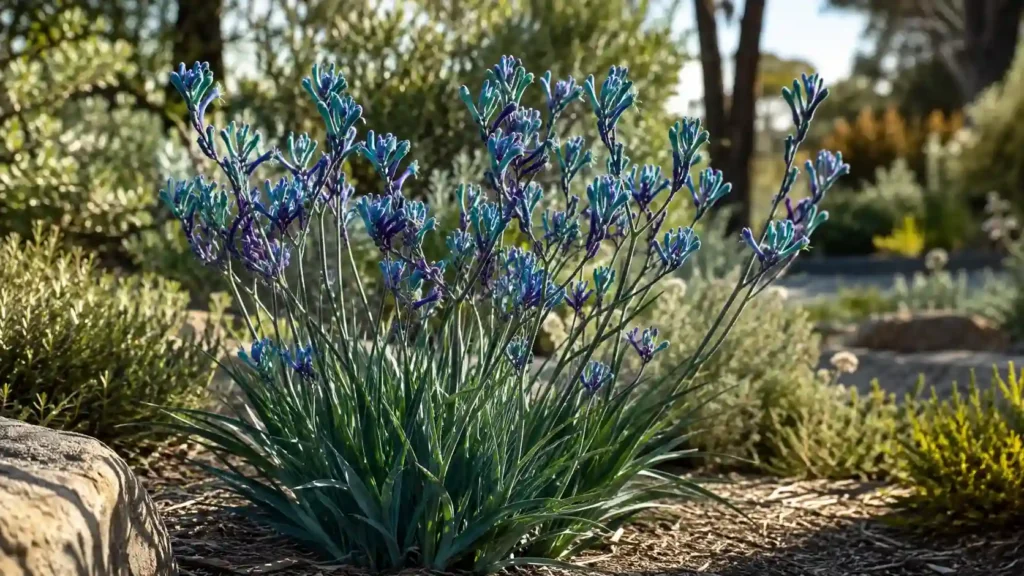
According to Manuela Nogueira, blue kangaroo paw refers to Anigozanthos ‘Masquerade,’ a hybrid developed by Kings Park and Botanic Garden in Perth, Western Australia. Bred from five kangaroo paw species starting in 2007, it produced true teal-blue tubular flowers by chance in 2012 — the first blue-flowered kangaroo paw hybrid, reaching about 20 inches tall with blue-green foliage.
The breakthrough came when lead breeder Digby Growns crossed green-flowered and purple-flowered forms of the common red-and-green kangaroo paw, Anigozanthos manglesii; true blue pigmentation is notably rare among flowering plants, which is part of why the result drew scientific interest. Also sold as ‘Celebrations Masquerade’ and protected by plant breeders’ rights, the cultivar suits USDA zones 9-11 and briefly tolerates freezing temperatures outdoors.
Quick Summary
- Blue kangaroo paw is ‘Masquerade’, a cultivated Anigozanthos hybrid bred in Western Australia for its unusual teal-blue and purple flowers.
- Full sun, excellent drainage, and controlled watering are the foundation of reliable growth and flowering.
- ‘Masquerade’ grows to about 50 cm tall and 40 cm wide and can flower for an extended period when established under favorable conditions.
- Pet-toxicity information is inconsistent between horticultural sources, so prevent dogs and cats from chewing the plant and remember that its fine hairs can irritate skin and eyes.
What Is a Blue Kangaroo Paw?
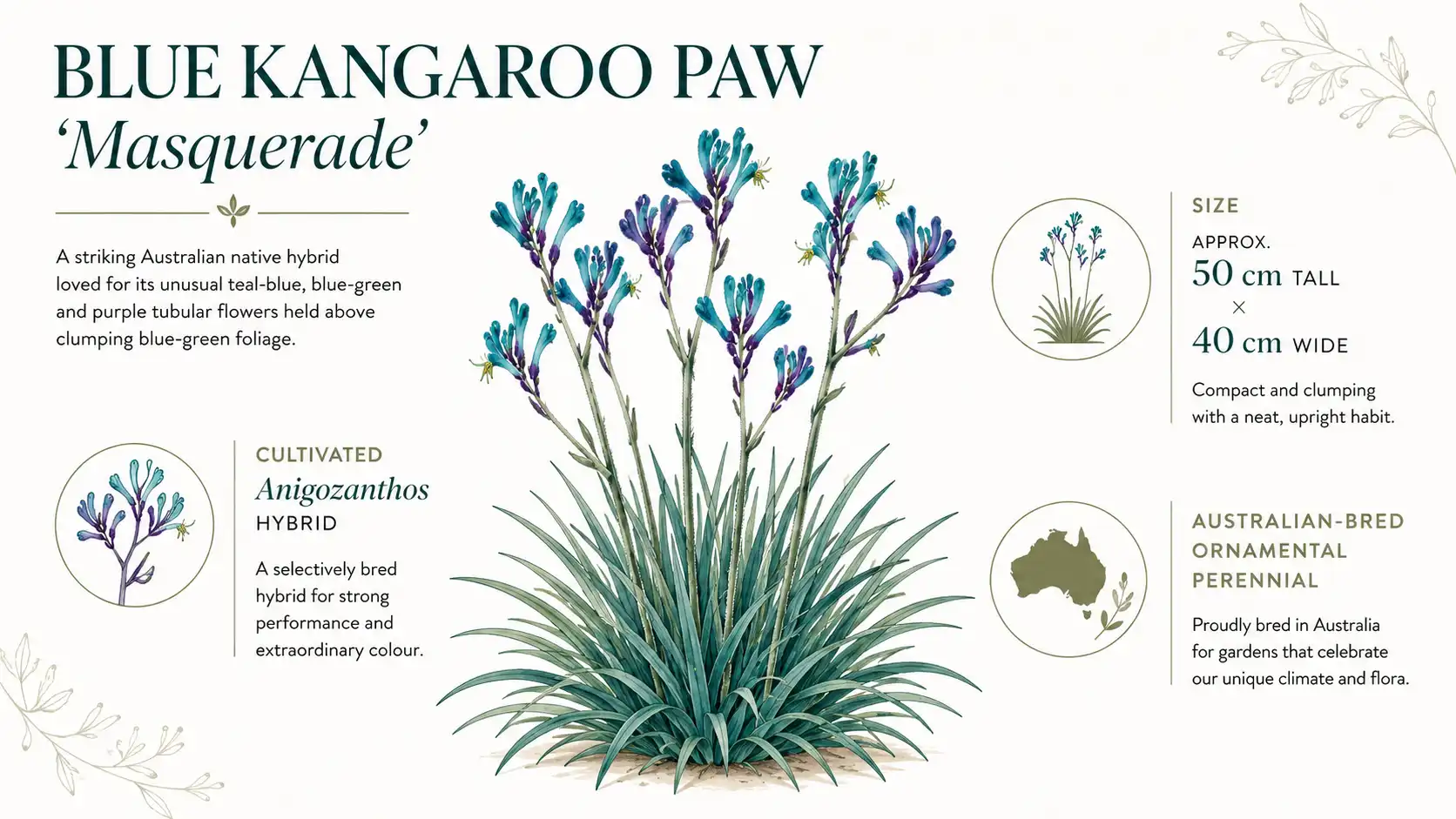
Blue kangaroo paw is Anigozanthos hybrid ‘Masquerade’, a cultivated hybrid developed at Kings Park in Western Australia and marketed as part of the Celebrations series. It is not a naturally occurring blue species; instead, its unusual teal, blue-green and purple flower coloration was produced through controlled hybridization and selection.
Blue kangaroo paw also fits naturally into broader Australian-style landscapes; see our guide to Australian Native Garden Plants for more native species, garden combinations, and design ideas.
The genus Anigozanthos contains the plants commonly called kangaroo paws. They are clumping, evergreen perennials associated with southwestern Western Australia, where many species and cultivated hybrids have evolved or been bred for different flower colors, forms, flowering periods and garden performance. Kings Park describes kangaroo paws as upright plants with colorful, velvet-like flowers and strap-shaped foliage.
‘Masquerade’ is especially notable because genuinely blue flower coloration is uncommon among flowering plants. Its flowers are best described as teal to blue-green with purple, rather than the intense cobalt or sky-blue color associated with some ornamental flowers. The intensity of the color is also influenced by growing conditions, particularly light.
The blue kangaroo paw should also not be confused with the black kangaroo paw, Macropidia fuliginosa. Macropidia is a different genus, although it belongs to the same broader family as Anigozanthos. The distinction matters because “black kangaroo paw” is a species-level common name, whereas ‘Masquerade’ is a cultivated Anigozanthos hybrid.
Blue Kangaroo Paw vs. Other Kangaroo Paw Varieties
Kangaroo paw varieties differ substantially in color, mature size, flowering period and breeding background. The following comparison gives a practical overview; exact dimensions can vary with cultivar, climate and growing conditions.
| Variety | Flower Color | Approx. Mature Height | Sun Needs | Notable Trait |
| ‘Masquerade’ | Teal/blue-green and purple | 50 cm | Full sun to bright part sun | Unusual blue-toned flowers; compact form |
| ‘Bush Gold’ / Landscape Gold types | Gold/yellow | Varies by cultivar | Full sun | Strong yellow-gold display and landscape use |
| ‘Landscape Lilac’ | Lilac/purple | Varies by cultivar | Full sun | Purple-toned flowers for borders |
| ‘Cocktail’ | Novel mixed tones | Varies | Full sun | Part of the Celebrations breeding group |
| Purple kangaroo paw types | Purple, burgundy or violet tones | Varies | Full sun | Broad color group rather than one species |
| Black kangaroo paw | Black and green | Varies | Bright sun | Macropidia fuliginosa, not an Anigozanthos |
The key difference is that ‘Masquerade’ combines a relatively compact size with an unusually cool flower palette. Kings Park lists it at approximately 50 × 40 cm and recommends a bright, sunny, protected position.
Blue Kangaroo Paw Plant Size
A mature blue kangaroo paw ‘Masquerade’ typically reaches about 50 cm in height and 40 cm in width, making it considerably more compact than some tall kangaroo paw species and cultivars. Its narrow, strap-like blue-green leaves form a clump near the base, while flowering stems rise above the foliage.
Actual size depends on:
- Amount of direct sunlight
- Soil drainage
- Water availability
- Fertility
- Container size
- Temperature
- Age of the clump
- Frequency of pruning
In the ground, a healthy plant can develop a fuller clump than a confined container specimen. In pots, root restriction naturally limits the overall size, although the plant can still flower well if it receives enough light.
Unlike some taller Anigozanthos cultivars that can reach well over 1 m, ‘Masquerade’ is better suited to containers, low borders, courtyards and smaller garden spaces.
Growth Rate and Flowering
Blue kangaroo paw has a moderate to relatively fast growth pattern when warmth, sunlight, water and drainage are favorable. It grows from underground rhizomes, allowing the plant to regenerate new shoots after older foliage and flower stems are removed.
Growth is usually strongest during favorable warm-season conditions. Plants grown in insufficient light may survive but become less vigorous, produce weaker flowering stems and show less intense flower coloration.
‘Masquerade’ has been described by Kings Park as a prolific flowering hybrid with flowering extending from winter into summer under suitable conditions, while other horticultural sources describe it as capable of flowering for much of the year once established. Flowering therefore depends strongly on climate rather than occurring on one identical calendar schedule everywhere.
Does Kangaroo Paw Bloom All Year?
Blue kangaroo paw can flower for an extended portion of the year, but “blooms all year” should not be interpreted as continuous flowering in every climate. ‘Masquerade’ has been reported to flower from winter through summer and, under favorable conditions, can produce flowers across much of the year.
Flowering is encouraged by:
- Strong sunlight
- Healthy rhizomes
- Good drainage
- Consistent but not excessive moisture
- Adequate nutrition
- Removal of spent flower stems
Cold weather, low light, drought stress, excessive shade or root problems can shorten the flowering period.
How Long Does It Take to Flower From Seed?
There is no single reliable seed-to-flower timeline for ‘Masquerade’, because this cultivar is normally propagated commercially rather than grown from seed to reproduce the exact named hybrid. Seed-grown kangaroo paws can also vary genetically and may not retain the defining characteristics of the parent cultivar.
For a named hybrid such as ‘Masquerade’, a nursery-grown plant is therefore the more predictable way to obtain the characteristic flower color and mature form.
A young established plant can flower substantially sooner than a seedling because it has already passed much of the juvenile development stage. Environmental conditions remain the biggest factor in how quickly a young plant reaches flowering size.
Ideal Growing Conditions
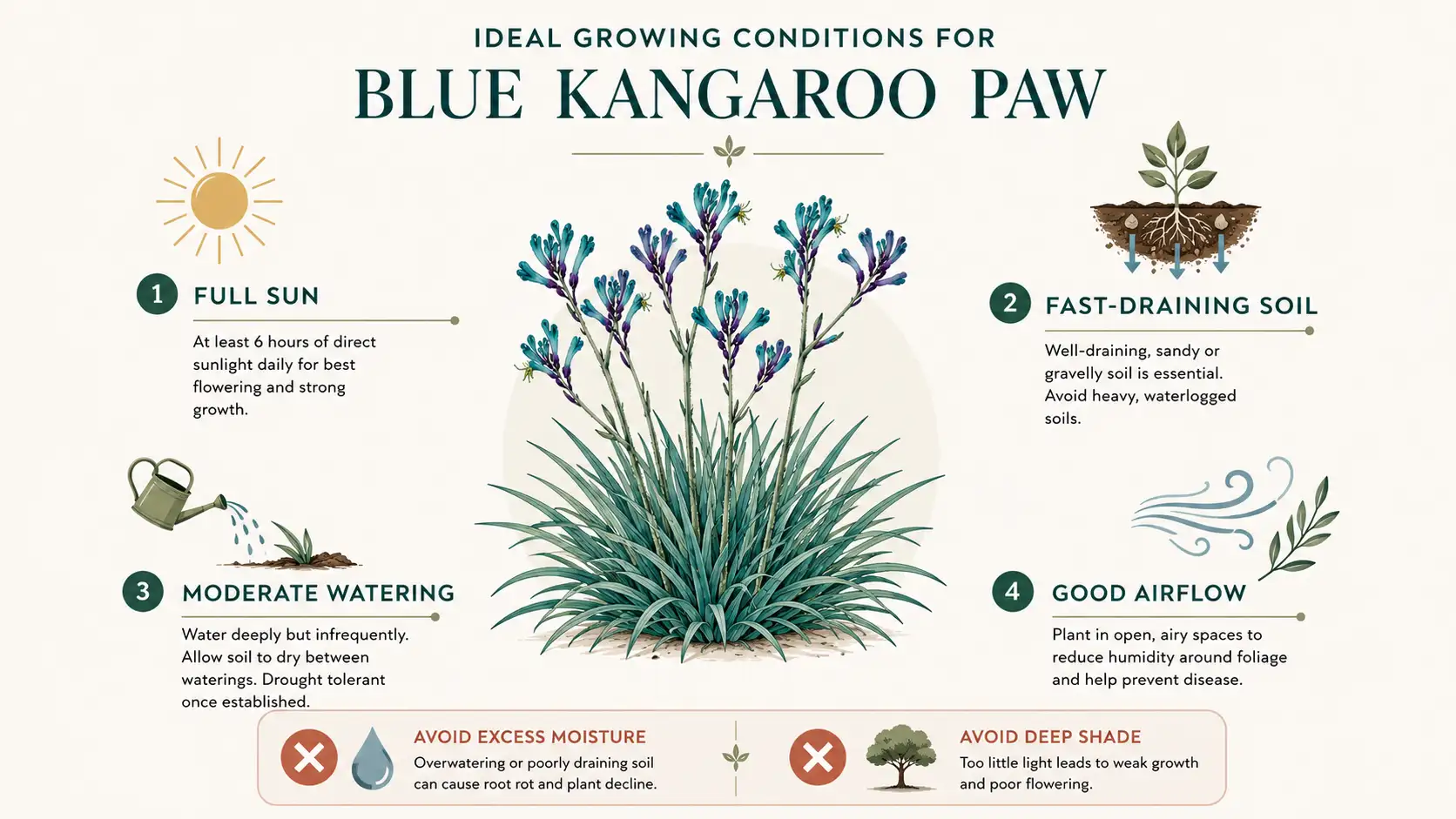
The ideal location for blue kangaroo paw is bright, sunny and well drained, with protection from conditions that keep the foliage wet for long periods. ‘Masquerade’ performs best in full sun or bright part-sun, and stronger light helps maintain its distinctive coloration.
For best results:
- Sun: Full sun is preferred; bright part sun can work.
- Soil: Fast-draining sandy or loamy soil is ideal.
- Water: Water deeply when needed, then allow excess moisture to drain.
- Airflow: Avoid persistently crowded, humid conditions.
- Wind: A protected position is preferable, especially for flowering stems.
- Containers: Use a free-draining potting mix and a container with drainage holes.
Kangaroo paws are adapted to relatively dry Australian environments, but drought tolerance does not mean they should be kept permanently dry. Young plants and container-grown specimens generally require more regular watering than established plants in the ground.
Soil Requirements
The most important soil characteristic for blue kangaroo paw is rapid drainage. Heavy, water-retentive soil can keep the rhizomes and roots wet for too long, increasing the risk of decline and root-related problems.
A practical soil mixture should contain:
- Free-draining native or general-purpose potting mix
- Coarse mineral material such as coarse sand or similar drainage-improving material where appropriate
- A moderate amount of mature organic matter
- No persistent layer that holds water around the roots
For heavy clay soil, a raised or mounded planting area can improve drainage more effectively than simply adding a small amount of sand to the existing soil.
The soil should generally be mildly acidic to neutral rather than strongly alkaline. Avoid fresh manure or excessive fertilizer, particularly products that create high nutrient concentrations around the roots.
Watering Needs
Water blue kangaroo paw according to soil moisture, temperature, plant age and drainage rather than following a rigid daily schedule.
For a container-grown ‘Masquerade’, Kings Park recommends watering when the top of the potting mix has dried.
A useful approach is:
- Check the upper layer of the growing medium.
- If it has dried, water thoroughly.
- Allow excess water to drain completely.
- Do not leave the pot sitting in water.
- Reduce watering during cool or rainy periods.
- Increase attention during hot weather and active flowering.
The biggest watering mistake is treating drought tolerance as a reason to either neglect the plant completely or keep it permanently dry. The goal is adequate moisture with excellent drainage, not constant saturation.
Planting and Companion Plants
Plant blue kangaroo paw in a sunny position where its upright flower stems can be seen clearly. It works especially well as a focal plant, repeated border planting, container specimen or part of a low-water Australian-style garden. If you want to build a compatible planting scheme around it, see what to plant with kangaroo paw for companion ideas and spacing guidance.
Suitable companions include plants with similar preferences for sun and relatively free-draining soil, such as:
- Lomandra cultivars
- Dianella cultivars
- Westringia
- Grevillea
- Chrysocephalum
- Other drought-tolerant Australian natives
Choose companions according to the local climate rather than simply matching flower colors. Plants with dramatically higher water requirements can make irrigation management more difficult.
Allow sufficient space around each kangaroo paw for airflow. Avoid planting it so tightly that foliage remains damp for extended periods. For another landscaping-focused kangaroo paw, compare the growing characteristics and garden use of Kangaroo Paw Landscape Scarlet.
Growing Blue Kangaroo Paw in Pots
Blue kangaroo paw is particularly well suited to containers because ‘Masquerade’ has a relatively compact mature size and Kings Park specifically recommends it for tubs and pots.
Choose a container with:
- Multiple drainage holes
- Enough volume for the developing root and rhizome system
- A free-draining potting mix
- Stable support if the plant becomes top-heavy while flowering
Container plants usually dry out faster than plants in garden beds, especially during hot weather. Check moisture more frequently, but avoid responding to dry soil by keeping the mix continuously wet.
A sunny balcony, courtyard or terrace can work well if the plant receives enough direct or very bright light.
Kangaroo Paw Care Guide
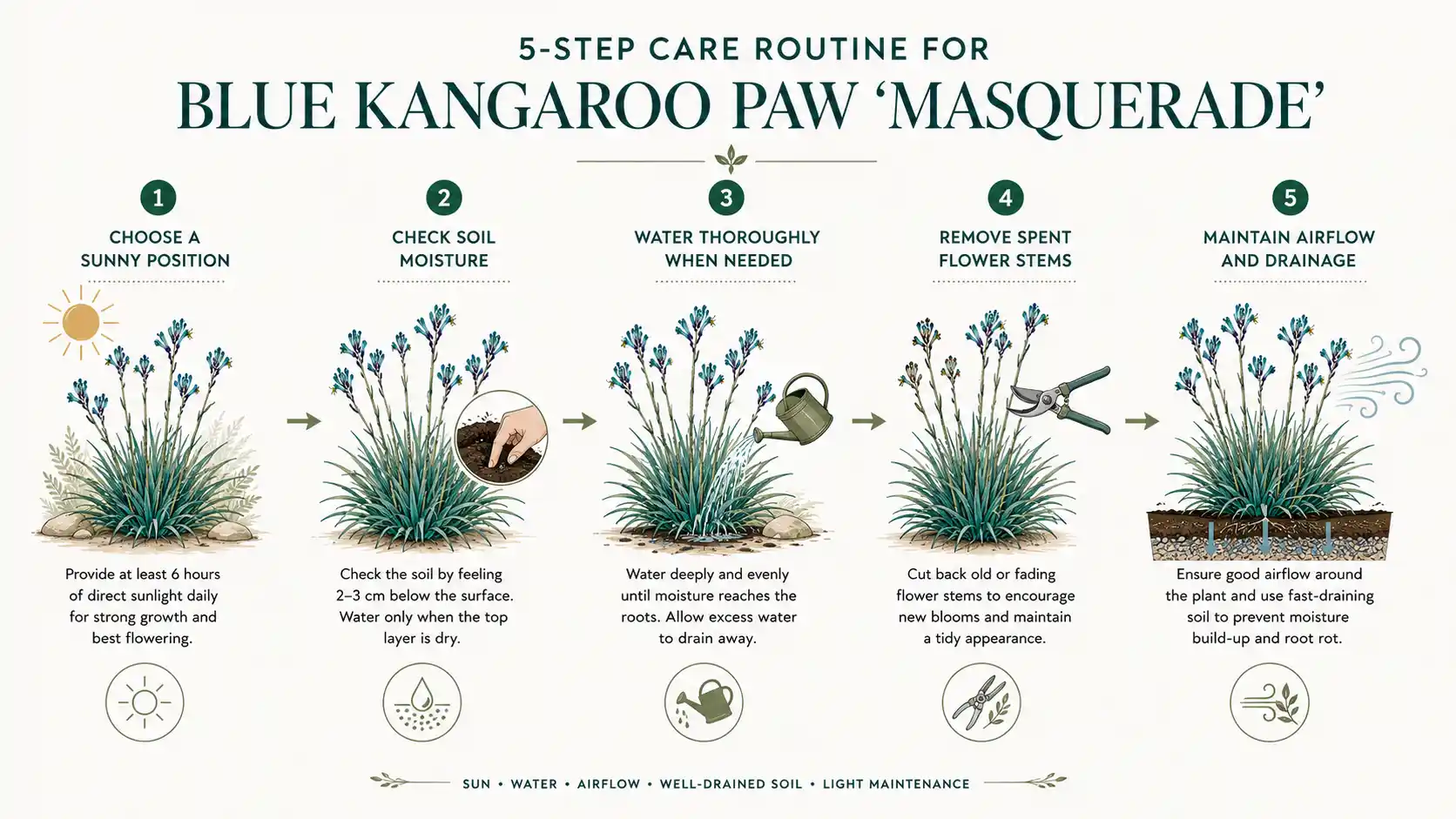
Blue kangaroo paw is relatively straightforward when its basic environmental requirements are met.
| Care Factor | Best Practice |
| Light | Full sun to bright part sun |
| Water | Moderate during active growth; allow the surface to dry before watering containers again |
| Soil | Well drained, preferably sandy or loamy |
| Fertilizer | Moderate feeding with a suitable native-plant fertilizer according to label directions |
| Pruning | Remove spent flower stems at the base; remove damaged or old foliage |
| Climate | Warm conditions preferred; ‘Masquerade’ has light-frost tolerance |
| Containers | Excellent choice when drainage is strong |
| Airflow | Good airflow helps reduce disease pressure |
Kings Park recommends removing old flowering stems at the base and damaged leaves, while the Anigozanthos Project notes that new shoots arise from underground rhizomes. Controlled-release fertilizer can be used in autumn and spring according to the cultivar’s growing conditions.
Do not automatically apply heavy fertilizer to force flowering. Excessive feeding can produce lush vegetative growth without solving problems caused by poor light, poor drainage or unsuitable temperatures. For a broader overview of watering, pruning, feeding, and maintaining healthy blooms, see our guide to Kangaroo Paw Care.
Is Blue Kangaroo Paw High Maintenance?
Blue kangaroo paw is generally low to moderate maintenance, especially when planted in the right location. Its care becomes difficult mainly when gardeners ignore its two most important requirements: strong light and good drainage.
For a healthy established plant, routine maintenance usually consists of:
- Watering when necessary
- Removing spent flower stems
- Removing damaged foliage
- Monitoring for pests
- Maintaining good airflow
- Occasional appropriate fertilization
The plant is therefore suitable for beginners who can provide a sunny location and avoid chronically wet soil.
Common Kangaroo Paw Problems and How to Fix Them
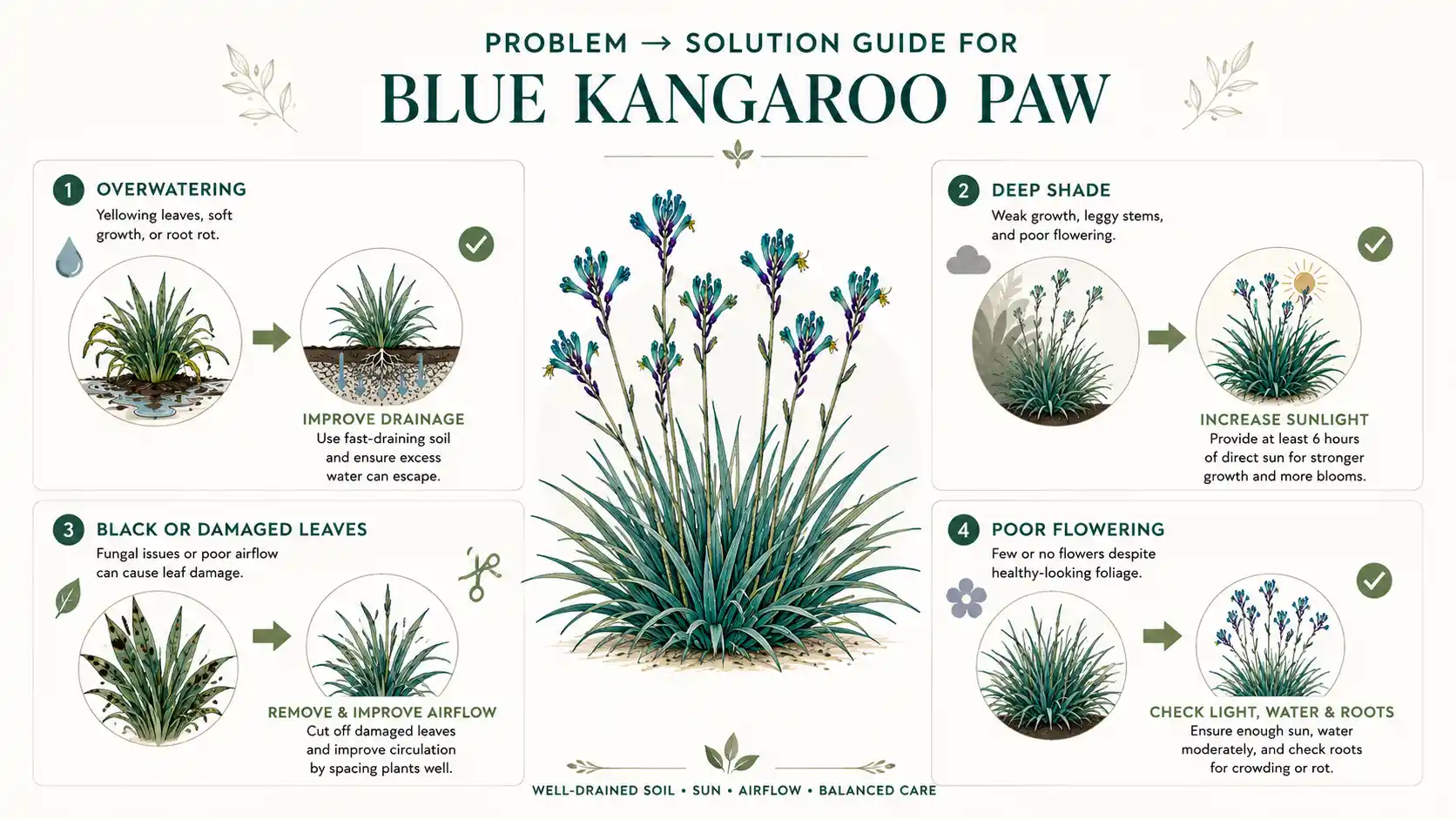
Most serious kangaroo paw problems are connected to environmental stress, disease pressure, poor drainage or unsuitable cultural conditions.
Why Do My Kangaroo Paws Keep Dying?
Repeated plant death usually indicates a persistent growing-condition problem rather than a need for more fertilizer.
Common causes include:
- Waterlogged soil
- Poor drainage
- Insufficient sunlight
- Excessive humidity and poor airflow
- Severe drought during establishment
- Disease pressure
- Damaged or declining rhizomes
Start by checking the roots and soil before changing the feeding program. If the soil remains wet for long periods, improving drainage is more important than increasing fertilizer.
Kangaroo Paw Disease and Black Leaves
Blackened leaves can be associated with disease, environmental stress or damaged tissue. Kangaroo paws are known to be affected by fungal problems including ink spot disease and rust, which can cause dark lesions or deterioration of foliage.
The development program behind ‘Masquerade’ specifically selected for improved disease tolerance, including tolerance to ink spot and rust, but disease resistance does not mean complete immunity.
If black or badly damaged foliage appears:
- Remove affected leaves and spent stems.
- Improve airflow around the plant.
- Avoid unnecessary overhead irrigation.
- Check that the soil drains rapidly.
- Avoid allowing dead foliage to accumulate around the crown.
- Monitor new growth for continued symptoms.
Persistent or rapidly spreading symptoms may require identification of the specific pathogen before treatment.
Overwatering and Root Rot Issues
Overwatering is one of the most important preventable problems for kangaroo paws. Their drought tolerance can lead gardeners to assume that watering is harmless as long as the plant receives enough light, but roots and rhizomes still require oxygen.
Symptoms associated with chronically wet conditions can include:
- Yellowing or collapsing foliage
- Poor growth
- Sudden decline
- Weak flowering
- Soft or damaged roots
- Persistent wet soil
Move container plants into a faster-draining medium if necessary. In garden beds, improve drainage by changing the planting position rather than simply watering less often.
Slow or Poor Flowering — Causes and Fixes
Poor flowering is commonly associated with insufficient sunlight, immature plants, excessive shade, drought stress, root problems or unsuitable nutrition.
The first thing to check is light. ‘Masquerade’ develops stronger coloration in bright conditions, and Kings Park recommends a bright, sunny position.
If light is adequate, check:
- Whether the soil stays wet
- Whether the plant is severely root-bound
- Whether watering is inconsistent
- Whether the plant is receiving excessive nitrogen
- Whether spent stems are being removed
- Whether temperatures are suitable for active growth
Do not try to solve every flowering problem with fertilizer. Light and root health usually deserve attention first.
Is Kangaroo Paw Poisonous to Pets?
The available information on kangaroo paw toxicity is not completely consistent, so it is safest not to describe blue kangaroo paw as definitively pet-safe or definitively poisonous without qualification. Some horticultural sources list Anigozanthos as non-toxic, while other Australian nursery sources classify kangaroo paw cultivars as moderately toxic if ingested.
There is also a separate, well-documented physical irritation issue: the fine hairs on kangaroo paw flowers and stems can irritate skin and eyes. The University of California Agriculture and Natural Resources recommends caution when handling Anigozanthos and supervising pets and children around the plant.
For households with dogs or cats:
- Prevent chewing of leaves and flowers.
- Keep fallen plant material away from pets.
- Wear gloves when doing extensive pruning.
- Seek veterinary advice if a pet consumes a substantial amount and develops symptoms.
This precaution is particularly appropriate because cultivar-specific toxicity data for ‘Masquerade’ are limited.
Do Kangaroo Paws Spread? Lifespan and Longevity
Kangaroo paws are clump-forming perennials rather than aggressive spreading groundcovers. Their underground rhizomes produce new shoots, gradually enlarging the clump rather than sending long invasive runners across the garden.
Longevity varies substantially between Anigozanthos species and hybrids. Some kangaroo paws are relatively short-lived, while vigorous forms can persist for many years under suitable conditions. The species Anigozanthos flavidus, for example, is documented as unusually long-lived compared with some other kangaroo paws.
For ‘Masquerade’, good drainage, disease management, adequate sunlight and periodic removal of declining foliage are more important than expecting one fixed lifespan.
Do Hummingbirds and Pollinators Like Kangaroo Paw?
Kangaroo paws are valuable nectar-producing plants for nectar-feeding birds and other pollinators, particularly in Australia. Their tubular flowers are strongly associated with bird pollination, including honeyeaters.
The flower structure is well suited to birds that perch on the stems while feeding. As the bird contacts the flower, pollen can be transferred between flowers, supporting pollination.
Depending on the region, kangaroo paws can also be visited by insects such as bees. Their wildlife value is therefore an additional reason to use them in gardens rather than treating them solely as ornamental plants.
One important geographical distinction is that hummingbirds are native to the Americas, not Australia. If ‘Masquerade’ is grown in a region where hummingbirds occur, its nectar-rich flowers may potentially be visited, but Australian gardens should primarily expect honeyeaters and other local nectar-feeding wildlife.
Beginner Mistakes to Avoid
The most common mistakes are simple but can significantly reduce plant health.
- Keeping the soil constantly wet.
Blue kangaroo paw needs moisture but also excellent drainage. Constantly saturated soil can damage the root and rhizome system. - Planting in deep shade.
Low light reduces flowering and can weaken the plant’s upright growth. - Treating drought tolerance as zero-water tolerance.
Established plants are resilient, but newly planted specimens still need appropriate irrigation while their roots establish. - Ignoring airflow.
Crowded, damp foliage can increase disease pressure. - Leaving old flower stems and damaged leaves indefinitely.
Removing old material keeps the clump cleaner and encourages fresh growth. - Using excessive fertilizer.
More fertilizer does not compensate for poor drainage or inadequate sunlight. - Planting a compact cultivar where a tall cultivar is expected.
‘Masquerade’ is intentionally compact at approximately 50 × 40 cm, so it should not be expected to develop the height of large kangaroo paw cultivars.
Blue Kangaroo Paw Varieties and Colors
Kangaroo paws have an unusually broad range of flower colors because extensive breeding has produced hybrids with combinations of red, orange, yellow, pink, purple, green and blue-toned flowers. The genus has been used extensively in breeding programs, particularly in Western Australia. For comparison with a warmer flower color, Yellow Kangaroo Paw offers a useful look at another popular color form and its growing requirements.
‘Masquerade’ is distinctive because it introduced a commercially released blue-toned flower form through a deliberate breeding program. The original blue-toned breeding material appeared during Kings Park’s hybridization work, but early selections had disease problems. Later selection produced a more disease-tolerant hybrid with teal, blue and purple flowers, which became ‘Masquerade’. Other cultivated color forms include pink selections such as Anigozanthos Pink Beauty, which provide a useful contrast to the blue-toned ‘Masquerade’.
Other kangaroo paw color groups include:
- Red: classic Australian kangaroo paw colors
- Orange: warm orange and orange-red hybrids
- Yellow: gold and yellow landscape cultivars
- Pink: soft pink through stronger rose shades
- Purple: lilac, violet and burgundy tones
- Green: green and green-yellow flowers
- Blue-toned: represented most notably by ‘Masquerade’
The Celebrations breeding program also includes cultivars such as ‘Cocktail’ and other novel-color selections. The important distinction is that these names refer to individual cultivars or breeding selections, not separate species of blue, purple or yellow kangaroo paw.
Conclusion
Blue kangaroo paw, particularly Anigozanthos hybrid ‘Masquerade’, stands out because it combines the distinctive form of an Australian kangaroo paw with an unusually cool teal-blue and purple flower palette. It is a compact clumping perennial, reaching roughly 50 cm tall and 40 cm wide, and is especially well suited to sunny borders and containers.
Its care is relatively simple: provide strong sunlight, fast drainage, sensible watering and periodic removal of old flower stems and foliage. Avoid chronically wet soil and deep shade, as both can reduce flowering and increase the risk of decline.
The most important takeaway is that the blue kangaroo paw is not a naturally occurring blue species but a carefully bred Western Australian hybrid. With the right combination of sunlight and drainage, ‘Masquerade’ can provide an unusually long-lasting and highly distinctive flowering display.
FAQs
1. Do kangaroo paw plants like sun or shade?
Kangaroo paw plants generally prefer full sun or very bright light. ‘Masquerade’ performs best in a bright, sunny position, and stronger light helps develop its characteristic flower coloration. Too much shade can reduce flowering and weaken the plant’s growth.
2. Does kangaroo paw bloom all year?
Kangaroo paw can flower for much of the year in favorable climates, but it does not bloom continuously in every location. ‘Masquerade’ is described as a prolific flowering hybrid with flowering that can extend from winter through summer, while other sources report flowering throughout the year once established.
3. Is kangaroo paw high maintenance?
Kangaroo paw is generally low to moderate maintenance when planted in full sun and well-drained soil. The main routine tasks are appropriate watering, removing spent flower stems, removing damaged foliage and monitoring for pests or disease.
4. What is the lifespan of a kangaroo paw plant?
The lifespan varies by species and cultivar. Some kangaroo paws can be relatively short-lived, while vigorous species such as Anigozanthos flavidus can survive for decades under suitable cultivation. Therefore, there is no single lifespan that applies to every kangaroo paw.
5. Do you cut back a kangaroo paw after flowering?
Yes. Spent kangaroo paw flower stems can be cut back to their base after flowering, and damaged or old foliage can also be removed. This tidies the plant and allows new growth to emerge from the underground rhizomes.
6. Is kangaroo paw plant poisonous to dogs?
Kangaroo paw toxicity information is inconsistent across available horticultural sources. Some sources describe Anigozanthos as non-toxic, while some Australian nursery references classify certain cultivars as moderately toxic if eaten. Because definitive cultivar-specific toxicity information for ‘Masquerade’ is limited, dogs should be prevented from chewing the plant.
7. How often should you water a kangaroo paw plant?
Watering frequency depends on climate, soil and whether the plant is in a pot or in the ground. For container-grown ‘Masquerade’, allow the upper portion of the potting mix to dry before watering thoroughly again. Established outdoor plants generally need less frequent irrigation, while newly planted specimens require more consistent moisture during establishment.