
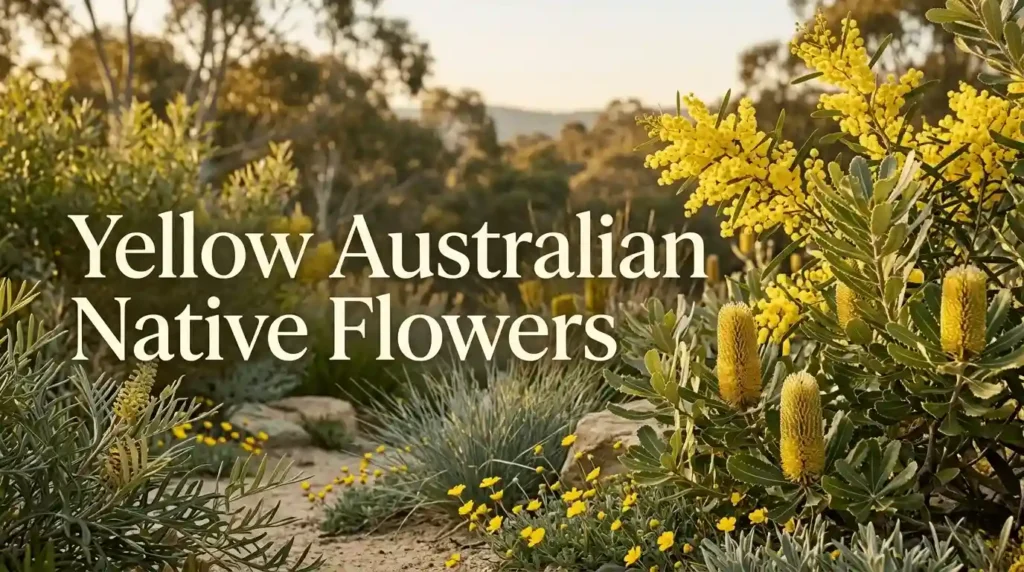
Introduction: What Are Yellow Australian Native Flowers?
Yellow Australian native flowers are native Australian plants that produce yellow blooms, including trees, shrubs, ground covers, and perennial flowering plants. These yellow flowers are valued in Australian gardens because they provide strong colour, support biodiversity, attract pollinators, and often tolerate dry conditions once established. Australian native yellow flowers include well-known groups such as wattles, banksias, hibbertias, goodenias, correas, and native sennas. Gardeners choose yellow native Australian flowers for feature planting, wildlife habitat, borders, screening, slopes, and low-maintenance landscapes. Across yellow flowers in Australia, plant form, climate suitability, soil drainage, and mature size are more important than flower colour alone.
Quick Summary
- Yellow Australian native flowers include wattles, banksias, hibbertias, goodenias, correas, and other native plants with yellow blooms.
- They can grow as trees, shrubs, ground covers, or perennial flowering plants, depending on the species.
- The best choice depends on garden size, climate, soil drainage, sun exposure, and whether the plant is for landscaping, screening, borders, or wildlife habitat.
- Identification often relies on flower shape, plant form, leaf type, bloom season, and whether the plant is a shrub, ground cover, or yellow flowering tree.
Common Types of Yellow Australian Native Flowers
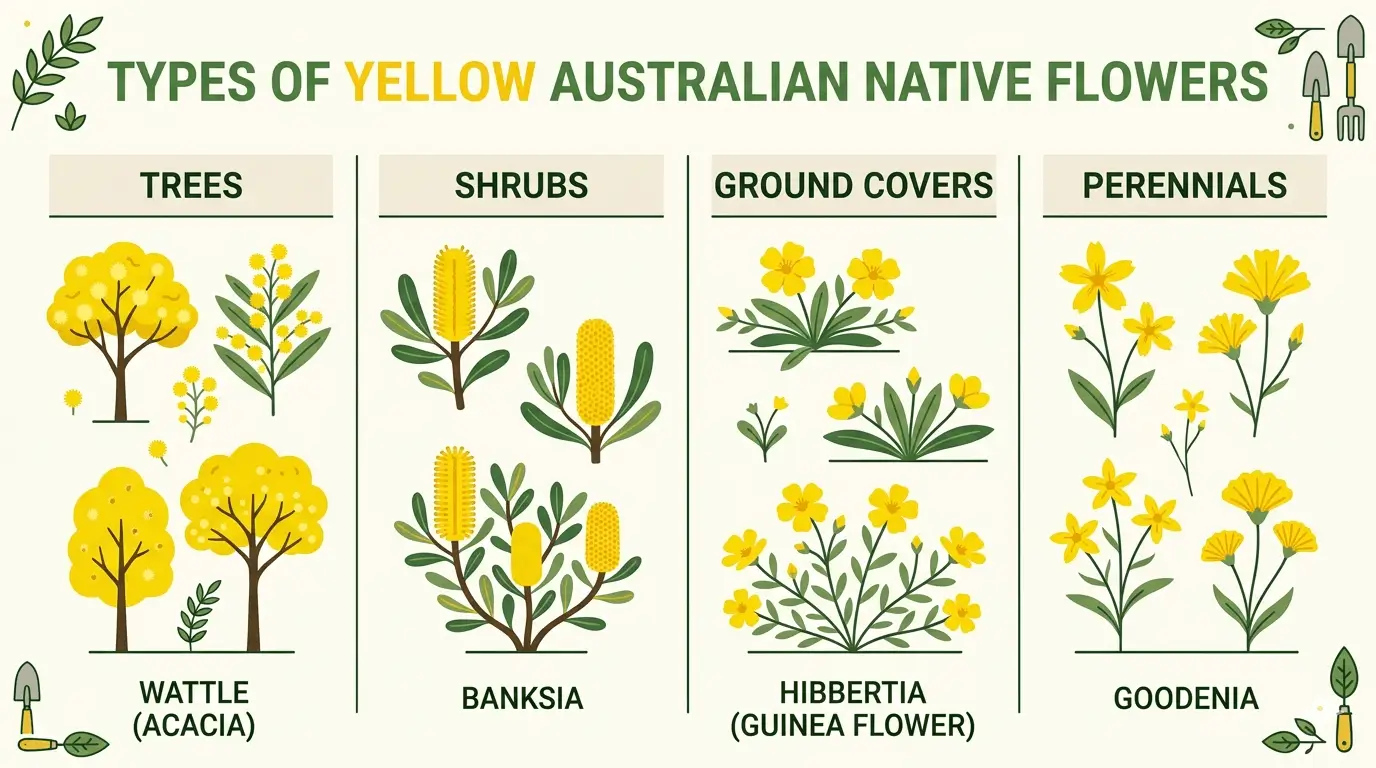
Yellow Australian native flowers occur across several plant forms, including trees, shrubs, ground covers, and perennials. The most common yellow native flowers Australia gardeners search for usually belong to groups such as Acacia, Banksia, Hibbertia, Goodenia, Correa, and Senna. For a broader colour-based overview beyond native species, see our guide to 7+ Essential Yellow Flowers in Australia: Types Guide.
Yellow blooms can appear in different flower structures. Some form rounded yellow ball flowers, while others produce spikes, clusters, bells, pea-like flowers, or open-petalled blooms. These differences help with identification and garden selection.
Common flower forms include:
- Round yellow balls or rods, often seen in wattles
- Cone-like yellow spikes, often seen in banksias
- Open yellow flowers, often seen in hibbertias
- Small fan-like or spreading yellow flowers, often seen in goodenias
- Tubular or bell-shaped flowers, sometimes seen in correas
- Bright yellow clusters, often seen in native senna-type plants
These Australian flowers yellow in colour are useful for native gardens because they add seasonal interest while supporting insects, birds, and other wildlife.
Yellow Flowering Trees
A yellow flowering tree is usually chosen for shade, habitat, street planting, or large garden structure. A native tree with yellow flowers can become a strong feature plant when it has dense bloom coverage, attractive foliage, and a suitable canopy shape.
Trees with yellow flowers Australia gardeners commonly consider include wattles and some banksia forms. An Australian native tree with yellow flowers may vary from a small feature tree to a larger canopy tree, depending on species and growing conditions.
Key factors to assess include:
- Flower colour and bloom density: Bright yellow or golden flowers can create a strong seasonal display.
- Mature height and canopy spread: Some Australian native tree yellow flowers belong to compact trees, while others need more space.
- Wildlife value: Yellow flowers on trees can attract bees, birds, and beneficial insects.
- Suitability for small vs large gardens: Small gardens need compact or prunable forms, while large gardens can support bigger trees.
- Seasonal flowering patterns: Some Australian trees with yellow flowers bloom in winter or spring, while others flower after rain or in warmer months.
An Australian yellow flower tree should be selected according to available root space, overhead clearance, climate, and long-term maintenance needs.
Yellow Flowering Shrubs
Yellow flowering shrubs Australia gardeners use are valuable for borders, hedging, wildlife gardens, informal screening, and low-maintenance planting. An Australian native shrub with yellow flowers can provide colour without needing the same space as a tree.
A yellow flower shrub Australia garden designers may choose can be compact, rounded, spreading, or upright. Australian native bush with yellow flowers is often used in informal landscapes because many native shrubs blend well with grasses, ground covers, rocks, and other indigenous plants.
Yellow flowering shrubs Australia gardens commonly use are suitable for:
- Borders and path edges
- Low hedges and informal screens
- Native cottage gardens
- Pollinator-friendly plantings
- Wildlife habitat
- Low-water landscapes
Shrubs are often easier to manage than trees because they can usually be shaped with light pruning after flowering.
Yellow Ground Covers and Low-Growing Plants
Australian native yellow flower ground cover plants are useful where gardeners need soil coverage, erosion control, and low-growing colour. Australian native ground cover yellow flowers are often used on slopes, between shrubs, beside paths, and in rockeries.
Little yellow flowers and small yellow flowers Australia gardeners notice may belong to low-growing plants such as Hibbertia or Goodenia types, depending on region and species. An Australian native plant with small yellow flowers may not dominate a garden visually, but it can provide strong seasonal detail at ground level.
Ground covers help:
- Suppress weeds by shading bare soil
- Soften hard edges near paths and paving
- Protect soil from erosion
- Fill gaps in native planting schemes
- Add colour to rockeries and slopes
They are especially useful in gardens where larger shrubs would block views or overcrowd narrow spaces.
Yellow Perennial Flowers
Perennial yellow flowers are plants that persist or return across seasons. Yellow perennial flowers in native gardens may include long-lived shrubs, herbaceous perennials, and low-growing native flowering plants that produce repeat seasonal colour.
Yellow flowering plants and yellow plants should be selected according to climate, drainage, sunlight, and mature size. Yellow flowering native plants can be low maintenance when they are matched to the right site.
Perennial natives are useful because they can:
- Provide recurring colour without annual replanting
- Support pollinators over multiple seasons
- Stabilise planting designs
- Reduce long-term garden maintenance
- Fit into mixed native borders and cottage-style gardens
The key is to choose a yellow flower that suits the local environment rather than selecting by colour alone.
Yellow Australian Native Flowers Names and Identification
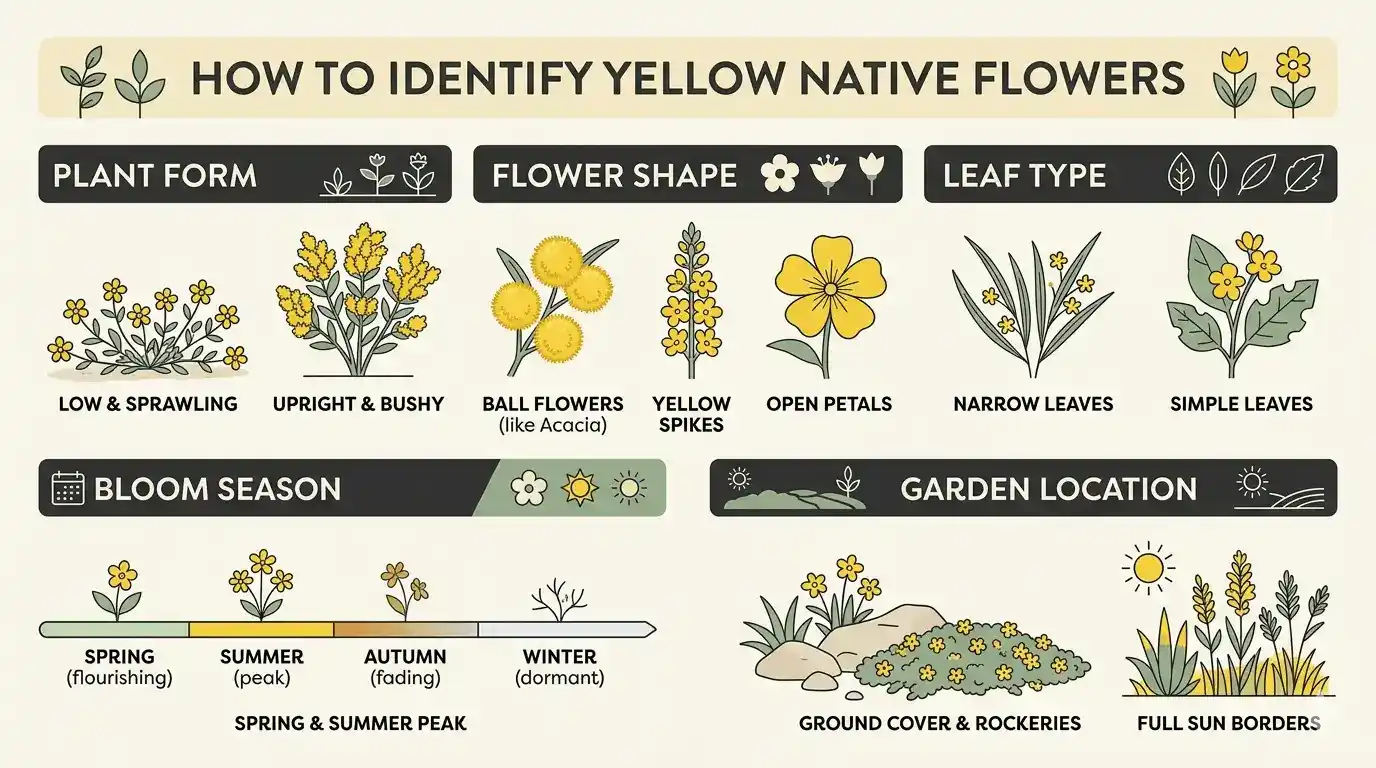
Yellow Australian native flowers names are often linked to plant groups rather than a single plant type. Common names may include wattle, banksia, guinea flower, goodenia, correa, and native senna. Botanical names are more reliable because common names can vary by region.
Tree with yellow flowers identification depends on observing the full plant, not just the bloom. Yellow flowering tree identification should consider growth habit, flower shape, leaf form, season, and location.
A yellow blossom on a tall woody plant may suggest a wattle or banksia, while small yellow flowers on a low spreading plant may suggest a native ground cover. Yellow ball flowers Australian native plants are commonly associated with Acacia species, while yellow flower spikes may suggest Banksia.
Identification Clues to Look For
Use these clues when identifying yellow native flowers:
- Is it a tree, shrub, ground cover, or perennial?
- Are the flowers ball-shaped, bottlebrush-like, pea-shaped, tubular, or open-petalled?
- Are the blooms bright yellow, golden, cream-yellow, or yellow-orange?
- Are the leaves narrow, leathery, fern-like, rounded, or silver-green?
- Does the plant flower in winter, spring, summer, or after rain?
- Are the yellow flowers on trees, low shrubs, or spreading ground covers?
- Does the plant have a single trunk, many woody stems, or a low mat-forming habit?
These details help separate yellow flowers trees from shrubs, ground covers, and perennial flowering plants.
Table: Yellow Native Flower Identification Guide
| Plant form | Flower appearance | Possible native groups | Best use | Identification clue |
| Tree | Yellow balls or clusters | Acacia / wattle types | Shade, habitat, feature tree | Often has dense seasonal yellow blossom |
| Shrub | Yellow bells, clusters, or open flowers | Correa, Hibbertia, Senna types | Borders, hedges, wildlife gardens | Compact woody form |
| Ground cover | Small yellow flowers | Goodenia, Hibbertia, Persoonia types | Slopes, rockeries, weed suppression | Low spreading habit |
| Banksia form | Yellow flower spikes | Banksia | Feature planting, bird attraction | Cone-like flower spikes |
Popular Yellow Australian Native Flowering Trees
Popular yellow Australian native flowering trees include wattles, banksias, and some senna-type native plants. These plants are commonly searched as Australian native tree with yellow flowers, Australian native tree with small yellow flowers, yellow flower Australian native tree, and yellow flowering Australian native tree.
Yellow flowering Australian trees are useful where the garden needs height, shade, wildlife value, and seasonal colour. A large tree with yellow flowers can become a major feature, but it must have enough space for canopy spread and roots.
Wattle and Acacia-Type Trees
Wattles are among the best-known Australian plants associated with yellow blooms. Many Acacia species produce yellow blossoms in balls, rods, or clusters, making them some of the most recognisable famous Australian flowers.
For botanical context, Acacia pycnantha, commonly known as golden wattle, is Australia’s official floral emblem and is native to southeastern Australia.
Wattles are also famous Australian plants because they occur widely across Australia and are strongly linked with native landscapes. Some species grow as shrubs, while others develop into small or medium trees.
Wattle-type trees are valued for:
- Bright yellow seasonal flowers
- Fast establishment in suitable conditions
- Habitat value for insects and birds
- Screening and informal shelter
- Native garden character
Some wattles are short-lived compared with slower-growing trees, but they can provide quick structure and colour in young gardens.
Banksia Trees and Shrubs with Yellow Flowers
Banksia plants are distinctive Australian native plants known for cone-like flower spikes. A banksia plant may grow as a shrub or tree depending on species, cultivar, climate, and soil conditions. Banksia Australia species are often used in coastal, sandy, and wildlife-friendly gardens. Banksia tree Australia forms can provide structure and bird habitat, while banksia bushes and banksia shrubs are useful in smaller landscapes. To compare different banksia forms, flower colours, and care needs, read our 7+ Essential Banksia Varieties: Types, Colors & Care Guide.
Banksias flower in colours including yellow, gold, orange, cream, and red, depending on species. Banksias flower spikes are visually distinct and often attract nectar-feeding birds.
Banksia plants are especially useful for:
- Feature planting
- Coastal gardens
- Bird-attracting landscapes
- Sandy or well-drained soils
- Structural native planting
Many banksias prefer excellent drainage and low-phosphorus fertiliser, especially phosphorus-sensitive types.
Table: Yellow Flowering Trees in Australia
| Type | Typical form | Flower feature | Garden role | Best for |
| Wattle / Acacia | Shrub to tree | Yellow balls or rods | Fast colour, habitat, screening | Native gardens and feature planting |
| Banksia | Shrub to tree | Yellow to golden spikes | Bird-attracting feature plant | Coastal and wildlife gardens |
| Senna-type natives | Shrub to small tree | Yellow clusters | Warm-climate colour | Tropical or subtropical gardens |
Yellow Native Shrubs for Australian Gardens
Yellow native shrubs for Australian gardens are practical plants for structure, colour, and habitat. A shrub with yellow flowers Australia gardeners choose may be used in borders, low hedges, mass planting, wildlife gardens, or small-space screening.
Shrubs with yellow flowers Australia landscapes commonly use should be selected for mature width, drainage tolerance, pruning response, and sun exposure. Yellow flowering shrubs Australia gardens often perform best in full sun to part shade, depending on the species.
Good shrub selection depends on:
- Soil drainage
- Climate suitability
- Mature height and width
- Flowering season
- Pruning tolerance
- Wildlife value
- Water needs after establishment
Many native shrubs prefer light pruning after flowering rather than heavy cutting into old wood.
Best Uses for Yellow Flowering Native Shrubs
Yellow flowering native shrubs are best used where the garden needs colour, structure, and moderate height without the scale of a tree.
Common uses include:
- Informal hedges
- Habitat gardens
- Borders and mass planting
- Screening in small spaces
- Low-water native landscapes
They are also useful for layered planting, where trees provide height, shrubs provide middle structure, and ground covers protect soil.
Shrubs vs Trees with Yellow Flowers
| Feature | Yellow native shrubs | Yellow native trees |
| Space needed | Small to medium gardens | Medium to large gardens |
| Main purpose | Borders, hedging, habitat | Shade, structure, feature planting |
| Maintenance | Usually easier to prune | May require more space planning |
| Identification | Woody multi-stem form | Single trunk or canopy structure |
Shrubs are usually better for compact gardens, while trees are better for shade, height, and long-term structure.
Yellow Native Ground Covers and Small Flowering Plants
Yellow native ground covers and small flowering plants are useful where gardeners need low growth, weed suppression, and seasonal colour. Australian native ground cover yellow flowers can fit into rockeries, banks, slopes, path edges, and native cottage gardens.
Small yellow flowers Australia gardeners see in native plantings may appear on compact shrubs, mat-forming plants, or spreading ground covers. An Australian native plant with small yellow flowers can still have strong ecological value, especially for small pollinators.
An Australian native plant with yellow flowers should be selected according to growth habit. Low spreading plants are better for soil coverage, while small shrubs are better for borders and structure. If you are planning a low-growing native planting scheme, our Australian Violet Ground Cover: Care, Growth & Uses Guide can help you compare spreading native ground cover options.
When to Choose Ground Covers
Choose ground covers when the garden needs low, spreading growth rather than height.
Best situations include:
- Slopes and erosion-prone areas
- Rockeries and native cottage gardens
- Gaps between shrubs
- Path edges
- Low-maintenance planting zones
Ground covers are also useful under open shrubs, provided they receive enough light and are not smothered by leaf litter.
Ground Covers vs Small Shrubs
| Feature | Ground cover | Small shrub |
| Growth habit | Spreading and low | Upright or rounded |
| Best use | Soil coverage and weed suppression | Borders and structure |
| Flower visibility | Close to ground | More visible at eye level |
| Maintenance | May need edge control | May need pruning |
Ground covers solve soil coverage problems, while small shrubs provide visible form and garden structure.
Plant Size: How Big Do Yellow Australian Native Flowers Grow?
Yellow Australian native flowers can grow from low ground covers to large trees. Size depends on species, climate, soil, water, pruning, and available root space. Yellow flowering plants Australia gardens use should always be matched to the space available at maturity.
Some yellow flowering plants stay compact, while wattles and banksias may vary widely by species. A plant that looks small in a nursery pot may become a large shrub or tree in the ground.
Typical Mature Height and Width
Typical size varies by plant form:
- Ground covers may stay low but spread widely.
- Small shrubs suit compact gardens and borders.
- Large shrubs and trees need more space for roots and canopy.
- Banksias and wattles vary widely by species and growing conditions.
Gardeners should check mature height and width before planting. This prevents overcrowding, blocked paths, excessive pruning, and root competition.
Indoor vs Outdoor Size Differences
Most Australian native yellow flowers perform best outdoors because they need strong light, airflow, and natural seasonal conditions. Some smaller native plants may grow in containers if the pot has excellent drainage, enough root space, and suitable sun exposure.
Indoor growing is usually less ideal because low light and poor airflow can reduce flowering and increase stress. Container growing outdoors is more practical for compact shrubs and ground covers.
Environmental Factors Affecting Plant Size
Plant size is influenced by:
- Sun exposure
- Soil drainage
- Rainfall and irrigation
- Pruning
- Climate zone
- Root space
Plants in deep, well-drained soil with adequate sun usually grow larger and flower better than plants in compacted soil, deep shade, or small containers.
Growth Rate of Yellow Australian Native Flowering Plants
The growth rate of yellow Australian native flowering plants may be slow, moderate, or fast. Yellow flowering native plants, yellow plants, and yellow perennial flowers do not all grow at the same speed.
Growth depends on plant group, temperature, soil quality, moisture, root establishment, and seasonal timing. A fast-growing wattle may establish quickly, while some banksias may take longer to settle before strong flowering begins.
Slow, Moderate, and Fast Growers
Growth patterns differ across plant types:
- Some wattles grow quickly and flower early.
- Some banksias may establish more slowly.
- Ground covers may spread steadily once established.
- Growth rate depends heavily on soil, water, sun, and climate.
Fast growth is not always better. Slower plants may live longer, need less pruning, or provide stronger long-term structure.
Seasonal Growth and Flowering Patterns
Seasonal growth and flowering patterns vary by species. Some yellow blossom displays occur in winter or spring, while other yellow flower Australia species may bloom after rain or during warmer months.
Flowering can be affected by:
- Day length
- Rainfall
- Temperature
- Plant maturity
- Pruning time
- Sun exposure
A healthy plant may still not flower heavily every season if weather conditions are unsuitable or if it was pruned at the wrong time.
Care Guide for Yellow Australian Native Flowers
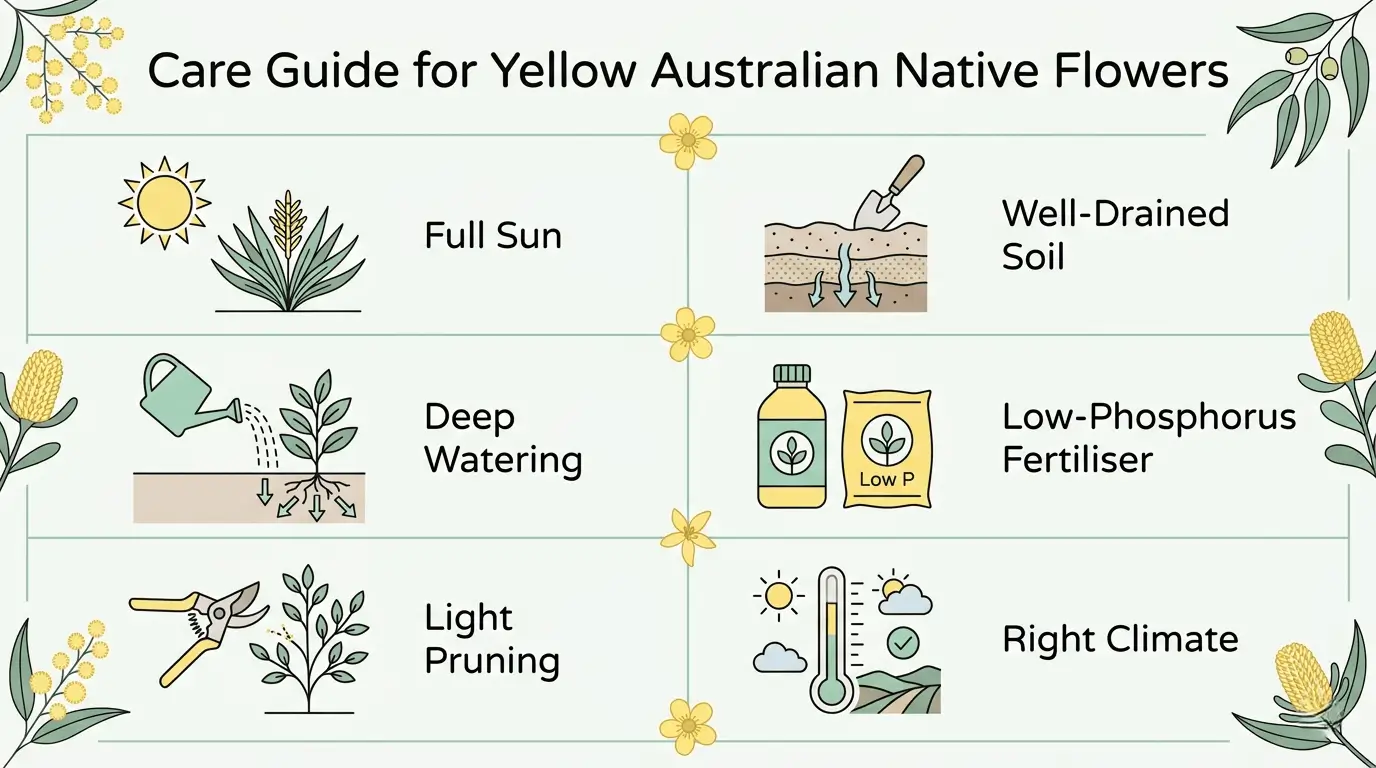
Yellow Australian native flowers are often low-maintenance once established, but they still need correct care. Australian native plants yellow flowers generally perform best when planted in the right site with suitable drainage, light, and climate.
For broader plant care, growing tips, and garden benefits, explore our pillar guide: Plants: Benefits and Guides.
Yellow flower plants Australia gardeners grow should not be treated as identical. Yellow flowering plants Australia landscapes include wattles, banksias, shrubs, ground covers, and perennials, each with different care needs.
Watering Needs
Yellow Australian native flowers need regular watering during establishment. After roots develop, many become more drought tolerant, especially when planted in suitable soil.
A practical approach is to water deeply but less often rather than shallowly every day. Overwatering is a common mistake, especially in clay soil or poorly drained pots.
Watering guidance:
- Water new plants regularly during the first growing season.
- Reduce watering once plants establish.
- Check soil moisture before watering again.
- Avoid constantly wet soil around roots.
- Use mulch lightly, keeping it away from the stem.
Too much water can cause root stress, yellow leaves, fungal problems, and poor flowering.
Light Requirements
Most yellow Australian native flowers flower best in full sun or bright part shade. Low light can reduce flower production, create weak growth, and make shrubs open or sparse.
Some plants tolerate part shade, especially in hot climates, but deep shade usually limits flowering. A sunny position is often best for wattles, many banksias, hibbertias, goodenias, and other yellow flowering native plants.
Soil Preferences
Well-draining soil is one of the most important requirements for many Australian native plants. Sandy soils are often suitable for species adapted to free-draining conditions, while heavy clay may need improvement.
Clay soil can be improved by:
- Planting on raised mounds
- Using raised beds
- Adding coarse mineral material where appropriate
- Avoiding waterlogged planting holes
- Selecting clay-tolerant species
Good drainage helps prevent root rot and supports healthier flowering.
Fertilisation Practices
Many Australian natives prefer low-phosphorus fertilisers, especially phosphorus-sensitive species such as some banksias and related plants. Standard high-phosphorus fertilisers can damage sensitive natives.
Use fertilisers labelled for Australian native plants when feeding is needed. Overfeeding can cause weak growth, fewer flowers, or nutrient imbalance.
A light feeding schedule is usually better than heavy fertilisation.
Pruning Considerations
Light pruning after flowering helps shape shrubs, remove spent flowers, and encourage bushier growth. Dead, damaged, or crossing branches can be removed when needed.
Pruning should be matched to plant type. Some natives reshoot well after trimming, while others do not respond well to harsh pruning into old wood. Banksias, wattles, and smaller shrubs may need different pruning approaches.
Good pruning practices include:
- Prune lightly after flowering.
- Avoid removing too much foliage at once.
- Use clean, sharp tools.
- Remove dead growth promptly.
- Research species-specific pruning tolerance.
Climate Tolerance
Climate tolerance is essential when choosing yellow Australian native flowers. A plant suited to coastal sand may not thrive in inland frost, and a tropical species may struggle in cold temperate regions.
Consider:
- Local rainfall
- Frost risk
- Heat exposure
- Coastal wind and salt
- Humidity
- Drought periods
- Soil type
Matching plants to local climate reduces maintenance and improves flowering reliability.
Common Problems with Yellow Australian Native Flowers
Common problems with yellow Australian native flowers usually come from poor drainage, incorrect watering, unsuitable light, nutrient imbalance, or planting the wrong species for the site. Most problems can be prevented by choosing climate-suitable plants and preparing soil properly.
Problem-solving should start with the growing conditions before assuming the plant has a pest or disease.
Yellow Leaves or Poor Flowering
Yellow leaves or poor flowering usually happen because of too much water, poor drainage, low light, nutrient imbalance, or unsuitable soil. The first step is to check whether the plant receives enough sun and whether the soil stays wet for too long after watering or rain.
To fix the problem:
- Improve drainage if soil is compacted or waterlogged.
- Adjust watering frequency.
- Move container plants into brighter light.
- Use native-suitable fertiliser if feeding is needed.
- Avoid high-phosphorus products on sensitive plants.
Prevention starts with choosing a species suited to the site before planting.
Overwatering and Root Rot
Overwatering and root rot happen when roots remain wet for too long. This can be caused by compacted soil, heavy clay, frequent watering, or pots without drainage holes.
Signs may include wilting despite wet soil, yellowing leaves, dieback, and poor growth.
To fix it:
- Reduce watering.
- Improve drainage.
- Repot container plants if needed.
- Remove badly affected plants if roots are severely damaged.
Prevention includes planting in raised beds, free-draining soil, or containers with excellent drainage.
Slow Growth After Planting
Slow growth after planting is often caused by transplant shock, cold weather, poor root establishment, or an unsuitable location. Newly planted natives may spend time developing roots before producing visible top growth.
To support recovery:
- Water deeply but less often.
- Mulch lightly without covering the stem.
- Avoid overfeeding.
- Protect young plants from extreme heat or frost where possible.
- Allow time for root establishment.
Prevention includes planting during suitable seasons and preparing the soil before planting.
Pest and Disease Issues
Pest and disease problems are more likely when plants are stressed by poor growing conditions. Scale insects, caterpillars, fungal issues, and dieback symptoms can occur in some native plantings.
Basic monitoring helps detect problems early. Check leaves, stems, flower buds, and new growth regularly. Improving light, airflow, drainage, and watering practices often reduces plant stress and vulnerability.
Beginner Mistakes When Choosing Yellow Australian Native Flowers
Beginner mistakes usually happen when gardeners choose yellow Australian native flowers by appearance only. A plant with attractive yellow blooms may still fail if it is too large, planted in the wrong soil, or unsuited to the local climate.
Successful native planting depends on matching plant form, mature size, drainage, sunlight, and maintenance level.
Mistake 1: Choosing by Flower Colour Only
Choosing by flower colour only can lead to poor plant performance. Mature size, growth habit, soil type, and climate matter more than colour.
A bright yellow flower may look ideal in a nursery, but the plant may become too large, need more sun, or require better drainage than the garden provides.
Mistake 2: Planting a Tree Where a Shrub Is Needed
Planting a tree where a shrub is needed creates long-term space problems. A tree with yellow flowers Australia gardeners buy as a small plant may later become too tall or wide for a narrow bed.
A yellow flower tree or yellow flowering tree Australia garden may be suitable for shade and structure, but not for small borders, tight courtyards, or spaces near buildings.
Mistake 3: Ignoring Soil Drainage
Ignoring soil drainage is one of the most common causes of failure. Poor drainage can damage roots even in hardy native plants.
Heavy clay, compacted soil, and constantly wet pots can lead to root rot, yellow leaves, and dieback. Raised beds, mounded planting, and species selection can reduce this risk.
Mistake 4: Assuming All Native Plants Need the Same Care
Not all native plants need the same care. Banksias, wattles, shrubs, and ground covers may differ in fertiliser sensitivity, pruning tolerance, water needs, and soil preferences.
A care method that works for one Australian native plant may harm another. Species-specific care is especially important for phosphorus-sensitive plants and plants adapted to dry, free-draining soil.
Comparison: Yellow Australian Native Flowers vs Other Australian Native Flowers
Yellow Australian native flowers create a bright, warm, high-visibility effect in gardens. Compared with other Australian native flowers, they are especially useful for feature planting, native cottage gardens, wildlife gardens, and contrast against grey-green foliage.
An Australian flower may be chosen for colour, habitat value, bloom shape, or design effect. Famous Australian flowers and famous Australian plants include many colours, but yellow flowers are especially associated with wattles and bright seasonal displays.
Yellow Native Flowers vs Red Native Flowers
Yellow native flowers create warmth, visibility, and a cheerful garden effect, while red flowers usually create a bolder and more dramatic focal point. Yellow blooms often stand out strongly against green or grey foliage, while red blooms are commonly used in bird-attracting gardens.
Both colours can support pollinators and wildlife, depending on flower shape, nectar availability, and local fauna. Yellow flowers are often used for brightness and mass effect, while red flowers are often used for strong contrast and bird-focused planting.
Yellow Native Flowers vs White or Cream Native Flowers
Yellow flowers create warmth and high visibility, while white or cream flowers create a softer, more neutral effect. White and cream blooms are useful for contrast planting, formal borders, and evening visibility.
Yellow flowers combine well with silver foliage, green foliage, red flowers, and orange tones. White or cream flowers are often used to soften bright planting schemes.
Table: Native Flower Colour Comparison
| Flower colour | Visual effect | Common garden use | Best paired with |
| Yellow | Bright, warm, high visibility | Feature planting, native cottage gardens, wildlife gardens | Green foliage, grey foliage, red flowers |
| Red | Bold and dramatic | Bird-attracting gardens, focal points | Yellow and orange tones |
| White / cream | Soft and neutral | Moon gardens, formal borders, contrast planting | Yellow, blue, and silver foliage |
Seasonal and Environmental Considerations
Seasonal and environmental conditions strongly affect flowering, growth, and long-term plant health. Heat, drought, frost, coastal exposure, soil drainage, and rainfall patterns should guide plant selection.
A yellow native flower that thrives in one region may struggle in another. Local climate suitability is often the difference between a low-maintenance plant and a plant that needs constant correction.
Best Conditions for Strong Flowering
Strong flowering usually depends on:
- Adequate sunlight
- Correct soil drainage
- Climate-suitable species
- Avoiding excessive fertiliser
- Pruning at the right time
Many yellow Australian native flowers flower best when they receive enough sun and are not overwatered. Excessive fertiliser, especially unsuitable fertiliser, can encourage leaf growth instead of flowers.
Regional Suitability Across Australia
Plant choice differs across coastal, inland, tropical, temperate, arid, and frost-prone regions. Coastal gardens may need plants tolerant of wind, salt, and sandy soil. Inland gardens may need drought and heat tolerance. Frost-prone areas need species that can withstand cold conditions.
Tropical and subtropical areas may suit different yellow flowering shrubs and small trees than cool temperate regions. Gardeners should choose plants known to perform in their local area or similar climate zones.
How to Choose the Right Yellow Australian Native Flower for Your Garden
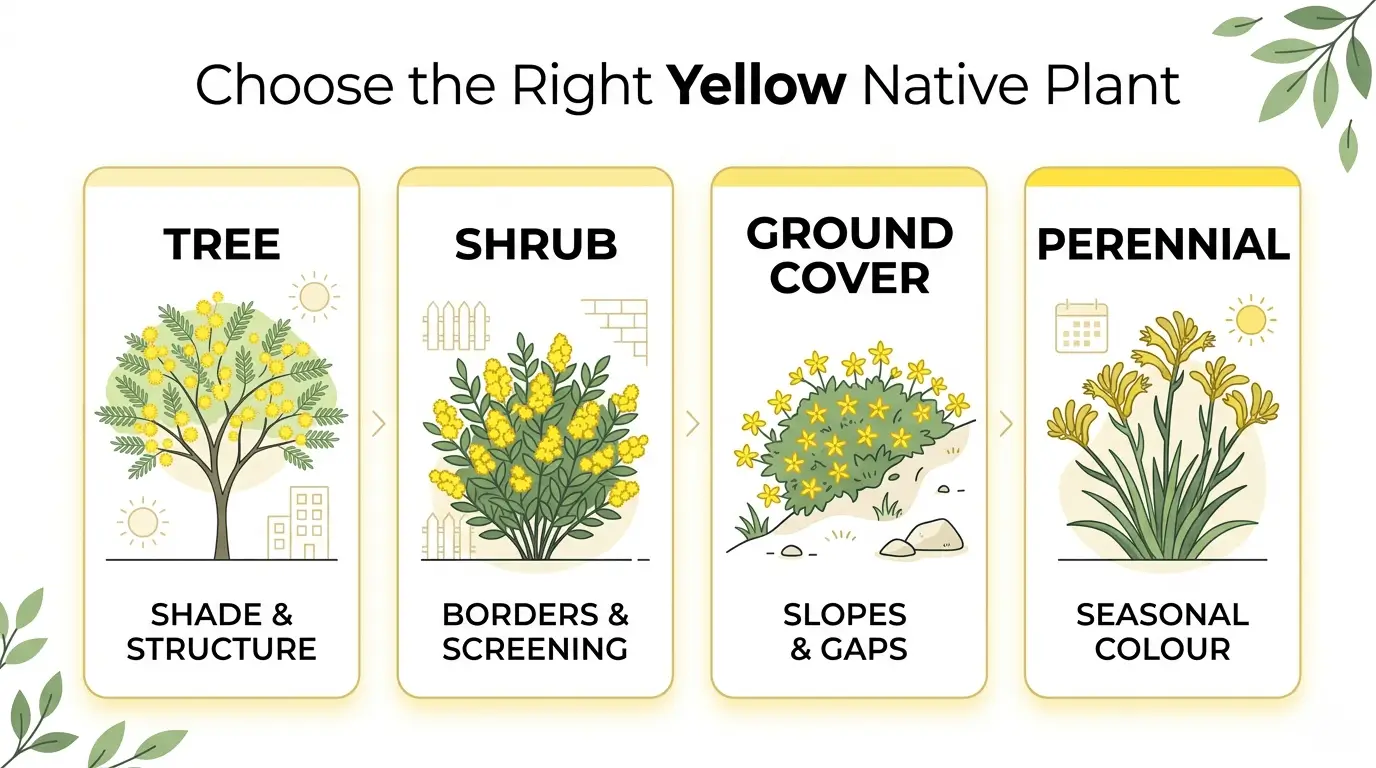
Choosing the right yellow Australian native flower means matching the plant to the site, not just selecting the brightest bloom. Australian yellow flowers vary widely in size, form, growth rate, and care needs.
A yellow native flower Australia garden can use may be a tree, shrub, ground cover, or perennial. Yellow native flowers Australia gardeners choose should fit the garden’s function, maintenance level, and environmental conditions.
Choose by Plant Form
Choose plant form according to the role the plant needs to perform.
- Tree for shade and structure
- Shrub for borders and screening
- Ground cover for slopes and gaps
- Perennial for recurring seasonal colour
This helps prevent planting a large tree where a compact shrub or ground cover would work better.
Choose by Garden Function
Yellow native flowers can serve many garden functions.
Common functions include:
- Pollinator support
- Bird habitat
- Low-maintenance landscaping
- Screening
- Cottage-style planting
- Coastal resilience
- Erosion control
A plant chosen for screening should have dense foliage and suitable height. A plant chosen for erosion control should have spreading growth and strong soil coverage.
Choose by Maintenance Level
Maintenance level depends on watering, pruning, soil preparation, and mature size. Low-maintenance plants still need the right site, especially during establishment.
Before planting, consider:
- How often the plant will need pruning
- Whether it needs special fertiliser
- Whether the soil drains well
- How large it will become
- Whether it can tolerate local heat, frost, or coastal exposure
The easiest plant is usually the one naturally suited to the site.
Conclusion: Why Yellow Australian Native Flowers Are Valuable in Australian Gardens
Yellow Australian native flowers are valuable because they provide bright colour, biodiversity benefits, wildlife habitat, and flexible design options across trees, shrubs, ground covers, and perennials. They can support bees, birds, butterflies, and other beneficial wildlife while adding strong seasonal interest to Australian gardens.
The best yellow Australian native flowers are not chosen by flower colour alone. Plant form, mature size, local climate, soil drainage, sunlight, and care needs all determine long-term success. A yellow flowering tree may suit a large garden, while a shrub, ground cover, or perennial may be better for smaller spaces.
The clear takeaway is to choose the right yellow native plant for the site, not just the flower colour.
FAQ: Yellow Australian Native Flowers
What are the most common yellow Australian native flowers?
The most common yellow Australian native flowers include wattles, banksias, hibbertias, goodenias, correas, and native senna-type plants. These may grow as trees, shrubs, ground covers, or perennial plants, depending on the species and growing conditions.
What Australian native tree has yellow flowers?
Several Australian native trees and large shrubs have yellow flowers, including many wattle species and some banksia types. Identification depends on flower shape and plant form. Yellow ball-shaped flowers often suggest Acacia, while yellow cone-like spikes may suggest Banksia.
What Australian native plant has small yellow flowers?
Australian native plants with small yellow flowers may include low-growing Goodenia or Hibbertia types, depending on region and availability. Some compact shrubs and ground covers also produce small yellow blooms suitable for rockeries, slopes, path edges, and native cottage gardens.
Are yellow Australian native flowers good for pollinators?
Yes, many yellow Australian native flowers are good for pollinators. Depending on flower shape and nectar availability, they can support bees, butterflies, birds, and other beneficial wildlife. Dense native plantings usually provide better habitat than isolated plants.
Are yellow native flowers easy to grow?
Many yellow native flowers are easy to grow once established, but success depends on soil drainage, sunlight, climate suitability, and correct watering. Overwatering, poor drainage, low light, and unsuitable fertiliser are common reasons for poor performance.
What is the difference between a yellow flowering shrub and a yellow flowering tree?
A yellow flowering shrub is usually shorter, multi-stemmed, and used for borders, hedging, or screening. A yellow flowering tree usually has a stronger trunk or canopy structure and is used for shade, height, habitat, or feature planting in larger spaces.
Can yellow Australian native flowers grow in pots?
Yes, some compact yellow Australian native flowers can grow in pots if the container has excellent drainage, enough sunlight, suitable pot size, and good airflow. Compact shrubs and ground covers are usually better container choices than large trees.
Why is my yellow native plant not flowering?
A yellow native plant may not flower because of low sunlight, overwatering, poor drainage, wrong pruning time, immaturity, nutrient imbalance, or unsuitable climate. Improving light, adjusting watering, using native-suitable fertiliser, and pruning after flowering can help improve bloom performance.