
Introduction
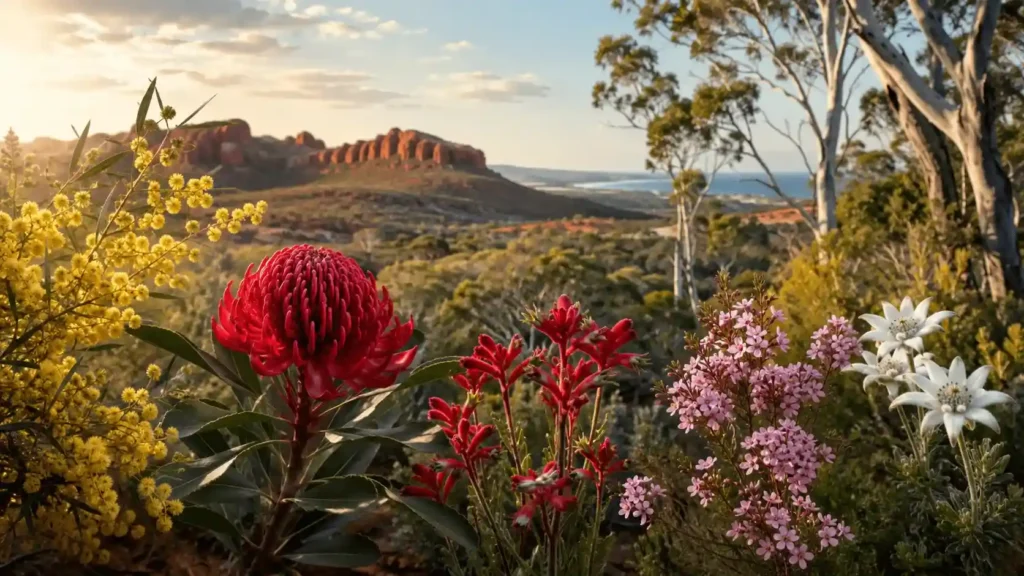
Australian flower names reflect one of the most botanically diverse ecosystems in the world. Australia is home to thousands of native flowering species that evolved in isolation across deserts, rainforests, coastal regions, and alpine habitats. Many Australian native flowers have names linked to Indigenous languages, scientific Latin taxonomy, or descriptive English terms based on appearance and habitat. Unlike many European garden flowers, Australian species are often drought-adapted, uniquely shaped, and closely tied to native wildlife pollination. This guide explores Australian flower names through alphabetical lists, color categories, bush flowers, baby names inspired by native flora, and the national flower of Australia in a structured and easy-to-reference format.
Quick Summary
- Australia is home to more than 24,000 plant species, including many globally unique flowering plants.
- The national flower of Australia is the Golden Wattle (Acacia pycnantha), officially recognized in 1988.
- Australian native flower names include colorful pink, red, white, and yellow flowering species.
- Many Australian flower names are also used as girls’ names and botanical-inspired baby names.
- Native flower names often originate from Indigenous language, habitat descriptions, or scientific taxonomy.
What Are Australian Flower Names? An Overview of Native Flora
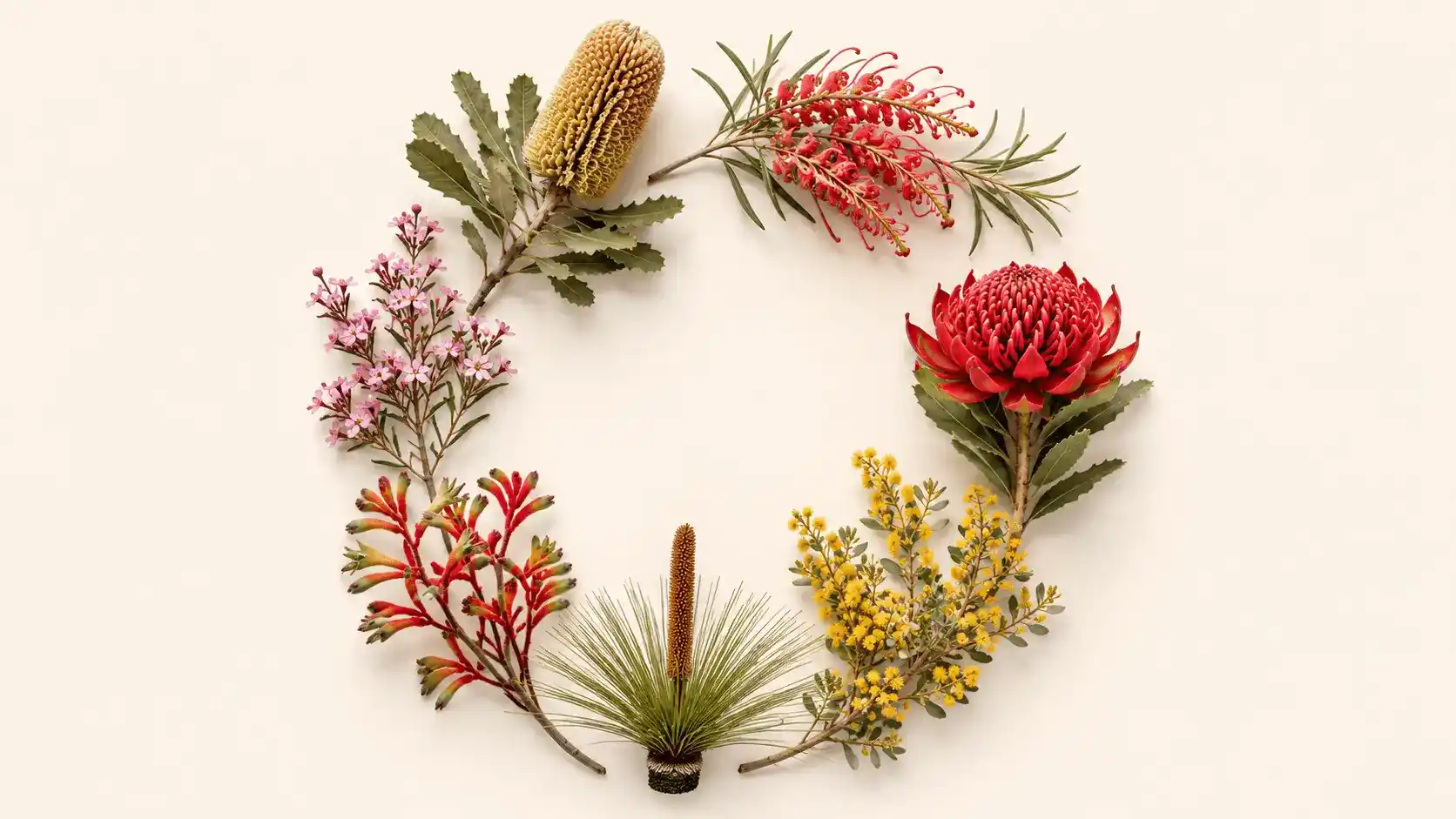
Australian flower names refer to the common and scientific names used to identify native flowering plants found across Australia. These names may describe a flower’s appearance, habitat, texture, color, or cultural significance. Some names come from Indigenous Australian languages, while others follow formal botanical naming systems.
Native Australian flowers are species that evolved naturally within Australia before European settlement. Introduced flowers, by contrast, were brought from overseas for gardening or agriculture. Examples of native Australian flowers include Waratah, Wattle, Kangaroo Paw, and Grevillea.
Many flower names unique to Australia describe animal-like shapes, environmental adaptations, or local geography. For example, Kangaroo Paw refers to the paw-shaped flower structure, while Bottlebrush describes flowers that resemble cleaning brushes.
Why Australian Native Plant Names Are Botanically Unique
Australian flora evolved separately from most other continents for millions of years. As a result, Australia contains plant genera found nowhere else on Earth.
Examples include:
- Banksia — named after botanist Sir Joseph Banks
- Waratah — derived from the Eora Aboriginal language
- Grevillea — named after horticulturist Charles Greville
- Xanthorrhoea — known for its grass-tree form
Many native Australian plant names have both scientific and common forms. For example:
- Scientific name: Telopea speciosissima
- Common name: Waratah
This dual naming system helps scientists classify plants accurately while allowing everyday identification through common bush names.
What Makes Australian Flower Names Different From Other Countries?
Australian flower names often differ from European flower naming traditions because many names are inspired by local wildlife, Indigenous culture, and landscape conditions.
Examples include:
- Kangaroo Paw — named for its paw-like flowers
- Waratah — from Indigenous language origins
- Bottlebrush — named after its cylindrical flower spikes
- Flannel Flower — named for its soft-textured petals
In many cases, Australian flower names directly describe physical characteristics or environmental traits rather than ornamental qualities alone.
The National Flower of Australia
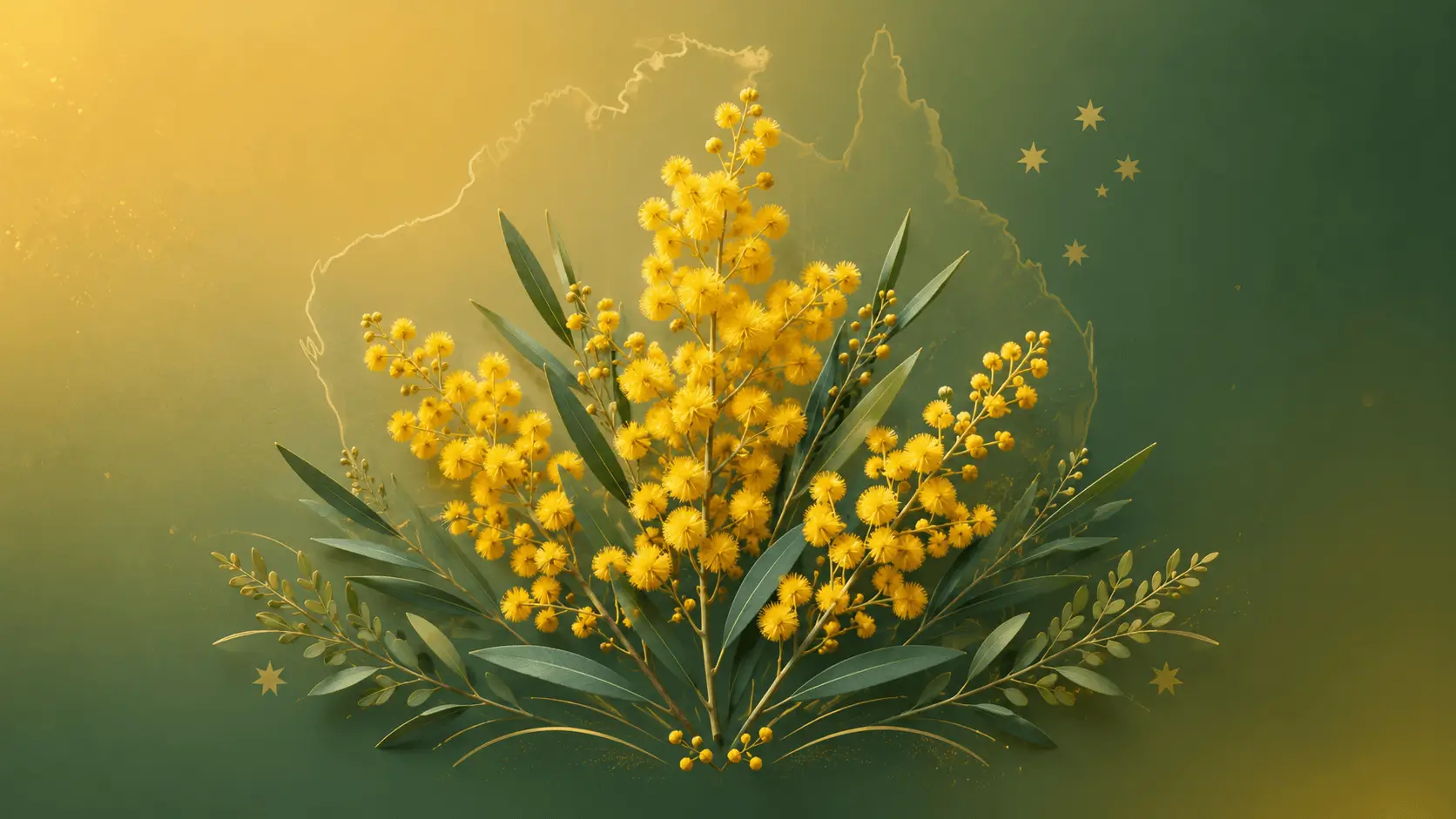
The national flower of Australia is the Golden Wattle (Acacia pycnantha). It was officially proclaimed as Australia’s national floral emblem in 1988. The Golden Wattle was chosen because it is native to Australia, widely distributed across southeastern regions, and recognized for its bright golden-yellow flowers and resilience in harsh climates. The Golden Wattle (Acacia pycnantha) is also scientifically documented as Australia’s floral emblem.
Australia’s national flower blooms primarily in late winter and early spring, producing clusters of fluffy golden flowers and grey-green foliage known as phyllodes.
What Does the National Flower of Australia Symbolize?
The Golden Wattle symbolizes unity, resilience, and the natural identity of Australia.
Key symbolism includes:
- Gold and green colors representing Australia’s national sporting colors
- Appearance on the Australian Coat of Arms
- Celebration during National Wattle Day on September 1
- Ecological importance as a nitrogen-fixing native species
The flower also represents adaptation and survival in Australia’s dry environmental conditions.
Are There Other Flowers Considered Nationally or Regionally Significant?
Australia also recognizes state and territory floral emblems.
- New South Wales — Waratah
- Queensland — Cooktown Orchid
- South Australia — Sturt’s Desert Pea
- Western Australia — Red and Green Kangaroo Paw
- Tasmania — Tasmanian Blue Gum
- Victoria — Common Heath
| State/Territory | Floral Emblem | Common Name | Color |
| New South Wales | Telopea speciosissima | Waratah | Red |
| Queensland | Dendrobium phalaenopsis | Cooktown Orchid | Purple |
| South Australia | Swainsona formosa | Sturt’s Desert Pea | Red |
| Western Australia | Anigozanthos manglesii | Red and Green Kangaroo Paw | Red/Green |
| Victoria | Epacris impressa | Common Heath | Pink |
| Tasmania | Eucalyptus globulus | Tasmanian Blue Gum | White |
Alphabetical List of Australian Native Flowers
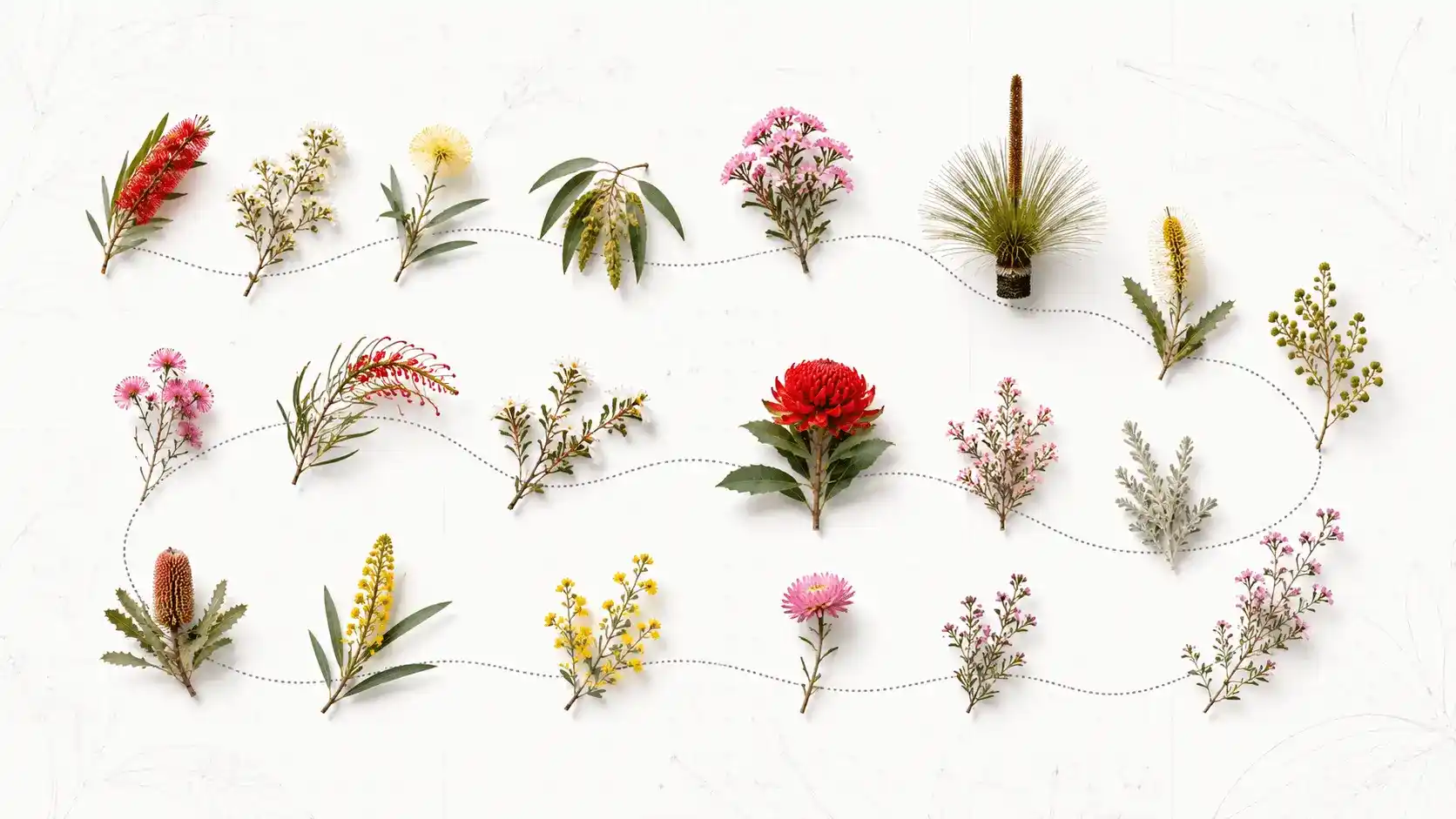
An alphabetical list of Australian native flowers helps with flower identification, gardening research, educational study, and botanical naming. Many users search for flowers by starting letter when researching native flora or choosing plant names.
| Letter | Common Name | Scientific Name | Color | Habitat |
| C | Callistemon | Callistemon citrinus | Red | Woodland |
| P | Pimelea | Pimelea ferruginea | Pink | Coastal |
| R | Rhodanthe | Rhodanthe chlorocephala | Pink/White | Arid |
| V | Verticordia | Verticordia grandis | Red | Western Australia |
| W | Waratah | Telopea speciosissima | Red | Forest |
| X | Xerochrysum | Xerochrysum bracteatum | Yellow | Grassland |
Flowers Starting with C — Australian Native Examples
- Callistemon (Bottlebrush) — Bright red cylindrical flowers that attract birds and pollinators.
- Correa (Australian Fuchsia) — Bell-shaped flowers found in coastal and woodland habitats.
- Crowea — Star-shaped pink flowers commonly grown in native gardens.
- Clematis — Native climbing vine with soft white blooms.
- Conostylis — Western Australian wildflower with yellow or orange fuzzy flowers.
Flowers Starting with P — Australian Native Examples
- Prostanthera (Mint Bush) — Fragrant purple or white flowering shrub.
- Pimelea (Rice Flower) — Dense clusters of pink or white flowers.
- Ptilotus (Mulla Mulla) — Feathery pink flower spikes adapted to arid conditions.
- Patersonia (Purple Flag) — Iris-like purple flowers.
- Pandorea — Native climbing plant with trumpet-shaped blooms.
Flowers That Start with R — Australian Native Species
- Rhodanthe — Paper-like everlasting daisies found in dry regions.
- Restio — Grass-like flowering wetland plant.
- Ricinocarpos (Wedding Bush) — White flowering shrub commonly used in floral arrangements.
Australian Native Flowers Starting with W
- Waratah — Large crimson flower and floral emblem of New South Wales.
- Wattle — Acacia species with golden puffball flowers.
- Westringia — Coastal shrub with small pale flowers.
- Wurmbea — Delicate native lily-like flower.
Plants Starting with V — Australian Native Examples
- Verticordia (Featherflower) — Fringed flowers native to Western Australia.
- Viola hederacea (Native Violet) — Small purple-and-white groundcover flower.
- Velleia — Yellow flowering herbaceous native plant.
Plants Starting with X — Rare Australian Native Examples
- Xanthorrhoea (Grass Tree) — Flowering grass tree with tall spear-like spikes.
- Xerochrysum bracteatum (Golden Everlasting) — Bright everlasting daisy known for papery petals.
Pink Australian Flowers — Names, Types, and Native Species
Pink Australian flowers are among the most recognizable native blooms in Australia. Many pink native flowers thrive in dry soils, sandy coastal environments, and Mediterranean climates.
Pink Flower Australian Native Species — The Most Recognized Varieties
- Pink Everlasting Daisy (Rhodanthe chlorocephala) — Arid-region wildflower with papery petals.
- Pink Boronia (Boronia serrulata) — Fragrant flowering shrub native to eastern Australia.
- Pink Flannel Flower (Actinotus forsythii) — Soft-textured pink blooms in sandstone habitats.
- Native Frangipani (Hymenosporum flavum) — Cream-to-pink blush flowers with fragrance.
- Pink Rice Flower (Pimelea ferruginea) — Compact shrub with clustered pink blooms.
Pink Flowers Names — A List of Australian Pink Native Blooms
- Geraldton Wax — Long-lasting pink flowers popular in floral arrangements.
- Pink Grevillea varieties — Nectar-rich flowers attracting birds.
- Leptospermum (Tea Tree) — Small pink blossoms in coastal environments.
- Crowea exalata — Star-shaped pink flowers with long blooming periods.
- Thryptomene — Fine-textured shrub covered in tiny pink flowers.
Pink Native Flowers Australia — Wildflowers vs. Garden Cultivars
Wild pink native flowers naturally occur in bushland and arid habitats, while cultivars are selectively bred for home gardens.
Comparison highlights:
- Wildflowers are often more drought-tolerant.
- Garden cultivars usually bloom longer.
- Some native pink species are endangered in natural habitats.
- Geraldton Wax and Crowea are among the easiest pink native flowers to grow domestically.
Many of these pink native species are also widely featured in structured native planting designs such as Australian Crowea Guide: 8+ Essential Care Tips and Correa Glabra Ivory Lantern: 7+ Essential Care Tips, which are commonly used in low-maintenance Australian native gardens.
| Flower Name | Scientific Name | Natural Region | Bloom Season | Garden Suitability |
| Pink Boronia | Boronia serrulata | Eastern Australia | Spring | Moderate |
| Geraldton Wax | Chamelaucium uncinatum | Western Australia | Winter–Spring | High |
| Pink Rice Flower | Pimelea ferruginea | Coastal Australia | Spring | High |
| Crowea | Crowea exalata | NSW/VIC | Autumn–Spring | Moderate |
Red, White, and Yellow Australian Native Flower Names
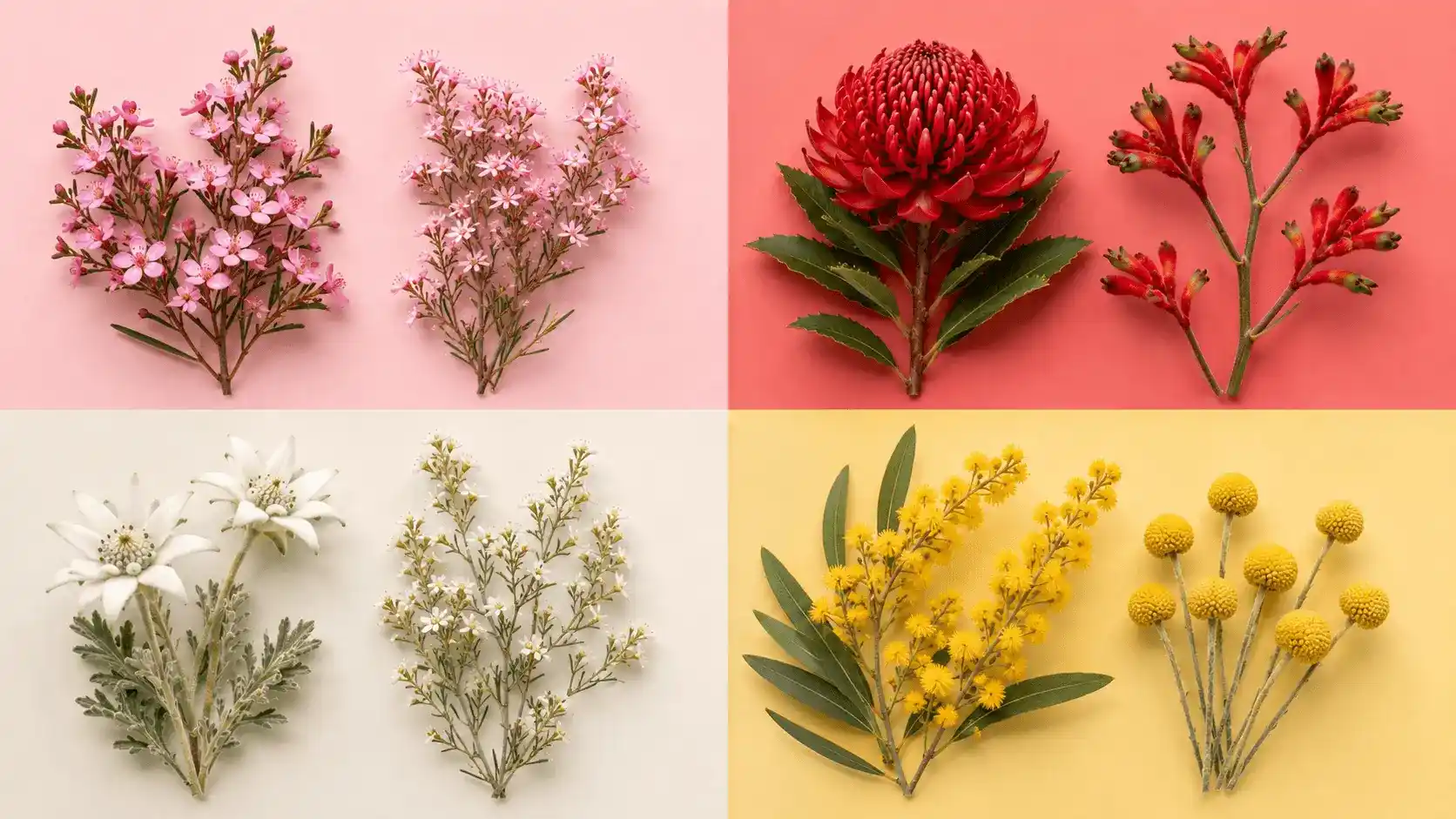
Australian native flowers occur in a wide spectrum of colors, including vivid reds, soft whites, and bright yellows.
Red Native Australian Flower Names
- Waratah — Large red flower heads native to NSW forests.
- Red Kangaroo Paw — Bird-pollinated tubular flowers.
- Sturt’s Desert Pea — Red petals with dark central markings.
- Red Grevillea varieties — Nectar-rich flowering shrubs.
- Crimson Bottlebrush — Cylindrical red flower spikes.
Several iconic red and yellow Australian native plants are also widely used in structured landscaping designs, including species such as Kangaroo Paw Landscape Scarlet Care and Landscaping Guide, Paper Daisy Plant: 7+ Essential Care & Growth Tips, and Lemon Myrtle Tree: 10+ Essential Growing & Care Tips, which are popular in modern Australian native gardens.
White Australian Flower Names
- White Flannel Flower — Velvety white petals.
- White Waratah — Rare cultivated variation.
- Eriostemon — White wax-like flowers.
- Brachyscome — White native daisy species.
- Wedding Bush — Fine white flowers used ornamentally.
| Color | Common Name | Scientific Name | Key Feature |
| Red | Waratah | Telopea speciosissima | Large flower head |
| White | Flannel Flower | Actinotus helianthi | Soft-textured petals |
| Yellow | Golden Wattle | Acacia pycnantha | National floral emblem |
Australian Bush Flower Names — Flora of the Outback and Bushland
Australian bush flowers are native flowering species associated with scrubland, outback environments, and open bush habitats.
Examples include:
- Billy Buttons (Craspedia) — Round yellow flowers common in dry grasslands.
- Everlasting Daisies — Long-lasting papery blooms.
- Flannel Flowers — Soft white star-shaped flowers.
- Emu Bush (Eremophila) — Drought-resistant flowering shrub.
- Dampiera — Blue-purple native wildflower.
- Scaevola (Fan Flower) — Distinctive fan-shaped petals.
Several bush flowers are also used in Australian Bush Flower Essences, a natural remedy system based on native flora.
Beautiful Australian Flower Names for Girls
Australian flower names are increasingly used as girls’ names because of their botanical meaning and connection to nature.
Most Popular Australian Flower Baby Names for Girls
- Acacia — Inspired by Wattle trees; symbolizes resilience.
- Boronia — Named after the fragrant native shrub.
- Violet — Inspired by Native Violet species.
- Daisy — Linked to Australian Paper Daisies.
- Waratah — Strong botanical and cultural identity.
Unique Australian Flower Names for Girls — Rare and Distinctive Choices
- Thea — Derived from Telopea.
- Dampiera — Named after the blue native wildflower.
- Pimelea — Botanical name with delicate sound.
- Dendrobium — Orchid-inspired botanical name.
- Eria — Inspired by orchid classification names.
Which Name Means Flower in Australian and Indigenous Contexts?
Some Australian and Indigenous-inspired names are associated with flowers, plants, or natural landscapes.
Examples include:
- Mia — Connected to nature-related meanings in some Indigenous contexts.
- Akira — Occasionally associated with bright or natural meanings.
- Waratah — Direct botanical association.
- Acacia — Tree and flower symbolism.
Many Aboriginal naming traditions are deeply connected to land, plants, water, and seasonal cycles.
Native Australian Plant Names — Beyond Flowers
Native Australian plant names also include flowering trees, shrubs, grasses, and groundcovers. These names may honor botanists, describe physical features, or derive from Indigenous language traditions.
Many of these species are also commonly used in landscaping and design, which is further explored in Australian native garden planning systems like Australian Native Garden Plants.
Common Native Australian Plant Names by Habitat Type
| Habitat Type | Plant/Flower Name | Scientific Name | Key Feature |
| Coastal | Pigface | Carpobrotus glaucescens | Succulent groundcover |
| Alpine | Snow Gum | Eucalyptus pauciflora | Cold-tolerant tree |
| Arid/Outback | Spinifex | Triodia spp. | Drought adaptation |
| Rainforest | Native Frangipani | Hymenosporum flavum | Fragrant flowers |
Common Mistakes When Identifying Australian Native Flower Names (SERP Gap Coverage)
Many people incorrectly identify Australian native flowers because of regional naming differences and similar-looking species.
Common mistakes include:
- Confusing Flannel Flower with Paper Daisy due to similar petal shape
- Assuming all Wattles are the same species
- Using common names instead of scientific names
- Mistaking introduced garden flowers for natives
- Ignoring regional naming variations between states
How to avoid mistakes:
- Cross-reference common names with botanical names
- Use regional field guides
- Observe leaf structure and habitat
- Check flowering season and pollinator activity
Australian Native Flowers vs. Common Garden Flowers — Key Differences
Australian native flowers differ significantly from imported ornamental garden flowers.
| Feature | Australian Native Flowers | Common Garden Flowers (Non-Native) |
| Water Requirements | Usually drought-tolerant | Often require regular watering |
| Soil Needs | Adapted to poor soils | Prefer nutrient-rich soils |
| Pest Resistance | Naturally resistant | More vulnerable to pests |
| Pollinator Attraction | Supports native wildlife | Often bred for appearance |
| Naming Origin | Indigenous or descriptive | Mostly European/Latin |
| Seasonal Bloom | Climate-adapted cycles | Variable depending on origin |
Conclusion
Australian flower names reflect one of the world’s most distinctive botanical ecosystems. From the Golden Wattle as the national flower of Australia to colorful pink, red, and white native blooms, Australian flora combines scientific diversity with cultural significance. Native flowers such as Waratah, Kangaroo Paw, Boronia, and Rhodanthe showcase how Australian plants evolved unique forms and identities across varied landscapes.
Whether researching native wildflowers, exploring botanical baby names, identifying bush flowers, or building a native garden, understanding Australian flower names provides deeper insight into Australia’s ecological and cultural heritage.
FAQs
What is the most famous Australian native flower?
The most famous Australian native flowers are the Waratah and the Golden Wattle. The Golden Wattle is Australia’s national flower, while the Waratah is one of the country’s most visually iconic native blooms.
What are some common pink flowers found in Australia?
Common pink Australian native flowers include Pink Boronia, Pink Rice Flower, Geraldton Wax, Crowea, and Pink Everlasting Daisy. Many grow naturally in coastal or bushland environments.
What Australian flowers are used as girls' names?
Popular Australian flower names for girls include Acacia, Boronia, Violet, Daisy, and Waratah. These names are inspired by native flowers and botanical traditions.
Are there Australian native flowers for every letter of the alphabet?
Yes. Examples include Callistemon (C), Pimelea (P), Rhodanthe (R), Verticordia (V), Waratah (W), and Xanthorrhoea (X).
What is the difference between Australian bush flowers and native flowers?
All Australian bush flowers are native flowers, but not all native flowers are bush flowers. Native flowers also include rainforest, alpine, and coastal species outside bushland habitats.
Which Australian native flowers are pink and easy to grow at home?
Geraldton Wax, Pink Boronia, Crowea, and Leptospermum are among the easiest pink Australian native flowers to grow in home gardens with good drainage and sunlight.