
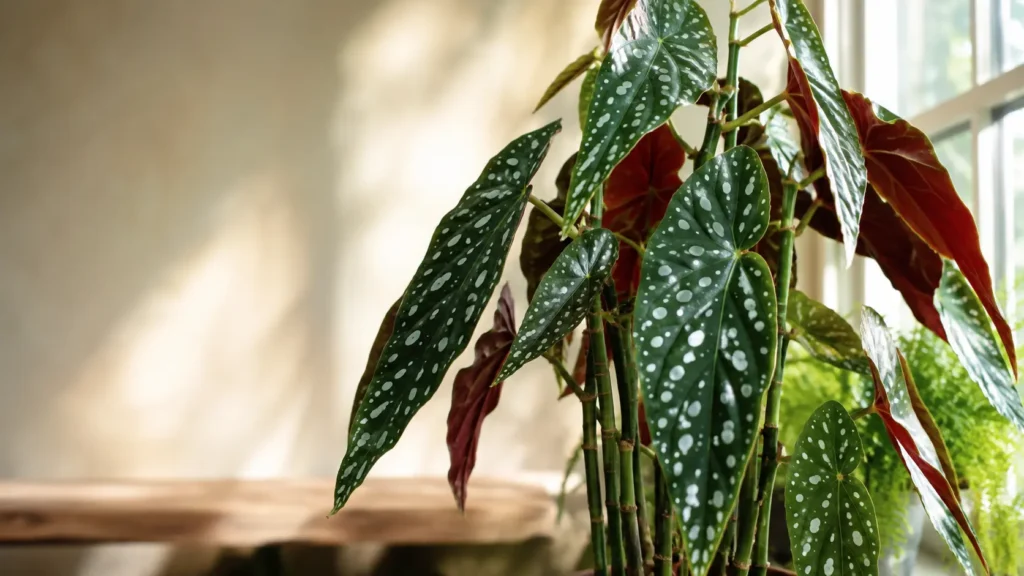
‘Begonia Morocco’ is a trade name for a rhizomatous Begonia cultivar prized for its textured, burgundy-and-green foliage and clusters of small white flowers, not a species native to Morocco, according to Furry Care Hub. It thrives in bright, indirect light, high humidity, and consistently moist, well-drained soil, similar to Begonia ‘Marmorata’ or Angel Wing varieties.
Nursery use of the name is inconsistent: some sell ‘Morocco’ as an Angel Wing type with olive-green, reddish-brown leaves and silver speckles (a Kartuz hybrid), others as a Rex begonia, so buyers should confirm growth habit before purchase. Separately, “Moroccan begonia” sometimes refers to tuberous Begonia × tuberhybrida plugs propagated in greenhouses near Agadir since 2015 for European and North American spring markets, unrelated to the foliage cultivar. In cultivation, watch for powdery mildew and botrytis in humid, low-airflow settings; feeding at roughly 150 ppm nitrogen with soil pH 6.0–6.5 supports fuller leaf color.
Quick Summary
- Begonia Morocco is a cultivar of Begonia maculata, known for its silver-spotted, angel-wing-shaped leaves.
- It grows best in bright, indirect light with moderate humidity rather than direct sunlight.
- Its botanical lineage traces back to Brazil, within the Begonia genus containing more than 2,000 species.
- Proper watering, consistent humidity, and suitable lighting are the biggest factors affecting healthy growth and preventing leggy stems.
What Is Begonia Morocco?
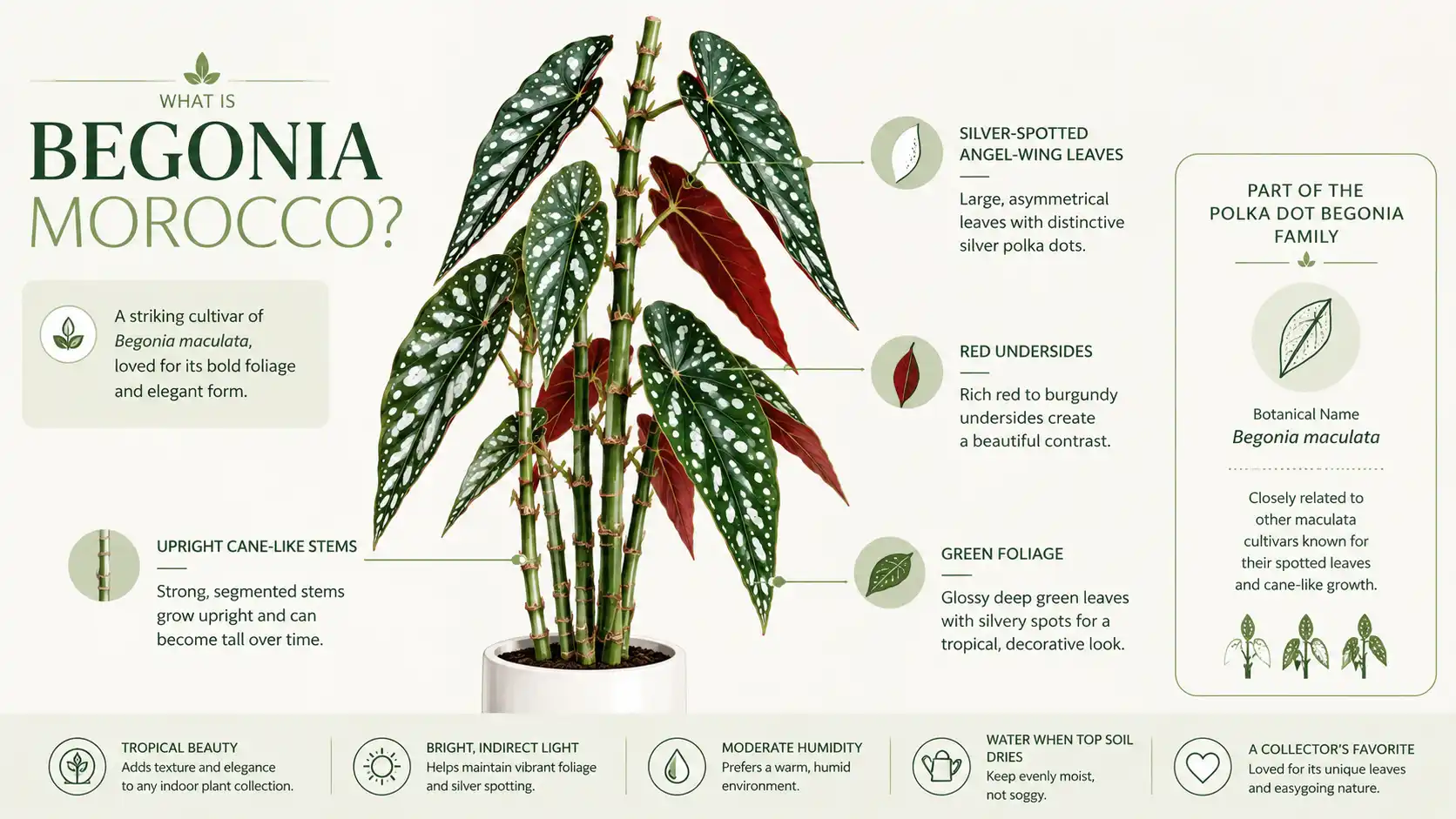
Begonia Morocco is a cultivated variety of Begonia maculata, a cane-type begonia admired for its dramatic foliage decorated with bright silver spots. It belongs to the large Begonia genus and shares the characteristic angel-wing leaf shape that makes polka dot begonias popular as houseplants.
Begonia Morocco belongs to the Begonia maculata group, and understanding general Begonia Maculata Care Guide for Healthy Growth practices can help growers provide the right light, humidity, and watering conditions for this cultivar.
This cultivar is closely linked to Don Miller, a respected begonia breeder known for introducing and preserving attractive begonia varieties. Because of this connection, Begonia Morocco is sometimes associated with searches for Don Miller begonia or Begonia Don Miller, although Morocco is recognized as its own distinct cultivar.
Like other spotted begonias, Begonia Morocco is primarily grown for its foliage rather than its flowers. Mature plants produce upright, bamboo-like stems and asymmetrical leaves that create a bold architectural appearance indoors.
Key characteristics include:
- Large angel-wing-shaped leaves
- Bright silver spotting across deep green foliage
- Red to burgundy leaf undersides
- Upright cane-like growth habit
- Small clusters of white to pale pink flowers under favorable conditions
Its attractive foliage and relatively manageable care requirements have made it one of the more desirable Begonia maculata cultivars for indoor collections.
Begonia Morocco vs. Standard Begonia Maculata
Begonia Morocco and standard Begonia maculata belong to the same species group but differ in appearance, growth characteristics, and availability. While both feature spotted foliage, Morocco often displays denser silver spotting and a more refined ornamental appearance.
| Feature | Begonia Morocco | Standard Begonia Maculata |
| Leaf Color | Deep green with abundant silver spots | Green with silver spots |
| Leaf Shape | Broad angel-wing leaves | Classic angel-wing leaves |
| Growth Habit | Upright, compact to moderately tall | Upright cane growth |
| Availability | Specialty cultivar | Widely available |
| Collector Appeal | Higher | Moderate |
Both cultivars require nearly identical care, making either an excellent choice for growers seeking decorative indoor foliage. Begonia Morocco is simply less common, which contributes to its popularity among collectors.
Where Do Begonias Grow Best?
Begonias grow best in warm, humid environments with filtered light and well-drained soil. Most ornamental begonias originate from tropical and subtropical forests where they naturally grow beneath tree canopies instead of receiving intense direct sunlight.
Although begonias are distributed across several continents, many popular houseplant species—including Begonia maculata—trace their native ancestry to Brazil in South America. Their natural habitat provides consistent warmth, high humidity, and protection from harsh afternoon sun.
Indoors, these conditions can be recreated by placing plants near bright windows with filtered light and maintaining moderate humidity.
Ideal growing conditions include:
- Bright, indirect sunlight
- Temperatures between 65–80°F (18–27°C)
- Humidity around 50–70%
- Loose, well-draining potting mix
- Good air circulation without cold drafts
Outdoors, begonias perform well in frost-free climates, generally corresponding to USDA Hardiness Zones 10–11. In cooler regions, they are commonly grown as seasonal plants or kept indoors year-round.
Do Begonias Prefer Full Sun or Shade?
Begonias prefer bright, indirect light or partial shade, not full sun. Direct afternoon sunlight can scorch their leaves, fade variegation, and dry out the soil too quickly, while extremely low light may lead to weak, elongated growth. Understanding the difference between bright indirect light and direct sunlight is essential, as explained in the guide on Bright Indirect Light vs Direct Sunlight for Plants.
For Begonia Morocco, the ideal location is near an east-facing window or a few feet away from a bright south- or west-facing window protected by a sheer curtain.
Signs of excessive sunlight include:
- Brown leaf edges
- Bleached foliage
- Crispy leaf tips
- Curling leaves
Signs of insufficient light include:
- Leggy stems
- Wider spacing between leaves
- Slower growth
- Reduced flowering
Providing consistent bright indirect light supports compact growth, healthy foliage coloration, and stronger stems.
How to Care for a Begonia ‘Morocco’
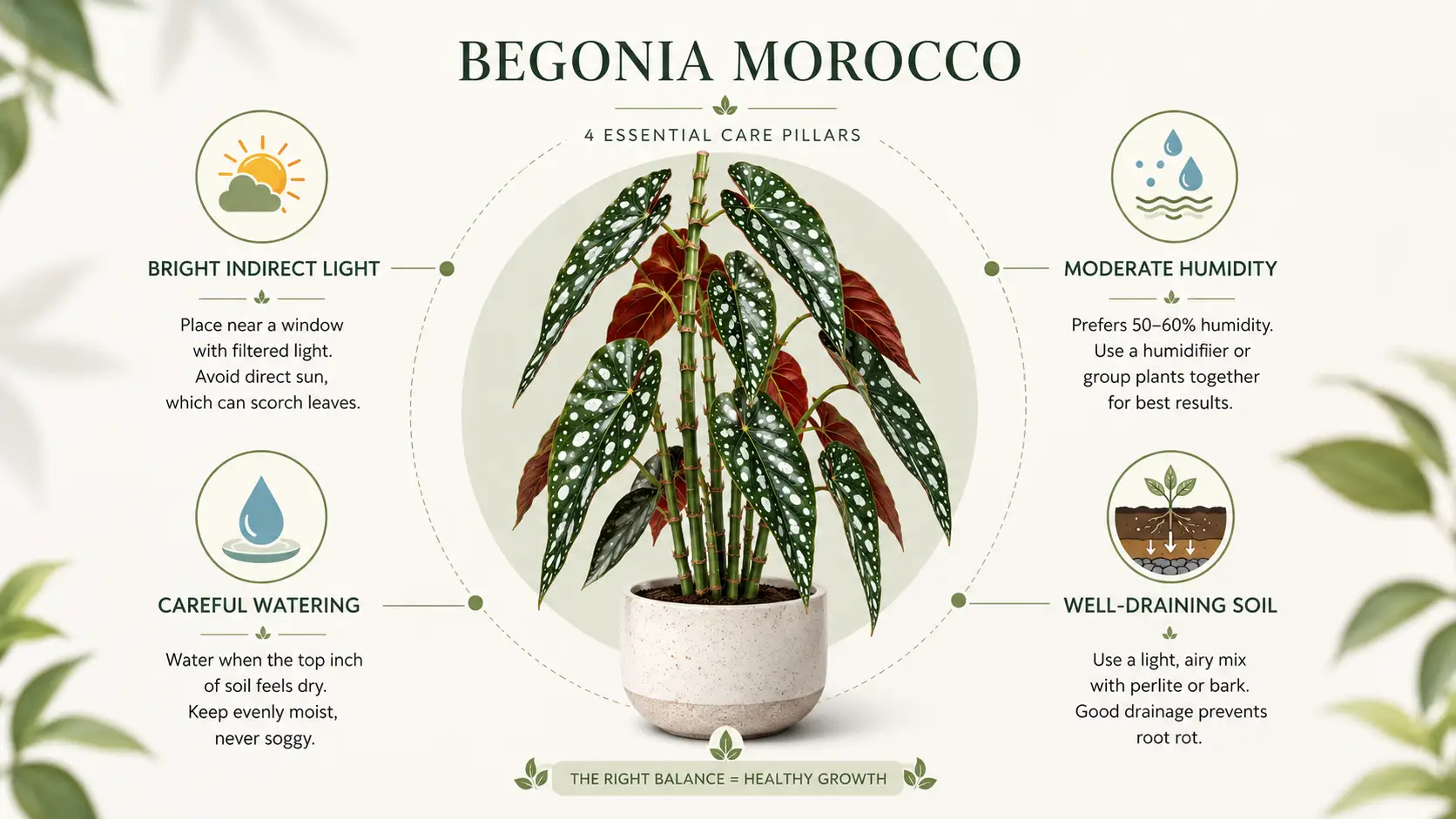
Caring for Begonia Morocco involves balancing light, moisture, humidity, temperature, and nutrition. Like most cane begonias, it rewards consistent conditions and is more sensitive to overwatering than occasional dryness. Like other spotted cane begonias such as Begonia Maculata Wightii, Begonia Morocco performs best when provided with bright indirect light, controlled watering, and stable indoor humidity.
The essential care requirements include:
- Bright indirect light
- Moderate watering
- Well-draining soil
- Stable indoor temperatures
- Moderate humidity
- Light, regular fertilization during active growth
Avoid placing the plant near heating vents, air conditioners, or drafty windows where sudden temperature changes can stress the foliage.
Watering Requirements
Begonia Morocco should not be watered every day. Instead, water thoroughly when the top 1–2 inches (2.5–5 cm) of soil become dry. This approach provides adequate moisture while preventing root rot. Before watering Begonia Morocco, growers can use methods from How to Check If Indoor Plant Needs Water to avoid overwatering and maintain healthy roots.
Daily watering keeps the soil excessively wet, reducing oxygen around the roots and encouraging fungal diseases.
General watering guidelines include:
- Water approximately once every 7–10 days during active growth.
- Water less frequently during winter.
- Always adjust watering based on soil moisture rather than a fixed schedule.
- Empty excess water from decorative containers after watering.
Should you water begonias from the top or bottom?
Both methods work, but bottom watering is often preferred because it keeps leaves dry and reduces the likelihood of fungal diseases such as powdery mildew and leaf spot.
When bottom watering:
- Fill a shallow tray with water.
- Place the pot in the tray for 15–20 minutes.
- Allow the soil to absorb moisture through the drainage holes.
- Remove the pot and let excess water drain completely.
Occasional top watering is also beneficial because it helps flush accumulated fertilizer salts from the soil.
Soil, Pot Size & Fertilizer
Begonia Morocco performs best in a loose, airy growing medium that drains quickly while retaining enough moisture for healthy root development.
A suitable soil mix typically contains:
- High-quality indoor potting mix
- Perlite
- Orchid bark
- Coco coir or peat moss
Do begonias like big pots or small pots?
Begonias generally prefer snug pots rather than oversized containers. A pot that is only slightly larger than the root ball helps prevent excess moisture retention, reducing the risk of root rot.
Do begonias grow better in pots or in ground?
Begonia Morocco grows better in containers in most climates because pots provide better control over soil quality, drainage, watering, and temperature. In tropical regions, it can also thrive outdoors in shaded garden beds with well-drained soil.
What is the best fertilizer for begonias?
A balanced, water-soluble fertilizer such as 10-10-10 or 20-20-20, diluted to half strength, supports healthy foliage and flowering during spring and summer.
Is Miracle-Gro good for begonias?
Yes. General-purpose Miracle-Gro products can be suitable when used according to label directions and preferably at half strength to avoid fertilizer burn. Excess fertilization may encourage lush foliage at the expense of flowers.
Do coffee grounds help begonias?
Fresh coffee grounds are generally not recommended because they can compact the soil and interfere with drainage. Composted coffee grounds may be used sparingly within compost, but they should not replace a balanced fertilizer.
Quick Reference
- Ideal soil: Potting mix + perlite + orchid bark + coco coir/peat
- Pot size: Slightly larger than the root ball
- Repotting: Every 1–2 years or when root-bound
- Fertilizer: Balanced liquid fertilizer every 2–4 weeks during spring and summer
- Drainage: Essential to prevent root rot
Why Are Begonias So Hard to Grow?
Begonias are considered challenging by some growers because they require a careful balance between moisture, humidity, temperature, and light. They are not necessarily difficult plants, but they respond poorly to inconsistent care, especially excessive watering, dry air, and sudden environmental changes.
Because Begonia Morocco is sensitive to dry air, growers can use practical methods from guides on how to increase humidity for indoor plants without a humidifier to maintain healthier foliage.
Begonia Morocco and other Begonia maculata varieties can struggle when indoor conditions do not match their tropical origins. Their thin leaves lose moisture quickly, while their roots are sensitive to constantly wet soil.
The main factors that make begonias seem difficult include:
- Humidity sensitivity: Dry indoor air can cause brown leaf edges and curling.
- Overwatering risk: Constantly wet soil can lead to root rot.
- Light imbalance: Too little light causes weak growth, while direct sun damages leaves.
- Temperature changes: Cold drafts and sudden shifts can stress the plant.
Providing stable conditions is usually more important than frequent maintenance. A consistent routine with proper drainage and suitable light often produces better results than excessive care.
Common Beginner Mistakes
Many begonia problems result from simple care mistakes rather than the plant being naturally difficult. Avoiding these common errors improves the chances of growing a healthy Begonia Morocco.
Common beginner mistakes include:
- Watering too frequently: Keeping the soil wet all the time prevents healthy root function.
- Using a pot without drainage holes: Excess water becomes trapped around roots.
- Placing the plant in direct sunlight: Strong rays can burn delicate leaves.
- Keeping humidity too low: Dry air can cause crispy edges and leaf drop.
- Ignoring pruning: Untrimmed stems may become tall and leggy.
- Overfertilizing: Too much fertilizer can damage roots and encourage excessive leaf growth.
Begonias benefit from observation. Checking soil moisture, monitoring leaf condition, and adjusting care gradually are more effective than following a rigid schedule.
Common Begonia Problems & Fixes
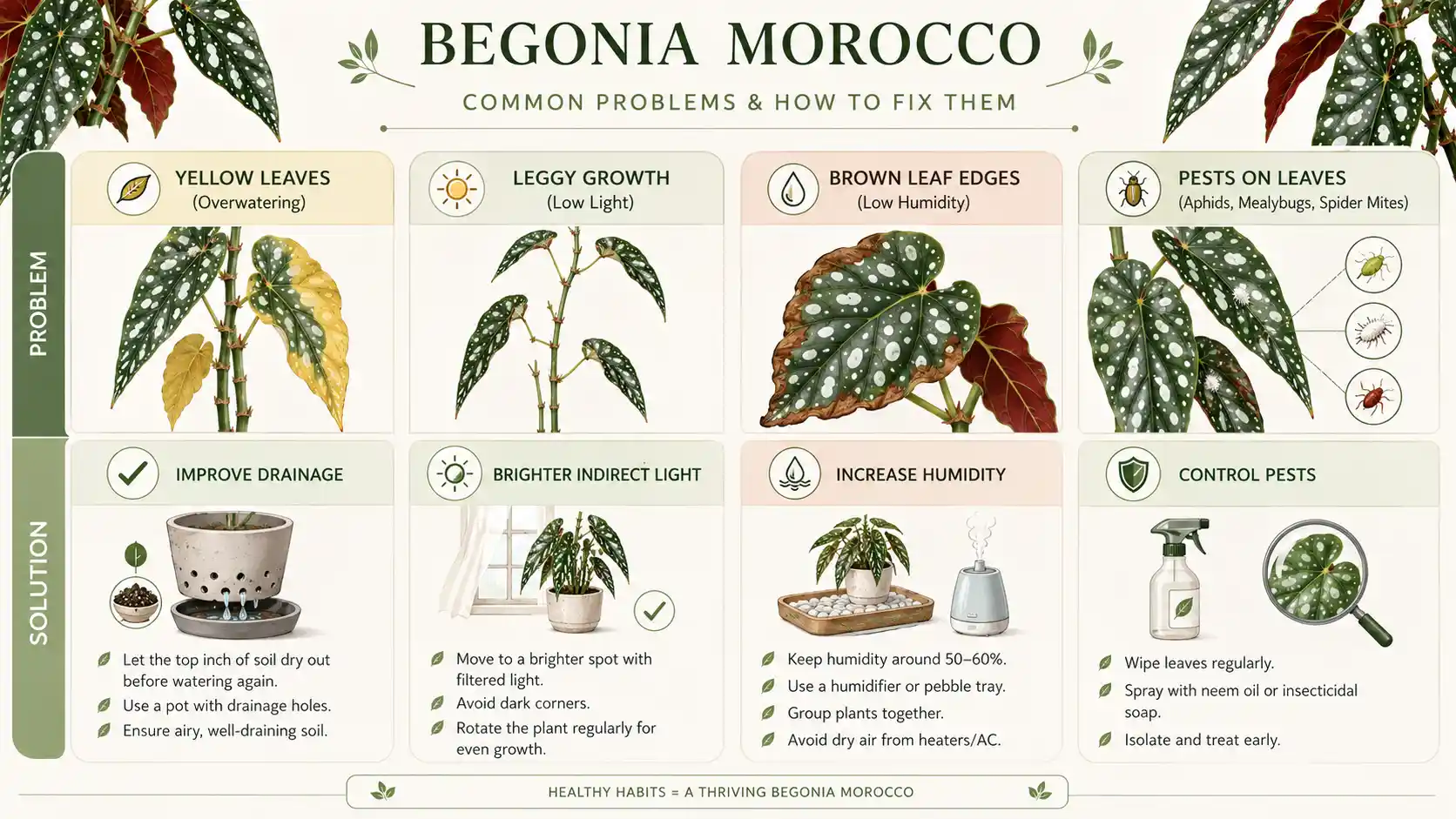
Begonia Morocco can experience several common issues related to watering, lighting, nutrition, and pests. Most problems can be corrected by identifying the cause early and adjusting growing conditions.
Why Are My Begonias All Leaves and No Flowers?
Begonias may produce many leaves but few or no flowers when growing conditions favor foliage instead of blooming. The most common causes are insufficient light and excessive nitrogen fertilizer.
To encourage flowering:
- Provide bright indirect light for several hours daily.
- Avoid heavy nitrogen fertilizers that promote leaf growth.
- Use a balanced fertilizer or one slightly higher in phosphorus during the growing season.
- Maintain consistent watering and humidity.
A healthy Begonia Morocco may flower less indoors than outdoors because indoor conditions often provide lower light intensity.
Begonia Maculata Leggy Growth — Causes & Fixes
Begonia maculata leggy growth occurs when the plant stretches upward with long stems and wide spaces between leaves. The main cause is usually insufficient light, although pruning and nutrition also influence growth shape.
Common causes include:
- Low light levels
- Lack of regular pruning
- Turning the plant infrequently
- Excess nitrogen fertilizer
Solutions include:
- Move the plant closer to bright indirect light.
- Rotate the pot regularly for balanced growth.
- Prune tall stems to encourage branching.
- Propagate healthy cuttings to create a fuller plant.
Pruning above a leaf node encourages new shoots and helps maintain a compact appearance.
Yellowing Leaves, Overwatering & Pests
Yellow leaves on Begonia Morocco are often caused by excess moisture, poor drainage, nutrient problems, or pest activity. Correct diagnosis is important because several issues can produce similar symptoms.
| Problem | Likely Cause | Fix |
| Yellow leaves | Overwatering, poor drainage, nutrient imbalance | Allow soil to dry slightly, improve drainage, adjust feeding |
| Soft, mushy stems | Root rot from excessive moisture | Remove damaged roots and repot in fresh soil |
| Brown leaf edges | Low humidity, underwatering, mineral buildup | Increase humidity and improve watering consistency |
| Sticky leaves | Aphids, scale, or other pests | Treat with insecticidal soap or neem-based products |
| Tiny webs on leaves | Spider mites | Increase humidity and use appropriate pest treatment |
Common begonia pests include:
- Spider mites
- Aphids
- Mealybugs
- Scale insects
- Fungus gnats
Prevent pest problems by maintaining airflow, avoiding overwatering, and checking leaves regularly.
Types of Begonias
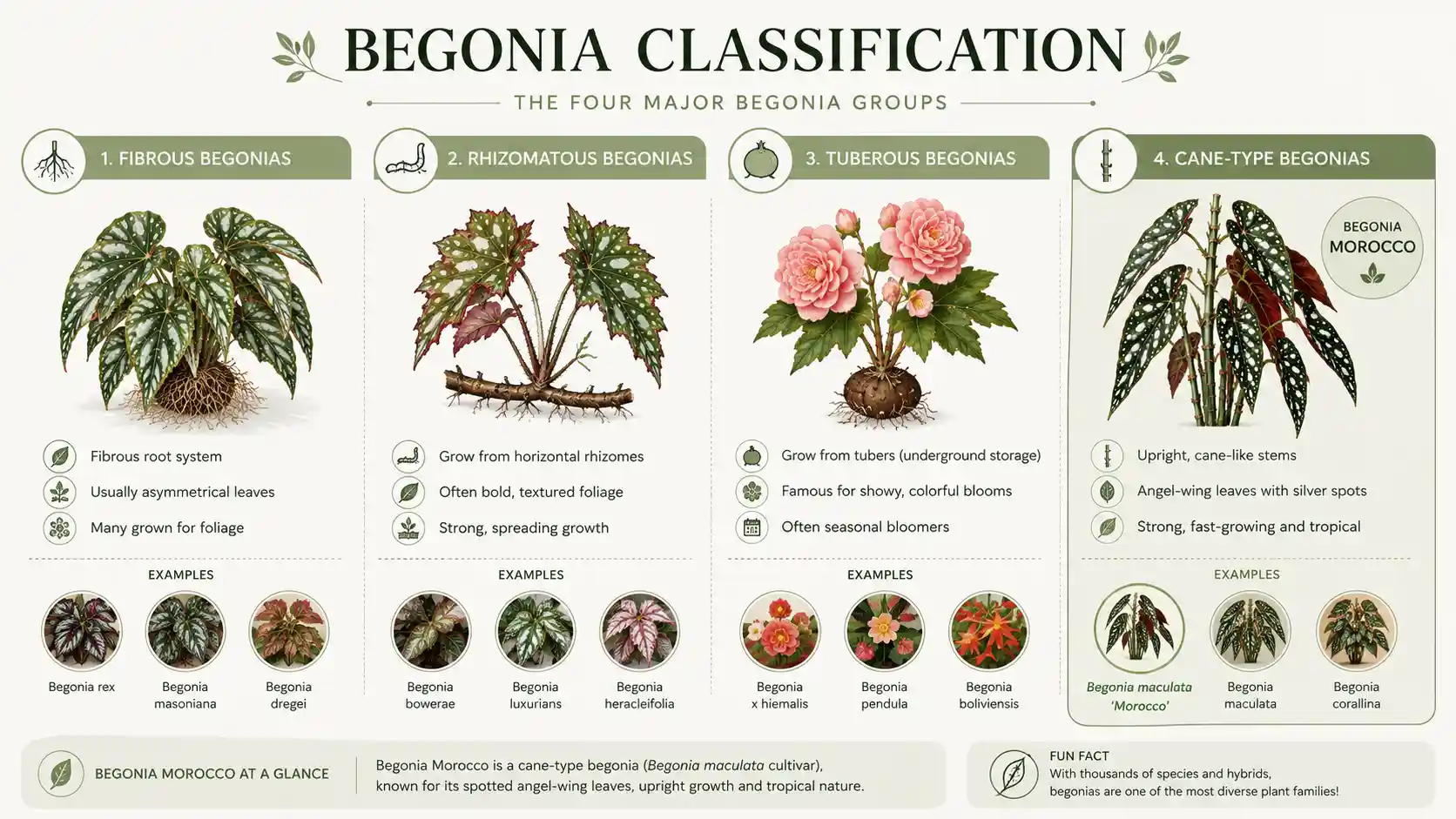
Begonias include thousands of species and cultivars with different growth habits. Classification systems vary, but gardeners commonly group begonias into major categories based on their roots, stems, and growth patterns. The Begonia genus contains thousands of species with diverse growth habits and classifications, including fibrous, rhizomatous, tuberous, and cane-type begonias.
The four commonly recognized begonia groups are:
| Type | Characteristics | Examples |
| Fibrous begonias | Fine roots, compact growth, often grown as bedding plants | Wax begonias |
| Rhizomatous begonias | Thick underground stems called rhizomes, grown mainly for foliage | Rex begonias |
| Tuberous begonias | Grow from tubers and produce large flowers | Tuberous hybrids |
| Cane-type begonias | Upright stems resembling bamboo, often with spotted leaves | Begonia maculata |
Begonia Morocco belongs to the cane-type begonia group because it develops upright, bamboo-like stems and decorative spotted foliage.
Some sources simplify begonia classification into three main groups by combining certain categories, which explains why gardeners may see references to either three or four begonia types.
What Is the Hardiest Begonia?
The hardiest begonia depends on climate and growing conditions, but many gardeners consider fibrous begonias, especially wax begonias, among the toughest varieties because they tolerate a wider range of conditions.
Hardy characteristics include:
- Better tolerance of temperature changes
- More forgiving watering needs
- Strong outdoor performance in suitable climates
However, decorative foliage begonias like Begonia Morocco require more controlled indoor conditions because their value comes from delicate leaf patterns.
What Are the Easiest Begonias to Grow for Beginners?
The easiest begonias for beginners are generally varieties that tolerate average indoor conditions and recover well from minor care mistakes.
Beginner-friendly options include:
- Wax begonias: Durable and adaptable flowering plants.
- Angel wing begonias: Attractive foliage with moderate care needs.
- Cane begonias: Reliable growers when provided with bright indirect light.
- Dragon wing begonias: Known for vigorous growth and outdoor performance.
Begonia Morocco is manageable for beginners who can provide proper humidity, drainage, and consistent indirect light.
Why Do Begonias Have Two Types of Flowers?
Begonias have two types of flowers because they are monoecious plants, meaning a single plant produces separate male and female flowers. This allows begonias to reproduce efficiently while keeping both flower types on the same individual plant.
The two flower types serve different purposes:
- Male flowers: Produce pollen and usually appear more showy.
- Female flowers: Contain the ovary and develop seeds after successful pollination.
This botanical feature is common in many Begonia species and helps explain why a flowering begonia may display different-looking blooms on the same plant.
Begonia Lifespan & Growth Timeline
Begonia lifespan varies depending on species, growing conditions, and care quality. Many begonias can live for several years when grown indoors with suitable light, humidity, and watering practices.
For Begonia Morocco:
- Indoor lifespan: Several years with proper care
- Growth rate: Moderate during active growing seasons
- Winter growth: Often slows due to reduced light and temperature changes
- Propagation: Stem cuttings can create new plants
How long do begonias live in pots?
Begonias can live in pots for many years if they receive regular care, fresh soil when needed, and proper root management.
Do begonia bulbs multiply?
Most decorative begonias do not grow from true bulbs. Tuberous begonias grow from tubers, while Begonia Morocco is a cane begonia that is typically propagated through stem cuttings.
Best Time to Plant & Grow Begonias
The best time to plant begonias depends on climate, but they generally perform best when started during warm growing periods after the risk of frost has passed.
Ideal timing:
- Spring: Best season for planting and repotting
- Summer: Active growth period with suitable warmth
- Autumn: Growth slows as temperatures decrease
- Winter: Reduce watering and avoid unnecessary disturbance
For outdoor planting, wait until temperatures remain consistently warm. Indoor Begonia Morocco can be grown year-round if light and humidity conditions remain stable.
What Is the Secret to Growing Begonias Successfully?
The secret to growing begonias successfully is maintaining a consistent balance of bright indirect light, controlled watering, moderate humidity, and excellent drainage. Begonias grow best when their tropical requirements are recreated without exposing them to extremes such as soggy soil, dry air, or harsh sunlight.
For Begonia Morocco, the most important success factors are:
- Provide filtered light: Bright indirect light supports strong stems, healthy leaves, and better coloration.
- Avoid overwatering: Allow the upper layer of soil to dry before watering again.
- Maintain humidity: Moderate humidity helps prevent crispy edges and leaf stress.
- Use well-draining soil: Loose soil prevents water from staying around sensitive roots.
- Prune regularly: Removing weak or stretched growth encourages a fuller plant shape.
Experienced growers often focus on consistency rather than frequent adjustments. Begonias usually decline because of repeated stress from changing conditions rather than a lack of attention.
A simple care routine works best:
- Check soil moisture before watering.
- Keep the plant in the same stable location whenever possible.
- Monitor leaves for early signs of stress.
- Adjust one growing condition at a time.
For Begonia Morocco, stable indoor conditions usually produce stronger growth than trying to maximize growth speed through extra fertilizer or excessive watering.
Why Are Begonias So Expensive?
Begonias can become expensive when a variety is rare, difficult to propagate, or highly desirable among collectors. Cultivars such as Begonia Morocco may have higher prices because specialty varieties are produced in limited quantities compared with common begonias.
The main reasons some begonias are expensive include:
- Limited availability: Rare cultivars are not produced in large numbers.
- Slow propagation: Many desirable varieties require careful stem cutting propagation.
- Collector demand: Unique leaf patterns and unusual colors increase interest.
- Breeding history: Cultivars connected to recognized breeders can become more valuable.
Begonia Morocco’s appeal comes mainly from its distinctive spotted foliage and connection to the broader Begonia maculata group. While price varies depending on location and availability, rare ornamental begonias often attract collectors because they offer characteristics not found in standard varieties.
What is the most sought-after begonia?
The most sought-after begonia changes over time depending on collector trends. Varieties with unusual foliage, strong patterns, limited availability, or unique genetics are often considered highly desirable.
Examples of highly collected groups include:
- Rare Rex begonias with unusual leaf patterns
- Specialty Begonia maculata cultivars
- Uncommon hybrid begonias
- Collector-focused foliage varieties
What Do Begonias Symbolize?
Begonias are often associated with symbolic meanings such as gratitude, caution, uniqueness, and appreciation. These meanings come from cultural interpretations rather than scientific plant characteristics.
Common symbolic associations include:
- Gratitude: Begonias are sometimes given as a sign of appreciation.
- Uniqueness: Their unusual foliage patterns represent individuality.
- Caution: Some traditions associate begonias with careful consideration or awareness.
Because Begonia Morocco is valued for its distinctive spotted leaves, it is often appreciated symbolically as a plant representing beauty, individuality, and careful attention.
Conclusion
Begonia Morocco is a distinctive cultivar of Begonia maculata, recognized for its silver-spotted angel-wing leaves, upright cane growth, and connection to the broader polka dot begonia family. Its successful growth depends on recreating the warm, humid conditions of its tropical origins through bright indirect light, careful watering, well-draining soil, and stable humidity.
Although begonias can be sensitive to environmental changes, understanding their needs makes them rewarding indoor plants. Avoiding common mistakes such as overwatering, low light, and poor drainage helps prevent problems like yellow leaves and leggy growth.
For anyone growing Begonia Morocco, the key takeaway is simple: provide consistent care, observe the plant’s responses, and maintain a balanced environment. With proper conditions, this striking begonia can remain healthy and attractive for many years.
Begonia Morocco is one example of how indoor plants can add decorative value and improve living spaces, alongside other topics covered in our complete Plants Benefits and Guides resource.
FAQs
How do I care for a Begonia ‘Morocco’?
Begonia Morocco grows best with bright indirect light, moderate humidity, well-draining soil, and careful watering. Allow the top layer of soil to dry before watering again, and avoid direct sunlight because it can scorch the leaves.
What is the most sought-after begonia?
The most sought-after begonia depends on collector preferences, but rare cultivars with unusual foliage patterns, limited availability, and unique genetics are often highly valued. Specialty Begonia maculata varieties and rare Rex begonias are commonly collected.
Do begonias prefer full sun or shade?
Begonias prefer bright indirect light or partial shade rather than full sun. Direct sunlight can burn leaves, while low light may cause weak, stretched growth and reduced flowering.
Why are begonias so hard to grow?
Begonias can be difficult because they require balanced moisture, humidity, and light conditions. Overwatering, dry air, temperature changes, and poor drainage are common reasons begonias decline.
What is the secret to growing begonias successfully?
The secret to growing begonias successfully is maintaining consistency. Provide bright indirect light, allow soil to partially dry between waterings, maintain moderate humidity, and use a well-draining potting mix.
Is Miracle-Gro good for begonias?
Miracle-Gro can be used for begonias when applied correctly and diluted according to instructions. Using too much fertilizer can damage roots or encourage excessive foliage growth without improving flowering.
Why do begonias have two types of flowers?
Begonias have two types of flowers because they are monoecious plants. They produce separate male flowers that create pollen and female flowers that contain the reproductive structures needed for seed development.