
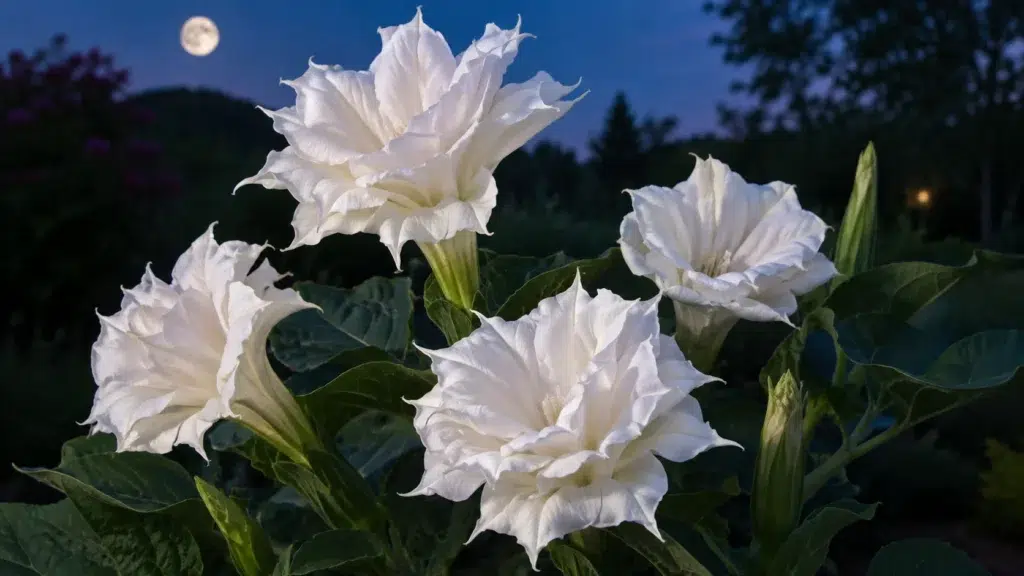
According to Manuela Nogueira, Datura ‘Ballerina White’ is a double-flowered Datura metel cultivar bred by Dutch grower Sahin in 1998. Its upward-facing trumpet blooms, up to 8 inches long, unfurl in swirling white layers for a “bloom-within-a-bloom” effect, releasing intense fragrance at dusk. Plants reach 2-4 feet; all parts are toxic.
Though rated hardy only to USDA zone 8, some gardeners in zone 5 have overwintered container specimens by bringing them indoors before frost. Night-flying moths pollinate the open flowers, while bumblebees pry open unopened buds during daylight hours to rob their pollen. Spent blooms give way to ornamental, prickly green seed pods that stay decorative for weeks.
Quick Summary
- Datura Ballerina White is Datura metel ‘Ballerina White’, a compact ornamental cultivar with large, double white trumpet-shaped flowers.
- Its standout feature is its ruffled, layered blooms, which are fragrant and especially noticeable around evening.
- The Ballerina series typically reaches about 24–36 inches tall and 18–24 inches wide, although growth varies with climate, containers, light, and growing conditions.
- Datura is poisonous: leaves, flowers, seeds, roots, and other plant material should not be eaten and should be handled carefully around children, pets, and livestock.
What Is Datura Ballerina White?
Datura Ballerina White is a cultivar of Datura metel selected for its large, double white, upward-facing trumpet flowers and compact growth habit. It belongs to the Solanaceae family and is part of the Ballerina series, which includes white, purple, and yellow forms. Commercial horticultural sources describe the series as producing fragrant double or triple trumpet-like flowers from approximately June through October.
Datura is a genus in the nightshade family, Solanaceae, containing numerous species known for their distinctive trumpet-shaped flowers and potent tropane alkaloids; see Datura on Wikipedia for a broader botanical overview.
The botanical classification is:
- Genus: Datura
- Species: Datura metel
- Cultivar: ‘Ballerina White’
- Family: Solanaceae
- Plant type: Warm-season annual or tender perennial, depending on climate
- Flower: Double to sometimes triple, white, trumpet-shaped
- Growth habit: Upright and branching
- Primary ornamental feature: Large ruffled flowers
The species Datura metel is closely associated with names such as devil’s trumpet, thorn apple, downy thorn-apple, Hindu datura, and angel’s trumpet in some horticultural references. However, angel’s trumpet is also widely used for the separate genus Brugmansia, so botanical names are preferable when distinguishing the plants.
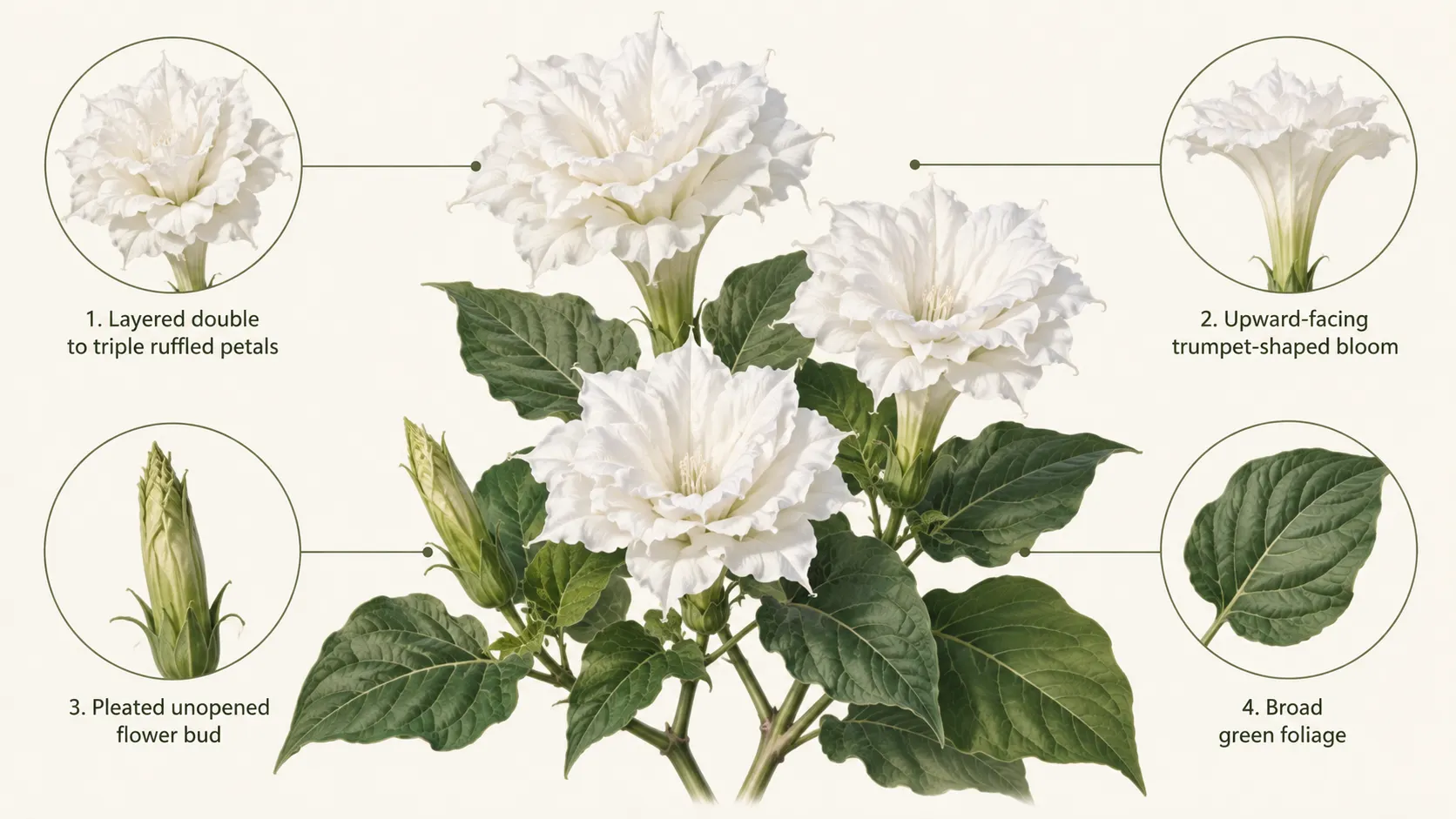
The flowers are particularly distinctive because the corolla can contain multiple layers rather than a single trumpet. Datura metel is botanically capable of producing double or even triple corollas, making the Ballerina forms especially showy.
Key identifying traits include:
- Large upright trumpet flowers.
- Double or layered, ruffled petals.
- White flowers in ‘Ballerina White’.
- Pleated buds that gradually unfurl.
- Strong evening fragrance.
- Broad, relatively large leaves.
- An upright, bushy habit rather than the strongly sprawling habit of some other Datura species.
Datura Ballerina White vs. Ballerina Purple vs. Ballerina Yellow
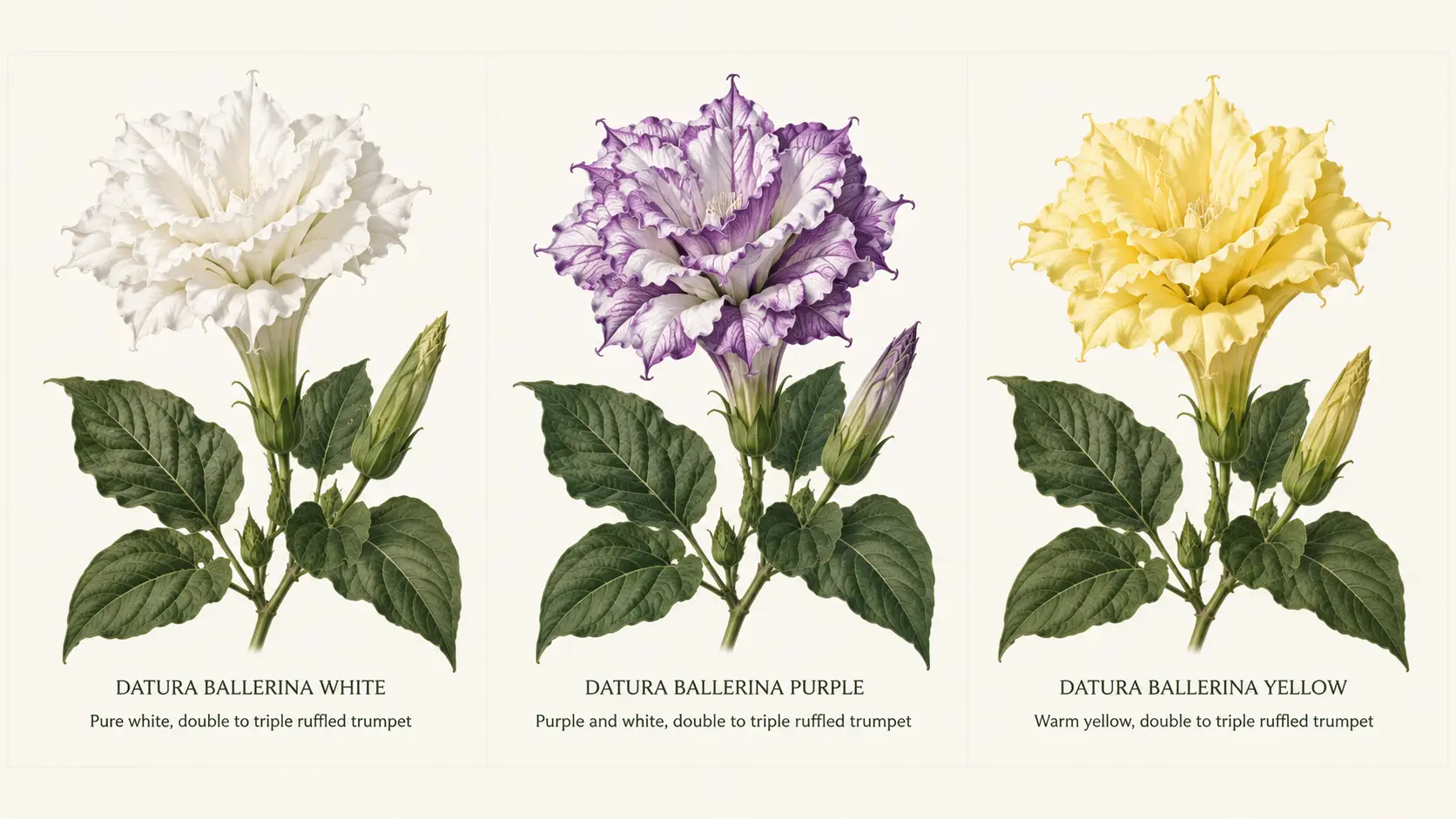
The three commonly marketed Ballerina forms share the same basic growth habit and flower structure. Their principal visual difference is flower color. Commercial seed and plant catalogs list Ballerina White, Ballerina Purple, and Ballerina Yellow as members of the same Datura metel Ballerina series.
For broader inspiration on yellow-flowering plants, explore our 7+ Essential Yellow Flowers in Australia: Types Guide.
| Variety | Flower Color | Bloom Form | Typical Height | Notable Trait |
| Ballerina White | White | Double to triple, ruffled | 24–36 in | Clean white upward-facing flowers |
| Ballerina Purple | Purple/white | Double to triple, ruffled | 24–36 in | Purple-and-white contrast |
| Ballerina Yellow | Yellow | Double to triple, ruffled | 24–36 in | Warm yellow, frilled appearance |
The available evidence supports treating the Ballerina cultivars as broadly similar in size and cultural requirements rather than assigning major hardiness differences to the individual colors. Their outdoor performance is primarily controlled by temperature, frost exposure, light, and growing conditions. If you want to compare another member of the series in greater detail, see our Ballerina Purple Datura Care Guide, which covers its growing conditions, flowering, size, and care requirements.
Datura Metel vs. Datura Wrightii vs. Datura Stramonium
These species are often confused because they share the Datura name and overlapping common names.
| Species | Common Name | Native/Associated Range | Flower Color | Growth Habit |
| Datura metel | Devil’s trumpet, thorn-apple | Mexico as accepted native range; widely cultivated/naturalized elsewhere | White, yellow, purple and combinations | Upright, shrub-like herb |
| Datura wrightii | Sacred datura, sacred thorn-apple | Southwestern U.S. and Mexico | Usually white | Sprawling, branching |
| Datura stramonium | Jimsonweed, common thorn-apple | Broadly distributed and naturalized in many regions | Usually white to pale violet | Upright annual herb |
Kew’s Plants of the World Online currently treats Datura metel as an accepted species and gives its native range as Mexico, while noting its widespread cultivation and introduction elsewhere.
Datura wrightii, often called sacred datura or sacred thorn-apple, is native to the southwestern United States and Mexico and commonly occurs in open or disturbed habitats. It can become considerably wider than the compact Ballerina series.
Datura stramonium, commonly called jimsonweed or common thorn-apple, is another species and should not be assumed to be the same plant as ornamental D. metel.
Plant Size
Datura Ballerina White typically reaches about 24–36 inches in height and 18–24 inches in spread under commercial growing conditions. The Ballerina series is specifically described by Ball Seed at this approximate size range.
Actual size can vary substantially. A plant grown directly in a warm garden bed generally has more root space than one restricted to a container. Rich soil, adequate moisture, long warm seasons, and strong light can also increase vegetative growth.
Factors affecting final size include:
- Sun exposure: Full sun supports stronger, more compact flowering growth.
- Pot size: Root restriction can keep container specimens smaller.
- Soil fertility: Excessive fertility can favor foliage over balanced flowering.
- Temperature: Warm conditions encourage active growth.
- Growing season: A long frost-free season allows the plant to become larger.
- Moisture: Severe drought can restrict growth, while saturated soil damages roots.
Although some sources give broader species-level dimensions of 3–4 feet, the Ballerina series is generally marketed as a more compact form.
Growth Rate
Datura is capable of fast growth in warm conditions, particularly after seedlings become established, although the exact time from seed to flower depends on temperature, light, cultivar, and sowing conditions. Commercial descriptions characterize the Ballerina group as quick-growing and long-blooming, while Datura metel cultivation references also describe rapid development under favorable conditions.
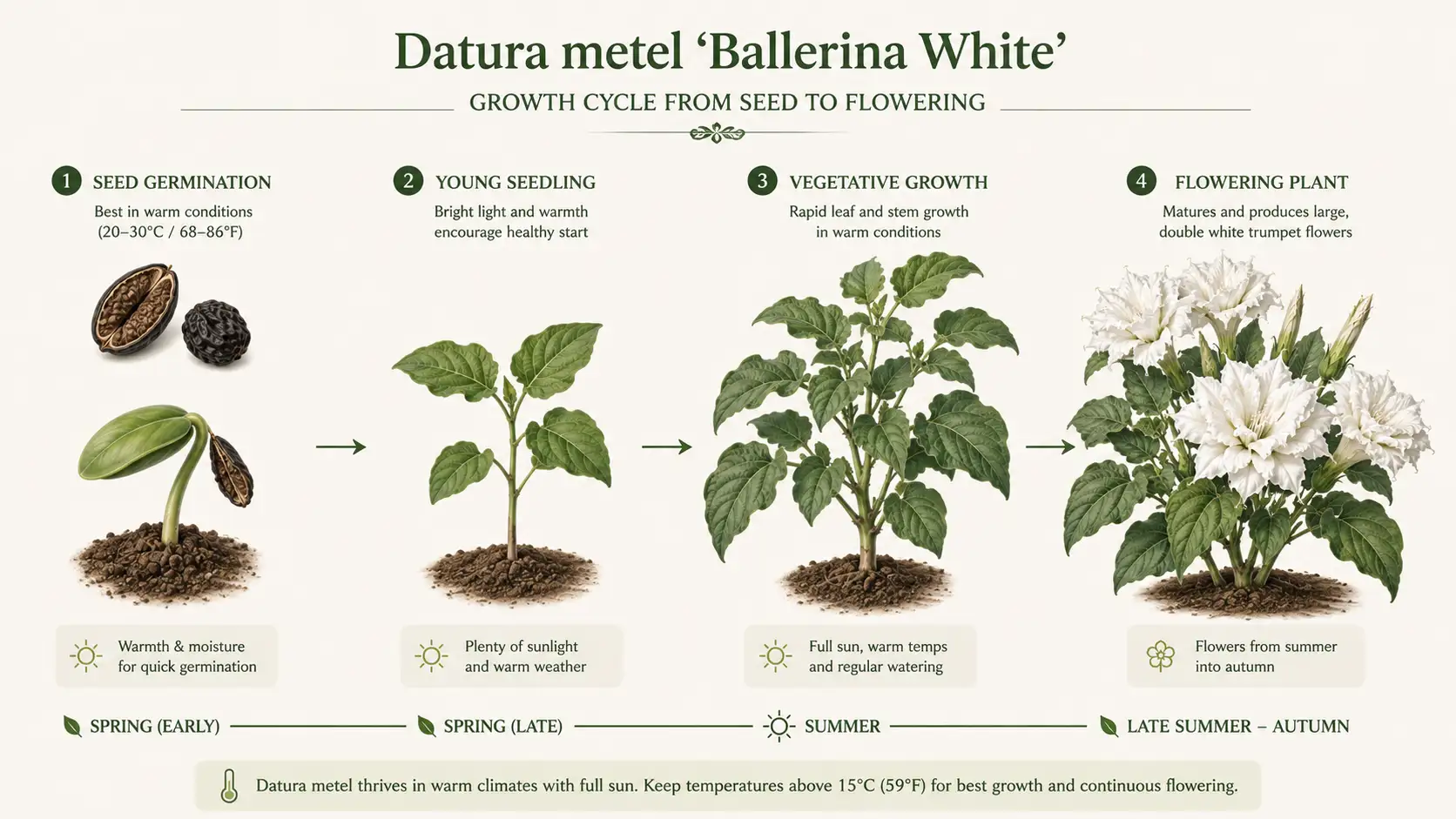
A typical seasonal progression is:
- Germination: Seeds require warmth and suitable moisture; commercial guidance for ‘Ballerina White’ gives roughly 21–28 days under specified germination conditions.
- Seedling stage: Young plants develop their first true leaves and establish roots.
- Vegetative growth: Warm temperatures and strong light accelerate branching and leaf production.
- Bud formation: Established plants begin producing flower buds as seasonal conditions become favorable.
- Flowering: In suitable climates, flowering can continue through much of summer and into autumn.
A useful target for indoor seed starting is roughly 75–80°F (24–27°C), with consistently warm conditions and adequate light. Germination and early growth become less reliable when temperatures are too cool.
How Often and How Long Datura Ballerina White Blooms
Datura Ballerina White can produce repeated flushes of flowers through the warm growing season rather than producing one short flowering event. Commercial descriptions of the Ballerina series list flowering from June through October, although the actual season varies by climate and planting date.
In frost-free climates, Datura metel can behave as a tender perennial, while colder climates generally treat it as a warm-season annual. North Carolina Extension lists D. metel as both an annual and herbaceous perennial and describes outdoor winter hardiness around USDA Zones 9–10.
Individual flowers are relatively short-lived compared with the plant’s overall flowering season. Many Datura flowers open around dusk, remain showy through the night, and fade as daytime progresses. The important distinction is that a single flower does not last for the entire blooming season; the plant continually produces new flowers when conditions are favorable.
Fragrance — Can You Smell Datura Flowers?
Yes, Datura flowers can have a strong, sweet fragrance, and the scent is generally most noticeable during the evening and night. The fragrance helps make Datura particularly suitable for gardens where evening sensory qualities are important. Datura metel is documented as having fragrant flowers, with cool nights also associated with flowering.
The scent is often described as heavy, sweet, floral, or somewhat honeysuckle-like. Nocturnal fragrance is associated with pollinator interactions, particularly with moths and other insects adapted to visiting flowers after dark.
Care Guide
Datura Ballerina White performs best with full sun, well-drained soil, regular moisture without waterlogging, and warm temperatures. The plant tolerates ordinary garden soil but generally performs better when drainage is good and moisture is available during active growth.
For broader information on plant care, growing requirements, plant types, and practical gardening guidance, explore our Plants: Benefits and Guides.
| Care factor | Recommended condition |
| Light | Full sun; at least about 6 hours of direct light |
| Water | Keep moderately and consistently moist during active growth; avoid saturation |
| Soil | Rich or average soil with good drainage |
| Fertilizer | Balanced feeding during active growth; avoid excessive nitrogen |
| Pruning | Remove spent flowers if desired and cut back before indoor overwintering |
| Outdoor climate | Best in warm conditions; commonly treated as annual outside Zones 9–10 |
| Container growing | Well suited to pots with adequate drainage |
Full sun is especially important for flowering. Plants grown in too much shade can become elongated and produce fewer flowers.
For watering, there is no universal requirement of exactly one inch every week because evaporation varies with temperature, rainfall, soil, and container size. A better practical rule is to water when the upper soil begins to dry while preventing prolonged saturation around the roots.
Avoid consistently wet soil. Datura prefers moisture but also requires drainage.
Can Datura Be Grown in Pots?
Yes, Datura Ballerina White is well suited to container culture, provided the container drains freely and is large enough to support the plant’s root system. The Ballerina series is specifically marketed for containers and is described as suitable for 6-inch pots during commercial production.
Container-grown plants usually remain smaller than specimens with unrestricted root space. Container care also requires more frequent monitoring because pots dry faster than garden beds.
For successful container culture:
- Use a drainage hole.
- Use a loose, well-drained growing medium.
- Do not allow the pot to remain in standing water.
- Give the plant strong direct light.
- Water according to soil moisture rather than a rigid calendar.
- Move the container indoors before frost if overwintering is intended.
- Keep the plant inaccessible to children and pets.
Can You Plant Datura at Home? Is It Safe to Grow?
Datura can be grown ornamentally at home, but it should not be treated as a safe edible or medicinal plant. The principal issue is toxicity: Datura metel is classified by North Carolina Extension as having high-severity poisonous characteristics.
A sensible planting site should be:
- Away from children’s play areas.
- Away from pets and livestock.
- Away from vegetable and herb gardens.
- Away from locations where fallen flowers or seeds could be easily handled.
- Accessible to the gardener without creating unnecessary contact with plant material.
Wear gloves when pruning or removing the plant, wash hands afterward, and never use Datura leaves, flowers, seeds, or roots as food or home remedies.
Local rules should also be checked because the cultivation or distribution of some Datura species may be regulated in particular jurisdictions.
Growing Datura Ballerina White From Seed
Datura Ballerina White can be grown from seed, with warm temperatures, light, moisture, and a sufficiently long growing season being important for successful establishment. Takii lists approximately 21–28 days for germination under its specified conditions and identifies the cultivar as a full-sun annual pot and bedding plant.
A practical seed-starting sequence is:
- Start indoors: Sow approximately 6–8 weeks before the expected last frost if your growing season is short. North Carolina Extension recommends indoor sowing in this general window for D. metel.
- Provide warmth: Keep the seed-starting environment around 75–80°F when possible.
- Maintain moisture: Keep the growing medium evenly moist but not waterlogged.
- Provide light: Once seedlings emerge, give them strong light to prevent weak, stretched growth.
- Harden seedlings: Gradually acclimate young plants to outdoor conditions.
- Transplant after frost: Move plants outdoors once damaging frost has passed and temperatures are consistently suitable.
- Allow adequate spacing: Give mature plants enough room for their eventual width.
Some commercial seed suppliers recommend different germination techniques, so the seed packet’s instructions should take priority for a particular seed lot.
Because Datura seeds are toxic, store packets securely and never place them in containers that could be mistaken for edible seeds.
Where Datura Grows
Datura grows naturally or has become naturalized in warm regions, particularly in disturbed habitats such as roadsides, waste ground, fields, and other sunny locations. The exact range depends on the species. Datura metel is currently treated by Kew as native to Mexico, while it has been introduced and naturalized in numerous other regions.
In the United States, different Datura species occupy different geographic ranges. Datura wrightii, for example, is native to the southwestern United States and Mexico and is associated with open, disturbed, and roadside habitats.
If you are comparing Datura with other flowering plants, our Australian Flower Names and Native Flower Guide provides a broader reference to Australian flowering plants.
In the UK, Datura can be cultivated as a warm-season ornamental, but it is not reliably winter-hardy outdoors in most areas. Plants are generally grown as annuals or protected in greenhouses or containers.
The plant’s performance depends heavily on heat and frost. A warm summer can produce vigorous growth, whereas cold temperatures can stop growth and frost can kill exposed plants.
Why Is Datura Called “Roadside Poison”?
“Roadside poison” is a descriptive folk-style label rather than the formal botanical name of Datura. It combines two recognizable characteristics: some Datura species commonly occur in disturbed roadside habitats, and the plants contain toxic tropane alkaloids.
The name should not be interpreted as meaning that every roadside Datura belongs to one particular species. Datura wrightii, D. stramonium, and other species can occupy disturbed habitats, so identification should be based on botanical characteristics rather than location alone.
Datura Toxicity — Is Datura Poisonous?
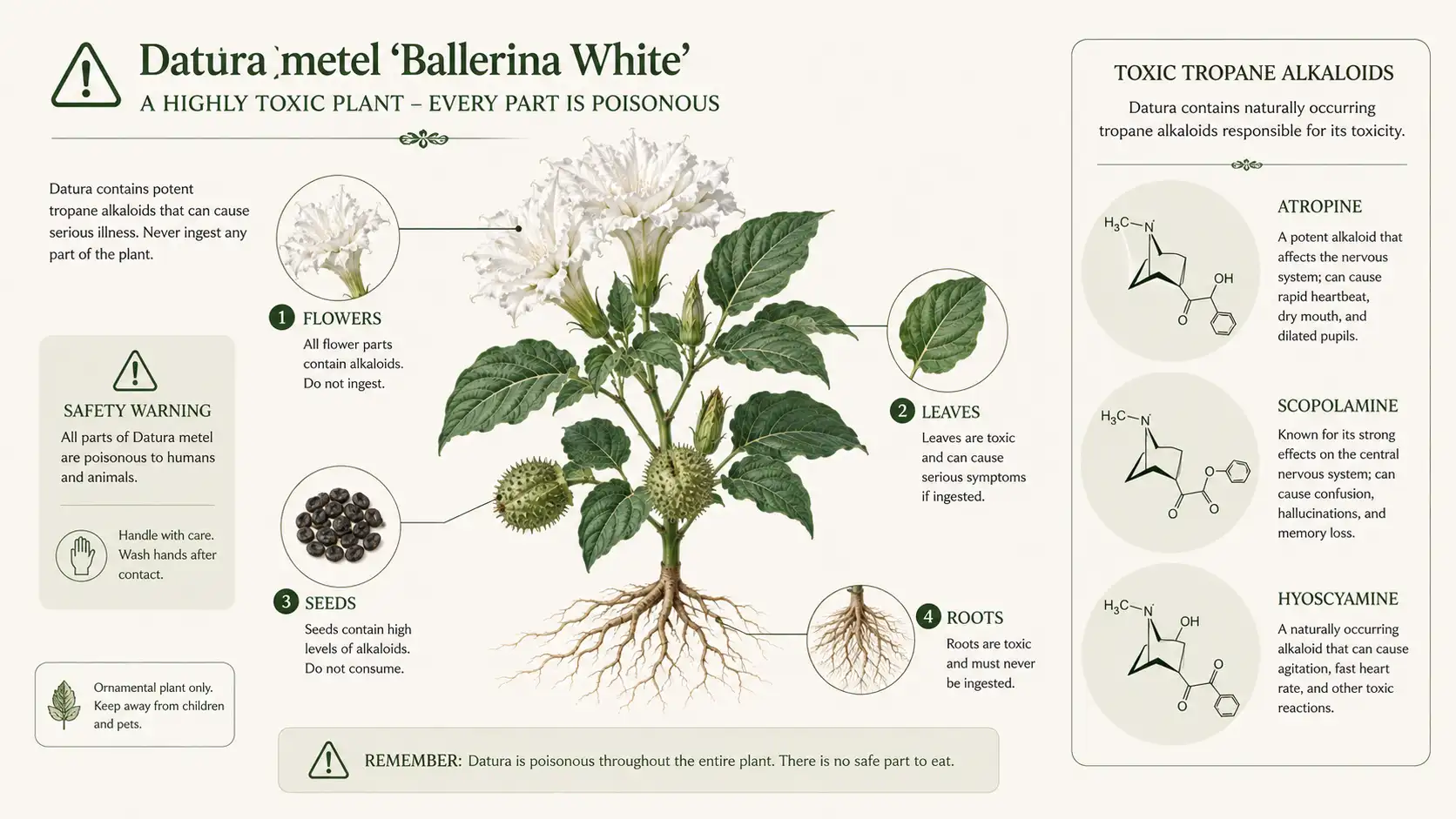
Yes. Datura is poisonous, and all parts of the plant should be considered dangerous if ingested. Datura species contain tropane alkaloids with potent anticholinergic effects, including atropine, scopolamine, and hyoscyamine. North Carolina Extension specifically warns that Datura metel is poisonous and should be handled with extreme caution.
The greatest risk is ingestion, particularly of seeds and other concentrated plant material. However, gardeners should avoid unnecessary exposure to sap or plant debris and should wash their hands after handling the plant.
Datura is not the same thing as scopolamine. Scopolamine is one of the pharmacologically active compounds that can occur in Datura. The plant contains multiple tropane alkaloids rather than being a single drug.
Datura poisoning produces an anticholinergic toxidrome. It is more accurate to describe recreational Datura exposure as poisoning with a potent deliriant effect than as ordinary narcotic use.
Datura Poisoning Symptoms and Treatment
Datura poisoning requires prompt medical assessment because severe anticholinergic poisoning can cause dangerous changes in heart rate, body temperature, mental state, and consciousness. Symptoms can include dilated pupils, dry mouth and skin, rapid heartbeat, hyperthermia, agitation, confusion, hallucinations, urinary retention, seizures, and coma in severe cases.
| Symptom Category | Common Signs |
| Eyes | Dilated pupils, blurred vision |
| Mouth/skin | Dry mouth, dry skin |
| Heart | Rapid heartbeat |
| Temperature | Abnormally high body temperature |
| Brain/behavior | Confusion, agitation, delirium, hallucinations |
| Urinary/GI | Urinary retention, reduced intestinal activity |
| Severe poisoning | Seizures, coma, potentially life-threatening complications |
There is no safe home antidote for Datura poisoning. Treatment depends on the patient’s symptoms and is provided by medical professionals.
Physostigmine may be used in selected severe anticholinergic poisonings under close medical supervision, but it is not a substance to administer at home. Merck notes that physostigmine requires careful clinical selection because inappropriate use can cause serious adverse effects, including seizures.
If Datura has been swallowed or poisoning is suspected, do not wait for symptoms to become severe. Contact a poison service or seek emergency medical care. Poison Control likewise advises obtaining expert help immediately after suspected poisoning rather than guessing about the risk.
What Kills Datura? Safe Removal
The safest way to remove an unwanted Datura plant is careful manual removal while wearing protective gloves, followed by secure disposal that prevents children, pets, and livestock from accessing the plant or seeds.
For small plants:
- Put on gloves and protective clothing.
- Remove the plant carefully from the soil.
- Collect fallen seed capsules and seeds.
- Place plant material in a secure disposal container according to local waste rules.
- Wash hands and tools after handling.
For larger infestations, a locally approved herbicide may be considered according to its label and local regulations. Herbicide is not automatically preferable to manual removal; the appropriate method depends on plant size, location, surrounding vegetation, and local rules.
Do not compost Datura unless local composting guidance specifically permits it and you understand how the facility handles toxic plant material. The goal is to prevent accidental exposure and unwanted reseeding.
Datura in Traditional Use and Folklore
Datura has a long history of traditional, ceremonial, medicinal, and folkloric use, but historical use does not make the plant safe. Different Datura species have been associated with traditional practices in various cultures, including some Indigenous traditions in the Americas and European folklore concerning magic and witchcraft.
Its historical symbolism has included:
- Dreams and altered states.
- Transformation.
- Mystery and deception.
- Death or danger.
- Ritual or spiritual practices.
The chemistry helps explain why Datura developed such a strong place in cultural history. Its tropane alkaloids can profoundly affect the nervous system.
However, there is no reliable basis for using Datura as a home health treatment or testosterone enhancer. Claims that Datura increases testosterone or provides general health benefits should not be treated as established medical facts. The potential for severe poisoning makes experimentation particularly dangerous.
Common Problems, Beginner Mistakes & Troubleshooting
Most Datura growing problems come from inadequate light, poor drainage, cold temperatures, inconsistent moisture, or pest pressure rather than from a need for unusually complicated care.
Yellowing leaves
Yellow leaves can result from several causes, including:
- Overwatering.
- Poor drainage.
- Root stress.
- Nutrient deficiency.
- Natural aging of older leaves.
Check the soil before adding more water. If the soil remains wet for prolonged periods, improve drainage and reduce watering frequency.
Overwatering and root rot
Persistent saturation can deprive roots of oxygen and encourage root decline.
Typical warning signs include:
- Soft or declining roots.
- Persistent leaf yellowing.
- Wilting despite wet soil.
- Poor new growth.
- Unpleasant-smelling soil in advanced cases.
Use a container with drainage holes and a well-drained growing medium.
Aphids, spider mites, and whiteflies
Datura generally has relatively few serious pest problems, but aphids, spider mites, whiteflies, and other sap-feeding insects can occur. Wisconsin Horticulture specifically identifies whiteflies, mealybugs, and spider mites among potential pests.
For help identifying common garden pests before choosing a control method, see our Common Garden Bugs Guide: 12+ Essential ID Tips.
Inspect the undersides of leaves regularly. Early detection makes control much easier.
Slow growth or no blooms
If a plant is healthy but produces few flowers, check:
- Whether it receives enough direct sunlight.
- Whether temperatures are warm enough.
- Whether the roots are waterlogged.
- Whether excessive nitrogen is encouraging foliage rather than balanced growth.
- Whether the plant was recently transplanted or exposed to cold.
Full sun is one of the most important factors for strong flowering.
Common beginner mistakes
The most important mistakes are not merely horticultural.
They include:
- Planting Datura where children or pets can reach it.
- Handling seeds casually.
- Assuming all Datura species have identical growth habits.
- Growing the plant in poorly drained soil.
- Keeping the soil constantly wet.
- Expecting a tender plant to survive hard frost outdoors.
- Allowing seed capsules to mature and spread where unwanted plants could appear.
Conclusion
Datura Ballerina White (Datura metel ‘Ballerina White’) is a striking ornamental cultivar valued for its large, ruffled white trumpet flowers, evening fragrance, and compact Ballerina-series growth habit. It performs best with full sun, warm temperatures, good drainage, and consistent but not excessive moisture, and it can be grown successfully in both garden beds and containers.
Its most important characteristic, however, is not ornamental: Datura is highly poisonous. All parts of the plant should be kept away from children, pets, and livestock, and suspected ingestion requires prompt professional medical or poison-control advice.
FAQs
Will Datura come back every year?
Datura can come back every year in warm, frost-free climates, but Datura Ballerina White is commonly grown as an annual in colder regions. Datura metel can behave as a tender perennial in suitable climates, while freezing temperatures can kill the exposed plant. North Carolina Extension lists it as an annual or herbaceous perennial and gives winter hardiness around USDA Zones 9–10.
Is Datura a narcotic?
Datura is not best classified as a conventional narcotic; it is a poisonous plant containing tropane alkaloids that can cause severe anticholinergic delirium. Atropine, scopolamine, and hyoscyamine can produce confusion, hallucinations, rapid heartbeat, dilated pupils, and other potentially dangerous effects.
Should I get rid of Datura if I have kids or pets?
Removing Datura is a reasonable precaution if children, pets, or livestock can access it, because all parts of the plant are poisonous if ingested. If it is retained, place it in an inaccessible location and handle it carefully.
How long does it take for Datura Ballerina White to bloom from seed?
Datura Ballerina White can flower during the same growing season when started early under favorable warm conditions, but the exact time varies with temperature, light, cultivar, and growing conditions. Commercial information lists approximately 21–28 days for germination under specified conditions and a June–October flowering period.
Can Datura Ballerina White be grown in pots?
Yes, Datura Ballerina White grows well in containers when given adequate drainage, sufficient root space, full sun, and appropriate watering. The Ballerina series is specifically marketed for container production, and plants generally remain more compact when grown in containers than when given unrestricted garden space.
Is Datura the same as scopolamine?
No. Datura is a plant genus, while scopolamine is one of several tropane alkaloids that can occur in Datura. Datura also contains other active alkaloids, including atropine and hyoscyamine, so the plant should not be equated with scopolamine alone.
What is the main antidote for Datura poisoning?
Physostigmine may be used by medical professionals for selected cases of severe anticholinergic poisoning, but it is not a home antidote. Treatment requires professional assessment and supportive care, with physostigmine considered only when clinically appropriate because it can itself cause serious complications.