
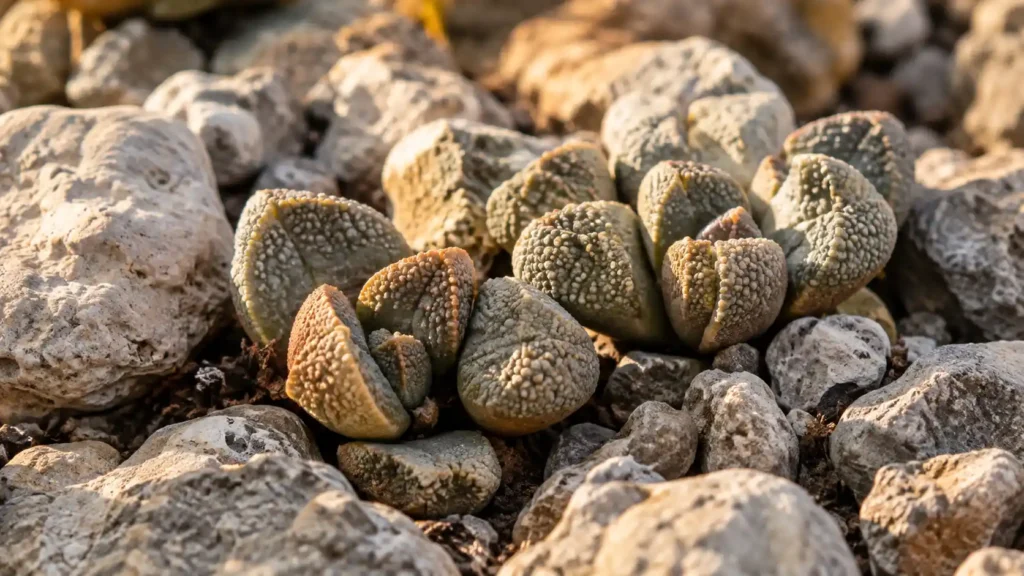
Titanopsis calcareum, commonly called the jewel plant or concrete leaf succulent, is a small South African species in the Aizoaceae family. According to Manuela Nogueira, its gray-green, wart-covered paddle-shaped leaves mimic surrounding limestone and quartz pebbles, camouflaging the plant in rocky habitats across the Cape Provinces, Free State, and Northern Provinces.
First described in 1926 by Rudolf Marloth as Mesembryanthemum calcareum before Gustav Schwantes reclassified it under Titanopsis, the species has since received the Royal Horticultural Society’s Award of Garden Merit. Its evening-opening, honey-scented yellow flowers and tolerance of light frost near 25°F make it a resilient windowsill succulent despite its cryptic wild camouflage.
By Manuela Nogueira | Plant Care & Gardening Expert
Last Updated: August 2026
Quick Summary
- Titanopsis calcareum is a mat-forming, rosette-shaped succulent (family Aizoaceae) with warty, gray-green leaves that mimic stone.
- It needs bright, direct sun, a gritty fast-draining mix, and a strict soak-and-dry watering rhythm, with watering cut back hard during its hottest-weather rest period.
- “Calcareum” and “calcarea” name the same plant, the spelling difference is a nursery-trade variant, not two separate species.
- It’s closely related to, but botanically distinct from, titanopsis schwantesii and titanopsis hugo-schlechteri.
What Is Titanopsis Calcareum?
Titanopsis is a small genus of succulents native to the arid interior of South Africa and southern Namibia, in the family Aizoaceae, the same family as living stones (Lithops) and other “mesembs.” The genus name blends the Greek opsis (“appearance”) with a root most horticultural sources trace to titanos (“lime” or “gypsum”), a nod to the plant’s chalky, rock-like leaf surface; some botanical references instead connect it to Titan, referencing the sun-like look of the flower. Titanopsis calcareum forms low rosettes, typically under 3 inches across, of thick, flattened, spoon- or paddle-shaped leaves capped with rough gray, white, or ochre tubercles. In our experience growing this species outdoors and in containers, the tubercle color intensifies noticeably with stronger light, which is one of the clearest health indicators the plant offers. It shares its Aizoaceae family with other well-known mesembs, including the daisy-flowered Dorotheanthus bellidiformis.
Titanopsis Calcareum vs. Titanopsis Calcarea: Which Spelling Is Correct?
The botanically accepted name is Titanopsis calcarea; “titanopsis calcareum” is a widely used spelling variant seen throughout the nursery trade and on plant tags, and it is formally recognized as a synonym. They are not separate species and not a naming error worth worrying about. The specific epithet calcarea itself simply means “chalky.” If a tag reads either spelling on a small, gray-green, warty rosette succulent, it’s the same plant.
Why It’s Called a “Concrete Leaf” or Mimicry Plant
In its native habitat, titanopsis calcareum grows among limestone outcrops and rocky, gravelly terrain, where typically only the textured leaf tips rise above the surface. Their gray, white, and ochre speckling matches surrounding pebbles closely enough to make the plant nearly invisible to grazing animals, the defining trait of mimicry plants. That same rough, cement-like texture is why mimicry plant care differs from typical succulent care: the plant is adapted to intense light and extended dryness, not the gentler routine many leafy succulents tolerate.
Titanopsis Species Comparison
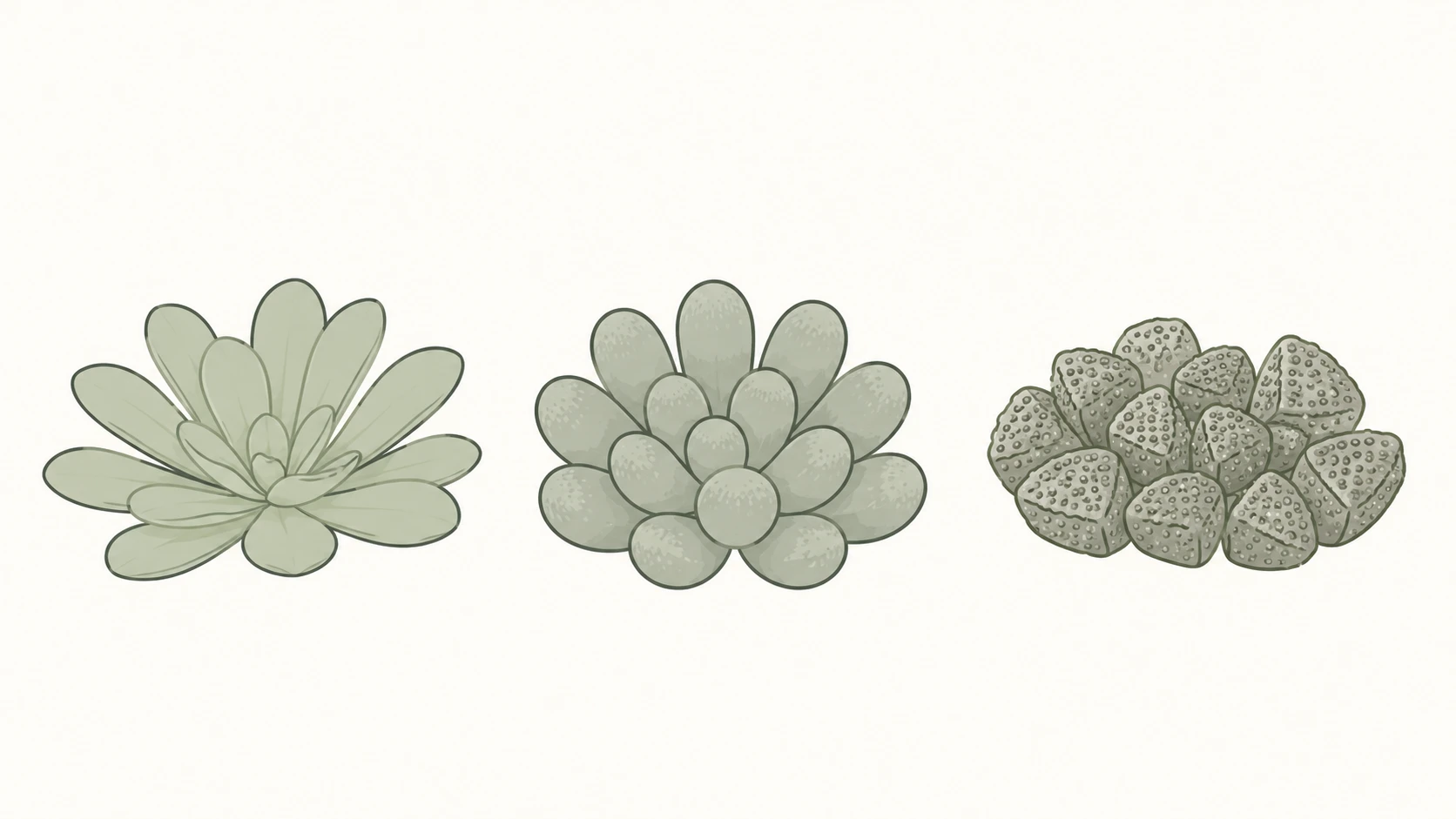
Botanists currently recognize somewhere between three and six Titanopsis species, depending on classification, because several long-used names, including T. fulleri and T. primosii, are now treated by many taxonomic authorities as synonyms or regional variants rather than fully distinct species. This is a genuine point of confusion most care guides skip past. The table below focuses on the names most consistently accepted in current classifications.
| Species | Leaf Shape & Texture | Native Range | Growth Pattern |
| Titanopsis calcarea (incl. calcareum, historically T. fulleri) | Flattened, spoon-shaped, gray-green, heavily warty tips | South Africa: Cape Provinces, Free State, Northern Provinces | Active fall–spring; blooms fall into winter |
| Titanopsis schwantesii (incl. names once listed as T. primosii, T. luederitzii) | Rounder, more club-shaped leaves, pale gray-green | Namibia and border regions of South Africa | Winter-growing group; blooms in spring |
| Titanopsis hugo-schlechteri | Mat-forming, warty tubercles similar to calcarea | Namibia | Similar rocky-habitat mimicry; also holds an RHS Award of Garden Merit |
The practical distinction growers rely on: calcarea-type leaves are flatter and spoon-like, while schwantesii-type leaves read as rounder and more club-shaped.
Titanopsis Calcareum Care Guide

Light Requirements
Titanopsis calcareum needs bright, direct sunlight to hold its natural coloring and compact, warty texture. A south- or west-facing window indoors, or full sun outdoors with light afternoon shade in peak summer heat, works well. Manuela Nogueira recommends increasing light exposure gradually for newly acquired plants, since sudden full sun can scorch leaves that were grown under shadier nursery conditions. If you’re unsure how your window’s light compares, our guide on bright indirect light vs. direct sunlight breaks down the difference.
Watering Needs & Seasonal Dormancy

Use a soak-and-dry method: water thoroughly, then let the soil dry out completely before watering again. Most water goes to the plant during its fall and spring growing periods; watering is cut back sharply during the hottest stretch of summer, when the plant rests, and reduced further in winter to avoid cold, wet roots. Watering by soil dryness rather than a fixed calendar is the single most important habit for this species. This soak-and-dry rhythm is similar to what other drought-adapted succulents need, see our String of Pearls watering guide for a comparable example.
Soil & Potting Mix
Use a mineral-heavy, fast-draining blend: a cactus or succulent mix cut with 50–70% coarse sand, pumice, or perlite. Titanopsis calcarea soil should never stay wet, since standing moisture around the roots quickly leads to rot. As of 2026, many experienced growers favor pumice over perlite in long-term pots, since pumice doesn’t float to the surface or break down with repeated watering the way perlite can.
Temperature & Hardiness Zone
Titanopsis calcareum tolerates warm, dry conditions well and is commonly cited as hardy in roughly USDA zones 9a–11b outdoors in frost-free, dry climates. Cold tolerance depends heavily on dryness, the plant handles brief chill far better than cold, wet soil.
Fertilizing
Fertilizer is rarely necessary. If used at all, apply a diluted, balanced fertilizer sparingly during active growth; overfeeding causes more problems than skipping it entirely.
Plant Size & Growth Rate
Typical Mature Size (Indoor vs. Outdoor)
Individual rosettes typically stay under 3 inches in diameter, though the plant clumps and spreads over time both indoors and outdoors, given enough light and root space. Outdoor plants in ideal rocky, sunny sites tend to form denser, wider mats than container-grown specimens. Container size plays a real role here too, see does pot size affect how fast a plant grows for how root space shapes growth rate.
Growth Rate & Seasonal Growth Pattern
Titanopsis calcareum is slow-growing year-round, with most visible growth concentrated in its non-dormant fall and spring windows. Slow growth is normal, not a warning sign, as long as the plant stays firm and well-colored.
How to Propagate Titanopsis Calcareum
Propagation From Seed
Collect seed from dried flower pods, sow on the surface of a well-draining mix, and cover lightly with sand or fine grit. Keep the mix lightly moist until germination, which can take one to four weeks; seedlings typically begin flowering after about two years.
Propagation From Offsets/Division
Because titanopsis calcareum has a thick, semi-tuberous root system, mature clumps can sometimes be divided, though offsets form slowly compared with many other succulents. Gently separate rooted offsets, let the cut ends callous for a day or two, then pot in dry, gritty soil and water sparingly until new growth confirms rooting.
Common Titanopsis Calcareum Problems
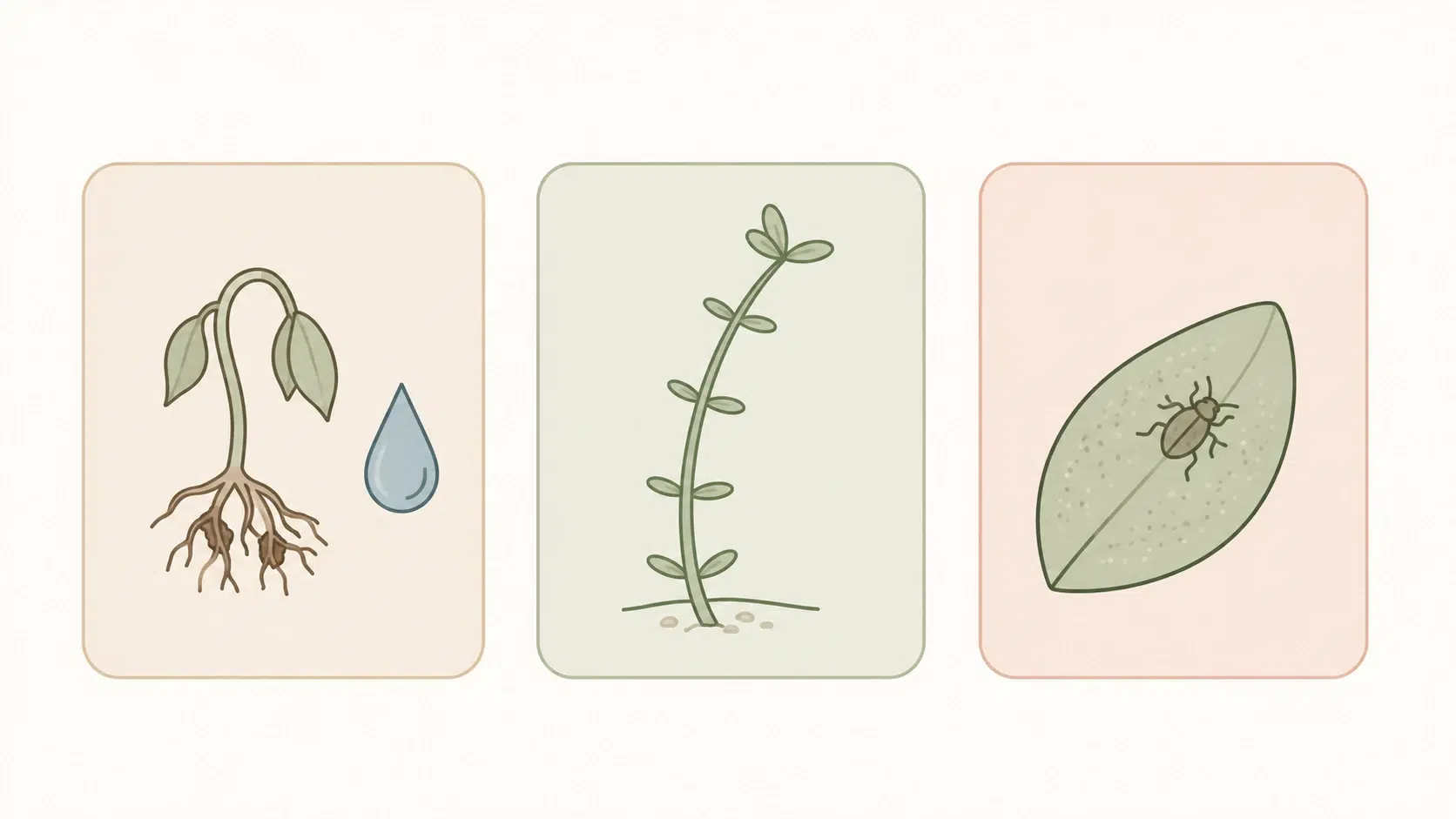
Overwatering / root rot: Happens when soil stays wet, especially during the summer rest period. Fix by letting the soil dry fully and trimming any mushy roots. Prevent by watering only when the pot is completely dry. The warning signs mirror overwatering symptoms in other houseplants, our overwatered coffee plant guide covers the same root-rot progression in more depth.
Stretching (etiolation) and color loss: Caused by insufficient light. Fix by gradually moving the plant into brighter, more direct sun. Prevent by keeping it in a south-facing window or full outdoor sun most of the year.
Pests (mealybugs): Can settle into leaf crevices. Fix with isopropyl alcohol on a cotton swab or an appropriate insecticidal soap. Prevent by inspecting new plants before adding them to a collection.
Beginner Mistakes to Avoid
- Watering on a fixed schedule instead of checking soil dryness first
- Using regular potting soil instead of a gritty, mineral-based mix
- Treating it like a leafy houseplant that wants consistent moisture
- Assuming dim indoor light is “good enough” because the plant is small
- Confusing dormancy for decline and increasing water in response
- Mixing it up with Lithops or other stone-mimicry succulents, which follow different watering windows
Conclusion
Titanopsis calcareum is a low-maintenance but detail-sensitive succulent: its stone-like camouflage, dormancy cycle, and drought tolerance all trace back to its rocky South African habitat. Success comes down to three constants, bright direct light, gritty fast-draining soil, and disciplined, season-aware watering. Whether it’s labeled titanopsis calcarea, the concrete leaf plant, or simply a mimicry succulent, respecting its natural rhythm is what keeps titanopsis calcareum healthy and true to form.
FAQs
Is titanopsis calcareum the same plant as titanopsis calcarea?
Yes. “Calcareum” and “calcarea” are spelling variants of the same species; they are not different plants.
How often should you water titanopsis calcareum?
Only after the soil has dried out completely, with watering reduced sharply during its hottest-weather rest period and again in winter cold.
Why is my titanopsis calcareum losing its color or stretching?
This is almost always a light problem. Move it to brighter, more direct sunlight to restore its color and compact shape.
Can titanopsis calcareum grow indoors?
Yes, provided it gets very bright light, ideally from a south- or west-facing window, along with gritty, fast-draining soil.
How long does titanopsis calcareum take to flower?
Plants grown from seed typically take about two years before they begin flowering.
Can you propagate titanopsis calcareum from a single leaf?
It’s better propagated from seed or by dividing rooted offsets; single-leaf propagation is not the reliable method for this genus.



One Response