
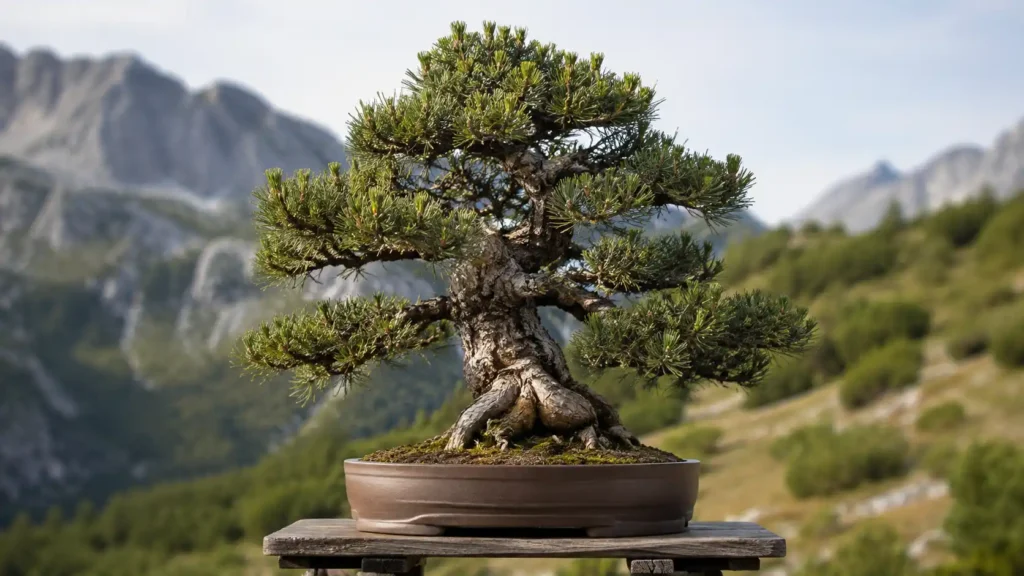
According to Manuela Nogueira, Pinus mugo (mugo pine) is favored for bonsai due to its compact growth, short needles, and rugged bark, suiting windswept, informal upright, or literati styles. It thrives in full sun, well-draining soil, and cold climates (USDA zones 2–7), requiring minimal watering and careful, infrequent wiring since its branches are brittle.
Unlike Japanese black pine, mugo pine back-buds poorly on old wood, so growers thin new shoots selectively rather than relying on heavy candle-pruning to build ramification. Nogueira also notes it resents aggressive root pruning, making repotting best spaced three to four years apart, done in early spring before candles extend.
Quick Summary
- Pinus mugo is a cold-hardy, evergreen European pine that can make an excellent outdoor bonsai.
- Its naturally dense, irregular growth and strong response to candle management make it suitable for compact bonsai training.
- The species can become a substantial landscape plant, so a bonsai remains small because of deliberate root, shoot, and container management—not because every mugo pine is naturally miniature.
- Mugo pine is generally treated as a single-flush pine in bonsai; candle shortening is more appropriate than blindly applying Japanese black pine-style full decandling.
What Is a Mugo Pine?
Pinus mugo is an evergreen conifer in the pine family, Pinaceae, native primarily to mountainous areas of central and southern Europe. It is commonly called mugo pine, mountain pine, or Swiss mountain pine. For additional botanical background, see the Pinus mugo entry on Wikipedia.
The term mugo pine therefore does not automatically mean a miniature or dwarf plant. Some cultivated forms are genuinely compact, while the species itself can become approximately 15–20 feet tall and 25–30 feet wide under suitable landscape conditions. Some botanical forms and specimens can become substantially larger.
For bonsai, this variability is useful because the grower can select material with desirable characteristics such as:
- Shorter needles
- Dense branching
- Interesting trunk movement
- Strong buds and candles
- Naturally rugged bark
- Low, spreading growth
- Existing deadwood or weathered branches
The needles are typically carried in pairs, and the foliage remains evergreen. Mugo pine’s mountain origin also explains its tolerance of cold, exposed conditions and relatively lean, well-drained soils.
The names mugo, Pinus mugo, and mountain pine can therefore refer to the same species in ordinary horticultural usage, while terms such as Pumilio and Mops identify particular cultivated forms rather than separate pine species.
Mugo Pine vs. Dwarf Mugo Pine — What’s the Difference?
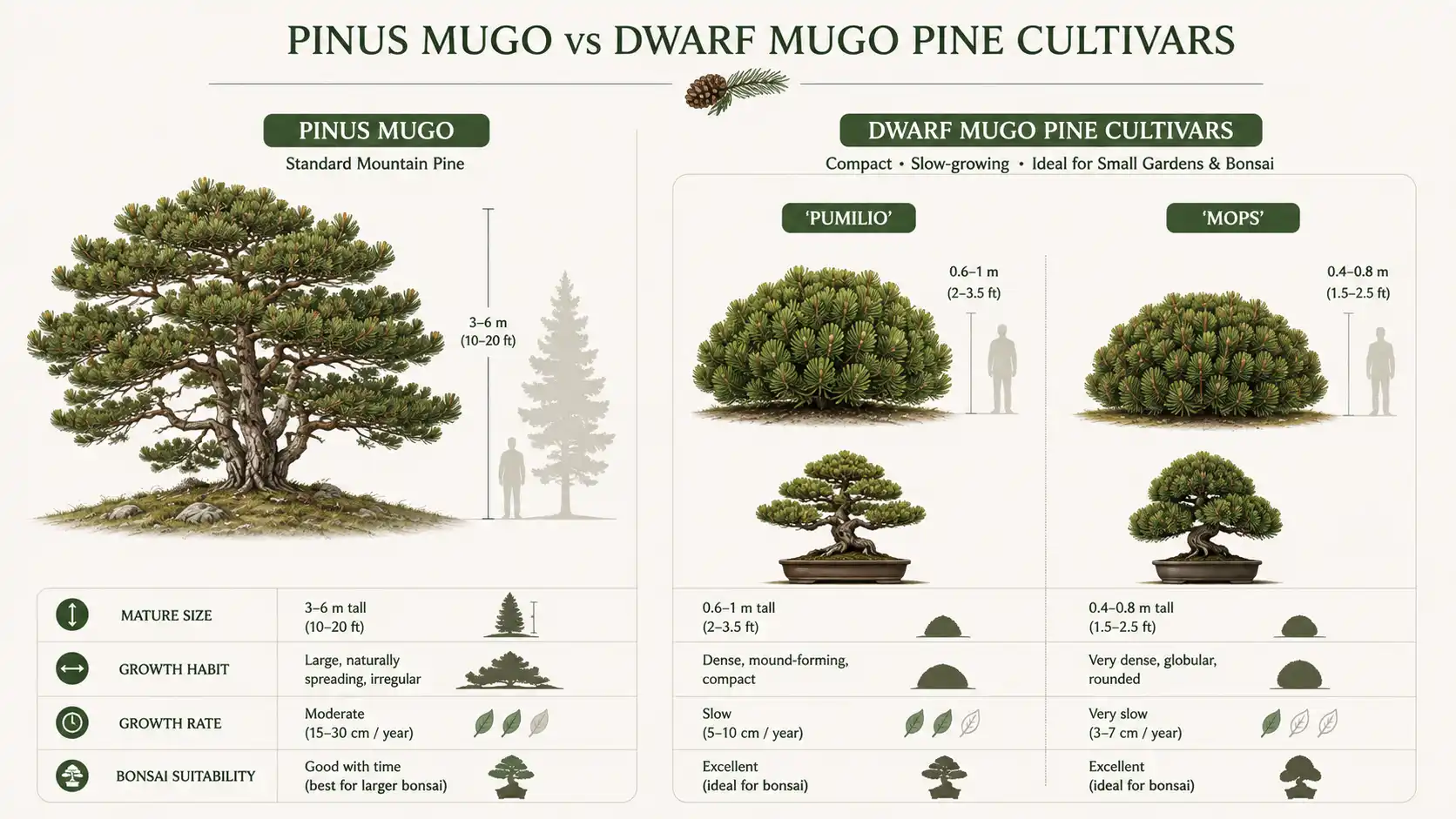
The key distinction is that Pinus mugo is the species, whereas dwarf mugo pines are selected cultivars or cultivated groups within that species.
This matters when buying bonsai material. A plant labeled simply Pinus mugo may eventually become much larger than a plant labeled Pinus mugo ‘Mops’. Choosing a compact cultivar can reduce the amount of long-term size control required, although bonsai training can be performed on many forms.
| Type | Typical mature size | Growth character | Bonsai suitability |
| Pinus mugo species | About 15–20 ft tall; often broader than tall | Variable | Excellent when suitable material is selected |
| ‘Pumilio’ Group | About 2.5–4 m tall and 4–8 m wide in RHS data | Low, spreading | Useful for compact, rugged material |
| ‘Mops’ | About 0.5–1 m according to RHS | Slow, rounded, bushy | Very suitable for small bonsai and containers |
| ‘Winter Gold’ | About 1–1.5 m tall and 1.5–2.5 m wide | Compact; winter foliage becomes golden | Suitable where seasonal foliage color is desirable |
The RHS lists ‘Mops’ as a slow-growing, rounded evergreen with a mature height and spread of roughly 0.5–1 m, while its Pumilio Group is considerably broader. ‘Winter Gold’ is another compact form with foliage that develops a golden-yellow winter color.
If the question is “What is the smallest dwarf mugo pine?”, the answer depends on the cultivar and what is commercially available. ‘Mops’ is a well-known compact form, while extremely dwarf selections such as ‘Teeny’ can remain only around 10–12 inches tall and wide after about ten years under the conditions described by Missouri Botanical Garden.
Can You Bonsai a Mugo Pine?
Yes, mugo pine can be successfully trained as bonsai, and its cold hardiness, dense growth, rugged appearance, and responsiveness to pine-training techniques make it a strong choice for outdoor bonsai. Missouri Botanical Garden specifically lists Pinus mugo among plants suitable for bonsai, while bonsai specialists identify mugo pine as one of Europe’s useful native pine species for bonsai.
A mugo pine is not automatically bonsai-sized. Bonsai is a horticultural training process that combines container restriction, root management, pruning, wiring, selective shoot development, and long-term seasonal care.
Why Mugo Pine Works Well for Bonsai
Several characteristics make mugo pine particularly useful:
- Cold tolerance
Mugo pine is adapted to mountainous European environments and is much better suited to outdoor winter conditions than tropical or subtropical bonsai. Depending on cultivar and climate, horticultural references place mugo pine broadly in cold-hardiness zones around 2–7.
- Dense, naturally rugged growth
The species commonly develops a bushy, multi-stemmed or broad-rounded structure. That gives a bonsai artist material for creating compact pads, irregular silhouettes, and weathered-looking forms.
- Strong response to candle management
Mugo pine produces conspicuous spring candles—the elongating shoots that carry the current season’s growth. Selectively shortening these candles can control extension and redistribute growth within the tree.
- Suitable trunk and branch character
Older mugo pines can develop rugged trunks and naturally weathered branches. This lends itself well to informal upright, slanting, windswept, and rugged naturalistic bonsai designs.
Like other bonsai species, including jade bonsai, successful training depends on balancing container culture, pruning, light, and long-term growth management.
How Big Does Pinus mugo Get?
An untrained Pinus mugo can commonly reach about 15–20 feet tall and 25–30 feet wide in landscape conditions, although the species is highly variable and some forms remain much smaller. Its ultimate size depends strongly on genetics, cultivar, climate, soil, light, and available root space.
This is an important distinction because the phrase “mugo pine” is sometimes incorrectly treated as synonymous with “dwarf pine.” The species contains both larger and genuinely dwarf forms.
Plant Size
A landscape mugo pine has access to considerably more root volume than a bonsai. In a bonsai container, root restriction and regular pruning prevent the plant from expressing its full landscape size.
A healthy mugo bonsai may remain relatively small for decades when its growth is managed appropriately. However, container culture does not mean the tree should be severely starved. The objective is controlled growth, not chronic stress.
Mugo pine is generally an outdoor bonsai, not an indoor bonsai. It needs strong light and a natural seasonal cycle, including winter dormancy. Keeping it permanently indoors can deprive the tree of the environmental cues and temperatures it requires. Container culture can significantly influence the eventual size and growth habit of woody plants, which is why choosing the right tree and container combination matters.
Factors that influence eventual size include:
- Cultivar genetics
- Container volume
- Root pruning and repotting
- Amount of sunlight
- Fertilizer availability
- Water availability
- Candle management
- Length of the growing season
- Overall tree health
Growth Rate
Mugo pine is generally slow to moderate in growth, but the rate varies substantially between cultivars. For example, Missouri Botanical Garden describes ‘Mops’ as very slow-growing at roughly 2–4 inches per year, while ‘Teeny’ may grow around 1 inch per year.
The seasonal growth pattern is more important for bonsai than a simple annual growth-rate figure. Because available root volume can influence plant vigor, container size is an important part of managing growth in bonsai.
In spring, new shoots emerge as candles. These extend rapidly before the needles mature and the new growth hardens. Bonsai training takes advantage of this predictable growth phase.
Growth can accelerate with:
- Full sunlight
- Adequate water
- Balanced nutrition
- Warm but suitable temperatures
- A healthy root system
- A sufficiently long growing season
Growth can slow because of:
- Excessive shade
- Root problems
- Poor drainage
- Severe root restriction
- Nutrient deficiency
- Repeated drought stress
- Excessive pruning
Mugo Pine Growing Conditions
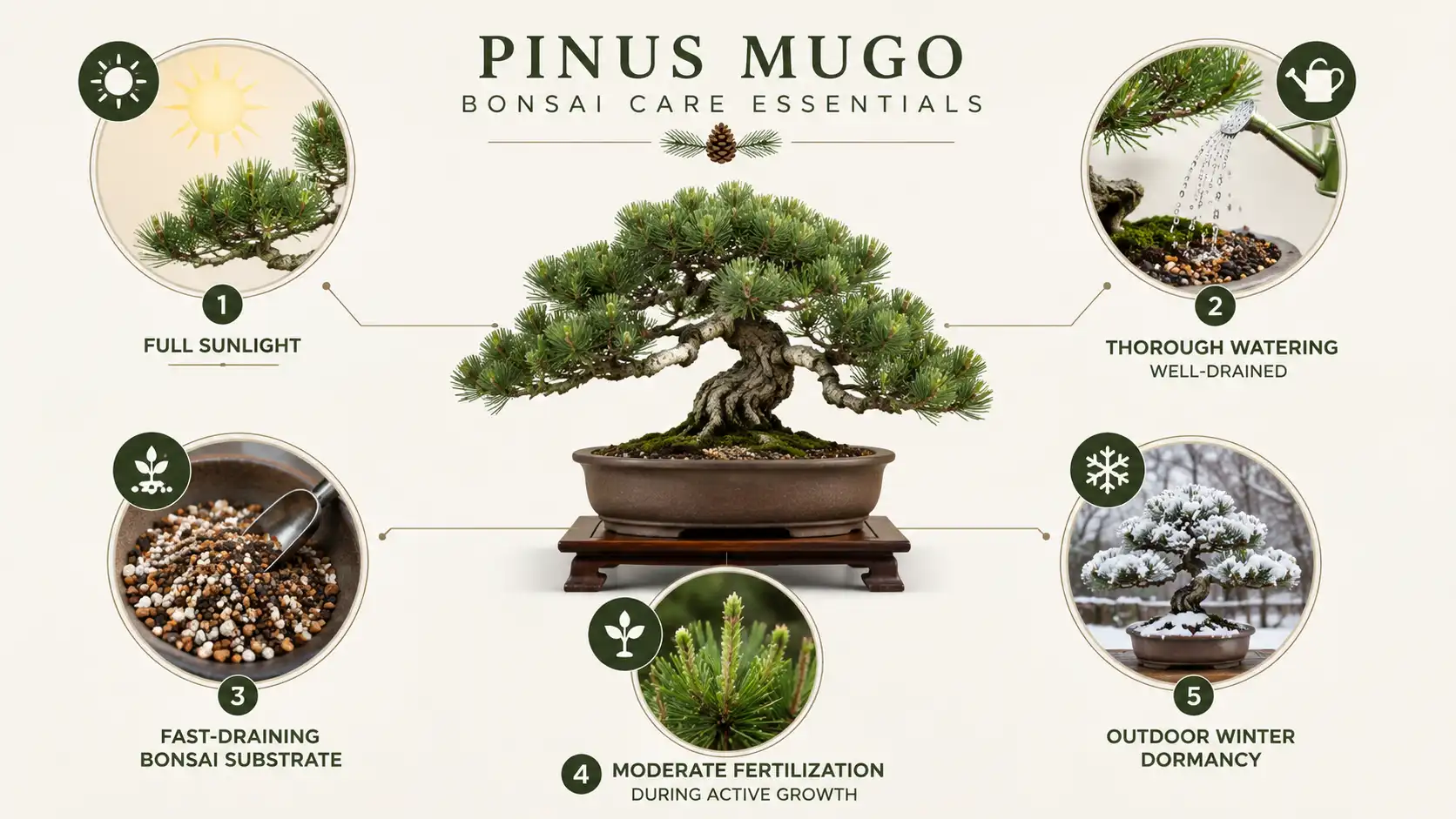
Mugo pine grows best outdoors in full sun, in a well-drained growing medium, with moderate moisture and excellent drainage. These principles are part of the broader approach to understanding plant care, growing conditions, and long-term cultivation covered in our Plants: Benefits and Guides resource. It tolerates relatively dry conditions once established but performs poorly when its roots remain continuously waterlogged.
For bonsai, drainage is especially important because a small container can become saturated quickly after watering.
Care Guide
| Care factor | Requirement | Practical bonsai note |
| Light | Full sun preferred | Strong light helps maintain compact growth |
| Water | Moderate; allow appropriate drainage | Water thoroughly when the substrate requires it, then drain completely |
| Soil | Very well-drained | Use an open bonsai substrate that does not stay saturated |
| Fertilizer | Moderate feeding | Avoid excessive nitrogen that produces weak, overly vigorous shoots |
| Pruning | Seasonal and selective | Focus on candles and structural decisions rather than indiscriminate shearing |
| Winter | Outdoor dormancy | Protect the container from extreme root-freezing where necessary |
| Humidity | Normal outdoor conditions | Constant indoor humidity is unnecessary |
| Container | Bonsai pot with drainage | Root volume controls growth but should not eliminate healthy root function |
Mugo pine tolerates both acidic and alkaline soils, but bonsai culture requires more attention to physical drainage than simply choosing a particular soil pH. Virginia Cooperative Extension describes the plant as tolerant of dry and alkaline soil and recommends full sun with average-to-dry moisture. These same fundamentals—appropriate light, controlled watering, suitable soil, and balanced nutrition—are central to maintaining healthy container-grown trees.
Watering: Do not use a fixed daily schedule as the sole rule. Check the substrate and the tree’s environmental conditions. During active growth, a bonsai exposed to strong sun and wind may need substantially more water than one in cool, cloudy weather.
Soil: Avoid dense garden soil in a shallow bonsai container. An open, free-draining bonsai medium allows oxygen to reach the roots while excess water drains away.
Fertilization: Mugo pine is not a heavy feeder, but bonsai in containers have limited nutrient reserves. Moderate feeding during active growth supports healthy development. Excessive high-nitrogen feeding can push long, coarse growth that works against refinement.
Roots: Mugo pine can live successfully in containers, but bonsai root systems need periodic management. Repotting should be performed according to the tree’s condition, root density, substrate breakdown, and climate rather than following an arbitrary calendar.
Evergreen foliage: Mugo pine remains evergreen. Needle color may vary seasonally, and some cultivars can develop yellow or golden winter tones. ‘Winter Gold’, for example, develops golden-yellow foliage during winter.
Lifespan: A healthy pine can be a long-lived bonsai when its roots, foliage, and seasonal growth are maintained correctly. There is no simple fixed lifespan for a mugo bonsai because longevity depends on genetics, cultivation, disease pressure, and the quality of long-term care.
Invasiveness: Mugo pine is widely cultivated as an ornamental plant and is not generally treated as a major invasive species across its horticultural range. However, invasive status is location-specific, so local plant regulations should always take precedence over a general statement.
Pruning and Styling Mugo Pine Bonsai
Mugo pine bonsai should be pruned selectively according to the tree’s strength and seasonal growth rather than treated like a hedge. The most important annual growth-control technique is managing spring candles, while structural pruning and wiring should be timed around the tree’s growth cycle.
One important correction to common online advice is that mugo pine should not automatically be treated like Japanese black pine and fully decandled. Mugo is generally considered a single-flush pine in bonsai practice. The goal is usually to shorten or selectively remove portions of candles while retaining enough current-year growth to keep branches alive. The same broader bonsai principles of branch selection, wiring, pruning, and maintaining a balanced silhouette also apply to other established bonsai species such as Chinese elm.
When to Prune a Mugo Pine
The exact calendar varies by climate, so the development stage of the candle is more reliable than a fixed date.
A practical sequence is:
- Spring: Allow new candles to extend and assess relative vigor.
- Late spring to early summer: Shorten suitable candles while they are still soft and actively growing.
- Late summer to autumn: Perform appropriate structural refinement and needle management according to tree strength and local climate.
- Dormant season: Wiring and major structural decisions can be appropriate, provided the tree is healthy and local winter conditions are considered.
Bonsai specialists recommend allowing the spring candles to develop and then shortening them once the new growth has matured enough to respond predictably. Bjorn Bjorholm’s European pine guide recommends candle cutting around early to mid-June in northern-hemisphere conditions, while Bonsai4Me emphasizes that mugo candles should be managed according to individual candle vigor rather than applying an identical cut to every shoot.
How to Prune and Style for Bonsai Form
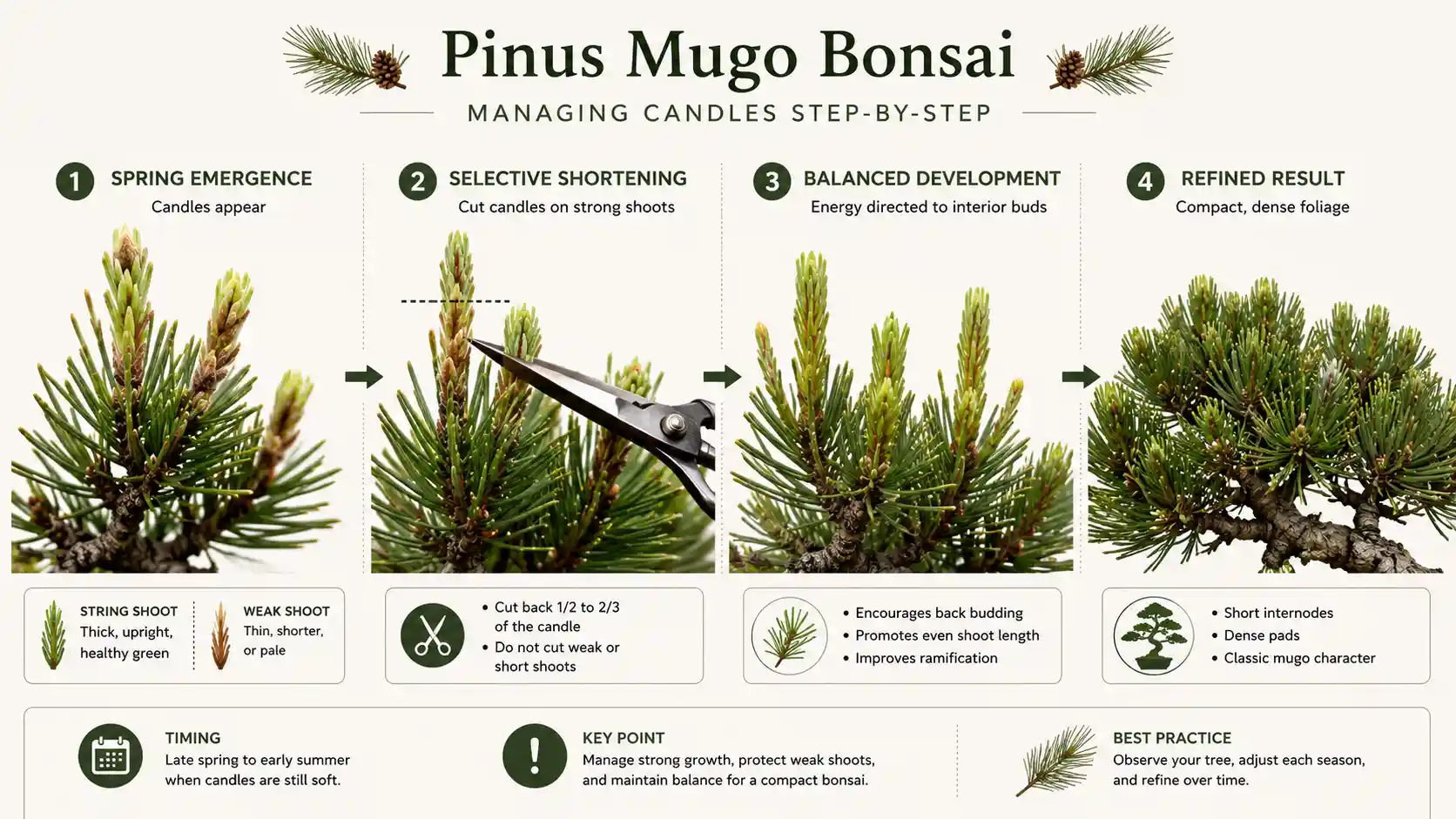
Candle-pinching: Identify the current-season candles and compare their strength. Strong extension shoots can be shortened to control vigor and maintain compact growth. Weak shoots may need to be left longer so they can gain strength.
Do not remove every candle indiscriminately. A branch that needs extension should generally be allowed more growth than an already-strong branch.
Branch selection: When several shoots emerge from one point, avoid allowing excessive clusters to develop into weak, congested branch structures. Select branches according to their direction, strength, and position.
Wiring: Mugo pine branches can be wired to create movement and improve branch placement. Wire should be monitored regularly because growing branches can thicken around wire surprisingly quickly.
Deadwood: Jin and other deadwood techniques can complement mature mugo pine because the species naturally lends itself to rugged, weather-exposed designs. Deadwood should be created conservatively and allowed to look consistent with the tree’s age and structure.
Needle management: Selective removal of older needles can improve light penetration into interior shoots, but excessive needle removal reduces the tree’s photosynthetic capacity. The objective is balance, not maximum foliage reduction.
The Rule of Three in Bonsai
The “rule of three” is a design principle rather than a universal botanical rule. In pine bonsai, branch structure is often simplified by selecting a limited number of visually useful branches at each important trunk level instead of allowing symmetrical clusters of competing shoots.
A common visual arrangement uses:
- A primary branch that establishes the first major layer.
- A secondary branch that creates depth or directional balance.
- A rear or back branch that adds visual depth.
This should not be interpreted as a rigid requirement that every mugo pine must have exactly three branches at every level. Good bonsai design depends on trunk movement, viewing angle, species characteristics, branch thickness, negative space, and the tree’s natural growth.
For mugo pine, a naturalistic structure is often more convincing than forcing every branch into a perfectly symmetrical three-part pattern.
What Pairs Well with Mugo Pine?
Mugo pine pairs best with plants and design elements that reinforce its alpine, rocky, or naturalistic character without competing with its compact evergreen structure.
For landscape planting, suitable companions can include:
- Low-growing alpine perennials
- Rock-garden plants
- Creeping groundcovers
- Ornamental grasses suited to the same light and drainage
- Hardy dwarf conifers
- Stone and natural rock
For bonsai display, the companion should remain visually subordinate. A small accent plant, moss arrangement, or understated stand can reinforce the tree without distracting from the trunk and foliage.
The most important compatibility factors are similar light, watering, drainage, and climate requirements. Avoid combining a mugo pine with a companion that demands permanently wet soil.
Common Mugo Pine Bonsai Problems and Fixes
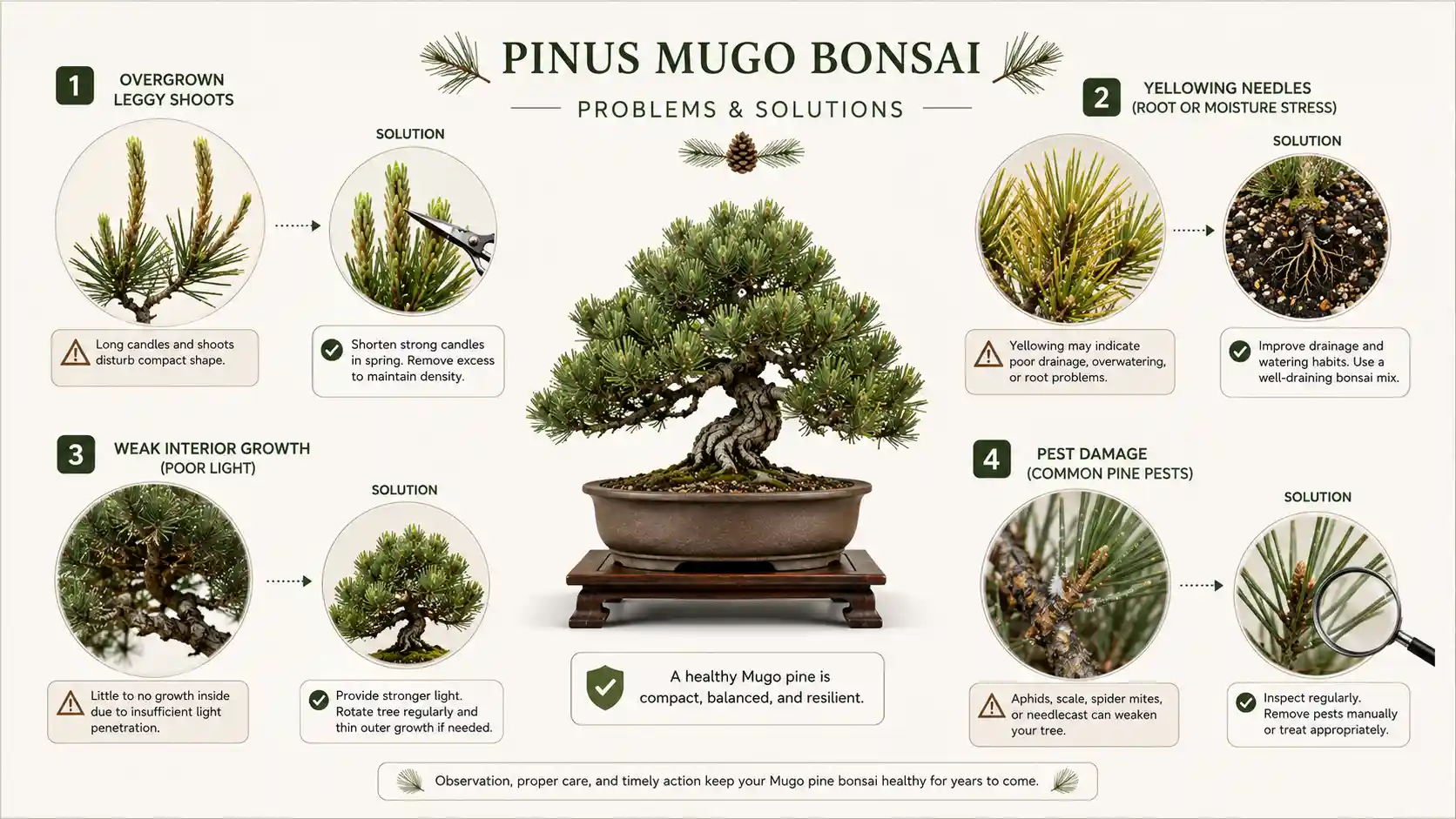
Overgrown or leggy growth: This usually develops when vigorous shoots are allowed to extend unchecked, light is insufficient, or the tree is repeatedly fertilized without corresponding structural management. Move the tree into stronger light where appropriate, improve branch selection, and manage new candles rather than cutting indiscriminately into bare old wood.
Yellowing needles: Some needle yellowing can be seasonal, especially as older needles age. However, widespread or abnormal yellowing can indicate root stress, poor drainage, drought, nutrient problems, pests, or disease. Mugo pine should not be kept permanently wet.
Slow or stalled growth: First check light, roots, drainage, watering, and nutrition. A newly repotted tree may also require recovery time. Avoid responding to slow growth by immediately applying excessive fertilizer or performing more aggressive pruning.
Weak interior branches: Interior growth may decline when dense outer foliage blocks light. Selective needle and shoot management can improve light penetration, while maintaining sufficient foliage to support the branch.
Pests: Mugo pine can be affected by pests including pine needle scale, sawflies, conifer aphids, adelgids, and pine shoot moths. Disease problems can include needle casts, rusts, rots, and tip blight.
When diagnosing a pest problem, inspect the needles, shoots, bark, and branch junctions rather than treating the entire tree based only on yellowing foliage.
Beginner Mistakes to Avoid With Mugo Pine Bonsai
The most damaging mistakes usually come from misunderstanding how a cold-hardy pine grows.
- Keeping it indoors
Mugo pine is an outdoor conifer. A bright indoor windowsill cannot reproduce the seasonal conditions of its natural growth cycle.
- Overwatering
Pines tolerate periods of relatively dry soil better than continuously saturated roots. Poor drainage is especially dangerous in a shallow bonsai pot.
- Applying Japanese black pine techniques without modification
Mugo pine should not automatically receive full decandling simply because another pine species responds to it. European single-flush pines have different growth behavior.
- Removing every candle
Strong and weak shoots should not always receive identical treatment. Selective candle management helps balance the tree.
- Cutting deep into bare wood
Pines generally have limited ability to regenerate from completely bare old sections. Before making a major cut, identify where viable buds or foliage remain.
- Wiring too aggressively
Mugo pine can be shaped, but branches should be bent progressively. Excessive force can split branches or damage the cambium.
- Removing too much foliage
Needles are the tree’s photosynthetic machinery. Severe needle removal can weaken a branch and reduce the tree’s ability to recover.
- Ignoring winter root protection
The foliage may tolerate severe cold better than roots confined inside a small bonsai pot. In very cold climates, the container may require protection from extreme freezing while still remaining outdoors.
- Treating every mugo as a dwarf
A label reading Pinus mugo does not guarantee a miniature plant. The species is highly variable, and some forms become large landscape shrubs or trees.
- Pruning by calendar alone
Climate changes the timing of candle development. Watch the tree’s actual growth stage rather than blindly following a date from another climate.
Conclusion
Pinus mugo bonsai is a strong choice for outdoor bonsai because mugo pine combines cold hardiness, evergreen foliage, rugged structure, dense branching, and manageable seasonal growth. The species itself is not necessarily dwarf: untrained plants can become substantial landscape specimens, while dwarf cultivars such as ‘Mops’ are naturally much smaller.
Successful cultivation depends on treating mugo pine as a living conifer rather than simply a miniature tree. Give it strong outdoor light, excellent drainage, appropriate watering, moderate nutrition, winter dormancy, and enough root space to remain healthy. For refinement, selectively manage spring candles, balance strong and weak areas, wire carefully, and avoid removing all foliage or cutting blindly into bare wood.
With consistent seasonal care, a healthy pinus mugo bonsai can remain compact and structurally attractive for many years while developing the rugged character that makes mature pine bonsai distinctive.
Frequently Asked Questions
Can you bonsai a mugo pine?
Yes, mugo pine can be successfully grown and trained as bonsai. Its cold hardiness, dense growth, rugged branching, and responsiveness to candle management make it well suited to outdoor bonsai culture. Missouri Botanical Garden specifically lists Pinus mugo as suitable for bonsai.
How big does Pinus mugo get if left untrained?
An untrained Pinus mugo commonly reaches about 15–20 feet tall and 25–30 feet wide, although size varies substantially among plants and cultivars. Some mugo forms remain low and spreading, while others develop into much larger trees.
Do mugo pines do well in pots long-term?
Yes, mugo pines can live in containers long-term when they receive adequate light, drainage, water, nutrition, and periodic root management. Bonsai containers restrict root volume and therefore help control size, but excessive root restriction or neglected repotting can eventually reduce vigor.
When should you trim a mugo pine for bonsai shaping?
The main candle-trimming period is generally late spring to early summer, when the current-season shoots are actively extending and still soft. Exact timing depends on climate and the tree’s development stage. Structural pruning and wiring are handled separately and should not be confused with candle shortening.
What is the difference between a mugo pine and a dwarf mugo pine?
Mugo pine (Pinus mugo) is the species, while a dwarf mugo pine is a selected compact cultivar or cultivated group within that species. For example, ‘Mops’ is a dwarf cultivar that remains far smaller than the typical species form.
Is mugo pine invasive or safe to grow in containers?
Mugo pine is widely grown as an ornamental conifer and is generally not considered a major invasive plant across most of its horticultural range. However, invasive status can vary by location, so local regulations should be checked. Growing it in a container also prevents the root-spreading behavior associated with landscape planting.
What is the rule of three in bonsai styling?
The rule of three is a visual design principle used to create balanced, natural-looking branch structure rather than a strict biological rule. It can involve arranging primary, secondary, and rear branches to create direction and depth, but a mugo bonsai does not need exactly three branches at every level.