
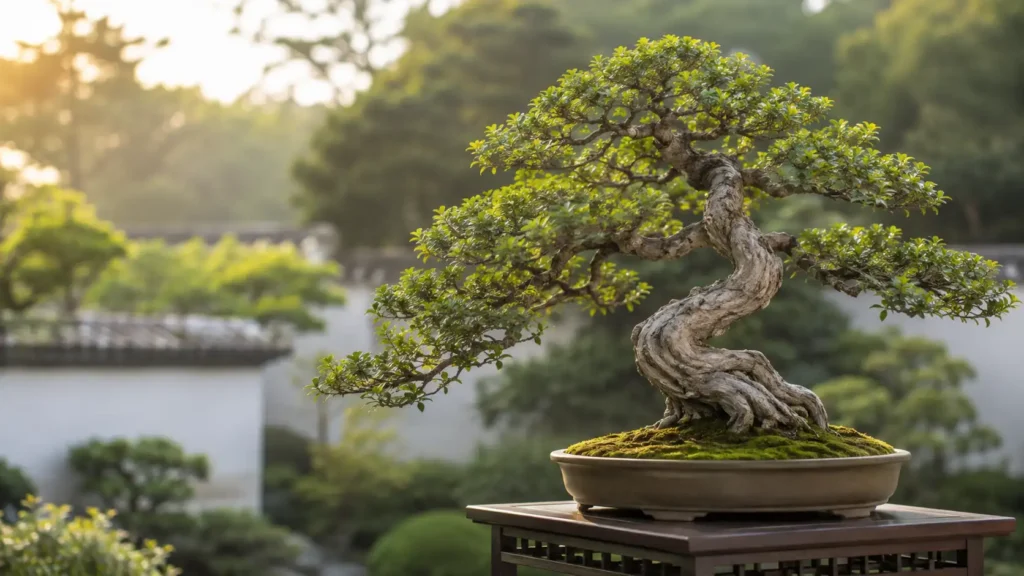
Chinese Elm (Ulmus parvifolia) is one of the most popular bonsai species, prized for its small leaves, fast growth, and adaptability to both indoor and outdoor settings. According to Manuela Nogueira, it tolerates aggressive pruning, develops corky bark and fine ramification quickly, and suits beginners due to its forgiving, resilient nature.
Chinese Elm is technically semi-deciduous, shedding leaves during cold snaps rather than on a fixed seasonal schedule, and dwarf cultivars such as ‘Seiju’ or ‘Yatsubusa’ offer even finer leaf reduction than the species type. It is particularly prone to scale insects and spider mites in dry indoor air, and its flexible trunk lends itself well to clump, forest, and exposed-root styling rather than formal upright forms alone.
Quick Summary
- Chinese Elm bonsai (Ulmus parvifolia) is a hardy, beginner-friendly bonsai species valued for its fine branches, small leaves, and attractive bark.
- Best results come from bright light, consistent watering, well-draining soil, and regular pruning.
- It is a fast-growing bonsai that can live for decades when properly maintained.
- One of its greatest strengths is its ability to tolerate pruning and recover well from routine maintenance.
What Is a Chinese Elm Bonsai?
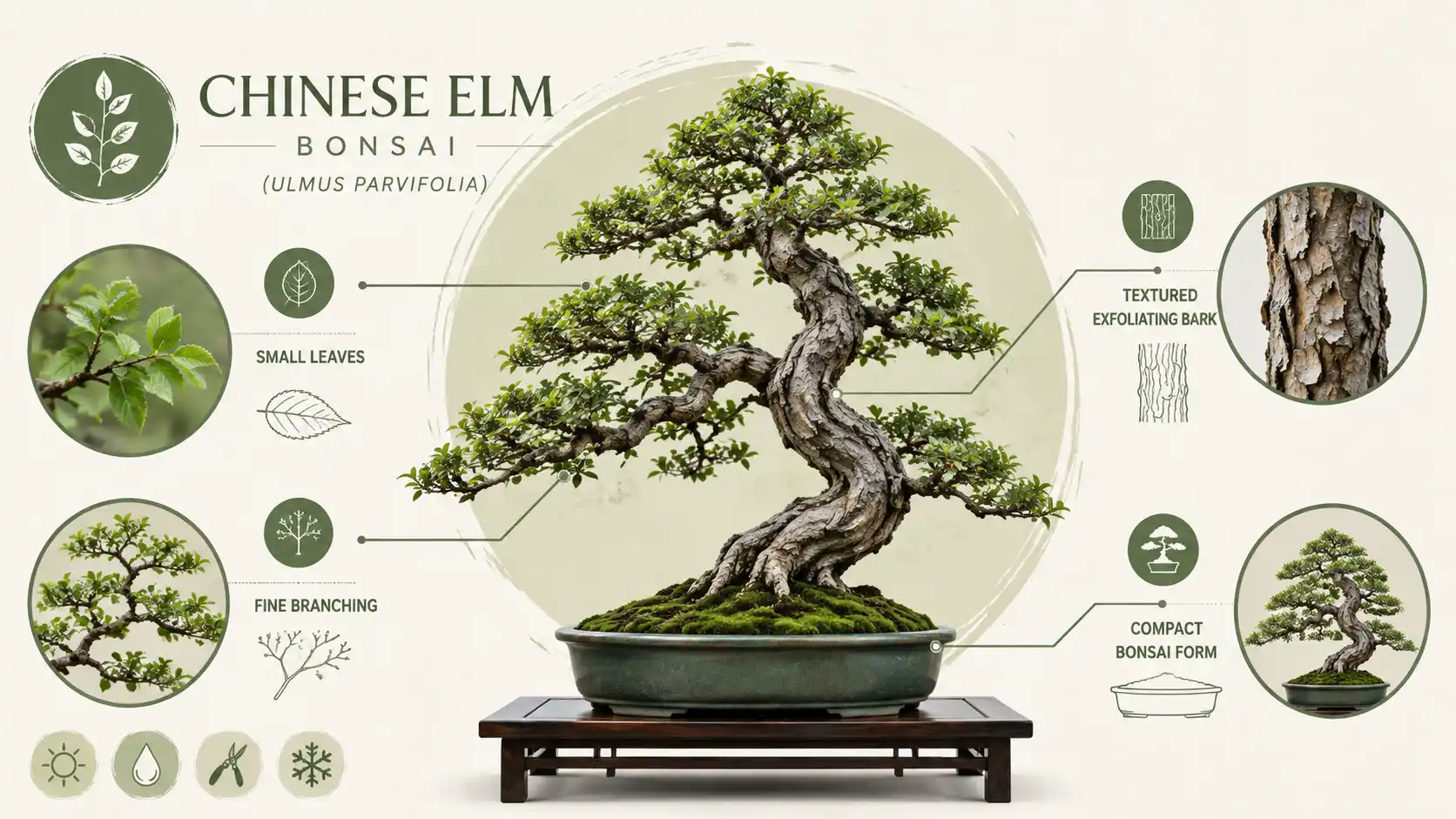
A Chinese Elm bonsai tree is a miniature version of Ulmus parvifolia, a deciduous to semi-evergreen elm species native to China, Korea, Japan, and parts of East Asia. It naturally develops small leaves, graceful branching, and textured bark, making it one of the easiest tree species to train into bonsai. Chinese Elm bonsai comes from Ulmus parvifolia, a species of elm tree native to East Asia and widely cultivated for ornamental purposes.
Although the scientific names Ulmus parvifolia and Ulmus chinensis are sometimes used interchangeably in horticulture, Ulmus parvifolia is the currently accepted botanical name. The species belongs to the elm family (Ulmaceae) and has been cultivated as bonsai for centuries because of its vigorous growth and excellent response to shaping. Like other popular bonsai species such as Ficus Ginseng, Chinese Elm bonsai is valued for its compact growth, attractive trunk structure, and ability to adapt to container cultivation.
Several characteristics make the Chinese elm plant especially suitable for bonsai cultivation:
- Naturally small leaves that remain proportional.
- Flexible young branches for wiring and shaping.
- Attractive bark that develops texture with age.
- Strong tolerance for repeated pruning.
- Rapid healing after branch trimming.
- Adaptability to different climates.
As the tree matures, the bark gradually flakes to reveal patches of gray, orange, and brown, giving older specimens exceptional visual appeal.
Chinese Elm vs Japanese Elm vs Zelkova Bonsai
Chinese Elm, Japanese Elm, and Zelkova bonsai are frequently confused because they have similar leaf shapes and branching patterns. However, they are different species with distinct growth habits, bark characteristics, and environmental preferences.
| Feature | Chinese Elm (Ulmus parvifolia) | Japanese Elm | Zelkova (Zelkova serrata) |
| Leaf size | Small | Medium | Small to medium |
| Bark texture | Attractive exfoliating bark | Smooth to lightly textured | Smooth gray bark when young |
| Growth rate | Fast | Moderate | Moderate |
| Indoor suitability | Better than most elms | Primarily outdoor | Best grown outdoors |
| Hardiness | Excellent | Good | Good |
| Care difficulty | Easy | Moderate | Moderate |
While Japanese elm bonsai and Japanese zelkova bonsai can both become beautiful specimens, Chinese Elm remains the preferred choice for beginners because it adapts more readily to varying environments and recovers quickly from pruning.
Can Chinese Elm Be Grown as a Bonsai?
Yes. Chinese elm can naturally be grown as a bonsai because its biological characteristics make it exceptionally well suited to miniature cultivation. Its small foliage, flexible shoots, dense branching, and strong tolerance for root and branch pruning allow growers to maintain a realistic tree shape over many years.
Unlike some tree species that struggle with repeated pruning, Chinese Elm continues producing new buds after trimming, making it highly responsive to styling techniques.
Its root system also adapts well to shallow bonsai containers. Regular root pruning encourages a compact, fibrous root mass that supports healthy growth without overwhelming the pot.
Additional reasons it excels as a bonsai include:
- Vigorous annual growth.
- Excellent branch ramification.
- Good recovery after repotting.
- High tolerance for beginner mistakes.
- Adaptability to numerous bonsai styles.
Do Chinese Elms Have Aggressive Roots?
Chinese elms develop vigorous root systems in open landscapes, but they are not considered aggressively invasive when maintained as bonsai. Container cultivation naturally limits root expansion, while routine repotting keeps the root system compact and healthy.
In garden settings, mature Chinese elm trees may spread roots widely in search of moisture, but bonsai cultivation prevents this behavior.
Regular repotting benefits the tree by:
- Preventing root binding.
- Encouraging fine feeder roots.
- Improving drainage.
- Supporting healthy nutrient uptake.
- Maintaining balanced top growth.
Young Chinese Elm bonsai are commonly repotted every one to two years, while mature specimens usually require repotting every two to four years.
Pros and Cons of Chinese Elm Bonsai
Chinese Elm is widely regarded as one of the most forgiving bonsai species because it balances vigorous growth with relatively simple care requirements.
Pros
- Hardy and adaptable.
- Excellent for beginners.
- Fast-growing.
- Small leaves produce realistic proportions.
- Responds well to pruning.
- Suitable for many bonsai styles.
- Can adapt to indoor or outdoor growing with proper conditions.
- Long lifespan.
Cons
- Sensitive to consistently wet soil.
- Leaf drop can occur after environmental stress.
- Requires adequate sunlight for compact growth.
- Fast growth means more frequent pruning.
- Indoor specimens require careful humidity and lighting management.
Is Chinese Elm the Hardest or Easiest Bonsai to Care For?
Chinese Elm is considered one of the easiest bonsai species to care for. Its resilience, fast recovery, and tolerance for pruning make it much more beginner-friendly than demanding species such as pines or many junipers.
Compared with more advanced bonsai species:
- Chinese Elm tolerates occasional watering mistakes better.
- It backbuds readily after pruning.
- It grows vigorously throughout the growing season.
- It adapts to different climates more easily.
By contrast, many pine bonsai require highly specialized pruning techniques, while junipers can decline quickly if improperly watered or kept indoors for extended periods.
For these reasons, Chinese Elm consistently ranks among the best choices for first-time bonsai growers.
Chinese Elm Bonsai Care Guide
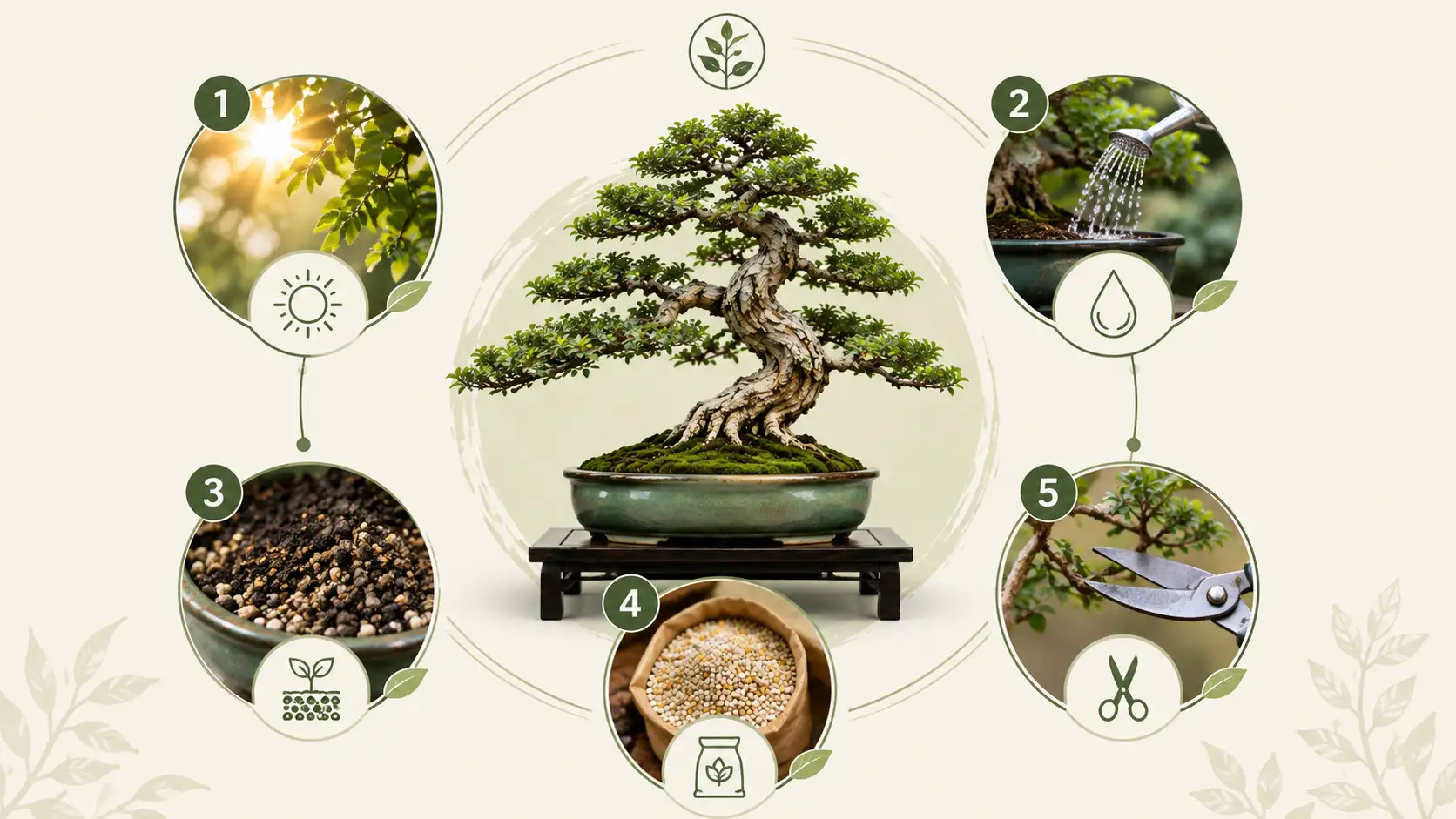
Proper Chinese Elm bonsai care focuses on maintaining balanced moisture, providing adequate sunlight, using well-draining soil, feeding consistently during active growth, and pruning regularly to preserve shape and health.
Watering Needs
Chinese Elm bonsai should be watered whenever the upper layer of soil begins to dry rather than on a fixed schedule. Water needs vary depending on season, temperature, humidity, tree size, and pot depth.
During warm growing months, watering may be needed daily, while cooler seasons usually require less frequent watering.
Signs of underwatering include:
- Wilting leaves.
- Dry, compact soil.
- Crispy leaf edges.
- Reduced growth.
Signs of overwatering include:
- Yellowing leaves.
- Persistently wet soil.
- Soft roots.
- Poor vigor.
Should you mist a Chinese Elm bonsai?
Misting may temporarily increase humidity around the foliage but does not replace proper watering. It can be beneficial in dry indoor environments but is generally unnecessary outdoors where natural air circulation is sufficient.
Can a bonsai survive two weeks without water?
Most Chinese Elm bonsai cannot safely survive two weeks without watering, particularly during warm weather. Larger trees in cool conditions may tolerate longer intervals, but leaving any bonsai unwatered for two weeks is not recommended and can cause severe stress or death.
Light Requirements
Chinese Elm bonsai grows best in bright sunlight.
Outdoor trees perform best with several hours of direct morning or afternoon sun combined with good air circulation.
Indoor specimens should be placed immediately beside a bright south- or east-facing window where they receive abundant natural light.
Common signs of insufficient light include:
- Long, weak shoots.
- Larger-than-normal leaves.
- Sparse branching.
- Slow growth.
- Increased leaf drop.
Rotating indoor trees every few weeks helps maintain balanced growth.
Soil and Potting Mix
The best potting mix for a Chinese Elm bonsai provides excellent drainage while retaining enough moisture to support healthy roots.
Many experienced growers use blends containing:
- Akadama.
- Pumice.
- Lava rock.
- Pine bark.
- Coarse inorganic particles.
A balanced bonsai mix reduces the risk of root rot while allowing oxygen to reach developing feeder roots.
Repotting recommendations generally include:
- Young trees: every 1–2 years.
- Mature trees: every 2–4 years.
- Repot during early spring before vigorous new growth begins.
Fertilization Practices
Chinese Elm benefits from regular feeding throughout the active growing season.
A balanced fertilizer applied every two to four weeks during spring and summer supports healthy leaf production, root growth, and branch development.
Reduce fertilization during late autumn and winter when growth naturally slows.
Possible nutrient deficiency symptoms include:
- Pale foliage.
- Weak shoots.
- Smaller leaves.
- Slow overall growth.
Applying fertilizer to moist soil rather than dry soil helps protect sensitive roots.
Pruning Considerations
Chinese Elm bonsai responds exceptionally well to pruning, making it one of the easiest species to shape. Routine maintenance encourages dense branching, while structural pruning establishes the long-term design of the tree.
A basic pruning process includes:
- Remove dead or damaged branches.
- Eliminate crossing or inward-growing shoots.
- Shorten vigorous new growth.
- Maintain branch balance throughout the canopy.
- Continue fine pruning during the growing season.
What is the rule of 3 in bonsai?
The “rule of 3” is a styling guideline in which excessive branching from a single point is reduced to create a cleaner branch structure. Instead of allowing multiple competing branches, growers typically retain the strongest and best-positioned branches to improve taper, movement, and overall design.
Structural pruning is usually performed in late winter or early spring, while maintenance pruning can continue throughout the growing season.
Climate Tolerance
Chinese Elm is one of the most climate-tolerant bonsai species. Established trees can withstand cool winters and warm summers when gradually acclimated.
Although cold tolerance varies among cultivars, prolonged exposure to temperatures below approximately -10°C (14°F) may damage roots in shallow bonsai containers.
During winter:
- Protect roots from prolonged freezing.
- Reduce watering as growth slows.
- Avoid placing indoor trees near heating vents.
- Maintain good airflow.
- Resume active care when spring growth begins.
Its adaptability to diverse climates is one of the main reasons Chinese Elm remains among the world’s most recommended bonsai species.
Indoor vs Outdoor Chinese Elm Bonsai
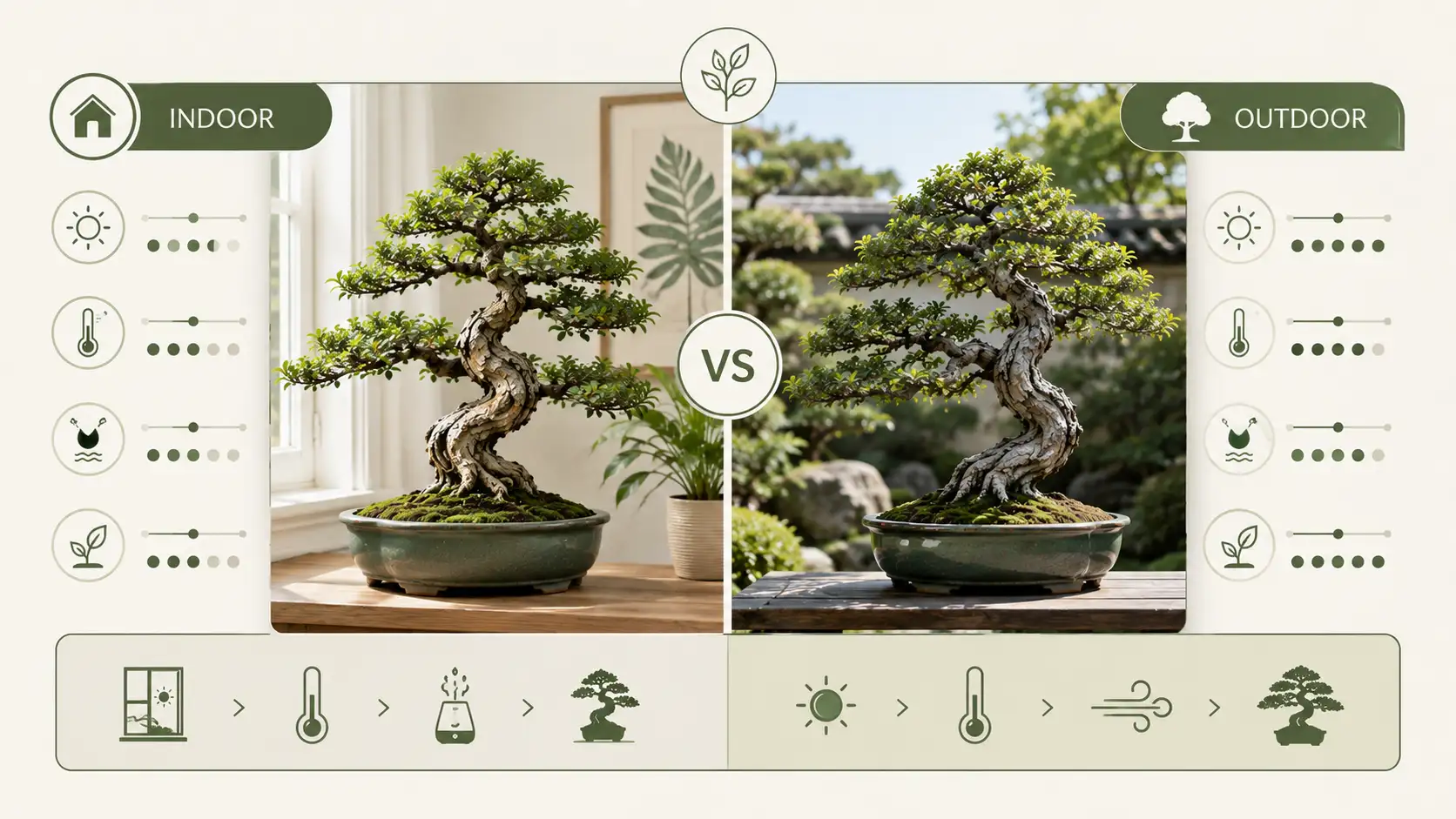
Chinese Elm bonsai can be grown both indoors and outdoors, but outdoor conditions usually provide stronger growth because they offer better light intensity, airflow, and natural seasonal changes. Indoor growth is possible when the tree receives sufficient light and stable environmental conditions.
Chinese Elm is considered semi-evergreen. In warm climates with consistent light, it may retain leaves throughout the year. In cooler climates or during seasonal changes, it may naturally lose some or all leaves before producing new growth. Many people also grow bonsai indoors for cultural and decorative reasons, with species like Chinese Elm often associated with the same symbolic interest discussed in bonsai meaning and Feng Shui traditions.
Indoor Chinese Elm Bonsai Requirements
Growing a Chinese Elm bonsai indoors requires careful attention to light, humidity, temperature, and airflow.
Indoor conditions work best when:
- The tree receives several hours of bright natural light daily.
- It is placed near a sunny window.
- Room temperatures remain stable.
- The air is not excessively dry.
- The tree is protected from heating and cooling vents.
Indoor Chinese Elm bonsai may struggle because homes usually provide lower light levels than outdoor environments.
Weak light can cause:
- Reduced leaf density.
- Longer internodes.
- Poor branch development.
- Increased leaf drop.
Outdoor Chinese Elm Bonsai Requirements
Outdoor placement is generally preferred during the growing season because sunlight and airflow support healthier development.
Outdoor Chinese Elm bonsai benefits from:
- Direct sunlight.
- Natural temperature changes.
- Better ventilation.
- Stronger seasonal growth cycles.
A tree grown outdoors often develops smaller leaves, stronger branches, and better overall structure compared with one grown permanently indoors.
| Factor | Indoor Chinese Elm Bonsai | Outdoor Chinese Elm Bonsai |
| Light | Requires strong window light or grow lights | Benefits from natural sunlight |
| Growth rate | Usually slower | Faster and stronger |
| Air circulation | Limited | Naturally improved |
| Seasonal behavior | Less pronounced | More natural dormancy cycles |
| Maintenance | Requires closer monitoring | Generally easier |
A Chinese Elm bonsai can survive indoors year-round, but it requires conditions that closely replicate outdoor growing needs. If light is insufficient, the tree may gradually weaken despite appearing healthy initially.
Chinese Elm Plant Size and Growth Rate
Chinese Elm (Ulmus parvifolia) is naturally a medium-sized tree, but bonsai techniques keep it at a much smaller scale. Its final size depends on whether it is grown as a landscape tree or maintained as a bonsai specimen.
Plant Size
A full-sized Chinese elm tree can reach approximately 10–60 feet (3–18 meters) depending on environmental conditions, age, and cultivar. In bonsai cultivation, the size is controlled through container restriction, root pruning, and regular trimming.
Typical Chinese Elm bonsai sizes include:
- Small bonsai: under 12 inches tall.
- Medium bonsai: 12–24 inches tall.
- Large bonsai: over 24 inches tall.
Factors affecting plant size include:
- Available root space.
- Amount of sunlight.
- Fertilization routine.
- Pruning frequency.
- Growing environment.
Outdoor Chinese Elm trees usually become much larger because their roots have unlimited access to soil, while bonsai specimens remain compact because their growth is carefully managed.
Growth Rate
Chinese Elm is considered a fast-growing bonsai species. Its vigorous growth is one of the main reasons beginners choose it because it responds quickly to care and training.
Growth is usually strongest during:
- Spring, when new shoots emerge.
- Summer, when foliage development is active.
- Early autumn in mild climates.
Factors that increase growth rate include:
- Strong sunlight.
- Regular feeding.
- Healthy roots.
- Adequate watering.
- Proper pruning.
Poor lighting, compacted soil, and root-bound conditions can significantly slow growth.
How to Thicken a Chinese Elm Bonsai Trunk
A Chinese Elm bonsai trunk becomes thicker through controlled growth rather than frequent trimming alone. Allowing the tree to grow freely for periods of time encourages trunk development.
Common methods include:
- Ground growing: Planting the tree in the ground temporarily allows rapid trunk expansion.
- Sacrifice branches: Keeping selected branches longer increases trunk thickness before removal.
- Trunk chops: Cutting back the main trunk encourages taper and new branching.
The process requires patience because significant trunk thickening usually takes several growing seasons.
Do Chinese Elm Bonsai Lose Their Leaves?
Yes, Chinese Elm bonsai can lose their leaves because they are naturally semi-deciduous trees. Leaf loss may occur during seasonal changes, environmental stress, or incorrect care conditions. The cause depends on timing, growing environment, and overall tree health.
In outdoor climates with cold winters, Chinese Elm may enter dormancy and drop most of its foliage. In warmer regions, it may remain partially or fully evergreen.
Normal seasonal leaf loss usually occurs when:
- Temperatures decrease.
- Daylight hours shorten.
- Growth slows naturally.
This differs from stress-related leaf drop, which may happen after:
- Sudden location changes.
- Overwatering.
- Underwatering.
- Repotting.
- Poor lighting.
A Chinese Elm bonsai tree losing leaves after being moved indoors is common because the tree must adapt to different humidity, temperature, and light levels.
Dormancy vs Stress Leaf Drop
| Type of Leaf Loss | Cause | Signs |
| Seasonal dormancy | Natural response to cooler conditions | Healthy buds remain |
| Environmental stress | Sudden changes | Rapid leaf yellowing or dropping |
| Overwatering | Root stress | Yellow leaves and wet soil |
| Underwatering | Lack of moisture | Dry leaves and brittle growth |
A dormant Chinese Elm bonsai is not dead. Healthy branches usually remain flexible, and new growth appears when conditions improve.
Common Chinese Elm Bonsai Problems (Problem-Solution Coverage)
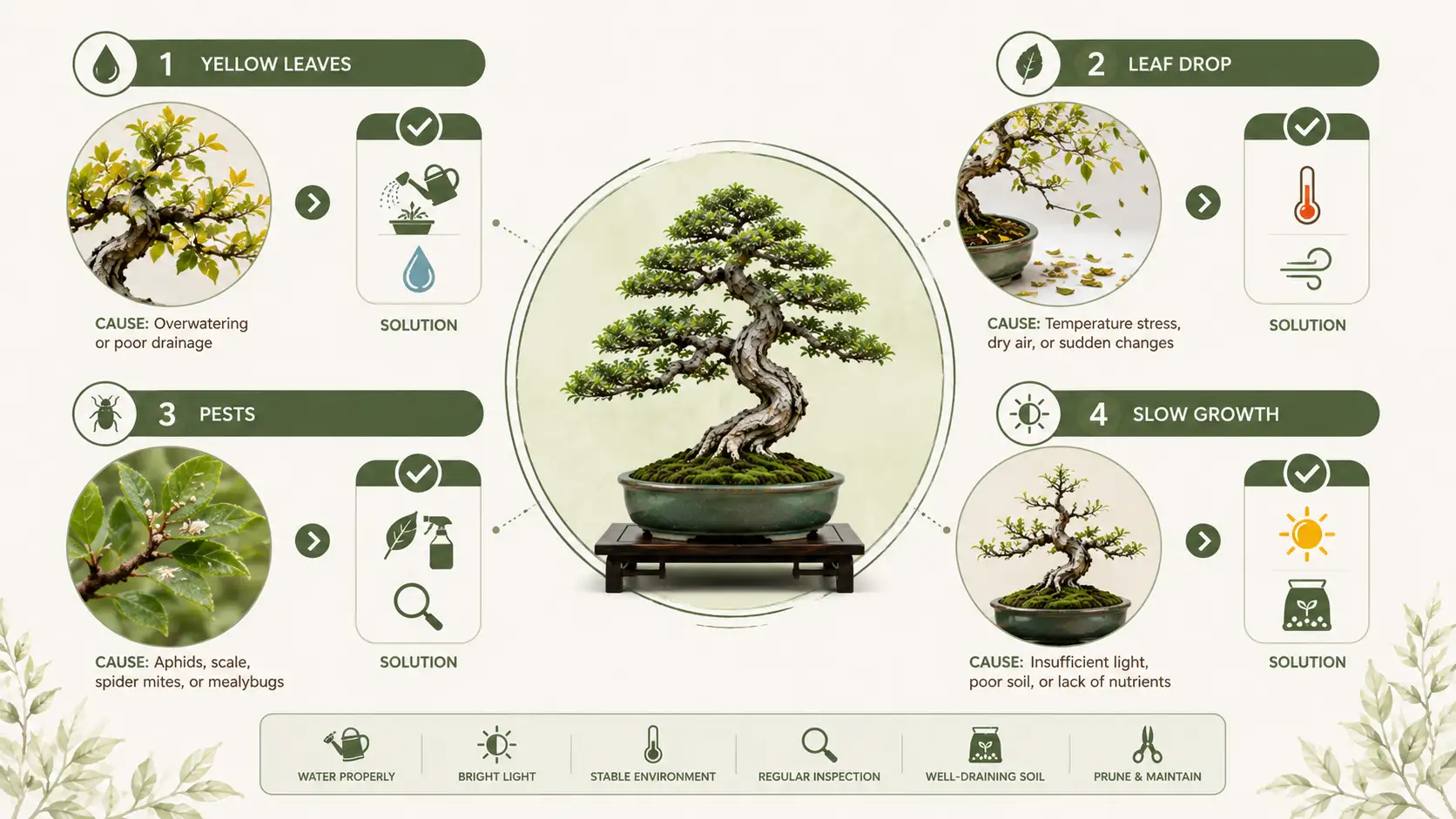
Chinese Elm bonsai are resilient, but they can experience problems caused by improper watering, poor lighting, pests, or unsuitable growing conditions.
Yellowing Leaves
Yellow leaves are commonly caused by overwatering, poor drainage, or nutrient imbalance.
Why it happens:
- Roots remain too wet.
- Oxygen cannot reach the root system.
- The tree lacks essential nutrients.
How to fix it:
- Allow soil to partially dry before watering again.
- Improve drainage.
- Check the fertilizer routine.
How to prevent it:
- Use a well-draining bonsai soil mix.
- Avoid watering on a fixed schedule.
- Monitor soil moisture regularly.
Leaf Drop After Repotting or Pruning
Leaf drop after major maintenance is often caused by temporary stress rather than disease.
Why it happens:
- Roots are disturbed during repotting.
- The tree loses moisture balance.
- Sudden environmental changes occur.
How to fix it:
- Place the tree in suitable light.
- Avoid heavy fertilization immediately after repotting.
- Maintain consistent watering.
How to prevent it:
- Repot during the correct season.
- Avoid removing too much foliage and roots at the same time.
Pest Infestations
Chinese Elm bonsai may occasionally suffer from pests such as:
- Scale insects.
- Aphids.
- Spider mites.
Treatment methods include:
- Removing visible pests manually.
- Using insecticidal soap.
- Improving airflow.
- Regularly checking leaves and branches.
Prevention is easier when trees are kept healthy because stressed plants attract pests more easily.
Slow or Stalled Growth
Slow growth usually indicates environmental limitations rather than a natural problem.
Common causes include:
- Insufficient sunlight.
- Root-bound conditions.
- Poor soil quality.
- Lack of nutrients.
Solutions include:
- Increasing light exposure.
- Repotting when roots fill the container.
- Providing seasonal fertilizer.
- Checking watering practices.
Beginner Mistakes and Troubleshooting
Many Chinese Elm bonsai problems occur because beginners provide too much care rather than too little.
Common mistakes include:
- Overwatering “just to be safe”: Constantly wet soil can damage roots and cause yellow leaves.
- Ignoring seasonal light changes: Indoor trees may require adjustments as sunlight intensity changes.
- Skipping structural pruning early on: Delayed pruning can lead to weak branch structure.
- Using poor-draining soil: Dense garden soil can restrict oxygen around roots.
- Moving the tree frequently: Constant environmental changes create unnecessary stress.
Successful Chinese Elm bonsai care depends on consistency rather than excessive intervention.
Why Can’t You Cut Elm Trees? (Common Misconception)
The statement “why can’t you cut elm trees” usually refers to restrictions related to full-sized elm trees affected by Dutch Elm Disease management, not bonsai pruning.
Some regions regulate the removal or movement of elm wood because Dutch Elm Disease can spread through infected trees and beetle vectors.
Chinese Elm bonsai pruning is completely acceptable and encouraged. Regular trimming is an essential part of bonsai cultivation because it helps maintain shape, improve branching, and control size.
Bonsai pruning differs from removing large landscape trees because it is controlled horticultural maintenance rather than disease management.
Lifespan of a Chinese Elm Bonsai
A Chinese Elm bonsai can live for several decades with proper care, and exceptionally maintained specimens may survive much longer. Its lifespan depends on watering practices, root health, climate, and ongoing maintenance.
Factors that extend lifespan include:
- Proper repotting.
- Good drainage.
- Adequate sunlight.
- Pest prevention.
- Regular pruning.
- Balanced fertilization.
Common causes of shortened lifespan include:
- Chronic overwatering.
- Severe root damage.
- Poor lighting.
- Neglected maintenance.
Because Chinese Elm is vigorous and adaptable, it is considered one of the more long-lived beginner-friendly bonsai species.
Chinese Elm Bonsai Varieties
Chinese Elm bonsai varieties differ in bark texture, leaf characteristics, and growth habits. Some cultivars are especially valued by collectors because of unique visual features.
Common varieties include:
- Cork Bark Chinese Elm: Known for thick, cork-like bark that creates an aged appearance even on younger trees.
- Standard Chinese Elm: The most common form used for bonsai due to reliable growth and attractive branching.
- Small-leaf Chinese Elm varieties: Selected for compact foliage suitable for miniature bonsai styles.
Chinese Elm bonsai flowers are small and usually not the main attraction of cultivation. Under suitable conditions, mature trees may produce tiny inconspicuous flowers, which can later develop into small winged fruits.
Conclusion
Chinese Elm bonsai is one of the most popular bonsai choices because of its adaptability, attractive appearance, and forgiving nature. The species (Ulmus parvifolia) combines small leaves, flexible branches, fast growth, and strong recovery after pruning, making it suitable for beginners and experienced growers alike.
With consistent watering, bright light, well-draining soil, and regular pruning, a Chinese Elm bonsai can remain healthy and attractive for many years. Its ability to tolerate mistakes while still responding well to training makes it one of the most reliable bonsai species available. Chinese Elm bonsai care is part of a wider approach to understanding plant selection, maintenance, and growing techniques covered in our complete Plants Benefits and Guides resource.
FAQs
Can Chinese Elm be grown as a bonsai?
Yes, Chinese Elm can be grown as a bonsai because it naturally has small leaves, flexible branches, strong pruning tolerance, and a root system that adapts well to container cultivation.
Is Chinese Elm bonsai easy to care for?
Yes, Chinese Elm bonsai is considered one of the easiest bonsai species for beginners. It tolerates pruning, adapts to different environments, and recovers well from minor care mistakes.
Do Chinese Elm bonsai lose their leaves seasonally?
Yes, Chinese Elm bonsai may lose leaves seasonally because it is semi-deciduous. Leaf loss can be normal during dormancy, especially in cooler climates.
Can Chinese Elm bonsai survive indoors year-round?
Yes, Chinese Elm bonsai can survive indoors year-round if it receives strong light, proper watering, good airflow, and stable temperatures. Outdoor conditions usually produce stronger growth.
How cold is too cold for a Chinese Elm bonsai outdoors?
Chinese Elm bonsai may suffer damage when exposed to prolonged temperatures below approximately -10°C (14°F), especially because shallow bonsai pots provide limited root protection.
What is the rule of 3 in bonsai pruning?
The rule of 3 in bonsai pruning is a styling guideline that reduces excessive branching from one point and encourages cleaner structure by maintaining balanced branch development.
Why do Chinese Elm bonsai leaves turn yellow or drop?
Chinese Elm bonsai leaves commonly turn yellow or drop because of overwatering, poor drainage, insufficient light, nutrient problems, environmental stress, or natural seasonal changes. Identifying the cause helps determine the correct solution.



One Response