
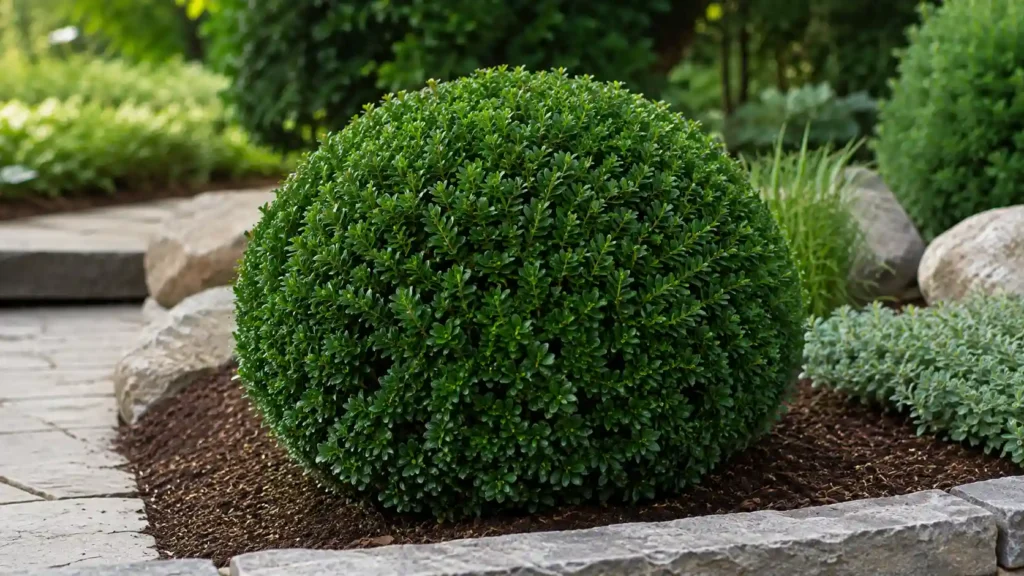
According to Manuela Nogueira, Mont Bruno boxwood (Buxus sempervirens ‘Mont Bruno’) is an extra-hardy, globe-shaped cultivar discovered by André Poliquin in Quebec, Canada. It features tiny, dark green leaves, reaches 2-2.5 feet tall and 1-1.5 feet wide, thrives in USDA zones 3-7, and suits hedging, topiary, and rock gardens.
Unlike many boxwood varieties, Mont Bruno holds its dark green color through winter rather than bronzing, and it shows resistance to verticillium wilt. Its insignificant spring flowers are fragrant, and while mature plants handle full sun, young specimens benefit from burlap protection in exposed winter sites. All parts are toxic if ingested, though the shrub is deer resistant.
Quick Summary
- Size: Mont Bruno commonly reaches about 2–3 feet tall and wide, although a 10-year average of approximately 18 × 18 inches is also reported.
- Hardiness: It is rated for USDA Zone 4, making it one of the more cold-hardy boxwood selections.
- Growth: It is slow-growing, with growers commonly reporting about 2–4 inches of annual growth under suitable conditions.
- Care: Full sun to part shade, well-drained soil, moderate and consistent moisture, and restrained pruning provide the best results.
- Best uses: Its small scale and globe-shaped habit make it particularly suitable for borders, rock gardens, containers, topiary, and small hedges.
What Is Mont Bruno Boxwood?
Mont Bruno boxwood is a dwarf, rounded cultivar of Buxus sempervirens, the species commonly known as common or European boxwood. It was found by André Poliquin in Quebec, Canada, and was selected for its compact form, tiny dark-green foliage, and ability to tolerate colder conditions than many traditional boxwoods. Nursery and botanical references consistently describe it as a globe-shaped, slow-growing selection suited to Zone 4. For broader botanical background on the genus and its cultivated forms, see the Boxwood entry on Wikipedia.
Its botanical name is Buxus sempervirens ‘Mont Bruno’. The plant belongs to the family Buxaceae and is a broadleaf evergreen shrub. Unlike many ornamental shrubs that become open or irregular without pruning, Mont Bruno naturally develops a dense, rounded form.
Its defining characteristics include:
- Tiny, dark-green evergreen leaves
- Compact, dense branching
- Naturally rounded or globe-shaped habit
- Slow growth
- USDA Zone 4 hardiness
- Suitability for borders, containers, hedges, rock gardens, and topiary
- Resistance to verticillium wilt reported by some horticultural sources
The cultivar is particularly valuable in cold-climate gardens because its purpose is not simply to remain small; it combines small scale with unusually strong winter hardiness.
Where the Name Comes From
The name Mont Bruno refers to the Quebec origin associated with the selection. “Mount Bruno boxwood” is therefore a spelling variant people may use when searching for the plant, but the established cultivar name is Mont Bruno.
It should not be confused with a separate botanical species called “Mount Bruno boxwood.” The plant is Buxus sempervirens ‘Mont Bruno’.
Mont Bruno Boxwood Size
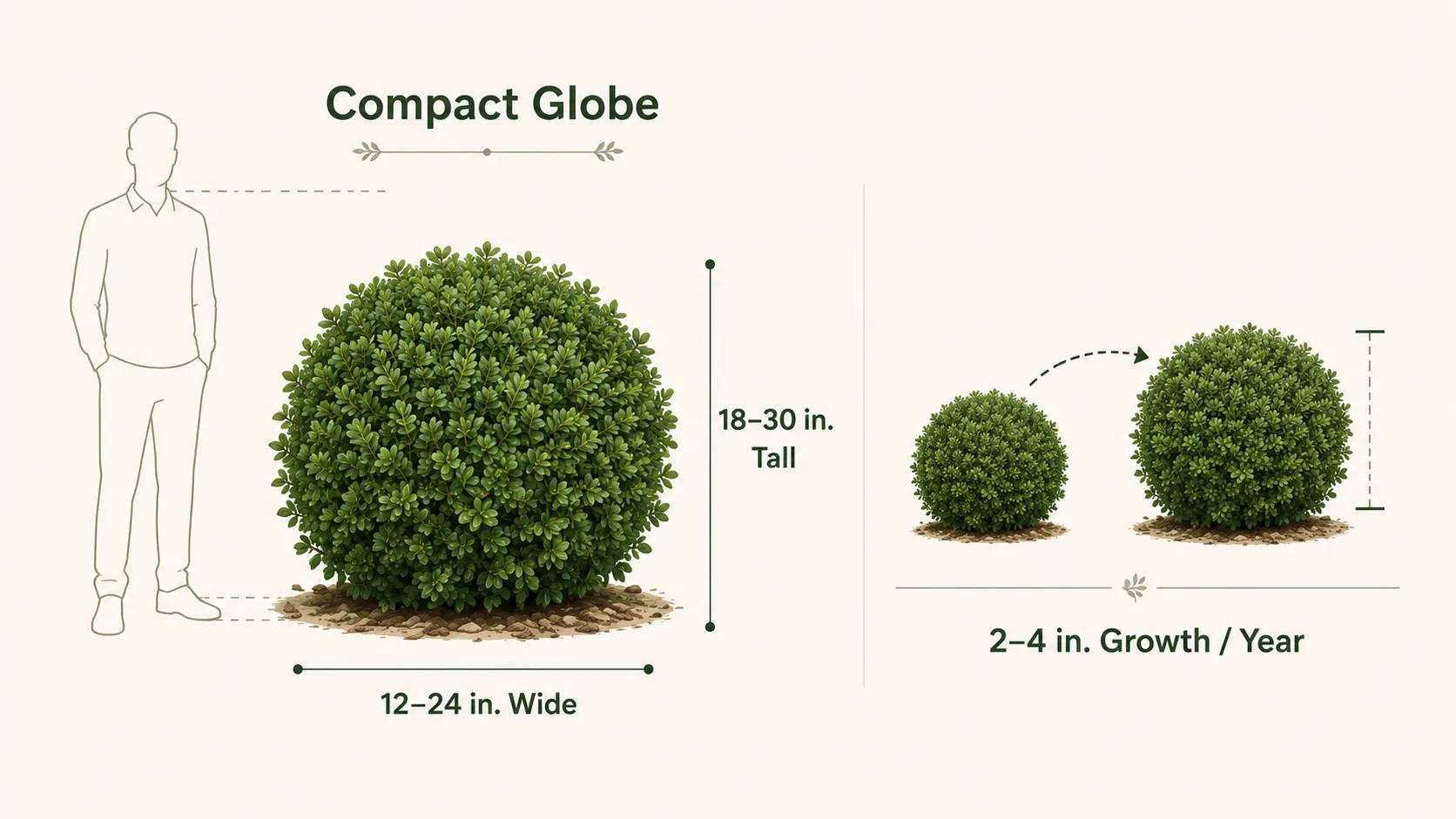
Mont Bruno boxwood generally matures to about 2–3 feet tall and 2–3 feet wide, although its reported dimensions vary considerably depending on the nursery, growing conditions, plant age, and whether the plant is maintained as a specimen or hedge. Chicago Botanic Garden lists an average size of about 2 × 2 feet, while several growers give a garden size of approximately 3 × 3 feet.
A particularly useful reference from a nursery specializing in dwarf plants gives a 10-year average size of approximately 18 × 18 inches, showing why young or slowly developing Mont Bruno plants can remain substantially smaller for many years.
Typical size references include:
- 10-year average: about 18 × 18 inches
- Common mature range: approximately 2–2.5 feet tall and 1–1.5 feet wide in some grower descriptions
- Broader mature range: approximately 2–3 feet tall and 2–3 feet wide
- Growth rate: approximately 2–4 inches per year under suitable conditions
The final size depends on sunlight, soil quality, water availability, climate, root competition, and pruning. An in-ground specimen generally has more room to develop than a container-grown plant, while a regularly pruned container specimen can remain considerably smaller.
For gardeners specifically asking which boxwoods stay small and round, Mont Bruno is a strong choice because its natural growth habit is already compact and globe-shaped rather than requiring heavy annual shearing to create that appearance.
How Mont Bruno Compares to Other Small Boxwoods
Mont Bruno and North Star are both compact, rounded boxwoods, but they are not interchangeable in every climate. North Star is generally listed for Zones 5–9, whereas Mont Bruno is rated to Zone 4. North Star also reaches roughly 2–2.5 feet in height and width and tolerates sun, part sun, and shade.
| Feature | Mont Bruno | North Star |
| Mature size | Commonly about 2–3 ft H × 2–3 ft W | About 2–2.5 ft H × 2–2.5 ft W |
| Hardiness | Zone 4 | Zones 5–9 |
| Growth rate | Slow; commonly 2–4 in./year | Moderate/steady |
| Habit | Dense, rounded globe | Dense, mounded globe |
| Light | Full sun to part shade | Full sun to shade |
| Best uses | Rock gardens, borders, containers, small hedges, topiary | Low hedges, edging, borders, containers |
| Cold-climate advantage | Particularly strong | Cold hardy, but less cold-hardy by zone rating |
The important distinction is climate versus ultimate size. North Star can be an excellent compact boxwood, but Mont Bruno has an advantage where Zone 4 winter temperatures are the limiting factor.
Mont Bruno Boxwood Growth Rate
Mont Bruno boxwood is a slow-growing shrub, commonly reported to add approximately 2–4 inches per year when growing conditions are favorable. Several nursery sources specifically classify it as slow-growing. For another example of how growth rate affects the use and maintenance of landscape shrubs, see Pittosporum Silver Sheen Growth Rate: 5+ Proven Facts.
Growth normally occurs primarily during the active spring and summer growing season. Winter growth is minimal or absent because boxwood enters a period of reduced physiological activity during cold conditions.
Growth can be improved by providing:
- Adequate sunlight without excessive heat or winter exposure
- Consistent soil moisture during establishment
- Well-drained soil
- Sufficient nutrients
- Minimal root competition
- Protection from prolonged drought
Growth slows when the plant experiences deep shade, drought, waterlogged roots, poor soil, or significant winter damage.
One important trade-off is that slow growth is both an advantage and a limitation. It helps Mont Bruno retain its compact shape and reduces pruning requirements, but it also means a newly planted hedge may take considerably longer to become visually dense than a faster-growing shrub.
Mont Bruno Boxwood Care Guide
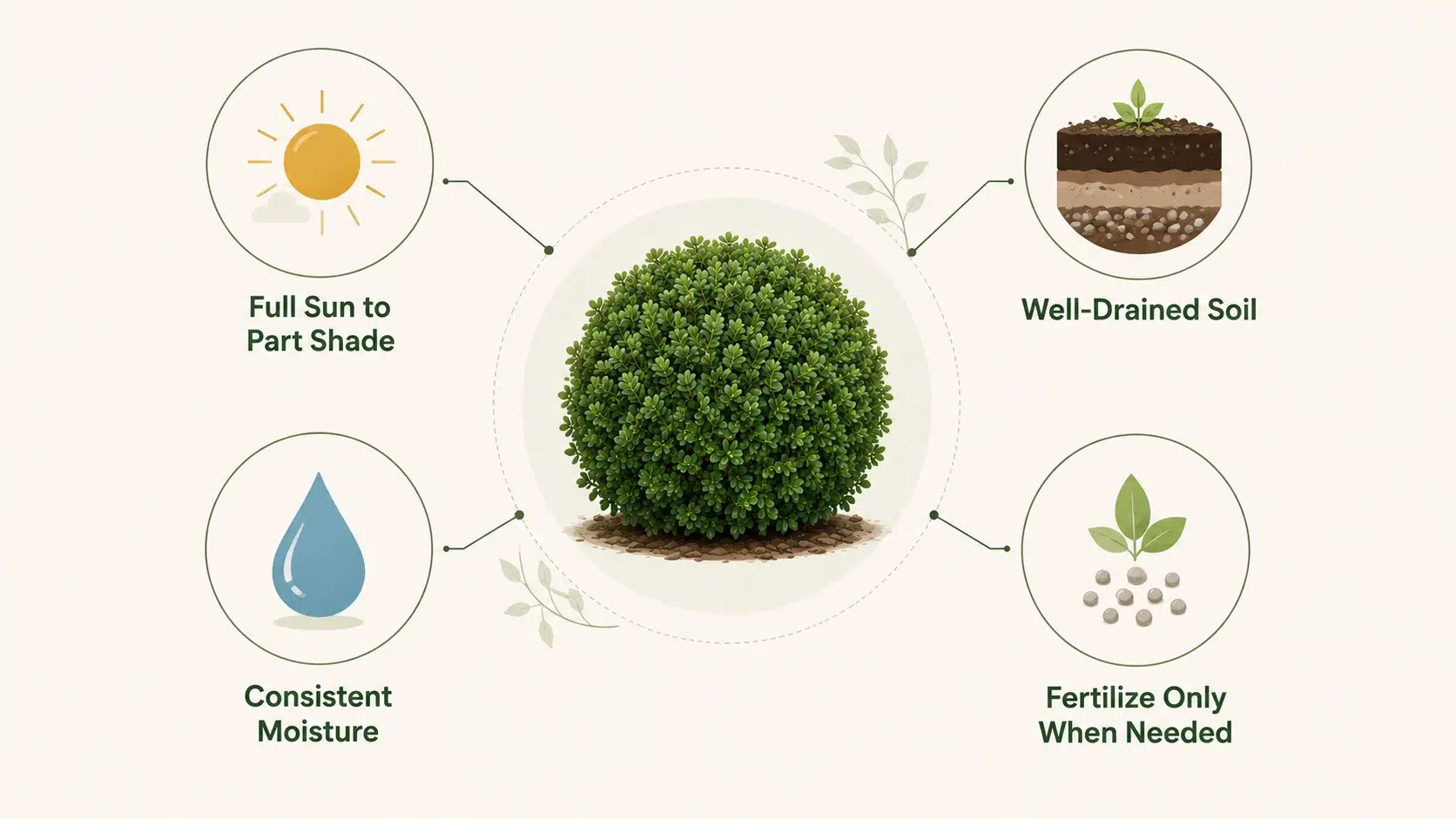
Mont Bruno boxwood is relatively easy to maintain once established, but “low maintenance” does not mean drought-proof or disease-proof. The most important care principle is to provide well-drained soil and steady moisture without creating saturated conditions. For broader information on plant care, growing requirements, and plant types, explore Plants: Benefits and Guides (Complete Care, Types & Growing Tips).
Watering Needs
You should not water Mont Bruno boxwood every day unless unusual conditions make frequent light irrigation necessary during initial establishment. Boxwoods prefer consistent moisture but do poorly when their roots remain constantly wet.
For newly planted plants, water deeply enough to moisten the root zone, then monitor the soil before watering again. University of Maryland Extension recommends watering newly planted boxwoods when rainfall is insufficient, while emphasizing watering at the base rather than overhead.
A practical approach is:
- Check the soil before watering.
- Water deeply rather than giving frequent shallow splashes.
- Allow excess water to drain away.
- Give newly planted plants more consistent moisture than established specimens.
- Increase attention during prolonged drought.
- Reduce irrigation during cool, wet periods.
Overwatering is particularly dangerous because persistently wet soil can contribute to root problems.
Sun or Shade?
Mont Bruno boxwood performs well in full sun to part shade. Grower references list full sun, partial sun, or partial shade as suitable exposures.
For a dense, compact form, adequate light is important. However, in climates with intense afternoon heat or severe winter sun, some protection can be beneficial.
Boxwoods can experience winter burn when foliage loses water faster than frozen soil can replace it. University of Maryland Extension notes that exposed winter-sun locations can cause foliage to turn orange or brown, particularly when combined with drying winds.
Soil and Fertilizing
Mont Bruno prefers well-drained soil rather than soil that stays saturated. Available horticultural references indicate that it tolerates a range of soil types provided drainage is adequate. SiteOne lists slightly acidic through neutral and slightly alkaline soil ranges as acceptable.
A reasonable target is moderately fertile soil with good drainage and a slightly acidic to neutral reaction.
Fertilization should be based on plant performance and, where appropriate, a soil test rather than automatically feeding every plant. University of Maryland Extension recommends fertilizing boxwoods when a soil test indicates a nutrient deficiency.
A general-purpose balanced or slow-release fertilizer can be appropriate when fertilization is actually needed and the product label permits use on shrubs.
Do coffee grounds help boxwoods? Not reliably enough to treat them as fertilizer. Used coffee grounds are not a substitute for a soil test or balanced fertilizer, and adding them repeatedly will not automatically create the ideal soil conditions. Use compost or other organic matter to improve soil structure when needed rather than relying on coffee grounds as a primary nutrient source.
Pruning Mont Bruno Boxwood
Mont Bruno usually requires less pruning than boxwoods that are grown primarily for tightly clipped geometric shapes because its natural form is already rounded and compact.
For routine maintenance, thinning is preferable to repeatedly shearing the entire outer surface. University of Maryland Extension recommends thinning boxwood by removing selected branches at their points of attachment to improve light penetration and air circulation.
Pruning should focus on:
- Removing dead or damaged branches
- Correcting an uneven shape
- Improving interior airflow
- Maintaining a desired size
- Removing diseased material when necessary
Avoid unnecessary heavy pruning late in the growing season if it encourages tender new growth that may be damaged by approaching frost.
Will boxwood grow back if cut to the ground? Boxwood can sometimes produce new growth from older wood, but severe cut-back is stressful and recovery can be very slow. A weak, diseased, or heavily stressed plant may not recover well. For Mont Bruno, maintaining its size through light, periodic pruning is preferable to repeatedly cutting it to ground level.
Planting Location and Spacing
Plant Mont Bruno where the mature shrub has enough room for air circulation and root development. SiteOne lists approximately 3 feet of spacing for the cultivar, while individual hedge spacing should be adjusted according to the desired density and the mature dimensions of the plants. The same center-to-center spacing principle is useful when planning other hedge plants, as explained in How Far Apart to Plant Lilly Pilly for Dense Hedges.
For a hedge:
- Closer spacing creates faster visual closure but increases competition and canopy density.
- Wider spacing improves airflow but leaves larger gaps while plants mature.
- Measure spacing from plant center to plant center.
- Use the mature width, not the current nursery-container size, when planning.
For foundation plantings, avoid pushing the shrub directly against a wall. A modest gap provides better airflow and makes maintenance easier.
Best Time to Plant
Spring or early fall are generally the best planting periods for boxwood because temperatures are usually less stressful than during extreme summer heat or winter cold. University of Maryland Extension identifies spring and fall as the best general planting seasons for woody landscape plants.
In cold climates, early enough fall planting is important so roots have time to establish before the ground freezes. In warmer climates, fall can provide an especially favorable establishment period.
Are Boxwoods Low Maintenance?
Yes, established Mont Bruno boxwoods are relatively low maintenance, particularly because the cultivar is naturally compact, slow-growing, evergreen, and rounded. Its slow growth reduces the frequency of pruning needed to maintain a neat appearance. If low-maintenance landscaping is your broader goal, you can also compare boxwoods with the options covered in our Low Maintenance Australian Native Plants Guide.
However, low maintenance does not mean maintenance-free.
The main recurring tasks are:
- Checking soil moisture during drought
- Removing dead or damaged growth
- Monitoring for pests and diseases
- Maintaining good drainage
- Avoiding excessive shearing
- Protecting plants from severe winter exposure when necessary
Its low-maintenance advantage is greatest when the plant is installed in a location that already matches its needs.
What Are the Disadvantages of Boxwoods?
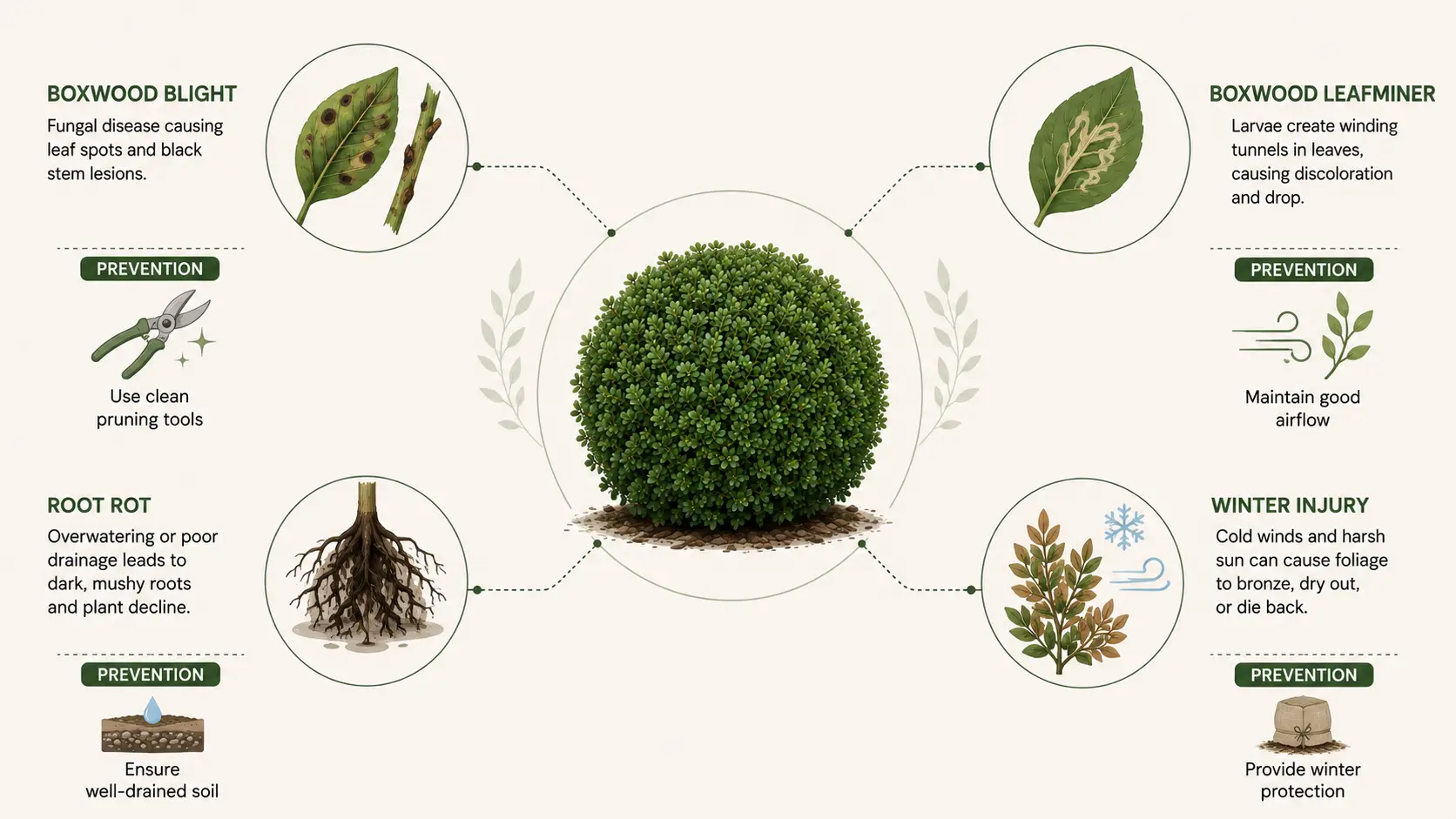
The main disadvantages of boxwoods are slow growth, susceptibility to several pests and diseases, potential winter injury, and the need for good drainage and airflow.
Mont Bruno’s exceptional hardiness does not make it immune to boxwood problems. Common concerns include boxwood blight, boxwood leafminer, root problems, winter injury, and fungal leaf or stem diseases.
Other limitations include:
- Slow growth can make hedge establishment frustratingly gradual.
- Dense foliage can retain moisture and reduce airflow.
- Poor drainage increases root disease risk.
- Winter wind can cause bronzing or desiccation.
- Premium or specialty cultivars can cost more because of limited availability and slow nursery production.
Boxwood blight deserves particular attention. It is caused by the fungus Calonectria pseudonaviculata and can produce leaf spots, stem lesions, bronzing, and rapid defoliation. Wet, humid conditions and prolonged leaf wetness favor disease development. For broader identification of garden pests beyond boxwood-specific problems, see our Common Garden Bugs Guide: 12+ Essential ID Tips.
Common Boxwood Problems and Fixes
| Problem | Why It Happens | How to Fix or Prevent |
| Yellowing or browning leaves | Winter stress, drought, root problems, or disease | Check moisture and drainage; protect exposed plants from drying winter winds |
| Leaf blistering or mining | Boxwood leafminer activity | Inspect new growth, prune affected material where appropriate, and monitor during the pest’s active season |
| Rapid leaf drop and dark stem lesions | Possible boxwood blight | Isolate affected plants, avoid overhead watering, sanitize tools, and seek a proper diagnosis |
| Slow or stalled growth | Poor light, drought, nutrient deficiency, or root stress | Correct the growing conditions and fertilize only when justified |
| Bronze winter foliage | Cold, drying wind, or winter sun | Maintain adequate fall moisture and use a sheltered site or wind protection |
Boxwood leafminer larvae feed within leaves and can cause characteristic damage. University of Maryland Extension notes that pruning infested growth can help reduce populations, while several Buxus sempervirens and Buxus microphylla cultivars show relative resistance to the pest.
For suspected boxwood blight, do not assume every brown or dropping leaf indicates the disease. Winter injury, Volutella blight, Macrophoma leaf spot, and root problems can produce similar symptoms.
If blight is suspected, avoid moving infected foliage around the garden. The pathogen can spread through contaminated tools, clothing, plant debris, and splashing water.
Why Is Mont Bruno Boxwood So Expensive?
Mont Bruno boxwood can cost more than ordinary landscape shrubs because it is a slow-growing specialty cultivar with limited production and strong cold-hardiness characteristics.
A nursery must spend more time growing a slow-growing shrub to saleable size than it does with a faster-growing plant. Specialty boxwoods can also require careful propagation, container production, shaping, and extended nursery maintenance.
Its compact form adds another benefit: the plant can be sold as a relatively mature-looking specimen without requiring aggressive pruning to create a rounded shape.
Price also varies significantly by nursery, container size, plant age, and availability. Therefore, a high price does not necessarily indicate that a particular plant is healthier; it may reflect production time and scarcity.
Best Uses for Mont Bruno Boxwood
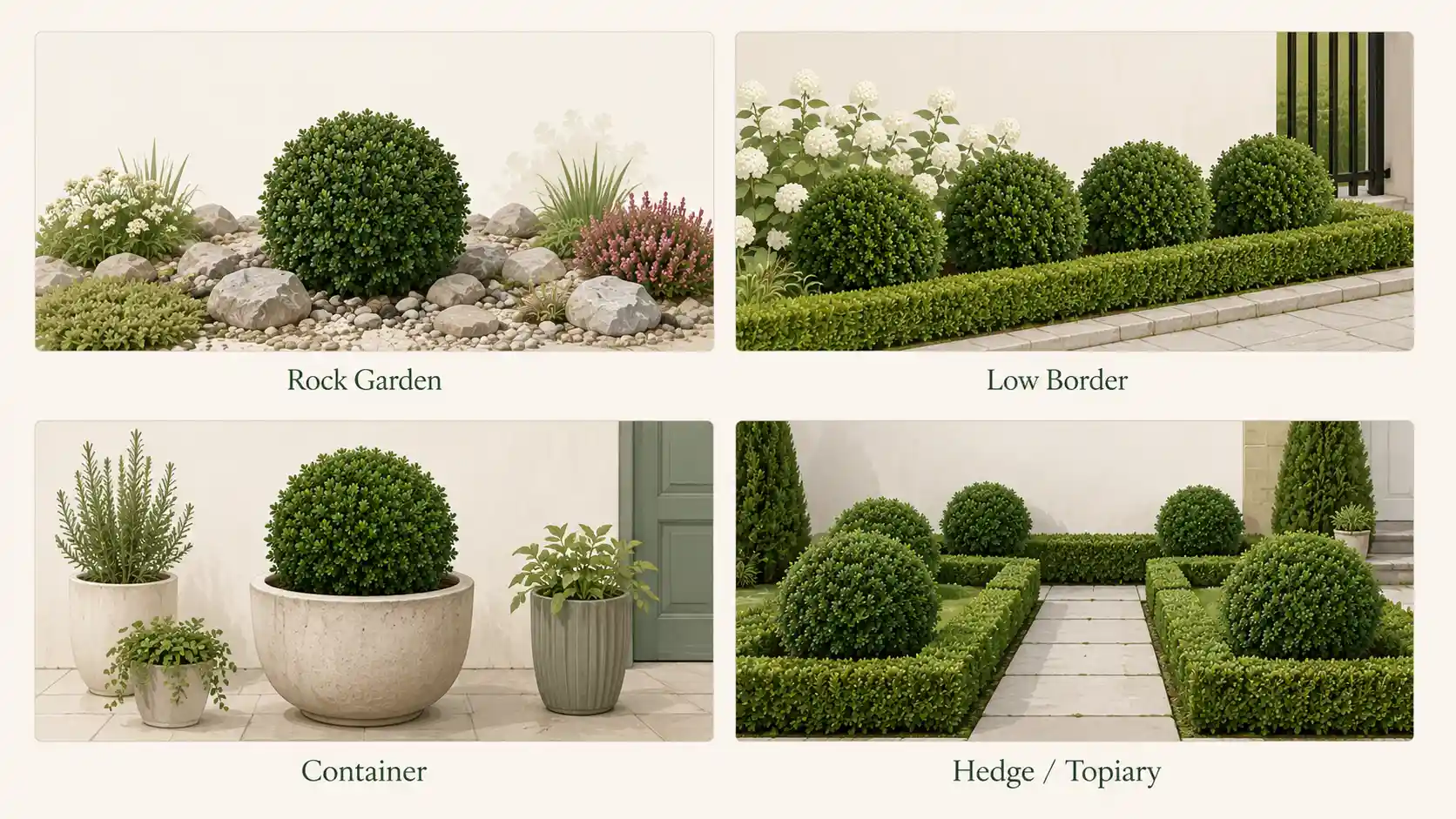
Mont Bruno is best used where small size, evergreen foliage, cold hardiness, and a naturally rounded form are more important than rapid growth. For gardeners comparing compact options for formal edging and low barriers, see our guide to 7+ Essential Small Hedge Plants for Easy Garden Borders.
Ideal applications include:
- Rock gardens
- Miniature or fairy gardens
- Containers
- Bonsai-style specimens
- Low landscape borders
- Walkway and patio edging
- Small formal hedges
- Foundation plantings
- Topiary and geometric designs
Its fine-textured leaves create a more refined appearance than large-leaved evergreen shrubs, while the dense globe habit provides structure throughout the year.
It is particularly useful in small gardens because it does not rapidly outgrow its planting area. The trade-off is that creating a continuous hedge from small plants takes patience because Mont Bruno grows slowly.
Mont Bruno Boxwood Varieties and Similar Cultivars
Mont Bruno is one cultivar rather than a group of varieties. The most useful comparisons are therefore with other compact boxwood cultivars.
North Star is another compact Buxus sempervirens selection. It typically reaches about 2–2.5 feet tall and wide, is hardy in Zones 5–9, and naturally forms a dense rounded habit.
Neatball is a compact Buxus microphylla selection rated for Zones 4b–9 and reaching roughly 2–3 feet tall and about 3 feet wide.
Sprinter is also compact but is specifically selected for faster growth than traditional slow-growing boxwoods, reaching roughly 2–4 feet tall and wide and rated for Zones 5–9.
This makes Mont Bruno especially attractive when the priority is Zone 4 hardiness plus a slow, naturally compact globe rather than rapid hedge filling.
Which Boxwood Is the Hardiest?
Mont Bruno is among the hardiest commonly available boxwood selections, with references consistently listing it for USDA Zone 4. It was found in Quebec and is specifically valued for cold-climate performance.
However, it is more accurate to say “among the hardiest” than to claim that it is universally the single hardiest boxwood. Hardiness depends on cultivar, local climate, winter exposure, snow cover, wind, and growing conditions.
For comparison, North Star is generally rated Zones 5–9, while some other newer cultivars also reach Zone 4 or approximately Zone 4b.
Mont Bruno’s particular advantage is the combination of Zone 4 hardiness, small scale, dense foliage, and naturally rounded growth.
Mont Bruno Boxwood Lifespan
A healthy boxwood can live for decades, and Mont Bruno should be considered a long-lived woody perennial when planted in suitable conditions and protected from serious disease, root problems, and repeated environmental stress.
There is no dependable single lifespan number for every boxwood. Longevity depends on cultivar, soil drainage, climate, pest pressure, disease exposure, and maintenance.
A well-sited plant can remain a permanent structural element of a garden rather than a short-lived seasonal shrub. The most important factors for long-term survival are avoiding saturated soil, managing drought stress, maintaining airflow, and monitoring for serious diseases.
Conclusion
Mont Bruno boxwood is a compact, slow-growing, globe-shaped evergreen Buxus sempervirens cultivar valued for its small dark-green foliage and exceptional Zone 4 cold hardiness. Its natural form makes it especially useful for rock gardens, borders, containers, small hedges, and formal landscapes where a large boxwood would outgrow the space.
For the best results, give Mont Bruno well-drained soil, suitable sun or light shade, consistent moisture without waterlogging, and restrained pruning. Its slow growth makes it easy to maintain, but gardeners should still monitor for winter injury, leafminer, root problems, and boxwood blight.
FAQs
How big does Mont Bruno boxwood get?
Mont Bruno boxwood commonly reaches about 2–3 feet tall and 2–3 feet wide, although some references report a smaller 10-year average of approximately 18 × 18 inches. Final size depends on growing conditions, age, climate, and pruning.
Is Mont Bruno boxwood the hardiest boxwood variety?
Mont Bruno is among the hardiest boxwoods, with a USDA Zone 4 rating and a history associated with Quebec’s cold climate. It should not necessarily be described as the single hardiest boxwood because other cultivars also have Zone 4 or approximately Zone 4 ratings.
How often should I water Mont Bruno boxwood?
Water Mont Bruno when the soil begins to dry rather than automatically watering every day. Newly planted shrubs need more consistent moisture while establishing, whereas established plants generally need supplemental irrigation mainly during prolonged dry periods. Always prioritize drainage because constantly wet soil can damage boxwood roots.
When is the best time to prune boxwood shrubs?
For routine structural maintenance, thinning during the dormant season can be effective; University of Maryland Extension recommends December through February for thinning boxwoods. Avoid unnecessary repeated shearing because dense outer growth can reduce airflow and increase disease problems.
What kills boxwood shrubs the fastest?
Severe boxwood blight can cause rapid defoliation and serious plant decline, particularly under favorable wet and humid conditions. The disease causes leaf spots, bronzing, rapid leaf drop, and dark stem lesions. Other serious problems include root disease and severe winter injury.
Do coffee grounds actually help boxwoods?
Coffee grounds should not be relied upon as a primary fertilizer for boxwoods. They do not replace soil testing or a balanced fertilizer when nutrients are deficient. Improving drainage and soil structure is more important than adding coffee grounds, and fertilizer should be applied when plant needs or soil-test results justify it.
How far apart should I plant Mont Bruno boxwoods for a hedge?
A spacing of about 3 feet center-to-center is a useful starting point based on nursery guidance for Mont Bruno, but the ideal distance depends on the desired hedge density and plant size. Closer spacing fills gaps sooner but increases competition and canopy density; wider spacing improves airflow but takes longer to form a continuous hedge.