
Introduction
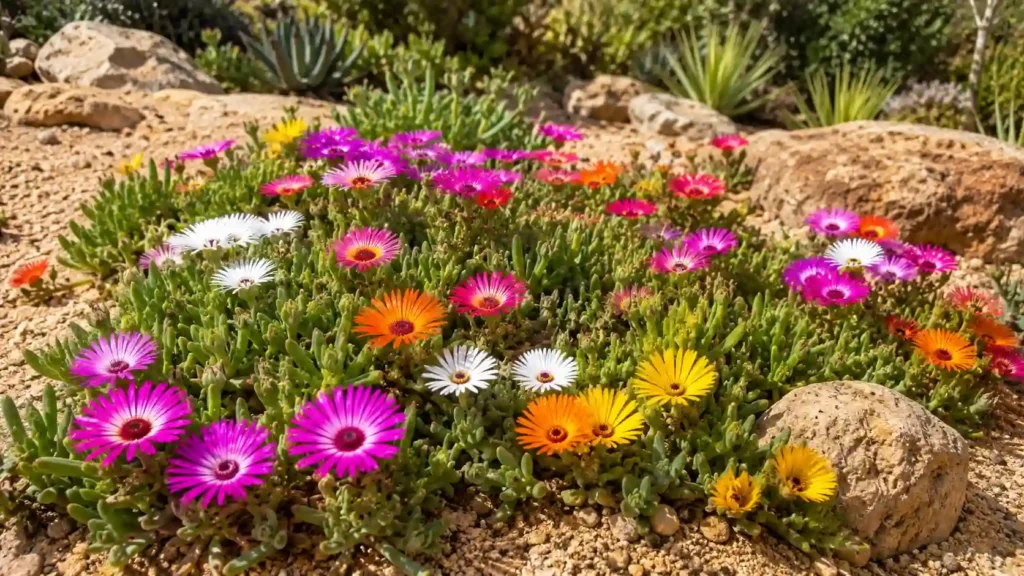
Dorotheanthus bellidiformis is a flowering succulent groundcover species commonly known as the Livingstone daisy, dorotheanthus, or dorotheanthus plant. This colorful ornamental plant belongs to the Aizoaceae family and is valued for its bright daisy-like flowers, low-growing habit, and drought tolerance. Native to South Africa, it thrives in sunny, dry environments with well-draining soil. This article explains what Dorotheanthus bellidiformis is, how it grows, whether it is an annual or perennial, and how to provide proper care for healthy growth and long-lasting blooms.
Quick Summary
- Dorotheanthus bellidiformis is a flowering succulent groundcover from South Africa, commonly called Livingstone daisy.
- It is usually grown as an annual in cold climates but can behave as a tender perennial in frost-free regions.
- The plant prefers full sun, sandy well-draining soil, and moderate watering with protection from excess moisture.
- Dorotheanthus grows well in garden borders, rock gardens, containers, and hanging baskets.
What Is Dorotheanthus Bellidiformis?
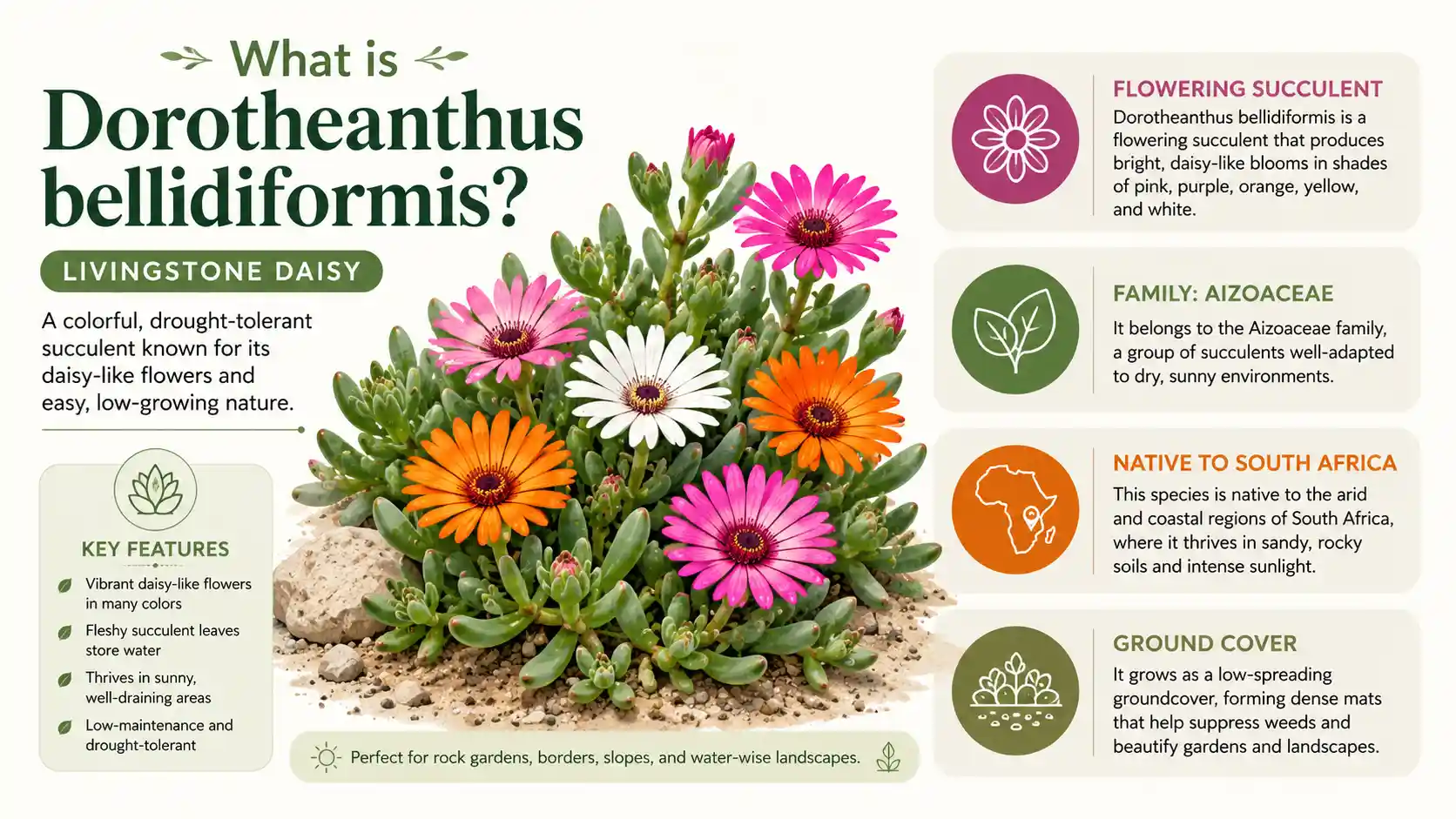
Dorotheanthus bellidiformis is a low-growing flowering succulent species in the Aizoaceae family, native to South Africa and commonly known as the Livingstone daisy. It produces colorful, daisy-like flowers and fleshy leaves that help it survive in dry conditions. Because of its spreading habit, Dorotheanthus works well alongside other flowering groundcover plants used for borders, rock gardens, and low-maintenance landscapes.
The dorotheanthus plant is often grown as an ornamental groundcover because of its spreading growth habit and vibrant blooms. Its flowers commonly appear in shades of pink, purple, red, orange, yellow, and white, creating a carpet-like display when planted in sunny locations.
The dorotheanthus common name, Livingstone daisy, refers to its bright, daisy-shaped flowers and historical association with explorer David Livingstone, although the plant itself belongs to a succulent group rather than true daisies in the Asteraceae family.
Key characteristics of Dorotheanthus bellidiformis include:
- Botanical family: Aizoaceae
- Native region: South Africa
- Growth type: Low-growing flowering succulent groundcover
- Leaves: Thick, fleshy, water-storing leaves
- Flowers: Bright, daisy-like blooms that open best in sunlight
- Common names: Livingstone daisy, dorotheanthus, dorotheanthus plant
Unlike many traditional flowering annuals, Dorotheanthus combines ornamental flowers with succulent traits, making it suitable for dry gardens, rock gardens, containers, and areas where water conservation is important.
Dorotheanthus vs. Mezoo — Are They the Same?
Dorotheanthus bellidiformis and Mezoo are related but are not exactly the same plant. Mezoo, commonly sold as Mezoo Trailing Red or Mezoo Trailing Red Livingstone daisy, is a popular ornamental cultivar associated with the Dorotheanthus group and selected mainly for its trailing growth habit and attractive foliage.
While Dorotheanthus bellidiformis is best known for colorful flowers, Mezoo is often grown for its decorative leaves and spreading habit.
Dorotheanthus bellidiformis vs. Mezoo Trailing Red vs. Dorotheanthus Variegated
| Feature | Dorotheanthus bellidiformis | Mezoo Trailing Red | Dorotheanthus Variegated |
| Plant type | Flowering succulent groundcover | Trailing succulent cultivar | Variegated foliage cultivar |
| Main attraction | Bright daisy-like flowers | Red-edged leaves and trailing growth | Decorative patterned leaves |
| Growth habit | Low and spreading | More trailing and cascading | Usually compact to spreading |
| Foliage | Green succulent leaves | Green leaves with red margins | Green leaves with lighter variegation |
| Flower color | Many colors including pink, orange, purple, and white | Small flowers may appear but foliage is the main feature | Depends on cultivar |
| Best use | Borders, rock gardens, seasonal displays | Hanging baskets, containers, groundcover | Decorative containers and mixed plantings |
The term dorotheanthus mezoo usually refers to the Mezoo cultivar rather than the wild species Dorotheanthus bellidiformis. Mezoo Trailing Red is especially popular because it combines succulent foliage with a trailing habit that works well in containers and hanging baskets.
Is Dorotheanthus an Annual or Perennial?
Dorotheanthus is usually grown as an annual in regions with cold winters, but it can grow as a tender perennial in frost-free climates. Its ability to survive year-round depends mainly on temperature, frost exposure, and growing conditions.
In USDA hardiness zones with freezing temperatures, Dorotheanthus bellidiformis typically completes its life cycle during one growing season. In warmer climates where frost is rare, the plant can continue growing for multiple years.
Its lifecycle depends on:
- Cold climates: Usually treated as an annual because frost damages or kills the plant.
- Warm climates: May survive as a perennial groundcover.
- Mild winters: Can persist if protected from freezing temperatures.
- Self-seeding: Plants may produce seeds that allow new plants to appear in following seasons.
Dorotheanthus is sensitive to frost, and prolonged exposure to temperatures near freezing can damage its leaves and stems. Gardeners in colder areas often grow it as a seasonal flowering plant or overwinter it indoors when possible.
Is Dorotheanthus a Succulent?
Yes, Dorotheanthus is a succulent because it has thick, fleshy leaves that store water and help the plant tolerate dry conditions. Its succulent structure allows it to survive periods of limited rainfall by using stored moisture. Like other succulent plants such as Peperomia rotundifolia, Dorotheanthus stores water in its fleshy leaves and prefers well-draining soil with careful watering practices.
The leaves contain specialized tissues that retain water, reducing the plant’s dependence on frequent watering. This adaptation makes Dorotheanthus drought tolerant compared with many traditional flowering groundcovers.
Important succulent traits include:
- Water-storing leaves
- Reduced water loss during dry periods
- Preference for fast-draining soil
- Better tolerance of short drought periods than moisture-loving plants
The Mezoo succulent cultivar has similar water-storage characteristics. However, drought tolerance does not mean the plant should remain completely dry for long periods. Extended drought can reduce flowering and cause leaf stress.
Dorotheanthus performs best when:
- Grown in full sun
- Planted in sandy or gritty soil
- Watered deeply but allowed to dry between watering
- Protected from constantly wet conditions
How to Grow Dorotheanthus Bellidiformis
Growing Dorotheanthus bellidiformis is relatively simple when its basic succulent requirements are met. The plant can be grown from seeds or established plants, with the most important factors being sunlight, drainage, and suitable planting timing.
The best growing conditions include:
- Full sun exposure for strong flowering
- Warm temperatures for active growth
- Loose, well-draining soil
- Protection from frost and excessive moisture
Gardeners commonly grow Dorotheanthus in flower beds, rock gardens, containers, borders, and hanging baskets. It spreads outward rather than growing tall, making it useful as a colorful groundcover.
Growing Dorotheanthus from Seed
Growing Dorotheanthus bellidiformis from seed is one of the most common propagation methods. Seeds are usually started indoors before the final frost date in colder climates or directly sown outdoors in warm regions.
For successful seed germination:
- Sow seeds in a light, well-draining seed-starting mix.
- Press seeds lightly into the soil surface because they need light to germinate.
- Maintain warm temperatures around 65–75°F (18–24°C).
- Keep the soil slightly moist but avoid waterlogging.
- Provide bright light after seedlings emerge.
Seedlings usually require several weeks of growth before transplanting outdoors. Young plants should be gradually exposed to outdoor conditions to prevent transplant shock.
When and Where to Plant
The best time to plant Dorotheanthus depends on climate. In areas with cold winters, planting should happen after the danger of frost has passed. In warm climates, it can be planted during cooler parts of the growing season.
Ideal planting conditions include:
- Season: Spring after frost or during mild weather in warm regions
- Light: Full sun with at least 6 hours of direct sunlight daily
- Spacing: Allow enough room for spreading growth, usually several inches between plants depending on the desired coverage
Step-by-step planting sequence:
- Choose a location with full sunlight and good air circulation.
- Prepare the soil by improving drainage with sand, grit, or organic material if needed.
- Plant seedlings or seeds at the correct depth.
- Water lightly after planting to help roots establish.
- Reduce watering once the plant begins active growth.
- Monitor moisture levels and avoid areas where water collects.
Dorotheanthus grows best when its natural South African environment is replicated: bright sunlight, dry conditions, and soil that allows excess water to drain quickly.
What Soil Is Best for Dorotheanthus?
The best soil for Dorotheanthus is a fast-draining, sandy soil mix that prevents excess moisture around the roots. Because Dorotheanthus bellidiformis is a succulent, it performs poorly in heavy, compacted soil that holds water for long periods.
An ideal soil mixture should include:
- Sandy soil or coarse sand to improve drainage
- Perlite or pumice to increase airflow around roots
- Light organic matter to provide limited nutrients
- Neutral to slightly acidic soil pH (approximately 6.0–7.5)
For outdoor planting, avoid low areas where rainwater collects. For containers, use a commercial cactus or succulent potting mix, or create a custom blend with regular potting soil, sand, and a drainage amendment.
Poor drainage is one of the most common reasons Dorotheanthus develops root problems. The roots need access to oxygen, and constantly wet soil can lead to root rot and weak growth.
Can Dorotheanthus Grow in Pots?
Yes, Dorotheanthus can grow successfully in pots when planted in containers with excellent drainage and enough sunlight. Livingstone daisies in pots are popular because their spreading habit works well in decorative containers, window boxes, and hanging baskets.
Container growing requirements include:
- A pot with drainage holes
- A well-draining succulent soil mix
- A sunny outdoor location
- Occasional deep watering followed by soil drying
For best results:
- Choose a container slightly larger than the root system.
- Avoid oversized pots that hold excess moisture.
- Use terracotta pots when possible because they allow soil to dry faster.
- Place containers where plants receive direct sunlight.
Livingstone daisy in pots can create colorful displays on patios, balconies, and garden edges. Their trailing growth also makes them suitable for mixed succulent arrangements.
Can Dorotheanthus Be a Houseplant?
Dorotheanthus can be grown indoors temporarily, but it is not an ideal year-round houseplant because it requires intense sunlight to maintain healthy growth and flowering. Dorotheanthus Mezoo indoors can survive near a bright window, but indoor conditions often reduce flowering. Although Dorotheanthus is not an ideal permanent indoor plant, it shares some low-maintenance qualities with other drought-tolerant houseplants that adapt well to bright indoor spaces.
For successful indoor growth:
- Place the plant near a south-facing or very bright window.
- Provide several hours of direct sunlight daily.
- Use a container with drainage holes.
- Avoid humid rooms with poor airflow.
Mezoo plant care indoors requires careful watering because indoor environments dry more slowly than outdoor locations. Allow the soil to dry between waterings to prevent root issues.
While Mezoo Trailing Red indoors can be grown as a decorative foliage plant, it usually performs better outdoors where sunlight intensity supports stronger growth and color development.
Dorotheanthus Bellidiformis Care Guide
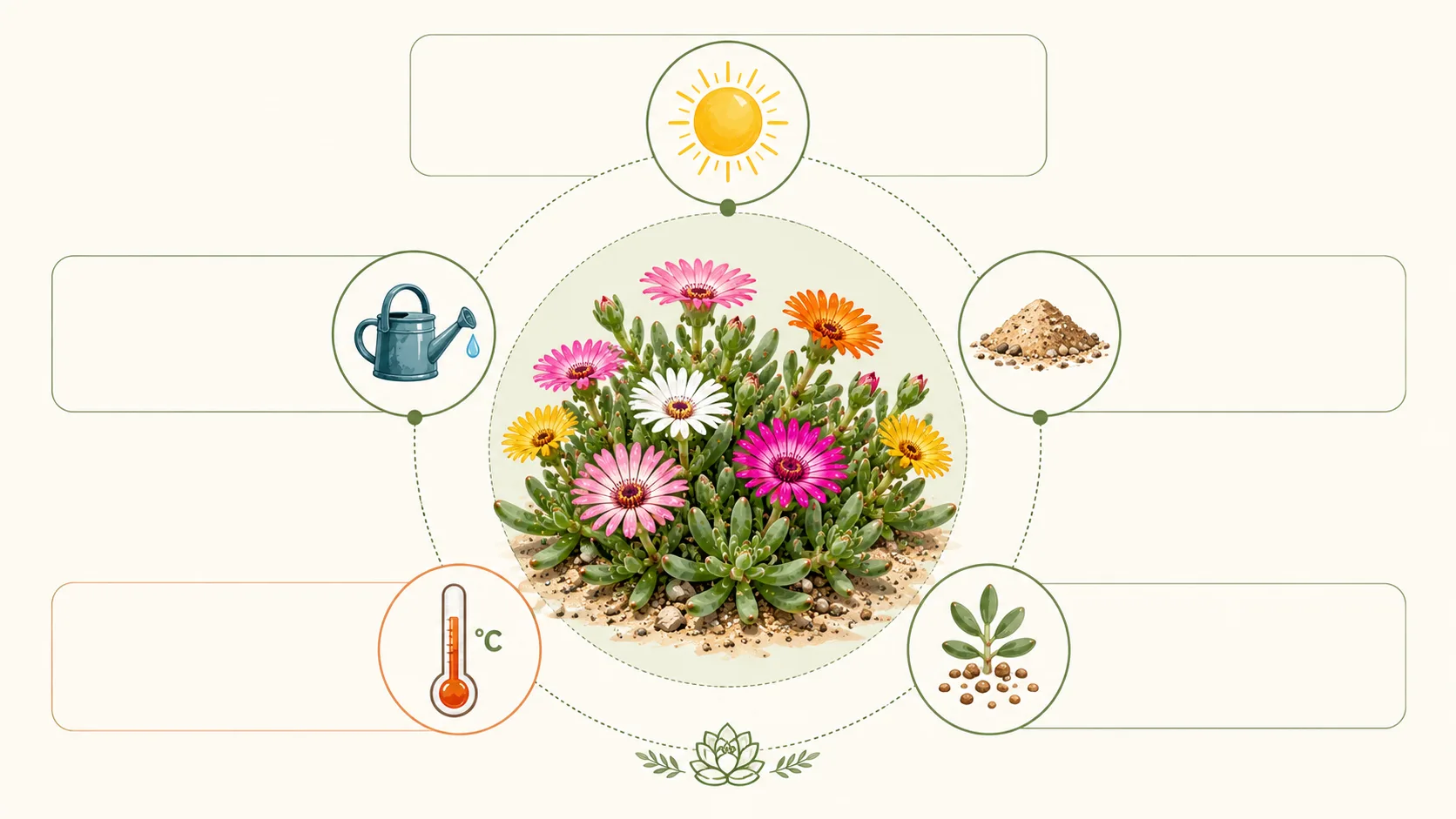
Dorotheanthus bellidiformis care is based on providing conditions similar to its native South African habitat. The plant prefers bright sunlight, dry soil conditions, warm temperatures, and minimal feeding.
Proper care focuses on preventing overwatering while maintaining enough moisture for active growth and flowering.
Watering Needs
Dorotheanthus is drought tolerant and requires less frequent watering than many flowering plants. Its succulent leaves store moisture, allowing it to handle short dry periods.
Watering guidelines:
- Water deeply when the top layer of soil becomes dry.
- Reduce watering during cooler months.
- Avoid keeping the soil constantly wet.
- Increase watering slightly during hot, dry growing periods.
Common watering mistakes include frequent shallow watering and watering on a fixed schedule without checking soil moisture. Overwatering is more harmful than underwatering for Dorotheanthus.
Light Requirements
Dorotheanthus requires full sun for the best flowering performance. Bright sunlight encourages compact growth, stronger colors, and more abundant blooms.
The flowers often close during:
- Cloudy weather
- Evening hours
- Low-light conditions
Plants grown in partial shade may survive but often produce fewer flowers and weaker stems.
For the healthiest growth:
- Provide at least 6 hours of direct sunlight daily.
- Avoid locations with heavy shade.
- Rotate containers occasionally for even growth.
Soil Preferences
Dorotheanthus prefers loose, gritty soil that drains quickly. The soil should allow water to pass through easily while providing enough support for the shallow root system.
Recommended soil characteristics:
- Fast drainage
- Good airflow
- Low to moderate fertility
- No standing water after irrigation
The same drainage requirements apply to both garden-grown plants and container-grown Dorotheanthus.
Fertilization Practices
Dorotheanthus has low fertilizer requirements because excessive nutrients can encourage soft growth instead of strong flowering. As a succulent, it generally performs well in nutrient-poor soils.
Fertilizing recommendations:
- Apply a diluted balanced fertilizer occasionally during active growth.
- Avoid heavy nitrogen fertilizers.
- Reduce feeding during winter or dormancy periods.
A light feeding schedule is usually enough to support healthy foliage and blooms.
Pruning and Deadheading
Deadheading Livingstone daisies in pots can help maintain a cleaner appearance and encourage continued flowering. Removing faded blooms prevents the plant from putting energy into seed production.
Pruning practices include:
- Remove dried flowers regularly.
- Trim damaged or weak stems.
- Cut back overgrown trailing growth to maintain shape.
Deadheading is not always required because Dorotheanthus naturally manages its growth, but it can improve the appearance of container plants.
Climate Tolerance and Winter Care
Dorotheanthus prefers warm, dry climates and has limited frost tolerance. In areas with cold winters, plants usually need protection or should be grown as seasonal annuals.
Mezoo Trailing Red cold tolerance is similar to many tender succulents. It can tolerate mild cool temperatures but may suffer damage from freezing conditions.
Winter care tips:
- Move container plants indoors before frost.
- Reduce watering during cold months.
- Keep plants away from freezing temperatures.
- Provide bright light if overwintering indoors.
Dorotheanthus Care Summary
| Care Factor | Requirement |
| Light | Full sun, preferably 6+ hours of direct sunlight |
| Water | Low to moderate; allow soil to dry between watering |
| Soil | Sandy, gritty, fast-draining soil |
| Temperature | Warm conditions; protect from frost |
| Feeding | Light fertilization during active growth |
How Long Do Livingstone Daisies Last?
Livingstone daisies typically last for one growing season in cold climates but may survive for several years as tender perennials in frost-free regions. Their flowering period depends on temperature, sunlight, and overall growing conditions.
Under suitable conditions, blooms can continue for several weeks or months during the active growing season.
Factors affecting flowering longevity include:
- Amount of sunlight received
- Temperature stability
- Watering practices
- Soil drainage
- Plant health
Plants grown in full sun with proper drainage usually produce longer-lasting displays than those grown in shade or overly wet soil.
How to Propagate Dorotheanthus
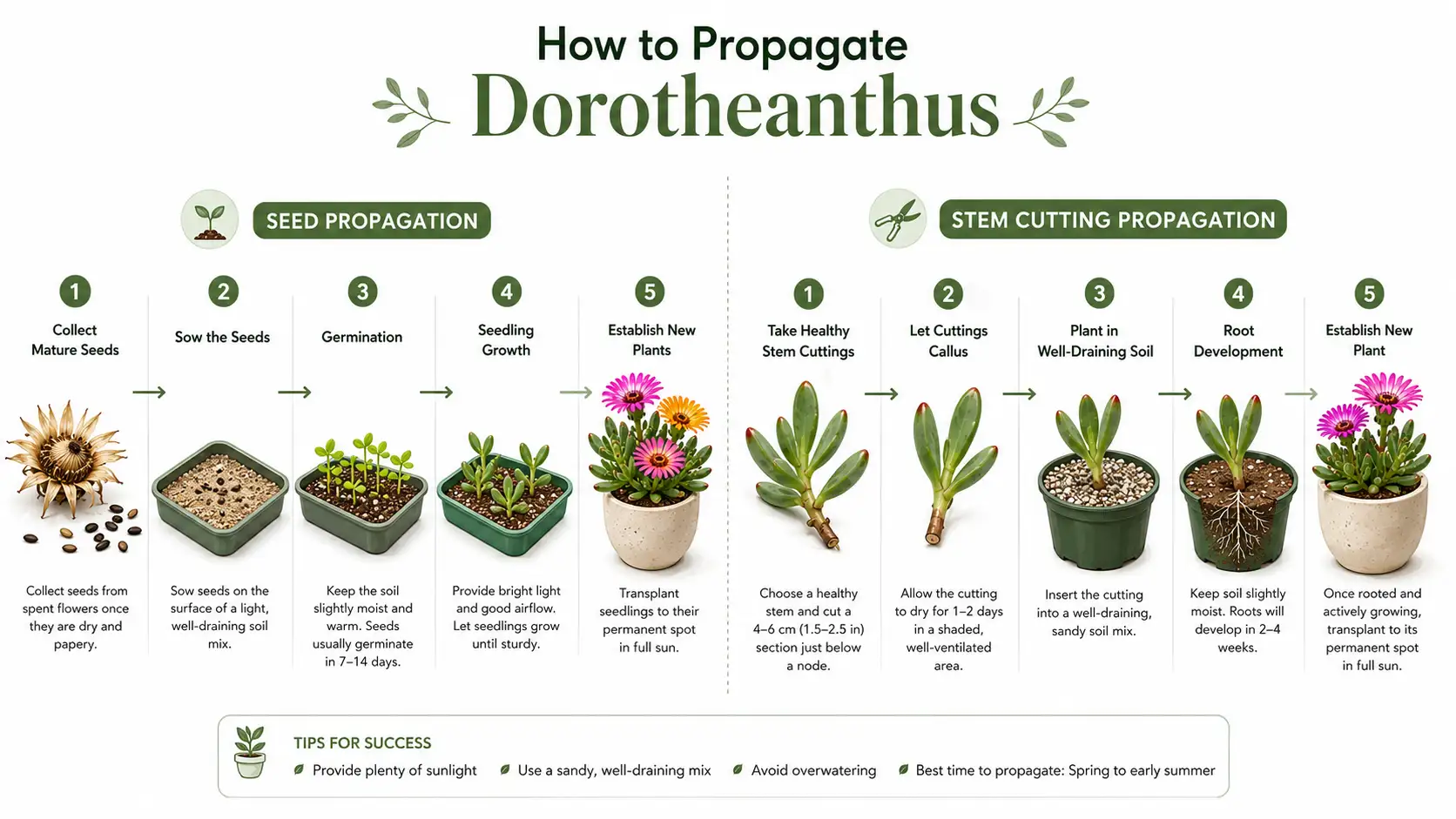
Dorotheanthus propagation can be done through seeds or stem cuttings. Seed propagation is common for Dorotheanthus bellidiformis, while cuttings are frequently used for trailing cultivars such as Mezoo.
The main propagation methods include:
- Seeds: Best for growing the species and creating flowering displays.
- Stem cuttings: Useful for maintaining specific cultivars and faster multiplication.
For successful propagation:
- Use healthy plant material.
- Provide warm temperatures.
- Use well-draining growing media.
- Avoid excessive moisture during rooting.
Propagating Mezoo Trailing Red from Cuttings
Mezoo propagation is commonly done through stem cuttings because it preserves the cultivar’s trailing characteristics.
Steps for Mezoo Trailing Red propagation:
- Cut a healthy stem section several inches long.
- Remove lower leaves near the cutting base.
- Allow the cut end to dry briefly.
- Place the cutting in moist succulent soil or another well-draining medium.
- Keep it in bright indirect light until roots develop.
Mezoo plant propagation is generally reliable because the stems can form roots from nodes when provided with suitable conditions.
Can You Propagate Dorotheanthus in Water?
Yes, Dorotheanthus cuttings can sometimes be rooted in water, but water propagation is not the preferred method because the plant naturally prefers dry, well-aerated conditions. Soil propagation usually produces stronger roots better adapted to succulent growth.
When propagating Mezoo in water:
- Use healthy stem cuttings.
- Change water regularly.
- Move rooted cuttings into well-draining soil once roots develop.
Although you can root Mezoo in water, soil or succulent propagation methods are generally more reliable for long-term growth.
Is Dorotheanthus Poisonous to Dogs?
Dorotheanthus is generally considered non-toxic to dogs, making it a relatively safer ornamental option for households with pets. However, pets can still experience mild digestive upset if they chew or consume large amounts of plant material.
Pet owners should still take precautions because:
- Individual animals may react differently to plant consumption.
- Large amounts of any unfamiliar plant material can cause stomach discomfort.
- Soil additives, fertilizers, or pesticides used around the plant may create additional risks.
If a dog repeatedly chews on Dorotheanthus or shows symptoms such as vomiting, diarrhea, or unusual behavior after eating plant material, contact a veterinarian for guidance.
Are Livingstone Daisies Easy to Grow? (Beginner Considerations)
Yes, Livingstone daisies are considered easy to grow for beginners because they require minimal maintenance, tolerate dry conditions, and adapt well to containers and sunny garden spaces. Their main requirements are strong sunlight, well-draining soil, and careful watering.
Many beginners succeed with Dorotheanthus because it behaves similarly to other low-maintenance succulents. However, problems often occur when gardeners treat it like a traditional moisture-loving flowering plant.
Common beginner mistakes include:
- Overwatering: Keeping the soil constantly wet can cause root rot and weak growth.
- Poor drainage: Heavy soil prevents oxygen from reaching roots and increases disease risk.
- Insufficient sunlight: Low light reduces flowering and causes weaker growth.
- Wrong climate expectations: Frost can damage plants because Dorotheanthus is not a cold-hardy succulent.
- Overfertilizing: Too many nutrients can encourage excessive foliage instead of strong blooms.
For beginners, the easiest approach is to plant Dorotheanthus in a sunny location, use a gritty soil mix, and water only when the soil has dried.
Common Dorotheanthus Growing Problems (Troubleshooting)
Dorotheanthus is generally resilient, but incorrect growing conditions can lead to yellow leaves, poor flowering, and pest issues. Most problems are related to moisture management, lighting, or environmental stress.
| Problem | Cause | Fix | Prevention |
| Leaves turning yellow | Overwatering, poor drainage, or root stress | Reduce watering and improve soil drainage | Use fast-draining soil and check moisture before watering |
| Soft or damaged leaves | Excess moisture or cold temperatures | Remove affected growth and adjust conditions | Protect from frost and avoid wet soil |
| Slow or no flowering | Lack of sunlight, excessive shade, or poor growing conditions | Move plant to brighter light and improve care | Provide full sun and avoid overfeeding |
| Pest infestations | Plant stress or crowded growth | Remove pests and treat with appropriate methods | Maintain airflow and healthy growing conditions |
Leaves Turning Yellow
Yellow leaves on Dorotheanthus are commonly caused by excessive moisture around the roots. Because the plant stores water in its leaves, frequent watering can create stress rather than improving growth.
Possible causes include:
- Waterlogged soil
- Poor drainage
- Overwatering during cool weather
- Root damage
Solutions:
- Allow the soil to dry before watering again.
- Replace heavy soil with a more porous mix.
- Remove severely damaged leaves.
Prevention is based on maintaining dry periods between watering and avoiding containers without drainage holes.
Overwatering Issues
Overwatering is one of the most common Dorotheanthus care problems. Although the plant flowers heavily, it does not require constant moisture like many annual bedding plants.
Signs of overwatering include:
- Yellowing leaves
- Soft or mushy stems
- Reduced flowering
- Root problems
To fix overwatering:
- Stop watering until the soil dries.
- Improve drainage if needed.
- Repot plants with damaged roots into fresh succulent soil.
The best prevention method is checking soil moisture before watering instead of following a strict schedule.
Pest Infestations
Dorotheanthus usually has few pest problems, but stressed plants may attract common garden pests such as aphids, spider mites, or mealybugs.
Possible causes include:
- Weak growth from poor lighting
- Excess humidity
- Crowded plants with limited airflow
Control methods:
- Remove visible pests manually.
- Use insecticidal soap when appropriate.
- Improve airflow around plants.
Healthy plants grown in proper sunlight are less likely to experience serious pest problems.
Slow or No Flowering
Dorotheanthus flowers best under bright sunlight. Lack of blooms is usually caused by insufficient light, unsuitable temperatures, or excessive nutrients.
Common causes:
- Too much shade
- Poor drainage
- Overfertilization
- Cold temperatures
To encourage flowering:
- Move plants to a full-sun location.
- Reduce excessive fertilizer use.
- Maintain proper watering habits.
- Grow during the plant’s active season.
Dorotheanthus Varieties and Differentiation
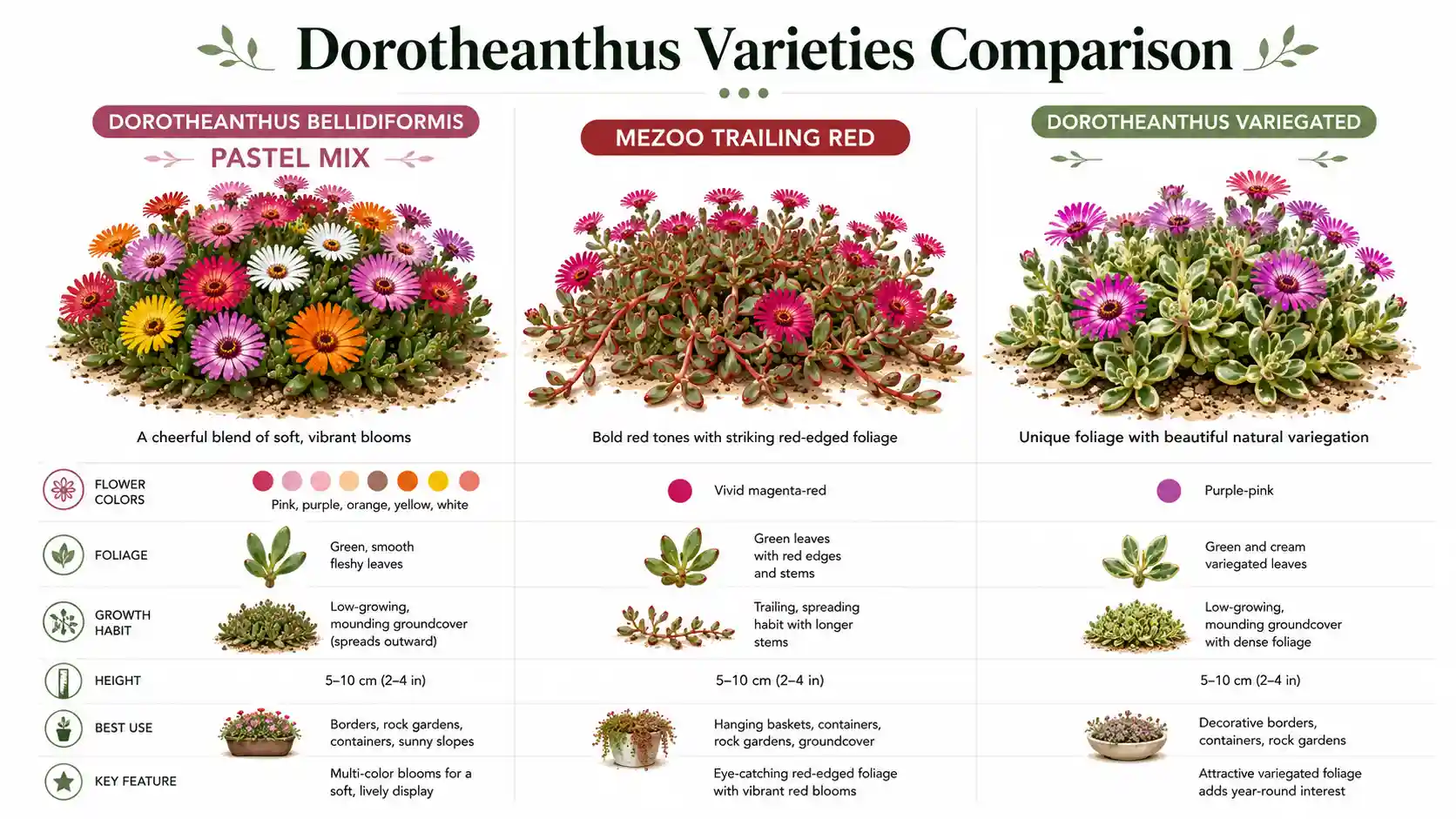
Dorotheanthus includes several ornamental forms selected for differences in flower colors, foliage patterns, and growth habits. While Dorotheanthus bellidiformis is primarily valued for colorful blooms, cultivars such as Mezoo Trailing Red are often grown for decorative foliage and trailing growth.
Different varieties are useful for different garden purposes:
- Flower-focused varieties work well in borders and seasonal displays.
- Trailing forms suit hanging baskets and containers.
- Variegated types add foliage interest even when flowers are limited.
Dorotheanthus Bellidiformis Pastel Mix
Dorotheanthus bellidiformis Pastel Mix is a seed variety known for producing flowers in soft, blended colors. These mixes typically include pastel shades such as pink, peach, lavender, white, and light yellow.
Characteristics include:
- Multiple flower colors from one seed packet
- Low-growing spreading habit
- Succulent foliage
- Strong performance in sunny locations
The dorotheanthus bellidiformis pastel mix is commonly used for creating colorful groundcover displays, rock gardens, borders, and container arrangements.
Dorotheanthus Variegated
Dorotheanthus variegated refers to ornamental forms with patterned or differently colored foliage rather than the standard solid green leaves. These plants are valued mainly for their decorative leaves.
Typical features include:
- Green leaves with lighter markings or contrasting patterns
- Succulent leaf texture
- Compact or spreading growth
- Use in mixed containers and ornamental displays
Variegated forms may grow slightly differently from standard Dorotheanthus bellidiformis because leaf coloration can influence photosynthesis and growth rate.
Dorotheanthus Variety Comparison
| Feature | Pastel Mix | Mezoo Trailing Red | Variegated Dorotheanthus |
| Main attraction | Multi-colored flowers | Trailing foliage with red edges | Decorative leaf patterns |
| Flower color | Soft pastel shades | Less focused on flowers | Depends on cultivar |
| Foliage | Green succulent leaves | Green leaves with red margins | Patterned or lighter foliage |
| Growth habit | Low mounding groundcover | Trailing and cascading | Compact to spreading |
| Best use | Borders, flower beds, seasonal displays | Hanging baskets and containers | Ornamental mixed plantings |
Conclusion
Dorotheanthus bellidiformis is a flowering succulent groundcover known for its colorful blooms, drought tolerance, and easy-care nature. Commonly called the Livingstone daisy, this South African Aizoaceae species can grow as an annual in colder climates or a tender perennial in frost-free regions.
The key to successful Dorotheanthus care is providing full sun, fast-draining soil, moderate watering, and protection from frost. The plant can be grown from seeds or cuttings and performs well in borders, rock gardens, containers, and hanging baskets.
With proper drainage and sufficient sunlight, Dorotheanthus bellidiformis is a reliable choice for gardeners seeking a low-maintenance flowering succulent with strong ornamental value.
FAQs
Is Dorotheanthus an annual or perennial?
Dorotheanthus is usually grown as an annual in cold climates but can behave as a tender perennial in frost-free regions. Its lifespan depends on temperature, frost exposure, and growing conditions.
Are Livingstone daisies easy to grow?
Yes, Livingstone daisies are easy to grow because they require little maintenance and tolerate dry conditions. They grow best with full sun, well-draining soil, and careful watering.
Can Dorotheanthus be a houseplant?
Dorotheanthus can be grown indoors temporarily, but it is not an ideal permanent houseplant because it requires strong sunlight for healthy growth and flowering. A bright sunny window is necessary for indoor success.
Can you propagate Dorotheanthus in water?
Yes, Dorotheanthus cuttings can be rooted in water, but soil propagation is generally preferred because it encourages stronger succulent root development.
Is Dorotheanthus poisonous to dogs?
Dorotheanthus is generally considered non-toxic to dogs. However, eating large amounts of plant material may still cause mild digestive discomfort in some pets.
How long do Livingstone daisies last?
Livingstone daisies usually last one growing season in cold climates but may survive for several years in warm, frost-free areas. Flowering duration depends on sunlight, temperature, and care.
Do you deadhead Livingstone daisies in pots?
Deadheading Livingstone daisies in pots is optional but can improve appearance and encourage continued blooming by removing faded flowers before seed production.



One Response