
Introduction
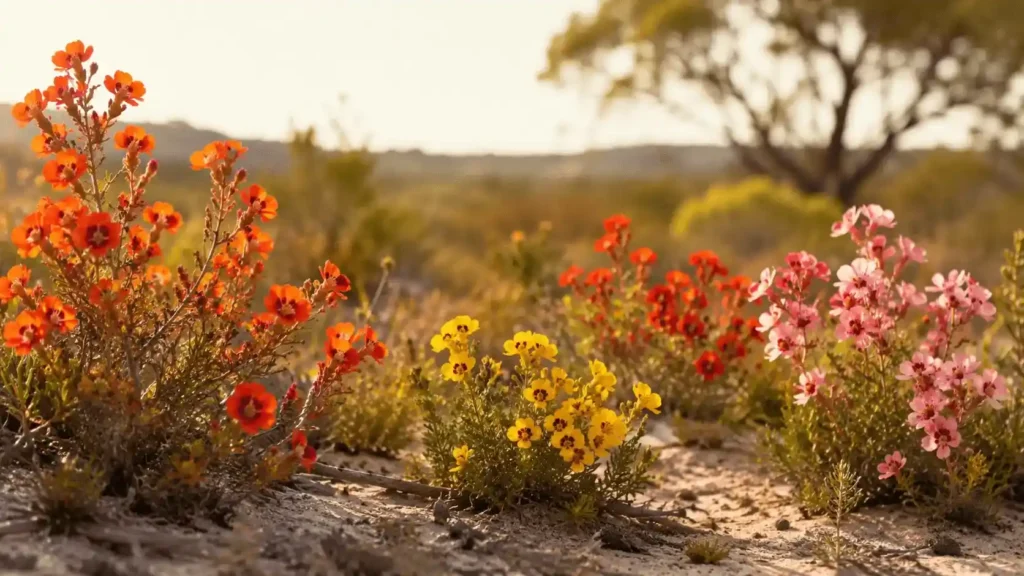
Lechenaultia formosa is one of Western Australia’s most visually striking native wildflowers, known for its intensely coloured blooms in shades of red, orange, yellow, and flame tones. This low-growing Australian native shrub belongs to the Goodeniaceae family and naturally grows in sandy, free-draining landscapes across south-western Western Australia.
The plant is commonly called red lechenaultia or flame lechenaultia, although many gardeners also search for it using the alternate spelling “leschenaultia.” Both lechenaultia and leschenaultia refer to the same Australian native plant genus. Due to its brilliant flower colours and drought-tolerant nature, lechenaultia formosa has become increasingly popular in native gardens, rockeries, and wildflower collections.
Quick Summary
- Lechenaultia formosa is a low-growing Australian native shrub native to Western Australia, prized for its vivid red, orange, yellow, and flame-coloured flowers
- It thrives in free-draining, sandy soils with full sun and low humidity, closely matching its natural bushland habitat
- Popular cultivars include Eldorado, Strawberry Sundae, Prostrate Red, Flame, Orange Form, and Lola
- The species belongs to the Goodeniaceae family and is related to blue lechenaultia (Lechenaultia biloba) and wreath lechenaultia (Lechenaultia macrantha)
- Excellent drainage and low-phosphorus fertilization are essential for long-term plant health
What Is Lechenaultia Formosa?
Lechenaultia formosa is an Australian native flowering shrub endemic to Western Australia. It belongs to the genus Lechenaultia within the Goodeniaceae family and is widely admired for its bright, vividly coloured flowers. The species naturally occurs in dry heathlands and sandy bushland environments where drainage is extremely sharp and rainfall patterns are seasonal. Lechenaultia formosa belongs to the Lechenaultia genus, a group of Western Australian native flowering plants within the Goodeniaceae family.
The plant is commonly known as red lechenaultia or flame lechenaultia due to the intense colour of its blooms. Some gardeners also refer to it informally as “leche formosa.” The spelling variation “leschenaultia” is also common in gardening circles, and both lechenaultia and leschenaultia describe the same genus.
Lechenaultia formosa is valued for ornamental use because of its compact size, spreading habit, and long flowering display. Its flowers can appear scarlet red, orange-red, flame orange, yellow, or even bi-coloured depending on the cultivar.
Common Names and Botanical Classification
Lechenaultia formosa is scientifically classified as part of the genus Lechenaultia in the Goodeniaceae family. The species name “formosa” refers to its showy and attractive floral display.
Common names include:
- Red lechenaultia
- Flame lechenaultia
- Leschenaultia flower
- Leschenaultia plant
- Leche formosa
The spelling confusion between lechenaultia and leschenaultia originates from the plant’s botanical history. The genus was named after French botanist Jean-Baptiste Leschenault de la Tour. Over time, spelling variations became common in horticulture and online plant searches.
Although “leche formosa” is sometimes used casually, the accepted botanical name remains Lechenaultia formosa.
Natural Habitat and Geographic Range
Lechenaultia formosa naturally grows across the sandplains, heathlands, and dry sclerophyll regions of south-western Western Australia. These environments are characterized by nutrient-poor sandy soils, excellent drainage, low humidity, and strong sunlight exposure.
The species has adapted to harsh Australian conditions where summers are hot and dry while winters are cooler and wetter. In the wild, it is often found growing alongside other iconic Western Australian wildflowers, including blue Australian native flowers and wreath flowers native to Western Australia.
Its natural habitat explains why the plant struggles in heavy clay soils or humid climates. Successful cultivation depends on recreating the dry, free-draining conditions of its native environment.
Lechenaultia Formosa Varieties and Cultivars
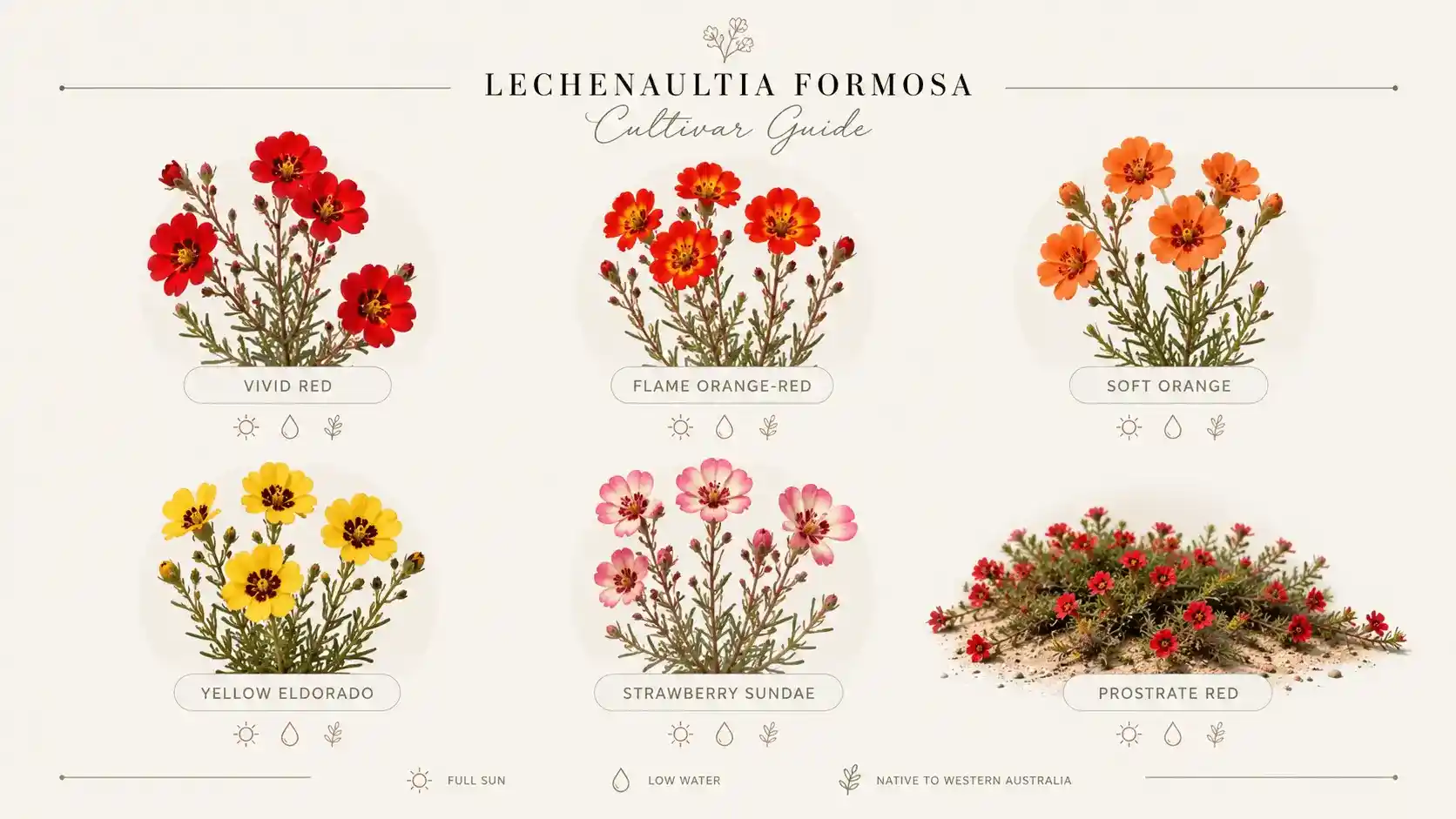
Lechenaultia formosa includes several cultivars selected for flower colour, plant habit, and ornamental performance. These varieties differ in growth form, colour intensity, and landscape application.
Key cultivars include:
- Lechenaultia Formosa Red — classic scarlet red wild-type flowers
- Lechenaultia Formosa Flame — intense flame-orange and red colouring
- Lechenaultia Formosa Orange / Orange Form — softer orange flower tones
- Lechenaultia Formosa Yellow / Eldorado — rare yellow-flowering selection
- Lechenaultia Formosa Strawberry Sundae — soft pink and cream bi-coloured blooms
- Lechenaultia Formosa Prostrate Red — spreading groundcover form
- Lechenaultia Lola — compact cultivar with distinctive ornamental flowers
Lechenaultia Formosa Red and Flame
The red and flame forms are among the most recognizable cultivars of lechenaultia formosa. Both produce intensely coloured flowers during the main flowering season from winter into spring.
The red form displays vivid scarlet blooms with a strong contrast against its green foliage. In comparison, Lechenaultia formosa Flame produces deeper orange-red or fiery flame-coloured flowers that create a warmer visual effect in the garden.
Both forms are commonly used in:
- Native wildflower gardens
- Rockeries
- Raised beds
- Coastal native landscapes
Lechenaultia Formosa Orange and Orange Form
Lechenaultia formosa Orange and Orange Form are valued for their softer flower tones compared to the classic red varieties. The flowers range from apricot-orange to rich burnt orange shades.
These cultivars are often selected for gardens that use warm colour palettes or mixed Australian native plantings. The orange forms also pair well with blue Australian flowers such as Lechenaultia biloba.
Compared to red cultivars, orange forms are sometimes less commonly available in commercial nurseries but remain highly attractive ornamental selections.
Lechenaultia Formosa Yellow (Eldorado)
Lechenaultia formosa Yellow, commonly sold as Eldorado or Lechenaultia Eldorado, is one of the rarest and most sought-after cultivars.
Unlike the traditional red-flowered forms, Eldorado produces bright yellow blooms that stand out dramatically in Australian native gardens. The unusual colour mutation has made it highly desirable among collectors and native plant enthusiasts.
Lechenaultia formosa Eldorado typically maintains a compact growth habit and performs best in extremely well-drained soils with low humidity.
Lechenaultia Formosa Strawberry Sundae
Lechenaultia formosa Strawberry Sundae is an ornamental cultivar known for its soft pink, cream, and blush-toned flowers.
The gentler flower colouring gives this variety a more decorative and cottage-garden appearance compared to the bold red or flame cultivars. Strawberry Sundae is frequently used in feature containers, native borders, and decorative rockeries.
Its softer colour palette also makes it suitable for blending with pastel-flowering Australian native plants.
Lechenaultia Formosa Prostrate Red
Lechenaultia formosa Prostrate Red is a spreading groundcover form with low-growing stems and vivid red flowers.
Unlike upright cultivars, this form spreads horizontally and works well in:
- Retaining walls
- Rock gardens
- Sloped landscapes
- Groundcover plantings
The prostrate growth habit helps soften hard landscaping while providing seasonal colour across a wider surface area.
Lechenaultia Lola
Lechenaultia Lola is a named cultivar appreciated for its compact habit and ornamental flower colouring.
Although details about its exact breeding origin are limited, Lechenaultia Lola is commonly grown as a decorative native shrub for small garden spaces and containers. Its dense growth habit makes it suitable for controlled landscape designs where compact Australian natives are preferred.
Plant Size and Growth Habit of Lechenaultia Formosa
Lechenaultia formosa is generally a compact, low-growing shrub. Most forms reach approximately:
| Growth Feature | Typical Size |
| Height | 20–50 cm |
| Spread | 60–100 cm |
| Prostrate Forms | Wider horizontal spread |
| Container Growth | Usually smaller and denser |
Upright forms develop loosely mounded growth, while prostrate cultivars spread outward as groundcovers.
Environmental factors influencing size include:
- Soil drainage quality
- Sun exposure
- Pot size
- Rainfall levels
- Root competition
Container-grown plants typically remain smaller than those planted directly into free-draining garden beds.
Growth Rate of Lechenaultia Formosa
Lechenaultia formosa has a moderate growth rate under suitable conditions. Newly planted specimens often establish slowly during their first year while developing healthy root systems.
Growth is most active during cooler seasons, particularly from autumn through spring. During very hot, dry summers, growth often slows significantly.
Factors that improve growth include:
- Full sun exposure
- Excellent drainage
- Low humidity
- Minimal root disturbance
Factors that inhibit growth include:
- Waterlogged soil
- Heavy clay
- Excess fertilizer
- Competition from aggressive nearby plants
Lechenaultia Formosa Care Guide
Soil and Drainage Requirements
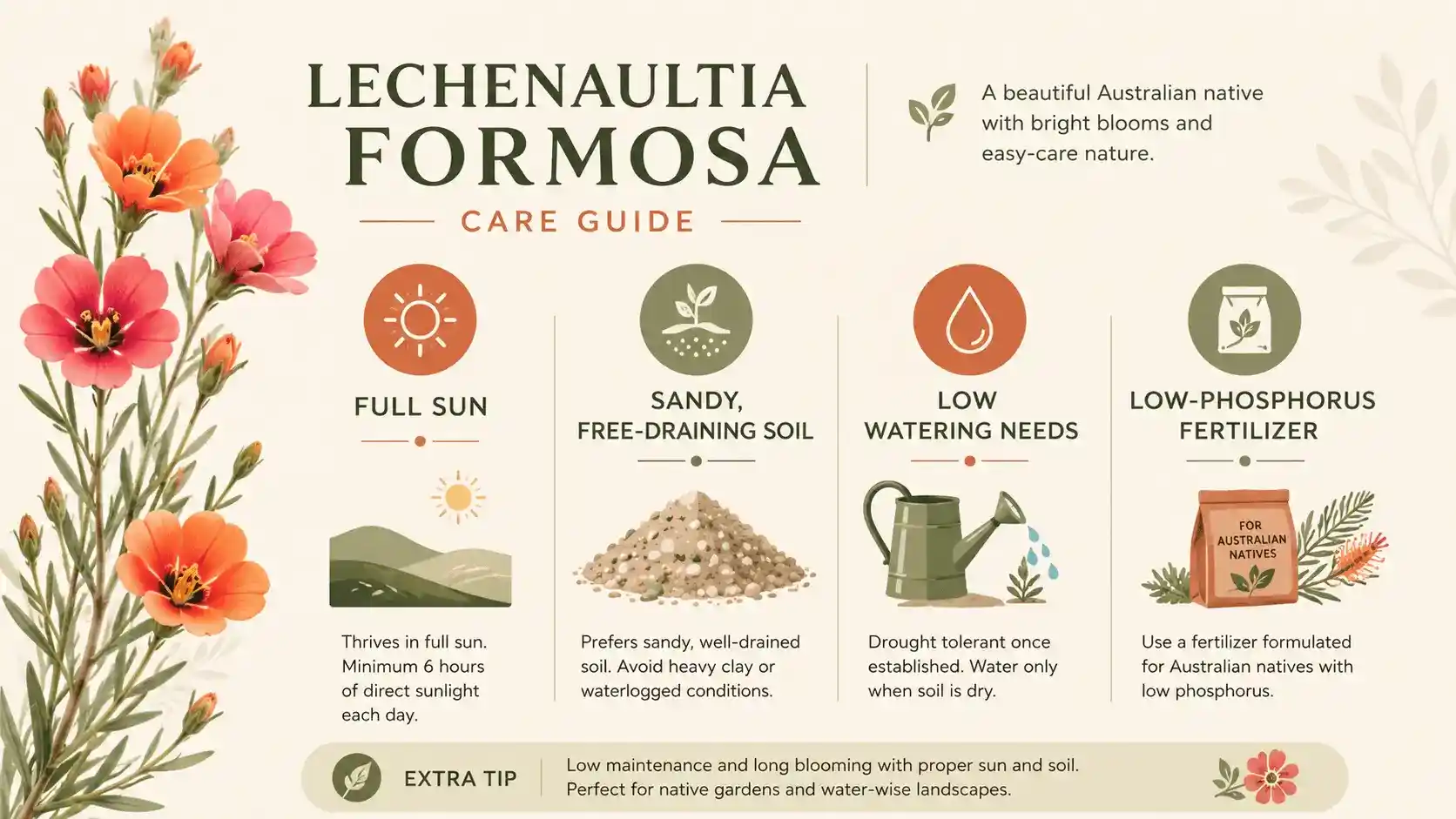
Excellent drainage is the single most important factor for successful lechenaultia formosa care.
Recommended soil conditions include:
- Sandy loam
- Gravelly native soils
- Raised beds
- Free-draining rockeries
The plant prefers slightly acidic to neutral soil pH. Heavy clay or poorly drained soils dramatically increase the risk of root rot. Once established in suitable conditions, lechenaultia formosa works well in an easy low maintenance Australian native garden designed around drought-tolerant species.
Sunlight Requirements
Lechenaultia formosa performs best in full sun with at least six hours of direct sunlight daily.
Insufficient light can cause:
- Reduced flowering
- Weak growth
- Leggy stems
- Increased fungal problems
In cooler climates, maximum sun exposure usually improves flowering performance.
Watering Needs
Lechenaultia formosa becomes drought-tolerant once established. Young plants require moderate watering during establishment, but mature plants prefer relatively dry conditions.
Watering guidelines:
- Water regularly during initial establishment
- Reduce watering once roots develop
- Avoid constantly wet soil
- Allow soil to dry slightly between waterings
Overwatering is the most common cause of plant decline.
Fertilization Practices
This species naturally grows in nutrient-poor soils and is sensitive to phosphorus.
Use only:
- Low-phosphorus Australian native fertilizers
- Slow-release native formulations
- Diluted native liquid feeds when necessary
Standard garden fertilizers can cause phosphorus toxicity, leading to yellowing leaves, root damage, and plant death.
Pruning and Maintenance
Light pruning after flowering helps maintain compact growth and encourages branching.
Maintenance tips:
- Trim lightly after blooming
- Remove dead stems promptly
- Avoid severe hard pruning
- Shape gently to preserve natural habit
Hard pruning can stress mature plants and reduce recovery.
Climate Tolerance
Lechenaultia formosa grows best in Mediterranean-type climates with warm dry summers and cool wetter winters.
The species has limited tolerance for:
- High humidity
- Tropical rainfall
- Poor airflow
- Severe frost
Gardeners in humid regions often achieve better results using raised beds or protected container culture.
Growing Lechenaultia Formosa from Seeds
Lechenaultia formosa seeds can be difficult to germinate due to natural dormancy mechanisms common among Australian native plants.
Many growers prefer propagation from cuttings because it provides more reliable results. However, seed propagation remains possible with proper preparation.
Key seed propagation considerations include:
- Smoke treatment may improve germination
- Seeds require excellent drainage
- Germination can be slow and inconsistent
- Fresh seed often performs better than old stored seed
Seeds are usually collected after flowering once capsules mature and dry naturally. They should be stored in cool, dry conditions until sowing.
Lechenaultia Formosa vs. Related Lechenaultia Species
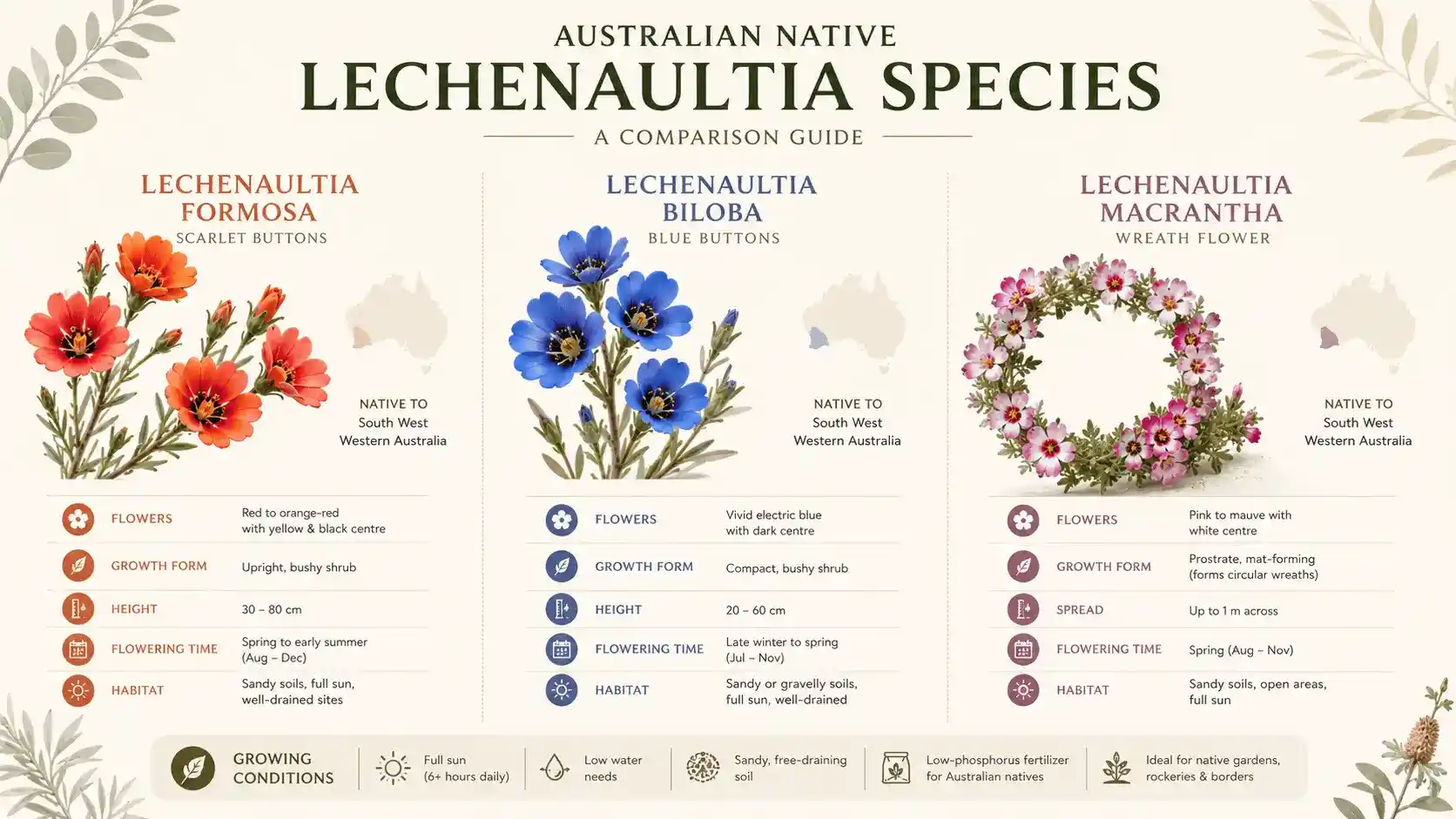
The Lechenaultia genus contains approximately 26 species, most of which are endemic to Western Australia. These species are valued for their unusual flower colours and ornamental potential in native gardens.
Comparison Table: Lechenaultia Species at a Glance
| Feature | L. formosa | L. biloba | L. macrantha |
| Common Name | Red/Flame Lechenaultia | Blue Lechenaultia | Wreath Lechenaultia |
| Flower Colour | Red, orange, yellow | Vivid blue | Red with white/yellow centre |
| Growth Habit | Spreading shrub | Spreading shrub | Prostrate wreath-forming |
| Native Region | SW Western Australia | SW Western Australia | SW Western Australia |
| Garden Use | Rockeries, borders | Mass planting | Feature displays |
| Care Difficulty | Moderate | Moderate | Moderate–challenging |
Lechenaultia Formosa vs. Lechenaultia Biloba (Blue Lechenaultia)
Lechenaultia biloba, commonly called blue lechenaultia, differs from lechenaultia formosa primarily through its flower colour.
While L. formosa produces red, orange, yellow, or flame blooms, Lechenaultia biloba displays intensely vivid blue flowers. The cultivar Lechenaultia biloba Big Blue is especially famous for its striking electric-blue colouring. Gardeners who enjoy vivid flowering natives often combine blue lechenaultia with other purple native flowers Australia gardens commonly feature for strong seasonal colour contrast.
Comparison highlights:
- L. formosa suits warm-toned native gardens
- L. biloba complements cool-toned plantings
- Both require excellent drainage
- Both thrive in full sun and low humidity
Blue lechenaultia is widely regarded as one of the most intensely blue Australian native flowers available.
Because Lechenaultia biloba produces exceptionally vivid blue blooms, it is frequently included among popular shrubs with blue flowers Australia gardeners use in native landscapes.
Lechenaultia Formosa vs. Lechenaultia Macrantha (Wreath Lechenaultia)
Lechenaultia macrantha, commonly known as wreath lechenaultia or wreath flower, has one of the most unusual growth habits among Australian native plants.
Unlike the shrub-like habit of lechenaultia formosa, wreath lechenaultia grows outward in circular rings across the ground. In its natural Western Australian habitat, the stems radiate outward to form spectacular wreath-like floral displays.
Key differences include:
- L. formosa forms compact flowering shrubs
- L. macrantha forms prostrate circular growth patterns
- Wreath flower Australia displays are highly seasonal
- Wreath flowers WA are often associated with wildflower tourism
Wreath flowers western Australia are considered iconic symbols of the state’s wildflower heritage.
Lechenaultia Formosa as Part of Western Australia’s Wildflower Heritage
Lechenaultia formosa plays an important role in Western Australia’s internationally recognized wildflower season.
The species contributes vibrant colour to native ecosystems and supports pollinators within dry heathland communities. Alongside blue Australian native flowers and wreath flowers Australia, it forms part of the extraordinary biodiversity that attracts wildflower tourism to WA each year.
In cultivation, the plant is widely used in:
- Native Australian gardens
- Habitat restoration projects
- Wildflower displays
- Rockeries and dry landscapes
Its vivid flower colours and drought tolerance continue to increase its popularity among native plant enthusiasts. Lechenaultia formosa is often featured in broader collections of Australian native garden plants because of its drought tolerance, brilliant flower colour, and suitability for low-water landscapes.
Common Problems When Growing Lechenaultia Formosa
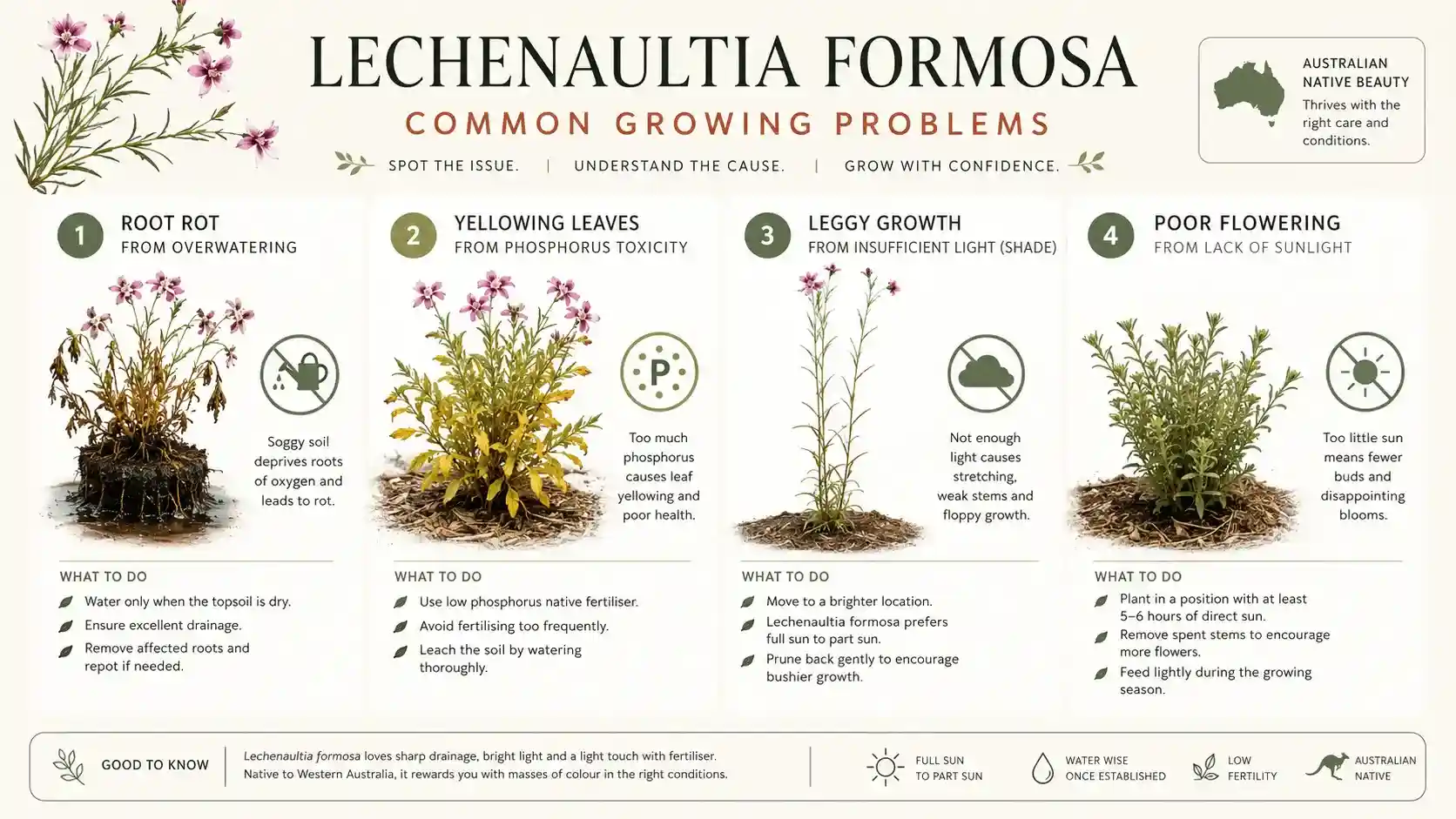
Root Rot From Overwatering or Poor Drainage
Cause:
- Waterlogged soil and poor airflow around roots
Correction:
- Improve drainage immediately
- Reduce watering frequency
- Replant into raised beds if necessary
Prevention:
- Use sandy, fast-draining soil
- Avoid heavy clay conditions
Yellowing or Wilting Leaves
Cause:
- Waterlogging or phosphorus toxicity
Correction:
- Stop applying standard fertilizers
- Check soil drainage
Prevention:
- Use native-specific fertilizers only
- Avoid overwatering
Failure to Flower
Cause:
- Insufficient sunlight or excessive fertilizer
Correction:
- Relocate to full sun
- Reduce feeding
Prevention:
- Provide at least six hours of direct sunlight daily
Leggy, Sprawling Growth
Cause:
- Too much shade or lack of pruning
Correction:
- Lightly prune after flowering
- Increase sun exposure
Prevention:
- Maintain compact growth with regular trimming
Pest Issues
Common pests include:
- Aphids
- Caterpillars
- Root-feeding grubs
Most infestations can be managed with early monitoring and appropriate native-safe pest control methods.
Common Beginner Mistakes With Lechenaultia Formosa
Many gardeners struggle with lechenaultia formosa because they treat it like a typical garden shrub rather than a specialized Western Australian native plant.
Common mistakes include:
- Planting in heavy clay soil without improving drainage
- Using standard fertilizers high in phosphorus
- Overwatering during summer dormancy periods
- Growing the plant in humid climates without airflow protection
- Expecting rapid establishment and growth
Patience is important. Lechenaultia formosa often establishes slowly before developing into a resilient flowering shrub.
Conclusion
Lechenaultia formosa is one of Western Australia’s most distinctive native wildflowers, valued for its brilliant flower colours, compact growth habit, and ornamental versatility. From the classic red and flame forms to unique cultivars like Eldorado, Strawberry Sundae, and Prostrate Red, the species offers exceptional diversity for Australian native gardens.
Successful cultivation depends on recreating the plant’s natural environment: full sun, sharply drained soil, low humidity, and minimal phosphorus. While lechenaultia formosa can be challenging in unsuitable conditions, gardeners who respect its native habitat are rewarded with a striking, low-maintenance flowering plant that captures the beauty of Western Australia’s wildflower landscapes.
Frequently Asked Questions (FAQ)
Q1. What is the common name for Lechenaultia formosa?
Lechenaultia formosa is commonly called red lechenaultia or flame lechenaultia. Some gardeners also use the spelling “leschenaultia,” but both names refer to the same plant genus.
Q2. How do you care for Lechenaultia formosa?
Lechenaultia formosa requires full sun, excellent drainage, sandy soil, and low-phosphorus fertilizer. Avoid overwatering and protect the plant from humid conditions.
Q3. What is the difference between Lechenaultia formosa and Lechenaultia biloba?
Lechenaultia formosa produces red, orange, flame, or yellow flowers, while Lechenaultia biloba is known for vivid blue flowers. Both species prefer similar growing conditions but create different visual effects in the garden.
Q4. What is the wreath lechenaultia and how is it different from Lechenaultia formosa?
Wreath lechenaultia refers to Lechenaultia macrantha, a species that grows in circular wreath-like patterns along the ground. Unlike the shrub-like form of Lechenaultia formosa, it creates prostrate ring-shaped floral displays.
Q5. Can Lechenaultia formosa be grown from seeds?
Yes, lechenaultia formosa can be grown from seeds, although germination is often difficult. Smoke treatment may improve success rates, but many growers prefer propagation from cuttings.
Q6. What are the best Lechenaultia formosa cultivars for home gardens?
Popular garden cultivars include Eldorado for yellow flowers, Strawberry Sundae for soft bi-coloured blooms, and Prostrate Red for groundcover use.
Q7. Why is my Lechenaultia formosa dying?
The most common causes are root rot from poor drainage and phosphorus toxicity from unsuitable fertilizers. Overwatering and humid growing conditions can also contribute to plant decline.