
Introduction
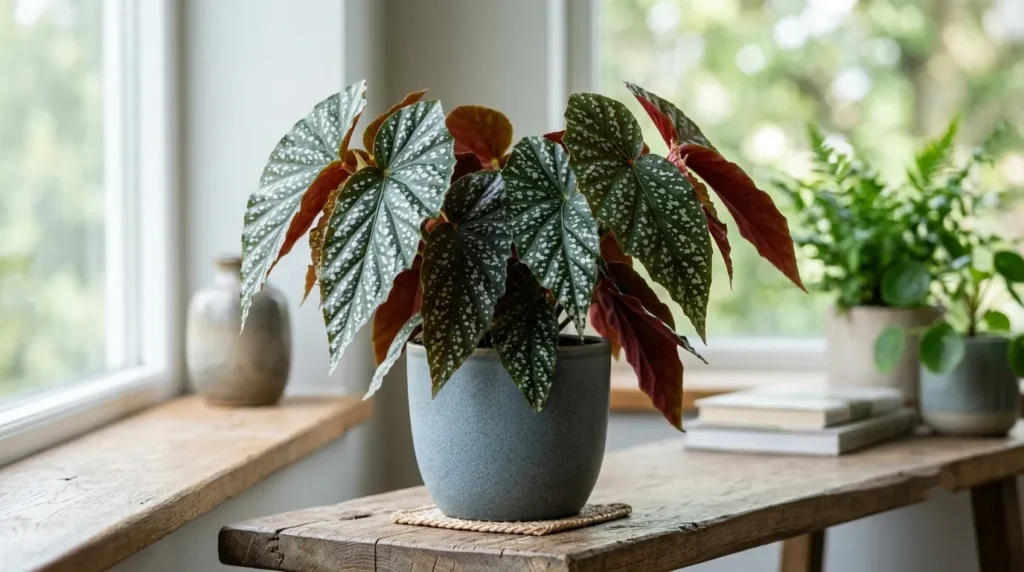
Begonia Miss Mummy is a cane-type Angel Wing Begonia cultivar known for its dark green leaves covered with attractive silver spotting. This decorative foliage plant is also commonly sold under the name Miss Mummy Begonia and has a naming connection with Fannie Moser Begonia. Developed by Brad Thompson in 1992 from the cross ‘Jumbo Jet’ × ‘Amelia,’ it has become popular among collectors because of its distinctive leaf pattern, manageable care needs, and historical importance among Angel Wing Begonias.
Quick Summary
- Begonia ‘Miss Mummy’ (also sold as ‘Fannie Moser’) is a cane-type Angel Wing Begonia with dark, silver-spotted foliage.
- It grows best in bright, indirect light with evenly moist, well-draining soil.
- Its care difficulty is easy to moderate, making it suitable for beginner collectors.
- Its unusual foliage and collector interest contribute to its reputation as a sought-after begonia.
What Is Begonia Miss Mummy?
Begonia Miss Mummy is a cane-type Angel Wing Begonia cultivar valued mainly for its ornamental foliage. It belongs to the Begoniaceae family and is recognized for its upright cane growth, spotted leaves, and attractive flowering habit.
Begonias belong to the genus Begonia, a large group of flowering plants known for their ornamental foliage and diverse growth forms.
The cultivar was created by breeder Brad Thompson in 1992 using the parent plants ‘Jumbo Jet’ and ‘Amelia.’ Its strong leaf pattern and reliable growth helped it become a recognized name among Angel Wing Begonia enthusiasts.
Like other decorative spotted begonias, such as Begonia Maculata, Miss Mummy is valued mainly for its unique foliage patterns and requires similar attention to light, moisture balance, and humidity.
The plant is commonly associated with several names:
- Begonia Miss Mummy — the cultivar name most collectors recognize.
- Miss Mummy Begonia — a common rearrangement used by growers and sellers.
- Fannie Moser Begonia — a name often used interchangeably because of historical nursery labeling.
Miss Mummy vs. Fannie Moser — Are They the Same Plant?
Miss Mummy and Fannie Moser are generally treated as the same or closely related plant in cultivation, although naming can vary between nurseries and collectors.
Common reasons for confusion include:
- Some growers list the plant as Fannie Moser Begonia instead of Miss Mummy.
- Older nursery records may use different naming conventions.
- “Little Miss Mummy” may appear in collections as a related naming variation, creating additional confusion.
| Name | Naming History |
| Miss Mummy | Original cultivar name associated with Brad Thompson’s 1992 introduction |
| Fannie Moser | Frequently used alternate nursery name |
| Little Miss Mummy | Related name that may refer to a smaller or differently labeled plant |
Key Identifying Features
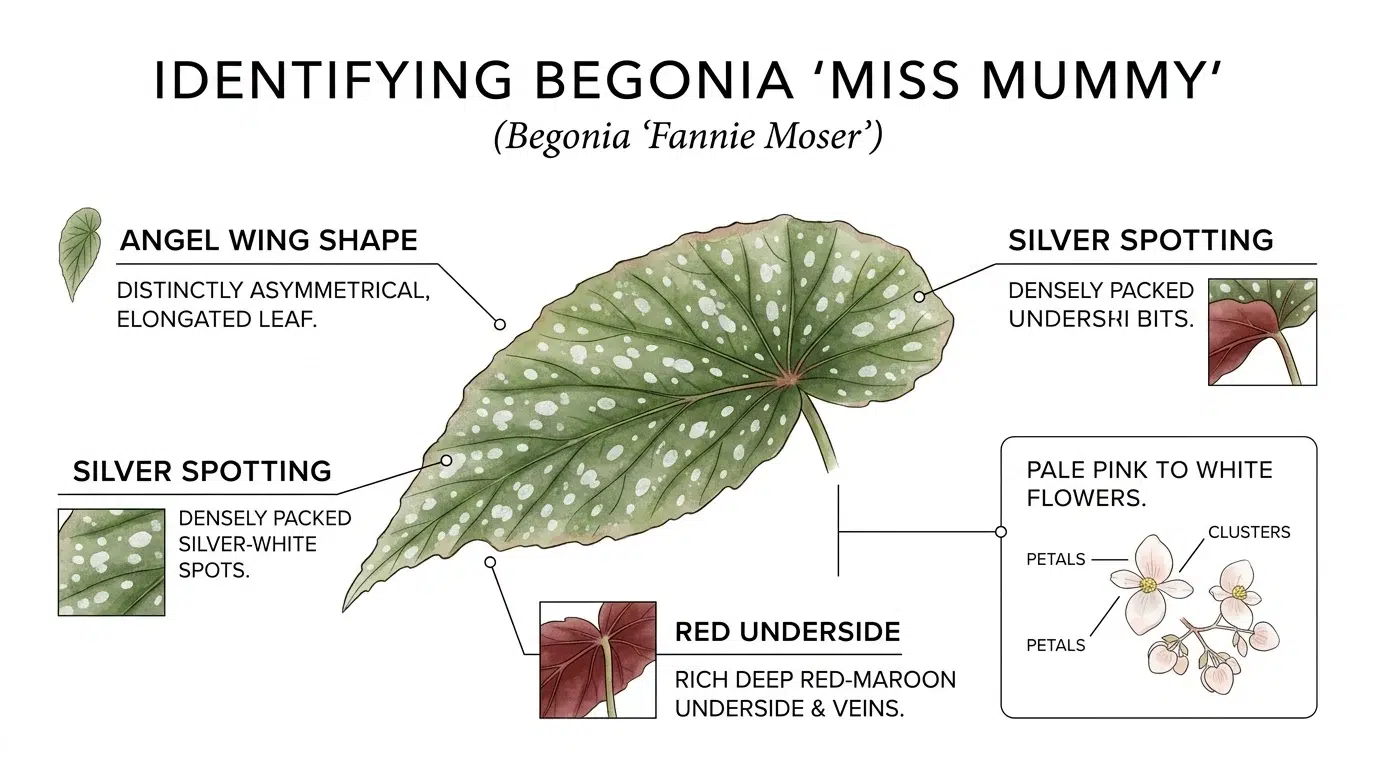
Begonia Miss Mummy can be identified by several distinct characteristics:
- Leaves: Long, asymmetrical Angel Wing-shaped leaves with a pointed tip.
- Leaf color: Deep green to dark foliage with contrasting silver spots.
- Undersides: Leaves often display reddish or burgundy tones underneath.
- Flowers: Small clusters of white to pale pink blooms.
- Bloom season: Flowering commonly occurs during active growing periods when light and nutrition are adequate.
Because Begonia Miss Mummy is grown mainly for its decorative foliage, keeping its spotted leaves clean helps maintain healthy photosynthesis and preserves its visual appeal.
Is Begonia Miss Mummy Rare?
Begonia Miss Mummy is considered uncommon rather than extremely rare. Its reputation as a rare begonia comes mainly from collector demand, inconsistent availability, and slower propagation compared with more common houseplants.
The reasons some begonias become expensive include:
- Limited nursery production.
- Slow propagation rates.
- High collector interest in unusual foliage patterns.
- Difficulty maintaining specific cultivars in large quantities.
A plant may have a high price because it is desirable and difficult to find, not necessarily because it is biologically rare.
What Makes a Begonia “Sought After”?
A sought-after begonia usually has unique characteristics that separate it from common varieties.
Collectors often value:
- Unusual leaf patterns.
- Strong variegation or metallic coloring.
- Historical cultivar background.
- Limited availability.
The most sought-after begonias include many Rex Begonia hybrids, rare cane begonias, and unusual variegated forms. The most expensive begonia plants are typically those with stable mutations, rare coloration, or limited propagation availability.
Begonia Miss Mummy is respected among collectors because of its silver-spotted foliage and cultivar history, although other rare begonias may command higher prices.
Light Requirements for Begonia Miss Mummy
Begonia Miss Mummy grows best in bright, indirect light. It prefers filtered sunlight rather than intense direct sun, which can scorch its leaves. Indoor growers can compare Begonia Miss Mummy’s lighting needs with other cane begonias like Begonia Maculata Wightii, which also performs best under bright indirect light rather than harsh direct sun.
The ideal placement includes:
- Near an east-facing window.
- Several feet away from a south-facing window.
- Behind sheer curtains if exposed to strong sunlight.
Begonias can tolerate some lower light, but insufficient brightness may reduce flowering and slow growth. Direct afternoon sun can cause brown patches and leaf damage.
Watering Begonia Miss Mummy Correctly
Begonia Miss Mummy should be watered when the top inch of soil becomes slightly dry. It prefers consistent moisture but does not tolerate constantly wet roots.
Proper watering practices include:
- Water deeply until excess drains from the pot.
- Allow the top layer of soil to dry slightly before watering again.
- Avoid leaving the plant sitting in standing water.
Begonias should not be watered every day unless growing conditions are extremely hot and dry. Overwatering is one of the most common causes of begonia decline.
Signs of Overwatering vs. Underwatering
| Problem | Symptoms |
| Overwatering | Yellow leaves, soft stems, mushy roots, slow growth, fungal problems |
| Underwatering | Crispy edges, curling leaves, drooping foliage, dry soil |
Best Fertilizer and Plant Food for Begonias
The best fertilizer for Begonia Miss Mummy is a balanced, diluted fertilizer designed for foliage plants or flowering houseplants. A moderate feeding schedule supports healthy leaves and blooms without causing excessive soft growth.
| Fertilizer Type | Frequency | Dilution | Suitability for Begonia Miss Mummy |
| Balanced water-soluble fertilizer | Every 2–4 weeks during growth | Half strength | Excellent choice |
| Miracle-Gro type fertilizer | Monthly during active growth | Use diluted according to label | Suitable when applied correctly |
| Coffee grounds | Occasionally, with caution | Not a complete fertilizer | Not recommended as primary feeding |
Miracle-Gro can be suitable for begonias when used correctly, but excessive fertilizer may damage roots or encourage weak foliage growth.
Coffee grounds are not an ideal main fertilizer because they do not provide a balanced nutrient supply and may affect soil structure if overused.
Plants that may not tolerate heavy Miracle-Gro feeding include sensitive plants requiring low nutrients or those growing in nutrient-poor environments.
Potting: Pots vs. Ground, Pot Size
Begonia Miss Mummy generally performs best in containers because its drainage and soil moisture can be controlled more easily.
Begonias prefer:
- Pots with drainage holes.
- Lightweight, well-aerated soil.
- A container only slightly larger than the root system.
Large pots can hold excess moisture and increase the risk of root rot. A slightly snug pot usually encourages healthier growth.
Begonia Miss Mummy Size and Growth Rate
Begonia Miss Mummy is a moderate-growing cane begonia that can develop upright stems and attractive foliage over time.
Typical size:
- Indoor height: Around 2–4 feet depending on care.
- Outdoor size: Can become larger in warm climates.
- Width: Controlled by pruning and growing conditions.
Indoor size is usually smaller because of limited light, temperature changes, and container restrictions.
Growth Rate and Seasonal Patterns
Begonia Miss Mummy grows fastest during spring and summer when temperatures, humidity, and light levels are favorable.
Growth patterns include:
- Active leaf production during warm months.
- Slower growth during winter.
- Reduced watering needs during cooler periods.
Factors affecting growth speed:
- Bright indirect light.
- Warm temperatures.
- Consistent moisture.
- Adequate nutrients.
Propagating Begonia Miss Mummy
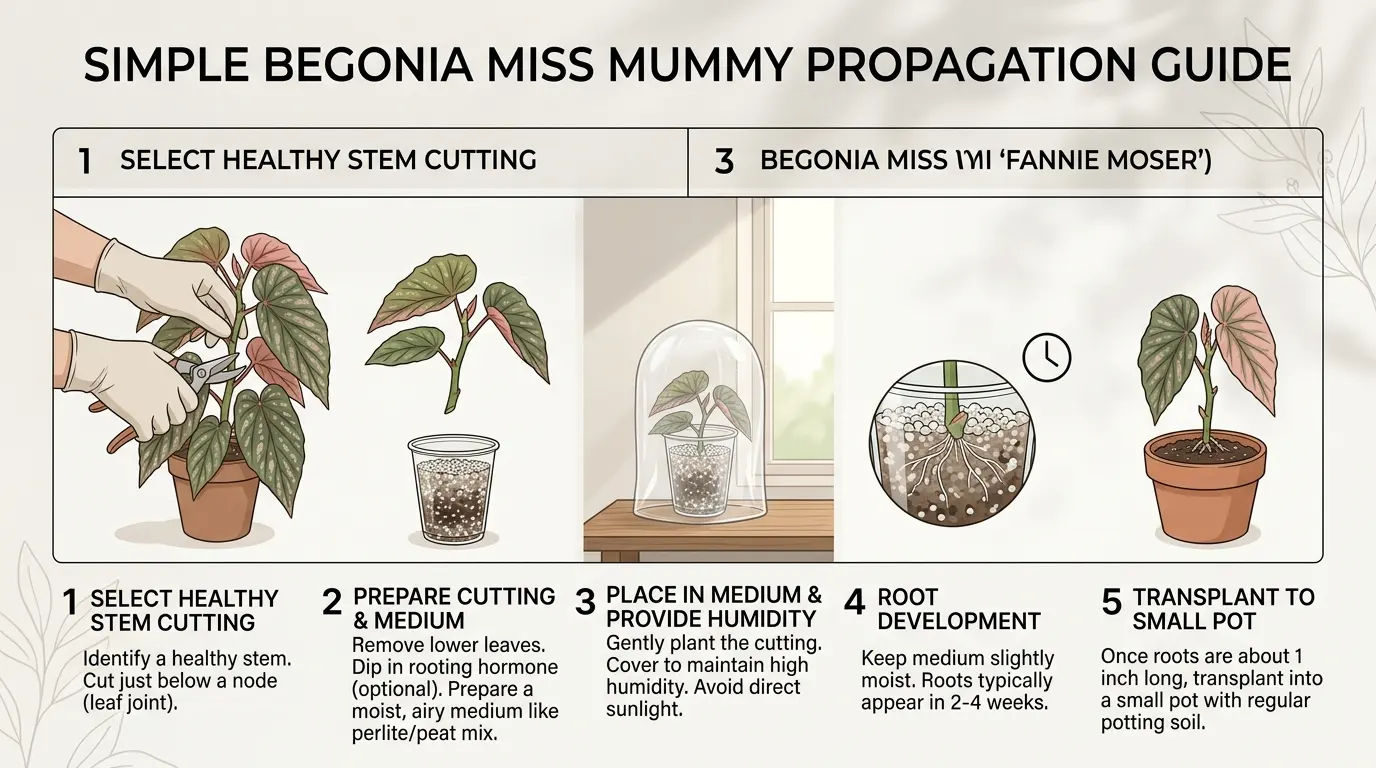
Begonia Miss Mummy can be propagated from cuttings. Stem cuttings are the most common method, although leaf cuttings and division may also work depending on the plant structure.
Begonia bulbs do not multiply because cane begonias grow from stems rather than true bulbs.
Propagation steps:
- Select a healthy stem cutting with at least one node.
- Place the cutting in moist perlite, peat, or a similar rooting medium.
- Keep it in bright indirect light.
- Maintain humidity and consistent moisture.
- Expect roots to develop in approximately 3–4 weeks.
- Transplant once roots are established.
Common Begonia Miss Mummy Problems (Problem-Solution Section)

Common issues usually result from incorrect watering, lighting problems, or nutrient imbalance.
| Problem | Cause | Fix | Prevention |
| Yellowing leaves | Overwatering or root problems | Repot into fresh dry soil | Follow proper watering schedule |
| Leaves but no flowers | Low light or excess nitrogen | Increase light and adjust fertilizer | Use balanced feeding |
| Pests | Mealybugs or spider mites | Use insecticidal soap | Maintain healthy humidity |
| Slow growth | Low light or nutrient shortage | Improve conditions | Monitor seasonal needs |
The Secret to Growing Begonia Miss Mummy Successfully
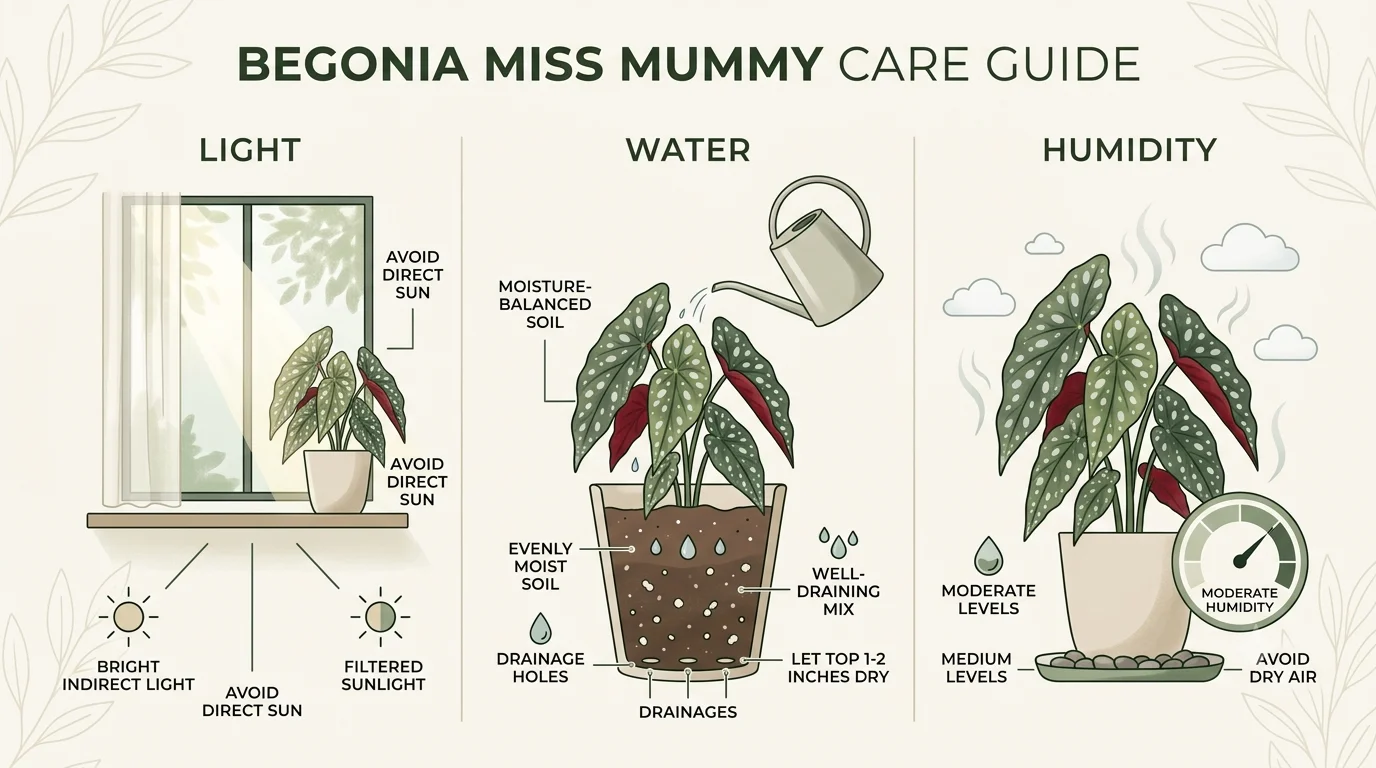
The secret to growing Begonia Miss Mummy successfully is maintaining balance between light, moisture, humidity, and nutrition.
The ideal conditions are:
- Bright indirect light.
- Moist but well-draining soil.
- Moderate humidity.
- Regular but gentle feeding.
Compared with some more sensitive begonias, Miss Mummy is relatively manageable and works well for beginners who understand basic moisture control.
Begonia Miss Mummy Lifespan
Begonia Miss Mummy can live for many years when properly maintained. As a perennial plant, it continues growing through repeated cycles of pruning, propagation, and repotting.
A young plant may reach maturity in about one year under good conditions.
Long-term survival depends on:
- Proper watering.
- Root health.
- Seasonal care adjustments.
- Regular pruning.
When and Where to Buy Begonia Miss Mummy
The best time to buy Begonia Miss Mummy is usually spring when plants are entering active growth.
When selecting a healthy plant, look for:
- Firm stems.
- Clean leaves without pests.
- Strong foliage color.
- Healthy root development.
Plants may be available through specialty nurseries, begonia collectors, and indoor plant growers. Availability varies because this cultivar is not always produced in large quantities.
Beginner Mistakes and Practical Tips
Many beginners struggle with Begonia Miss Mummy because they treat it like a drought-tolerant houseplant.
Common mistakes include:
- Overwatering frequently.
- Placing it in harsh direct sunlight.
- Ignoring humidity needs.
- Skipping pruning, which can reduce fullness.
- Maintaining the same watering routine during winter dormancy.
Practical tips:
- Check soil moisture before watering.
- Rotate the plant for even growth.
- Prune stems to encourage branching.
- Reduce watering during cooler months.
Comparing Begonia Miss Mummy to Similar Angel Wing Cultivars
Angel Wing begonias share similar growth habits but differ in leaf patterns, flower colors, and collector appeal.
| Cultivar | Leaf Pattern | Flower Color | Care Difficulty | Notable Trait |
| Miss Mummy/Fannie Moser | Dark leaves with silver spots | White/pale pink | Easy-moderate | Naming overlap and history |
| Benigo Pink | Pink-spotted leaves | Pink | Moderate | Bright foliage |
| Sinbad | Pink spots | Pink | Moderate | Compact growth |
| Maurice Amey | Silver spots | Pink | Moderate | Similar to Benigo Pink |
| Don Miller | Large leaves | Pink | Moderate | Larger cane type |
| Frosty | Frost-like silver pattern | White/pink | Easy-moderate | Silver variegation |
Begonia Maurice Amey vs. Benigo Pink
Begonia Maurice Amey and Benigo Pink are similar Angel Wing types because both feature spotted foliage and pink flowers.
Key difference:
- Maurice Amey: More silver-toned spotting and a classic cane begonia appearance.
- Benigo Pink: Known for stronger pink coloration in its leaf pattern.
New and Trending Begonia Varieties (2026)
New begonia trends in 2026 continue to focus on unusual foliage, compact growth, and distinctive patterns.
Popular collector interests include:
- Variegated begonias.
- Silver and metallic foliage types.
- Compact Angel Wing cultivars.
- Easier-care varieties for indoor growing.
The hardiest begonias are generally those adapted to stable indoor conditions and consistent care. The prettiest begonia depends on personal preference, with collectors often favoring unusual leaf colors and patterns.
Conclusion
Begonia Miss Mummy is a distinctive Angel Wing Begonia valued for its dark, silver-spotted foliage, manageable care needs, and collector history. Successful growth depends on providing bright indirect light, evenly moist but well-draining soil, moderate humidity, and balanced fertilizer. Although sometimes considered rare because of availability and demand, begonia miss mummy is a practical choice for collectors who can recreate its preferred bright-shade growing conditions.
FAQs
Is Begonia Miss Mummy rare?
Begonia Miss Mummy is considered uncommon rather than extremely rare. Its popularity comes from its attractive foliage, cultivar history, and limited availability in some regions.
Is Begonia Miss Mummy the same as Fannie Moser?
Begonia Miss Mummy and Fannie Moser are commonly treated as the same plant because many growers use the names interchangeably. Nursery labeling differences create most of the confusion.
What is the secret to growing Begonia Miss Mummy successfully?
The secret is maintaining a balance of bright indirect light, consistent moisture, good drainage, humidity, and moderate fertilizer. Avoiding overwatering is especially important.
Can you propagate Begonia Miss Mummy from a cutting?
Yes. Begonia Miss Mummy can be propagated from stem cuttings, and healthy cuttings usually root within about 3–4 weeks under suitable conditions.
Why are my Begonia Miss Mummy leaves turning yellow?
Yellow leaves are often caused by overwatering, poor drainage, or root stress. Allow the soil to partially dry and improve drainage to prevent further problems.
Does Begonia Miss Mummy do better in a pot or in the ground?
Begonia Miss Mummy usually performs better in pots because containers allow better control of drainage, moisture, and soil conditions.