
Introduction
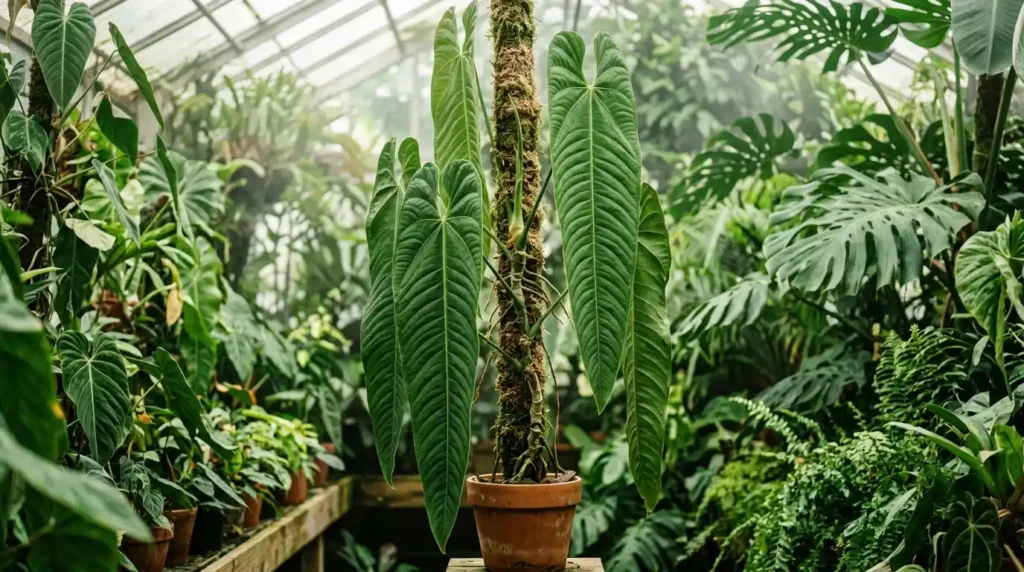
Anthurium veitchii growth rate is considered moderate to slow because this large-leafed aroid, commonly known as the King Anthurium, develops gradually compared with many common houseplants. Anthurium veitchii is a climbing, hemiepiphytic species valued for its long, ribbed leaves and tropical appearance. Its growth speed depends heavily on humidity, warmth, bright indirect light, and proper root support. While it can produce impressive leaves over time, it is not a fast-growing plant in average indoor conditions. Understanding its natural habitat and care requirements helps growers create conditions that encourage healthier and faster growth. Like other large-leaf indoor plants, Anthurium veitchii requires suitable light, humidity, and space to develop its characteristic foliage.
Quick Summary
- Anthurium veitchii is a slow-to-moderate growing plant, usually producing around 1–3 new leaves per year indoors.
- Growth increases significantly with high humidity, warm temperatures, and bright indirect light.
- It is a climbing, hemiepiphytic aroid that performs best with vertical support rather than as a compact tabletop plant.
- King Anthurium is moderately difficult to grow because it requires stable tropical conditions but is not the most challenging Anthurium species.
What Is Anthurium Veitchii? (King Anthurium Overview)
Where Anthurium Veitchii Comes From
Anthurium veitchii is a tropical aroid species from the family Araceae, native to the cloud forests and rainforests of Colombia. In its natural environment, it typically grows as an epiphyte or hemiepiphyte, attaching itself to trees rather than growing permanently in dense soil. Its thick, structured foliage places it among notable house plants with waxy leaves, which are often valued for their unique appearance and durability. Anthurium veitchii belongs to the genus Anthurium, a large group of tropical flowering plants in the Araceae family that includes hundreds of species.
The species developed adaptations for rainforest conditions, including:
- High humidity levels
- Filtered sunlight beneath forest canopies
- Warm temperatures throughout the year
- Access to moisture without constantly wet roots
These environmental factors directly influence the Anthurium veitchii growth rate. When grown indoors in dry air, low light, or poorly draining soil, growth often slows because the plant is no longer receiving the conditions it evolved to handle.
The name King Anthurium comes from its unusually large, elongated leaves that can become several feet long in mature specimens. The plant is also sometimes referred to as Anthurium king veitchii, although the accepted botanical name is Anthurium veitchii.
Compared with the popular Queen Anthurium (Anthurium warocqueanum), King Anthurium is known for thicker leaves, stronger growth habits, and slightly greater tolerance of average indoor conditions.
King Anthurium vs. Queen Anthurium (Comparison Block)
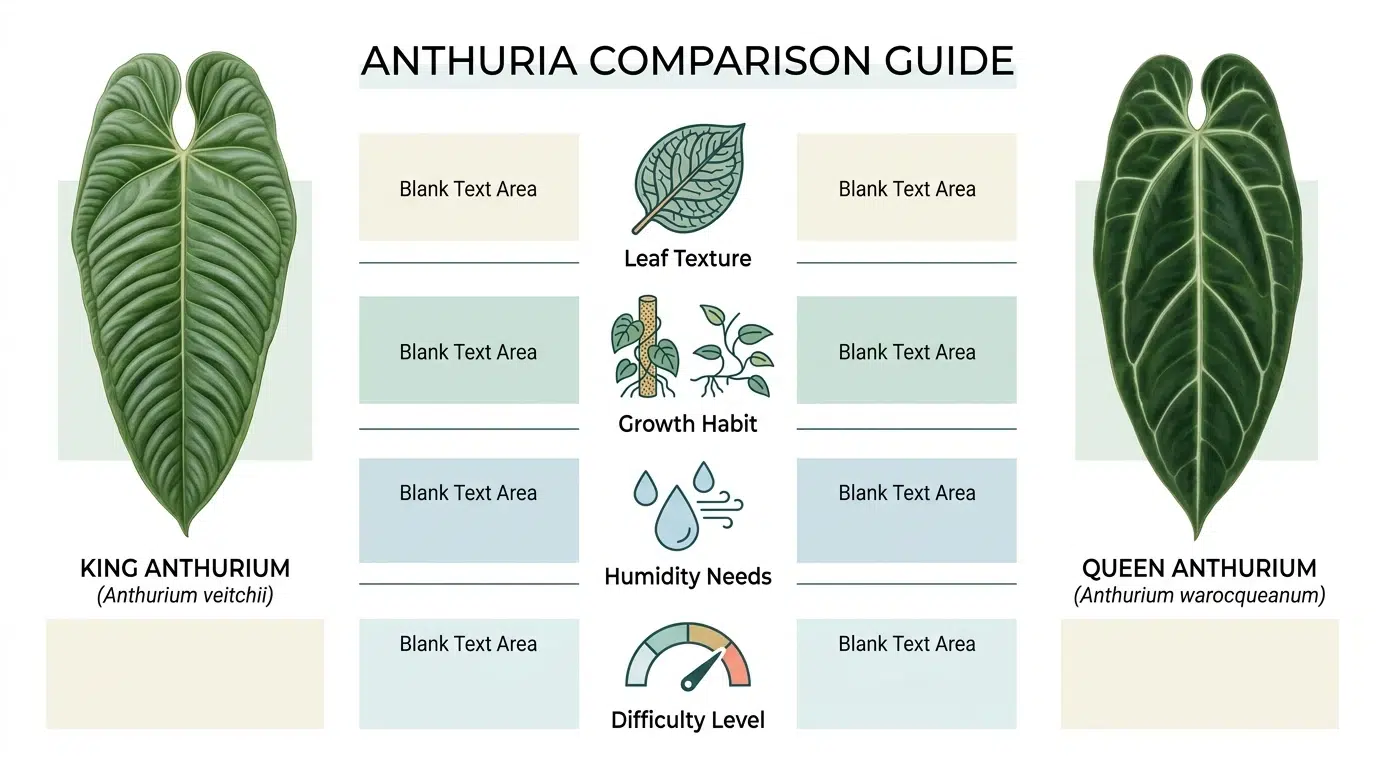
King Anthurium and Queen Anthurium are both highly valued tropical aroids, but they differ in leaf structure, growth habits, and care requirements.
| Feature | King Anthurium (Anthurium veitchii) | Queen Anthurium (Anthurium warocqueanum) |
| Leaf texture | Thicker, firmer leaves with strong ribbing | Thin, velvety leaves with delicate texture |
| Leaf size | Can exceed 3 feet in mature plants | Long leaves that can also become large but are often narrower |
| Growth rate | Moderate under ideal conditions | Usually slower and more sensitive |
| Growth habit | Climbing hemiepiphyte | Climbing hemiepiphyte |
| Humidity needs | High humidity preferred | Very high humidity often required |
| Difficulty level | Moderately difficult | More challenging for many growers |
| Rarity | Rare and highly sought after | Often considered rarer due to sensitivity |
Both species require tropical conditions, but Anthurium veitchii is generally considered more forgiving because its leaves are thicker and it adapts slightly better to indoor environments.
Anthurium Veitchii Growth Rate Explained
How Many New Leaves Does It Produce Per Year?
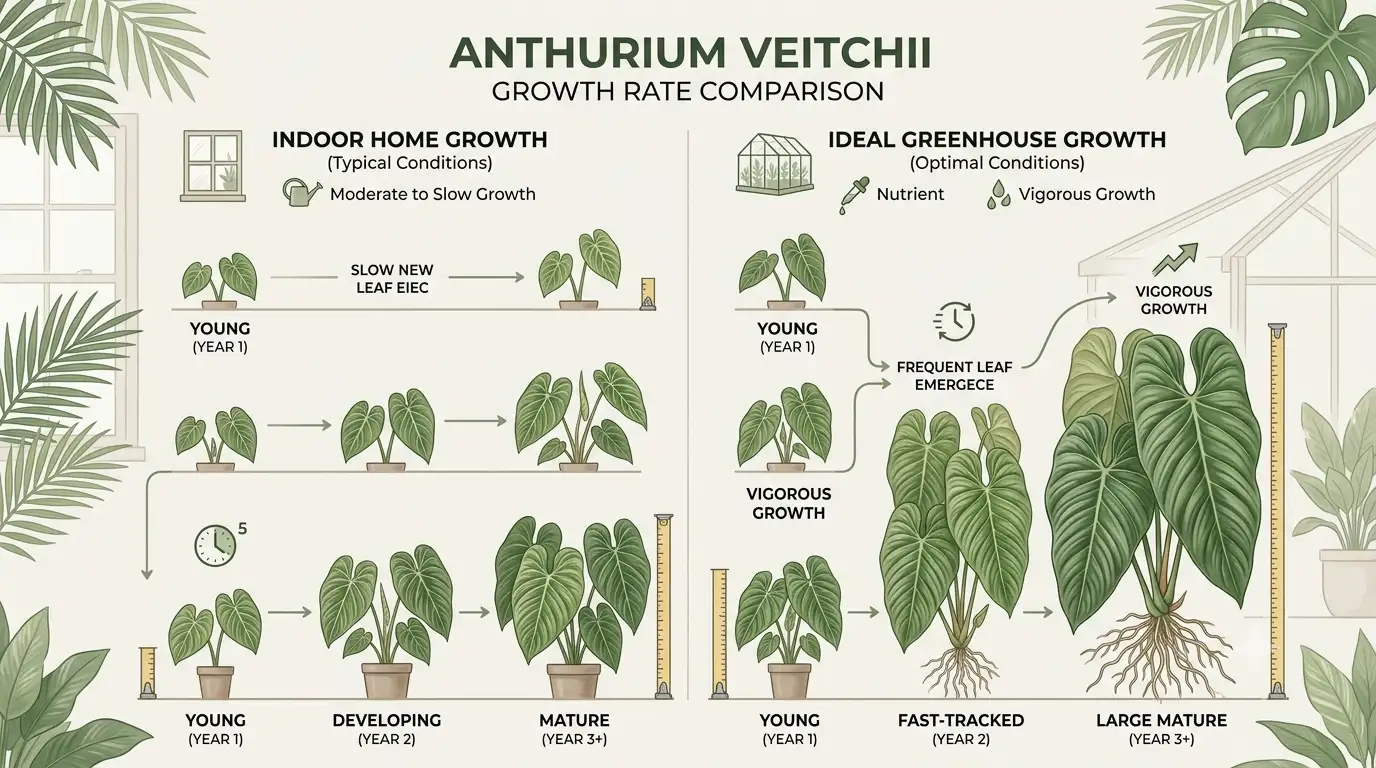
Anthurium veitchii typically produces 1–3 new leaves per year indoors when grown under average household conditions. However, plants grown in controlled greenhouses or highly optimized environments can grow faster and may produce several new leaves within a year.
Growth rate varies depending on environmental stability:
- Low-light indoor conditions: Growth may slow dramatically, with only occasional new leaves.
- Bright indirect light with good humidity: Growth becomes more consistent, often producing multiple leaves annually.
- Greenhouse conditions: Warm temperatures, high humidity, and strong filtered light can significantly increase leaf production.
Young plants usually grow more slowly because they spend energy developing roots and establishing their climbing structure. Once a mature plant has a healthy root system and proper support, leaf production often becomes more consistent.
The size and quality of new leaves are also important indicators of growth. A healthy Anthurium veitchii may not produce leaves frequently, but each new leaf should gradually become larger if growing conditions are suitable.
Is Anthurium Veitchii Slow-Growing or Fast-Growing?
Anthurium veitchii is considered a moderate grower under ideal conditions and a slow grower when conditions are unsuitable. It is not classified as a fast-growing houseplant like pothos or philodendrons, but it can develop impressive size when provided with proper tropical care.
Growth speed depends mainly on environmental factors:
| Growing Condition | Expected Growth Rate |
| Low light and low humidity | Slow growth, fewer new leaves, smaller foliage |
| Bright indirect light and 60%+ humidity | Moderate growth with healthier leaf development |
| Greenhouse-like tropical conditions | Faster growth with larger leaves and stronger climbing growth |
Many growers assume Anthurium veitchii is naturally extremely slow-growing, but much of its reputation comes from growing it in conditions that do not match its rainforest habitat. A plant receiving enough humidity, warmth, nutrients, and climbing support can grow significantly faster than one kept in a dry indoor environment.
The Anthurium veitchii growth rate is therefore less about genetics alone and more about recreating the stable conditions found in its native ecosystem.
Does Anthurium Veitchii Climb?
Anthurium veitchii is a hemiepiphytic climbing aroid, meaning it naturally grows upward by attaching its roots to trees and other structures in its native rainforest habitat. Unlike compact houseplants that remain bushy, King Anthurium develops along a climbing stem and produces larger leaves as it gains vertical support.
Providing a climbing structure can improve growth because it allows the plant to develop in a way similar to its natural environment. A moss pole, tree fern pole, or other moisture-retaining support encourages aerial roots to attach and helps the plant maintain stability.
Benefits of using a climbing support include:
- Larger and healthier leaf development
- Better aerial root attachment
- Improved vertical growth
- More natural plant structure
- Reduced stress on the main stem
Without support, Anthurium veitchii may still grow, but it often becomes less structured and may not reach its full mature potential. A climbing surface does not instantly increase growth speed, but it supports the conditions needed for larger leaves and stronger long-term development.
Anthurium Veitchii Size (Mature Plant Expectations)
Anthurium veitchii is known for its exceptionally long leaves and large mature size. In ideal greenhouse conditions, mature specimens can produce leaves that exceed 3 feet (90 cm) in length, while older plants grown in optimal environments may develop even larger foliage.
The overall size of a King Anthurium depends on several factors, including:
- Age of the plant
- Light intensity
- Humidity levels
- Root health
- Pot size
- Availability of climbing support
Indoors, Anthurium veitchii usually remains smaller because household conditions rarely match tropical rainforest environments. A mature indoor plant may develop impressive leaves but typically requires years of consistent care to reach maximum size.
Indoor vs. Outdoor Size Differences
The difference between indoor and outdoor or greenhouse-grown Anthurium veitchii size is mainly caused by environmental stability.
Indoor growth:
- Usually produces smaller leaves compared with greenhouse specimens.
- Growth may slow during dry seasons or in homes with low humidity.
- Requires careful management of light, moisture, and support.
Outdoor or greenhouse growth:
- Can achieve much larger leaves and stronger climbing growth.
- Benefits from consistent warmth and humidity.
- Has more space for roots and aerial root development.
Important factors that influence maximum size include:
- Humidity: Higher humidity helps leaves expand properly and reduces stress.
- Pot size: Adequate root space supports steady growth without encouraging excessive wet soil.
- Climbing support: Vertical growth allows the plant to mature naturally.
- Light quality: Bright indirect light promotes stronger leaf production.
- Temperature stability: Warm conditions encourage active growth.
Do Anthuriums Like Large Pots?
Anthuriums generally prefer a pot that matches their root system rather than an excessively large container. A pot that is too large can hold excess moisture around the roots, increasing the risk of root problems and slowing growth.
For Anthurium veitchii, the ideal approach is:
- Use a container slightly larger than the existing root mass.
- Repot when roots become crowded or growth slows.
- Choose pots with excellent drainage.
- Avoid moving a small plant into a very large pot.
A properly sized pot helps maintain the balance between moisture retention and airflow. Since Anthurium veitchii is naturally an epiphytic plant, its roots require oxygen and should not remain constantly saturated.
Ideal Growing Conditions to Maximize Growth Rate
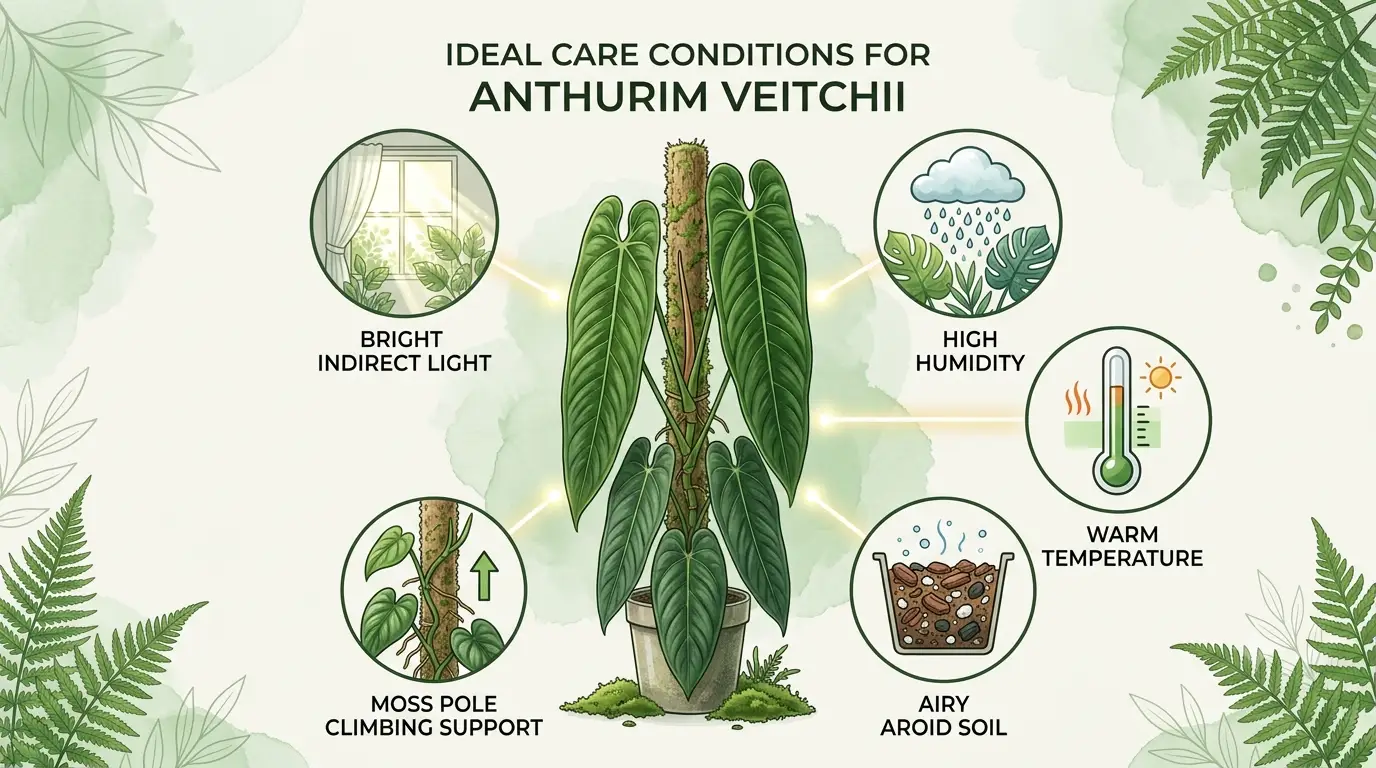
The Anthurium veitchii growth rate depends heavily on recreating tropical rainforest conditions. The plant grows best when light, humidity, temperature, water, and nutrition remain stable. Even small improvements in these areas can significantly affect leaf production and overall plant health.
Light Requirements
Anthurium veitchii requires bright indirect light for healthy growth. In its natural habitat, it grows beneath rainforest canopies where it receives filtered sunlight rather than direct exposure. Understanding bright indirect light for plants is essential because too little or too much sunlight can reduce Anthurium veitchii growth.
Insufficient light is one of the most common reasons for slow growth. A plant kept in a dark corner may survive but often produces fewer and smaller leaves.
Ideal lighting conditions include:
- Bright filtered sunlight near an east or north-facing window.
- Protection from harsh direct afternoon sun.
- Consistent daily light exposure.
- Supplemental grow lights when natural light is limited.
Too much direct sunlight can scorch the leaves, while too little light reduces photosynthesis and slows the Anthurium veitchii growth rate.
Humidity and Moisture (Sphagnum Moss, Watering)
High humidity is one of the most important factors for growing healthy Anthurium veitchii. As a rainforest plant, it performs best when humidity levels remain around 60% or higher, with many growers achieving better results at 70–80% humidity.
Sphagnum moss is commonly used with Anthurium veitchii because it helps maintain moisture around aerial roots while still allowing airflow. A moss pole or moss-based climbing support can encourage stronger root attachment. Growers struggling with dry indoor air can explore methods on how to increase humidity for indoor plants to create better tropical conditions.
Proper watering practices include:
- Water when the upper layer of the growing medium begins to dry.
- Avoid keeping roots constantly soaked.
- Use a well-aerated mix that drains quickly.
- Adjust watering frequency based on temperature and humidity.
Some growers ask, “Will Anthurium grow in just water?” Anthurium veitchii can survive in water culture or semi-hydroponic systems, but long-term growth usually requires careful nutrient management and oxygen availability around the roots. Traditional soil-free setups can work, but they require more monitoring than standard aroid mixes.
Temperature Tolerance
Anthurium veitchii grows best in warm tropical temperatures because it originates from humid Colombian forests.
Ideal temperature range:
- Daytime: approximately 65–85°F (18–29°C)
- Nighttime: above 60°F (16°C)
The plant can tolerate brief periods of higher temperatures if humidity and airflow are maintained. However, prolonged exposure to extreme heat can stress the plant.
When temperatures become too high:
- Leaves may lose moisture quickly.
- Growth may slow.
- Roots may struggle if the growing medium remains wet.
When temperatures drop too low:
- New leaf development slows.
- The plant may enter a resting period.
- Root activity decreases.
Stable temperatures are more beneficial than occasional extreme conditions.
Soil, Fertilization, and Feeding
Anthurium veitchii requires a loose, well-draining aroid mix that provides both moisture retention and airflow. Since it naturally grows as an epiphyte, heavy compact soil can restrict oxygen around the roots.
A suitable growing mix may include:
- Orchid bark
- Sphagnum moss
- Perlite or pumice
- Coco coir
- Quality potting material
During active growth periods, balanced fertilization can encourage stronger leaves and steady development. A diluted fertilizer applied regularly during the growing season is generally preferred over heavy feeding.
Common fertilizer questions include:
Can I use Miracle-Gro on Anthurium?
Yes, a balanced Miracle-Gro fertilizer can be used if diluted properly and applied according to plant needs. Overfertilizing can damage roots and cause leaf problems.
Are coffee grounds good for anthuriums?
Coffee grounds are not recommended as a primary fertilizer because they can alter soil conditions, encourage mold growth, and provide inconsistent nutrient availability. A balanced plant fertilizer is more reliable.
Care Requirements at a Glance
| Requirement | Ideal Condition |
| Light | Bright indirect light |
| Water | Moist but well-draining conditions |
| Humidity | 60%+ preferred, higher is beneficial |
| Temperature | 65–85°F (18–29°C) |
| Soil | Airy aroid mix with excellent drainage |
| Support | Moss pole or climbing structure recommended |
| Fertilizer | Balanced feeding during active growth |
Is Anthurium Veitchii Easy to Care For? (Difficulty Level)
Anthurium veitchii is considered moderately difficult to care for because it requires stable tropical conditions, but it is not the most challenging Anthurium species to grow. The plant is more demanding than common houseplants because it needs high humidity, proper airflow, bright indirect light, and careful watering.
The main challenge with King Anthurium is consistency. Sudden changes in humidity, temperature, or watering routines can slow growth or damage new leaves. However, growers who can provide a warm, humid environment often find Anthurium veitchii more manageable than some other rare Anthuriums.
Compared with beginner-friendly plants, Anthurium veitchii requires:
- More attention to humidity levels
- Better control of soil moisture
- Proper climbing support
- A suitable airy growing medium
- Patience for slow leaf development
It is not a plant that grows quickly with minimal care, but it can thrive when its rainforest requirements are consistently met.
What Is the Hardest Anthurium to Grow? (Comparison)
The difficulty level of Anthuriums varies widely between species. Some rare species are more sensitive because they have thinner leaves, higher humidity requirements, or slower recovery after stress.
Examples of challenging Anthuriums include:
- Anthurium warocqueanum (Queen Anthurium): Often considered one of the more difficult species because its thin, velvety leaves are sensitive to humidity fluctuations.
- Anthurium luxurians: Requires careful environmental management and can be slow to establish.
- Anthurium crystallinum hybrids: Some varieties need stable humidity and controlled conditions for best results.
Compared with these species, Anthurium veitchii is often considered moderately difficult because its thicker leaves provide slightly better tolerance. However, it still requires more specialized care than common aroids like pothos or many philodendrons.
Is Anthurium Veitchii Rare? What Is the Rarest Anthurium?
Anthurium veitchii is considered a rare and highly valued Anthurium because of its distinctive appearance, large elongated leaves, and limited availability compared with common houseplants.
Its rarity comes from several factors:
- It has a specific native habitat in Colombian rainforests.
- It grows slower than many popular indoor plants.
- Mature specimens take significant time to develop their characteristic large leaves.
- Propagation requires careful growing conditions.
The term “rarest Anthurium” can vary depending on availability, location, and collector interest. Species such as Queen Anthurium and other specialized rainforest Anthuriums are also considered rare because they are difficult to propagate and maintain.
The appeal of King Anthurium comes primarily from its botanical characteristics rather than rarity alone. Its dramatic leaf size, climbing growth habit, and tropical appearance make it a notable species among aroid collectors.
Why Is My Anthurium Veitchii Not Growing? (Troubleshooting)
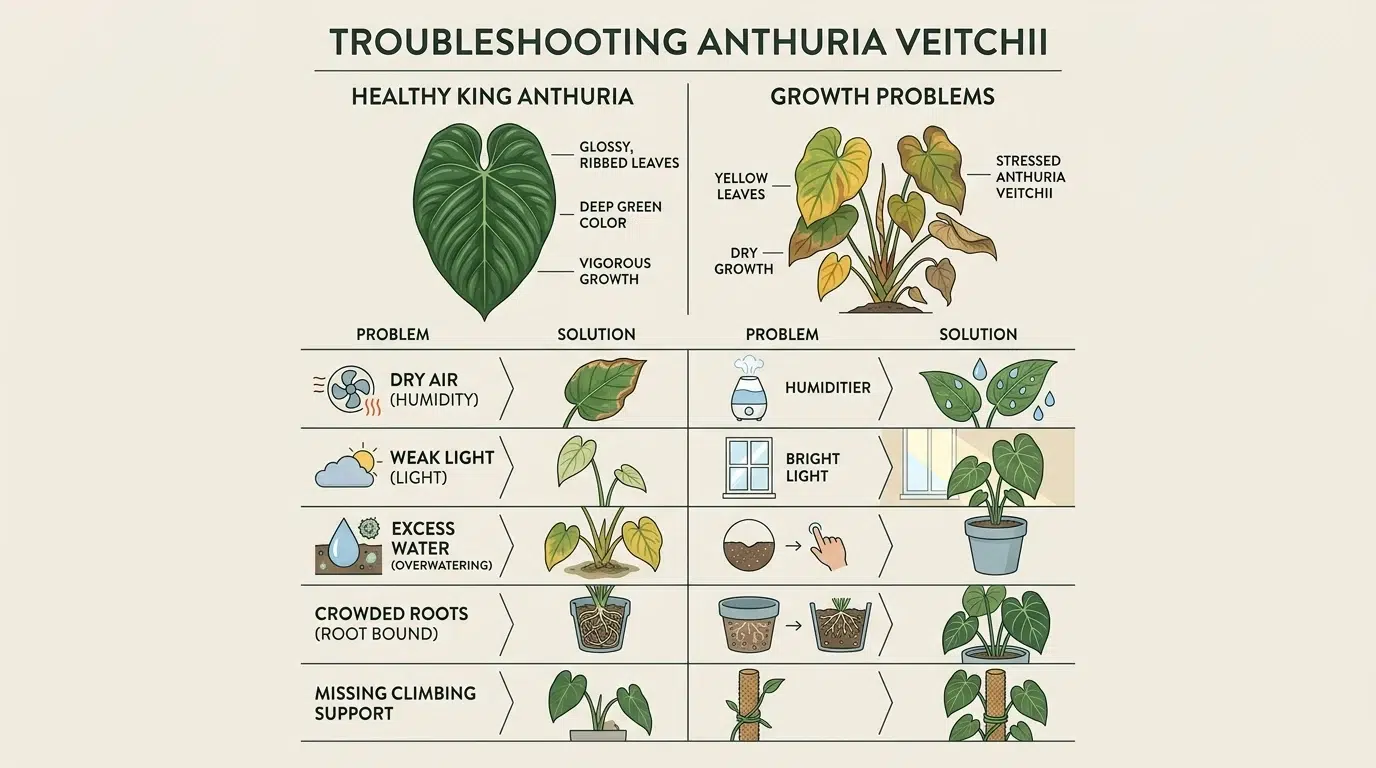
A slow Anthurium veitchii growth rate does not always indicate a problem because this species naturally grows slower than many houseplants. However, stalled growth, smaller leaves, or a lack of new leaves often means one or more environmental conditions need adjustment. Many aroids require specialized propagation methods, similar to techniques used when learning how to propagate alocasia corms.
Common Causes of Slow or Stalled Growth
Several factors can reduce Anthurium veitchii growth speed. Identifying the cause early helps prevent long-term stress.
| Problem | Why It Slows Growth | Solution |
| Low humidity | Reduces moisture availability and stresses leaves | Increase humidity using a humidifier or suitable growing area |
| Insufficient light | Limits photosynthesis and energy production | Move to brighter indirect light |
| Root-bound conditions | Restricts nutrient and water absorption | Repot into a slightly larger container when necessary |
| Overwatering | Reduces oxygen around roots and may cause root damage | Allow the mix to partially dry before watering again |
| Temperature stress | Slows metabolism and leaf development | Maintain warm, stable temperatures |
| Natural dormancy periods | Plant growth naturally slows during less favorable seasons | Maintain proper care and wait for active growth |
Other signs that growth conditions may be unsuitable include:
- New leaves emerging smaller than previous leaves
- Yellowing lower leaves
- Weak aerial roots
- Long periods without new growth
Begin by checking the basics: light, humidity, root health, and watering habits. Making several major changes at once can create additional stress, so gradual adjustments are usually better.
Beginner Mistakes That Slow Growth
Many Anthurium veitchii growth problems come from common beginner care mistakes rather than the plant itself.
Common mistakes include:
Overwatering:
Keeping the roots constantly wet can reduce oxygen availability and lead to root stress. Anthurium roots need moisture but also require airflow.
Using the wrong pot size:
A very large pot can retain excess water, making it harder for roots to access oxygen. A properly sized container encourages healthier root development.
Placing the plant away from humidity sources:
Dry indoor air can slow growth and prevent proper leaf expansion. Keeping the plant near a humid environment can improve performance.
Skipping a moss pole or climbing support:
Because Anthurium veitchii naturally climbs, growing it without support may limit its ability to develop its mature structure.
Providing too little light:
Low light is one of the most common reasons for slow growth. The plant may survive but will often produce fewer leaves and smaller foliage.
Conclusion
Anthurium veitchii is a moderate-growing climbing King Anthurium whose growth rate depends heavily on environmental conditions. While it is naturally slower than many common houseplants, it can produce impressive large leaves when provided with bright indirect light, high humidity, warm temperatures, proper nutrition, and climbing support.
The key to improving the Anthurium veitchii growth rate is recreating the stable rainforest conditions where the species naturally grows. Consistent care, an airy growing medium, and patience are essential because this plant develops gradually. For growers who understand its tropical requirements, Anthurium veitchii can become a large, healthy specimen with exceptional foliage. For more complete plant care information covering different species, growing techniques, and indoor plant guidance, explore our Plants Benefits and Guides (Complete Care, Types & Growing Tips) collection.
FAQs
How fast does Anthurium veitchii grow?
Anthurium veitchii grows at a moderate-to-slow rate, usually producing around 1–3 new leaves per year indoors. Growth can increase in greenhouses or high-humidity environments with bright indirect light, warmth, and proper nutrition.
Is Anthurium veitchii slow-growing?
Yes, Anthurium veitchii is considered slow-growing compared with many common houseplants, but it can grow at a moderate pace when provided with ideal tropical conditions. Its large leaves require significant energy and time to develop.
Does Anthurium veitchii climb?
Yes, Anthurium veitchii is a climbing hemiepiphytic aroid. It naturally grows upward by attaching its roots to trees, and it often benefits from a moss pole or similar climbing support when grown indoors.
Why is my Anthurium veitchii not growing?
Anthurium veitchii may stop growing because of low humidity, insufficient light, overwatering, poor root conditions, temperature stress, or lack of climbing support. Improving environmental stability usually helps restart healthy growth.
Is Anthurium veitchii easy to care for?
Anthurium veitchii is moderately difficult to care for. It is not ideal for complete beginners because it requires high humidity, careful watering, and stable tropical conditions, but it is easier than some highly sensitive Anthurium species.
Is Anthurium veitchii rare?
Yes, Anthurium veitchii is considered a rare Anthurium due to its limited natural distribution, slow growth, and distinctive large leaves. Its popularity comes from its unique appearance and botanical characteristics rather than rarity alone.