
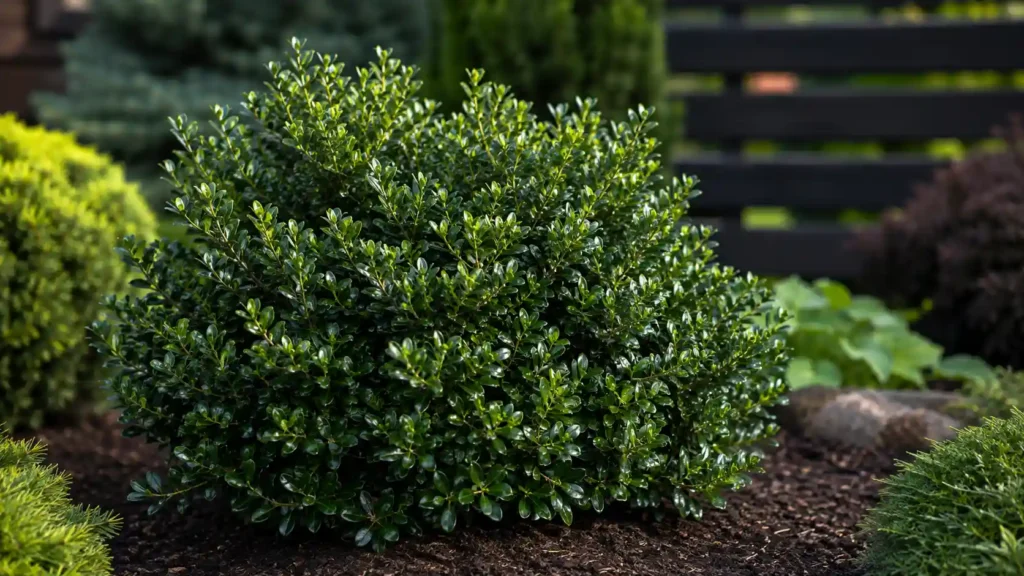
Ilex crenata ‘Jersey Jewel’, according to Manuela Nogueira, is a slow-growing dwarf Japanese holly from the Jersey pygmy hybrid series, reaching just 2–3 feet tall with tiny, deep green, cup-shaped leaves arranged in alternating 90° layers on stiff branches, thriving in full sun to partial shade and acidic, well-drained soil.
As a female cultivar, it needs a male pollinator such as ‘Jersey Male’ nearby to set its small black fruit, and its growth rate of roughly two inches a year makes it a favorite for bonsai and rock-garden work. It is often compared to ‘Dwarf Pagoda’, differing mainly in its smaller leaf size, and nursery hardiness ratings for it range from USDA zone 5 to zone 9 depending on the source.
Quick Summary
- Jersey Jewel Japanese Holly is a compact evergreen shrub that typically matures around 3 feet tall and 2 feet wide.
- It grows slowly to moderately, adding approximately 2–4 inches of new growth each year under favorable conditions.
- The plant performs best in full sun to partial shade with rich, acidic, well-drained soil.
- Dense branching and naturally small leaves make it an excellent choice for containers, borders, and bonsai.
- Proper watering, occasional pruning, and acidic soil help maintain healthy growth and attractive evergreen foliage.
What Is Jersey Jewel Japanese Holly? (Plant Profile & Identifying Features)
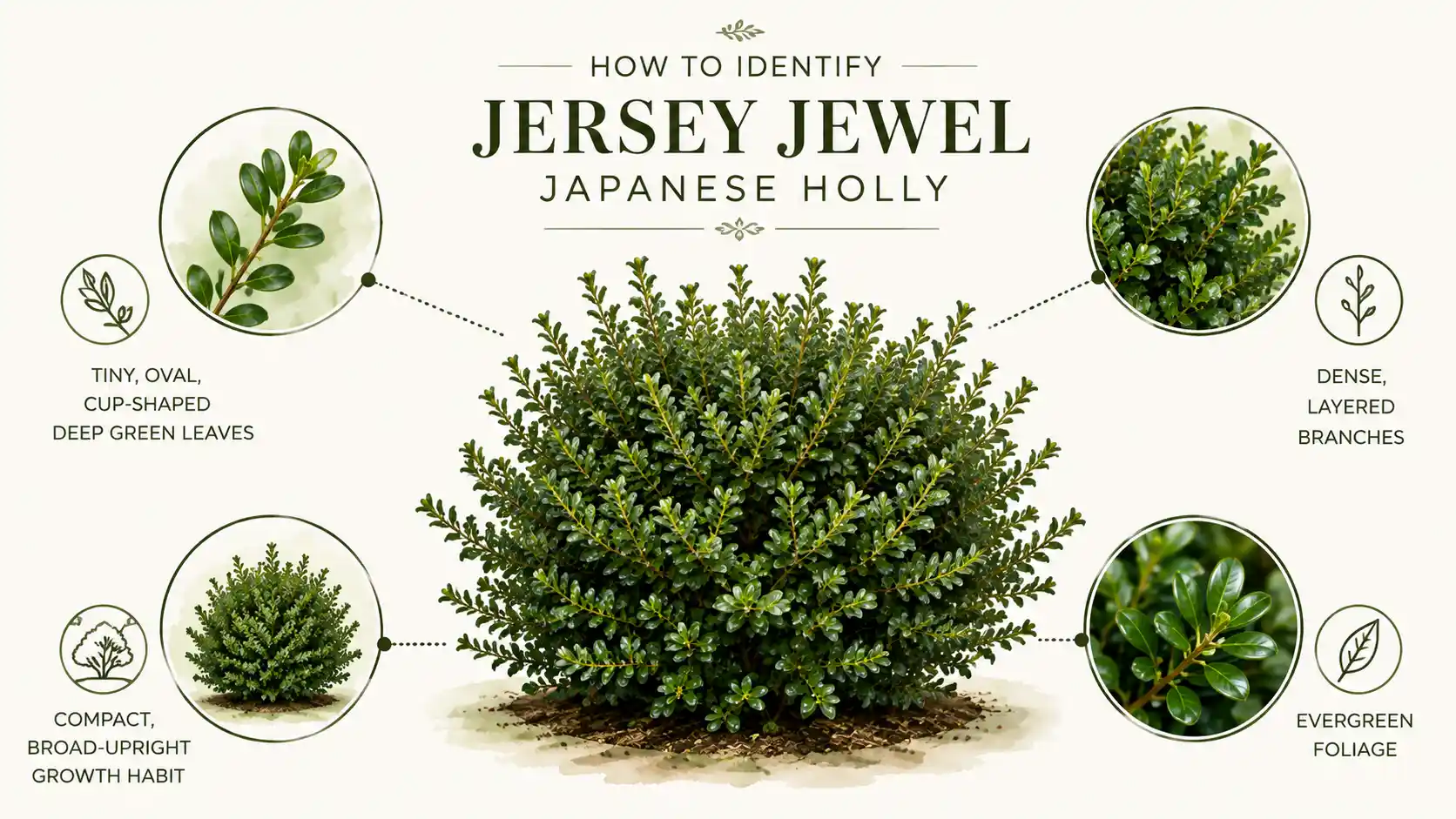
Jersey Jewel Japanese Holly is the cultivated variety Ilex crenata ‘Jersey Jewel’, a compact evergreen shrub selected for its fine-textured foliage, dense branching, and naturally sculptural growth habit. Ilex crenata, commonly known as Japanese holly, belongs to the holly family (Aquifoliaceae) and is widely grown as a boxwood alternative because of its small leaves and tidy appearance.
Unlike traditional hollies with sharply spined leaves, Jersey Jewel has tiny, smooth-edged leaves that create a soft, refined texture throughout the growing season. Its naturally irregular yet broad-upright framework adds architectural interest even without frequent pruning.
One of its defining characteristics is the arrangement of its branches. Short, stiff stems develop in alternating layers that rotate approximately 90 degrees from one another, producing an attractive layered appearance valued by collectors, landscape designers, and bonsai enthusiasts.
Because of its compact size and elegant branching pattern, Jersey Jewel is frequently planted:
- Along walkways
- In foundation plantings
- Beside dwarf conifers
- In rock gardens
- As an evergreen accent plant
- In decorative containers
It is also commonly compared with another Ilex crenata cultivar, ‘Dwarf Pagoda.’ While both develop layered branching, Jersey Jewel generally has noticeably smaller leaves, giving it an even finer texture.
Key Identifying Characteristics
| Feature | Description |
| Botanical name | Ilex crenata ‘Jersey Jewel’ |
| Common name | Jersey Jewel Japanese Holly |
| Plant type | Compact evergreen shrub |
| Leaf color | Deep green |
| Leaf shape | Small, oval, cup-shaped |
| Branch structure | Short, stiff branches arranged in alternating layers |
| Growth habit | Irregular broad-upright |
| Preferred soil | Rich, acidic, well-drained soil |
Other identifying traits include:
- Dense evergreen foliage throughout the year
- Naturally compact framework
- Fine texture that contrasts well with larger-leaved shrubs
- Excellent companion plant for dwarf conifers and ornamental evergreens
- Adaptability to formal and informal landscape designs
Jersey Jewel Japanese Holly Size
Jersey Jewel Japanese Holly remains considerably smaller than many other Japanese holly cultivars, making it ideal for gardens where space is limited. Because of its compact mature size, Jersey Jewel Japanese Holly works well alongside other small hedge plants designed for borders and structured garden spaces.
Under normal landscape conditions, mature plants typically reach:
| Growth Measurement | Average Size |
| Mature height | About 3 feet (0.9 m) |
| Mature width | About 2 feet (0.6 m) |
Its upright framework means the shrub occupies relatively little horizontal space while still providing year-round evergreen structure.
Container-grown specimens usually remain smaller because restricted root growth naturally slows development. A mature plant grown in a decorative container may stay closer to 2 feet tall with regular pruning.
When trained as bonsai, Jersey Jewel can be maintained at virtually any desired size through root pruning, branch pruning, and periodic repotting.
Several environmental factors influence ultimate size:
- Soil fertility
- Available root space
- Sunlight exposure
- Water availability
- Pruning frequency
- Container size
Plants growing in fertile, acidic soil with consistent moisture generally become fuller than those growing in dry or nutrient-poor locations.
Compared with the straight species Ilex crenata, which may grow between 5 and 10 feet tall depending on the cultivar, Jersey Jewel stays significantly more compact with less maintenance.
Growth Rate: How Fast Does Jersey Jewel Japanese Holly Grow?
Jersey Jewel Japanese Holly is considered a slow-to-moderate growing evergreen shrub, typically producing 2–4 inches (5–10 cm) of new growth per year under favorable growing conditions.
This slower growth rate is one of the reasons it develops such a naturally dense and refined appearance. Rather than producing long, coarse shoots, the shrub gradually builds compact branching over time.
Most plants require approximately 8–12 years to approach their mature landscape size, although growth speed varies depending on climate and care.
Growth occurs primarily during:
- Spring
- Early summer
Once temperatures become consistently hot in midsummer, growth often slows considerably. During winter dormancy, the shrub produces little to no new growth.
Factors That Influence Growth Rate
Several environmental conditions determine how quickly Jersey Jewel develops.
Sunlight
Plants receiving at least six hours of sunlight generally produce denser foliage and stronger annual growth. In very warm climates, light afternoon shade helps reduce heat stress while maintaining healthy development.
Soil Quality
Rich, organically amended soil encourages steady root expansion and supports healthy foliage production. Poor or compacted soil slows establishment considerably.
Watering
Consistent soil moisture during the first two growing seasons promotes healthy root development. Extended drought can temporarily halt growth and reduce foliage density.
Fertilization
Applying a balanced fertilizer formulated for acid-loving plants in early spring supports healthy new shoots. Excessive fertilization, however, may encourage weak, elongated growth rather than compact branching.
Tips for Encouraging Faster, Healthier Growth
To help Jersey Jewel Japanese Holly establish more quickly:
- Plant in organically enriched acidic soil.
- Water deeply during prolonged dry periods.
- Apply mulch to conserve soil moisture.
- Fertilize lightly in early spring.
- Avoid repeated heavy pruning during active growth.
- Choose a planting location with good air circulation and adequate sunlight.
While growth cannot be dramatically accelerated, providing optimal conditions results in fuller foliage, stronger branching, and healthier long-term development.
Where and When to Plant Jersey Jewel Japanese Holly
Choosing the correct planting location has a lasting impact on the health and appearance of Jersey Jewel Japanese Holly.
The shrub grows best in locations that provide:
- Full sun to partial shade
- Rich, well-drained soil
- Slightly acidic soil conditions (approximately pH 5.0–6.5)
- Consistent moisture without prolonged waterlogging
Poor drainage is one of the most common causes of root decline. Heavy clay soils should be improved with compost or other organic matter before planting to increase aeration and drainage.
Best Time to Plant
The ideal planting seasons are:
- Early spring, before vigorous new growth begins
- Early fall, while soil temperatures remain warm enough for root establishment
Planting during these cooler periods reduces transplant stress and allows roots to establish before extreme summer heat or winter cold.
Spacing Guidelines
Because mature plants typically spread about 2 feet wide, allow sufficient room between shrubs and nearby structures.
General recommendations include:
- 2–3 feet between individual plants
- At least 2 feet from foundations
- Additional spacing if planting beside larger shrubs or conifers
Proper spacing improves airflow, reducing humidity around foliage and helping minimize pest problems.
Sun vs. Shade Requirements
Jersey Jewel Japanese Holly adapts well to a range of light conditions, although performance varies depending on climate.
| Light Condition | Performance |
| Full sun | Produces dense growth and compact branching; requires more watering during hot weather |
| Partial shade | Ideal in warmer climates; helps prevent heat stress and occasional leaf scorch |
| Deep shade | Reduced density, slower growth, and a more open branching habit |
In northern regions, full sun generally encourages the most compact growth.
In southern climates, providing afternoon shade helps protect foliage during periods of intense summer heat while maintaining healthy evergreen color throughout the year.
Care Guide
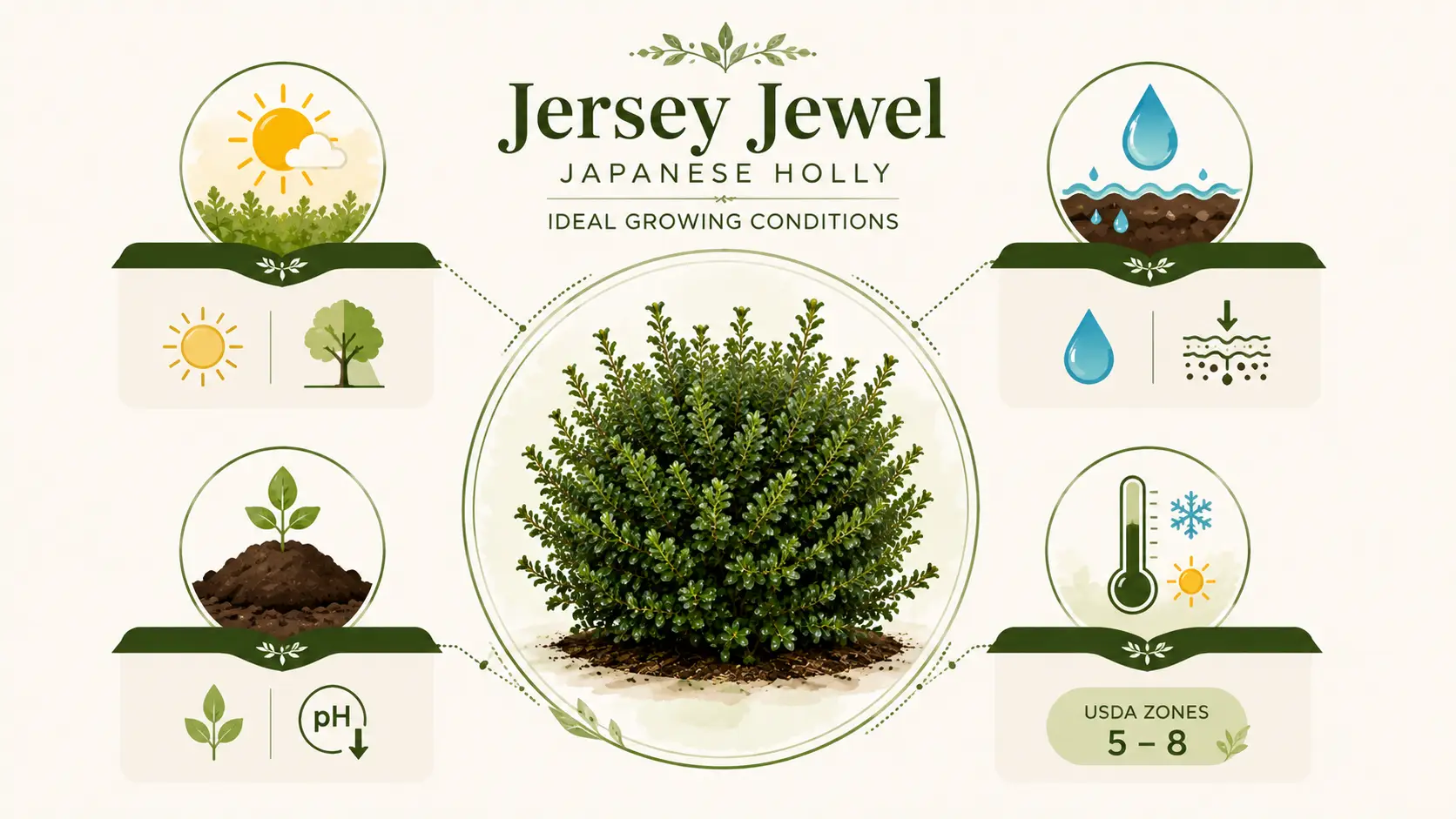
Jersey Jewel Japanese Holly is considered a relatively low-maintenance evergreen shrub when grown in suitable conditions. Once established, it requires moderate watering, occasional fertilization, and light pruning to maintain its naturally compact form.
Consistent care during the first few years after planting is especially important, as it allows the root system to establish and supports healthy long-term growth.
Watering & Soil
Newly planted Jersey Jewel Japanese Holly should be watered deeply once or twice each week during the establishment period, depending on rainfall and soil drainage. The goal is to keep the soil evenly moist without allowing it to become saturated.
After the shrub is established, watering needs decrease significantly. Mature plants are moderately drought tolerant but benefit from supplemental watering during prolonged dry spells, particularly in summer.
The ideal soil is:
- Rich in organic matter
- Well-drained
- Slightly acidic (pH 5.0–6.5)
- Evenly moist but never waterlogged
If your garden soil is alkaline, amendments such as composted pine bark, elemental sulfur, or acid-forming fertilizers may help maintain a more suitable pH. A soil test is the most reliable way to determine whether amendments are necessary before planting.
Light & Climate Tolerance
Jersey Jewel Japanese Holly is a hardy evergreen shrub that tolerates a wide range of growing conditions when planted in suitable soil. It is generally hardy in USDA Zones 5–8, allowing it to survive cold winters while maintaining evergreen foliage throughout the year.
Its climate preferences include:
| Environmental Factor | Ideal Condition |
| Hardiness | USDA Zones 5–8 |
| Light | Full sun to partial shade |
| Soil temperature | Cool to moderate |
| Moisture | Consistent but well-drained |
| Humidity | Moderate to high tolerance |
In cooler climates, full sun encourages dense branching and stronger foliage color. In warmer areas, especially regions with intense summer heat, partial afternoon shade can reduce stress and help prevent leaf scorch.
Jersey Jewel generally handles humidity better than many boxwood varieties, but prolonged poor airflow combined with excessive moisture can increase the likelihood of fungal issues and pest activity.
Common climate-related considerations include:
- Cold weather: Established plants tolerate winter temperatures well but benefit from mulch around the root zone in colder regions.
- Heat exposure: Hot, dry conditions may require additional watering to prevent stress.
- Wind exposure: Strong winter winds can increase moisture loss from evergreen foliage, especially in exposed locations.
Maintaining healthy soil moisture and avoiding extreme environmental stress are the best ways to support year-round evergreen performance.
Pruning Jersey Jewel Japanese Holly
Jersey Jewel Japanese Holly responds well to pruning and can be shaped into formal hedges, rounded shrubs, or bonsai-style specimens. However, because it naturally develops a compact structure, heavy pruning is usually unnecessary.
The best time to prune is:
- Late winter to early spring before active growth begins
- After spring growth flushes for light shaping
Avoid aggressive pruning during extreme summer heat because freshly cut foliage can be more vulnerable to environmental stress.
Pruning techniques include:
- Remove dead, damaged, or crossing branches first.
- Thin crowded interior growth to improve airflow.
- Lightly trim new shoots to maintain compact shape.
- Preserve the natural layered branching structure rather than forcing excessive symmetry.
Jersey Jewel can tolerate significant pruning when healthy, but repeated severe cutting may reduce its naturally attractive branching pattern.
For bonsai training, selective pruning is preferred over frequent shearing because individual branch structure is one of the plant’s most valuable visual characteristics.
Growing Jersey Jewel Japanese Holly in Containers and as Bonsai
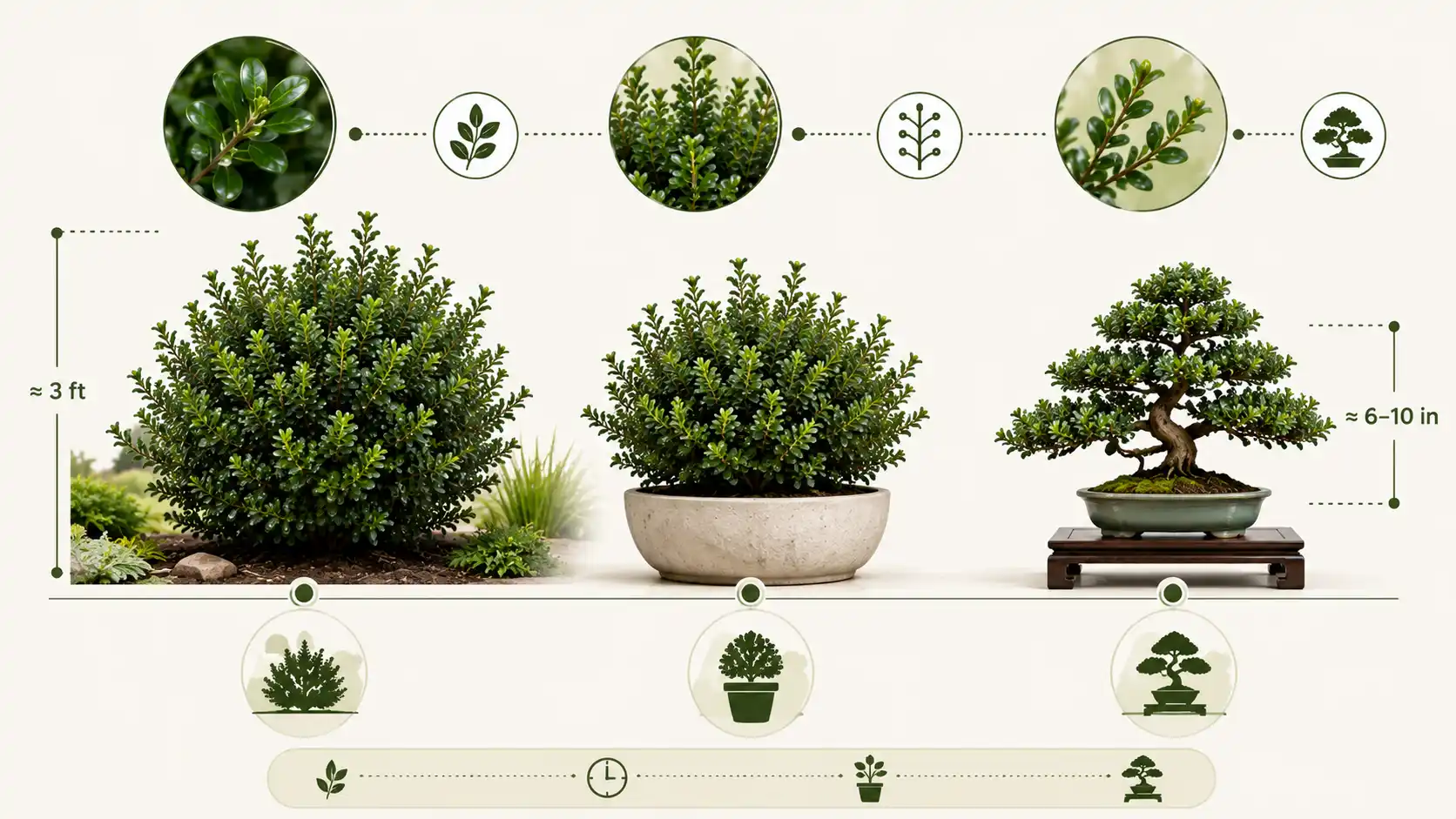
Jersey Jewel Japanese Holly is particularly suitable for container gardening and bonsai because of three important characteristics:
- Naturally small leaves
- Dense branching
- Slow, controlled growth rate
These traits allow growers to create miniature landscapes without constant aggressive maintenance. Container gardening allows compact woody plants to thrive in smaller spaces, similar to other carefully selected plants grown successfully in pots.
In containers, Jersey Jewel works well as:
- Patio accent plants
- Evergreen container arrangements
- Entryway plants
- Decorative seasonal displays
A container-grown plant remains smaller than an in-ground specimen because limited root space restricts overall growth. For beginners interested in miniature tree cultivation, understanding bonsai care principles can help maintain healthy structure and long-term growth.
Container Growing Requirements
Successful container growth depends on proper drainage and soil structure.
Recommended conditions include:
| Requirement | Recommendation |
| Container type | Pot with drainage holes |
| Soil mix | Acidic, well-draining mix |
| Watering | Maintain even moisture |
| Repotting | Every few years depending on root growth |
| Location | Bright light with protection from extreme heat |
A suitable container mix may include:
- Pine bark
- Quality potting soil
- Perlite or pumice for drainage
- Organic compost in small amounts
Avoid heavy garden soil in containers because it can compact around roots and restrict oxygen availability.
Bonsai Suitability and Care
Jersey Jewel Japanese Holly is considered a strong bonsai candidate because it naturally resembles miniature trees even before extensive training.
Its bonsai advantages include:
- Small evergreen leaves that scale well
- Fine branching structure
- Good response to pruning
- Ability to develop a mature appearance over time
Basic bonsai care includes:
Root pruning:
Container-grown bonsai specimens typically require periodic root pruning when roots become crowded. This helps maintain plant health and prevents excessive growth.
Wiring:
Young branches can be carefully wired to guide shape, but the branches should be monitored because holly stems can mark easily as they thicken.
Pruning:
Regular selective pruning encourages ramification, creating more compact branch structures.
Watering:
Bonsai specimens dry out faster than landscape plants and may require more frequent monitoring, especially during hot weather.
Keeping Jersey Jewel small long-term depends on balancing:
- Root restriction
- Branch pruning
- Adequate nutrition
- Correct light exposure
Foliage and Seasonal Appearance
Jersey Jewel Japanese Holly is a fully evergreen shrub, meaning it keeps its foliage throughout the year and does not naturally lose all its leaves during winter.
Its year-round appearance is one of its greatest landscape advantages.
The foliage features:
- Small oval leaves
- Deep green coloration
- Smooth edges
- Slightly cupped shape
- Dense arrangement along branches
Unlike many flowering shrubs, Jersey Jewel is grown primarily for structure and foliage rather than flowers.
Small white flowers may appear in spring, but they are generally:
- Tiny
- Inconspicuous
- Not the main ornamental feature
Female Japanese holly plants may produce small black berries when pollinated, although berry production varies depending on plant sex and nearby compatible plants.
Seasonal changes are subtle:
| Season | Appearance |
| Spring | Fresh green growth emerges |
| Summer | Dense evergreen foliage develops |
| Fall | Maintains green color with little change |
| Winter | Evergreen structure remains visible |
Because it stays green year-round, Jersey Jewel provides visual stability during seasons when deciduous plants lose their leaves.
Benefits of Jersey Jewel Japanese Holly
Jersey Jewel Japanese Holly offers several practical advantages that make it valuable for small gardens, formal landscapes, and container designs. For gardeners planning a landscape with year-round greenery, combining compact shrubs like Jersey Jewel Japanese Holly with suitable evergreen trees can create stronger structure and seasonal interest.
Evergreen Structure and Year-Round Interest
The plant maintains green foliage throughout the year, providing consistent structure even during winter months.
This makes it useful for:
- Foundation plantings
- Winter gardens
- Formal designs
- Mixed evergreen borders
Naturally Compact Growth
Unlike larger shrubs that require frequent size control, Jersey Jewel naturally stays small.
Benefits include:
- Less pruning
- Better suitability for small spaces
- Easier maintenance
- Improved container performance
Fine Texture for Landscape Design
The tiny leaves create a refined texture that contrasts well with plants featuring larger foliage.
It combines especially well with:
- Dwarf conifers
- Ornamental grasses
- Rock garden plants
- Other evergreen shrubs
Bonsai and Artistic Uses
The combination of small leaves and dense branching makes Jersey Jewel useful for gardeners interested in miniature tree cultivation.
Its structure allows growers to create:
- Informal upright bonsai styles
- Small landscape containers
- Decorative specimen plants
Potential Downsides and Cons of Jersey Jewel Japanese Holly
Although Jersey Jewel is adaptable and attractive, it has several limitations that gardeners should consider before planting.
Soil pH Sensitivity
Japanese hollies prefer acidic soil. In alkaline soils, plants may develop nutrient deficiencies that cause:
- Yellowing leaves
- Reduced growth
- Poor foliage color
Gardeners with naturally alkaline soil may need regular soil testing and amendments.
Slower Growth Rate
The same slow growth that creates a refined appearance can be a disadvantage for gardeners seeking rapid screening.
Compared with fast-growing shrubs, Jersey Jewel:
- Takes longer to fill large spaces
- Does not provide immediate privacy
- Requires patience during establishment
Pest Susceptibility
Dense evergreen foliage can occasionally attract pests such as:
- Holly leaf miners
- Scale insects
- Spider mites
Regular inspection helps detect problems before they become severe.
Pet Safety Considerations
Japanese holly berries are generally considered potentially harmful if eaten in significant amounts. Pet owners should prevent dogs, cats, or children from consuming plant material and seek advice from veterinary or poison-control professionals if ingestion occurs.
Limited Flower Display
Gardeners looking for colorful blooms may find Jersey Jewel less impressive because flowers are small and not ornamental compared with flowering shrubs.
Troubleshooting Common Jersey Jewel Japanese Holly Problems
Jersey Jewel problems are usually related to incorrect soil conditions, watering issues, environmental stress, or pests. Identifying the cause early helps prevent long-term damage.
Leaves Turning Brown or Yellow
Brown or yellow leaves usually indicate environmental stress, nutrient problems, or root issues.
Common causes include:
- Alkaline soil causing nutrient deficiencies
- Drought stress
- Poor drainage
- Root damage
- Excessive fertilizer application
Solutions:
- Test soil pH.
- Improve drainage if soil stays wet.
- Adjust watering habits.
- Apply appropriate acidic amendments if needed.
- Add mulch to stabilize moisture levels.
Prevention:
- Check soil conditions before planting.
- Avoid planting in compacted areas.
- Maintain consistent moisture during dry periods.
Pest Infestations
Pest problems can occur when dense foliage creates protected areas where insects can feed and reproduce.
Common pests include:
- Holly leaf miners
- Scale insects
- Spider mites
Why problems occur:
- Poor air circulation
- Plant stress
- Overcrowded branches
- Weak growth conditions
Solutions:
- Identify the specific pest before treatment.
- Remove heavily affected leaves when practical.
- Use targeted horticultural treatments appropriate for the pest.
Prevention:
- Inspect foliage regularly.
- Maintain proper spacing.
- Prune selectively to improve airflow.
Slow or Stunted Growth
Slow growth is normal for Jersey Jewel, but extremely limited development may indicate an underlying problem.
Possible causes include:
- Poor soil fertility
- Too much shade
- Root-bound container conditions
- Incorrect watering
- Lack of nutrients
Solutions:
- Improve soil quality.
- Increase light exposure if possible.
- Repot container plants when roots become crowded.
- Apply balanced fertilizer during active growth.
Prevention:
- Choose the correct planting location.
- Monitor container root growth.
- Maintain proper soil moisture and nutrition.
Jersey Jewel Japanese Holly vs. Similar Plants
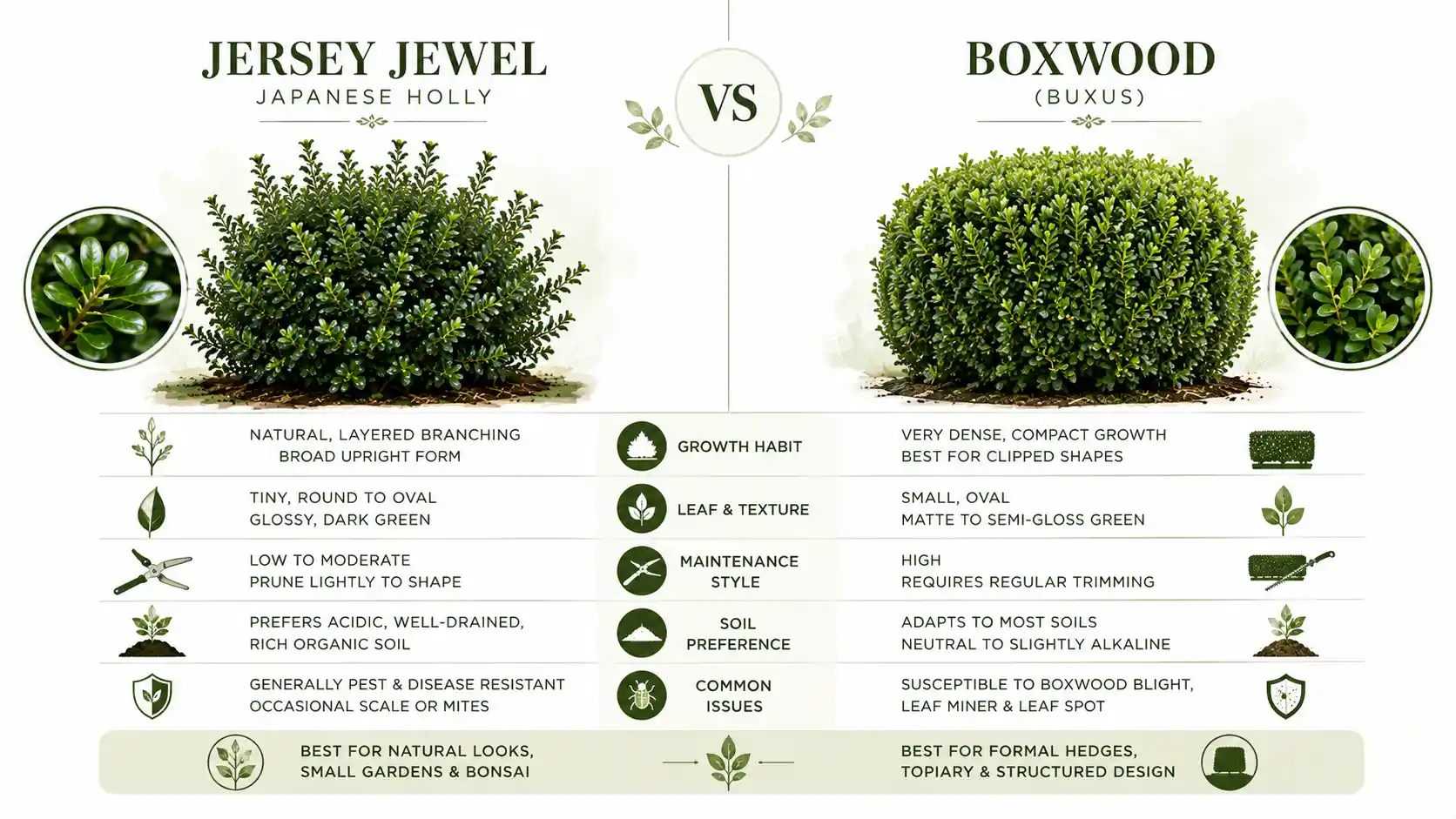
Jersey Jewel Japanese Holly is often compared with other fine-textured evergreen shrubs because its small leaves, compact size, and dense branching create a similar visual effect to traditional hedge plants. The most common comparisons include other Ilex crenata cultivars, especially ‘Dwarf Pagoda,’ and boxwood (Buxus species).
Understanding these differences helps gardeners choose the right plant based on available space, maintenance preferences, climate, and intended use.
Jersey Jewel vs. ‘Dwarf Pagoda’ (Both Ilex crenata Cultivars)
Jersey Jewel and ‘Dwarf Pagoda’ are closely related Japanese holly cultivars with similar layered branching habits. The main difference is leaf size and overall texture.
| Feature | Jersey Jewel Japanese Holly | ‘Dwarf Pagoda’ Japanese Holly |
| Botanical group | Ilex crenata cultivar | Ilex crenata cultivar |
| Leaf size | Extremely small leaves | Small leaves, usually slightly larger |
| Growth habit | Broad upright, compact | More upright and architectural |
| Texture | Very fine texture | Fine but slightly coarser |
| Bonsai suitability | Excellent | Excellent |
| Best use | Small gardens, containers, bonsai | Specimen planting, miniature landscapes |
The smaller leaves of Jersey Jewel give it an advantage for bonsai and highly detailed garden designs where scale and texture are important.
Both cultivars share:
- Evergreen foliage
- Dense branching
- Slow growth
- Preference for acidic soil
- Good tolerance of pruning
The choice often depends on the desired visual effect. Jersey Jewel creates a more delicate appearance, while ‘Dwarf Pagoda’ offers a slightly stronger vertical structure.
Japanese Holly vs. Boxwood
Japanese holly is frequently used as an alternative to boxwood because both plants provide small leaves, evergreen structure, and suitability for formal garden designs.
However, they differ in growth habits, disease concerns, and environmental preferences.
| Feature | Japanese Holly (Ilex crenata) | Boxwood (Buxus) |
| Leaf texture | Small, glossy, rounded leaves | Small, dense leaves |
| Growth rate | Slow to moderate | Slow to moderate |
| Soil preference | Acidic soil preferred | Neutral to slightly alkaline soil often tolerated |
| Maintenance | Moderate pruning needs | Frequent shaping often used |
| Disease concerns | Holly pests such as leaf miners and scale | Boxwood blight and other boxwood diseases |
| Cold tolerance | Generally hardy in Zones 5–8 depending on cultivar | Varies by species and cultivar |
| Appearance | Slightly more open, natural branching | Very formal, dense hedge appearance |
| Best use | Specimen shrubs, borders, bonsai, alternatives to boxwood | Formal hedges and clipped designs |
Japanese holly is often selected where gardeners want the appearance of boxwood but prefer a plant with different disease resistance characteristics.
Boxwood remains valuable for traditional formal gardens, but Japanese holly can provide a similar fine-textured evergreen effect with a slightly different growth pattern.
Common Beginner Mistakes with Jersey Jewel Japanese Holly
Jersey Jewel Japanese Holly is relatively easy to grow, but several common mistakes can reduce its health, density, and overall appearance. Gardeners creating low-maintenance landscapes can combine easy-care plants with suitable evergreen shrubs to reduce ongoing maintenance requirements.
Planting in Alkaline Soil Without Testing
One of the most frequent problems is placing Japanese holly in soil with a high pH.
Because Ilex crenata prefers acidic conditions, alkaline soil can prevent the plant from absorbing important nutrients.
Symptoms may include:
- Yellow leaves
- Weak growth
- Reduced foliage density
Better approach:
- Test soil before planting.
- Amend soil if necessary.
- Monitor pH periodically, especially in regions with naturally alkaline soils.
Overwatering in Poorly Draining Soil
Although Jersey Jewel likes consistent moisture, it does not tolerate constantly wet roots.
Excess water can lead to:
- Root stress
- Poor nutrient uptake
- Declining foliage quality
Common causes include:
- Heavy clay soil
- Containers without drainage holes
- Frequent shallow watering
Better approach:
- Water deeply but allow soil to partially dry between watering.
- Improve drainage before planting.
- Use well-draining container mixes.
Planting Too Close to Buildings
Because Jersey Jewel stays compact, gardeners sometimes underestimate the space needed for mature growth.
Planting too close to foundations can:
- Restrict airflow
- Make pruning difficult
- Create uneven growth
Allow enough room for the mature width of approximately 2 feet, while considering nearby plants and structures.
Over-Pruning at the Wrong Time
Heavy pruning at unsuitable times can reduce the plant’s natural shape and slow recovery.
Avoid:
- Severe trimming during extreme heat
- Removing too much interior branching
- Repeated shearing that destroys layered structure
Selective pruning is usually better because it maintains the shrub’s natural architectural form.
Growing in Deep Shade
Jersey Jewel can tolerate partial shade, but deep shade often produces weaker growth.
Possible results include:
- Thin branching
- Less dense foliage
- Slower development
For the best compact shape, provide bright light with several hours of direct sun whenever possible.
Conclusion
Jersey Jewel Japanese Holly is a compact evergreen cultivar of Ilex crenata that combines fine-textured foliage, dense branching, and manageable size for small landscapes, containers, and bonsai projects. Its mature size of approximately 3 feet tall and 2 feet wide makes it a practical choice where larger evergreen shrubs are unsuitable.
The plant performs best with acidic, well-drained soil, consistent moisture, and sun to partial shade. While its slow-to-moderate growth rate requires patience, it rewards growers with year-round green foliage and a naturally refined structure.
For gardeners seeking a low-maintenance evergreen with bonsai potential, strong landscape value, and a compact footprint, Jersey Jewel Japanese Holly is an excellent option. Proper soil preparation, thoughtful placement, and balanced care are the key factors for maintaining a healthy and attractive plant. For more detailed information on plant selection, care methods, and growing guides, explore our complete Plants Benefits and Guides resource.
FAQs
What are the cons of Japanese holly?
The main disadvantages of Japanese holly include its preference for acidic soil, slower growth rate, and susceptibility to pests such as holly leaf miners, scale insects, and spider mites. It may struggle in alkaline soils without amendments and is not ideal for gardeners who need a fast-growing privacy shrub.
Jersey Jewel Japanese Holly also produces small berries that may cause digestive problems if consumed, so pet owners should prevent pets from eating plant material.
How do I care for a Jersey Jewel Japanese holly bonsai tree?
A Jersey Jewel Japanese holly bonsai requires bright light, well-draining acidic soil, regular watering, and careful pruning to maintain its compact shape. Keep the soil evenly moist but avoid waterlogged conditions.
Essential bonsai care includes:
- Root pruning when the plant becomes root-bound
- Selective branch pruning for structure
- Occasional wiring to guide shape
- Fertilizing lightly during active growth
Because its leaves are naturally small, Jersey Jewel responds well to bonsai training and can maintain a mature appearance over time.
Is Japanese holly poisonous to dogs?
Japanese holly berries and plant material may cause digestive upset if dogs consume them in significant amounts. Symptoms can include stomach discomfort, vomiting, or diarrhea.
While Japanese holly is not generally considered among the most dangerous ornamental plants, pet owners should prevent dogs from eating berries or leaves and contact a veterinarian if ingestion occurs.
Which is better, boxwood or Japanese holly?
The better choice depends on the garden situation. Japanese holly is often preferred when gardeners want a boxwood-like appearance with small leaves but different disease considerations.
Japanese holly is a good choice for:
- Bonsai
- Natural evergreen shapes
- Small gardens
- Areas where boxwood problems are a concern
Boxwood may be better for:
- Traditional formal hedges
- Highly clipped geometric designs
- Gardens designed around classic boxwood structure
Both plants can provide attractive evergreen landscaping when matched with the right conditions.
Can Japanese holly be cut back?
Yes, Japanese holly can be cut back and responds well to pruning. The best time for major pruning is usually late winter or early spring before active growth begins.
Light trimming can be done after growth flushes to maintain shape. Selective pruning is recommended because it preserves the plant’s natural branching structure better than repeated heavy shearing.
Why is my dwarf holly turning brown?
A dwarf holly such as Jersey Jewel may turn brown because of drought stress, poor drainage, alkaline soil, root damage, winter injury, or pest problems.
Common solutions include:
- Checking soil moisture
- Testing soil pH
- Improving drainage
- Adjusting watering practices
- Inspecting for pests
Brown foliage often indicates environmental stress, so identifying the underlying cause is more effective than treating the symptom alone.