
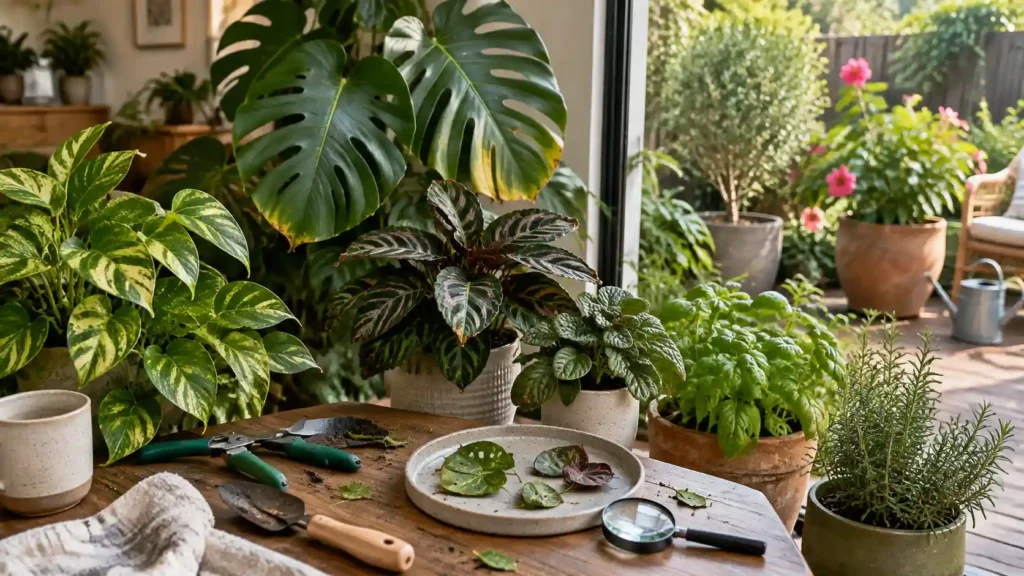
Plant pests are organisms that damage plants by feeding on leaves, stems, roots, flowers, or sap. The difficult part is that yellow leaves, curling, wilting, holes, or slow growth do not automatically mean you have a pest problem. Watering mistakes, poor light, nutrient issues, and plant diseases can produce surprisingly similar symptoms.
That is why the most useful way to deal with plant pests is to diagnose first and treat second. Look at what the damage looks like, where it occurs, whether you can find an actual pest, and how quickly the problem is spreading. Correct identification also matters because a treatment that helps a soft-bodied aphid may be irrelevant to a soil-dwelling pest or chewing caterpillar. University extension guidance similarly recommends identifying the cause before choosing a control method and isolating infested houseplants to reduce spread.
Quick Summary
- Identify before treating: webbing, sticky residue, cottony clusters, silvery damage, holes, and soil flies point toward different pest groups.
- Not every bug is harmful: some insects and soil organisms are harmless or beneficial, so treating everything you see can create unnecessary problems.
- Start with the least disruptive effective control: isolation, washing, hand removal, pruning, monitoring, and targeted treatments can all have a place depending on the pest.
- Prevent recurrence: quarantine new plants, inspect regularly, avoid chronic plant stress, and correct conditions that allow pests to build up.
What Is Causing the Damage? Start With the Symptoms
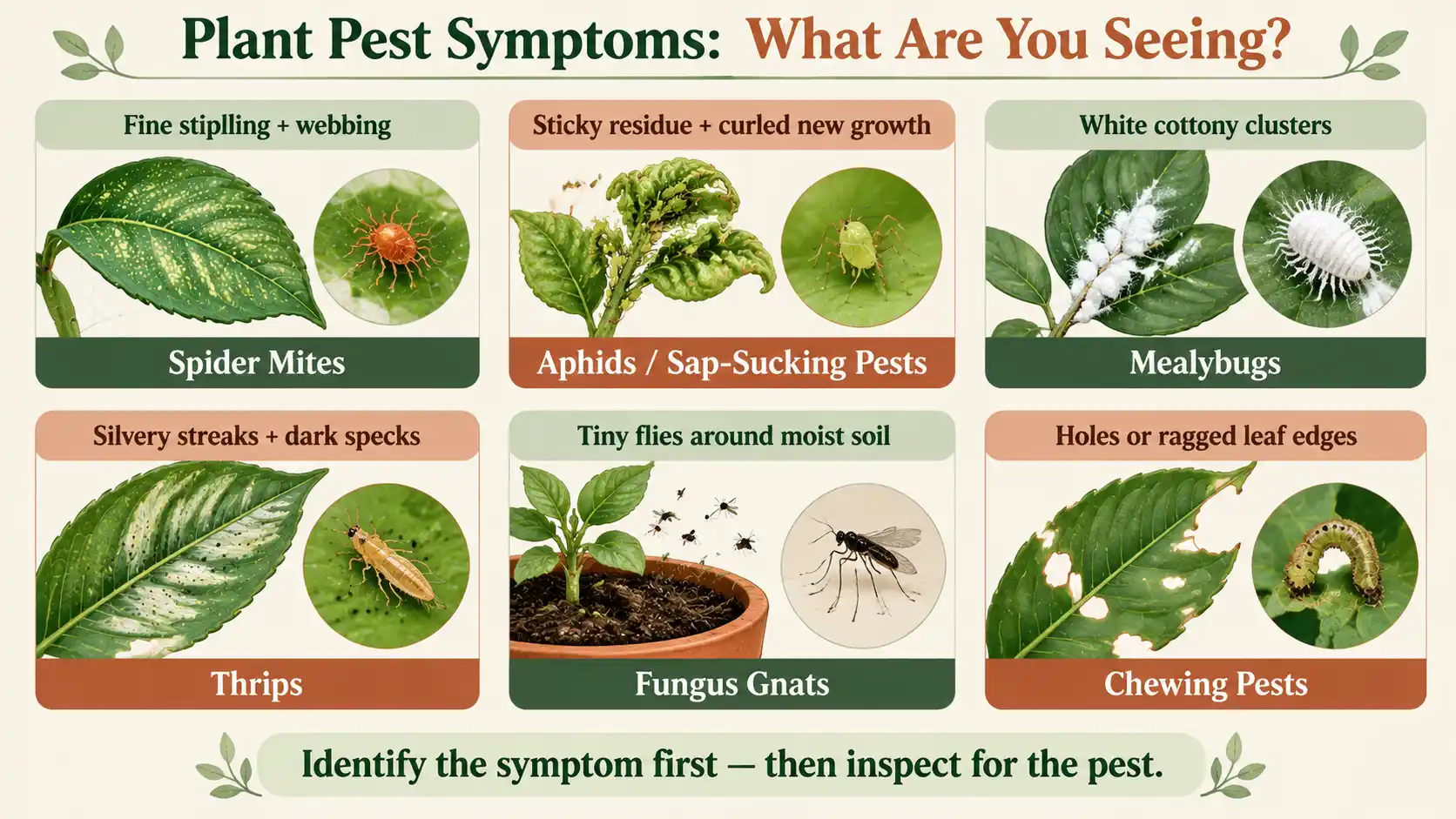
When you do not know the pest’s name, start with the symptom and location, not the product aisle. A visible pest is useful evidence, but the pattern of injury can be equally important, especially for tiny pests that are difficult to see. UC IPM’s houseplant diagnostic guide likewise separates symptoms such as stippling, sticky foliage, leaf distortion, root problems, and leaf spots because different causes can produce different patterns.
Symptom-Based Plant Pest Identification Table
| What you see | Where you see it | Likely pest/problem | Confidence clue | First action |
| Fine pale stippling, bronzing, possible fine webbing | Leaf undersides, growing points, stems | Spider mites | Moving mites plus stippling/webbing | Isolate and inspect closely |
| Sticky or glossy residue with curled/distorted new growth | New shoots, stems, leaf undersides | Aphids, scale, mealybugs or whiteflies | Visible clusters or insects plus honeydew | Inspect stems and leaf undersides |
| White cottony clusters | Leaf joints, stems, roots | Mealybugs | Waxy/cottony material that remains attached | Isolate and inspect crevices |
| Hard brown or tan bumps | Stems and leaf undersides | Scale | Bumps remain fixed while the plant is disturbed | Check for crawlers and treat according to identification |
| Silvery streaks or patches with dark specks | Leaves, flowers, young growth | Thrips | Slender insects or dark frass | Inspect young growth and flowers |
| Tiny dark flies around wet soil | Soil surface | Fungus gnats | Adults emerge when the pot is disturbed | Assess soil moisture and inspect the root zone |
| Jagged holes or missing leaf tissue | Leaf edges and surfaces | Caterpillars, beetles, slugs/snails and other chewing pests | Chewing marks, droppings or slime trails | Inspect leaves and soil after dark where appropriate |
| Yellowing, wilting or spotting without visible pests | Whole plant or affected leaves | Watering, roots, nutrient or disease issue | No pest evidence after careful inspection | Check growing conditions before spraying |
The table is a starting point rather than a substitute for confirmation. For example, yellowing alone is not enough to diagnose a pest; UC IPM notes that yellowing can also result from excessive or insufficient water, poor roots, inadequate light, fertilization problems, or several other causes.
How to Confirm a Suspected Pest Before Treating
Once you have a likely match, inspect the places pests prefer to hide:
- Undersides of leaves
- Leaf joints and nodes
- New shoots and growing tips
- Stems and flowers
- Soil surface and drainage holes
- Nearby plants that touch the affected plant
Use a magnifying glass when necessary. For extremely small pests such as spider mites or thrips, a white-sheet or paper-tap test can make moving pests easier to notice. The important point is to look for a pattern of evidence, not one unidentified speck.
Once you find a likely pest, move the affected plant away from healthy plants while you investigate. Isolation is a standard IPM recommendation for indoor plants because it reduces the chance of spreading an infestation during diagnosis and treatment.
For a dedicated spider-mite identification and treatment protocol, see Spider Mites on Houseplants.
Which Types of Plant Pests Affect Indoor and Outdoor Plants?
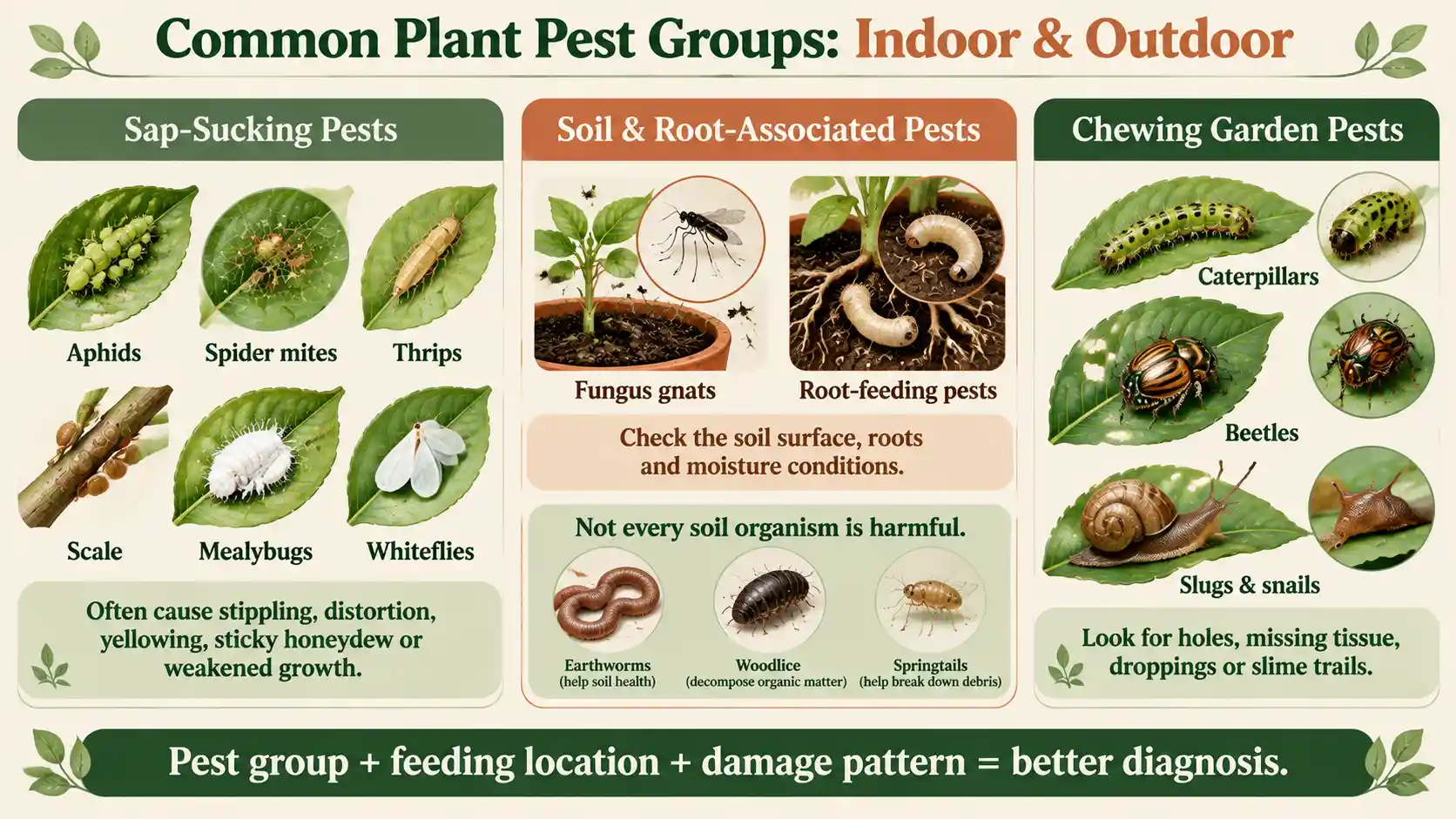
Plant pests overlap between indoor and outdoor environments, but the conditions are different enough that the dominant pest groups and management strategies can change. Indoors, plants are concentrated in a small space, so one infested plant can become a source of infestation for the rest of a collection. Outdoors, weather, predators, plant diversity, and seasonal cycles have a much larger influence.
Sap-Sucking Pests
Sap-sucking pests are among the most important groups to recognise because several cause similar symptoms.
Common examples include:
- Aphids
- Spider mites
- Thrips
- Scale
- Mealybugs
- Whiteflies
These pests often weaken plants by feeding on plant fluids and can produce symptoms such as stippling, distorted new growth, yellowing, or reduced vigor. Some, including aphids, scale, and mealybugs, produce honeydew, a sticky substance that can leave foliage glossy and can support sooty mold growth.
Do not assume that all sap-sucking pests should be treated identically. Spider mites are arachnids rather than insects, scale can be protected by a waxy covering, and thrips may hide in flowers or new growth. The pest’s biology determines which control method and coverage pattern make sense.
For the detailed aphid-specific diagnosis and treatment process, see Aphids on Houseplants.
Soil and Root-Associated Pests
Seeing organisms in soil does not automatically mean the plant is being attacked. Houseplant containers can contain harmless decomposers and organisms that feed on decaying material alongside genuinely damaging root pests.
Fungus gnats are a useful example. Adult fungus gnats are mainly a nuisance around pots, while their larvae live in the growing medium and can feed on organic material and, in some situations, plant roots.
Look beyond the soil surface when root damage is suspected. Poor growth, persistent wilting despite appropriate watering, or declining roots can justify checking the root zone rather than repeatedly treating the foliage.
For a deeper identification and control guide, see Bugs in Indoor Plant Soil: Identification, Treatment & Prevention.
Chewing and Outdoor Garden Pests
Chewing pests produce a different signature: missing plant tissue.
Common groups include:
- Caterpillars
- Beetles
- Slugs and snails
- Some weevils and other leaf-chewing insects
Look for holes, ragged edges, skeletonized leaves, droppings, eggs, or slime trails. Outdoor pests are often easier to understand when you inspect both the plant and its immediate surroundings rather than looking only at the damaged leaf.
The existing Common Garden Bugs guide is the better deep-dive resource for outdoor identification, beneficial insects, and common garden-pest patterns.
Harmful Pests vs Harmless or Beneficial Insects
The objective of pest management is not to eliminate every insect.
| Category | Typical role | Response |
| Plant pest | Feeds on or damages the plant | Identify and manage |
| Harmless organism | Present without meaningful plant damage | Usually monitor rather than eliminate |
| Beneficial insect or organism | Pollinates or naturally suppresses pests | Protect whenever practical |
Lady beetles, lacewings, predatory insects, bees, and other organisms can provide valuable ecological functions. Broad, unnecessary insecticide use can also damage natural enemies and pollinators, potentially making pest management harder rather than easier.
Is It Really a Pest? Plant Pest Look-Alikes
One of the easiest ways to make a plant problem worse is to treat a symptom without identifying its cause. Houseplant diagnostic guidance from Iowa State and UC IPM specifically warns that environmental problems, watering, nutrition, root health, disease, and pests can overlap in appearance.
When the cause of plant damage is still unclear, use this broader Garden Problems and Pests diagnostic guide to compare pest damage with watering, root, disease, light, and other growing-condition problems before treating.
Pest Damage vs Watering Problems
Yellow leaves and wilting are especially unreliable as standalone pest indicators.
Before spraying, ask:
- Is the soil staying wet for unusually long periods?
- Are the roots healthy and firm?
- Has the plant recently experienced a major light or temperature change?
- Is the plant repeatedly drying out?
- Are symptoms occurring throughout the plant rather than around active feeding sites?
- Can you actually find insects, mites, eggs, webbing, honeydew, or chewing evidence?
For example, overwatering can damage roots enough to cause wilting even though the soil is already wet. Watering again because the plant looks wilted can then compound the problem.
Pest Damage vs Disease and Nutrient Problems
Look for direct pest evidence before assuming that discoloration is insect damage.
A practical comparison is:
| Symptom | Additional clue | Direction to investigate |
| Fine stippling + webbing | Live mites present | Spider mites |
| Sticky foliage + distorted new growth | Insects clustered on stems/leaves | Sap-sucking pests |
| Isolated brown spots with no pests | Lesions or spreading spots | Disease/environment |
| Uniform yellowing | Poor roots, light, watering or nutrition | Cultural problem first |
| Wilting with wet soil | Root damage possible | Root-zone problem |
| Holes with droppings or slime | Chewing evidence | Outdoor chewing pest |
If careful inspection finds no live pest and the symptom does not match a known feeding pattern, stop and investigate environmental conditions or disease instead. Do not spray merely because a leaf looks unhealthy.
How Serious Is a Plant Pest Infestation?
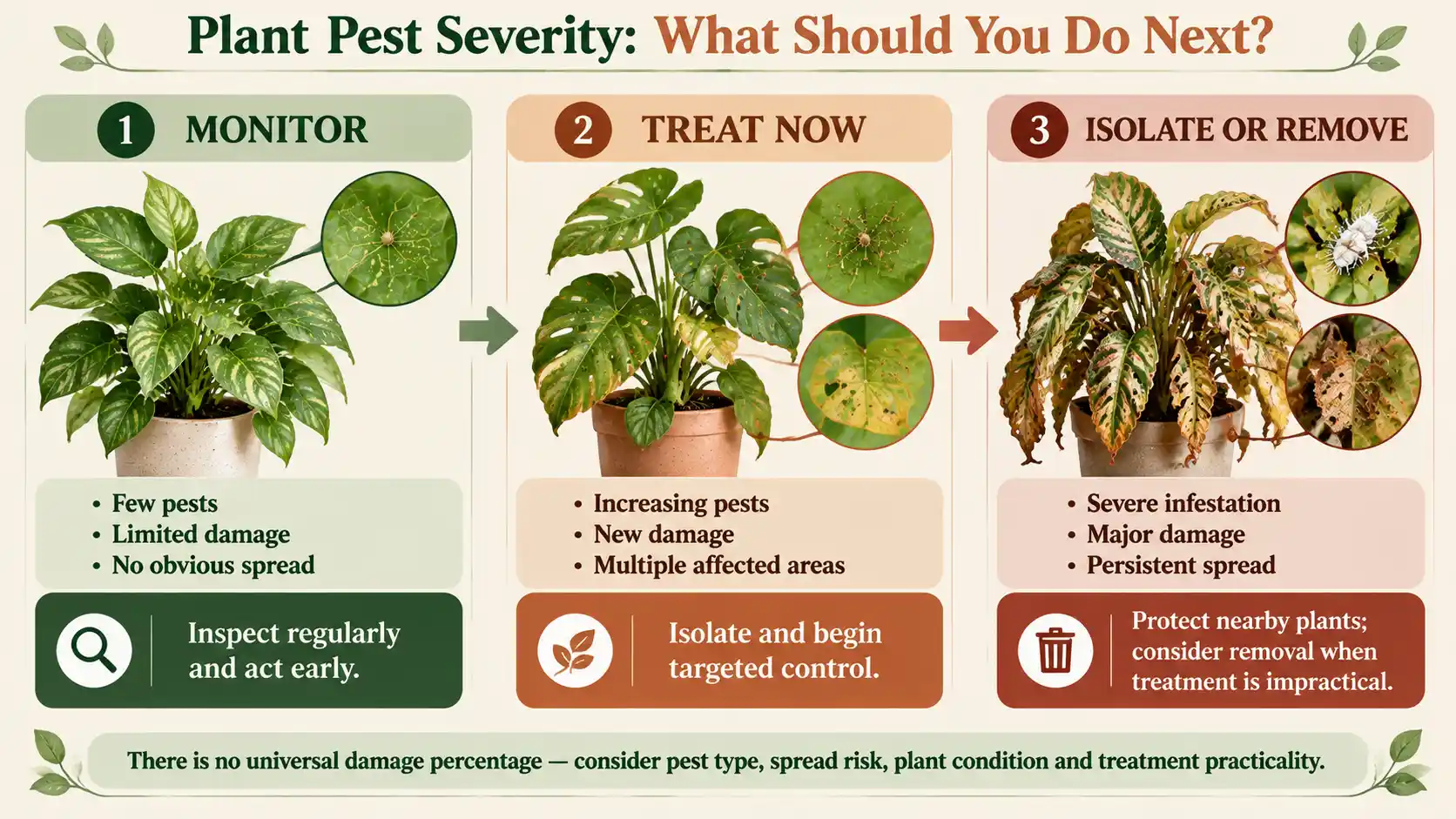
Severity should be judged by pest numbers, rate of spread, amount of active damage, plant condition, and the likelihood of affecting nearby plants. There is no useful universal rule such as “discard the plant after 50% of the leaves are damaged.”
Monitor: Early or Low-Level Infestation
Monitoring can be reasonable when you have:
- A small number of visible pests
- Limited damage
- A healthy plant with plenty of viable growth
- No obvious spread to neighboring plants
At this stage, early physical removal may be enough for some pests, especially when the affected area is easy to reach. Extension guidance consistently emphasizes dealing with pests while populations are still small.
Treat Now: Active or Increasing Infestation
Move from observation to active treatment when:
- Pest numbers are increasing
- New plant parts are becoming affected
- Damage is appearing on multiple leaves
- Nearby plants show similar symptoms
- Physical removal alone is no longer keeping the population down
The earlier you interrupt reproduction and spread, the fewer plants you have to treat.
Isolate or Remove: Severe or Persistent Infestation
Isolation becomes essential when the pest is spreading or when treatment is likely to disturb the rest of the collection.
A plant may be better removed when it is heavily infested, badly damaged, difficult to treat thoroughly, or continuing to act as a source of pests despite appropriate management. UC IPM and UMN Extension both recognise plant disposal as a practical option for severe indoor infestations when ongoing treatment is unlikely to justify the effort or risk to other plants.
The decision should consider the plant’s remaining healthy growth, sentimental or monetary value, pest species, spread risk, and whether effective treatment is realistically possible.
How to Control Plant Pests Without Making the Problem Worse
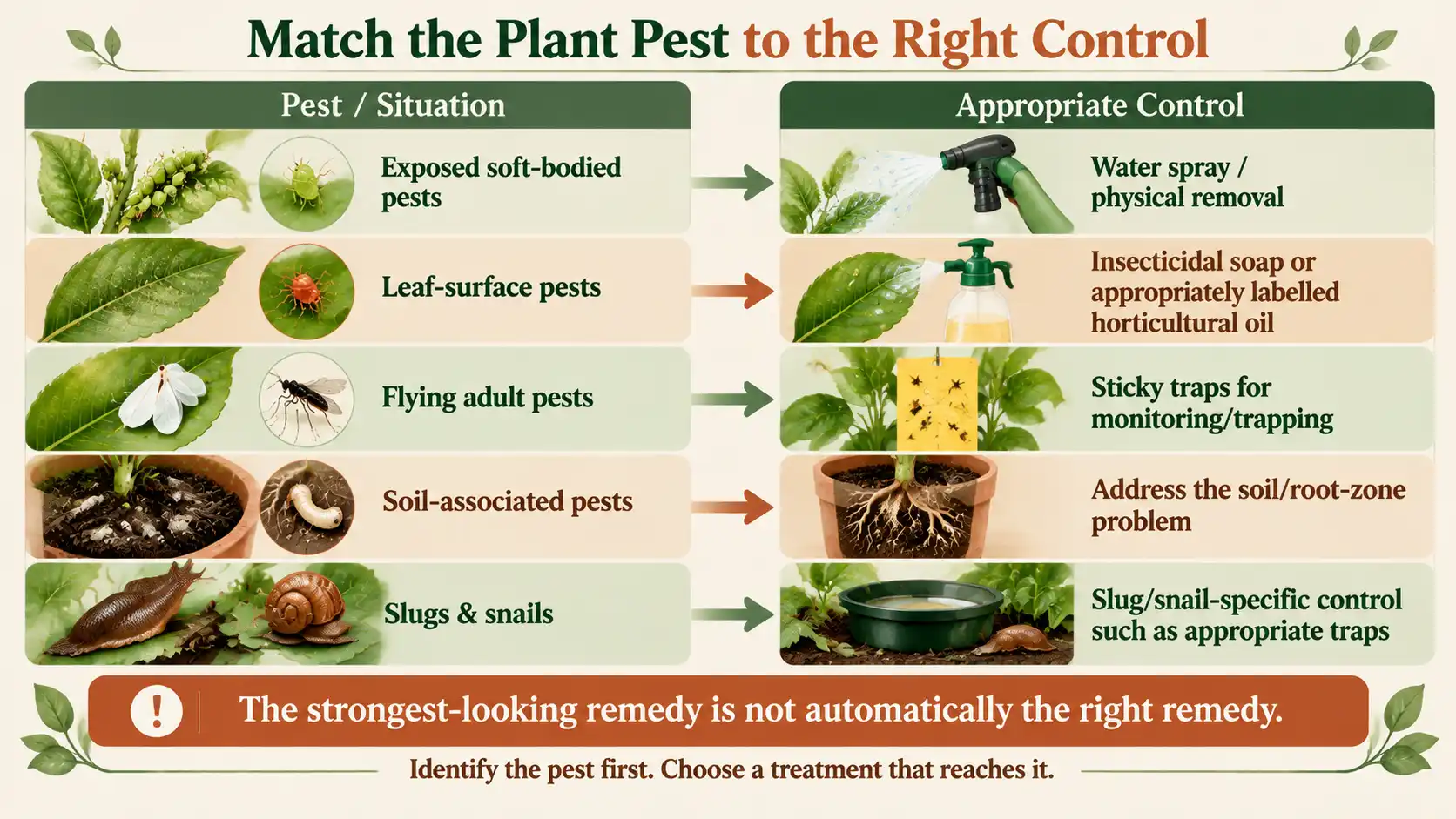
Effective pest control is usually a sequence, not one miracle spray. This approach follows the basic principles of integrated pest management (IPM), which combines monitoring, prevention, physical, biological, and targeted chemical controls rather than relying on routine pesticide use.
Step 1: Isolate the Affected Plant
Move the plant away from other plants before treating it.
Avoid placing it where leaves continue to touch neighboring plants. Then inspect the plants that were closest to it because spread may already have occurred.
Isolation does not kill the pest. Its purpose is to stop an individual problem from becoming a collection-wide problem. UC IPM specifically recommends immediate isolation when insect, mite, or disease problems are detected on established houseplants.
Step 2: Remove What You Can Physically
Physical control is often underrated because it does not look as dramatic as spraying.
Depending on the pest and plant, this may include:
- Rinsing foliage with water
- Wiping or hand-removing visible insects
- Removing heavily infested leaves
- Pruning severely affected portions
- Removing visible egg masses
- Cleaning fallen debris and contaminated plant material
Water sprays are especially useful against exposed soft-bodied pests such as aphids, while pruning can reduce heavily infested areas.
Step 3: Match the Control to the Pest
The right question is not “What is the strongest natural remedy?” It is “What control actually reaches this pest?”
| Control | Best suited to | What it does | Main limitation |
| Water spray/rinsing | Exposed soft-bodied pests and some mites | Physically dislodges pests | Does not prove complete eradication |
| Insecticidal soap | Several exposed soft-bodied pests and some mites | Kills primarily by direct contact | Thorough coverage and repeat applications may be necessary |
| Horticultural oil | Certain insects and mites | Contact control when pests are thoroughly covered | Plant sensitivity and label restrictions matter |
| Sticky traps | Flying adult pests such as fungus gnats | Monitoring and trapping adults | Does not by itself eliminate immature stages in soil |
| Neem-based products | Certain labelled pest situations | Can provide contact and pest-management effects depending on formulation | Not a universal treatment for every pest |
| Beer traps | Slugs and snails | Attracts and traps these pests | Irrelevant to aphids, spider mites, thrips and most houseplant pests |
This is where many generic pest articles fall short: they list remedies without explaining what the remedy can actually reach.
For example, a sticky trap can reduce adult fungus gnats but cannot substitute for addressing larvae in the growing medium. An insecticidal soap must contact the pest, so spraying only the upper surfaces of leaves can leave pests underneath untouched. UC IPM specifically stresses thorough coverage for contact treatments.
Beer traps are a specialised tool for slugs and snails, not a general insect remedy. Extension guidance supports beer or yeast-water traps for these mollusks, which is very different from recommending beer as a cure for plant pests generally.
Do not automatically substitute homemade dish soap for commercial insecticidal soap. Detergents can injure foliage, and extension guidance specifically warns against treating ordinary dishwashing products as interchangeable with labelled insecticidal soap.
Neem oil and horticultural oils also deserve realistic expectations. They are not magic “kill everything” products, and contact coverage matters. For aphids, for example, UC IPM notes that soaps and oils primarily kill pests present at the time of spraying, which is why repeat applications may be required.
When Chemical Control Becomes Reasonable
Chemical control becomes a consideration when the pest is correctly identified, the infestation is causing meaningful damage, nonchemical methods are insufficient, or the pest is difficult to manage physically.
That does not mean choosing the harshest product available.
Use only a pesticide labelled for the specific pest, plant, use site, and application method. Read the label before mixing or spraying, follow its protective instructions, and do not assume that an indoor-safe product is interchangeable with a garden product. UC IPM recommends using labelled products only when warranted and avoiding broad-spectrum, long-residual products when less disruptive approaches are available.
Why Plant Pests Keep Coming Back
Recurring infestations are usually not proof that a particular remedy “doesn’t work.” More often, something in the system is allowing pests to survive, reproduce, or return.
Quarantine New Plants
New plants are one of the easiest ways to introduce pests into an otherwise healthy collection.
Penn State Extension recommends isolating newly acquired plants, as well as plants being brought indoors for winter, for about three weeks while monitoring them for pests and disease.
A useful home routine is:
Inspect → isolate → monitor → introduce
Check the undersides of leaves, stems, growing points, flowers, and, where appropriate, the soil and roots before the plant joins the rest of the collection.
Inspect Before You See Obvious Damage
Do not wait for severe damage to become your detection system.
A weekly five-minute inspection can catch many problems while they are still small:
- Turn over several leaves.
- Check new growth.
- Inspect leaf joints and stems.
- Look at the soil surface.
- Look for webbing, honeydew, cottony material, or flying insects.
- Check nearby plants when one pest is found.
UC IPM recommends frequent inspection of houseplants and notes that early detection can allow removal of a small affected portion before the problem becomes widespread.
Correct Environmental Stress
Good plant care does not make plants pest-proof, but chronic stress can make a pest problem harder for the plant to tolerate.
Check:
- Light
- Watering
- Soil drainage
- Airflow
- Humidity
- Temperature
- Fertilization
Poor growing conditions can also create symptoms that resemble pest damage, making diagnosis harder. Iowa State Extension emphasises that houseplant problems frequently involve more than one factor and that environmental conditions should be assessed alongside pest symptoms.
Prevent Spread Between Plants
Once one plant is infested, think about movement.
Wash your hands after handling affected plants, clean tools before moving to healthy plants, remove discarded infested material, and avoid allowing foliage from the affected plant to brush against neighboring plants. Isolation should continue while active pests are still being detected.
Common Plant Pest Mistakes That Make Infestations Worse
Treating Before Identifying
Why it fails: the product may target the wrong organism while the real pest continues reproducing.
Fix: identify the symptom pattern, inspect the plant carefully, and confirm the likely pest before selecting a treatment.
Prevention: make diagnosis the first step every time.
Treating Only the Visible Adult Pests
Why it fails: eggs, larvae, nymphs, or pests hidden in soil and plant crevices may survive.
Fix: find out where the pest’s other life stages occur and choose a treatment schedule or combination that addresses them.
Prevention: monitor after treatment instead of judging success by a single spray day.
Spraying Everything With the Same Remedy
Why it fails: a contact spray cannot automatically reach a root pest, and a trap designed for flying adults will not remove insects feeding on leaves.
Fix: match the control method to the pest’s location and biology.
Prevention: keep a simple pest-treatment record so you remember what was identified and used.
Overwatering a Plant Because It Looks Unwell
Why it fails: wet soil can contribute to root problems and encourage fungus-gnat conditions. More water is not automatically a treatment for a wilted plant.
Fix: check the soil and roots before watering again.
Prevention: water according to the plant and its growing conditions rather than by a rigid calendar.
Killing Beneficial Insects Alongside Pest Species
Why it fails: broad insecticide use can kill natural enemies that help suppress pests.
Fix: identify the insect before treating and favour targeted methods.
Prevention: maintain a garden environment where beneficial organisms can survive.
How to Build a Simple Plant Pest Prevention Routine
A good prevention system should be simple enough to repeat.
Weekly 5-Minute Pest Check
Run the same routine each week:
- Inspect new growth.
- Turn over several leaves.
- Check stems and leaf joints.
- Look at the soil surface.
- Look for sticky residue or fine webbing.
- Scan nearby plants when any pest is detected.
The aim is not to search every leaf under a microscope. It is to make early detection normal.
New-Plant Intake Routine
Keep new plants separate for around three weeks when practical, especially when they are entering an established collection. Inspect them repeatedly rather than treating quarantine as a single check on arrival.
After-Treatment Monitoring
Do not assume that “I sprayed it” means “the pest is gone.”
Check the plant again after treatment according to the product label or pest-specific management schedule.
Look for:
- Live pests
- Fresh damage
- New growth without damage
- Reappearance on neighboring plants
Some contact treatments kill only pests directly reached by the application, so follow-up matters.
Conclusion
Plant pests are easiest to manage when you stop treating every symptom as an invitation to spray. Start by asking what you can actually see, where the damage is occurring, and whether a living pest is present. That simple diagnostic step can separate spider mites from thrips, aphids from environmental stress, soil pests from harmless organisms, and chewing damage from disease or watering problems.
Once a pest is confirmed, isolate the affected plant, remove what you can physically, and choose a control method that matches the pest’s location and biology. Contact treatments need contact; traps target particular stages or behaviours; and severe infestations may sometimes justify removing the plant rather than repeatedly exposing the rest of the collection to the problem.
Long-term success comes from prevention as much as treatment: inspect new plants, quarantine them before introduction, monitor regularly, maintain appropriate growing conditions, and check neighboring plants when one infestation appears. The goal is not simply to make damaged leaves look better. It is to interrupt the pest cycle, protect healthy plants, and prevent the same problem from quietly starting again.
For detailed pest-specific help, use Spider Mites on Houseplants, Aphids on Houseplants, Bugs in Indoor Plant Soil, or Common Garden Bugs according to the problem you identified.
Frequently Asked Questions
What are the most common plant pests?
Common plant pests include aphids, spider mites, thrips, scale, mealybugs, whiteflies, fungus gnats, caterpillars, beetles, and slugs or snails. The most useful distinction is not simply the pest’s name, but where it feeds and what evidence it leaves behind.
For example, spider mites are associated with stippling and fine webbing, aphids often cluster on soft new growth and produce honeydew, fungus gnats are associated with soil, and chewing pests leave holes or missing tissue.
How can I tell if my plant has pests or a disease?
Start by looking for direct evidence of feeding or the pest itself.
Webbing, honeydew, cottony clusters, visible insects, eggs, dark frass, chewing marks, or insects emerging from soil all strengthen the case for pests. When there is no pest evidence and the symptoms instead match problems such as water stress, root damage, nutrient imbalance, or leaf disease, investigate those causes first. Houseplant problems often have multiple contributing factors.
What should I do first when I find a pest on my plant?
Isolate the plant first, then inspect it carefully and identify the pest before choosing a treatment.
A practical sequence is:
Isolate → inspect → identify → physically reduce the pest → choose targeted treatment → monitor
This prevents you from spreading an unidentified pest while you are trying to solve the problem.
Can plant pests spread from one plant to another?
Yes. Pests can move between nearby plants through direct contact, handling, new plant introductions, or movement of contaminated plant material. This is especially important indoors because many plants are grown close together.
That is why an infested houseplant should be isolated promptly and nearby plants checked rather than treating only the visibly damaged plant.
Are all bugs on plants harmful?
No. Some insects are beneficial predators or pollinators, while some soil organisms are harmless decomposers. Eliminating every insect can remove organisms that help maintain ecological balance or naturally suppress pests.
The correct question is not “Is there a bug?” but “Is this organism causing meaningful plant damage?”
What is the safest way to get rid of plant pests?
There is no single safest method for every pest. The safest practical approach is to identify the pest first, begin with an appropriate low-disruption method when it is likely to work, and use a labelled pesticide only when necessary.
Physical removal, water sprays, selective pruning, insecticidal soaps, and horticultural oils can all have legitimate roles, but they are not interchangeable. Product labels, plant sensitivity, pest biology, and application conditions all matter.
How do I stop plant pests from coming back?
Focus on the system that allowed the infestation to establish.
Quarantine new plants, inspect foliage regularly, check soil and roots when appropriate, avoid chronic overwatering or other plant stress, keep plants from becoming excessively crowded, and inspect neighboring plants whenever one pest is found. A new plant can be monitored for about three weeks before joining an established collection.
When should I throw away a pest-infested plant?
Consider removing a plant when the infestation is severe, the plant is badly damaged, effective treatment is impractical, or the plant continues to act as a source of pests despite appropriate management.
There is no scientifically useful universal percentage of leaf damage at which every plant should be discarded. The decision depends on the pest, remaining healthy growth, treatment feasibility, plant value, and risk to nearby plants. UC IPM and UMN Extension both recognise disposal as a practical option for heavily infested indoor plants when continued treatment is unlikely to be worthwhile.

One Response