
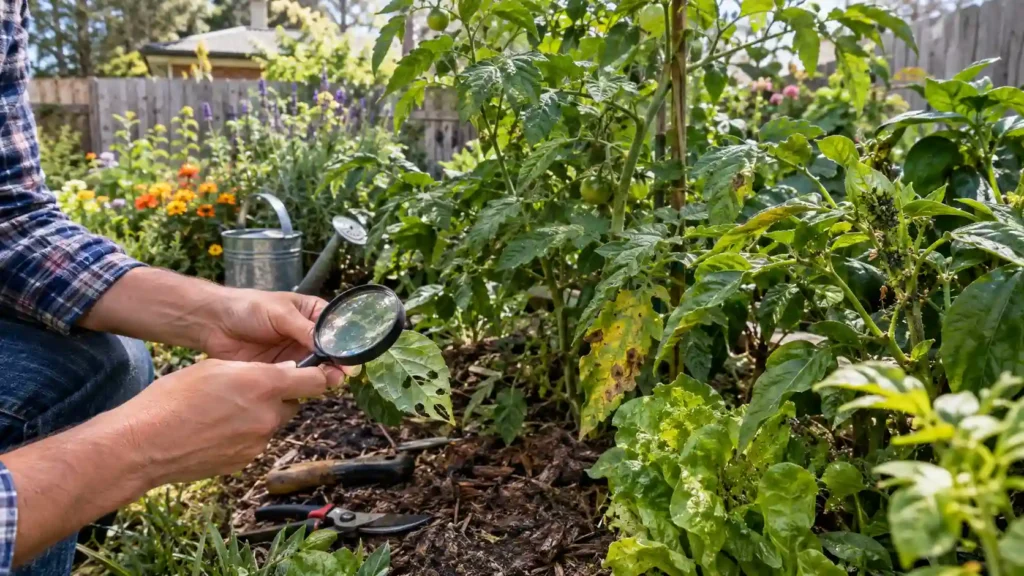
When something looks wrong in your garden, the hardest part is often not treatment—it is figuring out what is actually causing the damage. Holes in leaves may come from chewing insects, slugs, physical damage, or something else. Yellow leaves can be linked to watering, roots, light, nutrition, natural aging, or pests. Wilting can occur when the soil is too dry, but it can also happen when roots are damaged by excessively wet conditions.
That is why the best starting point is not a spray bottle. It is a diagnosis.
This garden problems and pests hub helps you work from what you can see to what is most likely causing it, decide whether you need to act immediately or simply monitor the plant, and choose the least disruptive practical response. The process also helps separate pests from plant diseases and cultural problems such as poor drainage, watering stress, unsuitable light, temperature changes, or nutrient issues.
Plant diagnosis is rarely based on one symptom alone. Penn State Extension groups common plant-health problems into environmental conditions, plant-care practices, insects and mites, diseases, and other possible causes, noting that more than one factor can sometimes be involved.
Quick Summary
- Start with the symptom, not the treatment. Look at the pattern, location, texture, progression, and growing conditions before assuming a pest is responsible.
- A damaged plant may have a pest, disease, or cultural problem. Watering, drainage, roots, light, temperature, nutrition, and environmental stress can produce symptoms that resemble pest damage.
- Look for direct evidence before spraying. Inspect leaf undersides, stems, new growth, soil, roots, and surrounding plants for insects, eggs, webbing, honeydew, chewing marks, frass, lesions, or other clues.
- Not every problem needs immediate treatment. Some damage should be treated promptly, some should be monitored, and some is best left alone—especially when beneficial organisms are involved.
- Once you narrow down the cause, use the appropriate specialist guide. Greenery Nest’s Plant Pests: Identification, Control & Prevention Guide covers the broader pest problem, while Yellowing, Browning and Drooping goes deeper into those common foliage symptoms.
How to Diagnose a Garden Problem Before Treating It
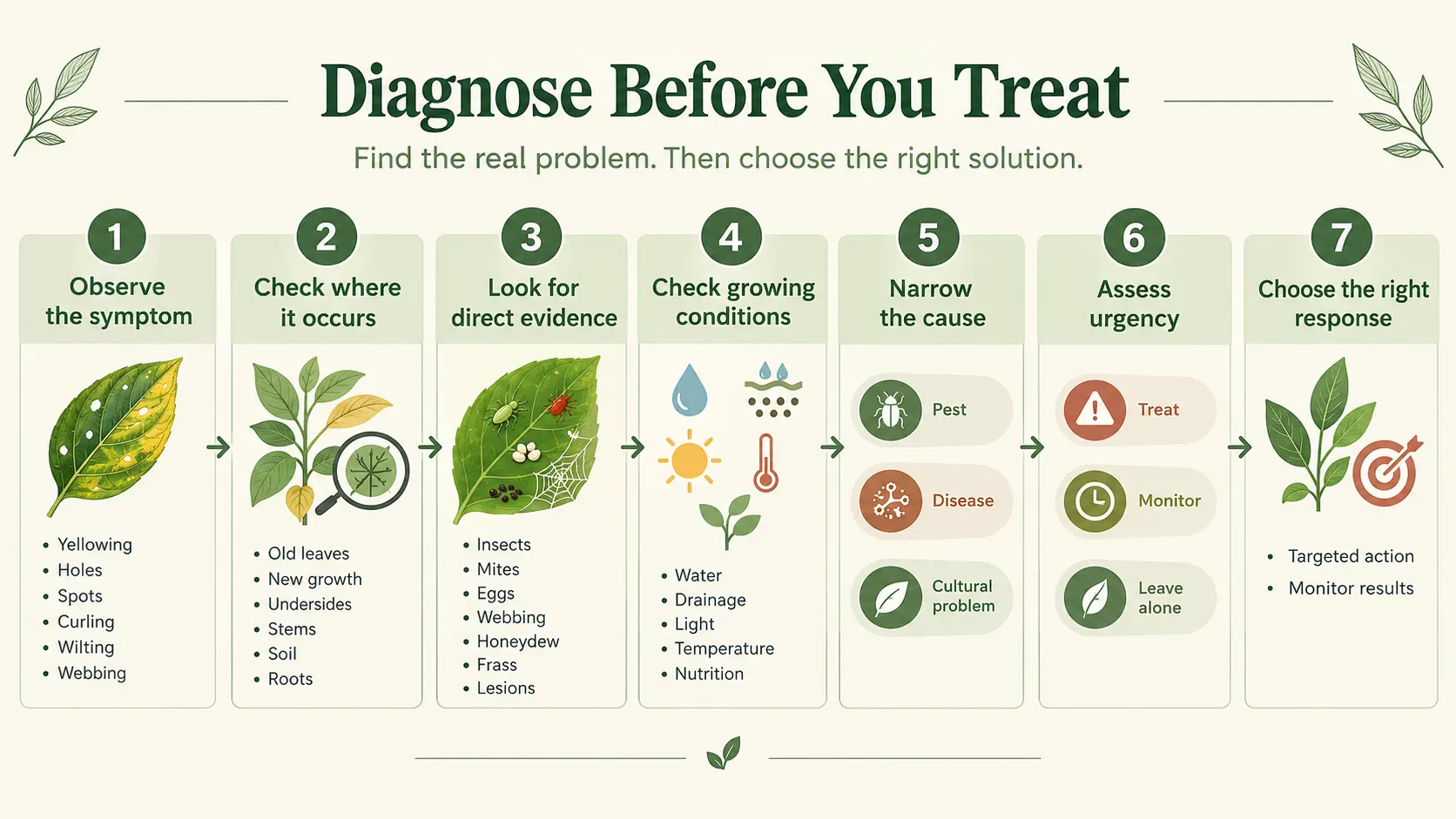
The most reliable diagnosis usually comes from combining several small observations instead of trying to match one symptom to one answer.
A useful way to think about plant diagnosis is:
What changed? → Where is it happening? → How quickly is it spreading? → What evidence can I find? → What growing condition could explain it? → How serious is it? → What is the least disruptive next step?
This approach also follows the basic principle behind integrated pest management, or IPM: correctly identify the pest or problem first, then choose management methods appropriate to the situation. UC IPM specifically emphasizes identification and monitoring before selecting control methods.
Step 1: Describe Exactly What You See
Do not begin with a label such as “pest problem” or “fungus.” Start with the physical evidence.
Ask:
- Are there holes in the leaves?
- Are the edges missing?
- Are the leaves yellowing uniformly or only in patches?
- Are brown areas dry and crispy or soft and dark?
- Is the foliage curling?
- Is new growth distorted?
- Is the plant wilting even though the soil is wet?
- Are there sticky deposits?
- Is there webbing?
- Are there tiny flies around the soil?
- Are spots spreading from leaf to leaf?
- Is the damage limited to one plant or appearing across many plants?
The more precisely you describe the symptom, the smaller the list of plausible causes becomes.
Step 2: Check Where the Problem Starts
The location of damage can be more useful than its colour.
Check whether the problem is concentrated on:
- Older leaves
- New leaves
- Leaf tips
- Leaf margins
- Leaf undersides
- Stems
- Nodes
- Flowers
- Fruit
- Soil surface
- Roots
For example, distorted young growth can point you toward sap-feeding activity or another problem affecting developing tissue, while widespread lower-leaf yellowing may have a very different explanation.
The key is to avoid assuming that a symptom has a universal meaning.
Step 3: Look for Direct Evidence
Once you know what you are looking at, inspect the plant closely.
Look beneath leaves and around stems for:
- Live insects
- Mites
- Eggs
- Fine webbing
- Sticky honeydew
- Frass
- Scale-like bumps
- Cottony material
- Chewed tissue
- Slime trails
- Larvae
- Unusual lesions
A magnifying glass can make a major difference when dealing with very small pests.
If you suspect a pest but cannot find any direct evidence, do not automatically assume the insects are simply hidden. Continue checking environmental and cultural causes before treating.
For a broader guide to identifying pest groups once you have evidence of a pest, see Plant Pests: Identification, Control & Prevention Guide.
Step 4: Check the Growing Conditions
A plant’s environment can create symptoms that look surprisingly similar to pest damage.
Review:
- Soil moisture
- Drainage
- Recent rainfall
- Irrigation
- Light exposure
- Temperature changes
- Strong wind
- Humidity where relevant
- Fertilizer use
- Transplanting
- Root disturbance
- Recent pruning
- Sudden movement or relocation
Ask yourself one particularly useful question:
What changed before the symptom appeared?
A recently moved plant may be reacting to a new light or temperature pattern. A garden that has experienced prolonged wet weather may develop problems that would not appear during a dry period. A plant that has suddenly begun growing rapidly may also reveal limitations in its root space, nutrition, or moisture supply.
Step 5: Check Whether the Problem Is Spreading
The scale and speed of the problem can help distinguish causes.
One damaged leaf on an otherwise healthy plant is different from:
- Ten plants showing the same symptom
- New leaves becoming affected every day
- Damage spreading rapidly after wet weather
- One pest appearing repeatedly on fresh growth
- A whole bed declining at the same time
Rapid spread deserves closer attention because the underlying cause may be active and continuing.
Is It a Pest, Disease, or Plant-Care Problem?
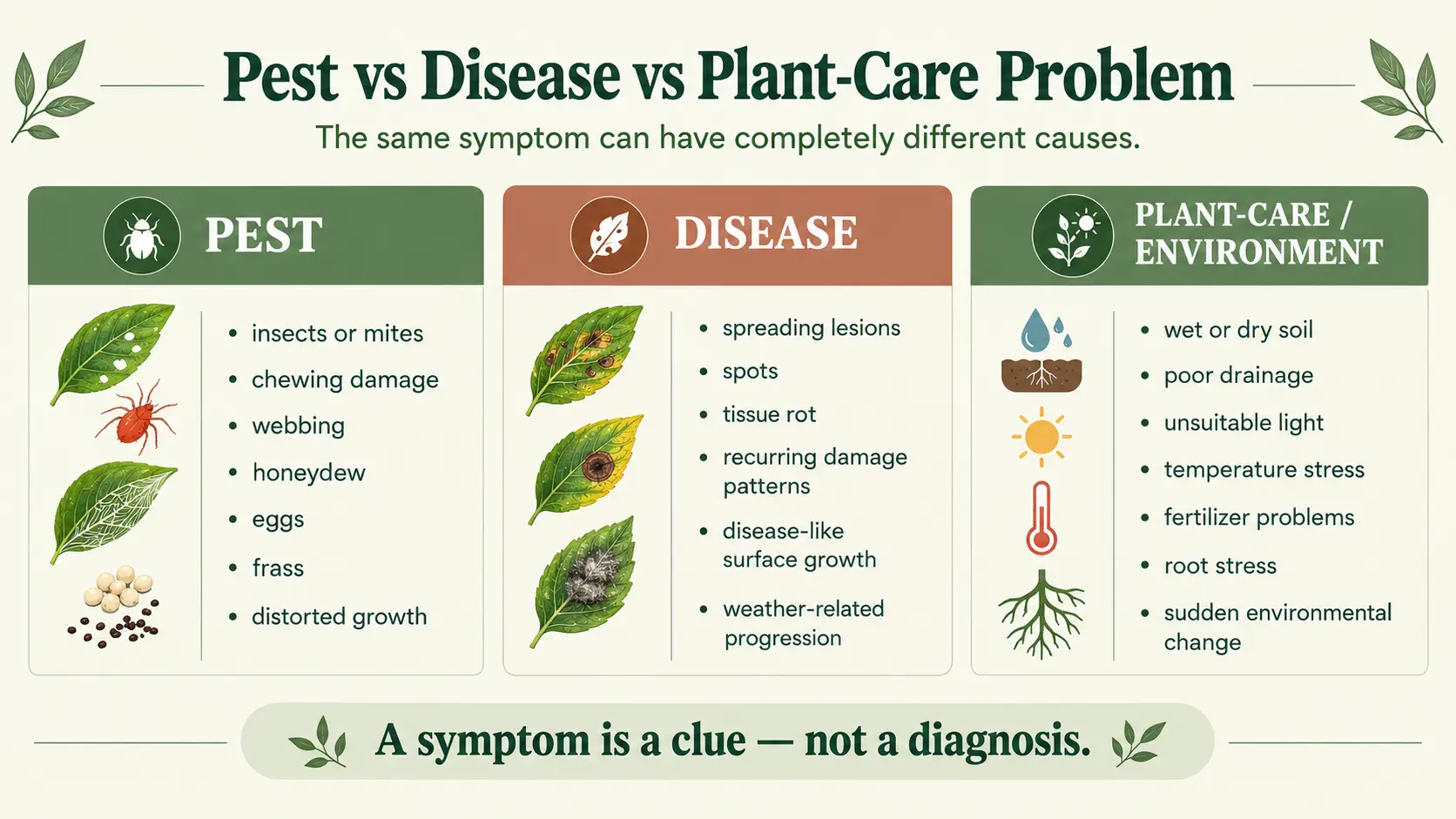
Many gardening mistakes begin with a premature diagnosis.
A hole becomes “caterpillars.” Yellow leaves become “overwatering.” Brown spots become “fungus.” Wilting becomes “underwatering.”
Each of those conclusions may sometimes be correct—but the symptom alone does not prove it.
For a more detailed diagnostic framework, see this plant diagnostics guide from Penn State Extension, which explains how environmental conditions, plant care, insects, mites, and diseases can produce overlapping symptoms.
Signs That Point Toward a Pest
Pests become more likely when you can connect the damage to direct evidence of feeding or infestation.
Possible clues include:
- Visible insects or mites
- Repeated chewing damage
- Honeydew
- Fine webbing
- Eggs
- Frass
- Distorted young growth
- Clusters of insects on stems or leaf undersides
- Sticky surfaces accompanied by pest activity
Some pests are very small and easy to miss, so the absence of an immediately visible insect is not enough to rule out every possibility.
Once you have strong evidence that a pest is responsible, the Plant Pests: Identification, Control & Prevention Guide is the best next step for the broader identification and management process.
Signs That Point Toward a Disease
Disease becomes more plausible when the plant develops patterns such as:
- Distinct lesions
- Spots that progressively enlarge
- Repeated areas of tissue death
- Rotting tissue
- Powdery or unusual surface growth
- Disease-like symptoms affecting multiple plants under similar conditions
- Symptoms associated with prolonged moisture or weather conditions
However, visual diagnosis of plant disease can be difficult because environmental damage, pests, and pathogens can produce overlapping symptoms.
Do not label an unfamiliar brown spot as a specific disease simply because it looks similar to a photograph online.
Signs That Point Toward a Cultural or Environmental Problem
Consider plant-care and environmental causes when you see symptoms alongside:
- Soil that stays wet for too long
- Extremely dry soil
- Poor drainage
- Sudden changes in light
- Heat or cold exposure
- Strong drafts
- Fertilizer changes
- Salt buildup
- Recent repotting
- Root disturbance
- Natural aging
This category is particularly important because many plant problems are not pest problems at all. Penn State Extension likewise recommends considering soil, light, temperature, care history, pests, diseases, and environmental conditions during diagnosis.
Why One Symptom Can Have Several Causes
Plant symptoms are clues, not diagnoses.
Yellowing may occur because of excess moisture, insufficient moisture, poor light, root stress, nutrition problems, natural aging, or pest activity.
Brown tissue may be associated with moisture stress, environmental damage, accumulated salts, physical injury, or disease.
Drooping may occur because a plant is genuinely short of available water—or because the roots are damaged and cannot supply the foliage properly even when the soil is wet.
For a deeper symptom-specific diagnostic guide, read Yellowing, Browning and Drooping.
Garden Problems by Symptom: What You See → What It Could Be
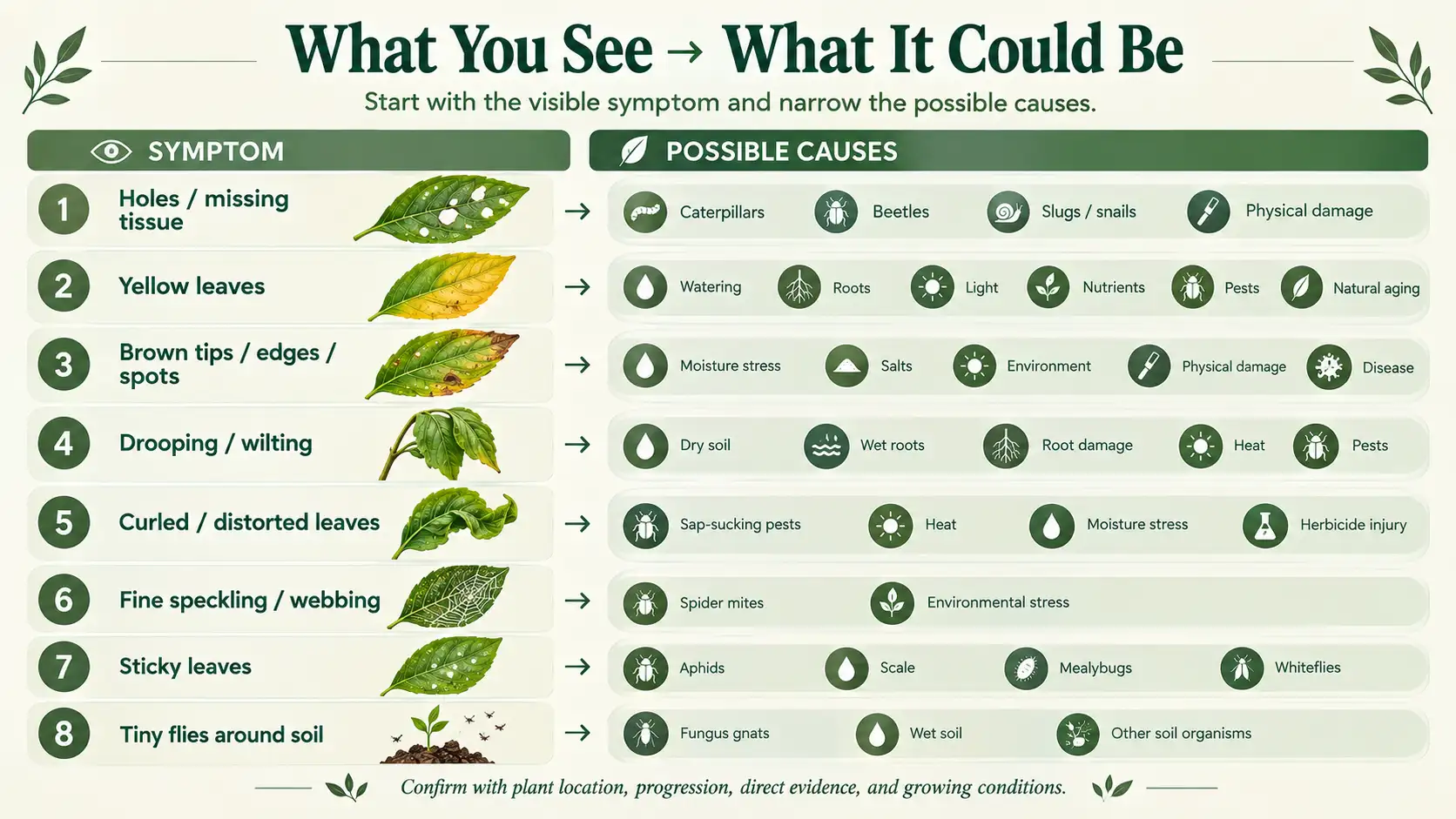
The fastest way to use this hub is to start from what is happening to the plant rather than trying to identify the pest by name.
Holes, Chewed Leaves, or Missing Tissue
Irregular holes and missing sections of leaves commonly point toward chewing activity, but the pattern still matters.
Possible causes include:
- Caterpillars
- Beetles
- Slugs
- Snails
- Other chewing insects
- Physical damage
- Weather-related injury
- Animals
Check the edges and undersides of damaged leaves. Look for droppings, eggs, larvae, slime trails, or fresh feeding.
Night-time inspection can sometimes reveal pests that are inactive or difficult to notice during the day.
For a broader guide to outdoor insect identification and distinguishing harmful insects from beneficial ones, see Common Garden Bugs Guide: 12+ Essential ID Tips.
Yellow Leaves
Yellowing is one of the least specific plant symptoms because so many different problems can produce it.
Consider:
- Excess moisture
- Poor drainage
- Root stress
- Underwatering
- Low light
- Nutrient problems
- Natural aging
- Sap-feeding pests
- Disease
- Environmental stress
Start with the soil and the pattern of yellowing.
A single older leaf that slowly turns yellow while new growth remains healthy is very different from rapid, widespread yellowing affecting the whole plant.
For a deeper framework for separating these possibilities, continue to Yellowing, Browning and Drooping.
Brown Tips, Edges, or Spots
Brown tissue must be interpreted by where it occurs and what it feels like.
Crispy brown margins can occur with moisture stress, dry conditions, salt buildup, or other environmental problems.
Soft, dark, rapidly expanding areas require a different line of investigation.
Brown spots may also be associated with disease, physical damage, excess moisture, sun injury, or pests.
Instead of asking only “Why are my leaves brown?”, ask:
Are the brown areas crispy or soft? Are they at the margins or in the middle of the leaf? Are they spreading? Is the soil unusually wet or dry? Is the affected side exposed to intense light?
For plant-specific examples, see Umbrella Plant Brown Leaves: Causes, Fix & Care Guide and Chinese Money Plant Brown Leaves: Causes & Fixes.
Drooping, Wilting, or Limp Growth
Drooping is another symptom that should never be interpreted in isolation.
Possible causes include:
- Dry soil
- Excessively wet soil
- Root damage
- Root rot
- Heat stress
- Transplant shock
- Sudden environmental changes
- Pest feeding
- Severe disease
The critical comparison is:
Dry soil + drooping versus wet soil + persistent drooping.
A plant that is wilting despite sitting in wet soil may have a root problem rather than a need for more water.
For a specific example of this symptom, see Rubber Plant Leaves Drooping: Causes and Fixes.
Curling, Distorted, or Twisted Leaves
Curling can result from:
- Sap-feeding pests
- Moisture stress
- Heat
- Cold
- Root stress
- Physical injury
- Herbicide exposure
- Rapid environmental changes
Pay particular attention to new leaves.
If young leaves emerge twisted, puckered, sticky, or unusually distorted, inspect the growing points and leaf undersides closely for pests.
Aphids are one possible cause of distorted growth, especially when pests are clustered around tender tissue. For deeper pest-specific identification and management, see Aphids on Houseplants: 8+ Proven Ways to Remove Them.
Fine Speckling, Bronzing, or Webbing
Tiny pale specks across foliage can be a sign of sap-feeding activity.
When stippling is accompanied by fine webbing, spider mites should be considered.
Look carefully at:
- Leaf undersides
- New growth
- The junction between stems and leaves
- Fine webbing between foliage
Do not confuse ordinary dust or larger decorative webs with the fine webbing associated with an active mite infestation.
Once spider mites are suspected or confirmed, move to the specialist guide Spider Mites on Houseplants: Identify, Treat & Get Rid of Them.
Sticky Leaves or Glossy Residue
A sticky coating on foliage or nearby surfaces can be honeydew produced by sap-feeding pests.
Possible sources include:
- Aphids
- Scale
- Mealybugs
- Whiteflies
- Other honeydew-producing insects
Inspect stems, leaf undersides, and new growth.
Sooty-looking growth can also develop secondarily where sugary deposits remain on plant surfaces, so visible black residue does not necessarily identify the original pest.
If the plant is indoors, the Aphids on Houseplants: 8+ Proven Ways to Remove Them guide provides a deeper route once aphids are confirmed.
White Cottony Material or Fixed Bumps
White material can have several explanations.
Look for:
- Cottony clusters
- Individual fixed bumps
- Pest clusters around leaf joints
- Surface fungal growth
- Residue from water or other materials
Mealybugs and scale are important pest possibilities, but do not assume every white mark is an insect.
Check whether the material moves, whether it can be gently removed, and whether it is concentrated around stems, nodes, or leaf undersides.
For broader pest identification, use Plant Pests: Identification, Control & Prevention Guide.
Tiny Flies Around Soil
Small flies repeatedly emerging from damp potting mix often point toward a soil-associated problem, particularly fungus gnats in indoor plants.
Consider:
- How consistently wet the soil remains
- Whether adults are repeatedly appearing
- Whether the problem is limited to one pot or widespread
- Whether the plant itself is showing signs of root stress
Not every tiny organism in soil is harmful. Some are harmless decomposers or other soil organisms.
For identification and management of indoor soil pests, see Bugs in Indoor Plant Soil: Identification, Treatment & Prevention.
Spots, Lesions, or Rapidly Spreading Discoloration
When spots appear to spread, expand, merge, or develop a defined lesion pattern, disease deserves more attention.
Look at:
- Whether the lesions are wet or dry
- Whether they have distinct borders
- Whether they occur on several leaves
- Whether multiple plants have similar symptoms
- Whether the weather has recently been unusually wet or humid
- Whether airflow is poor
Do not immediately apply an insecticide to a symptom that may not involve an insect.
If the disease remains unclear, photograph both the entire plant and close-up symptoms and consider seeking help from a qualified diagnostic service or local extension resource.
How Serious Is the Problem? Treat, Monitor, or Ignore
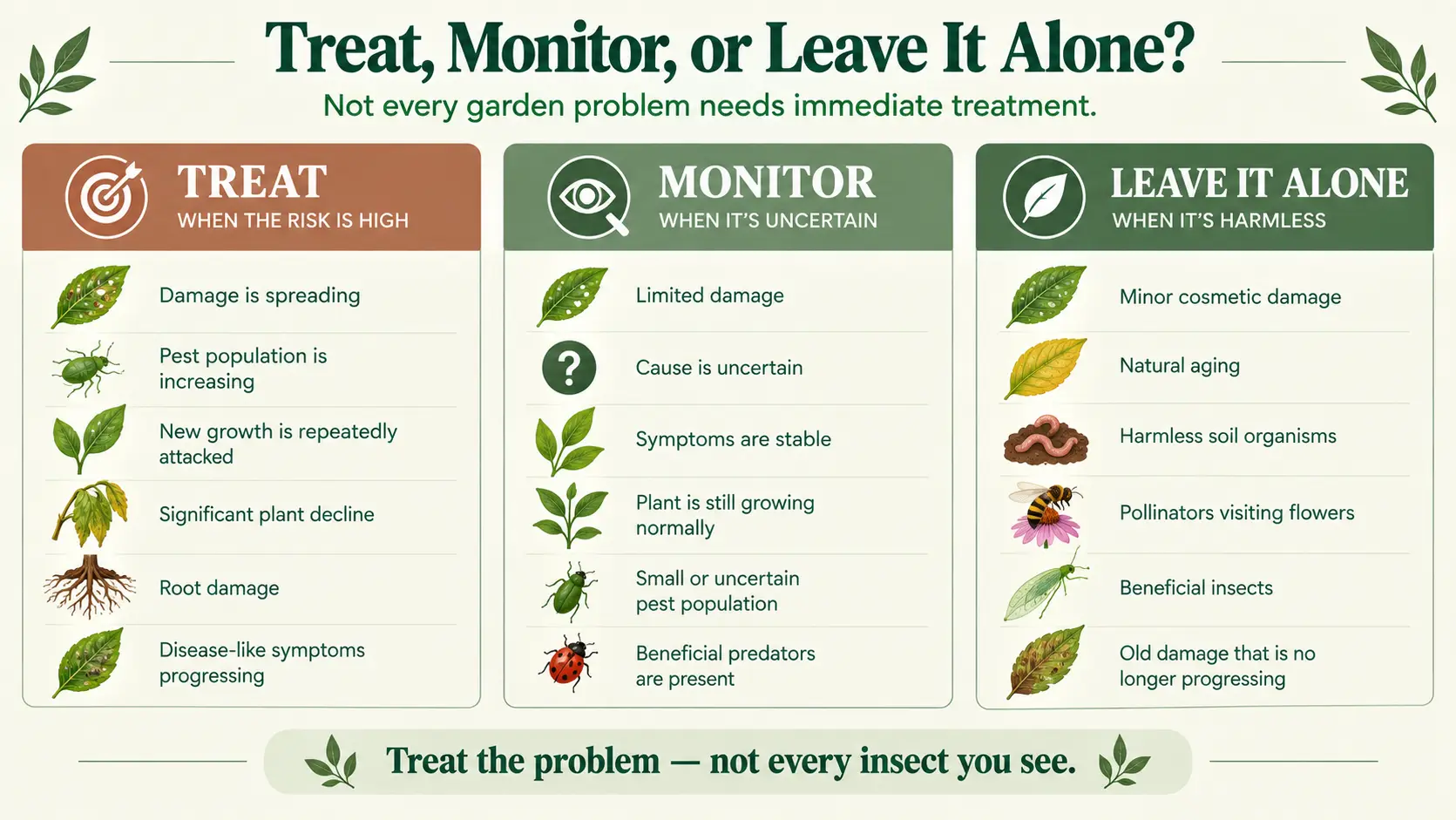
Not every garden problem deserves immediate treatment.
A healthy garden can contain insects, minor leaf damage, decomposers, predators, pollinators, and other organisms without requiring intervention.
The important question is whether the problem is causing meaningful damage and whether the cause is known well enough to justify action.
Treat Now
Prompt intervention deserves consideration when:
- Damage is spreading rapidly
- New growth is being repeatedly attacked
- A confirmed pest population is increasing
- Important plant tissue is being lost
- Roots are being damaged
- The plant is declining rapidly
- A disease-like problem is progressing
- The pest or pathogen could spread to valuable nearby plants
“Treat now” does not automatically mean “spray now.”
The first action may instead be isolation, removal of affected tissue, hand-picking, washing foliage, improving drainage, removing a heavily infested plant, or correcting the underlying environmental problem.
Monitor Closely
Monitoring is often appropriate when:
- Damage is limited
- The plant is still growing normally
- The suspected pest population is small or uncertain
- Symptoms are stable rather than progressing
- Beneficial predators are present
- The cause is unclear and more evidence is needed
Monitoring should be active rather than passive.
Record what you see, check the same plant again, and note whether the symptom is spreading or stabilizing.
Leave It Alone
Some situations do not justify intervention.
Examples include:
- Minor cosmetic damage
- Natural aging of older leaves
- Harmless soil organisms
- Beneficial predatory insects
- Pollinators visiting flowers
- Isolated old damage with no continuing decline
Trying to eliminate every visible insect can be counterproductive because beneficial organisms are part of a functioning garden ecosystem.
UC IPM recommends integrated approaches that can include biological control, garden-management changes, physical removal, trapping, barriers, and other lower-risk methods rather than relying automatically on pesticides.
Treat / Monitor / Ignore Framework
| Situation | What you observe | Initial response |
| Minor isolated damage | Little or no progression | Monitor |
| Uncertain cause | Symptoms present but no confirmed diagnosis | Investigate before treating |
| Confirmed, increasing pest | Repeated feeding or population growth | Begin targeted control |
| Rapid plant decline | Significant or accelerating symptoms | Investigate and act promptly |
| Beneficial insect activity | Insect present without meaningful plant damage | Protect and observe |
| Suspected environmental stress | Symptoms match a growing-condition problem | Correct the condition and monitor |
| Possible disease | Lesions or decline continuing to spread | Investigate rather than automatically spraying for insects |
Do not use a rigid percentage of damaged leaves as a universal treatment threshold. The appropriate intervention point varies with plant species, growth stage, crop value, pest identity, environmental conditions, and local recommendations.
What to Do First: A Low-Toxicity Response Plan
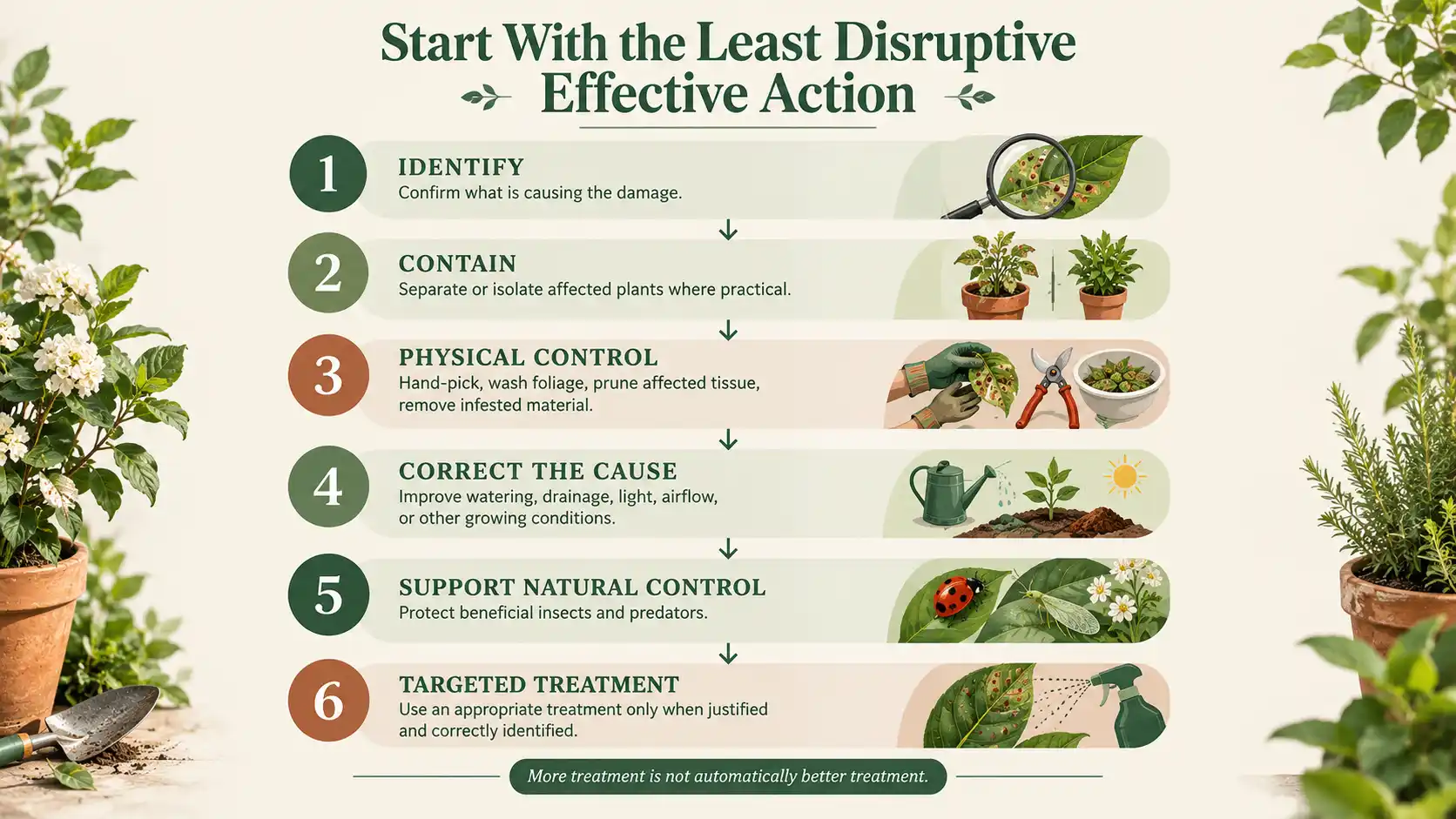
A good first response should reduce the problem while limiting unnecessary harm to the rest of the garden.
A useful framework for choosing between monitoring, prevention, physical controls, biological controls, and targeted pesticides is UC Integrated Pest Management (IPM), which emphasizes identification and monitoring before deciding whether control is necessary.
Isolate or Contain the Problem
If an indoor plant appears infested, move it away from nearby plants while you inspect it.
In an outdoor garden, physical isolation may not be realistic, but you can still:
- Remove heavily affected plant material
- Avoid moving infested leaves around the garden
- Clean tools after pruning diseased or heavily affected tissue
- Remove fallen material when appropriate
- Avoid transferring pests on hands, clothing, or tools
Containment is especially useful when the cause is confirmed or strongly suspected to be transmissible.
Remove What You Can Safely
Physical control is often overlooked because it seems too simple.
Depending on the problem, this can include:
- Hand-picking large pests
- Washing pests from foliage
- Removing heavily damaged leaves
- Pruning affected stems
- Removing infested plant material
- Using barriers
- Using appropriate traps
Physical measures can sometimes reduce pressure without exposing the entire garden to a broad treatment.
Protect Beneficial Insects
Before killing an insect, ask:
Is it actually damaging the plant?
Aphids may attract predatory insects. Caterpillars may be unwanted on a particular crop but can also form part of the food web. Bees and other pollinators may simply be visiting flowers without causing damage.
Beneficial organisms can include:
- Lady beetles
- Lacewings
- Hoverflies
- Predatory bugs
- Predatory mites
- Parasitic wasps
- Pollinators
The safest way to distinguish them is identification, not appearance alone.
For a useful introduction to beneficial versus harmful garden insects, see Common Garden Bugs Guide: 12+ Essential ID Tips.
When a Spray May Be Justified
Chemical treatment can have a place in garden management, but diagnosis should come first.
Before applying any spray:
- Identify the target as accurately as possible.
- Confirm that the proposed treatment is appropriate for that target.
- Read and follow the product label.
- Check whether the product is suitable for the plant or crop.
- Consider pollinators and other non-target organisms.
- Take extra care with edible crops.
- Avoid increasing the concentration because a problem looks severe.
- Reassess whether treatment actually worked before repeating it.
More product is not automatically more effective.
A targeted treatment applied for the wrong problem can waste time, injure plants, disrupt beneficial organisms, or leave the real cause untouched.
Common Garden Pest Groups: Use the Right Specialist Guide
Once you have established that you are dealing with a pest, the next question is which type?
The goal of this pillar is not to reproduce an entire pest encyclopedia. Its role is to route you to the right deeper resource.
Sap-Sucking Pests
Common groups include:
- Aphids
- Spider mites
- Thrips
- Scale
- Mealybugs
- Whiteflies
Typical clues can include:
- Distorted growth
- Yellow stippling
- Sticky honeydew
- Leaf drop
- Fine webbing
- Weak or stunted new growth
For the broad pest-identification framework, use Plant Pests: Identification, Control & Prevention Guide.
For confirmed spider mites, go directly to Spider Mites on Houseplants: Identify, Treat & Get Rid of Them.
For confirmed aphids on indoor plants, use Aphids on Houseplants: 8+ Proven Ways to Remove Them.
Soil and Root-Associated Pests
When insects repeatedly appear from potting soil, investigate the root zone rather than treating the foliage blindly.
Possible problems include:
- Fungus gnats
- Root-associated pests
- Soil mites
- Root mealybugs
- Other soil organisms
Remember that not every organism living in soil is a plant pest.
For indoor containers, see Bugs in Indoor Plant Soil: Identification, Treatment & Prevention.
Chewing Garden Pests
Chewing damage can come from:
- Caterpillars
- Beetles
- Slugs
- Snails
- Other leaf-chewing organisms
Look for the difference between:
fresh feeding damage and old damage that is no longer increasing.
That distinction helps determine whether the pest is still active.
For broader outdoor identification, use Common Garden Bugs Guide: 12+ Essential ID Tips.
Beneficial Bugs vs Harmful Garden Pests
One of the most useful gardening habits is learning not to equate bug with pest.
A pest is an organism that is causing unacceptable damage under the circumstances. An insect being present does not automatically make it a pest.
Beneficial Insects
Beneficial organisms can:
- Pollinate flowers
- Eat pest insects
- Parasitize pests
- Contribute to natural biological control
- Form part of the wider garden ecosystem
Predatory insects can be particularly valuable when pest populations are increasing.
Harmful or Potentially Harmful Pests
A harmful pest is more likely when there is clear evidence of:
- Feeding
- Repeated damage
- Population growth
- Plant decline
- Fruit or flower injury
- Root damage
The question is not simply “What insect is this?”
It is:
“What is this organism doing to my plant?”
Why Identification Matters Before Treatment
Correct identification can prevent several common mistakes:
- Killing beneficial insects
- Treating a disease with an insecticide
- Treating environmental stress with pesticides
- Using an inappropriate treatment
- Repeating a treatment that has not worked
- Disrupting natural predators
For practical identification and examples, see Common Garden Bugs Guide: 12+ Essential ID Tips.
Plant Problems That Look Like Pest Damage
Some of the most important garden diagnoses have nothing to do with insects.
Watering and Root Problems
Watering-related stress can produce:
- Yellow leaves
- Drooping
- Brown areas
- Leaf drop
- Slow growth
- General decline
The confusing part is that both too little and too much water can cause a plant to wilt.
Check the soil before adding more water.
If the soil is persistently wet and the plant remains wilted, inspect drainage and consider root damage rather than assuming dehydration.
For plant-specific examples, see Overwatered Coffee Plant: Symptoms, Fixes, and Care Guide and Pachira Aquatica Problems Explained: Causes & Fixes.
Light, Temperature, and Environmental Stress
Plants can respond visibly to changes in their surroundings.
Look for:
- Recent relocation
- Strong direct sun
- Sudden shade
- Cold drafts
- Heat exposure
- Air-conditioner airflow
- Heating vents
- Rapid weather changes
- Abrupt humidity changes
Ficus plants are a useful example because sudden changes in light, temperature, location, watering, or other growing conditions can contribute to leaf drop and other stress symptoms.
For that deeper plant-specific example, see Are Ficus Difficult to Take Care Of? Care Guide.
Nutrient and Fertilizer Problems
Nutrition can be involved in poor growth and abnormal foliage, but fertilizer should not be the automatic answer to every yellow leaf.
Before adding more nutrients, check:
- Root health
- Soil moisture
- Light
- Drainage
- Recent feeding
- Salt buildup
- Natural aging
If roots are damaged, adding more fertilizer may not solve the real problem.
Natural Leaf Aging and Cosmetic Damage
Some plant damage is normal.
Older leaves eventually age and decline. A few cosmetic marks may remain even after the plant has fully recovered.
Judge the plant by more than its oldest damaged leaf.
Look at:
- New growth
- Overall vigour
- Stem health
- Root condition where relevant
- Whether the problem is actively spreading
Healthy new growth after correcting the cause is often more meaningful than trying to make old damaged tissue look perfect.
Plant-Specific Problem Examples: When the Symptom Needs More Context
The same visual symptom can have different causes on different plants.
This is why plant-specific articles remain useful even when the hub has already explained the general diagnostic process.
Yellowing on Different Plants
For example, yellowing on an Aspidistra does not necessarily demand the same diagnosis as yellowing on a Syngonium.
Compare:
- Soil moisture
- Leaf age
- Light exposure
- Root condition
- Recent environmental change
- Presence of pests
For more specific cases, see Aspidistra Leaves Turning Yellow: Causes and Fixes and Syngonium Leaves Turning Yellow: Causes and Solutions.
The same principle applies throughout the garden: the symptom tells you where to investigate, not automatically what to treat.
Brown Leaves on Different Plants
Brown foliage also needs context.
A crispy margin, a soft dark patch, and a rapidly spreading lesion can represent very different problems.
Plant-specific examples include:
- Umbrella Plant Brown Leaves: Causes, Fix & Care Guide
- Chinese Money Plant Brown Leaves: Causes & Fixes
Use these guides when the affected plant matches, rather than assuming that every brown-leaf problem can be solved using the same care adjustment.
Drooping on Different Plants
Drooping can result from different combinations of soil moisture, root health, light, temperature, and plant-specific tolerance.
For a focused example, see Rubber Plant Leaves Drooping: Causes and Fixes.
The purpose of the pillar is to teach you how to interpret the symptom before you reach that plant-specific stage.
Broader Plant-Problem Troubleshooting
For plants with multiple simultaneous symptoms rather than one isolated issue, Pachira Aquatica Problems Explained: Causes & Fixes, Overwatered Coffee Plant: Symptoms, Fixes, and Care Guide, and Are Ficus Difficult to Take Care Of? Care Guide provide narrower troubleshooting routes.
These articles should complement—not replace—the diagnostic process used on this hub.
Why Garden Problems Keep Coming Back
Fixing today’s symptom is not the same as preventing the next outbreak.
Recurring problems usually have a reason.
Repeated Plant Stress
Plants under chronic stress may be more difficult to maintain and can become harder to diagnose because several symptoms appear at once.
Review whether the garden has:
- Poor drainage
- Chronic overwatering
- Severe dryness
- Poor airflow
- Unsuitable light
- Repeated temperature stress
- Nutritional problems
- Congested growth
Correcting the growing environment can sometimes reduce recurring pest or disease pressure without relying on repeated treatment.
New Plants Can Introduce Problems
New plants should be inspected before being placed alongside established plants.
Check:
- Leaf undersides
- Stems
- New growth
- Soil surface
- Drainage holes
- Signs of insects or eggs
- Unusual discoloration
For indoor plants, temporary separation can make it easier to observe symptoms before a possible infestation reaches the rest of the collection.
Garden Conditions Can Favour Pest Pressure
Pest pressure can increase when the garden consistently provides suitable food, shelter, moisture, or other favourable conditions.
Management can include:
- Appropriate watering
- Better drainage
- Removing heavily affected debris
- Avoiding unnecessary dense growth
- Encouraging natural predators
- Monitoring plants regularly
- Using barriers where appropriate
This is another reason IPM focuses on changing conditions and monitoring rather than relying on one universal treatment.
Keep a Simple Garden Problem Log
A garden log can turn recurring problems into useful information.
Record:
- Date
- Plant
- Location
- Symptoms
- Weather
- Soil condition
- Recent watering
- Fertilizer use
- Suspected cause
- Action taken
- Result
- Whether symptoms returned
A season-long record is especially useful because problems often repeat under similar environmental conditions.
It can also reveal that what seemed like several unrelated outbreaks were actually linked to one recurring factor.
When to Stop DIY and Get Expert Help
Home diagnosis is useful, but there are situations where professional input saves time and prevents unnecessary treatment.
When you cannot confidently identify the cause, the University of Minnesota Extension plant diagnostic tools provide step-by-step resources for problems caused by insects, diseases, and nonliving factors.
Get Help When the Cause Is Still Unclear
Consider getting expert help when:
- The plant is declining rapidly
- Several plants are affected without an obvious explanation
- Repeated treatments have failed
- A suspected disease is spreading
- Root or stem problems are severe
- The symptoms do not match the obvious environmental conditions
- You cannot distinguish pest damage from disease
- The plant or crop is particularly valuable
Plant diagnosis is genuinely difficult in some cases because multiple stress factors can occur simultaneously. Penn State Extension recommends seeking expert or diagnostic-clinic help when needed rather than relying solely on guesswork.
Useful Sources of Expert Help
Depending on where you live, useful options can include:
- Local university extension services
- Horticultural advisers
- Plant diagnostic clinics
- Qualified horticulture professionals
- Agricultural or government plant-health services
When contacting an expert, provide clear photographs and a concise history rather than only saying that a plant is “sick.”
What to Record Before Asking for Help
Take:
- A whole-plant photograph
- Close-up photographs of symptoms
- Images of leaf undersides
- Photos of stems and growing points
- A picture of the soil or planting area
- Notes on watering
- Recent weather details
- Recent fertilizer applications
- The date symptoms appeared
- Whether the problem is spreading
- Any treatment already attempted
This information can significantly narrow the diagnostic possibilities.
How to Prevent Garden Problems and Pest Outbreaks
The best pest-management system is not simply a shelf full of treatments.
It is a combination of plant observation, appropriate growing conditions, early detection, correct identification, and targeted intervention.
Inspect Regularly
Look at your plants often enough to notice changes while the problem is still small.
Pay particular attention to:
- New growth
- Leaf undersides
- Crowded foliage
- Plants showing recent stress
- Plants recently introduced into the garden
Early discovery gives you more options.
Monitor Before You Need to Treat
Monitoring means actively looking for change.
You can:
- Photograph affected leaves
- Inspect the same plant repeatedly
- Record pest numbers qualitatively
- Check whether new growth is affected
- Compare affected and unaffected plants
- Track whether symptoms are spreading
Monitoring also helps determine whether a treatment actually changed the problem.
Maintain Healthy Growing Conditions
Good basic plant care does not guarantee freedom from pests, but it can remove avoidable stress factors.
Maintain:
- Appropriate moisture
- Suitable drainage
- Suitable light
- Adequate air movement
- Appropriate nutrition
- Reasonable plant spacing
- Healthy root conditions
Quarantine or Separate Problem Plants Where Appropriate
For indoor collections and valuable plants, isolation can be particularly useful when a pest is suspected.
For outdoor gardens, physical separation may be limited, so focus on rapid identification and preventing the movement of infested material.
Encourage Beneficial Organisms
A garden that supports predators and pollinators has more biological activity than a garden managed around total insect elimination.
Where practical:
- Avoid unnecessary broad-spectrum treatments
- Provide suitable flowering resources
- Maintain habitat for beneficial organisms
- Learn to identify common predators
- Intervene when damage actually justifies it
The objective is not a completely insect-free garden. It is a garden where damaging populations are kept at acceptable levels.
For the broader pest-prevention framework, see Plant Pests: Identification, Control & Prevention Guide.
Garden Problem Diagnostic Checklist
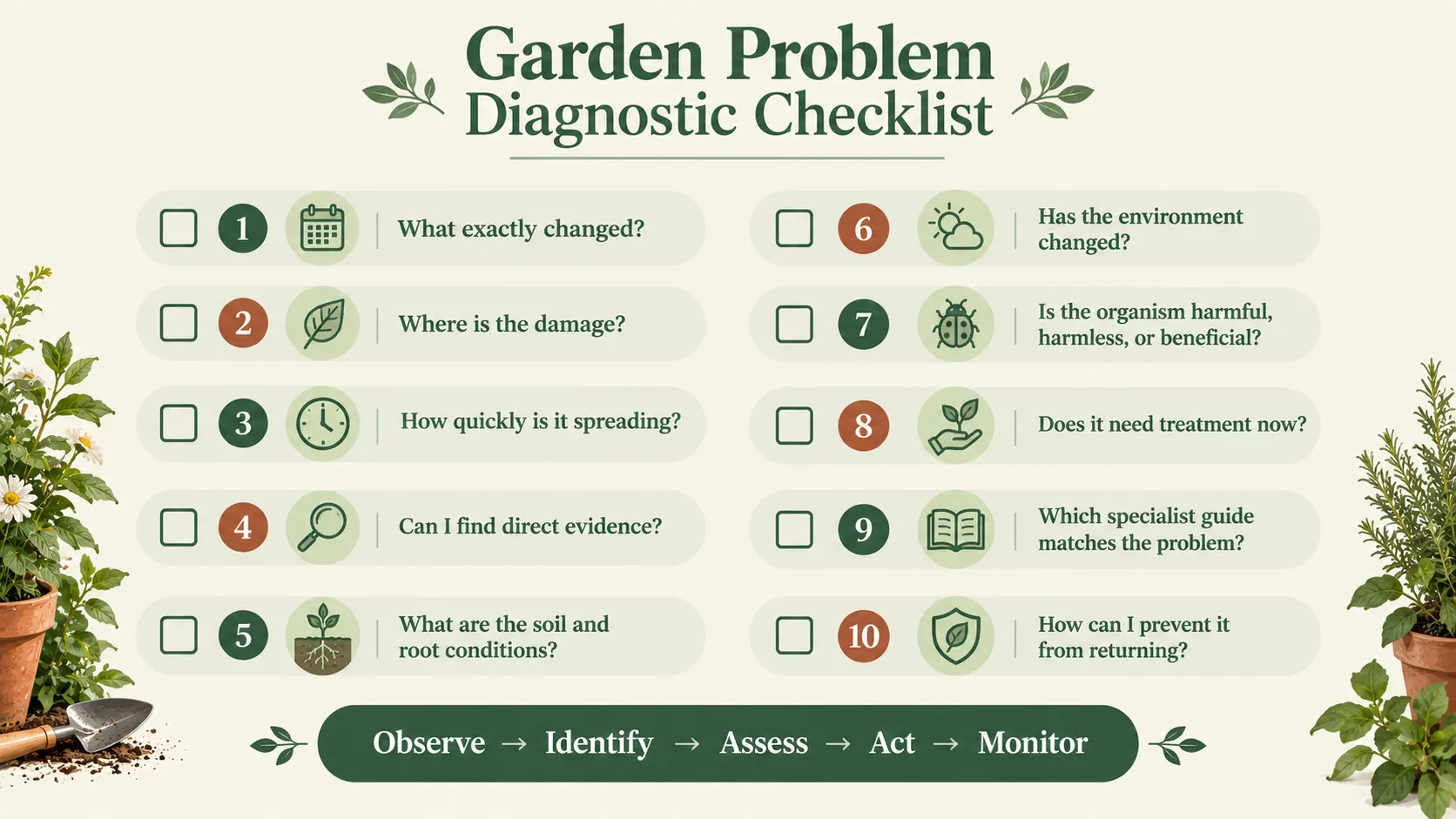
When you find a new plant problem, work through this sequence before choosing a treatment.
1. What Exactly Changed?
Write down the visible symptom.
Is it yellowing, browning, holes, curling, wilting, spotting, webbing, sticky residue, distortion, or something else?
2. Where Is the Damage?
Check:
- Old leaves
- New leaves
- Tips
- Margins
- Undersides
- Stems
- Roots
- Soil
- Flowers or fruit
3. How Quickly Is It Spreading?
Compare the affected plant with healthy nearby plants.
Ask whether the damage is stable, slowly progressing, or rapidly expanding.
4. Can You Find Direct Evidence?
Inspect closely for:
- Insects
- Mites
- Eggs
- Webbing
- Honeydew
- Frass
- Larvae
- Chewing marks
- Disease-like lesions
5. What Are the Soil and Root Conditions?
Do not skip the root zone.
Ask:
- Is the soil excessively wet?
- Is it extremely dry?
- Does water drain properly?
- Has the watering pattern changed?
- Could the roots be damaged?
6. Has the Environment Changed?
Think about:
- Weather
- Light
- Temperature
- Wind
- Humidity
- Fertilizer
- Repotting
- Pruning
- Moving the plant
7. Is the Organism Harmful, Harmless, or Beneficial?
Do not treat an unknown insect simply because it looks unpleasant.
Identify its behaviour and role first.
8. Does It Need Treatment Now?
Choose among:
Treat → Monitor → Leave Alone
based on the evidence, severity, progression, plant value, and confirmed cause.
9. Which Specialist Guide Matches the Problem?
Once the cause is narrowed down, use the relevant deeper resource:
- Pest problem → Plant Pests
- Yellowing/browning/drooping → Yellowing, Browning and Drooping
- Spider mites → Spider Mites on Houseplants
- Aphids → Aphids on Houseplants
- Soil pests → Bugs in Indoor Plant Soil
- Outdoor bug identification → Common Garden Bugs
10. What Will Prevent Recurrence?
Once the plant is recovering, look beyond the immediate symptom.
Ask:
Why did this happen here, under these conditions, at this time?
That answer is often more valuable than the treatment itself.
Conclusion: Diagnose First, Intervene Second
Garden problems become much easier to manage when you stop treating symptoms as diagnoses.
A yellow leaf does not automatically mean overwatering. A hole does not automatically identify a caterpillar. A wilted plant does not automatically need more water. A visible insect does not automatically belong in the “pest” category.
The most useful sequence is:
Observe → identify the pattern → inspect for evidence → check growing conditions → narrow the causes → assess urgency → choose the least disruptive effective action → monitor the result.
That approach protects plants from unnecessary treatments and helps you respond more intelligently when something genuinely damaging is present.
Use this page as the starting point when you do not know what is wrong. Once the cause becomes clearer, move into the specialist guide that matches the problem—whether that is Plant Pests: Identification ,Control & Prevention Guide, Yellowing, Browning and Drooping, Spider Mites on Houseplants, Aphids on Houseplants, Bugs in Indoor Plant Soil, or Common Garden Bugs.
The goal is not a garden with zero insects or zero imperfect leaves.
The goal is a garden where you can recognize problems early, understand what is actually happening, protect helpful organisms, and take the right action for the right reason.
Frequently Asked Questions
How do I tell whether my plant has a pest, disease, or watering problem?
Start by examining the symptom pattern rather than guessing the cause. Check soil moisture, drainage, recent environmental changes, affected plant parts, and the undersides of leaves. Then look for direct evidence such as insects, mites, webbing, honeydew, eggs, chewing marks, or spreading lesions. If no pest evidence is present, environmental, root, watering, nutritional, or disease-related causes deserve more attention.
What should I check first when something is wrong with my plant?
Start with the symptom itself: where it is occurring, what the damaged tissue looks and feels like, and whether the problem is spreading. Then check soil moisture, drainage, roots where appropriate, light, recent environmental changes, and the plant for visible pests or disease-like signs.
Should I treat every bug I find in my garden?
No. A visible insect is not automatically a pest. Some insects pollinate flowers or prey on organisms that damage plants. Identify the organism and determine whether it is actually causing unacceptable plant damage before deciding to intervene.
How do I know whether plant damage needs immediate treatment?
Rapid spread, repeated feeding, significant tissue loss, root damage, severe plant decline, or a confirmed pest population that is increasing can justify prompt action. Minor cosmetic damage or stable symptoms may be better suited to monitoring. The appropriate threshold depends on the plant, pest, growing conditions, and consequences of continued damage.
Can yellow leaves be caused by pests and not just watering?
Yes. Sap-feeding pests can contribute to yellowing, but yellow leaves can also result from excess moisture, insufficient moisture, poor drainage, root damage, low light, nutrition problems, natural aging, and other stresses. Yellowing should therefore be treated as a symptom to investigate rather than a diagnosis.
For a more detailed symptom framework, read Yellowing, Browning and Drooping.
What can I do about garden pests without using pesticides?
Start with accurate identification and physical or cultural controls where appropriate. Depending on the problem, options can include hand removal, washing foliage, pruning affected material, barriers, traps, improving drainage or growing conditions, and supporting natural predators. IPM emphasizes combining suitable approaches rather than relying automatically on chemical control.
How can I prevent garden pest and plant problems from coming back?
Monitor plants regularly, inspect new plants, maintain appropriate watering and drainage, reduce unnecessary plant stress, encourage beneficial organisms, remove heavily affected material when appropriate, and keep records of recurring problems. Prevention becomes much easier when you understand the conditions that allowed the problem to develop.
When should I ask a professional about a plant problem?
Seek expert help when the plant is declining rapidly, the cause remains unclear, several plants are affected, suspected disease is spreading, repeated treatments have failed, or you cannot distinguish between pest, disease, and environmental damage. Photographs and a record of the plant’s growing conditions can make professional diagnosis much easier.


One Response