
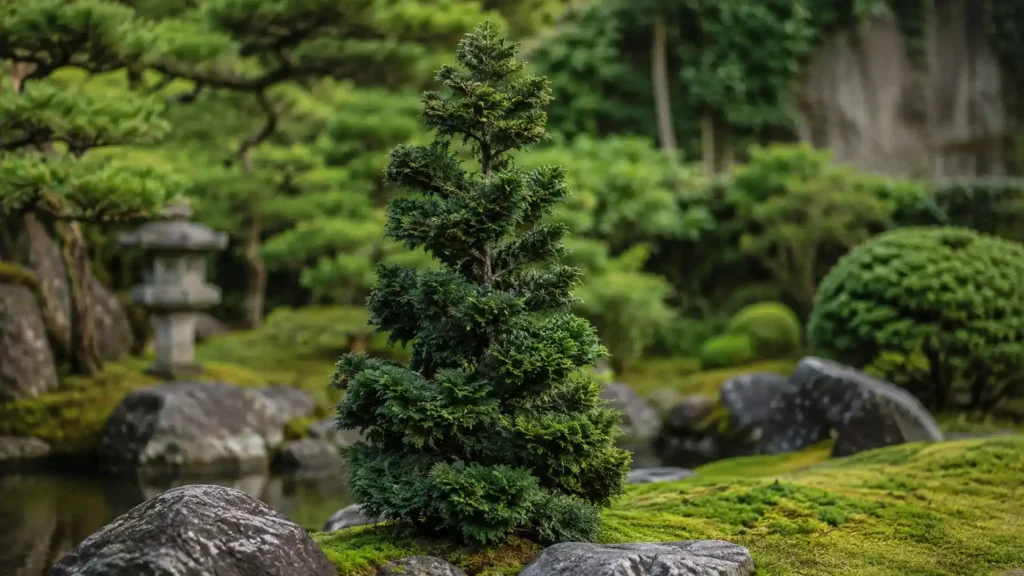
According to Manuela Nogueira, Thoweil Hinoki Cypress (Chamaecyparis obtusa ‘Thoweil’) is a slow-growing, narrow upright conifer introduced by Iseli Nursery, prized for its naturally sculpted, deep-green scalloped foliage. Hardy in USDA zones 5–8, it reaches roughly 4–6 feet tall and 1–2 feet wide over decades, thriving in full sun to partial shade.
Unlike broader dwarf Hinoki selections such as ‘Nana Gracilis,’ ‘Thoweil’ holds a slimmer columnar profile, making it well suited to tight foundation beds, container culture, and pre-bonsai training. It favors moist, well-drained, slightly acidic soil, is generally deer resistant once established, and can live 40 years or more under proper drainage.
Quick Summary
- Thoweil Hinoki cypress is a slow-growing, narrow-upright cultivar reaching about 6 feet tall and 2 feet wide after 10 years.
- Its typical growth rate is approximately 3–6 inches per year, with dense deep-green, scalloped foliage and irregular natural branching.
- It grows best in full sun to partial shade with consistently moist but well-drained soil.
- The cultivar is particularly useful as a specimen, container plant, compact landscape accent, or bonsai-training subject.
- Iseli Nursery lists ‘Thoweil’ as hardy to USDA Zone 5; the broader Chamaecyparis obtusa species is commonly rated for Zones 5–8.
What Is Thoweil Hinoki Cypress?
Chamaecyparis obtusa ‘Thoweil’ is a named cultivar of Hinoki false cypress in the cypress family, Cupressaceae. It is not a separate species. Instead, ‘Thoweil’ is a selected form of Chamaecyparis obtusa distinguished by its narrow upright habit, irregular branching, dense deep-green foliage, and relatively small mature footprint. The American Conifer Society records it as a seedling selection originating with Iseli Nursery in Boring, Oregon.
Thoweil belongs to Chamaecyparis obtusa, the species commonly known as Hinoki cypress; you can learn more about the species’ botanical background in the Chamaecyparis obtusa reference.
The cultivar was selected for its naturally sculpted appearance. Rather than developing the broad, conventional pyramidal outline associated with many conifers, Thoweil tends to form a narrow vertical silhouette with irregular branches. This makes it especially useful where a gardener wants strong year-round structure without occupying much horizontal space.
Hinoki cypress is an evergreen conifer native to Japan. The species has numerous horticultural cultivars that vary considerably in size, shape, foliage color, and texture. Extension references specifically note that dwarf cultivars are often better suited to residential landscapes than the full-size species.
The name “Hinoki” is commonly translated as “fire tree,” a reference traditionally associated with the wood’s historical use for fire and its importance in Japanese construction, including temples and shrines. The name therefore refers to the species rather than specifically to the ‘Thoweil’ cultivar.
Thoweil vs. Standard Hinoki Cypress
The main difference is form and scale. Standard Chamaecyparis obtusa is a tree species capable of becoming much larger, whereas ‘Thoweil’ is a selected dwarf, narrow-upright form.
- Thoweil: narrow, upright, irregularly branched, naturally sculpted.
- Typical species form: larger, broadly pyramidal to columnar, with spreading branches.
- Thoweil foliage: dense, deep green, and scalloped.
- Landscape footprint: substantially narrower than many larger Hinoki forms.
- Best use: compact specimen, container, small garden, or structured accent.
The American Conifer Society describes ‘Thoweil’ as a narrowly upright, naturally sculpted selection with dense deep-green scalloped foliage.
Tree or Shrub?
Thoweil is best thought of as a dwarf conifer cultivar with a shrub-like landscape scale, although its parent species is a true evergreen tree. The distinction depends on whether the question refers to the species or the cultivar.
Hinoki cypress can develop into a substantial tree, while dwarf cultivars are deliberately selected for smaller forms. The Morton Arboretum therefore lists Hinoki cypress within both tree and shrub landscape categories, reflecting the wide variation among cultivars.
Thoweil Hinoki Cypress Size and Growth Rate
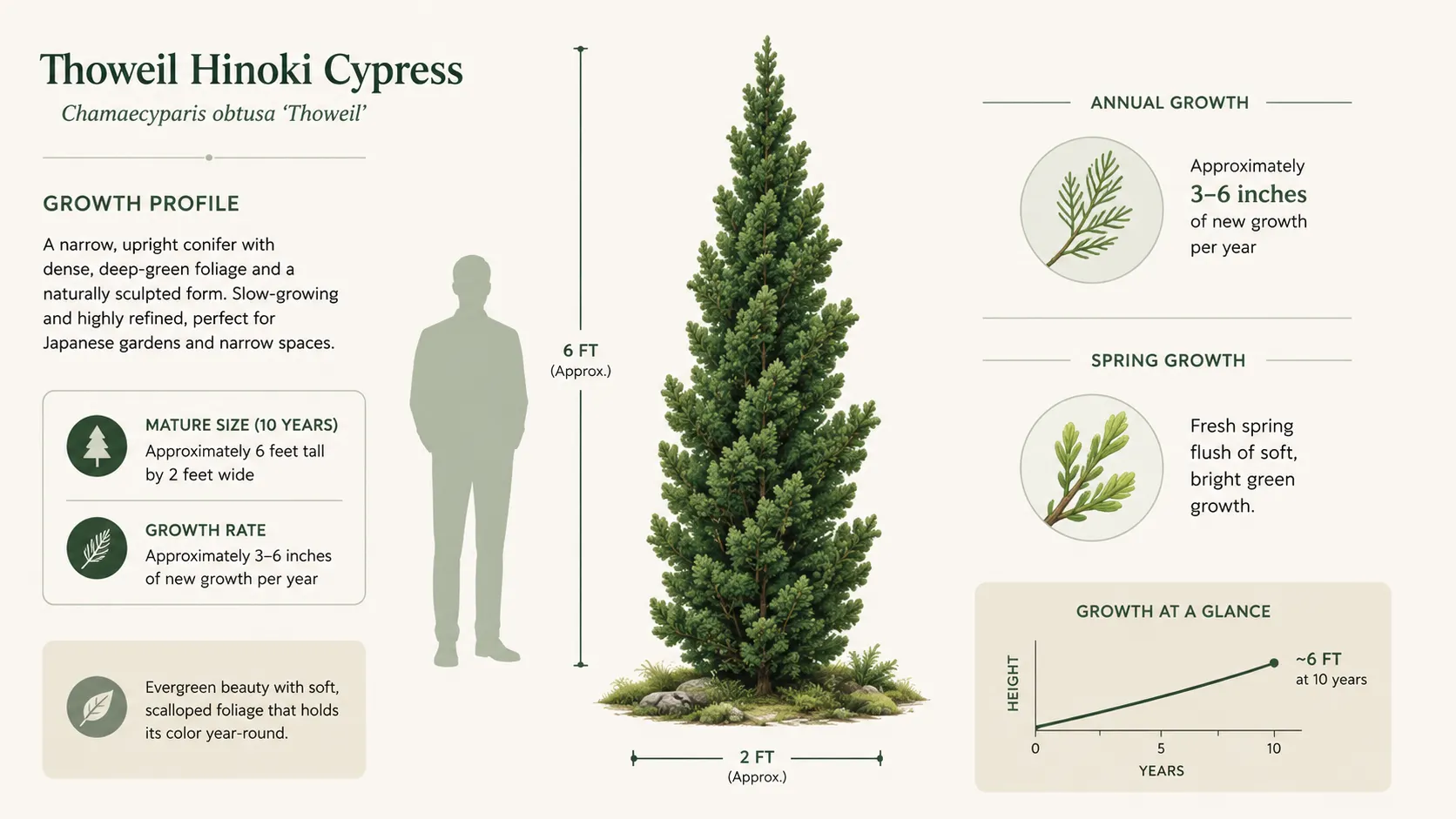
Thoweil Hinoki cypress is a slow-growing conifer with a particularly narrow mature form. The American Conifer Society records a 10-year size of approximately 6 feet tall by 2 feet wide and an annual growth rate of about 4–6 inches. Iseli Nursery gives the same garden-size dimensions and describes its growth as 3–6 inches per year.
This slow growth is important when planning a landscape. Thoweil is useful where a permanent narrow accent is desired, but it is not an appropriate choice when rapid screening or immediate height is the priority.
How Big Does Thoweil Hinoki Cypress Get?
A well-grown Thoweil Hinoki cypress can reach approximately 6 feet tall and 2 feet wide after 10 years. Individual plants can vary according to climate, soil, light, root space, watering, and nursery conditions.
Container-grown specimens generally remain smaller because the root system has less room and the plant experiences greater environmental constraints. However, a container does not permanently prevent growth; regular root management and appropriate repotting may eventually be necessary.
For landscape planning, its narrow width is one of its strongest characteristics. It can occupy a relatively small planting area while still providing vertical evergreen structure.
How Fast Does It Grow?
Thoweil grows approximately 3–6 inches per year, making it a slow-growing conifer.
Growth is generally strongest during the active growing season, particularly in spring and early summer when adequate moisture, warmth, and sunlight support new shoot development. Growth may slow considerably during stressful periods such as drought, extreme heat, transplant recovery, or winter dormancy.
Factors that can influence its growth rate include:
- Amount and intensity of sunlight
- Soil drainage and root health
- Consistent moisture availability
- Nutrient availability
- Container versus in-ground cultivation
- Heat, drought, and transplant stress
| Cultivar | General Habit | Foliage Character | Approximate Scale | Useful Landscape Role |
| Thoweil | Narrow upright | Deep green, dense, scalloped | About 6 ft × 2 ft at 10 years | Specimen, container, small garden |
| Kosteri | Rounded to spreading | Green, textured | Dwarf to compact | Rock gardens, accents |
| Verdoni | Upright | Golden-yellow to green | Larger than many dwarf forms | Color accent, specimen |
| Mariesii | Upright/spreading | Green with contrasting new growth | Medium | Specimen, foundation planting |
| Fernspray | Upright, irregular | Fine, fern-like texture | Medium to large | Specimen, Japanese gardens |
| Butterball | Compact, rounded | Yellowish new growth | Compact | Small gardens, containers |
Cultivar size can vary by source and growing conditions, so the listed dimensions should be treated as planning estimates rather than guaranteed maximums.
Is Thoweil Hinoki Cypress Good for Bonsai?
Yes. Thoweil Hinoki cypress can be useful bonsai or pre-bonsai material, but ‘Thoweil’ is not itself a bonsai species. It is a landscape cultivar whose naturally compact growth and irregular branching can be adapted to bonsai training. Hinoki cypress cultivars in general are recognized as popular bonsai subjects.
Its value for bonsai comes primarily from its structure rather than from an inherent “bonsai” classification. A gardener can train a suitable young specimen into a miniature tree through controlled pruning, wiring, root management, and long-term development. For comparison, Chinese elm is another popular bonsai subject where pruning, branch structure, and controlled long-term growth are central to developing the desired form.
The same principles of controlled growth, structural pruning, and long-term form development are important when caring for other bonsai specimens as well.
What Makes It Suitable for Bonsai Training
Several characteristics make Thoweil interesting for bonsai work:
- Naturally irregular branching: provides structural material for styling.
- Slow growth: makes the overall form easier to maintain.
- Dense foliage: creates visual mass on a relatively compact plant.
- Narrow upright habit: lends itself to upright and formal compositions.
- Small foliage: helps maintain proportion in miniature designs.
However, pruning should be conservative. Hinoki cypress generally does not respond well to severe cuts into old, leafless wood, so bonsai development should preserve viable foliage and branches rather than relying on aggressive cutting followed by regrowth.
Where to Plant Thoweil Hinoki Cypress
The best planting location provides adequate sunlight, reliable moisture, excellent drainage, and protection from severe environmental stress. Iseli Nursery recommends sun to partial shade, while Virginia Cooperative Extension lists Hinoki false cypress for full sun to part shade with average moisture and acidic soil conditions.
Thoweil is especially appropriate for locations where its vertical form can be appreciated from multiple angles. Iseli specifically recommends it as a feature specimen and notes its suitability as a container specimen.
For more guidance on selecting suitable plants and understanding their growing requirements, see our comprehensive Plants: Benefits and Guides resource.
Sun and Soil Requirements
Thoweil performs best with substantial sunlight, although partial shade can be appropriate.
- Light: Full sun to partial shade.
- Soil: Moist but well drained.
- Preferred reaction: Slightly acidic conditions are generally suitable.
- Moisture: Consistent moisture without prolonged saturation.
- Drainage: Essential for healthy roots.
The key distinction is between moist soil and wet soil. Hinoki cypress appreciates available moisture but can suffer when roots remain in poorly drained conditions. Virginia Tech recommends average moisture and acidic soil, while the RHS describes Chamaecyparis obtusa as suited to moist but well-drained soil.
In very hot climates, some afternoon protection can reduce heat and moisture stress, particularly for young or recently transplanted plants.
Spacing Considerations
Spacing depends on whether Thoweil is being used as an individual specimen, foundation accent, informal screen, or container plant.
For a specimen, leave enough surrounding space to preserve its narrow architectural outline. For closely planted accents or informal screening, plants may be positioned closer together, but spacing should account for their eventual width rather than their nursery size.
Because a mature specimen is only about 2 feet wide after 10 years according to the American Conifer Society, it can be useful in narrow beds where wider shrubs would overwhelm the available space.
Thoweil Hinoki Cypress Care Guide
Thoweil Hinoki cypress is relatively low maintenance once established, but its long-term health depends heavily on correct planting conditions. The most important care principles are consistent moisture, good drainage, sufficient light, and restrained pruning.
Watering Needs
Hinoki cypress needs moderate, consistent moisture rather than constantly wet soil. Newly planted specimens require regular watering while their roots establish, especially during warm or dry weather. Virginia Tech notes that Hinoki false cypress requires irrigation during periods of drought.
A practical approach is to check the soil before watering rather than following a rigid calendar.
Water when the upper soil begins to dry, then irrigate deeply enough to moisten the root zone. Reduce unnecessary watering during cool, wet weather.
Choosing plants according to drainage conditions is especially important in difficult sites, although Thoweil itself prefers consistently moist soil that remains well drained rather than permanently waterlogged.
Avoid two extremes:
- Allowing a newly planted tree to remain severely dry for extended periods.
- Keeping heavy clay or poorly drained soil saturated.
A layer of organic mulch around, but not directly against, the trunk can help moderate soil moisture and temperature.
Light and Soil Preferences
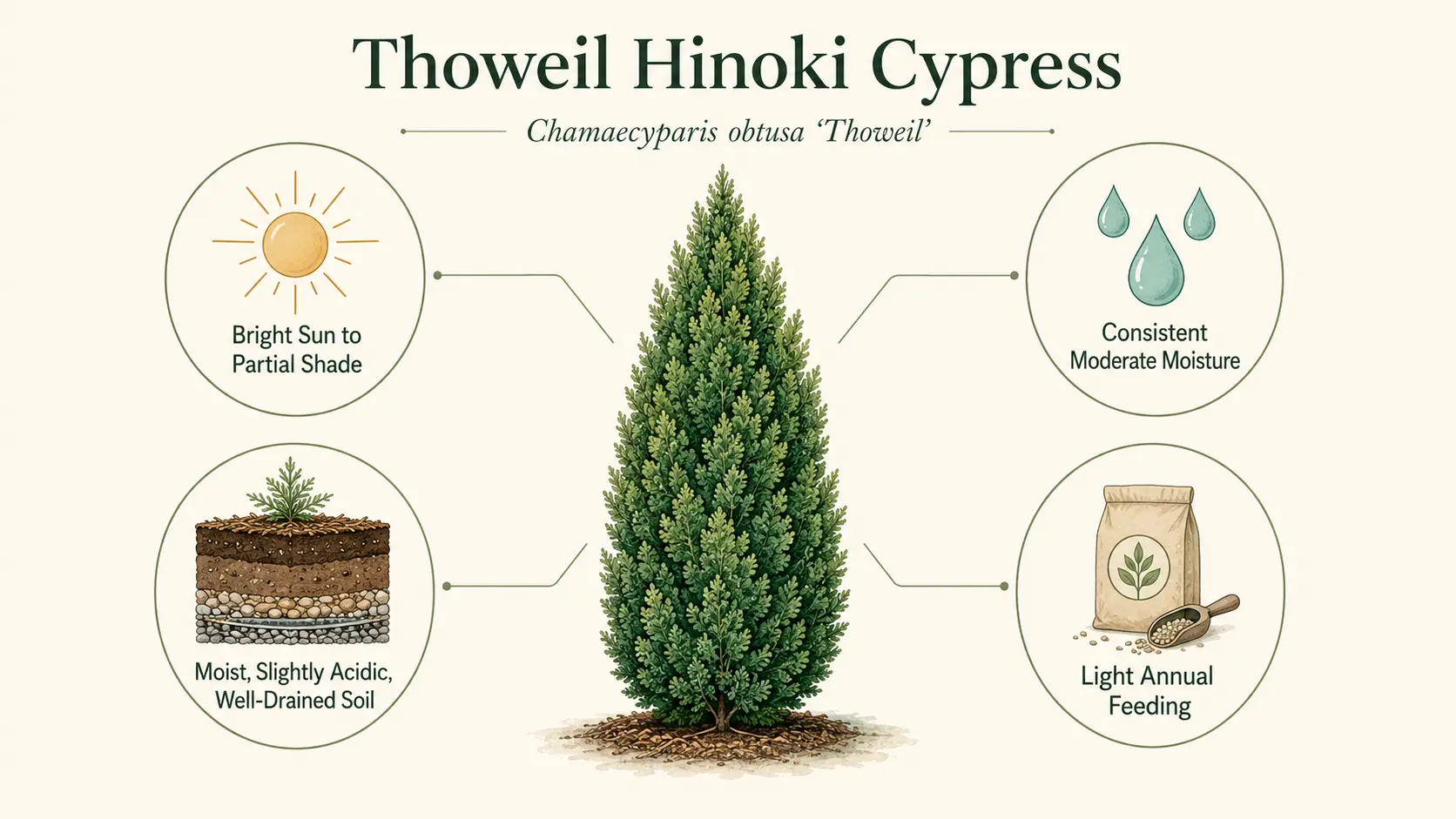
Full sun to partial shade is appropriate. More sunlight generally supports dense growth, while excessive shade can reduce vigor and contribute to interior foliage loss.
The soil should retain some moisture while draining efficiently. Slightly acidic soil is particularly suitable, although the species has some adaptability to different soil types.
If the planting site contains heavy clay, improve drainage before planting rather than attempting to compensate later with excessive watering adjustments.
Fertilizing and Pruning
Because Thoweil is naturally slow growing, it generally does not require aggressive fertilization. A soil test can determine whether nutrients are actually deficient. If fertilization is needed, a balanced slow-release fertilizer applied according to its label can be appropriate during active growth.
Pruning should be conservative.
- Remove dead or damaged branches.
- Correct obvious structural problems while growth is young.
- Avoid routine shearing that destroys its naturally sculpted form.
- Avoid cutting deeply into old, bare wood.
- Do not remove the growing tip simply to force a smaller plant.
The question “Can I cut the top off my cypress?” requires caution with Hinoki cypress. Severe topping can permanently damage the natural form, and old, leafless sections may not readily produce replacement growth. The safest approach is gradual structural pruning while preserving green foliage.
Climate Tolerance and Zones
There is an important distinction between the species hardiness rating and the specific cultivar listing.
Virginia Tech rates Hinoki false cypress generally for USDA Zones 5–8. However, Iseli Nursery currently lists Chamaecyparis obtusa ‘Thoweil’ as Zone 5.
For that reason, gardeners should use the cultivar-specific nursery rating when making a planting decision and consider local exposure. A plant at the edge of its hardiness range may need more protection from drying winter winds, extreme heat, or abrupt temperature changes.
Common Problems With Thoweil Hinoki Cypress
Most problems with Thoweil can be traced to environmental stress, poor drainage, inappropriate pruning, or pests and diseases. Browning does not automatically mean the plant is dying.
Why Is My Hinoki Cypress Turning Brown or Yellow?
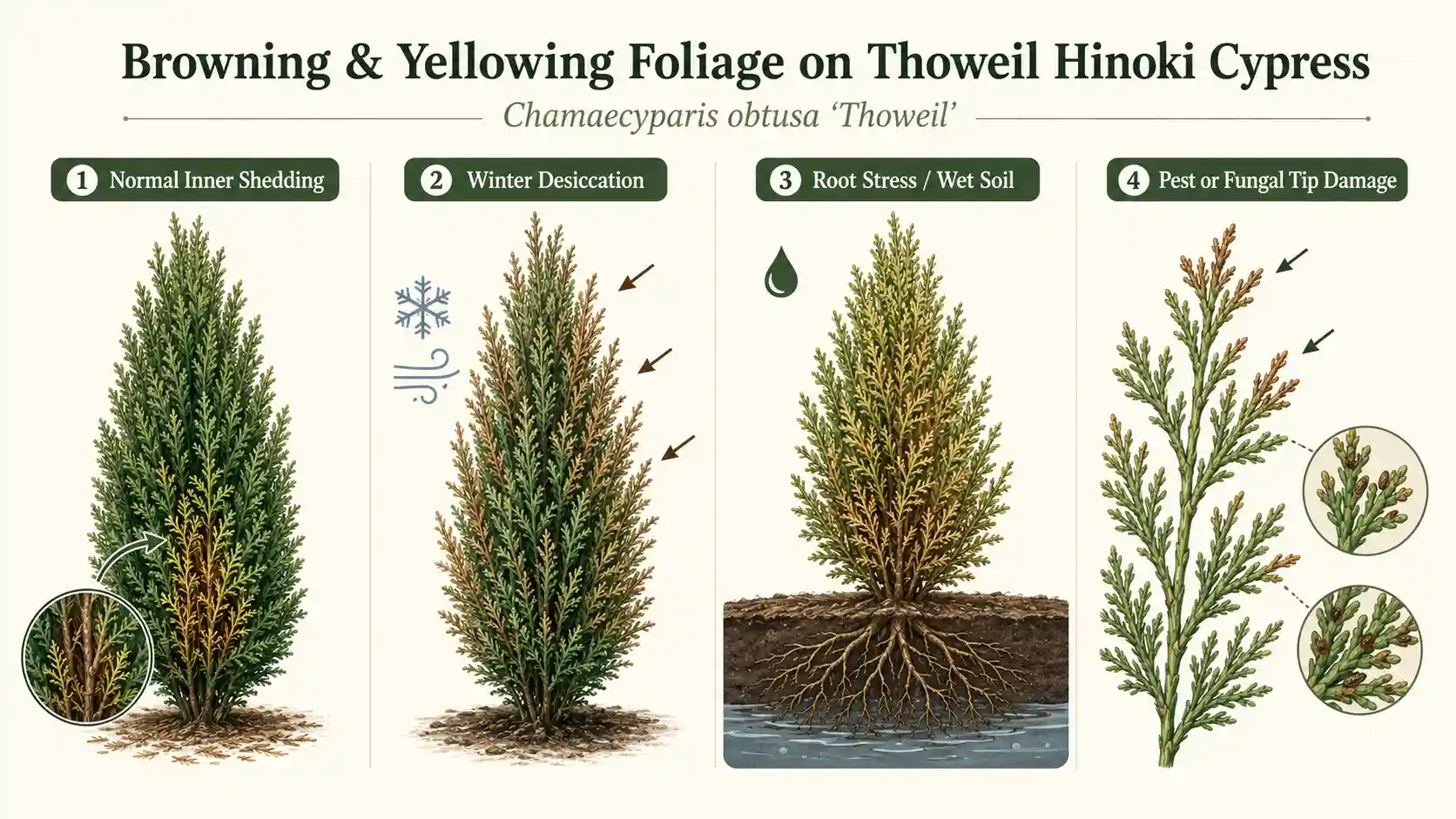
Brown or yellow foliage can result from normal aging, winter stress, root problems, fungal disease, or pests. The location and pattern of discoloration are important diagnostic clues. Correct pest identification is important because browning foliage can have several causes, and distinguishing sap-feeding insects from environmental stress helps determine the appropriate response.
Normal inner-needle shedding: Evergreen conifers still shed older foliage. If browning is concentrated inside the plant while newer outer growth remains healthy, seasonal aging may be responsible.
Winter desiccation: Cold wind can remove moisture from foliage faster than roots can replace it. Watering adequately before the ground freezes and providing protection from severe drying winds can reduce stress.
Fungal tip or shoot problems: Browning concentrated on new shoots or branch tips may indicate a disease problem. Different cypress diseases can produce overlapping symptoms, so diagnosis should be based on the pattern, affected tissue, and local disease conditions rather than assuming one pathogen.
Root problems: Whole-plant yellowing, declining vigor, and persistent moisture around the root zone can indicate drainage-related root stress. Hinoki cypress is known to have susceptibility to root rot and certain blight problems.
Scale insects: Sap-feeding scale insects can cause localized discoloration and reduced vigor. Inspect stems and foliage closely for small, stationary insects or scale coverings before treating.
The most useful troubleshooting sequence is:
- Check whether browning is limited to older interior foliage.
- Inspect the soil moisture and drainage.
- Look for pests on stems and foliage.
- Examine new shoots for localized damage.
- Consider recent weather extremes or transplanting.
- Remove clearly dead material and correct the underlying stress.
Slow or Stunted Growth
Slow growth is partly normal because Thoweil is genetically a slow-growing cultivar. The expected rate is only about 3–6 inches annually.
Growth that is substantially weaker than expected may result from:
- Too much shade
- Root disturbance after transplanting
- Poor drainage
- Prolonged drought
- Nutrient deficiency
- Severe heat or cold stress
- Root restriction in a container
Do not respond to slow growth by automatically adding large amounts of fertilizer. Correcting light, water, drainage, and root conditions is usually more important.
Thoweil Hinoki Cypress vs. Other Cultivars
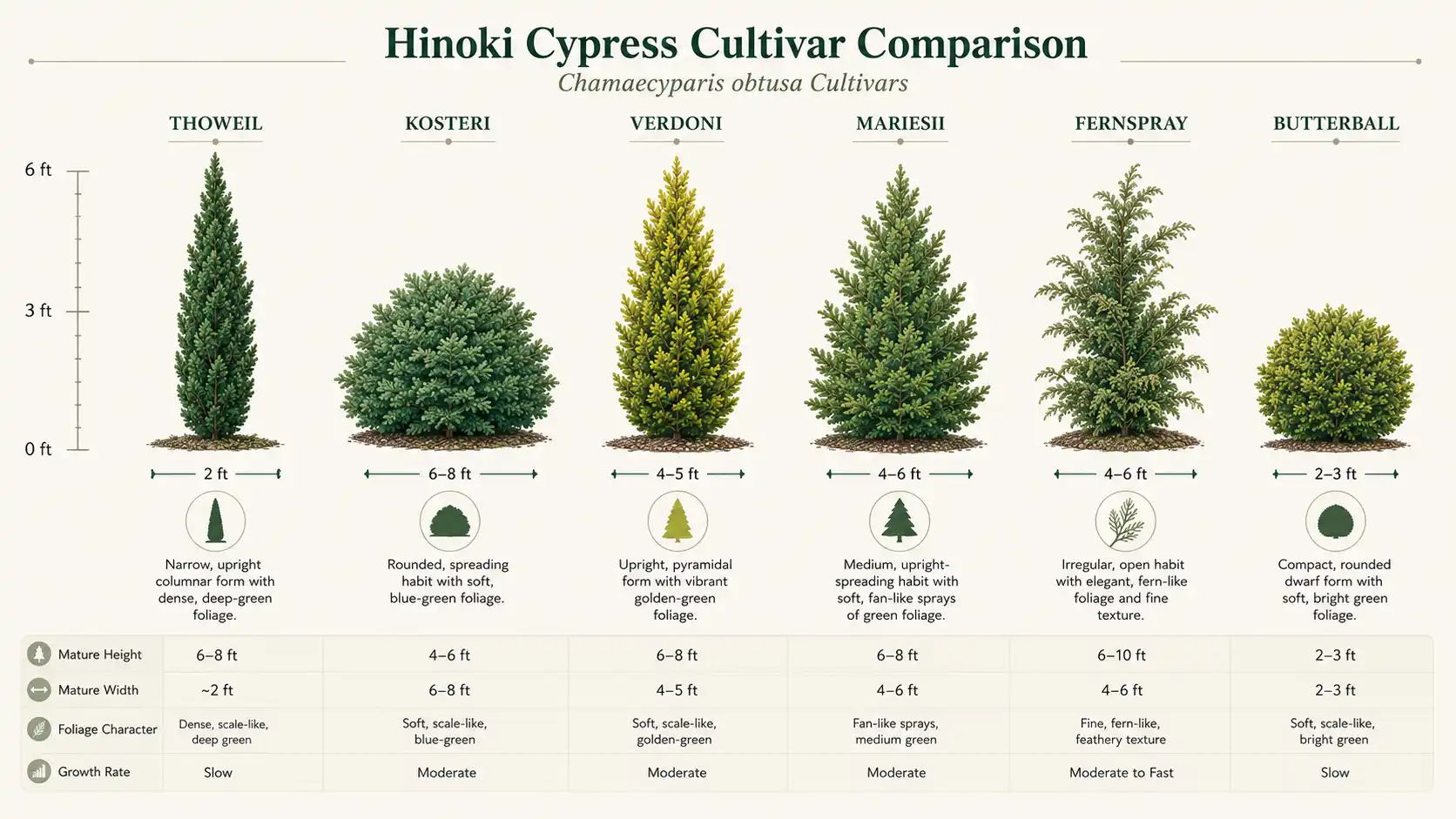
Hinoki cypress has an unusually broad cultivar range, so comparing cultivars by habit, size, and foliage is more useful than treating every dwarf Hinoki as interchangeable. North Carolina Extension notes that Chamaecyparis obtusa has many cultivars differing in size, form, color, and texture.
| Cultivar | Habit | Color/Texture | Relative Size | Best Landscape Use |
| Thoweil | Narrow upright | Deep green, dense, scalloped | Dwarf | Narrow specimen, container |
| Kosteri | Rounded/spreading | Green, textured | Dwarf | Rock gardens, low accents |
| Verdoni | Upright | Golden-green | Compact to medium | Color contrast |
| Mariesii | Upright/spreading | Green, textured | Medium | Specimen or foundation |
| Fernspray | Upright, irregular | Fine, fern-like | Medium to larger | Specimen, Japanese-style garden |
| Butterball | Rounded/compact | Yellow-green new growth | Compact | Small gardens and containers |
Exact mature dimensions vary with cultivar source and growing conditions, so these categories are most useful for choosing a general form rather than predicting a precise final size.
Thoweil vs. Kosteri Hinoki Cypress
Thoweil is the better choice when the goal is a narrow vertical silhouette. Kosteri is generally associated with a more rounded or spreading dwarf form.
The distinction matters in small gardens. A narrow plant can fit against a wall, in a foundation bed, or beside a path where a wider shrub would consume too much horizontal space.
Thoweil vs. Verdoni and Fernspray
Thoweil emphasizes deep green foliage and compact upright architecture. Golden-toned cultivars such as Verdoni offer stronger color contrast, while Fernspray types are valued for finer, more fern-like foliage texture.
Choose Thoweil when form and dark evergreen color are the priorities; choose a golden or fine-textured cultivar when foliage color or texture is the main design objective.
Pros and Cons of Growing Thoweil Hinoki Cypress
Thoweil has several qualities that make it useful in small landscapes, but its slow growth and sensitivity to poor growing conditions should be considered before planting.
Pros
- Slow growth means relatively low long-term pruning requirements.
- Narrow form fits small planting spaces.
- Evergreen foliage provides year-round structure.
- Naturally sculpted branching adds visual interest.
- Suitable for containers and specimen planting.
- Can provide useful material for bonsai training.
- Deer resistance is commonly associated with many Hinoki cypress plantings.
- Long-lived conifers can provide structure for many years when correctly sited.
Cons
- Slow growth means it takes years to gain substantial size.
- Poor drainage can cause serious root problems.
- Severe pruning can permanently damage the natural form.
- It may require irrigation during drought.
- Heat and drying conditions can be stressful near the warm edge of its growing range.
- Specialty dwarf cultivars can cost more than common landscape conifers because they are slower to produce and less widely propagated.
The higher price of a specialty Hinoki cultivar is therefore not necessarily a sign of superior performance; it can reflect slower nursery production, limited availability, and the additional time required to produce a desirable specimen.
What Pairs Well With Thoweil Hinoki Cypress
Thoweil works particularly well with plants that contrast with its fine evergreen texture and upright form. It can anchor Japanese-inspired gardens, rock gardens, foundation beds, and container compositions.
Good companion categories include:
- Japanese maples: broad leaves create strong texture contrast.
- Dwarf mondo grass: provides a low, grass-like foreground.
- Moss: reinforces a cool, woodland or Japanese garden appearance.
- Azaleas: provide seasonal flowers against the evergreen foliage.
- Other dwarf conifers: create layered evergreen structure.
- Low-growing groundcovers: soften the base without competing with its vertical silhouette.
When combining plants, avoid surrounding Thoweil with aggressive, fast-growing species that will quickly shade or crowd its narrow canopy.
Beginner Mistakes to Avoid
The most common mistakes are usually related to planting conditions and pruning rather than complicated care requirements.
- Planting in heavy, poorly drained clay: correct drainage before planting.
- Overwatering “just in case”: moisture is important, but saturated roots are harmful.
- Cutting into bare old wood: preserve green foliage when pruning.
- Topping the plant: this destroys its naturally narrow structure and may leave permanent bare areas.
- Ignoring sunlight: excessive shade can reduce vigor and foliage density.
- Expecting fast growth: 3–6 inches per year is normal for this cultivar.
- Ignoring climate limits: use the cultivar-specific hardiness information when possible.
- Planting too close to competing shrubs: its narrow mature width still requires enough light and root space.
- Using fertilizer as the solution to every growth problem: first check light, water, drainage, and root health.
Conclusion
Thoweil Hinoki cypress is a slow-growing, narrow-upright cultivar of Chamaecyparis obtusa that combines compact size with naturally sculpted branching and dense deep-green foliage. Its approximately 6-foot-by-2-foot size after 10 years makes it particularly useful for small landscapes, containers, specimen plantings, and selected bonsai-training projects.
The two most important factors for long-term success are correct siting and restrained pruning. Give Thoweil adequate sunlight, consistent moisture, and well-drained soil, then allow its naturally slow growth and distinctive structure to develop without aggressive shearing. For climate planning, remember that Iseli Nursery lists the cultivar as Zone 5, while broader references for the species commonly extend through Zone 8.
FAQs
Is Thoweil Hinoki cypress the same as regular Hinoki cypress?
No. Thoweil Hinoki cypress is a specific cultivar, Chamaecyparis obtusa ‘Thoweil’, while regular Hinoki cypress generally refers to the species Chamaecyparis obtusa. ‘Thoweil’ was selected for its narrow upright habit, deep-green foliage, irregular branching, and compact size.
How big will a dwarf Hinoki cypress get?
The size depends on the cultivar. Thoweil reaches approximately 6 feet tall and 2 feet wide after 10 years under suitable conditions, according to the American Conifer Society and Iseli Nursery. Other dwarf Hinoki cultivars can be substantially smaller, wider, or more rounded.
Do Hinoki cypress turn brown in winter?
Yes, Hinoki cypress can develop brown foliage during winter because of cold, drying winds, root-zone stress, or other environmental problems. Some interior older foliage can also naturally age and drop. Widespread or rapidly progressing browning should be investigated for drainage, moisture, pests, disease, or winter injury rather than assumed to be normal.
Does Hinoki cypress have invasive roots?
Hinoki cypress is not generally considered an invasive-root tree in the way some aggressively spreading plants are. However, its roots still require adequate soil volume and drainage, particularly when the plant is grown in a container or confined planting bed. The bigger concern is usually poor drainage and root health rather than invasive root spread.
How long does it take for Thoweil Hinoki cypress to reach mature size?
Thoweil grows slowly at approximately 3–6 inches per year. The American Conifer Society records a specimen at about 6 feet tall and 2 feet wide after 10 years, so reaching its characteristic landscape size takes years rather than a few growing seasons. Actual growth varies with light, moisture, soil, climate, and root conditions.
Can Thoweil Hinoki cypress be grown in a container long-term?
Yes. Thoweil is particularly well suited to container cultivation because of its narrow, slow-growing habit, and Iseli Nursery specifically identifies it as a suitable container specimen. Long-term container culture requires excellent drainage, appropriate watering, periodic root assessment, and protection from extreme temperature fluctuations. The plant should not be kept permanently waterlogged or allowed to become severely root-bound.