
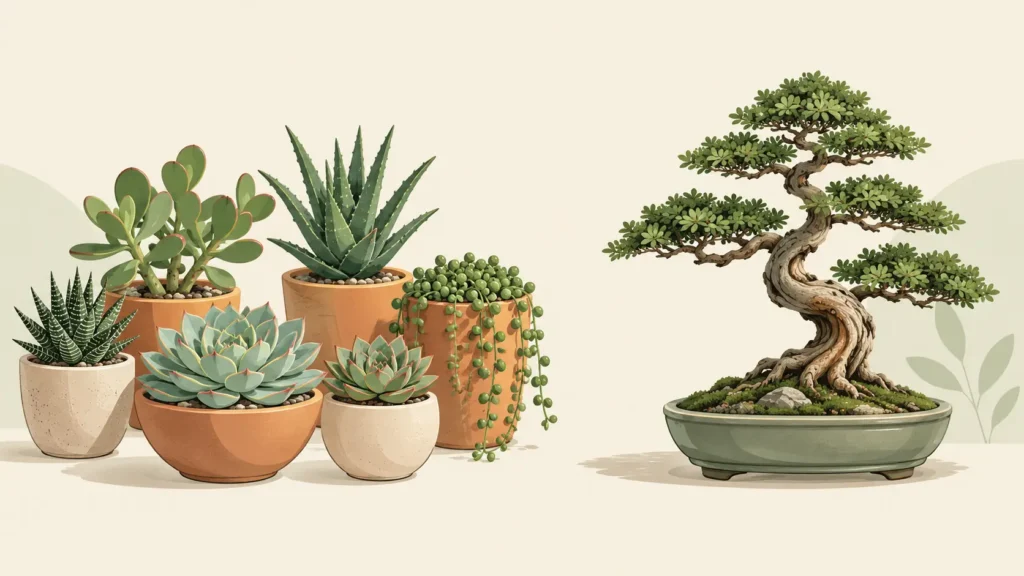
If you’ve ever browsed plant accounts online, you’ve probably noticed that succulents and bonsai keep showing up in the same breath — small, sculptural, seemingly effortless, and endlessly photogenic on a windowsill. But the two aren’t the same thing, and treating them as interchangeable is one of the fastest ways to accidentally kill either one.
A succulent is a type of plant — anything that stores water in thick leaves, stems, or roots. Bonsai is a technique — a way of training a woody tree to grow in miniature over years of careful pruning and shaping. One describes what a plant is; the other describes what you do to it. That distinction matters more than it sounds like it should, because it’s the root of almost every piece of conflicting care advice you’ll find online — including the increasingly popular (and increasingly misunderstood) idea of growing a “succulent bonsai.”
This guide exists to sort all of that out in one place: what each plant style actually is, how their care differs, whether and how they can genuinely overlap, which species are worth knowing in each category, and how to decide what’s right for your space. Along the way, we’ll point you to our full Succulent Care and ID guide and complete guide to bonsai for the deeper dives — this page is the map, not the whole territory.
Quick Summary
- A succulent is defined by water-storing tissue in its leaves, stems, or roots — it’s a plant type, not a single species or family.
- Bonsai is a training method applied to woody perennial trees to keep them miniature and shaped — it’s a technique, not a species.
- Certain succulents — especially Portulacaria afra and Crassula ovata (jade) — can be trained using bonsai-style pruning and shaping, but this is meaningfully different from a “true” bonsai and carries its own risks, particularly brittle stems and rot at wound sites.
- Succulent care revolves around infrequent, deep watering and fast-draining soil; bonsai care revolves around regular pruning, wiring, and more consistent moisture in a shallow pot.
- Day to day, most beginners find succulents lower-effort; bonsai demands more ongoing attention and a longer-term commitment to shaping.
- Both plant styles are prized for the same reason: they deliver a big visual impact in a small footprint.
What Is a Succulent? What Is a Bonsai?
Before comparing the two, it’s worth being precise about what each word actually means — because a lot of the confusion online starts with people using them as if they were parallel categories.
Succulent is a broad, purely descriptive term. It refers to any plant that has evolved thickened, fleshy tissue — usually in the leaves, but sometimes in the stem or roots — to store water for use during dry periods. This trait shows up independently across dozens of unrelated plant families: cacti, agaves, sedums, aloes, sansevierias, and even some orchids and euphorbias all qualify as succulents despite having little else in common botanically. In other words, “succulent” tells you something about a plant’s physiology, not its family tree.
Bonsai, by contrast, isn’t a plant at all — it’s a horticultural art form. The word describes the practice of growing a woody, perennial tree or shrub in a shallow container and using deliberate pruning, wiring, and root management to keep it small while making it look like a full-sized, aged tree in miniature. Almost any woody species with the right growth habits can theoretically become a bonsai; what makes it a bonsai is the technique applied over years, not the species itself.
This is why the two terms aren’t really opposites or even a clean comparison — one is about plant biology, the other is about a cultivation style. The comparison only gets interesting when you ask whether a plant that qualifies as a succulent can also be trained using bonsai technique. (Short answer: sometimes — more on that below.)
For a full identification walkthrough of what counts as a succulent, see our Succulent Care and ID guide. For the complete history, styling philosophy, and technique library behind the art form, see our complete guide to bonsai.
Succulents vs. Bonsai: How They’re Different (and Where They Overlap)
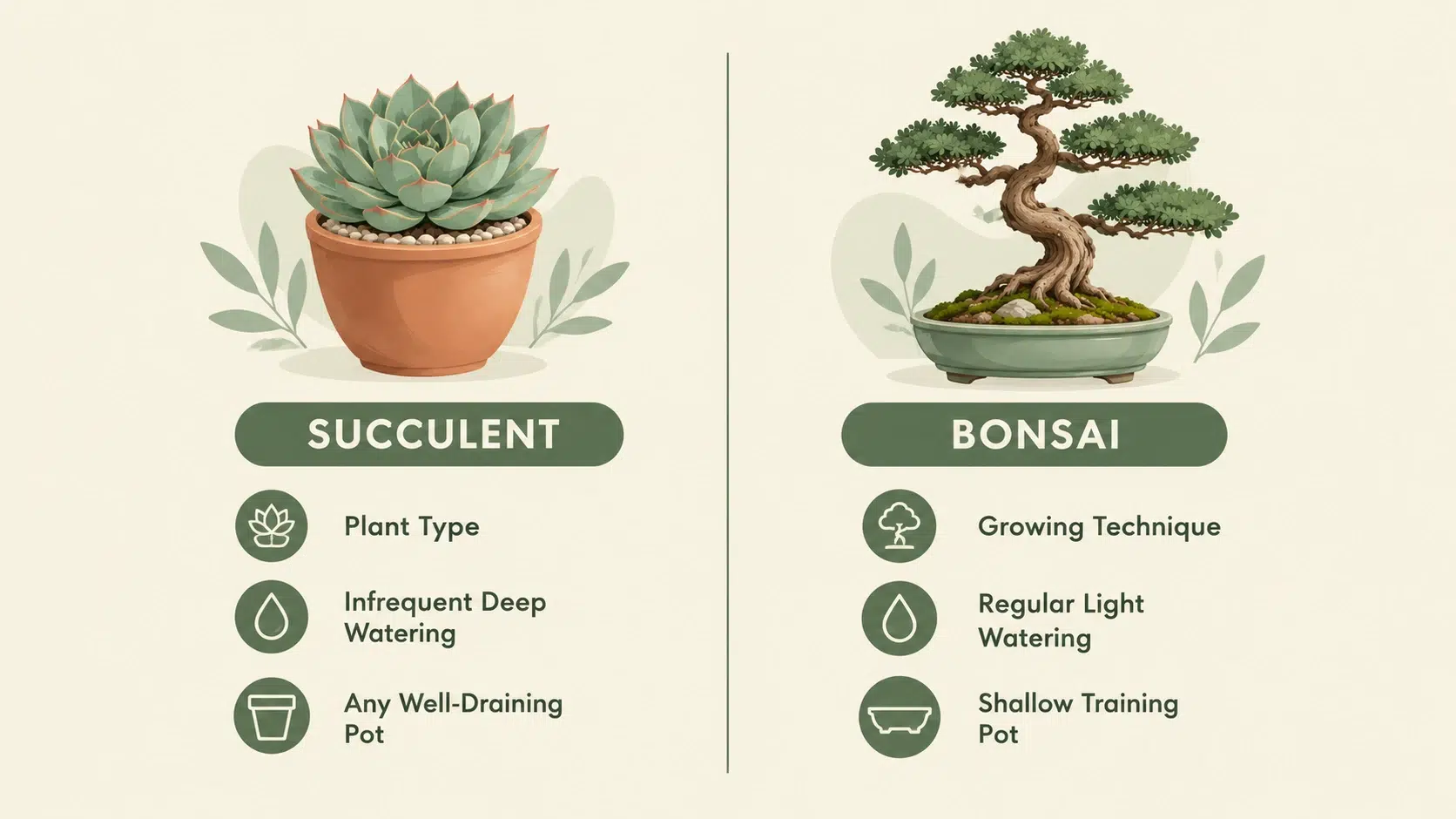
Here’s the side-by-side comparison most other articles gloss over — because “succulent” and “bonsai” aren’t actually two branches of the same tree, the comparison has to account for the fact that you’re comparing a plant category to a growing technique.
| Succulents | Bonsai | |
| What it is | A plant type (any species storing water in leaves/stems/roots) | A training technique applied to woody trees |
| Typical care difficulty | Low to moderate | Moderate to high |
| Watering pattern | Infrequent, deep soak-and-dry cycles | More frequent, consistent light watering |
| Pot style | Any well-draining pot; depth varies by species | Shallow, wide bonsai pot (restricts root growth deliberately) |
| Growth speed | Varies; many are slow to moderate | Deliberately slowed and shaped over years to decades |
| Ongoing maintenance | Occasional repotting, propagation, pest checks | Regular pruning, periodic wiring, careful root pruning at repotting |
| Primary goal | Healthy, attractive plant; often collected for variety | A living sculpture that evokes a mature, full-sized tree |
| Lifespan as a “project” | Can be enjoyed immediately | Often a multi-year to multi-decade practice |
Where the two genuinely overlap: both favor fast-draining soil over consistently soggy conditions, both are popular precisely because they stay compact, and both reward patience over quick results. That overlap is exactly why some growers try to apply bonsai technique to succulent species — which is its own topic, covered in detail further down this page.
Succulent Care Fundamentals
If you’re starting from scratch with succulents, three things drive almost everything else: how you water them, what light and soil they get, and which species you pick to begin with.
Watering Succulents the Right Way
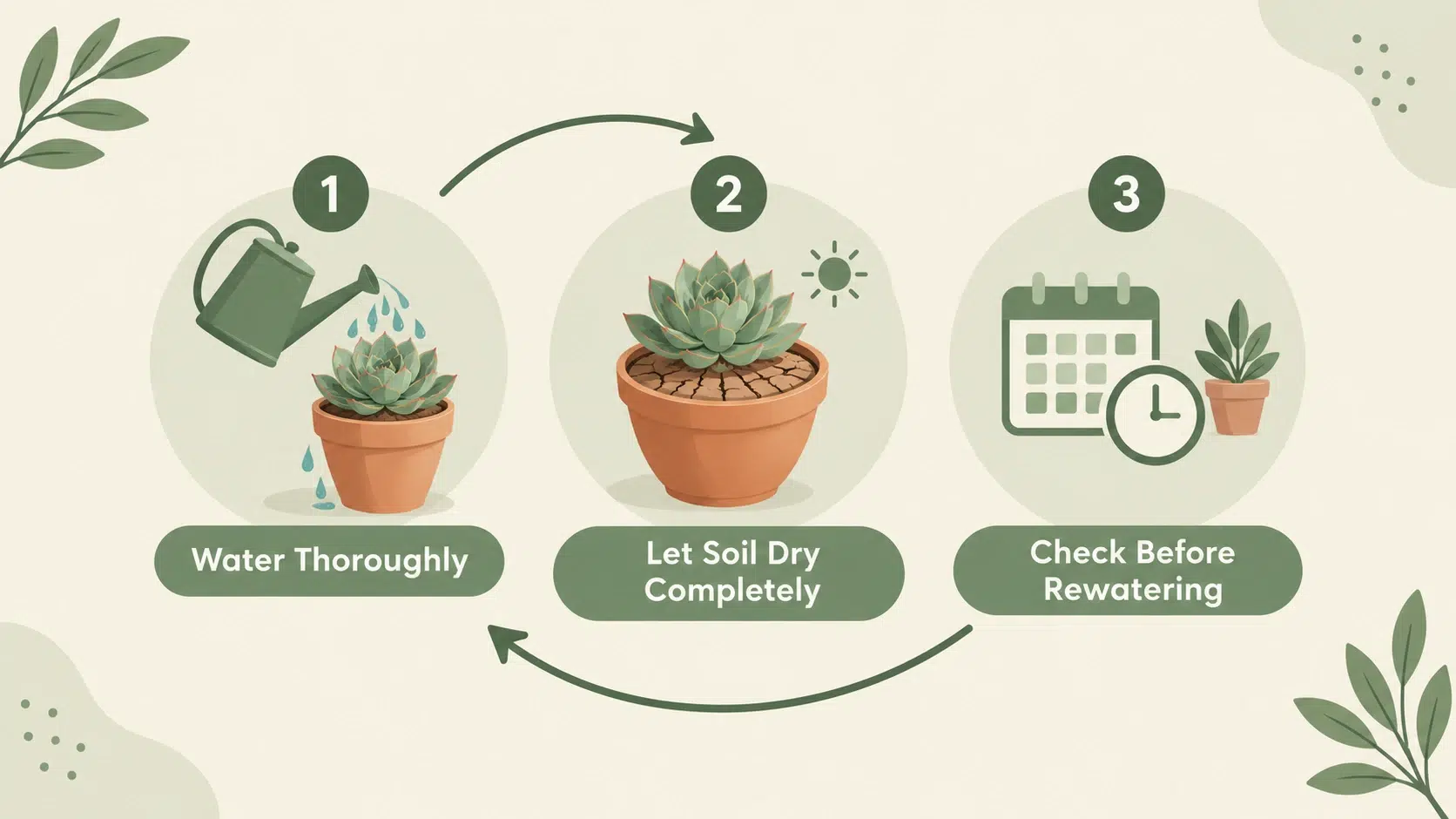
More succulents die from overwatering than from any other single cause, and it’s rarely subtle — mushy, translucent, or blackened leaves and stems are the telltale signs of root or stem rot setting in. The core principle is a “soak and dry” cycle: water thoroughly until it runs through the drainage hole, then let the soil dry out completely before watering again. How often that works out to in practice depends on your climate, pot material, light level, and the specific species — which is exactly why we’ve broken it down separately in our full guide to how often to water succulents, including seasonal adjustments and how to read your plant’s own signals rather than following a fixed schedule.
Light, Soil, and Potting Basics
Most succulents want bright light — often several hours of direct or strong indirect sun daily — and will stretch, pale, or grow leggy if they don’t get enough. Soil should be fast-draining and gritty; a dedicated cactus/succulent mix, or a standard potting soil cut with perlite or coarse sand, is the standard starting point. Whatever pot you choose, a drainage hole isn’t optional — it’s the single easiest way to prevent the rot that overwatering causes in the first place. For species-specific light and soil preferences, our Succulent Care and ID guide covers the full range in more depth.
As a general baseline, the Missouri Botanical Garden’s Kemper Center fact sheet notes that cacti and succulents generally need at least four hours of bright, direct light daily to stay healthy and compact rather than stretched and leggy.
Best Succulents for Beginners
If you’re choosing your first succulent, look for species that are genuinely forgiving of a missed watering, tolerant of average household light, and slow enough growing that you won’t be repotting every few months. Not every popular succulent fits that description — some of the most Instagram-famous varieties are actually fussier than they look. We’ve put together a full breakdown of the best succulents for beginners if you want species-level recommendations before you buy.
Bonsai Care Fundamentals
Bonsai care asks more of a grower than succulent care does, mainly because the entire point of the practice is active shaping rather than passive maintenance.
Pruning, Shaping, and Wiring Basics
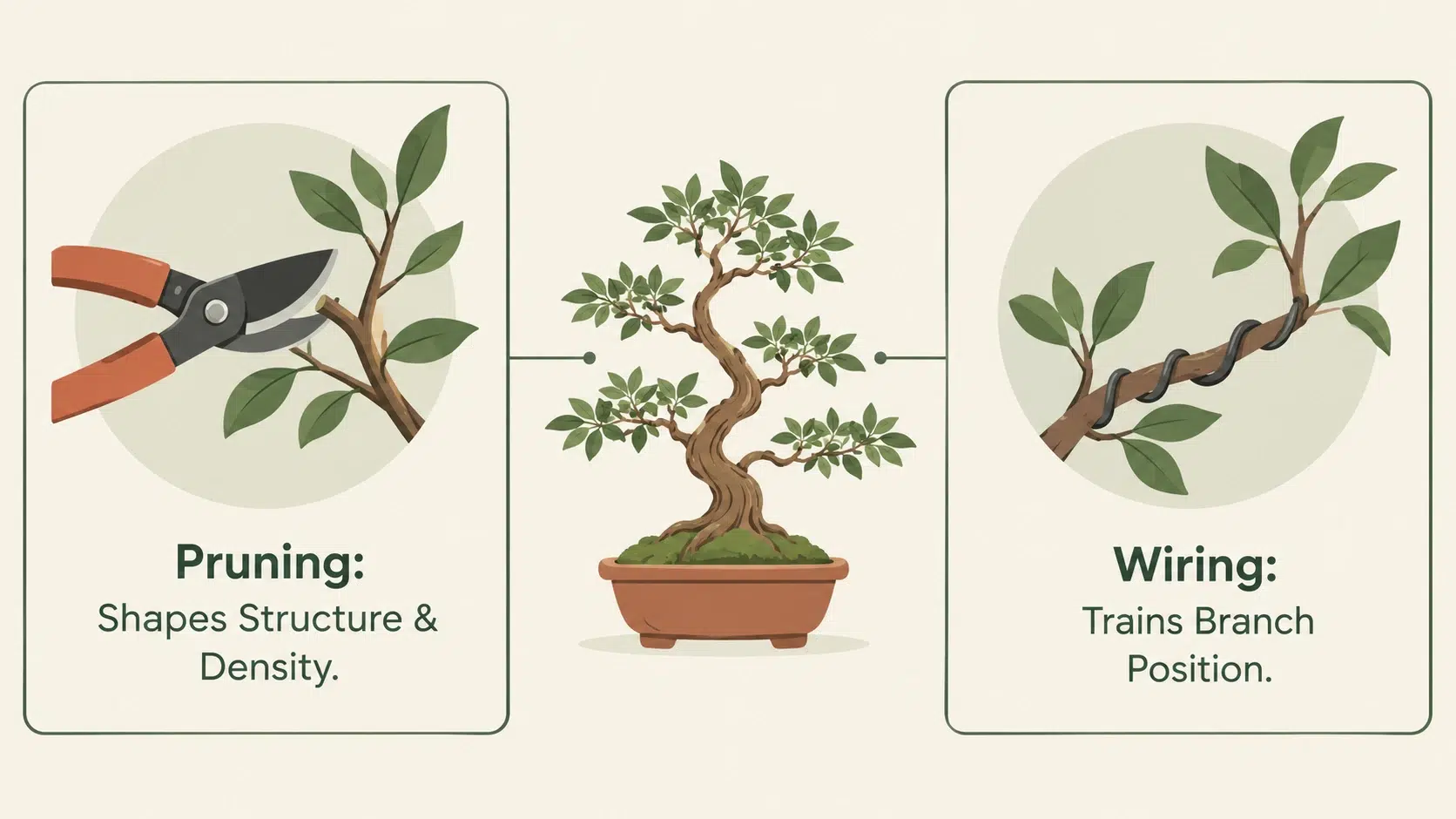
Pruning is what actually makes a bonsai a bonsai — without it, you just have a small tree in a shallow pot. Regular pruning controls the tree’s size, encourages the dense branching that gives mature bonsai their characteristic silhouette, and directs energy toward the trunk and structure you want to develop. Wiring is a complementary technique: copper or aluminum wire is wrapped around branches to gently bend them into a desired position while they’re still flexible enough to hold the new shape once the wire is removed. Both techniques take practice to do without stressing or injuring the tree, which is why we’ve dedicated a full, step-by-step resource to it in our complete bonsai pruning guide.
Pruning demands also change as a tree matures — the RHS notes that a young bonsai typically needs pruning about once a year to establish its shape, while an established tree requires pruning and trimming several times a year to stay balanced.
Choosing a Bonsai Species
Almost any woody perennial with small leaves, flexible young growth, and a tolerance for root pruning can become a bonsai candidate, but some species are far more forgiving for beginners than others. Traditional outdoor species like pines and elms are classic choices with centuries of technique built around them, while a handful of tropical species have become popular “starter” bonsai because they tolerate indoor conditions and recover well from pruning mistakes. There’s also a smaller, newer category worth knowing about: certain succulents can be trained using bonsai principles, which blurs the line between the two plant styles covered on this page — and deserves its own closer look.
Can You Grow Succulents as Bonsai?
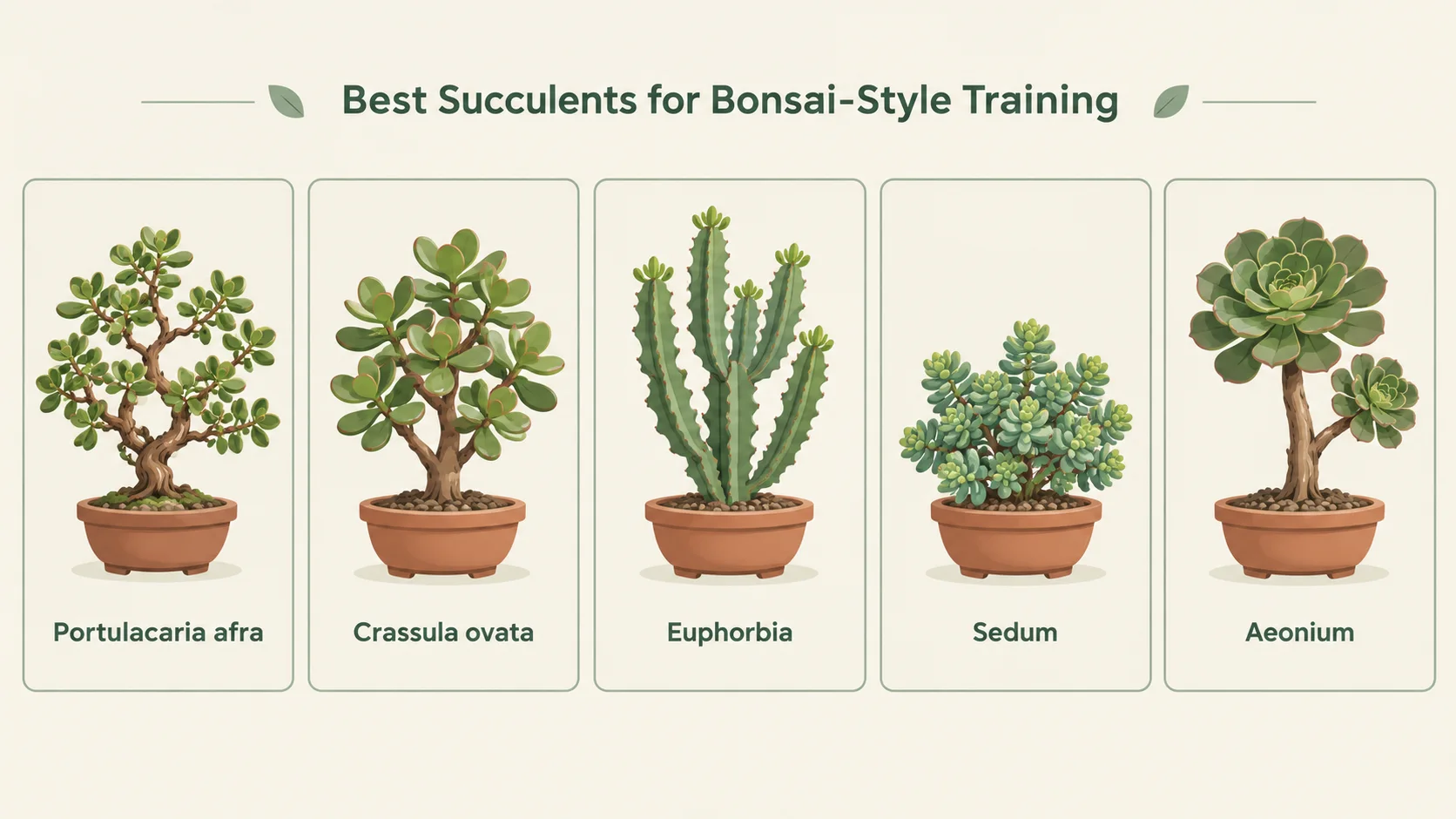
Yes — with an important caveat. A small number of succulent species can be trained using bonsai-style pruning and shaping to develop a thick, aged-looking trunk and a miniature tree-like silhouette. But there’s a meaningful difference between a true bonsai (a woody perennial trained according to bonsai principles) and a succulent styled to look like bonsai — and most articles on this topic blur that line rather than clarifying it.
If you’re seriously considering training a succulent this way, our closest existing guide covers one of the best species for it in detail: ripple jade bonsai care. For a broader look at species difficulty levels beyond the ones covered here, the Brooklyn Botanic Garden’s guide to succulent bonsai groups suitable plants into beginner, intermediate, and advanced categories based on how demanding their care is.
The appeal is easy to understand: succulents used for this style typically need far less water than traditional bonsai species, tolerate the restricted root space of a shallow pot reasonably well, and can develop genuinely striking swollen, gnarled trunks that read as “ancient” far faster than a woody tree would. The species most commonly used this way include:
- Portulacaria afra (elephant bush, sometimes sold as “dwarf jade” or used for “ripple jade” bonsai) — widely considered the most forgiving and fastest to develop a convincing trunk
- Crassula ovata (jade plant) — a classic choice, slower to thicken than Portulacaria but very tolerant of pruning
- Select Euphorbia species — striking, architectural forms, though some varieties have irritating sap that requires careful handling
- Certain Sedum varieties — smaller-scale, better suited to more delicate styling
- Aeonium — valued for dramatic rosette form at the branch tips rather than trunk thickness alone
What most general succulent-care advice glosses over is that pruning and wiring a succulent is not the same exercise as doing it to a woody tree. Succulent stems are far more brittle and prone to snapping than they look, and any cut or wound is a direct entry point for rot in a way that’s less forgiving than it is on true bonsai wood. Getting this right — along with a realistic sense of how long it actually takes to develop a convincing trunk (this is a multi-year project, not a weekend one) — is enough of its own topic that it deserves a dedicated, step-by-step resource rather than a summary paragraph here. If you’re seriously considering training a succulent this way, our closest existing guide covers one of the best species for it in detail: ripple jade bonsai care.
Popular Succulent Species to Know
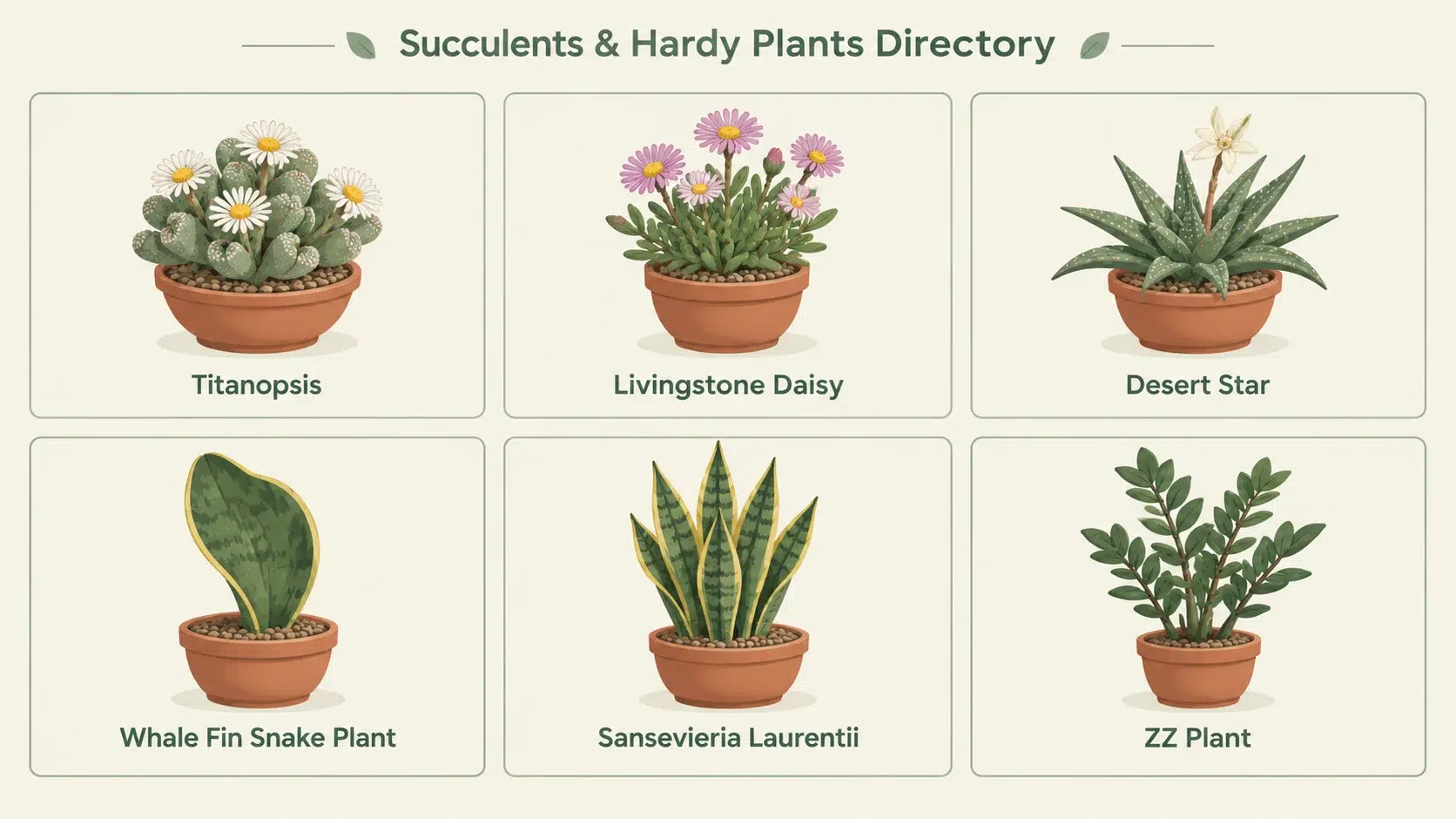
Succulents span several unrelated plant families, which is part of why identification trips people up so often. Here’s a quick orientation to the species covered in depth elsewhere on this site.
Mesemb and Flowering Succulents
The mesemb family (Aizoaceae) includes some of the most visually unusual succulents grown today. Titanopsis calcareum is a stone-mimicking rosette succulent that blends into rocky terrain in its native habitat. Dorotheanthus bellidiformis, commonly called the Livingstone daisy, is a low-growing, flowering succulent ground cover known for its vivid, daisy-like blooms. And the desert star plant is prized for a distinctive, uncommon flower form that sets it apart from more common succulent varieties.
Rose of Jericho — And the Plant Often Confused With It
“Rose of Jericho” is actually used to describe two entirely different plants — a true resurrection plant and an unrelated species sold under the same common name — and the mix-up causes real confusion about care requirements, since the two aren’t botanically similar. We’ve untangled the difference in a dedicated comparison: rose of Jericho vs. false rose of Jericho.
Sansevieria and Other Architectural Succulents
Sansevierias are some of the most popular low-light-tolerant succulents grown indoors, prized for their bold, upright, architectural form. The whale fin snake plant grows as a single broad, paddle-shaped leaf rather than the more familiar clustered rosette. Sansevieria ‘Fernwood Mikado’ produces distinctive cylindrical, upward-fanning leaves, while Sansevieria laurentii is the classic striped, upright variety most people picture when they hear “snake plant.”
ZZ Plant: A Succulent-Adjacent Favorite
The ZZ plant (Zamioculcas zamiifolia) stores water in thick underground rhizomes rather than in its leaves, which is why it’s frequently grouped with succulents and low-maintenance plants even though it’s botanically distinct from most of the species on this list. It’s an easy addition to a succulent-style plant collection for anyone who wants the same low-water, low-fuss profile with a very different look.
Popular Bonsai Species to Know
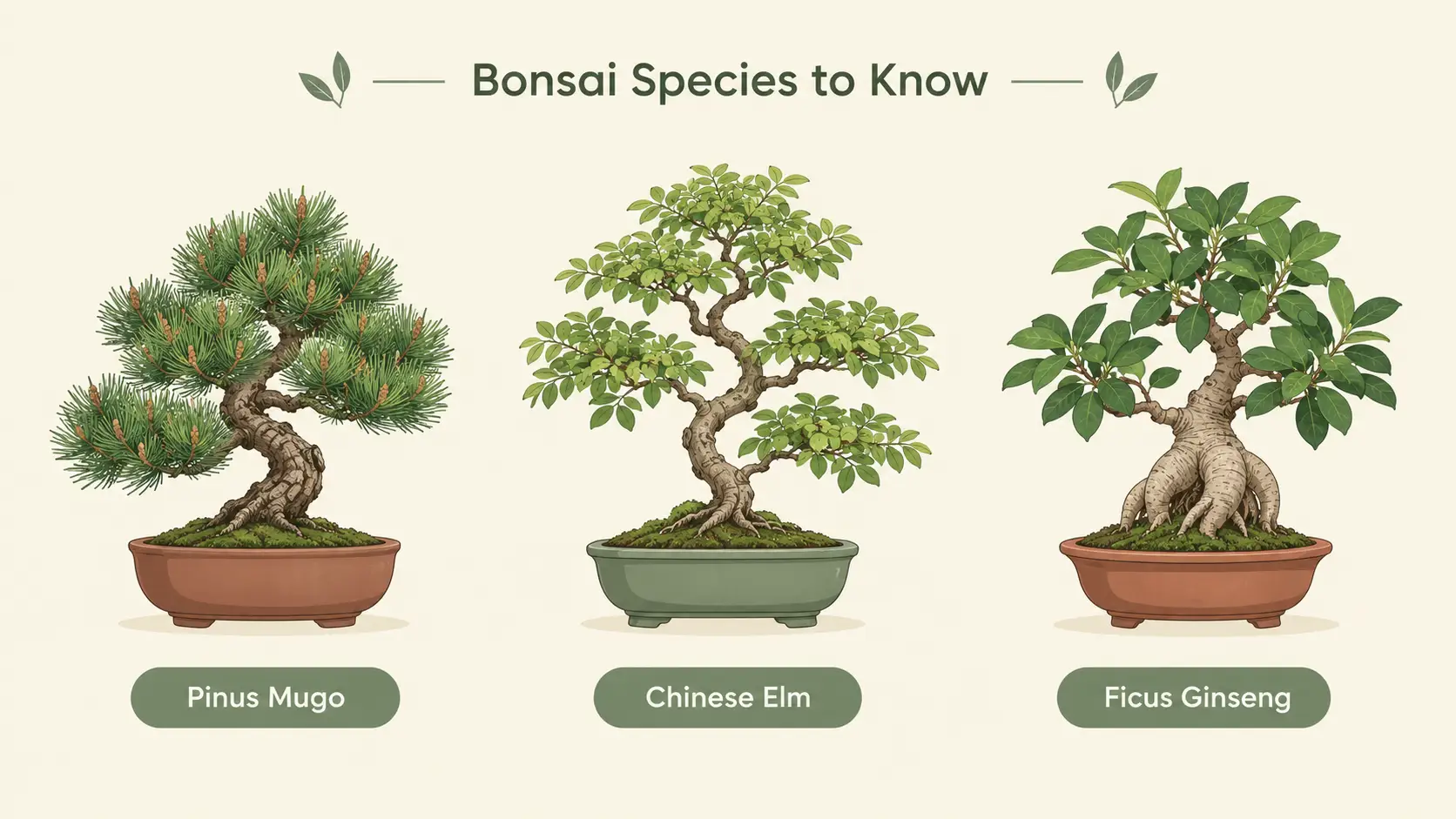
Bonsai spans a much wider range of tree families than succulents do, since almost any suitable woody species can be trained this way. These are the species most worth knowing as a starting point.
Outdoor and Traditional Bonsai Species
Pinus mugo (mountain pine) bonsai represents the classic outdoor conifer approach to bonsai, with dense needles and a rugged, weathered trunk character that develops beautifully over time. The Chinese elm is one of the most forgiving species for growers transitioning between outdoor and indoor conditions, and its tolerance for pruning mistakes makes it a frequent recommendation for anyone moving beyond their first bonsai.
Indoor-Friendly and Beginner Bonsai
The Ficus ginseng bonsai is one of the most widely recommended first bonsai trees, thanks to a thick, distinctive aerial-root trunk that looks striking even on a young specimen, combined with genuine tolerance for the lower light and humidity of an average home. For growers who want an even lower-maintenance entry point and are comfortable exploring outside traditional woody species, the succulent-based approach covered above — particularly Portulacaria afra — offers a comparable “easy starter bonsai” experience from an entirely different plant family.
Do Succulents and Bonsai Have Symbolic Meaning?
Bonsai carries centuries of cultural association, particularly in Japanese tradition, with patience, harmony, balance, and the passage of time — since a tree’s shape is quite literally the record of years of deliberate care. In some traditions and popular belief, bonsai are also associated with good fortune, though how strongly that belief holds and where it comes from is worth its own explanation rather than a one-line claim. Succulents carry a lighter but related symbolism in some cultures, often tied to resilience and endurance, given how well they survive in conditions that would kill less hardy plants. If you’re curious whether the good-luck association with bonsai has any real basis, we cover it fully in are bonsai trees good luck?
Succulents, Bonsai, or Both? Choosing What’s Right for Your Space
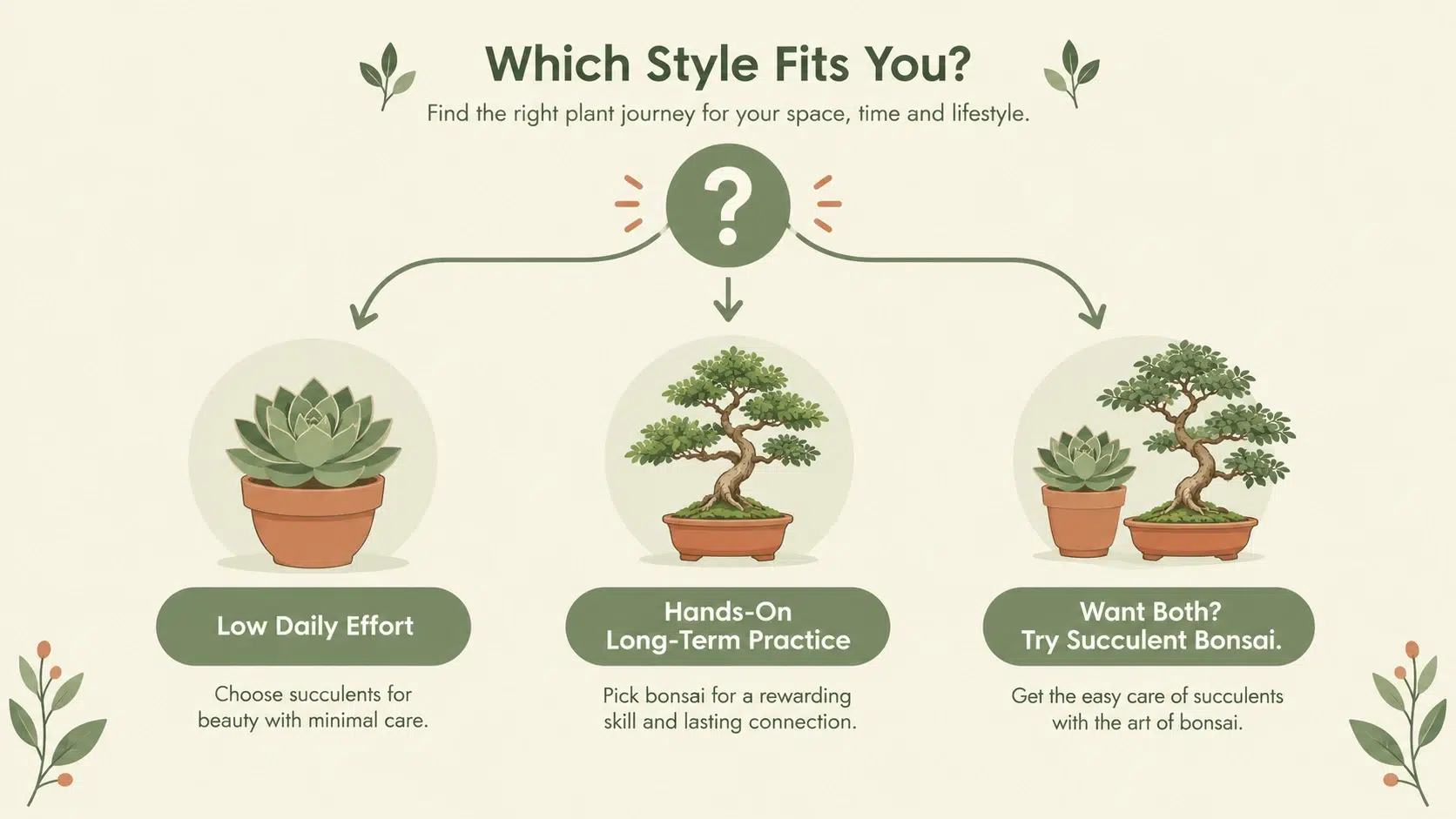
There’s no universally “better” option between the two — the right choice comes down to how much ongoing attention you actually want to give a plant, and what aesthetic you’re going for.
If you want low day-to-day effort, a rotating collection of interesting shapes and colors, and forgiveness for the occasional missed watering, succulents are the easier starting point. If you’re drawn to a long-term, hands-on practice — one where you’re actively shaping the plant’s form over years rather than just keeping it alive — bonsai will be more rewarding, even though it demands more consistent attention.
Space matters too: most succulents tolerate a sunny windowsill or a bright shelf without much fuss, while bonsai (especially outdoor species like pine or elm) may need a spot outside for at least part of the year to thrive. And if neither option feels like a full commitment on its own, the succulent-bonsai middle ground described above offers a genuine hybrid: lower water demands than a traditional bonsai, with enough of the pruning-and-shaping practice to scratch the same creative itch.
Conclusion
Succulents and bonsai are often mentioned together, but they solve different problems: one is about choosing a plant type built for low water and easy care, the other is about a long-term practice of shaping a tree into living art. Understanding that distinction — rather than treating the two as interchangeable — is the difference between a thriving plant and a rotted trunk or a snapped stem, especially if you’re tempted to try training a succulent using bonsai technique.
Wherever you land, there’s a deeper resource waiting for the next step: our Succulent Care and ID guide for the full range of succulent identification and care, our complete guide to bonsai for the full art and technique, and our ripple jade bonsai care guide if the succulent-bonsai hybrid approach is what caught your interest. Whichever path you choose, the same principle holds for both: get the water and light right first, and everything else — including any shaping you want to attempt — becomes far easier to get right too.
Frequently Asked Questions
What’s the difference between a succulent and a bonsai?
A succulent is a type of plant defined by its water-storing leaves, stems, or roots. Bonsai is a training technique applied to woody trees to keep them small and shaped like a miniature mature tree. They describe different things — one a plant category, the other a cultivation method.
Can any succulent be turned into a bonsai?
No. Only a handful of succulent species — most notably Portulacaria afra and Crassula ovata — hold up well to the pruning, wiring, and shallow-pot culture that bonsai styling requires. Many succulents are too brittle, too slow-branching, or too prone to rot at pruning wounds to make good candidates.
Is a “succulent bonsai” a true bonsai?
Not in the strictest traditional sense. True bonsai refers specifically to woody perennial trees trained per classical bonsai principles. A succulent trained in a similar style is more accurately described as “succulent styled to look like bonsai,” even though the visual result and many of the techniques overlap significantly.
Which is easier to take care of, succulents or bonsai?
Succulents are generally lower-effort day to day, since they’re forgiving of infrequent watering and require far less regular shaping. Bonsai demands more consistent attention — regular pruning, occasional wiring, and more careful watering — because the entire practice is built around ongoing, active shaping rather than passive growth.
Do succulents and bonsai need the same type of pot?
Not exactly. Both benefit from excellent drainage, but bonsai pots are specifically shallow and wide to restrict root growth as part of the training process, while succulent pots simply need to drain well and can vary much more in depth and shape.
Can I keep succulents and bonsai together in the same space?
Yes, as long as you’re mindful that they typically have different watering rhythms. Grouping them by care needs — rather than assuming one watering schedule fits both — is the easiest way to keep both thriving side by side.
Do bonsai or succulents bring good luck?
Bonsai carry a popular association with good fortune in some traditions, more so than succulents do, though the belief varies by culture and isn’t universal. We cover where this idea comes from in more detail in our dedicated article.
How long does it take for a succulent to develop a bonsai-style trunk?
Realistically, years rather than months — a convincing, aged-looking trunk on a species like Portulacaria afra typically takes multiple years of consistent pruning and growth to develop, not the “overnight transformation” some sources imply. A full growth timeline is beyond the scope of this overview, but it’s a question worth exploring in depth if you’re serious about the technique.