
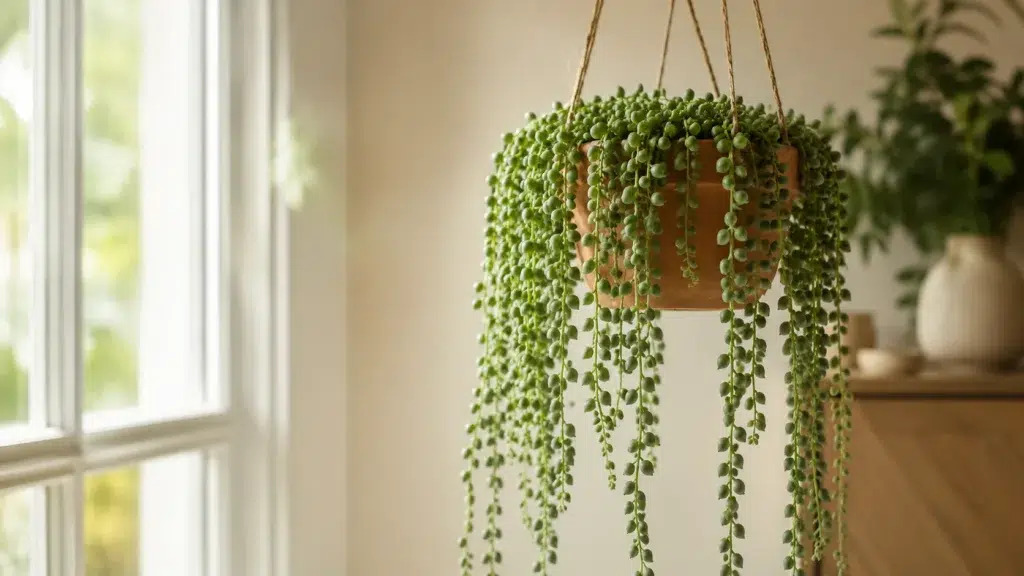
Manuela Nogueira notes that string of tears (Senecio citriformis) thrives in bright, indirect light and fast-draining succulent soil, watered only once the soil is completely dry—roughly every 2–3 weeks. It prefers temperatures of 60–75°F (15–24°C) and is frost-sensitive. Overwatering and poor drainage are the leading causes of root rot in this plant.
Its bead-like leaves store water and visibly shrivel before other stress signs appear, giving growers an early warning that watering is overdue. Though often confused with string of pearls due to nearly identical care needs, string of tears has slightly elongated, teardrop-shaped foliage rather than round beads. Propagation is straightforward: a cutting laid across moist soil roots at the leaf nodes within a few weeks.
Quick Summary
- String of tears (Senecio herreianus) is a low-maintenance trailing succulent with distinctive teardrop-shaped leaves.
- It grows best in bright indirect light, porous soil, and containers with drainage holes.
- Water thoroughly only after the growing medium has dried sufficiently to reduce the risk of root rot.
- Stem cuttings are the most practical propagation method, while leaf propagation is slower and less reliable.
- The plant is considered toxic to cats and dogs, so it should be kept out of pets’ reach.
What Is a String of Tears Plant?
A string of tears plant is a trailing succulent species, Senecio herreianus, known for its fleshy, elongated leaves that resemble tiny water droplets or teardrops. The stems grow outward and downward, making the plant particularly recognizable when grown in a hanging container.
The names string of tears, string of teardrops, and teardrop succulent are commonly used for the same plant. Its bead-like foliage can also lead to the informal description “beads on a string plant.” It is closely associated with other trailing succulents in the genus Senecio, including string of pearls.
Botanical Classification and Origin
The scientific name of the plant is Senecio herreianus. It belongs to the daisy family, Asteraceae, and is a succulent species adapted to storing water in its fleshy foliage. Senecio is a large plant genus within the daisy family (Asteraceae), containing numerous species with different growth forms and habitats.
Its natural distribution is associated with southern Africa, where its trailing growth habit allows its stems to spread across or hang from surrounding surfaces. Like many drought-adapted succulents, it is better suited to periods of dryness than consistently wet soil.
The plant’s relationship with other Senecio succulents explains why its care requirements overlap with plants such as string of pearls. However, the different leaf shapes help distinguish the species visually.
Physical Characteristics
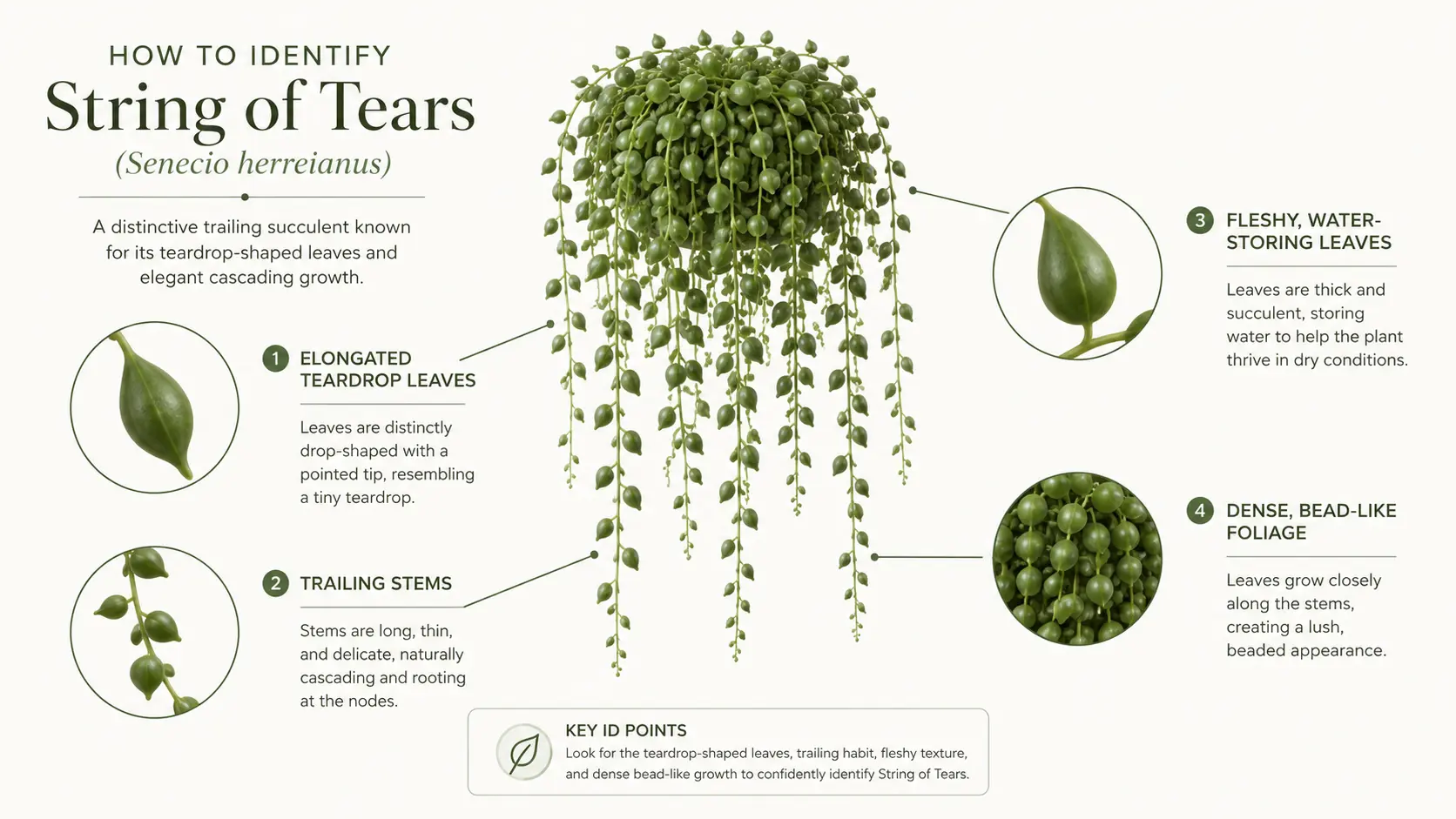
String of tears has several features that make it easy to identify:
- Leaf shape: Small, elongated, teardrop-like leaves with a pointed appearance.
- Stem growth: Thin, flexible stems that trail downward as they mature.
- Foliage density: Leaves are spaced along the stems rather than forming a compact rosette.
- Trailing habit: Healthy stems can become long and cascade from hanging baskets or elevated containers.
- Foliage color: Leaves are generally green and may show translucent areas that help distinguish them from some related species.
The fleshy leaves function as water-storage structures. This adaptation is one reason the plant does not require frequent watering.
String of Tears vs. Similar Trailing Succulents
String of tears is frequently confused with other trailing succulents because several species have small leaves arranged along thin, cascading stems. The most important difference is leaf shape: string of tears has elongated teardrop-shaped leaves, while string of pearls has more spherical leaves. For another trailing houseplant with a similar cascading appearance, compare its growth requirements with those discussed in our Peperomia Rotundifolia care guide.
String of Tears vs. String of Pearls
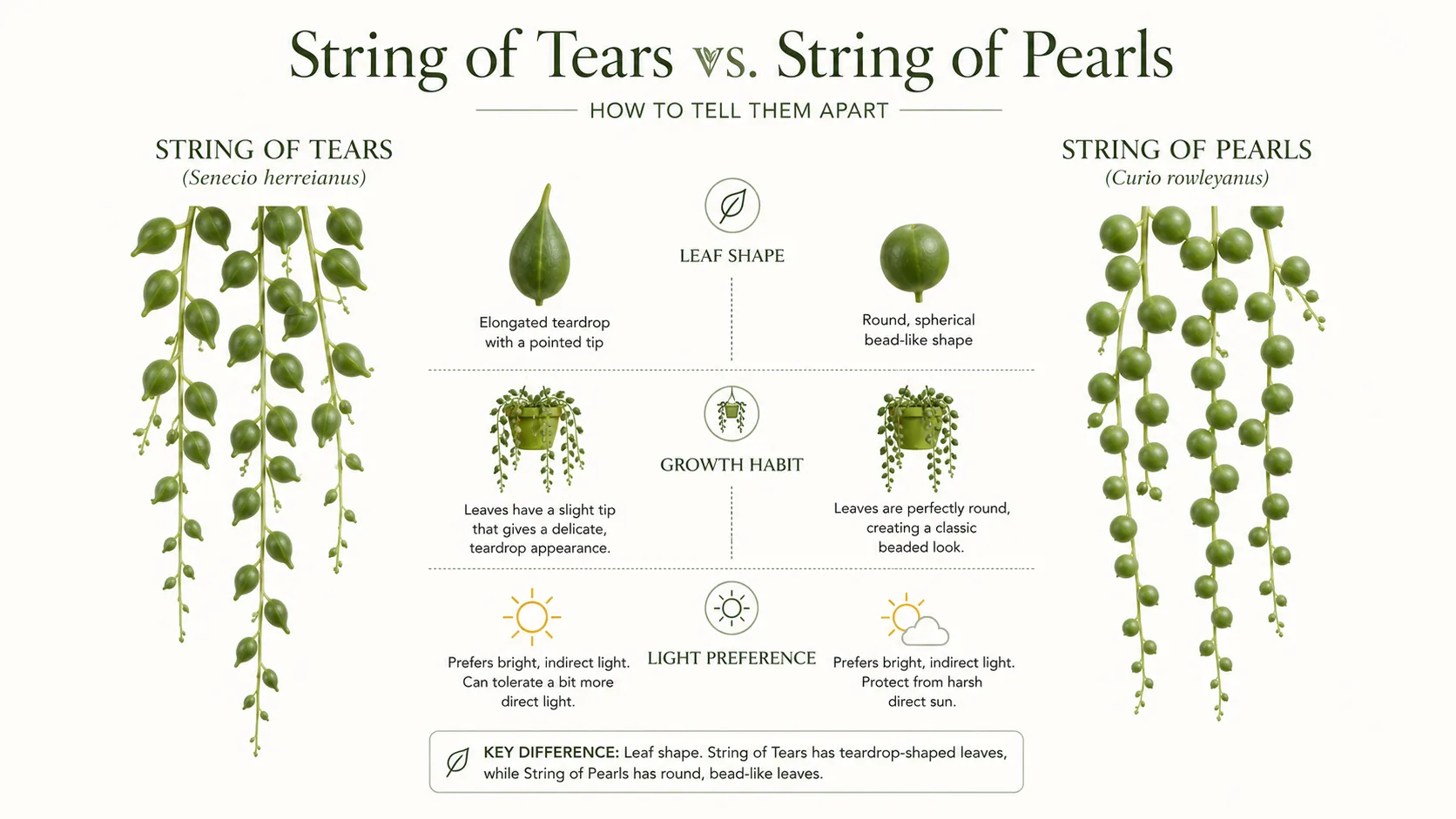
String of tears and string of pearls are closely related-looking trailing succulents, but their foliage provides the clearest distinction. For a closer look at the related species, see our Senecio rowleyanus care guide, which covers the growing requirements of string of pearls.
String of tears (Senecio herreianus) produces elongated, teardrop-shaped leaves, whereas string of pearls (Curio rowleyanus, formerly Senecio rowleyanus) produces rounded, pearl-like leaves.
Both prefer bright light, porous soil, and careful watering. String of pearls is often recognized by its more obviously spherical foliage, while string of tears has a narrower, pointed appearance.
| Plant | Leaf Shape | Growth Rate | Light Needs | Common Confusion |
| String of tears | Teardrop or elongated bead | Moderate under good conditions | Bright indirect light | Often mistaken for string of pearls |
| String of pearls | Round, spherical bead | Moderate to relatively fast in active growth | Bright indirect light | Often confused with string of tears |
| String of raindrops | Elongated, raindrop-like | Moderate | Bright light | Frequently confused with string of tears |
String of Tears vs. String of Raindrops
String of raindrops is another name that can create confusion because it describes a similar trailing succulent appearance. The distinction can be subtle, particularly when plants are young or photographed from a distance.
String of tears is identified by its characteristic teardrop-like leaves and trailing stems. Related plants may have leaves that are more elongated, more pointed, or marked differently. For reliable identification, the scientific name and foliage characteristics should be considered together rather than relying only on common names.
String of Tears Plant Care Requirements
String of tears plant care is based on four main factors: bright light, controlled watering, fast drainage, and restrained fertilization. Because the leaves store water, the plant generally handles short dry periods better than consistently wet conditions. Although string of tears does not require extremely high humidity, understanding how to increase humidity for indoor plants without a humidifier can help when indoor air becomes unusually dry.
Light Requirements
String of tears grows best in bright indirect light, with several hours of strong filtered light each day. A very bright indoor location near a window can support compact growth when the plant is protected from excessive harsh afternoon sun.
Too little light can cause stretched stems, wider spacing between leaves, and sparse growth. Excessive direct sunlight, especially through hot glass, can cause leaf scorching or stress.
Signs of insufficient light include:
- Long, thin, stretched stems
- Large gaps between leaves
- Slow growth
- Pale or weaker-looking foliage
A gradual transition is preferable when moving the plant from low light into a much brighter location.
Watering Needs
The safest approach is the soak-and-dry method: water thoroughly when the growing medium has dried sufficiently, then allow excess water to drain completely. If you are unsure whether the soil has dried enough, use a simple soil-checking method explained in our guide on how to check if an indoor plant needs water.
Avoid watering according to a rigid calendar because indoor temperature, humidity, pot size, soil composition, and light exposure all affect drying time.
Signs of overwatering include:
- Yellowing or translucent leaves
- Soft or mushy foliage
- Persistent wet soil
- Stem deterioration
- Root rot
Signs of underwatering include:
- Shriveled leaves
- Flattened or less-firm foliage
- Dry, lightweight potting mix
- Slower growth
The frequency may increase during active growth and decrease during cooler or darker periods.
Soil and Potting Requirements
String of tears requires a well-draining succulent or cactus potting mix. The growing medium should allow excess water to move away from the roots quickly.
A suitable mix can contain components such as:
- Cactus or succulent soil
- Perlite or pumice
- Coarse mineral material for additional drainage
The container should always have a drainage hole. Terracotta pots can be useful because their porous walls allow moisture to evaporate more readily than from some nonporous containers.
Avoid heavy garden soil or containers without drainage because they increase the likelihood of prolonged moisture around the roots.
Fertilizing and Seasonal Care
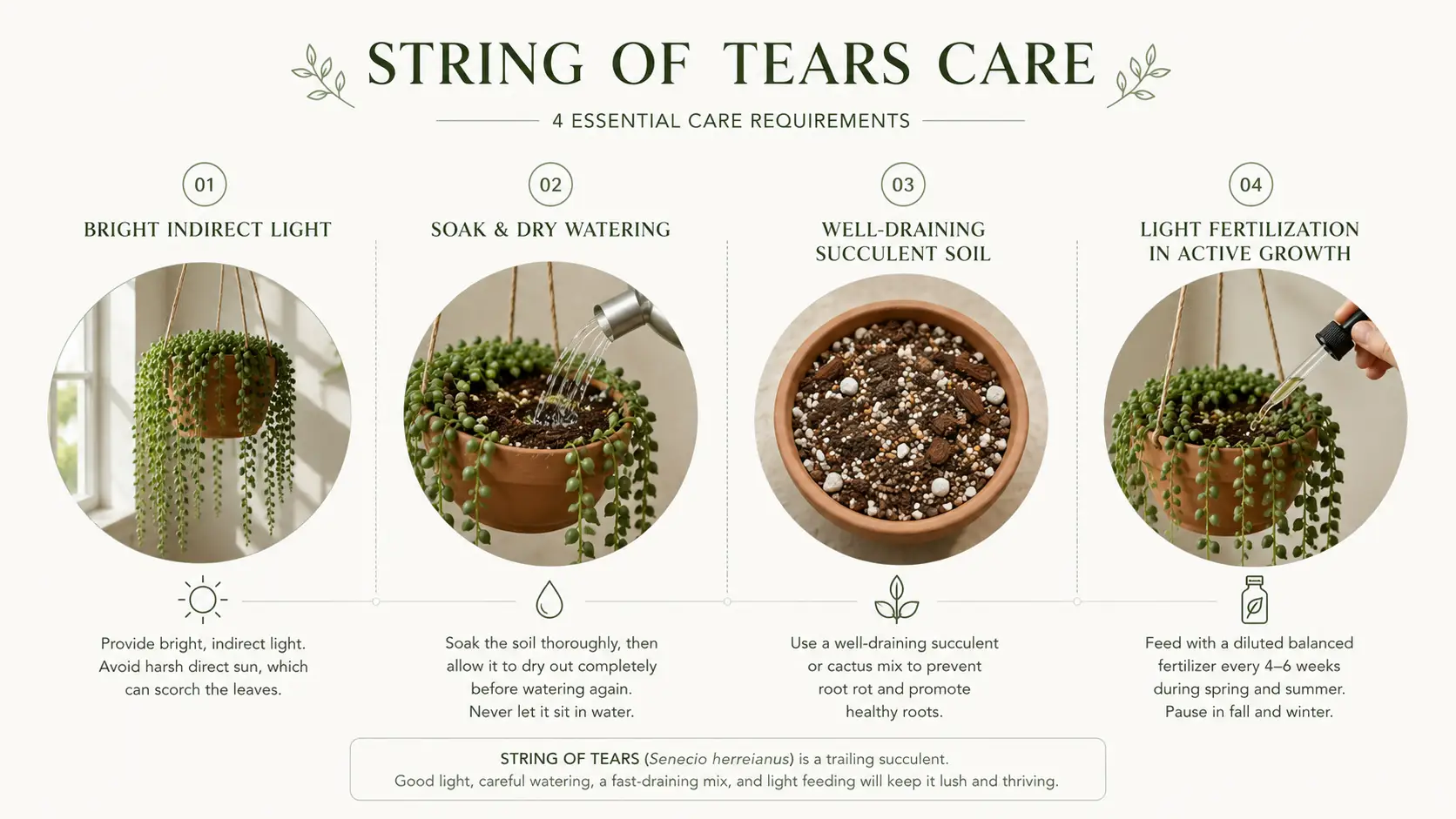
String of tears generally needs only light fertilization during active growth. A balanced, diluted houseplant or succulent fertilizer can be applied occasionally during the growing season according to its label instructions.
Avoid heavy feeding because excessive fertilizer can contribute to weak growth or salt buildup in the growing medium.
During cooler, darker periods, growth may slow naturally. Watering should be adjusted to the plant’s drying rate rather than maintaining the same schedule used during active growth.
| Care Requirement | Ideal Condition | Warning Signs |
| Light | Bright indirect light | Leggy growth or leaf scorch |
| Water | Thorough watering after drying | Yellow, soft leaves or shriveling |
| Soil | Porous, well-draining mix | Soil remains wet for too long |
| Pot | Drainage hole, preferably porous | Root problems |
| Fertilizer | Light feeding during active growth | Weak growth or fertilizer buildup |
How to Propagate String of Tears
String of tears can be propagated from stem cuttings, which are generally the most practical method. Leaf propagation is also possible but usually requires more patience and can be less consistent. Because string of tears and string of pearls share similar trailing-succulent growth habits, the techniques discussed in our guide on how to propagate string of pearls can also help explain the basic principles of propagation.
Stem Cutting Propagation
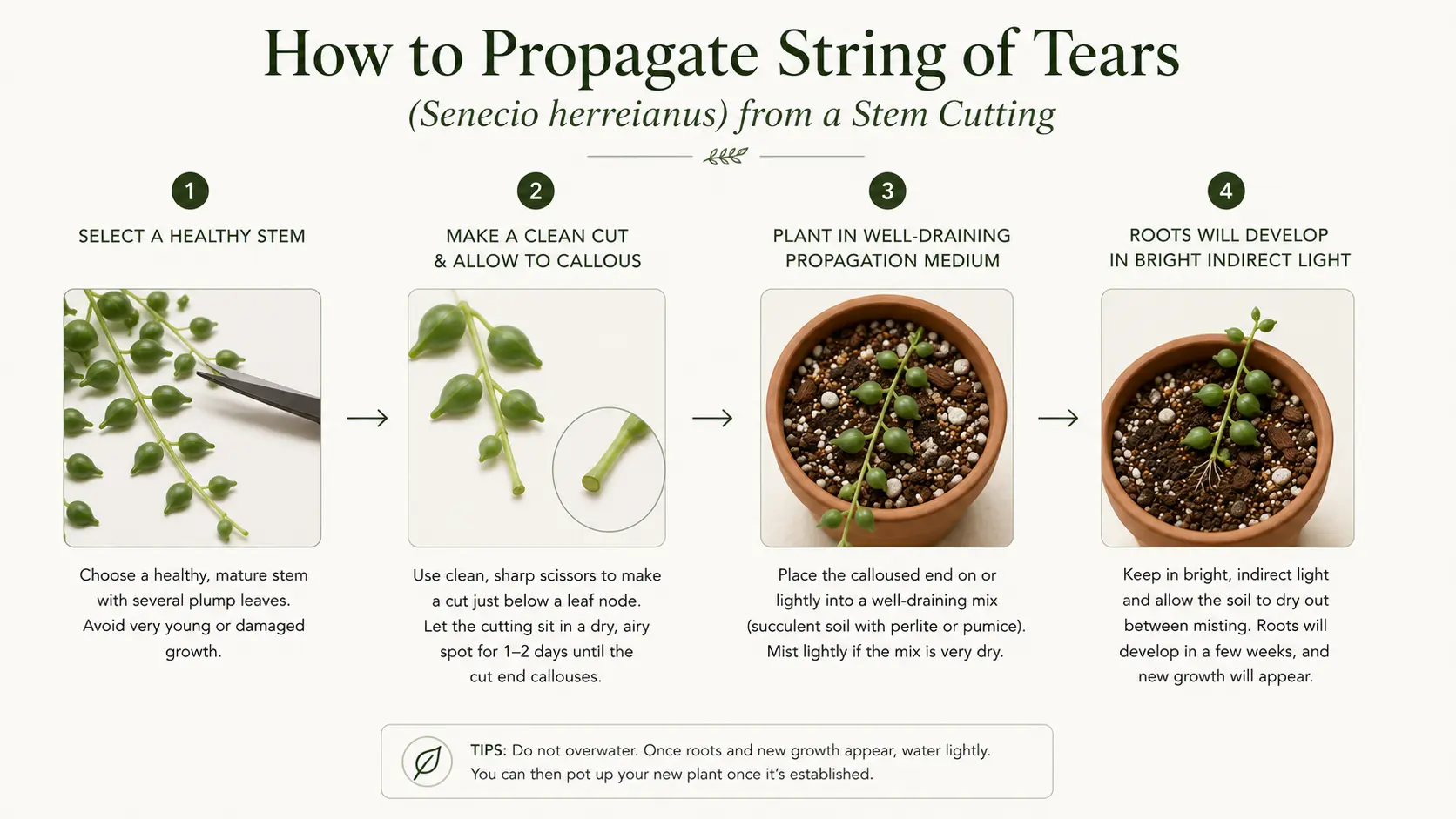
Stem cuttings are a straightforward way to produce new plants.
- Cut a healthy stem: Choose a healthy section containing several leaves and at least one suitable node.
- Allow the cutting to callous: Let the cut end dry for a short period so the wound can seal.
- Plant the cutting: Place the prepared section on or slightly into a well-draining succulent medium, ensuring the appropriate portion is in contact with the medium.
- Water carefully: Avoid keeping the medium constantly wet. Provide moisture cautiously while roots develop.
- Provide bright indirect light: Keep the cutting warm and brightly lit without exposing it to intense direct sun.
Root development generally depends on temperature, moisture, light, and cutting health. Avoid pulling on the cutting repeatedly to check for roots because this can damage developing roots.
Leaf Propagation
Leaf propagation is possible, but it is generally slower and less reliable than stem cuttings.
- Select a healthy, undamaged leaf.
- Separate it carefully from the plant without leaving the base badly damaged.
- Allow the detached leaf to dry briefly.
- Place it on suitable, well-draining propagation medium.
- Provide bright indirect light and controlled moisture.
- Wait for roots or new growth to develop.
Not every detached leaf will successfully produce a new plant. Stem cuttings are usually preferred when reliable propagation is the goal.
Common Problems With String of Tears (and String of Pearls)
Most problems with string of tears are related to watering, insufficient light, poor drainage, or pests. Correcting the environmental cause is more effective than simply treating the visible symptom.
| Problem | Likely Cause | Fix | Prevention |
| Yellowing leaves | Overwatering or light stress | Let soil dry and improve drainage | Use soak-and-dry watering |
| Shriveled leaves | Underwatering | Water thoroughly when appropriate | Check soil dryness regularly |
| Leggy growth | Insufficient light | Move to brighter indirect light | Maintain adequate light |
| Pest infestation | Sap-feeding insects | Isolate and treat affected areas | Inspect plants regularly |
| Root rot | Constantly wet soil | Remove damaged roots and repot into dry, draining mix | Use drainage holes and avoid overwatering |
Yellow leaves do not always mean the plant needs more water. In a succulent, yellowing combined with wet soil is often a warning that moisture is being retained for too long.
Shriveled leaves, by contrast, commonly indicate that the plant’s stored water reserves are becoming depleted, although severe root damage can also prevent a plant from absorbing water properly.
Leggy growth is usually a light problem. Pruning can improve appearance, but increasing light is necessary to prevent the same problem from returning.
Common pests may include mealybugs, aphids, and other sap-feeding insects. Early detection makes control easier.
Root rot develops when roots remain in excessively wet conditions for prolonged periods. Prevention through drainage and appropriate watering is much easier than repairing advanced root damage.
Is String of Tears Toxic to Pets?
String of tears is considered toxic to cats and dogs, so pets should not be allowed to chew or ingest the plant. Ingestion can cause gastrointestinal and other irritation-related symptoms, and contact with plant sap may also irritate sensitive tissues.
Pet owners should keep the plant in a location that cats and dogs cannot easily reach. Hanging baskets can reduce access, but they should still be positioned securely.
Possible symptoms after ingestion can include:
- Drooling
- Vomiting
- Diarrhea
- Reduced appetite
- Mouth or gastrointestinal irritation
The severity can depend on the amount consumed and the individual animal. If a pet has eaten part of the plant and shows concerning symptoms, veterinary advice should be sought.
Not all succulents have the same toxicity profile, so pet owners should identify each plant individually rather than assuming that all succulents are cat-safe.
Beginner Mistakes to Avoid With String of Tears
The most common beginner mistake is overwatering. String of tears stores moisture in its leaves and does not need consistently damp soil.
Avoid these common errors:
- Watering too frequently: Wait for the growing medium to dry sufficiently before watering again.
- Using low-light locations: Insufficient light encourages weak, stretched growth.
- Choosing pots without drainage: Excess water needs a clear escape route.
- Repotting too frequently: Frequent disturbance can stress the root system and is usually unnecessary when the plant is healthy.
- Using heavy soil: Dense soil can hold too much moisture around the roots.
A consistent routine based on environmental conditions is more effective than following a fixed watering calendar.
String of Tears Varieties and Related Senecio Plants
String of tears belongs to a group of trailing succulents that are often grouped together because of their bead-like foliage and cascading growth. Common names can overlap, so scientific identification is useful when distinguishing related plants.
Some related plants have spherical leaves, while others produce elongated or teardrop-shaped foliage. Variegated forms may also occur in cultivation, showing lighter areas on otherwise green foliage.
| Variety or Related Plant | Leaf Shape | Distinguishing Feature |
| String of tears (Senecio herreianus) | Elongated teardrop | Narrow, teardrop-like leaves |
| String of pearls (Curio rowleyanus) | Round or spherical | Pearl-like leaves |
| String of raindrops | Elongated bead | Similar trailing form and easily confused common name |
| Variegated related forms | Variable | Light or cream-colored areas on foliage |
The terms string of beads plant, pearl succulent, and string of succulents can refer to several visually similar plants rather than one universally defined species. For accurate care, the botanical identity should be confirmed before applying species-specific recommendations.
Conclusion
Successful string of tears plant care depends primarily on providing bright indirect light, well-draining soil, and controlled watering. As a drought-adapted trailing succulent, Senecio herreianus stores water in its fleshy teardrop-shaped leaves and is more vulnerable to prolonged wet conditions than occasional dryness. Stem cuttings provide the simplest propagation method, while leaf propagation can take longer and may be less reliable. Regular inspection also helps prevent pests, root rot, and weak growth. Because the plant is considered toxic to cats and dogs, it should be positioned where pets cannot chew it. With proper drainage, light, and watering, string of tears can maintain healthy cascading growth indoors. For more plant care information covering different species, growing requirements, and practical gardening guidance, explore our Plants Benefits and Guides pillar.
FAQs
How often should I water a string of tears plant?
Water a string of tears plant when its growing medium has dried sufficiently, then soak the soil thoroughly and allow excess water to drain. Watering frequency varies with light, temperature, humidity, pot size, and season, so a fixed weekly schedule is less reliable.
Is string of tears the same as string of pearls?
No, string of tears and string of pearls are different trailing succulents. String of tears (Senecio herreianus) has elongated, teardrop-shaped leaves, while string of pearls (Curio rowleyanus) has distinctly round, spherical leaves.
Why are my string of tears leaves turning yellow?
Yellow string of tears leaves are commonly associated with overwatering, prolonged wet soil, or environmental stress. Check the growing medium and drainage first. If the soil remains wet for a long time, reduce watering and improve drainage to help prevent root problems.
Is string of tears toxic to cats?
Yes, string of tears should be treated as toxic to cats and kept out of their reach. Eating the plant may cause gastrointestinal or irritation-related symptoms. If a cat has ingested the plant, contact a veterinarian for appropriate guidance.
How do you propagate string of tears from a cutting?
To propagate string of tears from a cutting, take a healthy stem section, allow the cut end to callous, then place it in or against a well-draining succulent propagation medium. Keep it in bright indirect light and provide controlled moisture while roots develop.
What’s the difference between string of raindrops and string of tears?
String of raindrops and string of tears are often confused because both have trailing stems and elongated bead-like foliage. The distinction can be subtle, so leaf shape, markings, and the plant’s scientific identification should be considered rather than relying only on common names.