
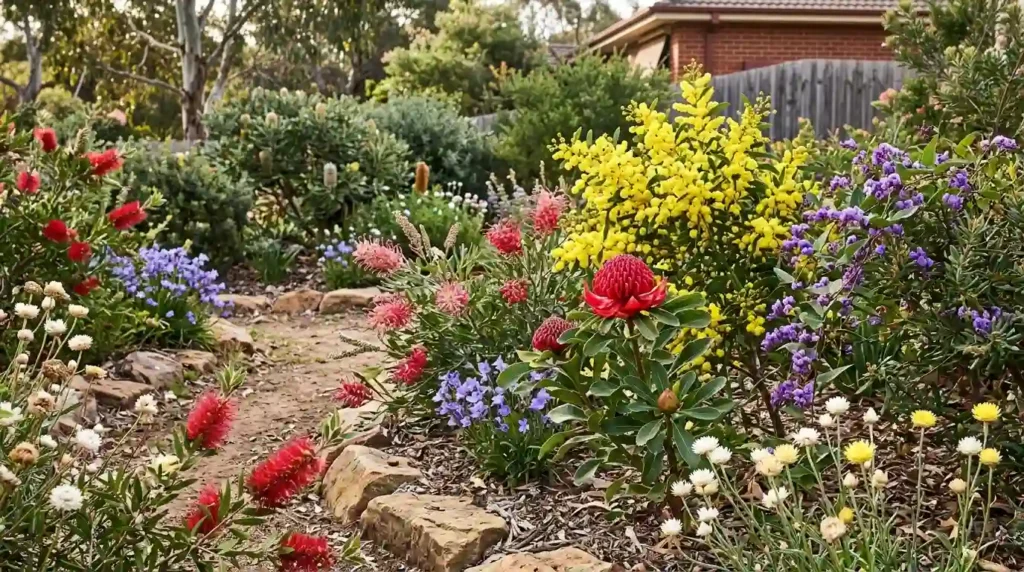
Why It’s Hard to Know When Australian Natives Flower
An Australian native flower calendar is best understood as a guide to typical flowering windows by month, region and climate—not a fixed timetable. Native plants can be flowering somewhere in Australia in every month, but the exact timing shifts with rainfall, temperature, latitude, altitude, provenance and species. The same genus can therefore flower in different months in Sydney, Perth, Brisbane or Darwin. The Australian Museum makes the same caution for its Sydney flowering calendar: its dates are a guide and may move backwards or forwards with regional and rainfall conditions.
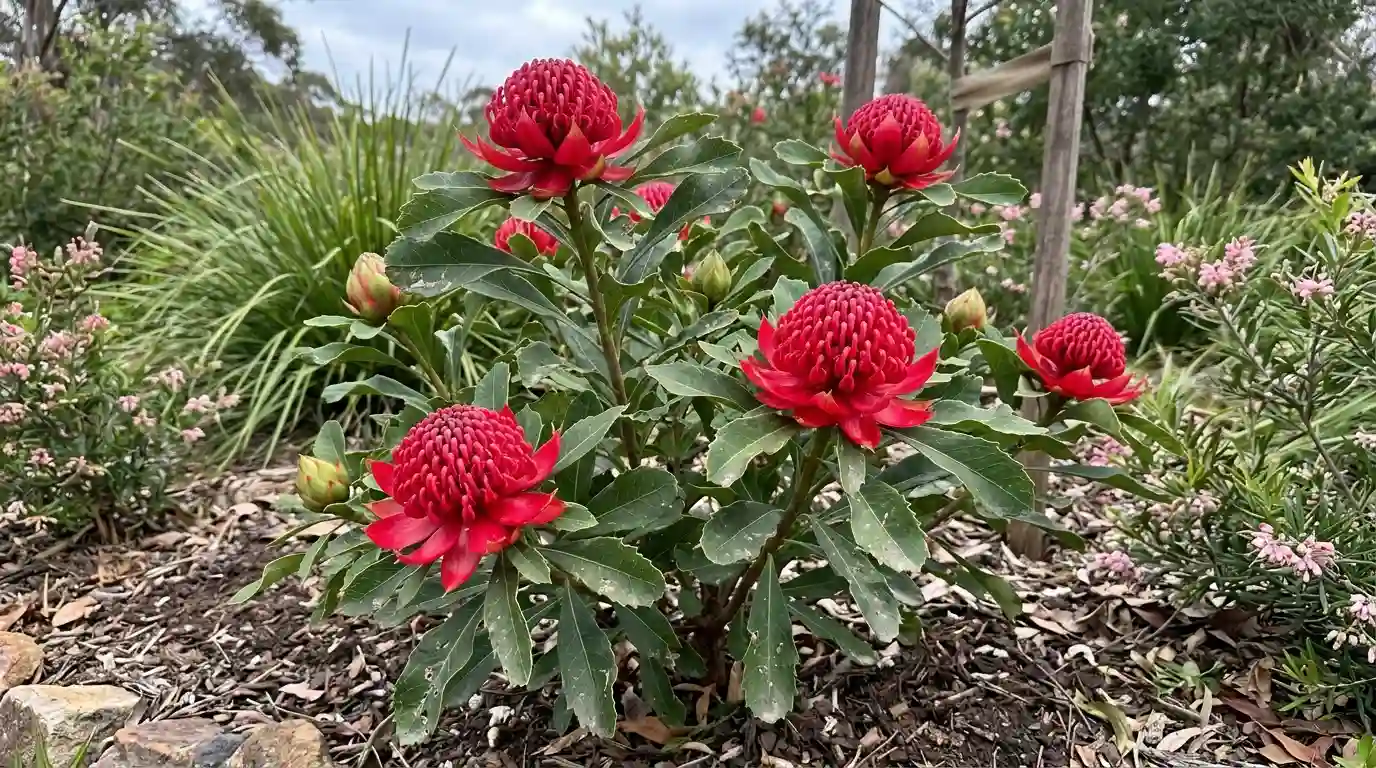
That is why a useful calendar needs both a month and a climate zone. It also explains apparent contradictions such as Waratah being listed as September–November by the Australian National Botanic Gardens while another ANBG profile describes the Sydney flowering period more narrowly as September–October, with later flowering in cooler areas.
For a broader starting point, see GreeneryNest’s Australian native garden plants guide.
Quick Summary
- Australian natives flower in every month somewhere, but local climate and rainfall matter more than the calendar date alone.
- In many temperate-east gardens, the strongest flowering period is late winter through spring, leaving late summer and early autumn needing deliberate planting for continuity.
- No single native reliably flowers for 12 months; year-round colour comes from combining plants with overlapping flowering windows.
- Birth-flower assignments are cultural traditions, not botanical records of when a native actually blooms.
Why Native Bloom Times Vary and Why Sources Conflict
Why natives don’t flower to a strict timetable
Australian flowering times are driven by environmental conditions rather than by the Gregorian calendar alone. Rainfall can trigger or extend flowering, temperature changes development speed, and latitude and altitude can move the same seasonal event earlier or later. Provenance matters too: two plants with the same common name can originate from populations adapted to different environments. The Australian Museum’s calendar of common flowering native plants points out that native plants don’t tend to flower to a strict timetable, so treat any month listing as a guide rather than a deadline.
It is also useful to distinguish a flowering range from a peak. A plant listed as flowering September–November may produce occasional flowers outside those months, while the majority of the display may occur for only a few weeks. The Australian Museum explicitly warns that flowering dates in its Sydney calendar may need adjustment for regional, rainfall and situational factors.
Fire can add another layer. Some Australian plants have fire-linked life cycles, but that does not mean every native flowers after fire. For example, flannel flowers can respond strongly after fire, while other species depend on different environmental cues.
Conflicts and corrections
| Plant | Conflicting claims | Trusted source and reason |
| NSW Waratah (Telopea speciosissima) | September–November; September–October around Sydney; some generic wedding/birth-flower pages use unrelated months. | Trust the Australian National Botanic Gardens and herbarium-backed material for phenology. ANBG gives September–November; a Growing Native Plants profile narrows the Sydney region to about six weeks in September–October and notes later flowering in cooler areas. |
| Hibbertia | January on some birth-flower lists versus April in the Australian Museum calendar. | Treat the Australian Museum calendar as phenology evidence for Sydney and the January assignment as a symbolic birth-flower convention. The Museum specifically lists Hibbertia in April. |
| Waratah in cooler regions | One month range may appear to conflict with another. | It is not necessarily a contradiction: ANBG explicitly notes that flowering occurs later in cooler areas. |
The practical hierarchy is simple: use state herbarium and flora databases first, species-level botanical references next, regional museum calendars after that, and florist or birth-flower lists only for symbolic associations. That prevents a cultural month assignment from being mistaken for a flowering observation.
How Indigenous Seasonal Calendars Track Flowering
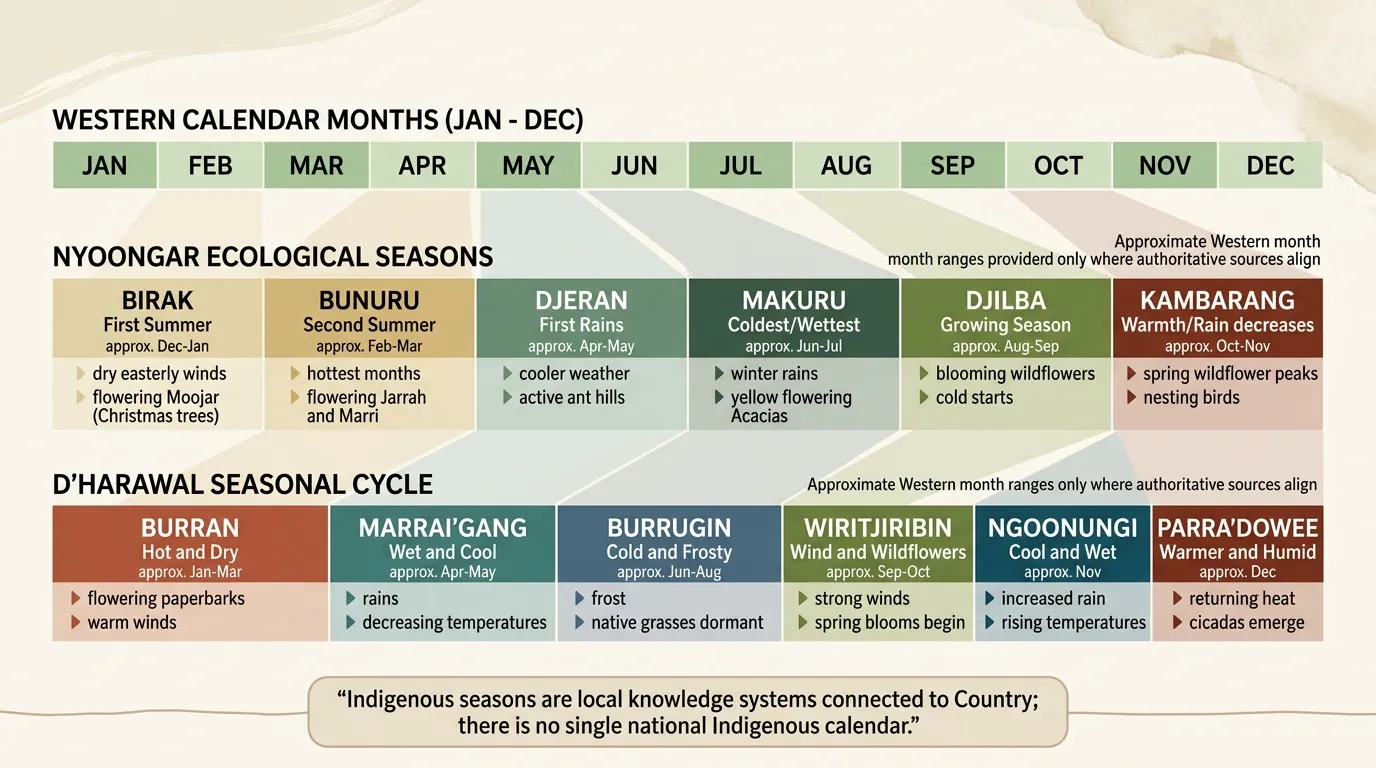
Australian Indigenous seasonal calendars do not simply divide the year into four equal Western seasons. They are local systems tied to weather, plants, animals, water, food availability and other observable changes on Country. There is therefore no single national Indigenous seasonal calendar. The Bureau of Meteorology documents many different calendars across Australia. The Bureau of Meteorology’s Nyoongar Seasonal Calendar describes six seasons that follow what plants and animals are doing, rather than dates on a calendar.
Two examples are particularly useful alongside a native-flower calendar:
| Region / people | Season | Approx. Western months | Flowering cue |
| Nyoongar Country, south-west WA | Birak | Dec–Jan | Seasonal plant and animal changes mark the first summer |
| Bunuru | Feb–Mar | Hotter, drier period | |
| Djeran | Apr–May | Cooler conditions begin | |
| Makuru | Jun–Jul | Cold, wet period | |
| Djilba | Aug–Sep | Major flowering build-up | |
| Kambarang | Oct–Nov | Wildflower season; flowers abound | |
| D’harawal Country, Sydney region | Burran | Jan–Mar | Weetjellan blooming |
| Marrai’gang | Apr–Jun | Lilly pilly ripens | |
| Burrugin | Jun–late Jul | Forest red gum flowering | |
| Wiritjiribin | Aug | Wattles and other flowering indicators | |
| Ngoonungi | Sep–Oct | NSW Waratah flowering | |
| Parra’dowee | Nov–Dec | Coast Myall flowering cue |
The Nyoongar calendar is particularly revealing because Kambarang, October–November, is described as the season when flowers abound, while Djilba in August–September is the transition into the major flowering explosion.
For D’harawal Country, flowering itself is an indicator of seasonal change. The Bureau’s calendar records Waratah flowering during Ngoonungi in September–October and other plant cues in different seasons. Permission to host that seasonal knowledge was granted by D’harawal Traditional Knowledge holders and Descendants Circle.
Month-by-Month Native Flower Calendar
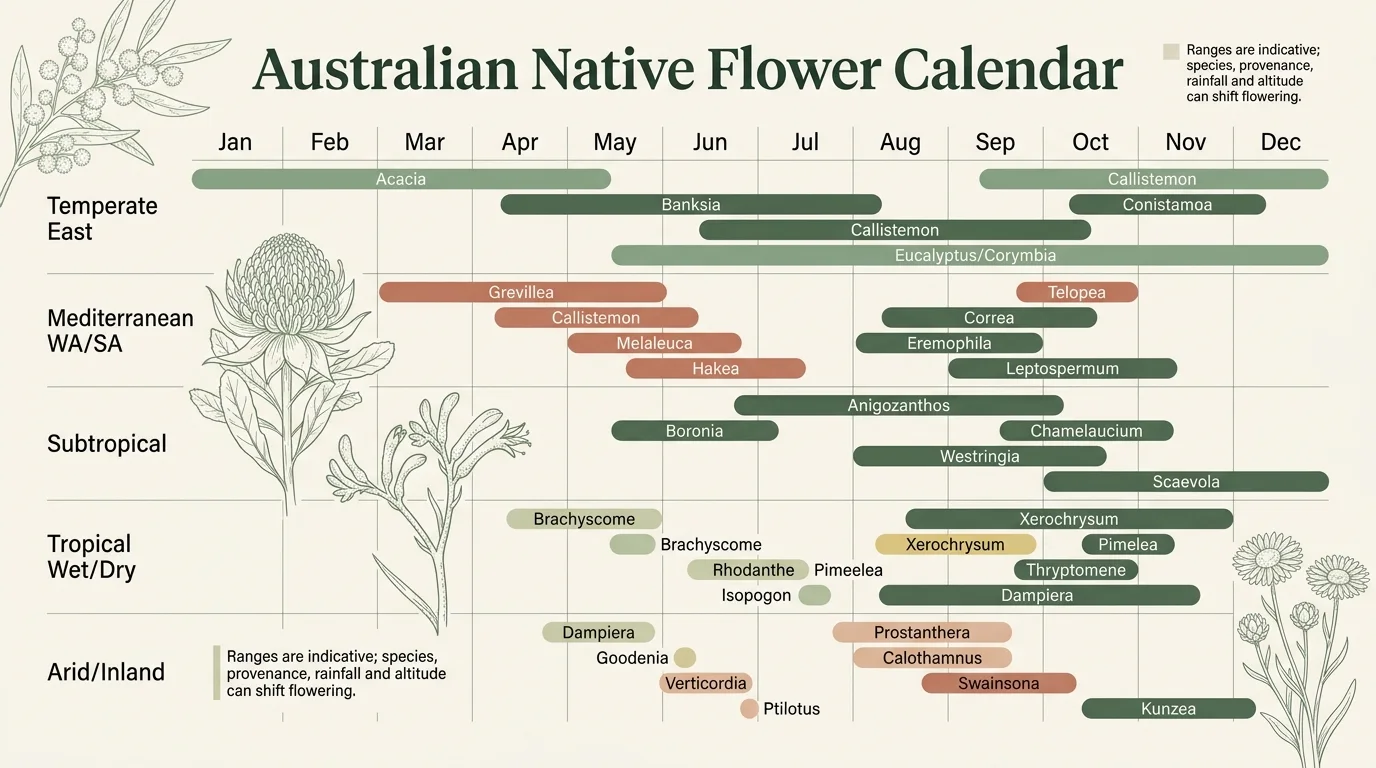
The matrix below is deliberately a planning calendar, not a botanical rulebook. The entries are broad windows for representative Australian native plants and garden forms within each climate grouping. A genus can contain species with substantially different flowering times, and cultivars can extend flowering further.
Australia’s climate zones are strongly shaped by latitude, rainfall and ocean influence: the north is tropical, much of the east coast is subtropical, the south is temperate, and much of the interior is arid or desert-influenced.
| Native genus | Temperate east | Mediterranean WA/SA | Subtropical | Tropical wet/dry | Arid / inland |
| Acacia | Jul–Sep | Jul–Oct | Jun–Sep | Dry-season to wet-season transition, variable | Aug–Oct, often rain-dependent |
| Banksia | Mar–Sep, species-dependent | Apr–Nov | Mar–Nov | Variable; many species differ strongly | Rainfall/species-dependent |
| Grevillea | May–Nov, many cultivars longer | Jun–Nov | Mar–Nov, some repeat-flower | Dry season to early wet, variable | Autumn–spring after useful rain |
| Callistemon | Aug–Nov | Sep–Nov | Aug–Dec; some repeat | Wet-season transition, variable | Spring after rain, irregular |
| Melaleuca | May–Nov | Aug–Nov | Aug–Jan | Dry–wet transition, variable | Rainfall-dependent |
| Corymbia / Eucalyptus | Late winter–summer, species-dependent | Winter–spring or summer, species-dependent | Spring–summer | Dry–wet transition, highly variable | Rainfall/species-dependent |
| Telopea | Sep–Nov | — | Sep–Nov, chiefly cultivated selections | — | — |
| Correa | Mar–Aug | Mar–Aug | Mar–Aug in suitable climates | — | — |
| Eremophila | Jul–Nov, species-dependent | Jul–Oct | Aug–Oct in suitable selections | — / highly variable | Rainfall-dependent, often winter–spring |
| Hakea | Winter–spring | Autumn–spring | Winter–spring | — | Variable |
| Leptospermum | Jul–Dec | Winter–spring | Winter–spring | Variable | — |
| Hibbertia | Mar–Oct, species-dependent | Winter–spring | Seasonal or extended, species-dependent | Variable | Rainfall-dependent |
| Anigozanthos | Sep–Dec | Aug–Dec | Sep–Nov in suitable cultivars | — | — |
| Boronia | Aug–Oct | Aug–Oct for suitable species | Winter–spring | — | — |
| Chamelaucium | Aug–Nov | Jul–Oct | Winter–spring | — | — |
| Westringia | Extended, often spring–autumn | Spring–summer | Extended in suitable sites | Extended in suitable dry sites | — |
| Scaevola | Spring–summer | Aug–Nov | Spring–summer | Dry-season/variable | After rain, species-dependent |
| Brachyscome | Spring–autumn | Winter–spring | Autumn–spring | Variable | Rainfall-dependent |
| Xerochrysum | Spring–summer | Spring | Spring–summer | Variable | Spring after rain |
| Rhodanthe | Spring | Winter–spring | Winter–spring | Dry-season/variable | Rainfall-dependent |
| Pimelea | Winter–spring | Winter–spring | Winter–spring | Variable | Spring after rain |
| Thryptomene | Winter–spring | Late winter–spring | Winter–spring | — | — |
| Isopogon | Spring | Winter–spring | Spring in suitable species | — | Variable |
| Dampiera | Winter–spring | Winter–spring | Spring | Dry-season/variable | After rain |
| Goodenia | Spring–summer | Winter–spring | Spring–summer | Wet/dry transition, species-dependent | Spring after rain |
| Prostanthera | Spring | Spring | Spring | — | — |
| Calothamnus | Spring | Spring | Winter–spring | — | Variable |
| Verticordia | — | Aug–Nov | — | — | Variable |
| Swainsona | Spring–summer | Winter–spring | Spring | Dry-season/after-rain, variable | Spring after rain |
| Ptilotus | Spring–summer in cultivation | Spring | Warm months in suitable forms | Variable | Rainfall-driven |
| Kunzea | Winter–spring | Spring | Winter–spring | Variable | — |
This synthesis draws on the Australian Museum’s Sydney flowering calendar, Australian Native Plants Society seasonal records, Australian Plant Society Victoria’s plant data, ANBG species profiles and Western Australian flora/regional records. These sources show why species-level differences are substantial; for example, ANPSA records the same genera across different flowering seasons, while WA flora records individual species with flowering windows spanning multiple months.
Summer (December–February)
Summer is not simply a “quiet” flowering season. Banksias, eucalypts, grevilleas, callistemons, some brachyscomes and many subtropical or tropical plants can be flowering, while some Mediterranean plants are finishing a spring display and entering a dry-season lull.
For flowers in season in February Australia, start with the climate zone rather than the common name. In a temperate-east garden, look for summer-active grevilleas, banksias, bottlebrushes and daisy-type plants. In subtropical gardens, the range can be broader and extend further into summer. In tropical Australia, rainfall rhythm matters more than the four Western seasons.
For a low-maintenance planting shortlist, GreeneryNest’s low-maintenance Australian native plants guide is a useful companion resource.
Autumn (March–May)
Autumn is an important bridge season. Some spring-flowering plants have finished, while winter and cool-season flowers are only beginning. Correas, boronias, thryptomenes, some banksias, croweas and selected grevilleas can help close that gap.
The Australian Museum’s Sydney calendar is a good example of this transition: it records Hibbertia and Crowea in April, Banksia, Grevillea, Hakea and Melaleuca in May, and Correa, Kunzea and other natives in June.
That makes autumn a useful time to inspect which beds have lost colour and deliberately add plants whose peak occurs later.
Winter (June–August)
Winter is one of the strongest opportunities for native flowers in cool and temperate Australia. Wattle, grevillea, hakea, correa, boronia, thryptomene, banksia and some daisies can provide winter colour and nectar.
The Australian Native Plants Society’s flowering-season records include numerous Acacia, Boronia, Correa, Pimelea, Thryptomene, Scaevola and other genera in winter, while Gardening Australia has specifically highlighted winter-flowering natives as valuable seasonal garden plants.
For gardeners trying to support nectar-feeding birds, overlapping winter flowers can be especially useful. The key is not one “bird plant” but a succession of nectar-producing blooms.
Spring (September–November)
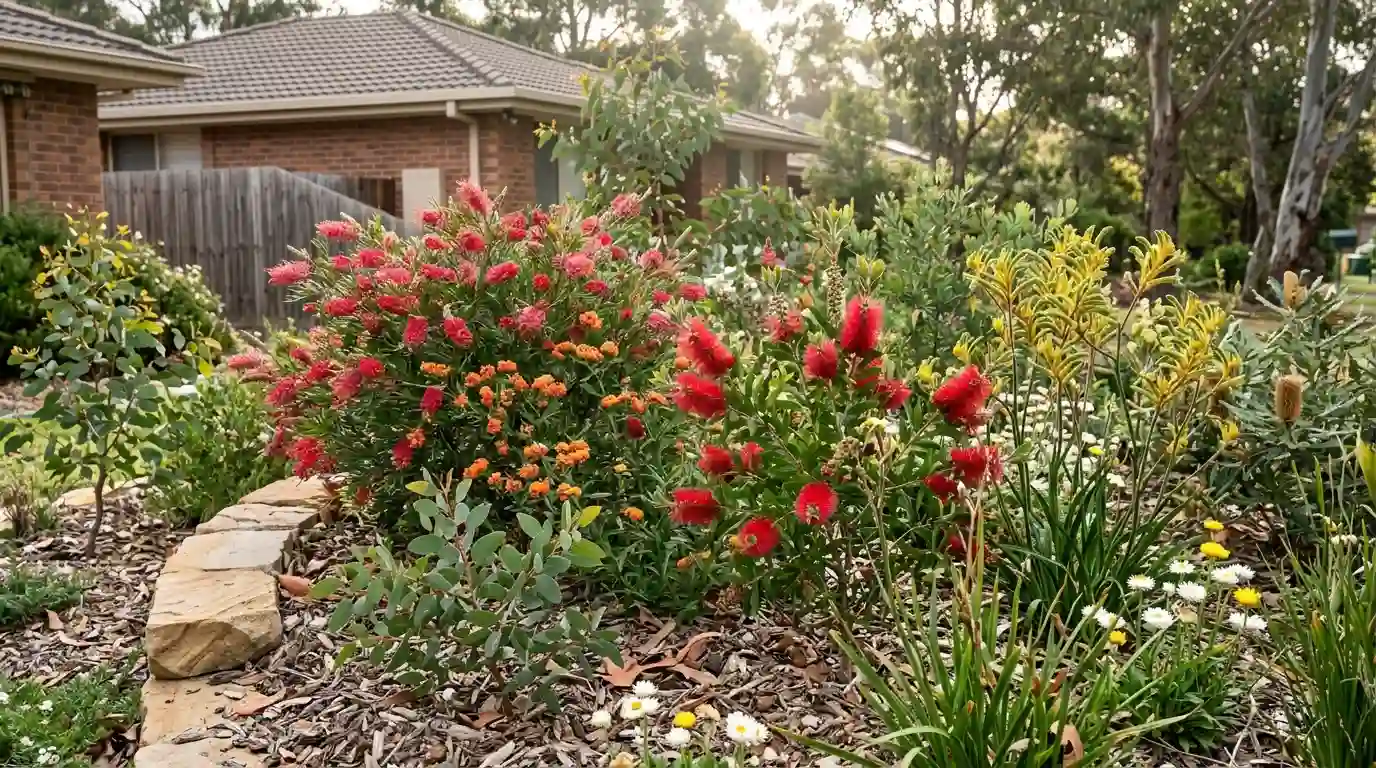
Spring is the great flowering season across much of southern and eastern Australia, although the exact peak moves by latitude and climate. In Sydney, the NSW Waratah typically flowers through spring; in south-west Western Australia, wildflower displays commonly build from August and September into October and November.
For flowers in season in October Australia, think broadly: Waratah and grevilleas in temperate-east gardens; wattles, banksias, kangaroo paws and other wildflowers in south-west WA; bottlebrushes and paper-daisy-type flowers in suitable temperate and subtropical gardens; and rainfall-driven plants in arid districts.
Western Australia’s October significance is especially clear in the Nyoongar calendar: Kambarang, October–November, is described as a period when flowers abound.
What’s flowering now: a quick-finder block
Early October 2026 — spring in southern Australia
- Temperate east: Waratah, grevilleas, bottlebrushes, native daisies and other spring shrubs may be active, with timing varying by species and elevation.
- Mediterranean WA: this is peak wildflower territory, with spring displays commonly running through September and October.
- South Australia: Mediterranean-climate gardens are generally in their spring transition, with many winter–spring native plants at or near flowering.
- Subtropical Queensland/NSW: spring flowering can overlap into summer, with grevilleas, callistemons, melaleucas and other warm-climate natives active.
- Tropical north: check the wet/dry cycle before relying on a temperate spring calendar; the tropical flowering rhythm is fundamentally different.
- Arid Australia: flowering is strongly rainfall-responsive, so a recent rain event can matter more than the month.
How the Calendar Shifts Across Australian Cities
Australia’s climate zones explain much of the geographical shift. Brisbane is subtropical, while Melbourne and Hobart are temperate; Perth and parts of Adelaide sit within Mediterranean-influenced areas where winter rainfall strongly affects spring growth. Darwin has a tropical wet/dry rhythm that does not map neatly onto the southern four-season calendar.
| City | Broad climate pattern | Typical shift vs Sydney baseline | Notable local native examples |
| Sydney | Temperate/subtropical transition | Baseline | Waratah, grevillea, banksia, flannel flower |
| Melbourne | Temperate | Many spring displays later than Sydney, especially in cool sites | Common Heath, grevillea, banksia, paper daisies |
| Brisbane | Subtropical | Many warm-climate plants start earlier or flower for longer | Grevillea, bottlebrush, melaleuca |
| Perth | Mediterranean | Distinct winter–spring wildflower pattern; often later than northern WA but highly seasonal | Kangaroo Paw, Verticordia, Dampiera, waxflower |
| Adelaide | Mediterranean | Winter–spring flowering strongly influenced by rainfall | Sturt’s Desert Pea, grevillea, correas |
| Darwin | Tropical wet/dry | Do not apply the Sydney spring calendar directly; flowering follows tropical rainfall and dry-season cues | Melaleuca, eucalypts, tropical natives |
| Hobart | Cool temperate | Spring generally later than Sydney | Tasmanian blue gum, correas, heath relatives |
Western Australia’s distinction is especially strong: regional government sources place much of its celebrated wildflower season between roughly late July and October, with timing varying according to rainfall and location.
Natives That Flower for Most of the Year
The safest answer to “What Australian natives flower all year?” is: no single native should be assumed to flower continuously for 12 months. Some cultivars can flower for long periods or repeat-flower under favourable conditions, but year-round colour is more reliably created by combining species.
| Plant | Practical flowering range | Care effort | Best-suited zones |
| Grevillea hybrids | Extended; some can flower through much of the year | Low–moderate | Temperate to subtropical; selected cultivars elsewhere |
| Westringia | Long or intermittent flowering, often spring–autumn | Low | Temperate, Mediterranean, subtropical |
| Scaevola | Long flowering in warm conditions | Low–moderate | Mediterranean to subtropical |
| Correa | Mainly autumn–winter, sometimes extended | Low | Temperate and Mediterranean |
| Kangaroo paw hybrids | Mainly spring–autumn, cultivar-dependent | Moderate | Mediterranean and many temperate gardens |
| Brachyscome | Often spring–autumn depending on species and conditions | Low | Temperate, Mediterranean, subtropical |
GreeneryNest’s Scaevola aemula guide covers its long flowering behaviour, while our Dorothy Gordon Grevillea guide gives a cultivar-level example of an extended-flowering grevillea. These should be read as examples, not proof that every member of the genus has the same flowering period.
Gap-month planting plan
For many temperate-east gardens, the hardest continuity period is late summer into early autumn, when the huge spring flush has passed.
A practical strategy is to combine plants with different peaks:
- Temperate east: Grevillea + Westringia + autumn/winter Correa.
- Mediterranean WA/SA: Grevillea + Scaevola + selected Eremophila or other locally adapted long-flowering shrubs.
- Subtropical: Grevillea + Callistemon/Melaleuca + Scaevola.
- Arid: Eremophila + Ptilotus + Swainsona, with rainfall treated as the trigger rather than the calendar.
The principle is more important than the exact recipe: use at least three flowering windows so one plant’s decline overlaps another’s peak.
When to Plant, Prune and Support Wildlife by Season
| Season | Plant now | Prune after | Wildlife focus |
| Summer | Only where establishment can be watered and heat is manageable | Early-summer flowers after flowering; avoid unnecessary heat stress | Maintain water and nectar continuity |
| Autumn | Often an excellent planting window in temperate/Mediterranean areas | After flowering, avoiding removal of developing flower buds | Build winter nectar supply |
| Winter | Good planting window in many frost-free or Mediterranean areas | Prune finished winter flowers only when appropriate | Winter nectar for birds and insects |
| Spring | Prime growth period, but water new plants consistently | Prune early spring bloomers after flowering | Peak nectar and pollinator season |
The general rule is to plant during milder conditions and water until new plants establish. Pruning is usually safest after flowering because it preserves the current display and allows regrowth before the next cycle. Gardening Australia also recommends trimming many Australian natives immediately after flowering and warns against cutting into leafless old wood.
For wildlife, think in terms of a flowering sequence. Banksias, grevilleas, bottlebrushes, eucalypts and other nectar-rich natives can contribute to a garden that offers food at different times rather than creating one spectacular but very short flowering event. Australian native flower gardens can also provide habitat and food for native insects and birds when plants are selected for local conditions.
Why isn’t my native flowering?
Too much phosphorus fertiliser
Why it happens: some native families, especially Proteaceae such as banksias, hakeas and grevilleas, can be highly sensitive to phosphorus. This is not the same as saying every Australian native is phosphorus-intolerant.
Fix: stop high-phosphorus feeding and identify the species before changing the fertiliser regime.
Prevent: choose a fertiliser appropriate for the particular plant rather than automatically applying a blanket “native fertiliser” rule.
Pruning too hard or at the wrong time
Why it happens: pruning just before a flowering flush can remove developing buds.
Fix: identify the plant’s flowering season, then prune after the main flowering period.
Prevent: record the flowering date each year before reaching for the secateurs.
Too much shade
Why it happens: many flowering Australian natives need substantial light to produce their best display.
Fix: compare the plant’s actual light conditions with its cultivation requirements.
Prevent: place sun-loving species where their canopy receives enough light rather than compensating later with fertiliser.
Overwatering and poor drainage
Why it happens: a plant adapted to free-draining soil can decline when roots stay saturated.
Fix: inspect drainage, irrigation frequency and soil structure before adding more fertiliser.
Prevent: match the species to local soil and rainfall patterns. Australia’s native flora is not uniformly drought-tolerant, and plants from different habitats have different water needs.
Yellowing leaves from poor soil conditions
Why it happens: yellow leaves can reflect several problems—including water stress, root problems or nutrient imbalance—so colour alone is not a diagnosis.
Fix: check drainage, recent watering, soil conditions, plant age and new versus old leaves before treating the symptom.
Prevent: choose plants suited to your local soil and source plants from suitable local provenance where possible.
Birth Month Flowers vs Actual Bloom Time
A birth flower is a cultural assignment; a bloom window is a botanical observation. The two can overlap, but they answer different questions.
Western birth-flower traditions commonly assign a primary and secondary flower to each month, but these lists are not universally standardised.
Australian native birth-flower lists are even less standardised. One Australian gardening feature assigns a different native to each month, while other Australian commercial and artistic lists use different species. That variation is exactly why a birth-flower chart should not be presented as an Australian flowering calendar.
| Month | Example native birth flower named by an Australian list | Typical actual flowering window | Match? |
| January | Guinea flower (Hibbertia scandens) | Warmer months; species-dependent | Yes / broad |
| February | Cut-leaf daisy (Brachyscome multifida) | Spring–autumn | Yes |
| March | Native rhododendron (Rhododendron lochiae) | Species/locality-dependent | Partial |
| April | Native violet (Viola hederacea) | Nearly year-round | Yes |
| May | Pink waxflower (Crowea saligna) | Autumn–winter | Yes |
| June | Payne’s thryptomene (Thryptomene saxicola) | Cool-season flowering | Yes / broad |
| July | Dampiera diversifolia | Winter–spring | Yes |
| August | Brown boronia (Boronia megastigma) | Winter–spring | Yes |
| September | Gum blossom (Eucalyptus spp.) | Species-dependent; spring examples occur | Yes / broad |
| October | Callistemon cultivar | Spring–autumn in some cultivars | Yes |
| November | Flannel flower (Actinotus helianthi) | Season varies with conditions and population | Partial |
| December | Christmas bells (Blandfordia grandiflora) | Spring–summer | Yes |
The Australian list above comes from Homes to Love, where the named plants are explicitly presented as native birth flowers. Its own descriptions sometimes reveal why a symbolic monthly assignment should not be confused with a narrow flowering date—for example, Brachyscome is described as flowering from spring to autumn, and Viola as nearly year-round.
For July, other Australian native-birth-flower lists instead use Adenanthos or Grevillea; for November, Tea Tree/Leptospermum and Wattle are both used by different sources. These differences demonstrate that there is no authoritative national Australian native birth-flower registry.
So the answer to “What are the native birth flowers in Australia for each month?” is: there are several published traditions, but no single official list. Choose one source for consistency, and label it as a symbolic list rather than a phenology calendar.
Famous, Favourite and Rare Native Flowers
There is no scientifically defensible single answer to “What is Australia’s prettiest flower?” Beauty is subjective. A more useful “top 10” can be based on cultural recognition, distinctive appearance, garden popularity, cut-flower significance and geographic representation. The Australian National Botanic Gardens lists the floral emblem of each state and territory, from New South Wales’ Waratah to Western Australia’s red and green kangaroo paw.
| Iconic native | Why it belongs on the shortlist |
| Golden Wattle (Acacia pycnantha) | National floral emblem |
| NSW Waratah (Telopea speciosissima) | Strong cultural identity and distinctive spring flowers |
| Kangaroo Paw (Anigozanthos) | Iconic Australian flower form |
| Banksia | Major native flowering group with wide geographic representation |
| Grevillea | Large diversity of forms and extended flowering in many cultivars |
| Bottlebrush / Callistemon | Familiar brush-like flowers and garden use |
| Sturt’s Desert Pea (Swainsona formosa) | Signature arid-zone flower |
| Waxflower (Chamelaucium) | Important native cut flower |
| Everlasting Daisies (Xerochrysum) | Strong seasonal wildflower displays |
| Flannel Flower (Actinotus helianthi) | Distinctive white starry native bloom |
Australia’s national floral emblem is the golden wattle (Acacia pycnantha), proclaimed on 19 August 1988.
Australia also has official floral emblems for each state and territory:
| State / Territory | Floral emblem |
| Commonwealth | Golden Wattle — Acacia pycnantha |
| ACT | Royal Bluebell — Wahlenbergia gloriosa |
| NSW | Waratah — Telopea speciosissima |
| Northern Territory | Sturt’s Desert Rose — Gossypium sturtianum |
| Queensland | Cooktown Orchid — Dendrobium phalaenopsis |
| South Australia | Sturt’s Desert Pea — Swainsona formosa |
| Tasmania | Tasmanian Blue Gum — Eucalyptus globulus |
| Victoria | Common Heath — Epacris impressa |
| Western Australia | Red and Green Kangaroo Paw — Anigozanthos manglesii |
The official Australian National Botanic Gardens floral-emblem reference confirms the national, state and territory list.
For “What is Australia’s rarest flower?”, avoid naming one species as a universal answer. Rarity depends on the conservation category and jurisdiction, and threatened-flora lists change as species are assessed. Western Australia’s Department of Biodiversity, Conservation and Attractions maintains threatened and priority flora lists, while Victoria maintains a current threatened-flora list under the Flora and Fauna Guarantee framework.
That is a more responsible answer than declaring one flower “the rarest” without defining the metric.
Building and Tracking Your Own Calendar
Start with your local climate zone, choose regionally appropriate native species, and record the first, peak and last flowering dates each year. Join a native plant society, compare your observations with state flora databases, and use GreeneryNest’s Australian native garden plants guide and Australian flower names guide as supporting references.
For garden combinations, GreeneryNest also has what to plant with kangaroo paw, which can help turn a flowering calendar into a practical planting design.
Conclusion
An Australian native flower calendar works best as a month-and-region range, not a list of fixed dates. Start with your climate zone, then choose overlapping species so late summer and early autumn do not become colour gaps. Treat Indigenous seasonal calendars as local ecological knowledge, and keep birth-flower traditions separate from actual flowering records. Identify the zone first, then plant for overlapping bloom windows.
FAQs
What Australian natives flower all year?
No single Australian native should be guaranteed to flower for 12 months. Some grevilleas, westringias, scaevolas and selected cultivars can flower for long periods, so combining several species is more reliable.
What is Australia’s most famous flower?
The golden wattle, Acacia pycnantha, is Australia’s national floral emblem. It was proclaimed in 1988.
Are there two birth flowers for every month?
Often, yes, in Western traditions. However, different countries, eras and sources use different pairings, so the list is not universal.
What are the six Indigenous seasons in Australia?
There is no single national set. The Nyoongar seasonal calendar in south-west Australia has six seasons: Birak, Bunuru, Djeran, Makuru, Djilba and Kambarang.
What native flowers are in season in February or October?
February depends strongly on zone; grevilleas, banksias and other summer flowers can continue in warmer areas. October is a major spring flowering month, especially across temperate Australia and south-west WA.
When is the best time to prune Australian natives?
For many flowering natives, prune lightly after flowering so you do not remove the next display. Species-specific exceptions exist.
What are the native birth flowers in Australia for each month?
There is no single official Australian list. Published lists vary, so use the comparison table above as a source-specific cultural guide—not as a flowering calendar.