
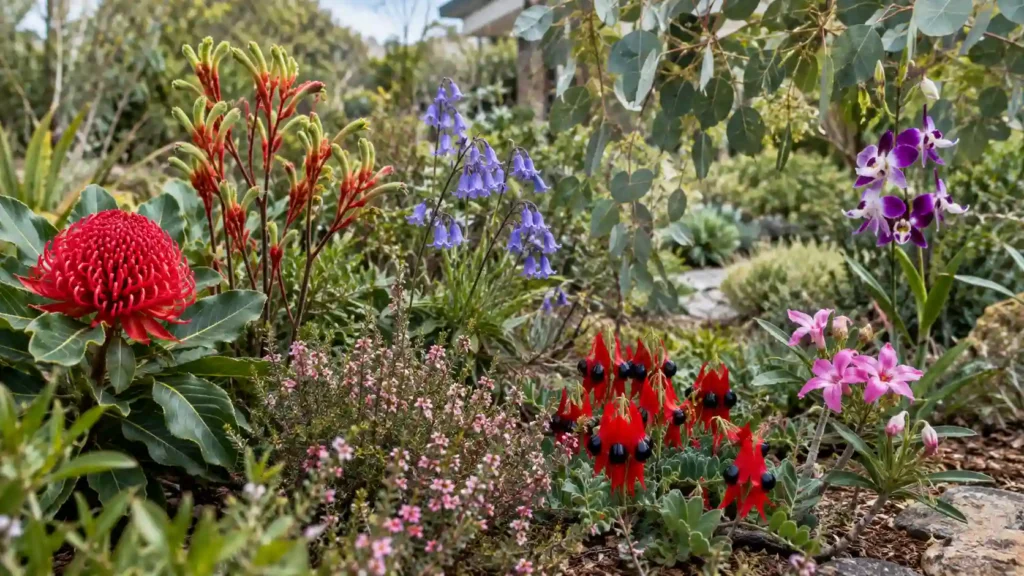
Australian native flowers by state are not limited to a list of eight official emblems. Each Australian state and territory has a recognised floral emblem, but that flower may be difficult to grow outside its natural climate, while many other native flowers occur across state borders. For example, NSW’s Waratah (Telopea speciosissima) flowers in spring on sandstone and forest sites, Western Australia’s Red and Green Kangaroo Paw flowers in late winter and spring, and Tasmania’s Blue Gum flowers in early summer. The most useful way to choose a native flower is therefore to consider where it naturally grows, when it flowers, and whether your garden can reproduce those conditions.
Quick Summary
- Australia has eight state and territory floral emblems, ranging from NSW Waratah and Queensland’s Cooktown Orchid to Western Australia’s Red and Green Kangaroo Paw.
- Flowering seasons are regional windows, not fixed nationwide dates; rainfall, elevation, soil and climate can shift flowering considerably.
- Waratah and Sturt’s Desert Pea are particularly challenging examples, while the Cooktown Orchid is described by Queensland Government material as relatively easy to cultivate in suitable frost-free coastal Queensland conditions.
- Not every Australian native needs low-phosphorus fertiliser. Phosphorus sensitivity varies by species and family, with Proteaceae such as banksias, grevilleas and waratahs among the better-known sensitive groups.
Australian Native Flowers by State: The Eight Floral Emblems at a Glance
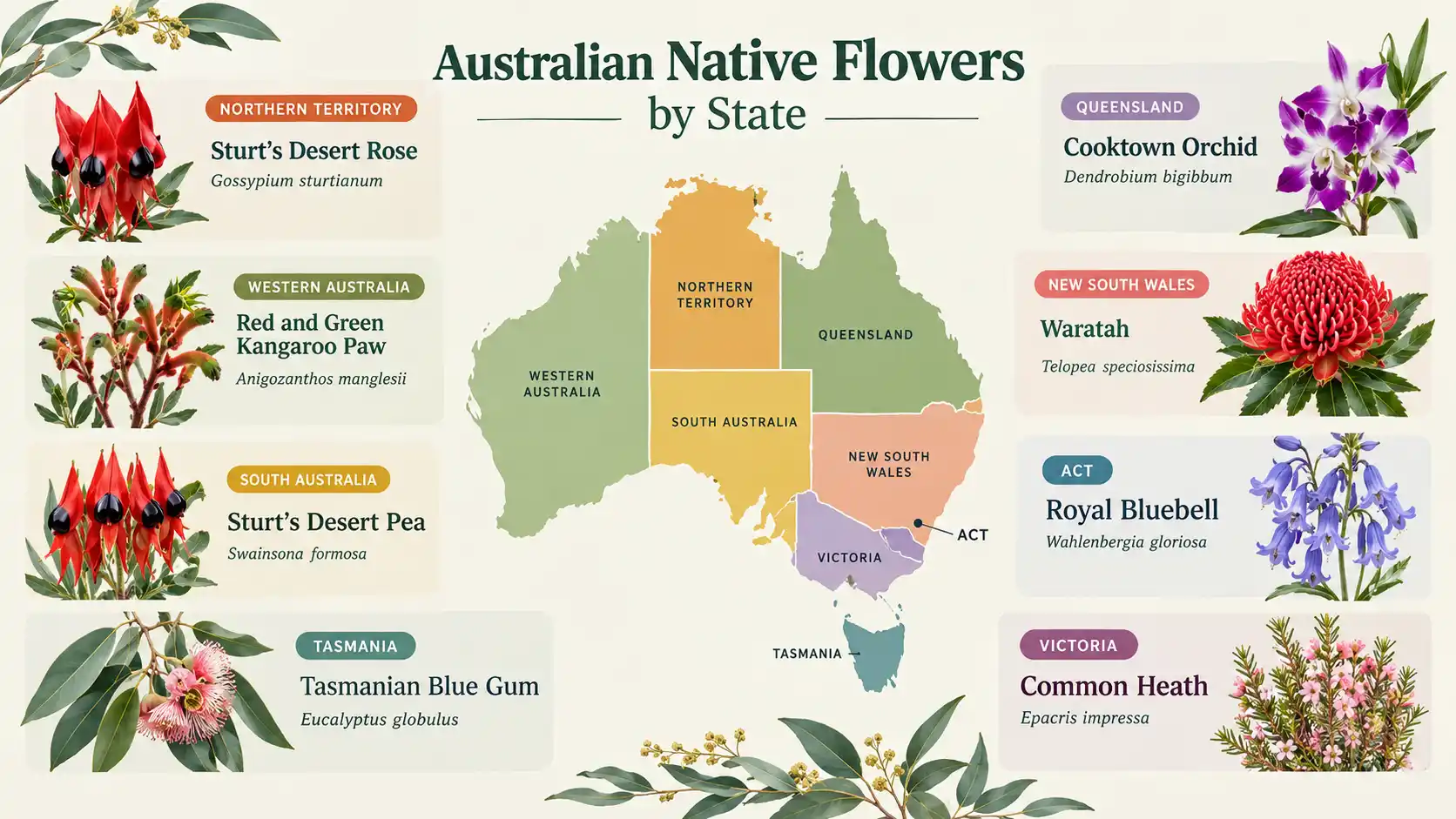
The Australian Government’s current Floral Emblems of Australia reference lists the eight state and territory emblems and their botanical names.
| State/Territory | Official floral emblem | Botanical name | Broad flowering window | Main habitat/region | Practical garden difficulty |
| ACT | Royal Bluebell | Wahlenbergia gloriosa | Spring to early autumn | Subalpine/cool regions | Moderate–challenging |
| NSW | Waratah | Telopea speciosissima | Spring | Sandstone ridges, forests, coastal NSW | Challenging |
| NT | Sturt’s Desert Rose | Gossypium sturtianum | Rainfall-dependent | Southern arid NT | Moderate with climate match |
| QLD | Cooktown Orchid | Dendrobium phalaenopsis | Autumn–winter | Northern tropical Queensland | Moderate; easier in suitable QLD sites |
| SA | Sturt’s Desert Pea | Swainsona formosa | Rainfall-dependent | Dry inland Australia | Challenging |
| Tasmania | Tasmanian Blue Gum | Eucalyptus globulus | Early summer | Tasmanian forests/coasts | Unsuitable for many small gardens |
| Victoria | Common Heath | Epacris impressa | Broad; late autumn–late spring commonly cited | Heathlands and mountains | Moderate |
| WA | Red and Green Kangaroo Paw | Anigozanthos manglesii | Late winter–spring | Southwest WA | Moderate |
These difficulty ratings are Greenery Nest’s practical guide, not official horticultural rankings. They depend heavily on whether the plant is being grown in a climate similar to its natural habitat. The biggest example is Tasmania’s Blue Gum: it can reach about 60 m in favourable conditions, making mature scale more important than simple “ease of care.”
New South Wales: Waratah and Other Native Flowers
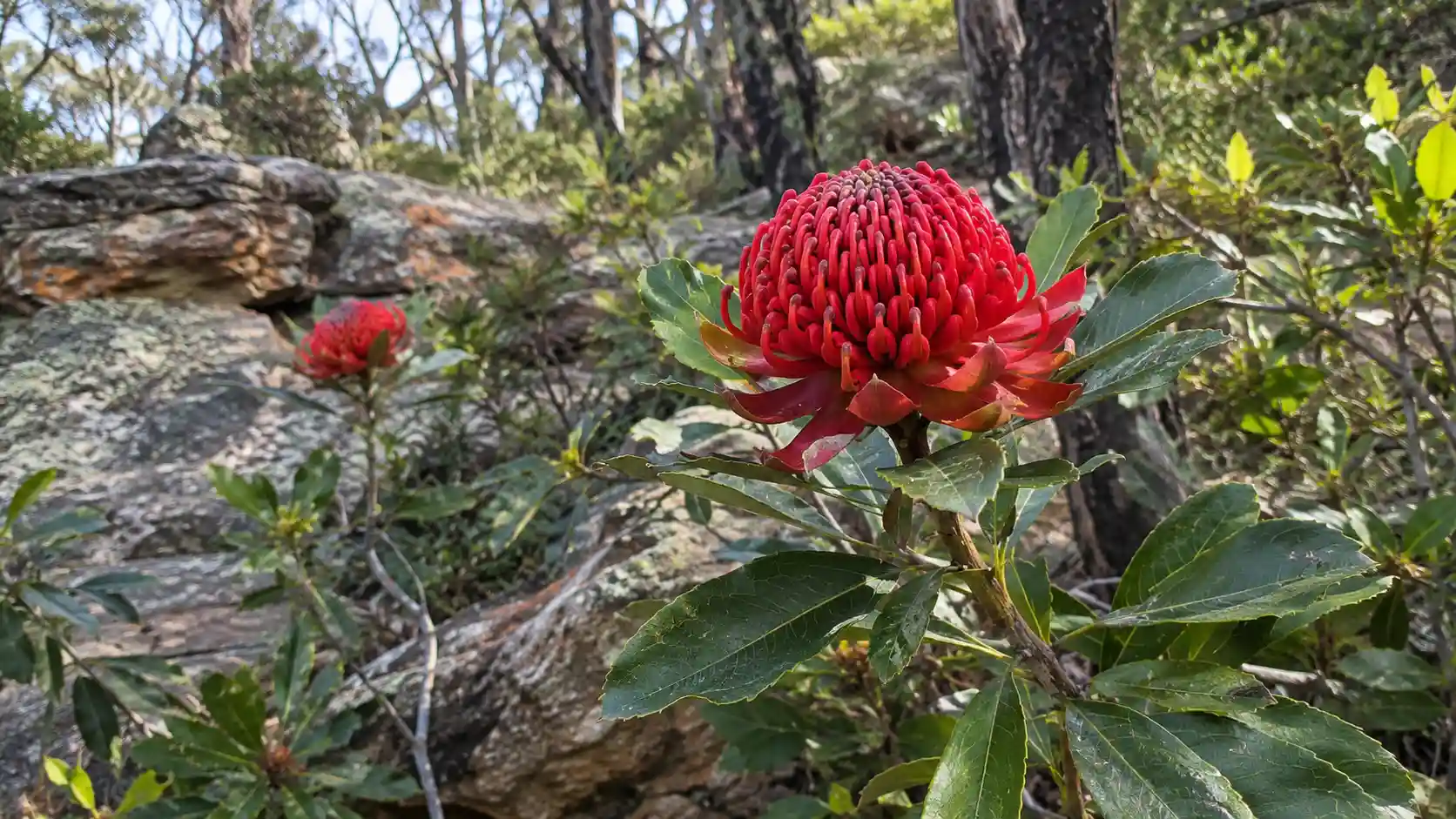
What is NSW’s floral emblem?
The Waratah (Telopea speciosissima) is NSW’s floral emblem. It produces large crimson flowerheads and is protected by law. NSW National Parks records it from sandstone ridges around Sydney, nearby mountain ranges and the NSW South Coast.
Other native flowers strongly associated with NSW include flannel flowers, grevilleas and bottlebrushes. These are not substitutes for the official emblem; they illustrate the much broader native-flower diversity within the state.
When and where can you see NSW native flowers?
Waratahs bloom in spring, with NSW National Parks documenting populations from the Gibraltar Range south toward Lake Conjola, including sites such as the Blue Mountains and Muogamarra.
What should NSW gardeners watch out for?
Waratah is a good example of a flower that is iconic but not necessarily easy. It prefers excellent drainage, suitable moisture and a sheltered position, and it is sensitive to excess phosphorus.
For additional colour-based identification, Greenery Nest’s guides to purple native flowers in Australia and white native flowers in Australia can help readers explore NSW’s wider native palette.
Victoria: Common Heath and Temperate Wildflowers
What is Victoria’s floral emblem?
Victoria’s floral emblem is the Common Heath (Epacris impressa), particularly the pink form. Parks Victoria describes it as a small shrub found in coastal heathlands as well as mountains and foothills.
When does Common Heath flower?
Common Heath can flower across a surprisingly long period. Parks Victoria describes flowering from late autumn to late spring in the Grampians, while educational material notes that flowers can occur year-round depending on conditions.
Where are Victoria’s native flowers easiest to see?
The Grampians/Gariwerd, Brisbane Ranges and Anglesea Heath are useful examples of Victorian landscapes where native flowering displays can be observed.
The important gardening lesson is that a plant adapted to Victorian heathland may need very different treatment from a tropical native grown in Brisbane.
Queensland: Cooktown Orchid and Tropical Native Flowers
What is Queensland’s floral emblem?
Queensland’s floral emblem is the Cooktown Orchid, listed in Australian Government sources as Dendrobium phalaenopsis. Queensland Government material describes it as a northern tropical native associated with Cape York Peninsula.
Why can’t one Queensland flower calendar fit the whole state?
Queensland spans tropical, subtropical and warmer temperate environments. A plant native to Cape York should not automatically be treated as a good choice for every garden from Cairns to Brisbane or inland Queensland.
Where and when can Queensland native flowers be seen?
The Cooktown Orchid flowers for up to about six weeks in autumn and winter under suitable conditions. Queensland Government guidance describes it as relatively easy to cultivate as a garden specimen in frost-free coastal Queensland, provided it has drainage, sun and protection from cold winter winds.
This is an important exception to the idea that “native” automatically means “hardy everywhere.”
South Australia: Sturt’s Desert Pea and Dryland Wildflowers
What is South Australia’s floral emblem?
South Australia’s floral emblem is Sturt’s Desert Pea (Swainsona formosa), adopted in 1961. It is an arid-zone plant with trailing stems, grey foliage and distinctive red flowers with a dark central marking.
Why is Sturt’s Desert Pea difficult to grow?
Its natural environment provides the clue. Sturt’s Desert Pea is associated with dry inland Australia, so recreating its preferred combination of drainage, dryness and suitable growing conditions can be difficult in a conventional garden.
It should therefore be treated as a specialist choice, not simply as a drought-tolerant plant that can be planted and forgotten.
When and where can you see South Australian wildflowers?
Flowering in arid regions is strongly influenced by rainfall. That means a “best month” can be less useful than understanding whether the preceding season provided enough moisture.
For gardeners choosing among colour groups, Greenery Nest’s yellow Australian native flowers guide provides a broader look at native flowering plants that can suit different Australian climates.
Western Australia: Kangaroo Paw and the Southwest Wildflower Region
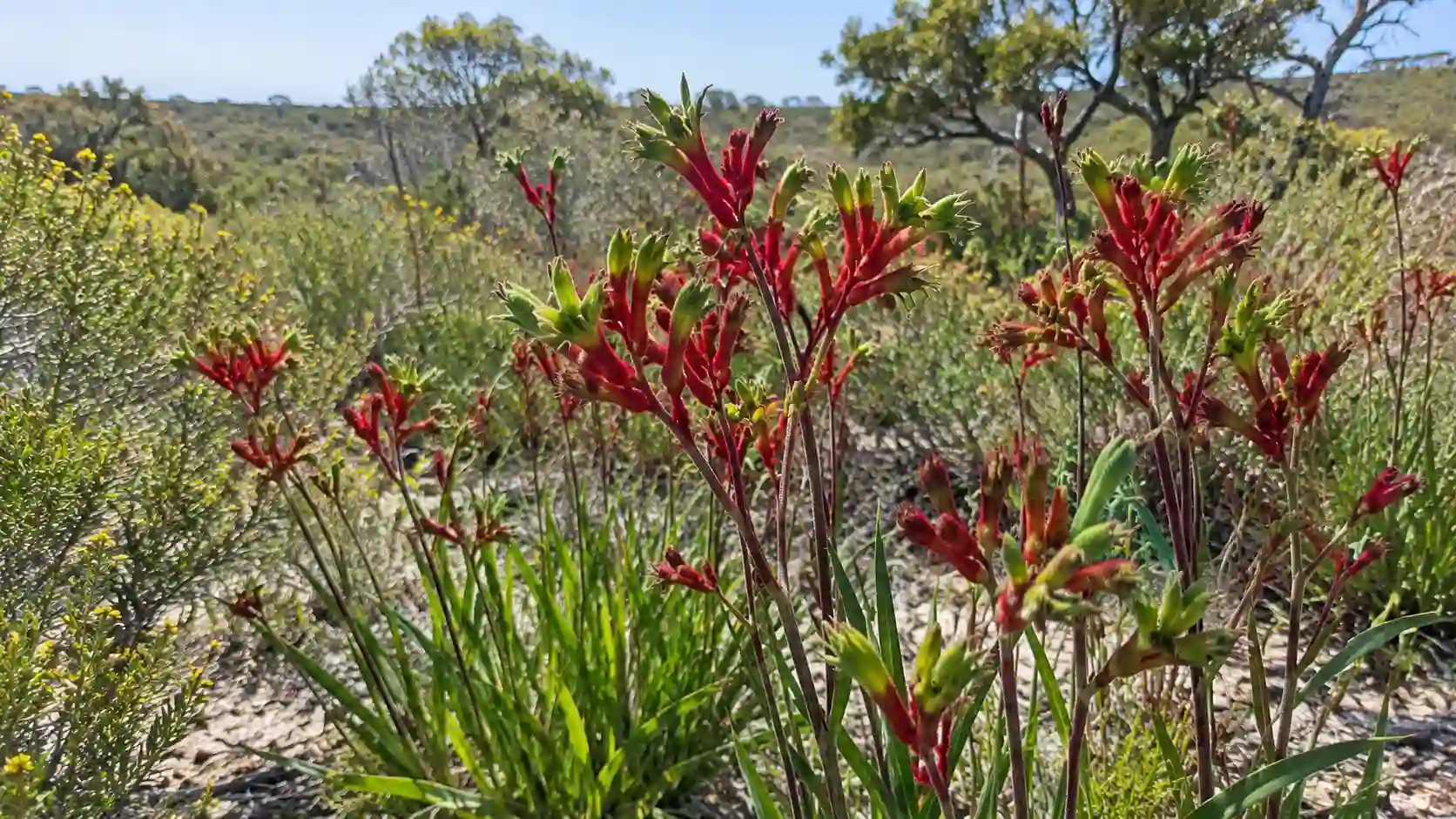
What is Western Australia’s floral emblem?
Western Australia’s floral emblem is the Red and Green Kangaroo Paw (Anigozanthos manglesii), naturally found only in Western Australia. The WA Government describes it as a distinctive native of the state, particularly associated with southwestern bushland and sandy coastal plains.
When does Mangles Kangaroo Paw flower?
Kings Park describes the flowers as appearing from late winter through spring, with August to October a particularly good viewing period at Kings Park.
Why is WA different from the other states?
Western Australia contains enormous regional variation, and the southwest is especially important for wildflower diversity. A plant described simply as “a WA native” may have very specific habitat requirements.
For cultivation details, link directly to Greenery Nest’s kangaroo paw care guide. Readers interested in colour variation can also compare the yellow kangaroo paw guide and blue kangaroo paw guide.
Tasmania: Tasmanian Blue Gum and Cool-Climate Flowers
What is Tasmania’s floral emblem?
Tasmania’s floral emblem is the Tasmanian Blue Gum (Eucalyptus globulus). Tasmanian Government sources note that it can reach about 60 metres in favourable conditions.
When does Tasmanian Blue Gum flower?
Flowering occurs fairly regularly in early summer. The flowers provide food for insects and birds, and the species is important habitat for the endangered swift parrot.
Is the emblem suitable for a home garden?
Not necessarily. This is one of the clearest examples of why a floral emblem should not be confused with a recommended suburban garden plant.
Parks Tasmania lists Freycinet National Park, Maria Island National Park and Tinderbox Marine Nature Reserve among places where Blue Gum can be seen.
The common mistake is choosing a state emblem without considering mature size and root/canopy space.
Australian Capital Territory: Royal Bluebell and Canberra’s Alpine-Influenced Flora
What is the ACT floral emblem?
The Royal Bluebell (Wahlenbergia gloriosa) became the ACT floral emblem in 1982. ACT Government describes it as native to alpine and subalpine woodlands around the ACT, southeastern NSW and Victoria.
When does Royal Bluebell flower?
ANBG records flowering from October to March, while ACT parliamentary material describes it as a spring flower.
What makes the ACT emblem different?
Royal Bluebell is legally protected in the wild, so seeing it is not an invitation to collect it. It is adapted to cool regions and can be cultivated in sunny or semi-shaded positions where conditions are appropriate.
For identification context, our native iris guide covers Patersonia species, another group of Australian plants with iris-like flowers that can be confused with introduced irises.
Northern Territory: Sturt’s Desert Rose and Arid-Zone Flowers
What is the NT floral emblem?
The Northern Territory’s floral emblem is Sturt’s Desert Rose (Gossypium sturtianum). It has been the NT emblem since 1974 and belongs to the cotton family, not the rose family.
Where does Sturt’s Desert Rose grow naturally?
NT Government guidance describes it as an arid plant that grows best on stony or rocky ground, including dry creek beds. It occurs in the southern Territory and is also found in parts of South Australia, NSW and Queensland.
What does this teach gardeners?
The NT emblem demonstrates a recurring principle throughout this article: habitat is more informative than state borders.
A dryland flower may perform poorly in a humid, poorly drained garden even though both locations are technically in Australia.
Which Australian Native Flowers Occur Across Multiple States?
Why do some native flowers appear in several states?
State emblems are political and cultural designations; natural distributions are ecological. They do not follow state borders.
| Flower group | Distribution pattern | Important distinction |
| Grevillea | Numerous species across several regions | The same genus does not mean the same growing requirements |
| Acacia | Very widespread across Australia | Species vary greatly in size, climate and flowering |
| Bottlebrush-type plants | Several Australian regions | Species and genera need to be identified rather than relying on the common name |
| Telopea/waratahs | NSW, Victoria and Tasmania | Different species are commonly called waratahs |
| Kangaroo paws | Strongly associated with southwest WA | Cultivars and hybrids are now grown beyond the natural range |
Our Australian native flower names guide provides a useful bridge from state identity to broader native-flower identification.
Which flowers are truly state-specific?
“State-specific” needs careful wording. A flower can be an official emblem of one state while the species itself occurs elsewhere. Conversely, a species can have a naturally narrow distribution but still be cultivated far beyond it.
The NSW Waratah is a good example: the emblem species is Telopea speciosissima, but other Telopea species occur in Victoria and Tasmania.
NSW Waratah vs Tasmanian and Victorian Waratahs: How Are They Different?
Are all waratahs the NSW waratah?
No. “Waratah” is a common name used for several Telopea species.
| Common name | Botanical name | Region | Key point |
| NSW Waratah | Telopea speciosissima | NSW | Official NSW floral emblem |
| Tasmanian Waratah | Telopea truncata | Tasmania | Different species |
| Victorian Waratah | Telopea oreades | Victoria | Different species |
Gardening Australia specifically distinguishes these three species and notes that NSW’s emblem is T. speciosissima.
This matters when buying plants because common names can conceal important differences in climate and cultivation requirements.
Which State Floral Emblems Are Easiest or Hardest to Grow?
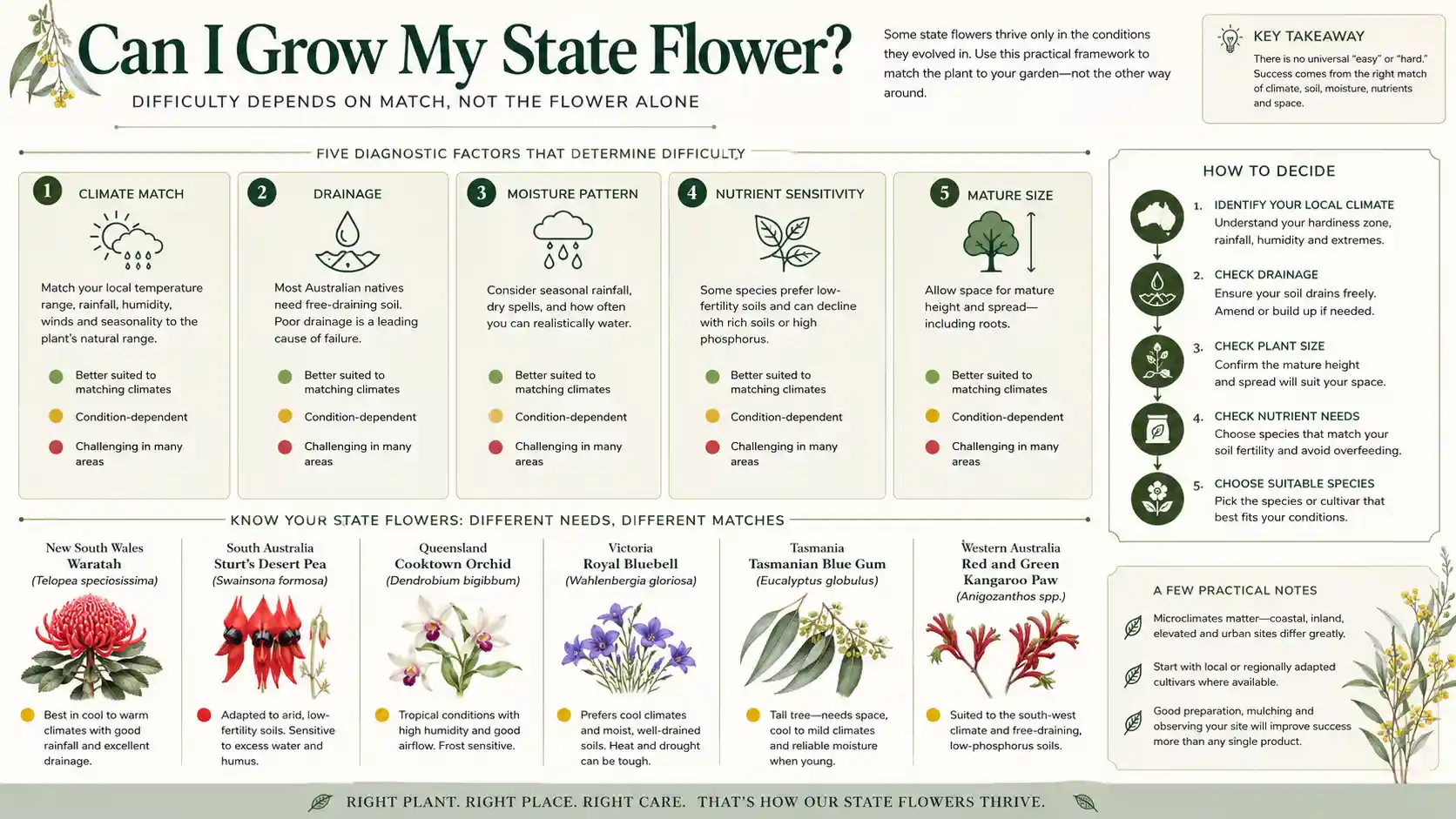
How should “easy” and “difficult” be judged?
Ease should be based on whether a plant’s natural conditions can reasonably be reproduced:
- climate and temperature
- drainage
- moisture pattern
- soil type
- nutrient sensitivity
- mature size
- availability of suitable cultivated material
Which are clearly challenging?
NSW Waratah and Sturt’s Desert Pea are useful examples of difficult emblem plants.
Waratah can be fussy about position, drainage and phosphorus, while Sturt’s Desert Pea has a reputation for requiring conditions that are difficult to reproduce consistently in ordinary gardens.
Which should not be labelled “easy” without qualification?
The Cooktown Orchid provides the important counterexample: Queensland Government information describes it as relatively easy to cultivate in frost-free coastal Queensland. That qualification matters. A plant can be easy in Brisbane or coastal northern Queensland and unsuitable somewhere with regular frost.
So there is no universally easiest Australian state flower.
What Soil, Drainage and Fertiliser Conditions Matter for Australian Native Flowers?
Do all Australian natives need low-phosphorus fertiliser?
No. This is one of the most persistent Australian gardening oversimplifications.
The Australian National Botanic Gardens states that most native plants respond well to standard nutrient levels, while some families, including Proteaceae and Fabaceae, contain plants that cannot tolerate high phosphorus levels.
Gardening Australia similarly identifies many Proteaceae, including banksias, hakeas and grevilleas, as particularly phosphorus-sensitive.
Why does drainage matter so much?
Drainage is critical because many Australian plants evolved in soils where water does not remain around roots for long periods. But the requirement is species-specific: a tropical orchid growing on trees has very different moisture conditions from an arid-zone desert pea.
The practical rule is match drainage to the species rather than applying one “native plant” formula to every flower.
What should gardeners check before planting?
Use this checklist before choosing any native flower:
- local rainfall pattern
- winter versus summer rainfall
- soil drainage
- soil texture
- frost and heat exposure
- available sunlight
- mature size
- phosphorus sensitivity
- whether the plant is naturally occurring or a cultivated hybrid
For broader planting principles, our Australian native garden plants guide expands on soil, watering, plant selection and regional conditions.
The 2001 Federation Flowers Are Not the Same as State Floral Emblems
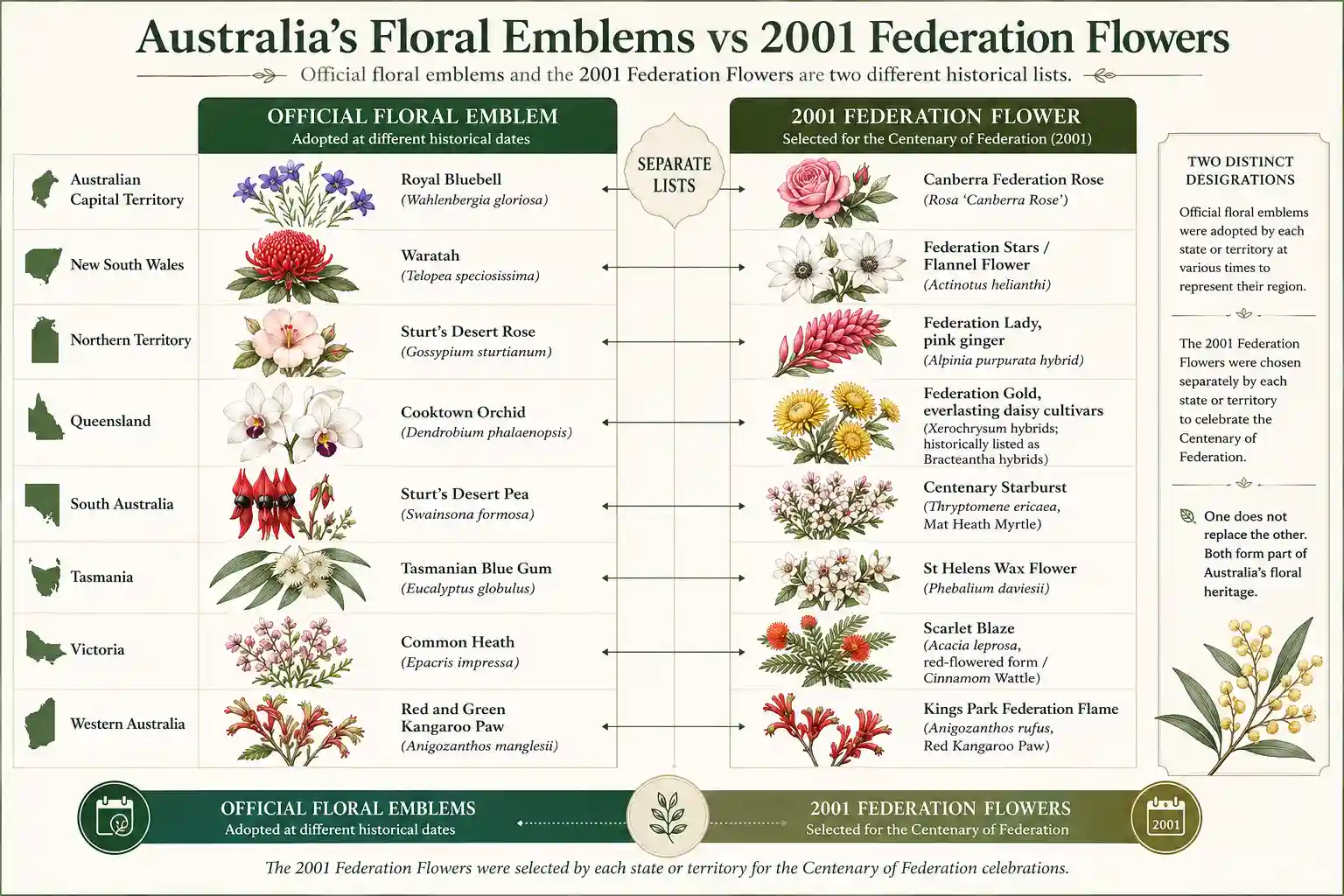
What is a Federation Flower?
The Federation Flowers were a separate 2001 Centenary of Federation initiative. Each state and territory nominated an ornamental plant intended for release around the centenary. They were therefore not simply replacements for the official floral emblems.
The complete historical list is documented by the Australian National Botanic Gardens Federation Flowers record.
How do Federation Flowers differ from official emblems?
| State/Territory | Official floral emblem | 2001 Federation Flower |
| ACT | Royal Bluebell | Canberra Federation Rose |
| NSW | Waratah | Federation Stars / Flannel Flower |
| NT | Sturt’s Desert Rose | Federation Lady / Pink Ginger |
| QLD | Cooktown Orchid | Federation Gold / Everlasting Daisies |
| SA | Sturt’s Desert Pea | Centenary Starburst / Mat Heath Myrtle |
| Tasmania | Tasmanian Blue Gum | St Helens Wax Flower |
| Victoria | Common Heath | Scarlet Blaze / red-flowered Cinnamom Wattle |
| WA | Red and Green Kangaroo Paw | Kings Park Federation Flame / Red Kangaroo Paw |
The ANBG record gives the botanical names and trade names for each of these Federation selections.
This distinction is useful when researching “Australian state flowers” because the two lists answer different historical questions.
Common Mistakes When Choosing Australian Native Flowers by State
Mistake 1: Assuming every native grows well everywhere
A plant being native to Australia does not mean it is native to your climate, soil or rainfall pattern. Match species to local conditions first.
Mistake 2: Treating all native flowers as phosphorus-sensitive
As the ANBG and Gardening Australia explain, phosphorus sensitivity varies substantially between plant groups and species.
Mistake 3: Treating bloom months as fixed dates
Rainfall, elevation and local climate can change flowering times. Kings Park, for example, gives a particularly useful August–October viewing window for Mangles Kangaroo Paw, while ACT Royal Bluebell has a much broader October–March flowering range in cultivation records.
Mistake 4: Choosing an emblem without checking mature size
Tasmanian Blue Gum is the clearest warning: a tree that can reach around 60 m should not be chosen for a small suburban garden simply because it represents the state.
Mistake 5: Picking wildflowers or assuming public sightings mean collection is allowed
Some native plants are protected. ACT Government explicitly notes that Royal Bluebell should not be picked in the wild. Check the rules for the park or reserve you are visiting and enjoy protected wildflowers in place.
How to Choose an Australian Native Flower for Your Own State
Start with your local conditions, not the emblem list
A better selection process is:
- Identify your local climate and rainfall pattern.
- Check whether the soil is free-draining, compacted, sandy, clayey or seasonally wet.
- Record frost, heat and exposure conditions.
- Decide the plant’s job: feature flower, ground cover, shrub, screening plant or tree.
- Check the natural flowering season.
- Check mature height and width.
- Confirm fertiliser and nutrient requirements.
- Choose a species or cultivar documented for conditions similar to yours.
This approach is more reliable than asking only, “What is my state’s native flower?”
Our low-maintenance Australian native plants guide can help narrow the choices further by garden use and maintenance level.
Where should readers go next?
Use this article as the state-level map, then move into species-specific guidance before planting. For example, gardeners interested in paper daisies can continue with our Paper Daisy Plant guide, while kangaroo paw growers can use the dedicated care guide linked above.
Conclusion
Australian native flowers by state make the most sense when official identity, natural distribution, flowering season and growing conditions are considered together.
The eight floral emblems are useful cultural reference points, but they are not a universal planting list. NSW Waratah needs different conditions from Queensland’s Cooktown Orchid; WA’s Red and Green Kangaroo Paw has a different natural range from Tasmania’s Blue Gum; and ACT Royal Bluebell has protection and cool-climate requirements that make local context essential.
The best native flower for your garden is therefore not necessarily your state’s emblem. It is the plant whose climate, soil, drainage, light, size and flowering pattern match your actual site.
FAQs
What is the native flower for each Australian state and territory?
The official floral emblems are: ACT — Royal Bluebell; NSW — Waratah; NT — Sturt’s Desert Rose; Queensland — Cooktown Orchid; South Australia — Sturt’s Desert Pea; Tasmania — Tasmanian Blue Gum; Victoria — Common Heath; and Western Australia — Red and Green Kangaroo Paw.
Which Australian state flower is the easiest to grow?
There is no universally easiest state flower because climate changes the answer. The Cooktown Orchid is described by Queensland Government material as relatively easy to cultivate in frost-free coastal Queensland when given appropriate drainage and protection.
Which Australian native state flowers are hardest to grow?
The NSW Waratah and Sturt’s Desert Pea are useful examples of challenging plants. Waratah is sensitive to poor drainage and excess phosphorus, while Sturt’s Desert Pea is strongly associated with demanding arid-zone growing conditions.
Do Australian native flowers only grow in their own state?
No. State emblems represent jurisdictions, not biological borders. Several native genera and groups occur across multiple states, and some species are now widely cultivated outside their natural ranges.
Which Australian native flowers bloom in spring?
Spring bloomers include the NSW Waratah and WA Red and Green Kangaroo Paw, while Victoria’s Common Heath can flower from late autumn into late spring. The exact timing varies with location and conditions.
Do all Australian native flowers need low-phosphorus fertiliser?
No. Some native families are highly phosphorus-sensitive, especially many Proteaceae, while many other Australian native plants tolerate ordinary fertiliser levels. The safest approach is to identify the species or family before selecting a fertiliser.
What is the difference between a state floral emblem and a Federation Flower?
A floral emblem is the official flower representing a state or territory. A Federation Flower was part of the separate 2001 Centenary of Federation ornamental plant initiative. The two lists are therefore not interchangeable.