
Introduction
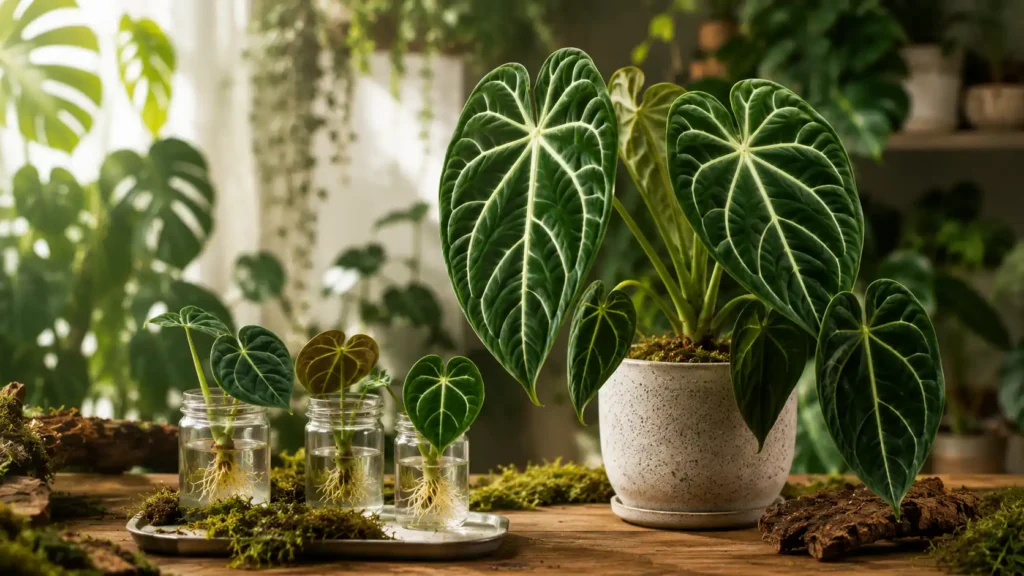
Learning how to propagate Anthurium Crystallinum allows plant enthusiasts to multiply one of the most admired velvet-leaf aroids at home. Anthurium Crystallinum is a tropical plant known for its dark, heart-shaped leaves, velvety texture, and striking silver veins. Propagation involves creating new plants from a mature specimen through methods such as stem cuttings, division, and rooting in water or soil. This guide explains the best propagation techniques, ideal timing, environmental conditions, and common mistakes to avoid. With the right combination of healthy nodes, warmth, humidity, and proper moisture control, Anthurium Crystallinum can be successfully propagated indoors.
Anthurium Crystallinum is one of many tropical houseplants that benefit from understanding proper lighting, watering, and propagation techniques, which are covered in our complete Plants: Benefits and Guides resource.
Quick Summary
- Anthurium Crystallinum is commonly propagated through stem cuttings with viable nodes or by dividing mature plants with established growth points.
- The best propagation time is during the active growing season when the plant naturally produces new roots and leaves.
- Water propagation and soil propagation can both work when humidity, warmth, and moisture levels are carefully maintained.
- Successful propagation depends on having a healthy node, avoiding rot, and providing bright indirect light with high humidity.
What Is Anthurium Crystallinum?
Anthurium Crystallinum is a tropical velvet-leaf aroid from the Araceae family, valued for its large heart-shaped leaves, soft texture, and contrasting silver-white vein patterns. The plant is often grown as an ornamental houseplant because of its unique foliage rather than its flowers. Anthurium Crystallinum belongs to the genus Anthurium, a large group of flowering plants in the Araceae family.
The Anthurium Crystallinum plant is native to tropical regions of Central and South America, where it grows naturally in warm, humid forest environments. Its common name is typically “velvet anthurium” because of the soft appearance of its leaves.
The Anthurium Crystallinum flower is a typical aroid inflorescence consisting of a spadix and spathe. However, indoor growers usually appreciate this species primarily for its foliage characteristics rather than flowering performance.
Propagation allows growers to create new Anthurium Crystallinum plants from mature specimens. Unlike some easy-propagating houseplants, this species requires careful attention because it depends on proper humidity, airflow, and root health.
Anthurium Crystallinum is sometimes confused with Philodendron Crystallinum, but they belong to different plant genera. Both have attractive veined leaves, yet their growth patterns, leaf structures, and botanical characteristics differ.
Another related plant often discussed among collectors is Villenaorum Anthurium, which shares similar elongated or textured foliage characteristics and may appear in hybrid discussions within the Anthurium community.
Anthurium Crystallinum vs. Philodendron Crystallinum (Comparison Block)
Although Anthurium Crystallinum and Philodendron Crystallinum share similar names and visual features, they are different plants with different growth habits.
| Feature | Anthurium Crystallinum | Philodendron Crystallinum |
| Plant family | Araceae | Araceae |
| Leaf texture | Velvety, soft surface | Velvety but often thicker-textured |
| Leaf shape | Broad heart-shaped leaves | Large elongated heart-shaped leaves |
| Veins | Bright silver-white veins | Prominent lighter veins |
| Growth habit | Mostly terrestrial or epiphytic growth | Primarily climbing aroid growth |
| Propagation | Stem division or node cuttings | Stem cuttings with nodes |
| Main attraction | Velvet foliage and silver venation | Large decorative foliage |
The main difference is that Anthurium Crystallinum develops from a short stem structure with growth points close together, while many Philodendron species naturally produce longer climbing stems.
Is Anthurium Crystallinum Hard to Grow?
Anthurium Crystallinum is considered moderately difficult to grow because it requires stable tropical conditions, especially high humidity, warmth, and careful watering. It is not the easiest aroid for beginners, but it can thrive indoors when environmental needs are consistently maintained.
Like other rare tropical foliage plants, Anthurium Crystallinum requires stable conditions, similar to the care approach used for collectible plants such as the Variegated Monstera Deliciosa.
Compared with common houseplants such as pothos or philodendrons, Anthurium Crystallinum is more sensitive to changes in:
- Humidity levels
- Root moisture
- Temperature fluctuations
- Poor airflow
- Compact soil conditions
The biggest challenge during propagation is preventing root rot. Because Anthuriums prefer moisture without waterlogged roots, an overly wet environment can quickly damage new cuttings.
The question “What is the hardest Anthurium to grow?” does not have one universal answer because difficulty depends on growing conditions. However, rare collector species with very specific humidity and temperature requirements are generally considered more challenging than Anthurium Crystallinum.
For successful propagation, growers should focus on maintaining:
- Humidity around 60–80% when possible
- Warm temperatures above 18°C (65°F)
- Bright indirect light
- A breathable growing medium
- Healthy stems with active nodes
Is Anthurium Crystallinum a Climber or Crawler?
Anthurium Crystallinum is not considered a true climbing plant or a ground-crawling plant. It has a compact growth habit and typically grows as a terrestrial or epiphytic aroid with short stems and closely spaced growth points.
This growth structure affects propagation because new plants usually develop from:
- Stem sections containing active nodes
- Offsets produced near the base of mature plants
- Divided sections with existing roots
Unlike climbing Philodendrons that produce long aerial-rooted stems, Anthurium Crystallinum does not usually provide long sections of stem for repeated cuttings.
Because nodes are essential for new growth, identifying the stem structure before cutting is one of the most important steps in propagation.
Anthurium Propagation Methods
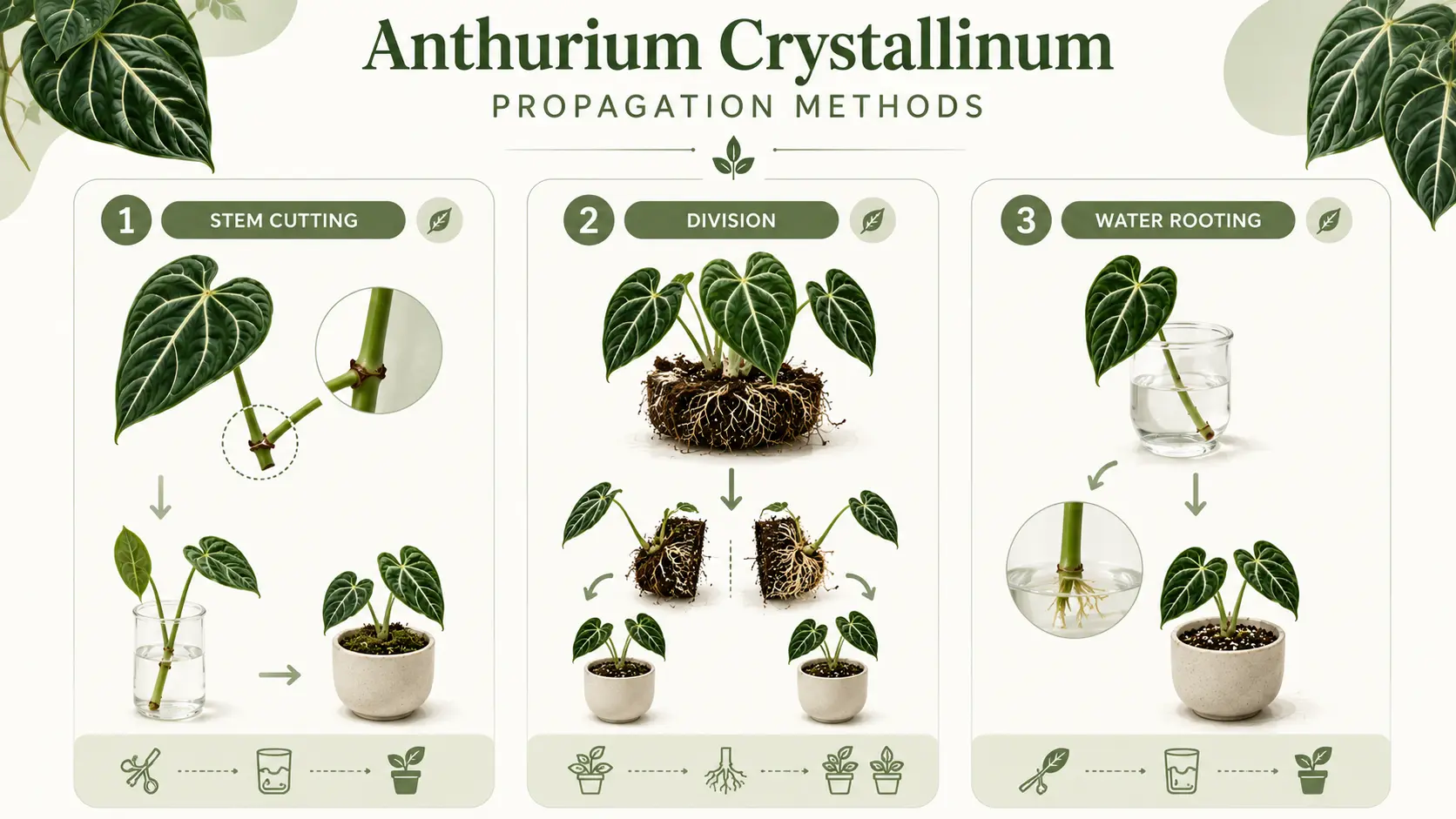
Anthurium propagation involves creating new plants from parts of a mature plant that contain the ability to produce roots and new growth. The most reliable methods for Anthurium Crystallinum are stem cutting propagation and division.
Similar to other tropical aroids, successful propagation depends on identifying the correct plant structure and using the right technique, as explained in our guide on how to propagate Alocasia corms.
The main propagation methods include:
- Stem cuttings with healthy nodes
- Division of mature plants with multiple growth points
- Water rooting followed by soil transfer
- Soil propagation using suitable aroid mixtures
Leaf-only propagation is generally unsuccessful because Anthuriums require a node containing meristematic tissue to produce new growth.
Stem Cutting Propagation
Stem cutting Anthurium propagation is one of the most common techniques for multiplying Anthurium Crystallinum. A successful anthurium cutting must contain a healthy node because the node is where new roots and shoots develop.
Understanding where growth points develop is essential for propagation success, and the same principle applies when learning about aroid structures through a Monstera plant node identification guide.
Important steps include:
- Select a mature, healthy plant with active growth.
- Identify a stem section containing at least one visible node.
- Use sterilized pruning scissors or a sharp blade.
- Make a clean cut to reduce tissue damage.
- Allow the cutting surface to dry slightly before planting if needed.
When selecting a cutting, avoid stems that show:
- Soft or blackened tissue
- Signs of fungal damage
- Severe dehydration
- Root problems
A healthy node is the foundation of successful propagation because leaves alone cannot create a complete new plant.
Propagating Anthurium from a Leaf
Propagating Anthurium from a leaf alone is generally not successful because an Anthurium leaf does not contain the necessary growth point to produce a new plant.
Unlike some succulents that can regenerate from individual leaves, Anthuriums require:
- A stem section
- A node
- Active growth tissue
A leaf attached to a small stem section without a viable node may remain green for some time but will not usually develop into a new Anthurium Crystallinum plant.
To propagate an Anthurium successfully, growers should focus on stem sections or divisions rather than leaf-only methods.
Division Method
Division is another effective way to propagate Anthurium Crystallinum, especially when the mature plant has multiple growth points or naturally produced offsets.
This method involves separating sections of the plant that already contain:
- Roots
- Stems
- Leaves
- Active growth points
Division is often faster than stem cutting because the new plant already has an established root system.
Steps include:
- Remove the plant carefully from its container.
- Inspect the root system and locate natural separation points.
- Gently separate connected sections.
- Replant each division into a suitable aroid mix.
- Maintain high humidity while the plant adjusts.
| Propagation Method | Difficulty | Speed | Success Rate |
| Stem cutting | Moderate | Medium | Good when nodes are healthy |
| Leaf propagation | Very difficult/impractical | Very slow | Low without a node |
| Division | Easy to moderate | Faster | High when roots are established |
Division is usually the preferred option for mature Anthurium Crystallinum plants because it reduces the stress of developing a completely new root system.
How to Propagate Anthurium Crystallinum in Water
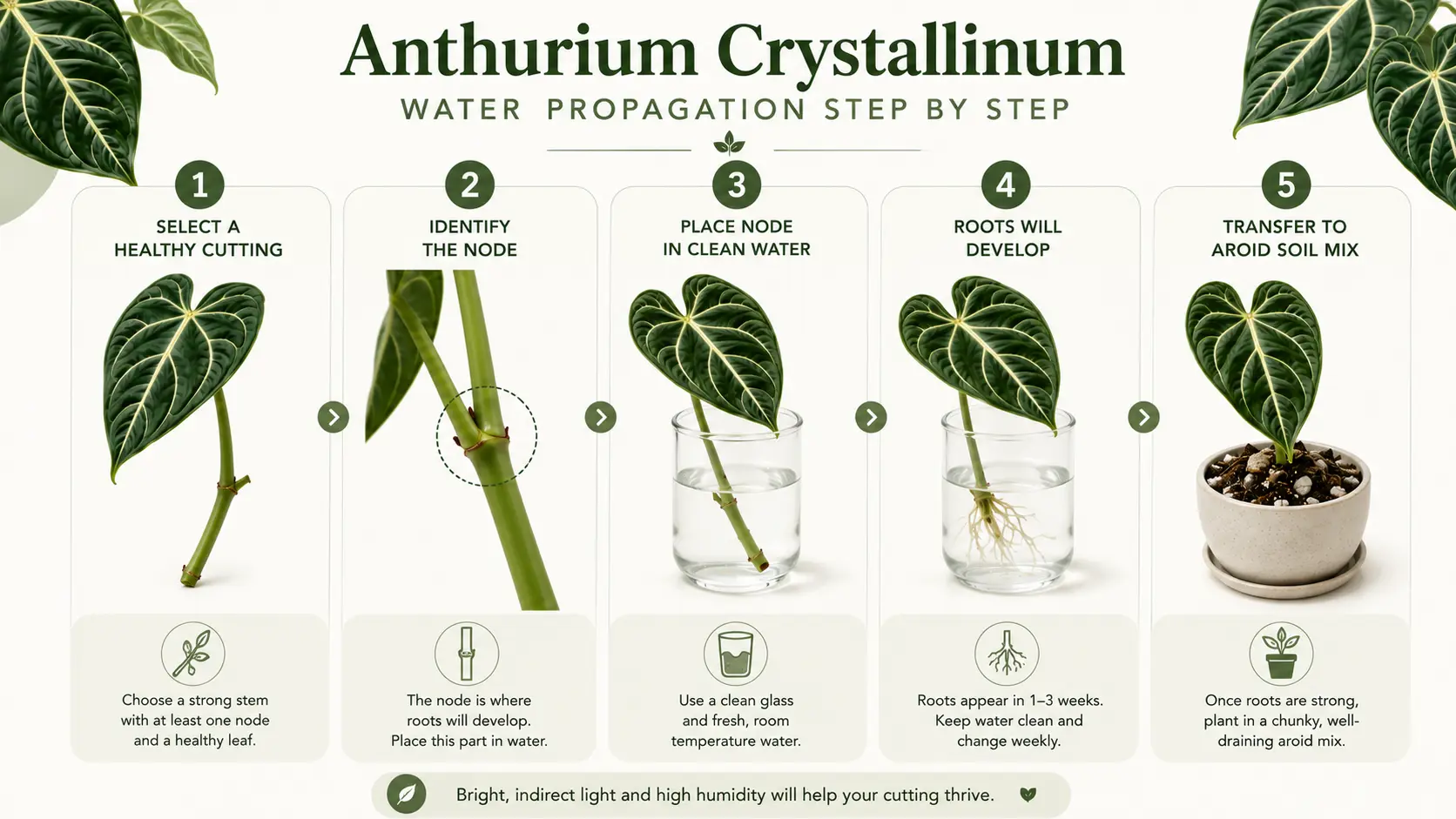
Propagating Anthurium Crystallinum in water is possible when a healthy stem cutting with a node is used. Water rooting allows growers to observe root development, but the cutting must eventually be moved into a suitable soil mix.
To propagate in water:
- Choose a healthy cutting with at least one node.
- Place the node section into clean water while keeping leaves above the surface.
- Keep the container in bright indirect light.
- Change the water regularly to prevent bacterial buildup.
- Transfer the cutting to soil once roots are developed.
Water propagation is a popular method among tropical plant growers, and similar techniques are also used for other aroids such as the Heartleaf Philodendron propagation process.
Water propagation works best when:
- Water remains clean
- Temperatures stay warm
- Humidity remains stable
- The cutting receives indirect light
Can You Use Tap Water on an Anthurium?
Anthuriums can tolerate tap water in many locations, but water quality affects long-term health. If tap water contains high levels of chlorine, minerals, or salts, filtered or distilled water may reduce stress on developing roots.
For sensitive propagations, growers often prefer:
- Filtered water
- Rainwater
- Distilled water
If tap water is used, allowing it to sit before use may help reduce chlorine levels in some areas, although treatment methods vary depending on local water systems.
How to Propagate Anthurium Crystallinum in Soil/Indoors
Propagating Anthurium Crystallinum indoors in soil is a reliable method when the growing medium provides both moisture retention and airflow. The plant requires a loose, well-draining mix because dense soil can trap water around delicate roots.
A suitable Anthurium Crystallinum soil mix often includes:
- Orchid bark for airflow
- Sphagnum moss or coco coir for moisture retention
- Perlite or pumice for drainage
- Quality potting soil for nutrients
An effective aroid potting mix should remain slightly moist but never saturated.
Container preparation includes:
- Choosing a pot with drainage holes
- Avoiding oversized containers
- Using fresh, breathable substrate
- Keeping the cutting stable after planting
Can I Use Orchid Potting Mix for Anthuriums?
Orchid potting mix can be used for Anthuriums when combined with additional moisture-retaining materials. Orchid bark improves aeration, but pure orchid mix may dry too quickly for Anthurium Crystallinum.
A balanced mixture usually works better because Anthuriums need both:
- Oxygen around roots
- Consistent moisture availability
A customized aroid mix is generally more suitable than using orchid mix alone.
Do Anthuriums Like Deep Pots?
Anthuriums generally do not prefer deep pots because they have relatively compact root systems that grow outward rather than requiring excessive vertical space. A pot that is too deep can hold extra moisture around the roots, increasing the risk of root rot.
Choosing the correct container size is important for tropical plants because oversized pots can increase moisture problems, a concept also explained in our guide to selecting the best pot for Monstera.
For Anthurium Crystallinum, a suitable container should:
- Be slightly larger than the root system
- Have drainage holes
- Allow airflow through the growing medium
- Provide enough room for gradual root expansion
Shallow or moderately sized pots are often preferred because they allow better moisture control. When the container is significantly larger than the plant’s root mass, the unused soil may remain wet for too long and create unfavorable conditions for healthy growth.
Best Time and Conditions to Propagate Anthurium Crystallinum
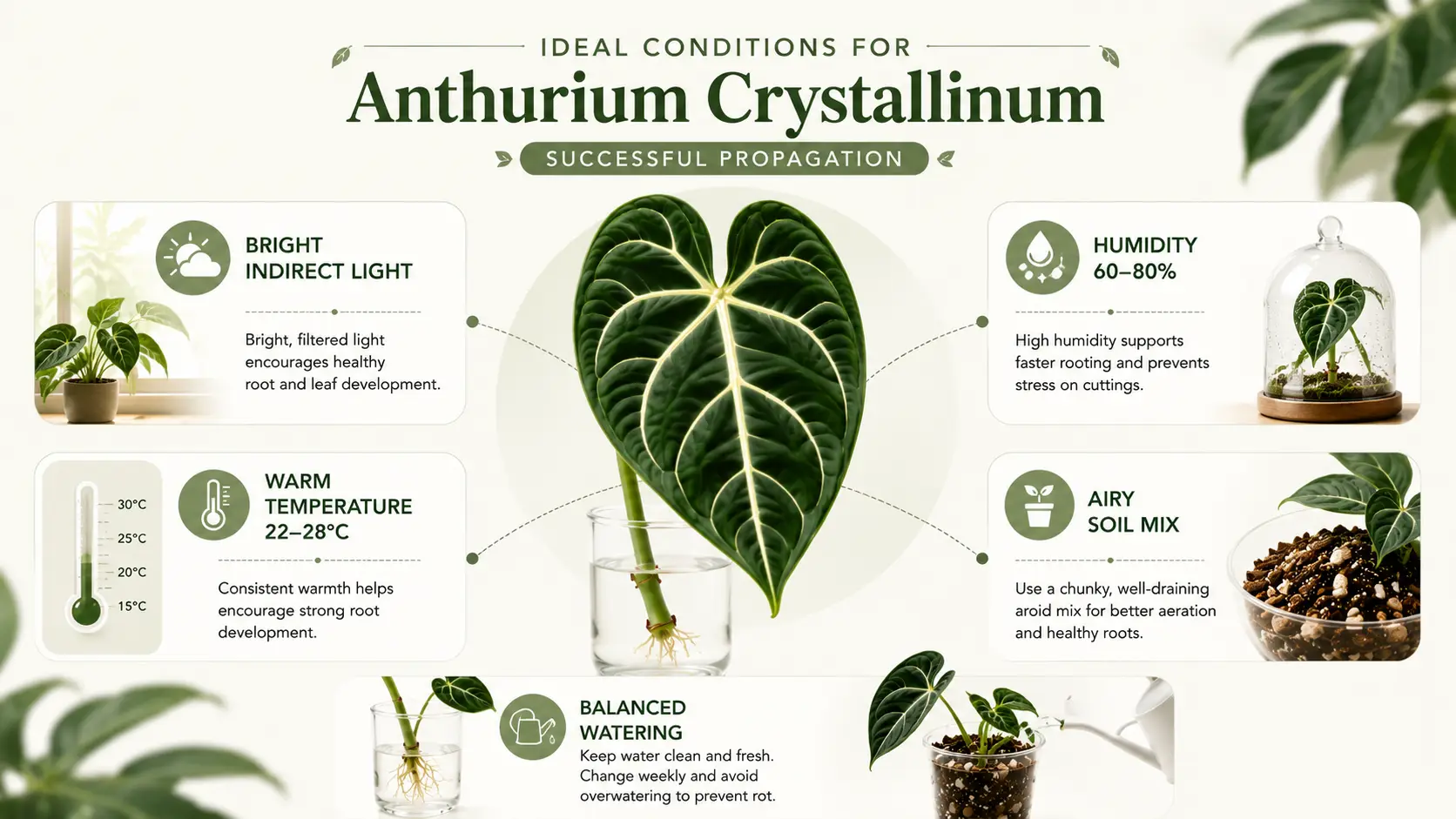
The best time to propagate Anthurium Crystallinum is during the active growing season, usually spring through summer when temperatures are warmer and the plant naturally produces new roots and leaves. Propagation is more successful when the plant is actively growing rather than during slower winter growth.
The most important conditions for successful propagation include:
| Condition | Ideal Range or Requirement |
| Temperature | Around 18–29°C (65–85°F) |
| Humidity | Approximately 60–80% |
| Light | Bright indirect light |
| Soil moisture | Slightly moist but well-draining |
| Airflow | Gentle circulation to prevent fungal issues |
Anthurium Crystallinum humidity is one of the most important factors because the plant naturally grows in tropical forest environments. Low humidity can cause:
- Slow root development
- Leaf curling
- Dry leaf edges
- Propagation stress
Anthurium Crystallinum light requirements are also important. The plant prefers bright indirect light rather than direct sunlight, which can damage its thin, delicate leaves.
Signs that environmental conditions are suitable include:
- New roots forming steadily
- Leaves remaining firm and healthy
- New growth emerging from active nodes
Propagation during colder months can still work indoors, but slower growth and delayed rooting are common because the plant’s metabolism decreases when temperatures drop.
Fertilizing and Feeding Newly Propagated Anthuriums
Newly propagated Anthurium Crystallinum plants should not be heavily fertilized immediately because developing roots are sensitive and can be damaged by excess nutrients. Fertilizer should be introduced only after the plant has established roots and begins producing new growth.
A balanced feeding approach includes:
- Waiting until roots are visible and active
- Using diluted fertilizer rather than full-strength applications
- Feeding during active growth periods
- Avoiding fertilizer on stressed or newly transferred cuttings
Many growers ask, “Can I use Miracle-Gro on anthurium?” Miracle-Gro can be used on Anthuriums when properly diluted, but strong concentrations may burn delicate roots. A gentle application designed for houseplants or tropical foliage plants is usually safer.
Newly propagated plants benefit more from:
- Stable humidity
- Proper light
- Healthy roots
- Correct moisture levels
than from early fertilizer applications.
Signs of Successful Propagation (New Growth Indicators)
Successful Anthurium Crystallinum propagation is shown by healthy root development, new leaf formation, and stable plant growth. The first signs usually appear below the surface before visible leaf growth occurs.
Common indicators of success include:
- White or light-colored new roots
- Firm stem tissue
- A developing growth point
- A new leaf emerging from the node
- Increased stability in the growing medium
Anthurium Crystallinum new growth often begins slowly because the plant focuses energy on establishing roots before producing foliage.
A new leaf is one of the clearest signs that propagation has succeeded. The first new leaf may appear smaller than mature leaves, but it usually develops larger size and stronger texture as the plant becomes established.
The timing of new growth depends on:
- Cutting health
- Temperature
- Humidity
- Light exposure
- Rooting method
Common Propagation Mistakes and Troubleshooting
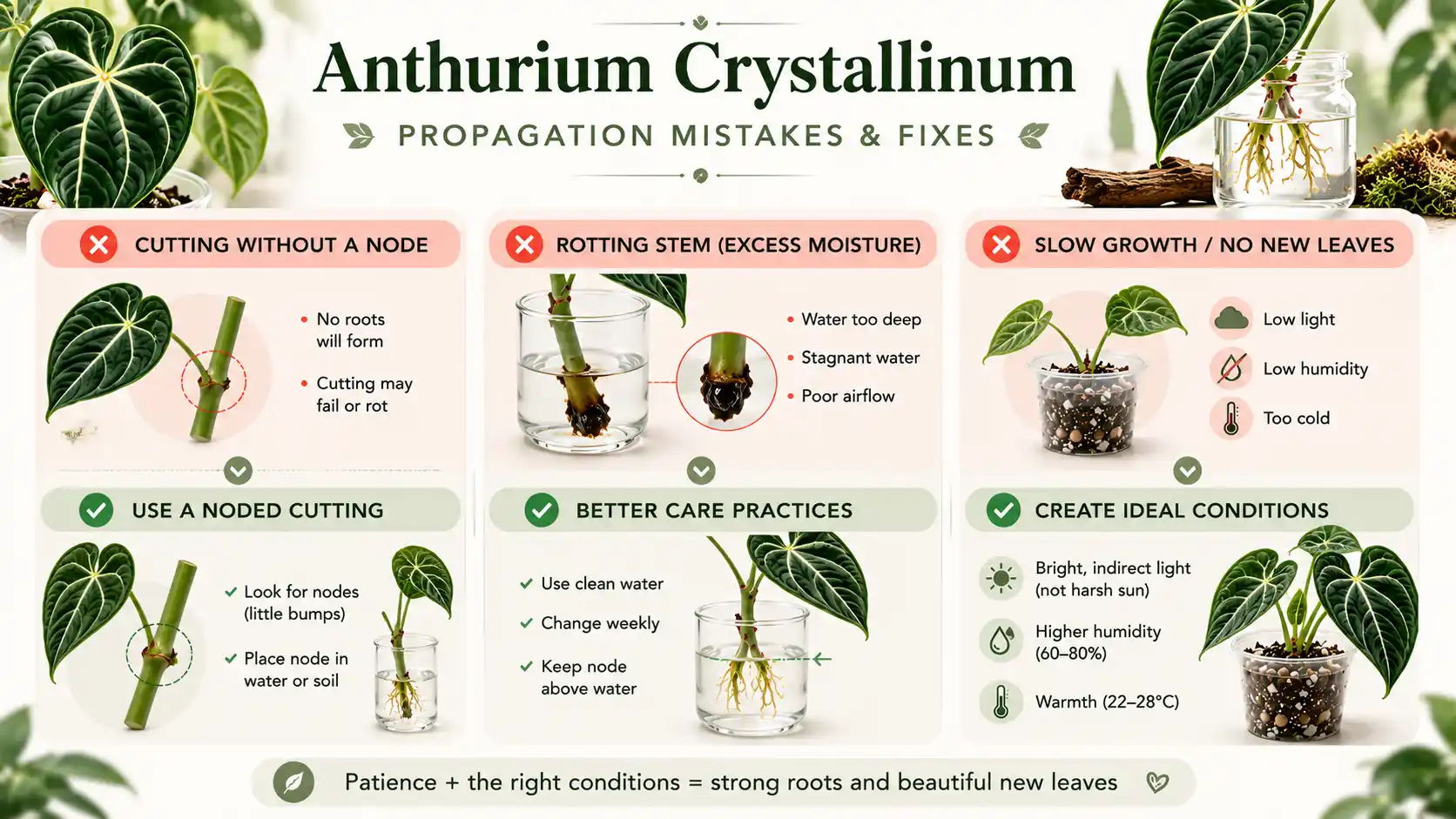
Anthurium Crystallinum propagation failures usually occur because of incorrect moisture levels, unhealthy cuttings, or unstable environmental conditions. Understanding common problems helps improve success rates and prevents repeated mistakes.
Cutting Fails to Root — Why It Happens, How to Fix, How to Prevent
A cutting that fails to root is often caused by the absence of a viable node, poor cutting health, or unsuitable environmental conditions.
Common causes include:
- Cutting taken from a leaf without a node
- Damaged or immature stem tissue
- Low humidity
- Cold temperatures
- Excess moisture causing tissue damage
Solutions include:
- Confirming that the cutting contains a healthy node
- Moving the propagation setup to a warmer location
- Increasing humidity carefully
- Using fresh, clean propagation materials
Prevention methods:
- Always inspect the stem before cutting
- Use sterilized tools
- Choose healthy mature growth
- Avoid stressed or diseased plant sections
Rot at the Cut Site — Overwatering-Related Cause, Fix, Prevention
Rot at the cut site usually occurs when the propagation environment stays too wet with poor airflow. Damaged plant tissue can become vulnerable to bacterial or fungal problems.
Signs of rot include:
- Black or brown soft tissue
- Unpleasant smell
- Mushy stem areas
- Rapid cutting decline
To fix the issue:
- Remove affected tissue with a sterile tool
- Allow healthy tissue to dry slightly
- Replace contaminated water or soil
- Improve airflow around the plant
Prevention includes:
- Avoiding constantly saturated soil
- Using breathable growing media
- Keeping tools clean
- Maintaining balanced humidity rather than excessive moisture
Slow or Stalled Growth — Environmental Causes, Fix, Prevention
Slow growth after propagation is common because Anthurium Crystallinum naturally develops at a moderate pace. However, extremely slow progress may indicate environmental problems.
Possible causes include:
- Insufficient humidity
- Low temperatures
- Poor lighting
- Root stress
- Lack of nutrients after establishment
Solutions:
- Move the plant into brighter indirect light
- Maintain stable warmth
- Improve humidity levels
- Check root health
- Begin gentle feeding once growth resumes
Prevention involves creating consistent tropical-like conditions instead of frequently changing the plant’s environment.
Anthurium Crystallinum Care After Propagation
Proper Anthurium Crystallinum care after propagation helps the young plant transition from a cutting or division into an established specimen. Newly propagated plants need stability because their root systems are still developing.
Essential care requirements include:
- Bright indirect light
- High humidity
- Warm temperatures
- Moist but well-draining soil
- Good airflow
Watering Requirements
Anthurium Crystallinum watering should maintain consistent moisture without creating soggy conditions. The soil should be allowed to slightly dry at the surface before watering again.
Overwatering is one of the most common problems because Anthurium roots require oxygen.
Signs of excessive moisture include:
- Yellowing leaves
- Soft roots
- Slow growth
- Leaf decline
Underwatering may cause:
- Drooping leaves
- Crispy edges
- Reduced new growth
A balanced watering routine depends on:
- Pot size
- Soil composition
- Temperature
- Humidity
- Light levels
Light and Placement
Anthurium Crystallinum performs best in bright indirect light. Direct sun can scorch the leaves, while insufficient light can slow growth and weaken new leaves.
Ideal placement includes:
- Near an east-facing window
- Behind filtered sunlight
- Under suitable grow lights indoors
How Tall Does Anthurium Crystallinum Get?
Anthurium Crystallinum typically reaches a moderate size rather than becoming a very tall plant. Mature indoor plants commonly grow around 30–60 cm (12–24 inches) tall, although leaf size can become much larger under ideal tropical conditions.
Growth size depends on:
- Genetics
- Humidity
- Light availability
- Root health
- Growing environment
Indoors, Anthurium Crystallinum usually remains compact because container size and climate limit expansion.
Outdoors in suitable tropical climates, the plant may develop larger leaves and a stronger growth habit because it receives:
- Higher humidity
- Warmer temperatures
- More consistent environmental conditions
Understanding mature size helps growers decide spacing requirements when propagating multiple plants. Young propagated plants may start small but gradually develop larger leaves as their root systems mature.
Anthurium Crystallinum Flowers and Pollination
Anthurium Crystallinum flowers are less commonly valued than its foliage, but the plant can produce flowers under suitable conditions. The flower structure consists of a spathe surrounding a spadix, which contains the tiny individual flowers.
Anthurium Crystallinum bloom production depends on:
- Plant maturity
- Stable growing conditions
- Adequate light
- Proper nutrition
The plant is generally grown by collectors for its leaves rather than flowers because the silver-veined foliage is its main feature.
How to Tell If an Anthurium Is Pollinated?
A pollinated Anthurium flower may begin developing berries along the spadix. Signs of successful pollination include:
- Swelling sections on the spadix
- Developing fruit structures
- Seed formation over time
Pollination requires compatible pollen timing and suitable conditions. For most indoor growers, propagation through division or cuttings is a much simpler method than growing Anthuriums from seed.
What Is the “Holy Grail” and “Red Flag” of Anthurium?
In Anthurium enthusiast communities, the term “holy grail” usually refers to exceptionally rare, highly desirable Anthurium varieties valued for unusual foliage characteristics, rarity, or collector demand.
The “holy grail” concept is not a botanical classification but a collector term used to describe plants with:
- Exceptional leaf texture
- Rare genetics
- Unique coloration
- Limited availability
The “red flag” of Anthurium generally refers to warning signs that indicate problems with plant health or questionable growing practices.
Common red flags include:
- Root rot symptoms
- Unhealthy imported plants
- Severe leaf damage
- Poor acclimation after purchase
Understanding these terms helps growers distinguish between plant quality, rarity, and actual growing performance.
Anthurium Crystallinum Price and Value
Anthurium Crystallinum price varies depending on plant size, genetics, leaf quality, and availability. Small propagated plants are usually more affordable than large mature specimens with developed leaves.
Factors affecting value include:
- Leaf size
- Vein contrast
- Plant maturity
- Root health
- Collector demand
Large Anthurium Crystallinum plants are often more expensive because they require significant time and care to develop.
Propagation provides a cost-effective way to expand a collection because growers can create additional plants from an established specimen rather than purchasing every plant individually.
For those searching for Anthurium Crystallinum for sale, evaluating plant health is more important than size alone. A smaller healthy propagated plant can often establish better than a large stressed specimen.
Conclusion
Learning how to propagate Anthurium Crystallinum requires understanding the plant’s growth structure, propagation methods, and environmental needs. The most reliable approaches include stem cuttings with healthy nodes and division of mature plants with established growth points. Water propagation and soil propagation can both succeed when humidity, warmth, moisture balance, and light conditions are properly maintained.
Successful Anthurium Crystallinum propagation depends on patience and consistency. Healthy nodes, breathable growing mediums, and careful watering practices help prevent common problems such as failed rooting and rot. After propagation, continued care with appropriate humidity, indirect light, and balanced moisture allows new plants to develop strong roots and mature foliage. With the right conditions, even a single mature Anthurium Crystallinum can become the source of multiple healthy plants.
FAQs
Is Anthurium Crystallinum hard to grow?
Anthurium Crystallinum is moderately challenging to grow because it requires stable humidity, warm temperatures, and careful watering. It is more sensitive than common houseplants like pothos but can grow successfully indoors when provided with tropical-like conditions.
The main challenges are:
- Preventing root rot
- Maintaining humidity levels
- Providing bright indirect light
- Avoiding sudden environmental changes
Consistent care is usually more important than advanced techniques.
Can I grow Anthurium from a cutting?
Yes, Anthurium can be grown from a cutting if the cutting contains a healthy node. A leaf alone usually cannot produce a new plant because Anthuriums need stem tissue with an active growth point.
For successful cutting propagation:
- Choose a healthy stem section
- Include at least one node
- Use clean cutting tools
- Provide warmth and humidity
- Root the cutting in water or a suitable growing medium
Anthurium Crystallinum stem cuttings are most successful when the node remains healthy throughout the rooting process.
Can you root an Anthurium in water?
Yes, Anthurium Crystallinum can be rooted in water when a stem cutting with a viable node is used. Water propagation allows growers to monitor root development, but the cutting should eventually be moved into soil or an appropriate aroid mix.
For better results:
- Use clean water
- Change water regularly
- Keep the node submerged but leaves above water
- Provide bright indirect light
- Transfer after strong roots develop
Filtered or low-mineral water may be preferable in areas where tap water contains high levels of salts or chemicals.
What’s the best time to propagate anthuriums?
The best time to propagate Anthuriums is during the active growing season, usually spring and summer. During this period, warmer temperatures and increased plant activity encourage faster root development and new growth.
Propagation is most successful when:
- The parent plant is healthy
- Temperatures remain warm
- Humidity is consistent
- The plant is actively producing growth
Propagation can still be done indoors during other seasons, but rooting may take longer in cooler conditions.
Can I use Miracle-Gro on anthurium?
Yes, Miracle-Gro can be used on Anthurium when applied correctly and diluted according to plant needs. However, newly propagated Anthuriums should not be fertilized immediately because young roots are sensitive to excess nutrients.
A safer approach is:
- Wait until roots are established
- Begin with diluted fertilizer
- Feed during active growth
- Avoid fertilizing stressed plants
Balanced feeding supports healthy leaves and root development, but proper humidity, watering, and light remain the most important factors.
How tall do Anthurium Crystallinum get?
Anthurium Crystallinum commonly grows about 30–60 cm (12–24 inches) tall indoors, although leaf size can become larger under ideal conditions. Mature size depends on genetics, humidity, light, root health, and growing environment.
Indoor plants usually remain compact, while plants grown in tropical outdoor conditions may develop larger leaves and stronger growth due to better environmental stability.
Adequate spacing is important when growing multiple propagated plants so each specimen has enough room for healthy leaf development.