
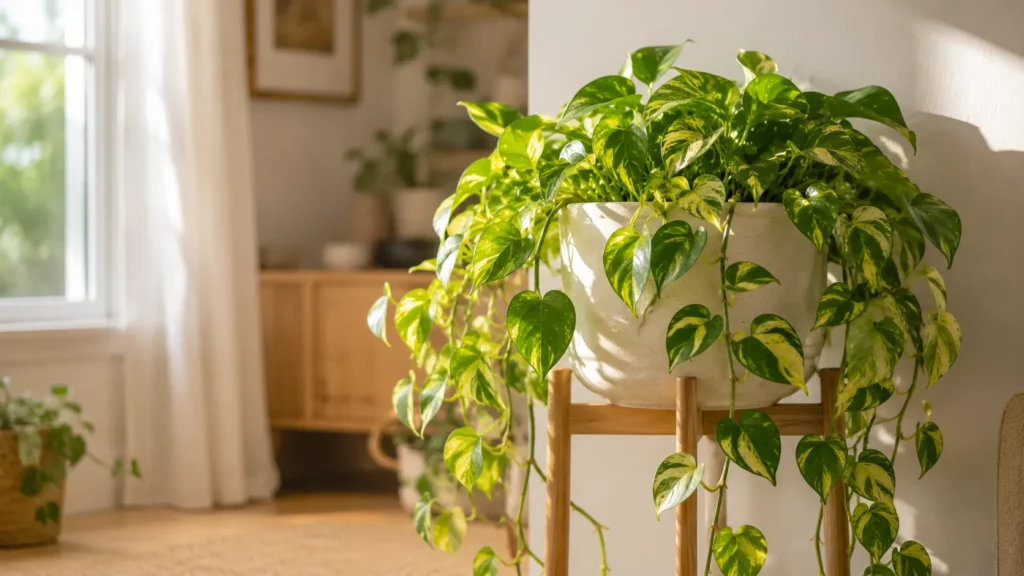
According to Manuela Nogueira, pothos thrives in bright, indirect light and tolerates low light, needing water only when the top two inches of soil feel dry, roughly every 7-10 days. Use well-draining potting mix, feed monthly during spring and summer, and keep temperatures between 65-85°F for healthy, trailing vines. Pothos is one of the easiest starting points for anyone building out an indoor green living hub, thanks to how forgiving it is of missed waterings and low light.
Pothos propagates easily from stem cuttings placed in water, often rooting within two to three weeks before transplanting to soil. Yellowing leaves typically signal overwatering rather than underwatering, while variegated varieties lose their pattern and revert to solid green if light levels drop too low. The plant is mildly toxic to cats and dogs if ingested, so placement matters in pet-friendly homes.
Quick Summary
- Pothos (Epipremnum aureum) grows best in bright, indirect light, with thorough watering after the potting mix has dried sufficiently rather than according to a fixed calendar.
- It tolerates lower light and ordinary household humidity, but stronger indirect light usually supports better growth and better variegation.
- Pothos can trail from a hanging basket or climb a support; climbing encourages larger mature foliage when the plant has suitable light and support.
- The most common beginner problems are overwatering and root rot, insufficient light that produces weak or elongated growth, and pests such as mealybugs and spider mites.
- Pothos is a long-lived perennial, and Penn State Extension notes that the same plant can be kept for more than ten years with appropriate care.
What Makes a Pothos Happy? (Ideal Growing Conditions)
A happy pothos has access to bright, indirect light, an airy and well-draining root environment, watering that allows the soil to dry between applications, warm temperatures, and adequate but not necessarily tropical-level indoor humidity. Clemson Extension recommends bright, indirect light, well-draining soil, and warm indoor conditions, while noting that pothos can tolerate lower light and ordinary household humidity.
The most useful growing conditions are:
- Light: Bright, indirect light is the best general target. Lower light is tolerated but can reduce growth and variegation.
- Water: Allow the potting mix to dry between waterings, then water thoroughly.
- Temperature: A warm indoor environment is ideal; Clemson lists roughly 70–85°F (21–29°C) days and 60–70°F (16–21°C) nights.
- Humidity: Pothos prefers around 50–70% relative humidity but can tolerate ordinary household levels.
- Soil: Use an airy, well-draining potting mix rather than dense soil that stays wet for long periods.
The biggest beginner misconception is that a plant known for tolerating neglect should also tolerate constant moisture. Pothos is drought-tolerant relative to many houseplants, but its roots still require oxygen. Repeatedly saturated soil reduces air-filled pore space and increases the risk of root problems.
What Makes a Pothos Happy — At a Glance
Healthy pothos usually shows several simple signals:
- Leaves remain firm and reasonably well colored rather than repeatedly yellowing.
- New leaves continue appearing during active growth.
- Stems remain sturdy instead of becoming extremely stretched between leaves.
- Soil drains readily after watering and does not remain swampy for days.
- Roots are not persistently dark, mushy, or foul-smelling.
A plant can survive in less-than-perfect conditions, but these signals are better indicators of actual health than simply asking whether it is alive.
Pothos Care at a Glance (Quick-Reference Table)
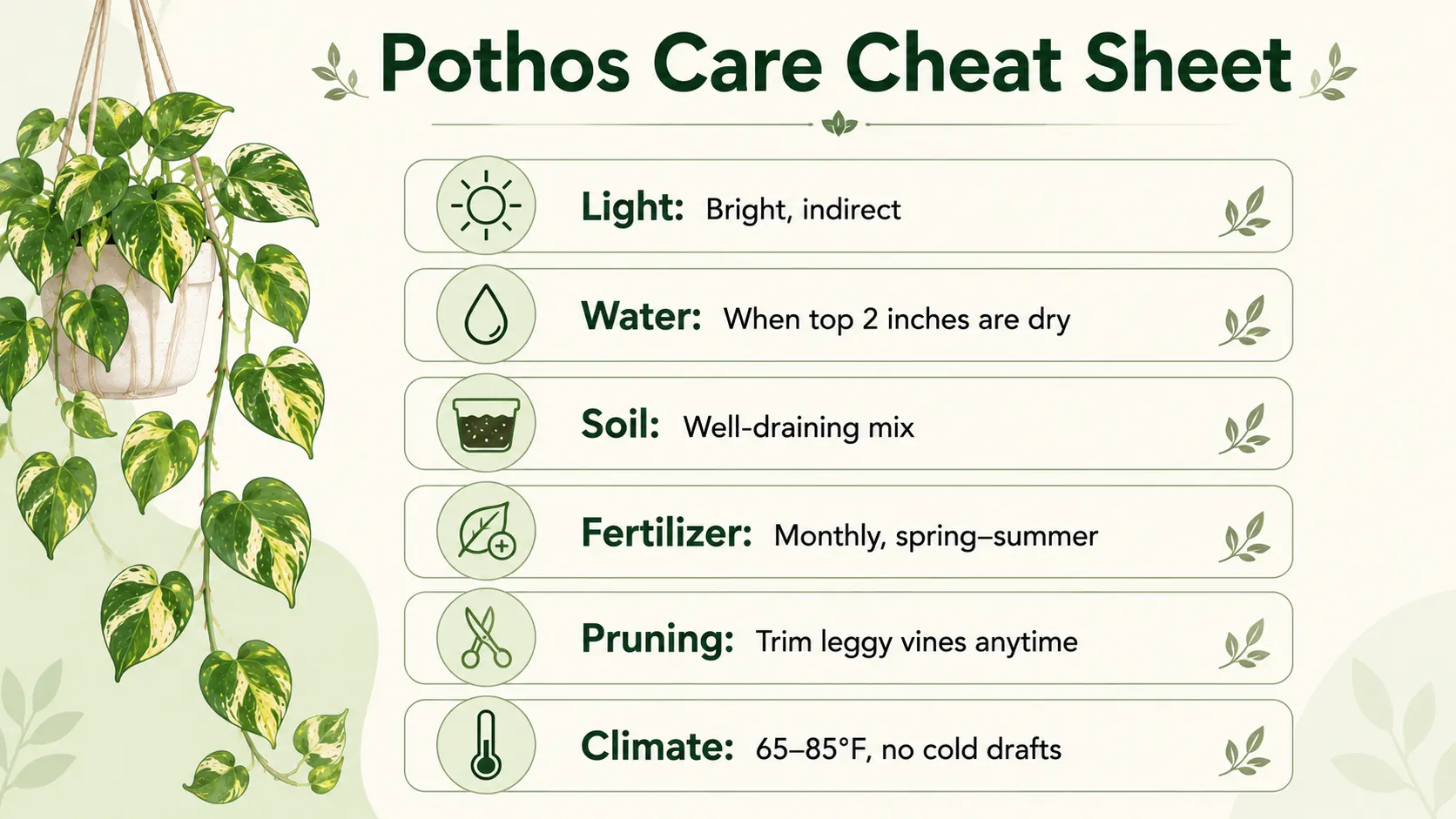
| Care factor | Requirement |
| Watering | Water thoroughly when the potting mix has dried sufficiently; avoid keeping roots constantly wet |
| Light | Bright, indirect light; tolerates lower light |
| Soil | Airy, well-draining indoor potting mix |
| Fertilizer | Balanced houseplant fertilizer during active growth, used according to label directions |
| Pruning | Remove damaged growth and shorten long vines just above nodes to encourage branching |
| Climate tolerance | Warm indoor conditions; protect from cold and frost |
Clemson Extension specifically recommends allowing the soil to dry between waterings, providing bright indirect light, and using an airy, well-draining soil mix. Penn State also emphasizes that pothos is better kept somewhat dry than consistently too wet.
Once you understand the basics, it can help to have a quick reference for ongoing care. Explore this Pothos care resource hub for additional guidance and practical plant-care references.
Where to Place Your Pothos Indoors
The best pothos location is determined primarily by light, not by whether a shelf or corner looks attractive. A bright room with filtered or indirect light normally gives more dependable growth than a dark decorative corner.
Best Light Placement in Your Home
The best place to put a pothos is usually near a bright window where direct midday sunlight does not strike the leaves for prolonged periods. An east-facing window can provide gentle morning light, while a bright area near a south- or west-facing window may work when the plant is positioned far enough back or protected by a sheer curtain.
Pothos can survive in lower light, but survival and vigorous growth are not the same thing. Clemson notes that lower light may reduce variegation, while other extension guidance notes that leaves become smaller as light levels fall. Light needs can shift slightly by variety — brighter cultivars like Neon pothos need more light to hold their color, which we cover in our Neon pothos light requirements guide.
A useful practical test is to watch new growth. If new leaves are consistently small and stems have increasingly long gaps between leaves, move the plant gradually toward brighter indirect light.
Do Pothos Prefer to Climb or Hang?
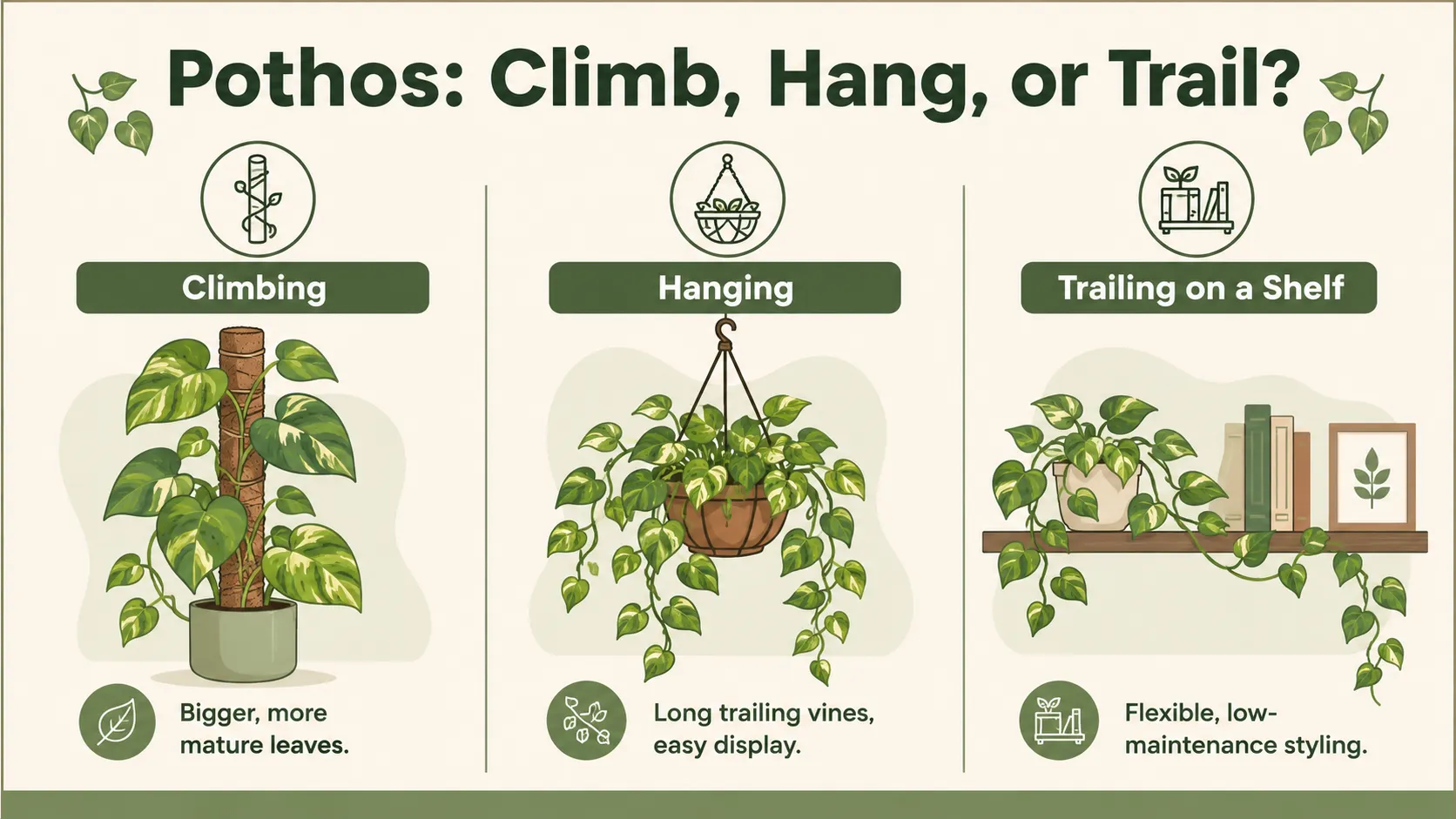
Pothos can do either, but climbing and trailing produce different growth patterns.
| Growth style | What it encourages | Best setup |
| Climbing | More vertical growth and potentially larger mature foliage | Moss pole, trellis, or other textured support |
| Hanging/trailing | Long cascading vines and an ornamental drape | Hanging basket or elevated planter |
In nature, Epipremnum aureum climbs tree trunks using aerial roots. As it moves upward toward better light, its foliage can become dramatically larger than the juvenile leaves typically seen indoors.
This means a moss pole is not merely decorative. It can reproduce part of the plant’s natural climbing habit. However, a support does not automatically produce giant leaves; adequate light, active growth, and a mature climbing phase are also important.
Hanging Baskets and Best Hanging Spots
Pothos performs very well in hanging baskets because its natural vine structure allows stems to cascade over the container edge. A hanging position works best where the foliage still receives suitable indirect light.
Avoid hanging it in a dark corner simply because the vines are decorative. A plant receiving inadequate light may survive but develop longer, thinner internodes and smaller new leaves. Clemson and Penn State both identify low maintenance and trailing growth as major characteristics of pothos, while Clemson specifically notes that it can be grown successfully in hanging baskets.
Watering Pothos: Soil, Water, and Humidity
Pothos watering should be based on soil moisture and plant conditions rather than a rigid weekly schedule. The soil should be allowed to dry between waterings, and the plant should then be watered thoroughly enough to wet the root zone.
How Often and How Much to Water
There is no universally correct pothos watering interval because the drying rate changes with pot size, light, temperature, humidity, soil composition, and season.
Use this sequence:
- Check the potting mix with a finger or moisture check rather than watering by date alone.
- When the mix has dried to the appropriate depth, water thoroughly.
- Allow excess water to drain freely.
- Empty standing water from a saucer or cachepot.
- Reduce watering frequency when growth and evaporation slow in cooler, darker periods.
Clemson recommends allowing the soil to dry completely before watering, while other extension guidance for houseplants commonly recommends checking the upper part of the mix and using plant conditions as the guide. The exact drying point varies with container and growing environment, so the key principle is avoiding prolonged saturation.
Drooping leaves can indicate temporary water stress, but yellowing in combination with wet soil is a different signal and may point toward excessive moisture or root problems.
Growing Pothos in Water vs. Soil
Pothos cuttings root readily in water or soil, but the two methods are not identical.
| Factor | Water | Soil |
| Root visibility | Roots are easy to observe | Roots remain hidden |
| Propagation convenience | Very beginner-friendly | Simple and direct |
| Long-term nutrition | Requires nutrients for sustained growth | Nutrients come from the potting system and fertilizer |
| Root environment | Constantly wet | Alternates between wet and drying conditions |
| Long-term method | Possible with nutrient management | Standard and generally simplest for beginners |
Pothos can remain in a water-based growing system, but plain tap water is not the same thing as complete hydroponic culture. Long-term hydroponic growth requires a nutrient solution containing the essential nutrients plants need. Penn State defines hydroponics as growing plants in water containing nutrients and emphasizes the importance of maintaining the nutrient solution.
For a beginner who simply wants a pothos cutting in a glass, water propagation is easy. For indefinite production in water, use an appropriate nutrient system and maintain suitable water quality rather than relying on plain water alone.
Should You Mist or Shower Your Pothos?
Misting is not necessary for healthy pothos. A brief increase in humidity from misting is temporary, while Clemson notes that pothos already tolerates typical household humidity.
A gentle shower can occasionally be useful for rinsing dust from leaves and inspecting the plant for pests. It should not be treated as a substitute for proper watering because repeatedly wetting foliage does not hydrate roots in the same way that watering the potting mix does.
After washing the plant, allow the leaves to dry with reasonable airflow rather than leaving the foliage constantly wet.
Choosing the Right Pot: Size, Depth, and Root Care
The best pothos pot is not the largest container you can find. The priority is a stable container with drainage and enough room for the current root system without creating a large reservoir of unused wet soil.
Big Pot or Small Pot?
A slightly snug pot is usually safer than an oversized pot for a beginner because excess soil can remain wet around a relatively small root system. University of Minnesota Extension recommends increasing houseplant container diameter by only about 2–3 inches when moving to a larger pot, noting that overly large containers can increase root-rot risk. Pot size doesn’t just affect root health — it directly influences growth speed too, as we explain in does pot size affect how fast a plant grows.
The correct principle is therefore appropriately sized, not deliberately tiny.
Choose a bigger pot when:
- Roots are circling densely through the existing mix.
- Roots are emerging from drainage holes.
- The plant becomes unstable because the root system is crowded.
- The potting mix dries much faster than it previously did because roots occupy most of the container.
- Growth has become restricted despite otherwise suitable light and nutrition.
Deep vs. Wide Pots — What the Research Says
Pothos does not require an unusually shallow container simply because it is often described as having a relatively fine root system. It is a climbing vine with roots that can occupy the available growing medium, while stems also produce aerial roots at nodes.
| Pot style | Why it works or doesn’t for pothos |
| Standard-depth pot | Usually the easiest choice for indoor growth |
| Very shallow pot | Can work for small specimens but dries faster and offers limited root volume |
| Very deep oversized pot | More unused wet soil can remain around roots, increasing moisture problems |
| Wide, oversized pot | Unnecessary unless the root system actually needs the volume |
The best pot shape is one that matches the plant’s root mass and allows the soil to dry predictably.
Do Pothos Like Being Root Bound?
Pothos tolerates being mildly root-bound, but severe root restriction is not a desirable long-term condition. When a container becomes densely packed with roots, water may rush through quickly, the plant has less access to fresh growing medium, and growth can become constrained.
Clemson recommends repotting when roots become visible through drainage holes or the plant becomes overcrowded and root-bound.
Best Planter Materials
The most important feature is a drainage hole, not whether the pot is terracotta, plastic, or ceramic.
- Terracotta: Porous and tends to dry faster; useful for growers who frequently overwater.
- Plastic: Retains moisture longer and is lightweight.
- Glazed ceramic: Holds moisture similarly to other nonporous containers and can provide stability.
University of Minnesota Extension emphasizes the importance of drainage holes and warns that excessively large containers can encourage root problems.
Repotting and Transplant Shock
Repotting can cause temporary stress because roots and the surrounding growing environment have been disturbed. Mild drooping or a short pause in growth can occur after transplanting.
To reduce stress:
- Repot only when there is a practical reason.
- Avoid jumping to a dramatically larger container.
- Use fresh, well-draining mix.
- Water appropriately after repotting rather than keeping the new mix constantly saturated.
- Return the plant to suitable light without immediately exposing it to intense direct sun.
Penn State specifically notes that excess water during repotting can add stress, while Minnesota Extension recommends only modest increases in container size.
Plant Size
How Big Do Pothos Get Indoors vs. Outdoors
Indoor pothos is usually maintained as a juvenile-looking trailing or climbing houseplant, but the species has much greater potential in warm tropical conditions. Clemson reports mature leaves in natural conditions reaching as much as 3 feet, while Wisconsin Horticulture describes stems that can grow to roughly 65 feet in suitable tropical environments.
Indoors, size is controlled by light, support, pot volume, pruning, cultivar, and available growing space. A plant with long stems can become visually large without having a huge root system because its growth is distributed along vines.
Outdoor plants in warm climates can become substantially larger and may behave as groundcover or vigorous climbing vines. UF/IFAS notes that pothos can be used as a landscape plant in warmer locations but also warns of high invasion risk in Florida and recommends keeping it indoors there.
Root System Depth
Pothos should not be managed as if it were a deep-rooted tree. Its roots occupy the potting medium, while its climbing stems can also produce aerial roots from nodes. The practical result is that pot choice should be based on total root volume and drainage rather than attempting to provide a very deep root chamber.
Growth Rate
How Fast Does Pothos Grow?
Pothos is generally a moderate-to-fast-growing indoor vine when light, temperature, water, and nutrition are favorable. Clemson describes pothos as vigorous and notes cultivar differences, with some cultivars such as Neon growing quickly and others, such as Manjula, growing more slowly.
Growth often slows during periods of reduced light, cool temperatures, or root stress. A plant that suddenly stops producing new leaves should be evaluated for environmental limitations rather than automatically given more fertilizer.
What Helps Pothos Grow Faster
The most reliable way to encourage faster growth is to improve the limiting condition rather than simply adding fertilizer.
Focus on:
- Brighter indirect light.
- Adequate but not excessive watering.
- Warm temperatures.
- Well-draining soil.
- Enough root space.
- Nutrients during active growth.
- Regular pruning when long, sparse vines need restructuring.
Penn State and Clemson both emphasize bright indirect light, proper watering, and occasional feeding as the foundation of vigorous pothos growth.
How to Get Bigger Leaves
To encourage larger leaves, give pothos the conditions that support mature climbing growth: strong indirect light and an upward support such as a moss pole or trellis.
Clemson notes that climbing can help pothos showcase its climbing habit and develop larger leaves, while its natural growth form produces much larger foliage as the plant matures into a climbing phase.
Do not expect a cutting placed in a dim hanging basket to suddenly produce giant mature leaves simply because it has been tied to a pole. Support and adequate light work together.
Pruning and Training for a Bushier Pothos
Pruning changes the architecture of pothos. Cutting long, sparse stems encourages the plant to produce new shoots from nodes farther back on the vine, while repeated trimming can maintain a more compact appearance.
How to Make Pothos Bushier
To make a pothos bushier, prune long stems back to healthy nodes and use multiple rooted cuttings in the same container when a denser plant is desired.
A single original cutting cannot create unlimited density without producing additional shoots.
The most effective fuller-looking plants often combine:
- Regular pruning.
- Adequate light.
- Multiple rooted stems.
- Occasional propagation and replanting.
Minnesota Extension notes that trimming leggy stems just above a leaf node can encourage fuller growth.
Should You Cut the Vines? When and How Long Is Too Long
Yes. Pothos vines can be cut whenever their length becomes excessive or growth becomes sparse.
There is no universal maximum vine length because a plant can naturally produce very long stems. The question is whether the vine still has the desired appearance and healthy foliage.
Penn State recommends shortening vining stems with sharp scissors just above a node or removing an entire vine while leaving a small stub.
A long vine with healthy, evenly spaced leaves is not automatically unhealthy. A long vine with very large spaces between leaves, weak stems, or sparse foliage is a stronger candidate for corrective pruning and improved light. The exact spot you cut matters more than most beginners realize — for a full breakdown of where to snip along the vine, see our guide on where to cut pothos to encourage growth.
Giving Pothos Something to Climb
| Support type | Best for |
| Moss pole | Encouraging climbing and larger mature foliage |
| Trellis | Structured vertical growth across a wider surface |
| Stake | Supporting a few selected stems |
| No support | Trailing and hanging-basket growth |
Pothos naturally climbs using aerial roots, so a textured support can better imitate its natural growth habit than a smooth object that provides little grip. If you’d rather train your pothos upward than let it trail, our guide on training N’Joy pothos to climb walks through the process step by step.
Natural Fertilizing: Coffee Grounds and DIY Options
Natural does not automatically mean balanced or safe for routine fertilization. Pothos needs access to essential plant nutrients, and a consistent, appropriately formulated houseplant fertilizer is easier to control than kitchen scraps added directly to the pot.
Do Coffee Grounds Help Pothos?
Coffee grounds are not a reliable standalone pothos fertilizer. Spent grounds contain some nitrogen and organic matter, but their nutrient contribution is limited and they can create problems when used excessively or directly in the growing medium. Oregon State University Extension notes that spent coffee grounds are close to neutral after brewing and are better understood as an amendment or compost ingredient rather than a dependable fertilizer source.
For a potted pothos, repeatedly dumping used grounds onto the soil can also alter the physical structure of the potting mix and potentially encourage excessive moisture retention.
Other Natural Fertilizer Options
For a beginner, the safest interpretation of “natural fertilizer” is not “kitchen ingredients.” It is a controlled organic fertilizer or mature compost used appropriately for the plant and container.
Good principles include:
- Use a formulated houseplant fertilizer according to its label.
- Feed more during active growth than during low-light periods.
- Avoid excessive fertilizer because salt accumulation can damage roots.
- Use mature compost only as an amendment rather than assuming it supplies every nutrient at a predictable rate.
Common Pothos Problems and How to Fix Them
Overview of Common Problems
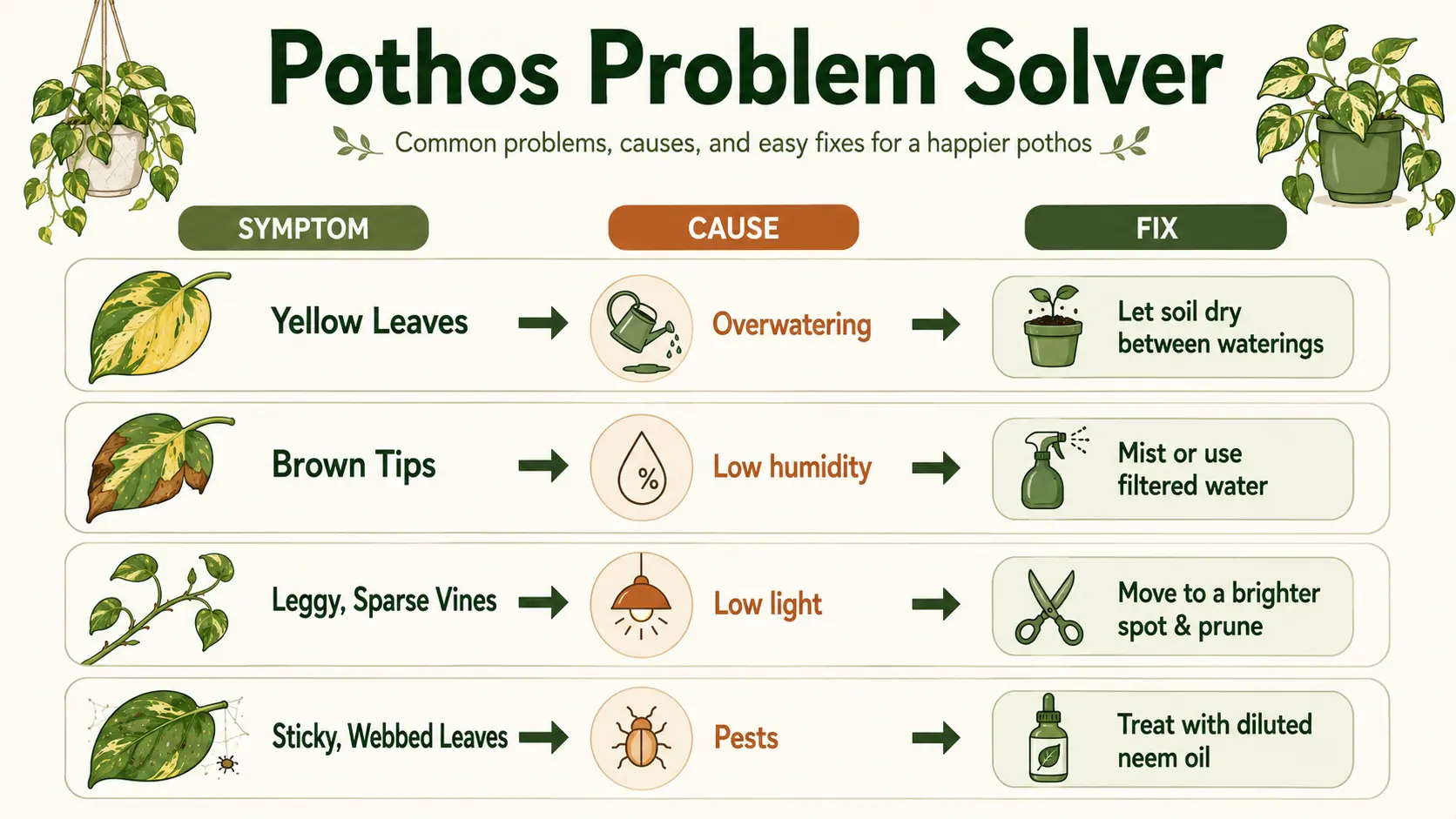
Most pothos problems can be traced to a short list of environmental stresses:
- Yellow leaves: Often associated with excessive moisture, though low fertility and other stressors can also contribute.
- Brown tips: Can be associated with low humidity, intense light, salt stress, or inconsistent watering.
- Leggy vines: Usually indicate insufficient light or a growth habit that needs pruning.
- Pests: Common indoor pests include spider mites and mealybugs.
- Root rot: Most strongly associated with chronically wet roots and poor drainage.
How to Perk Up a Struggling Pothos
Do not immediately add fertilizer to a visibly struggling plant. First identify the limiting factor.
A useful recovery sequence is:
- Check whether the soil is staying wet for too long.
- Inspect roots if root rot is suspected.
- Check available light.
- Examine leaves and stems for pests.
- Remove severely damaged growth.
- Correct the environmental problem before increasing fertilizer.
A pothos often recovers once the cause is corrected, but damaged leaves cannot be restored to perfect condition. Judge recovery by the appearance of new growth rather than expecting old leaves to reverse every symptom.
Using Vinegar on Pothos — What It Actually Does
Vinegar is not a pothos fertilizer and should not be used routinely as a DIY pest or fungal treatment on foliage. Acetic acid can injure plant tissue, particularly at concentrations strong enough to function as a weed-control product.
Therefore, adding household vinegar to pothos soil is not a reliable way to improve fertility, and spraying vinegar onto leaves can create more plant damage than benefit.
For routine pothos care, correct the growing conditions first and use a treatment specifically labeled for the pest or disease involved when intervention is necessary.
| Symptom | Likely cause | Fix |
| Yellow leaves with wet soil | Overwatering or poor drainage | Allow more drying, improve drainage, inspect roots |
| Brown leaf tips | Low humidity, salts, intense light, or inconsistent watering | Check environment and watering; avoid excessive fertilizer |
| Leggy vines | Insufficient light | Move toward brighter indirect light and prune |
| Sticky or damaged foliage | Possible insect activity | Inspect undersides and stems; treat according to identified pest |
| Wilting with persistently wet soil | Root stress/root rot | Inspect roots and correct chronic saturation |
Clemson Extension identifies root rot as a common pothos problem linked to overwatering or poor drainage and lists spider mites and mealybugs among possible pests. This works because diluted acetic acid lowers surface pH past the range fungal spores need to spread — a mechanism documented in antifungal research on vinegar.
Beginner Mistakes to Avoid
The five most important pothos mistakes are:
- Overwatering: Watering on every Monday regardless of soil moisture is less reliable than checking the pot.
- Using the wrong pot size: A very large container can keep unnecessary soil wet for too long.
- Putting the plant in harsh direct sun: Pothos tolerates bright conditions but prolonged intense sunlight can damage foliage.
- Ignoring root-bound signs: A plant that has completely filled its container may need fresh mix or a modestly larger pot.
- Over-fertilizing: More fertilizer does not equal faster, healthier growth; excessive soluble salts can damage roots.
Another common mistake is assuming that “low light tolerant” means “low light preferred.” Pothos can survive lower light, but good growth and strong variegation generally require better illumination.
Pothos Toxicity and Other Disadvantages
Is Pothos Toxic? How It Compares to Other Houseplants
Yes. Pothos is toxic if chewed or ingested because its tissues contain insoluble calcium oxalate crystals. ASPCA lists golden pothos (Epipremnum aureum) as toxic to dogs and cats, with signs including oral irritation, burning and irritation of the mouth, drooling, vomiting, and difficulty swallowing.
Penn State Extension likewise identifies the roots, stems, and leaves as containing calcium oxalate crystals that can irritate the skin and oral and digestive tracts in humans and pets.
Pothos is therefore not unusually dangerous compared with other common calcium-oxalate houseplants. ASPCA identifies several familiar houseplants, including pothos, philodendron, dieffenbachia, peace lily, and calla lily, in this same broad category.
The practical rule is simple: keep pothos out of reach of children and pets who chew plants. Pothos contains insoluble calcium oxalates, which the ASPCA lists as toxic to both dogs and cats, typically causing oral irritation and drooling if chewed.
Other Downsides of Growing Pothos
Pothos is easy to grow, but its disadvantages are worth understanding:
- It can become very leggy when light is inadequate.
- It can outgrow its display space because the vines continue extending.
- It requires pruning if a compact shape is desired.
- It can suffer severe root damage from chronic overwatering.
- It is toxic when chewed or ingested.
- In warm outdoor environments, it can become an aggressive landscape vine and has invasive potential in some regions.
Its reputation for toughness should therefore mean forgiving, not indestructible.
Pothos Propagation Basics
Pothos is one of the easier houseplants to propagate because stem cuttings can root readily in either water or soil. Clemson Extension recommends using a stem cutting that contains at least one node.
Propagating Cuttings in Water or Soil
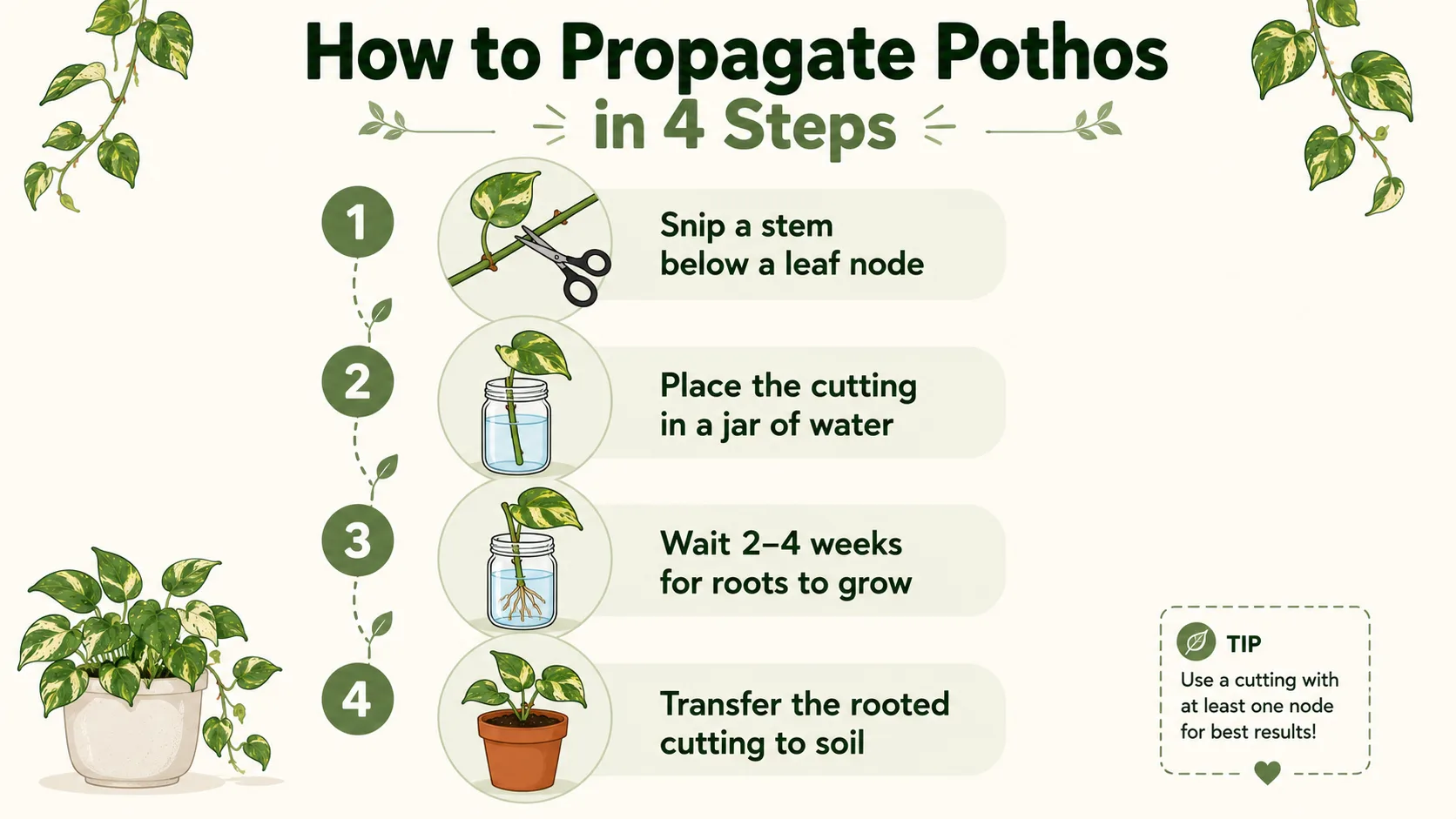
For a basic cutting:
- Select a healthy vine.
- Cut a section containing at least one node.
- Remove leaves that would be submerged or buried.
- Place the node in water or an appropriate propagation medium.
- Provide bright, indirect light.
- Once a water cutting has established roots, it can be transferred to potting mix if desired.
The node is critical because pothos produces roots from its nodes; a leaf without a node does not contain the same growth potential as a viable stem cutting. Those brown nubs along the vine aren’t just for climbing — they’re also the easiest propagation point on the plant. Learn more in our pothos aerial roots propagation guide.
What to Do With Trimmed Vines
Do not automatically throw healthy trimmed vines into the trash. Sections containing viable nodes can be used for propagation.
You can either root them separately and transplant later or establish several cuttings together to create a fuller container. Penn State notes that pothos is particularly useful as a “pass-along” plant because stem cuttings can generate new plants.
Indoor vs. Outdoor Pothos Care
Indoor pothos is the safest and most controllable growing method for most gardeners. Outdoors, it requires a warm, frost-free climate and protection from conditions that can damage tropical foliage.
Wisconsin Horticulture identifies Epipremnum aureum as hardy only in USDA Zones 10–12, while Clemson notes that tropical pothos should be protected from cold conditions.
Outdoor care differs because:
- Light can be much more intense than indoors.
- Wind increases water loss.
- Rain can keep soil wet for extended periods.
- Cold nights can damage tropical tissue.
- The plant may spread much more aggressively.
In warm tropical or subtropical regions, pothos can climb trees and act as groundcover. UF/IFAS specifically warns that the species has high invasion risk in Florida and recommends keeping it indoors rather than planting it outside.
For gardeners outside suitable warm climates, growing pothos in a container indoors gives far greater control over temperature, moisture, light, and spread.
How Long Do Pothos Live? (Life Expectancy)
Pothos is a perennial plant and can live for many years indoors with appropriate care. There is no scientifically established universal indoor expiration point such as exactly five or ten years; lifespan depends heavily on environmental conditions and whether the original plant remains healthy.
Penn State Extension describes pothos as long-lived and reports an individual specimen kept for more than ten years.
That makes 10+ years a realistic documented possibility, but it is better not to treat “5–10 years” as a strict biological lifespan. Healthy pothos can persist for considerably longer, especially because the plant can continually produce new stems and can be propagated from cuttings.
The main threats to longevity are not normal aging but preventable problems such as chronic overwatering, poor drainage, inadequate light, severe pest pressure, and prolonged cold exposure. The best strategy for a long-lived plant is therefore stable environmental care rather than trying to follow an artificial lifespan schedule.
Conclusion
Successful pothos care for beginners comes down to a small number of decisions: provide bright, indirect light, water according to soil dryness rather than the calendar, use a well-draining mix and a pot with drainage, and prune or train the vines according to the shape you want. Pothos can trail or climb, grow in soil or a properly managed nutrient-water system, and remain healthy for many years when its roots are not kept chronically wet. It is forgiving, but not immune to root rot, pests, inadequate light, or cold. The clearest beginner takeaway is simple: give pothos good light, let the soil dry between waterings, and avoid oversized pots. For more beginner-friendly houseplant guides like this one, explore our full plant care and benefits hub.
Frequently Asked Questions
Do pothos prefer to climb or hang?
Pothos can thrive either climbing or hanging, but climbing more closely matches its natural growth habit and can encourage larger mature foliage when light and support are adequate. Hanging baskets are ideal for producing long cascading vines.
What is the life expectancy of a pothos?
A pothos can live for many years indoors, and Penn State Extension documents an individual plant kept for more than ten years. There is no fixed biological lifespan of exactly five or ten years; good care can allow individual plants to persist much longer.
Is pothos more toxic than other houseplants?
Pothos is toxic when chewed or ingested because it contains insoluble calcium oxalate crystals, but it is not uniquely toxic among common houseplants. ASPCA lists several other familiar arum-family plants with similar calcium-oxalate-related risks.
Do pothos like to be root bound?
Pothos tolerates mild root restriction, but it should not remain severely root-bound indefinitely. Repot when roots are densely circling, emerging from drainage holes, or the plant becomes overcrowded. A modest increase in pot size is generally preferable to a dramatically larger container.
Can I grow pothos in water permanently instead of soil?
Yes, pothos can be maintained in a water-based growing system, but plain water is not a complete long-term nutrient supply. Permanent water culture requires appropriate nutrients and management of the water and root environment, as in hydroponic growing.
How do I know if my pothos needs a bigger pot?
A pothos may need a bigger pot when roots are growing through drainage holes, the root system has densely filled the container, the plant becomes unstable, or the soil dries unusually quickly because little growing medium remains around the roots. Move up only modestly rather than choosing an oversized pot.



One Response