
Introduction
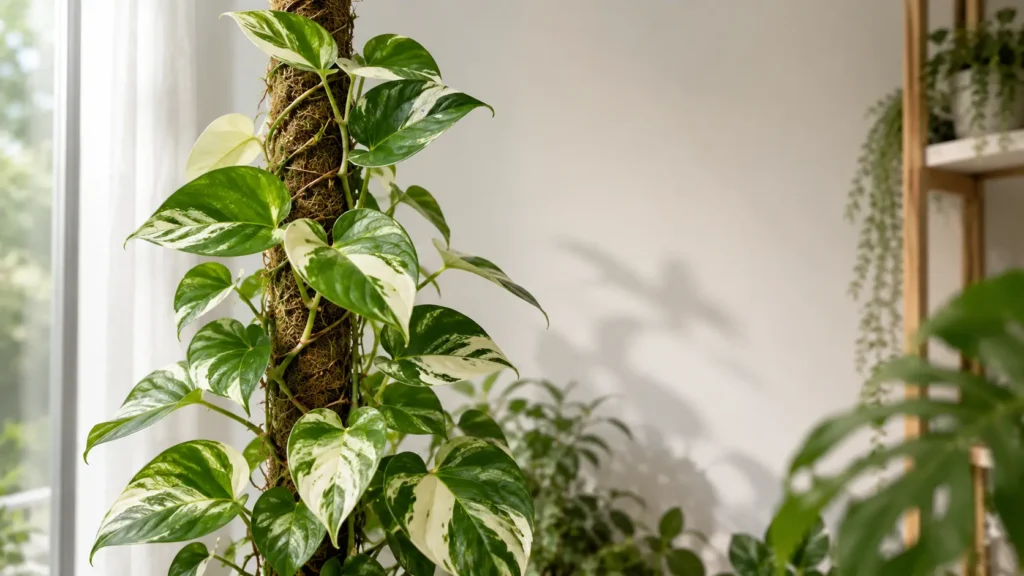
N’Joy pothos climbing refers to the natural ability of the N’Joy pothos (N’Joy pothos, N-Joy pothos, or pothos N Joy), a variegated cultivar of Epipremnum aureum, to grow upward using aerial roots for support. This tropical vine can climb moss poles, trellises, and other structures while producing fuller growth and potentially larger leaves. This guide explains how N’Joy pothos climbs, how to train it, how climbing affects growth, and how it compares with similar pothos cultivars. N’Joy pothos is a variegated cultivar of Epipremnum aureum, a tropical vine species commonly known for its adaptability as a houseplant.
Quick Summary
- N’Joy pothos is a natural climber that uses aerial roots to attach to moss poles, trellises, or other supports.
- It can grow as a climbing vine or trailing plant, and both styles are healthy.
- Climbing often encourages larger, more mature leaves compared with hanging growth.
- N’Joy pothos is a slow-to-moderate grower that benefits from bright indirect light and proper support.
- Training a N’Joy pothos to climb is simple with the right structure and attachment method.
Do N’Joy Pothos Like to Climb?
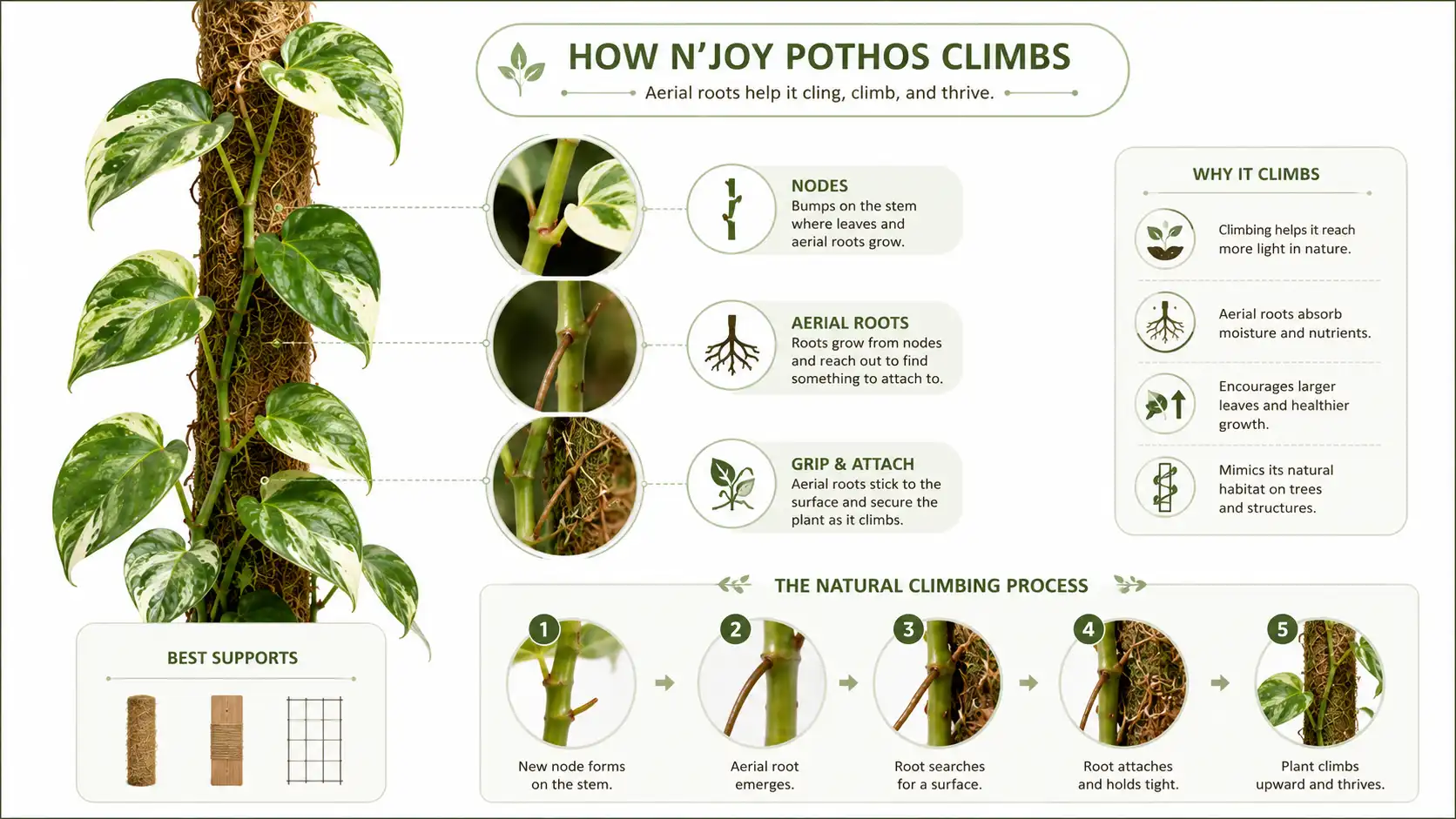
Yes, N’Joy pothos naturally likes to climb because it is an epiphytic tropical vine that uses aerial roots to attach itself to nearby surfaces. In its natural rainforest habitat, Epipremnum aureum grows upward along trees to access better light while using surrounding structures for stability.
N’Joy pothos climbing works because the plant produces small aerial roots along its stems. These roots help the vine grip supports such as moss poles, tree-like structures, and trellises.
Key climbing characteristics include:
- Epiphytic growth habit: N’Joy pothos naturally grows on other plants or structures without taking nutrients from them.
- Aerial roots: These roots attach to surfaces and help the plant climb upward.
- Natural rainforest behavior: Climbing allows vines to reach brighter areas where leaves can develop more fully.
Providing a climbing structure does not force unnatural growth. Instead, it recreates the plant’s natural growing environment.
Climbing vs. Hanging — Which Is Better?
Both climbing and hanging growth are healthy for N’Joy pothos, but each style produces different results. A climbing plant usually develops stronger stems and may produce larger leaves, while trailing plants are easier to maintain and work well in hanging baskets.
| Feature | Climbing N’Joy Pothos | Trailing N’Joy Pothos |
| Leaf size | Often produces larger mature leaves | Usually maintains smaller leaves |
| Growth direction | Upright and vertical | Cascading downward |
| Space use | Good for shelves and plant walls | Good for hanging baskets |
| Maintenance | Requires support and guidance | Requires occasional trimming |
| Appearance | Fuller, jungle-like look | Soft trailing aesthetic |
For growers who want larger foliage and a more mature appearance, climbing is usually the better option. For beginners or small spaces, trailing growth is often simpler.
How to Train Your N’Joy Pothos to Climb
To encourage N’Joy pothos climbing, provide a support structure and guide the vines upward as they grow. The plant will gradually attach itself using aerial roots, especially when humidity levels are suitable. Regular pruning and cutting above healthy nodes can encourage fuller vines and improve climbing growth, especially when training pothos onto supports.
A simple training process includes:
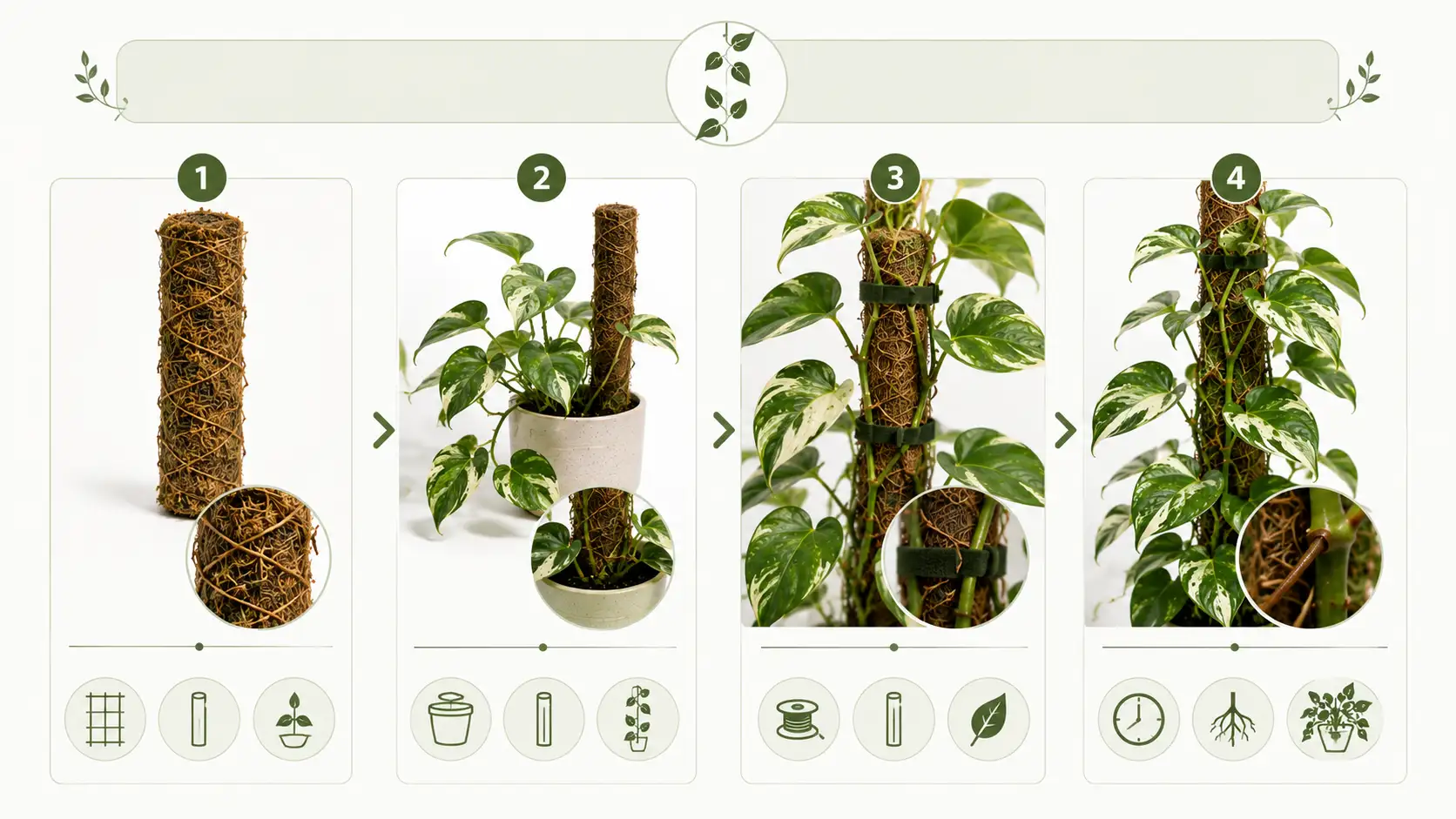
- Choose a support such as a moss pole, trellis, or coco coir pole.
- Place the support close to the main stems.
- Gently wrap or position vines around the structure.
- Use soft plant ties to secure stems without restricting growth.
- Mist the support lightly if using a moss pole to encourage root attachment.
Avoid tightly tying stems because pressure can damage growing points and restrict movement.
Best Support Structures for Climbing Pothos
Different supports provide different benefits depending on your growing conditions.
| Support Type | Cost | Moisture Retention | Ease of Use |
| Moss pole | Moderate | High | Easy |
| Coco coir pole | Moderate | Medium | Easy |
| Trellis | Low to moderate | Low | Very easy |
| Wall-mounted support | Variable | Low | Requires installation |
A moss pole is often the best choice because it provides a moist surface where aerial roots can attach. Higher humidity improves climbing success because aerial roots develop more actively in moist tropical conditions.
Does Climbing Affect N’Joy Pothos Size and Growth Rate?
Yes, climbing can influence N’Joy pothos size and overall growth development. When supported vertically, the plant receives better structural support and may produce larger leaves compared with a trailing plant.
Growth depends on several factors:
- Mature size: Indoor N’Joy pothos usually stays compact, but climbing plants can develop longer vines and larger foliage.
- Indoor vs outdoor growth: Outdoor plants in warm tropical climates can become significantly larger.
- Growth conditions: Light, humidity, nutrition, and support quality all affect growth speed.
N’Joy pothos remains a naturally slower-growing cultivar compared with many other pothos varieties because its heavy variegation reduces chlorophyll levels.
Environmental Factors That Speed Up Growth
Healthy climbing growth improves when environmental conditions match the plant’s tropical origin.
Important growth factors include:
- Light: Bright indirect light supports stronger stems and better variegation.
- Humidity: Moderate to high humidity encourages aerial root development.
- Fertilization: Balanced fertilizer during active growth supports new leaves.
- Support: Climbing structures help the plant mature naturally.
N’Joy Pothos Plant Size
N’Joy pothos size depends on whether it grows as a climber or trailer. Indoors, trailing vines commonly grow several feet long, while climbing plants can become taller when attached to a support.
Typical differences include:
- Climbing growth: Produces longer upright vines and potentially larger mature leaves.
- Trailing growth: Produces cascading stems with smaller foliage.
- Outdoor growth: Warm climates with high humidity allow significantly larger growth.
Environmental factors such as pot size, light availability, and pruning influence final plant size.
N’Joy Pothos Growth Rate
N’Joy pothos is considered a slow-to-moderate grower. It grows most actively during spring and summer when temperatures and light levels increase.
Growth speed improves with:
- Bright indirect sunlight
- Consistent watering
- Warm temperatures
- Adequate humidity
- Regular feeding during active growth
During winter, growth often slows because reduced light and cooler temperatures limit plant activity.
N’Joy Pothos Care Guide
N’Joy pothos care focuses on providing conditions similar to its tropical origins. The plant prefers balanced moisture, indirect light, and well-draining soil.
Essential care requirements include:
- Watering: Allow the top layer of soil to dry before watering again. Avoid constantly wet soil.
- Light: Bright indirect light helps maintain strong variegation.
- Soil: Use a loose, well-draining mix containing materials such as coco coir, peat, or perlite.
- Fertilization: Feed lightly during spring and summer.
- Pruning: Trim leggy growth to encourage fuller vines.
- Pot size: Use a pot only slightly larger than the root system to prevent excess moisture.
- Climate tolerance: Protect from cold temperatures and drafts.
Coffee grounds are not a reliable fertilizer replacement because they can alter soil conditions and may encourage moisture problems if overused. Checking soil moisture before watering is one of the easiest ways to prevent overwatering problems in indoor plants.
Light Requirements for Healthy Climbing Growth
N’Joy pothos needs bright indirect light for healthy climbing growth and strong variegation. Low light can cause slower growth and reduced white-and-green patterns. Like other pothos varieties, N’Joy pothos depends on the right light balance to maintain healthy growth and variegation. Understanding pothos light requirements can help prevent slow growth and color loss.
Avoid direct harsh sunlight because it can burn the leaves. A bright window with filtered light is usually ideal.
Common N’Joy Pothos Problems
N’Joy pothos problems are usually related to watering, lighting, or environmental stress. Identifying the cause early helps prevent long-term damage.
Common issues include:
- Yellowing leaves
- Cause: Overwatering, poor drainage, or root stress.
- Fix: Allow soil to dry more between watering.
- Prevention: Use a well-draining potting mix.
- Overwatering issues
- Cause: Constantly wet soil causing root problems.
- Fix: Reduce watering frequency and improve drainage.
- Prevention: Check soil moisture before watering.
- Slow or stalled growth
- Cause: Low light, cold temperatures, or lack of nutrients.
- Fix: Move to brighter indirect light and improve care conditions.
- Prevention: Maintain consistent growing conditions.
- Loss of variegation
- Cause: Insufficient light or new growth reverting.
- Fix: Increase light exposure.
- Prevention: Provide stable bright indirect light.
- Pest issues
- Cause: Common houseplant pests such as spider mites or mealybugs.
- Fix: Remove pests and treat affected areas.
- Prevention: Regularly inspect leaves.
N’Joy Pothos vs. Pearls and Jade Pothos
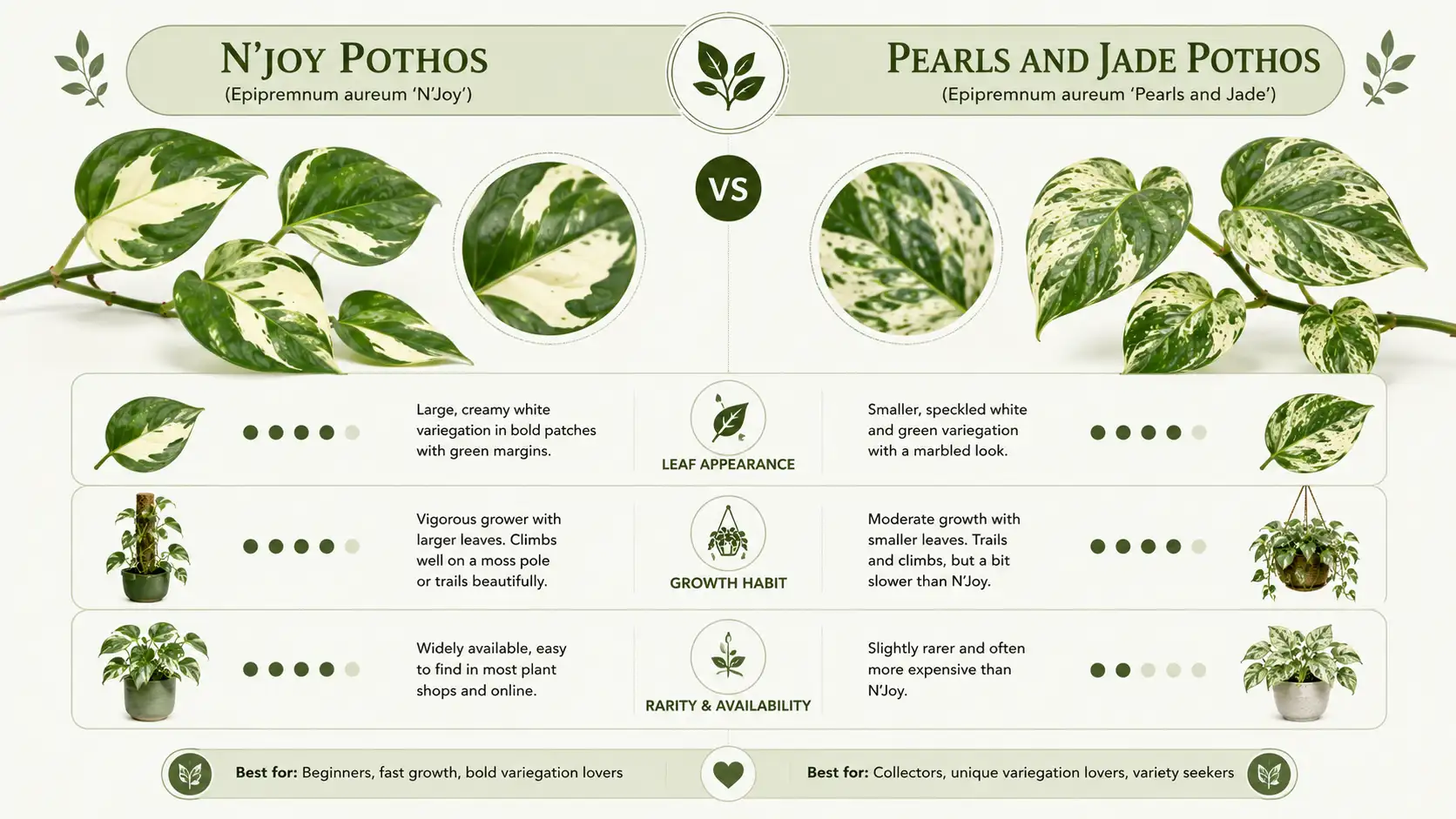
N’Joy pothos and Pearls and Jade pothos are closely related cultivars of Epipremnum aureum, but they differ in variegation patterns and growth characteristics.
Key differences include:
- N’Joy usually has larger blocks of white variegation.
- Pearls and Jade often has smaller green-and-white patterns along leaf edges.
- N’Joy typically has cleaner color separation.
- Pearls and Jade may show more speckled variegation.
N’Joy pothos is part of a larger group of decorative variegated pothos cultivars, including Manjula and Snow Queen pothos, which differ in leaf patterns, growth habits, and care needs.
| Feature | N’Joy Pothos | Pearls and Jade Pothos |
| Variegation | Large white patches | Smaller speckled patterns |
| Leaf size | Slightly larger | Usually smaller |
| Growth speed | Slow to moderate | Slow to moderate |
| Rarity | More commonly available | Sometimes less available |
Is N’Joy Pothos Rare?
N’Joy pothos is not considered extremely rare today. It was once harder to find, but increased propagation has made it widely available among houseplant growers.
Its price depends on plant size, maturity, and availability. Compared with highly uncommon pothos cultivars, N’Joy is generally easier to propagate through stem cuttings.
Can N’Joy Pothos Grow in Water?
Yes, N’Joy pothos can grow in water, especially during propagation. Stem cuttings with healthy nodes can develop roots in water within several weeks. Water propagation is a common method for many tropical houseplants, and similar propagation techniques are also used for plants such as Philodendron Birkin.
Long-term water growing is possible, but plants may grow differently compared with soil-grown specimens.
Benefits of water growing:
- Easy root monitoring
- Simple propagation method
- Decorative appearance
Limitations:
- Requires regular water changes
- Nutrient availability can be limited
- Growth may be slower without proper nutrients
Beginner Mistakes & Practical Tips
Many beginners struggle with N’Joy pothos climbing because of incorrect environmental conditions.
Common mistakes include:
- Overwatering before checking soil moisture
- Using weak supports that cannot hold vines
- Placing the plant in very low light
- Attaching stems too tightly
Practical climbing tips:
- Train vines while stems are young and flexible.
- Keep moss poles slightly moist for better attachment.
- Rotate the plant occasionally for even growth.
- Reduce watering during winter dormancy.
- Protect the plant from cold drafts and sudden temperature changes.
Conclusion
N’Joy pothos climbing is a natural growth behavior that allows this variegated Epipremnum aureum cultivar to develop stronger stems and potentially larger leaves. With a moss pole, trellis, or similar support, N’Joy pothos can be trained easily while maintaining healthy growth. Whether grown as a climber or a trailing plant, it remains a beginner-friendly houseplant when provided with proper light, watering, and humidity. N’Joy pothos is one of many popular indoor plants that thrive with proper light, watering, and care routines. For more houseplant care guides, explore our complete Plants Benefits and Guides collection.
Frequently Asked Questions
Do N'Joy pothos like to climb?
Yes, N'Joy pothos naturally likes to climb because it uses aerial roots to attach to nearby structures. Providing a moss pole or trellis allows it to grow in a way similar to its natural tropical environment.
Is it better to let pothos hang or climb?
Both methods are healthy, but climbing often encourages larger leaves and a more mature appearance. Hanging is easier to maintain and works well for decorative trailing growth.
How do I train my N'Joy pothos to climb?
Train N'Joy pothos by placing a support near the stems, gently attaching vines with soft ties, and allowing aerial roots to connect with the structure over time.
How big do N'Joy pothos get when climbing?
When climbing, N'Joy pothos can develop longer vines and larger leaves than trailing plants. Indoor size depends on light, humidity, support, and care conditions.
Are N'Joy pothos rare compared to Pearls and Jade?
N'Joy pothos is generally not considered rare today. It is usually easier to find and propagate than many uncommon pothos cultivars.
Can N'Joy pothos grow in water long-term?
Yes, N'Joy pothos can survive in water long-term with proper care, but soil growing usually provides better nutrient availability and stronger overall growth.



One Response