
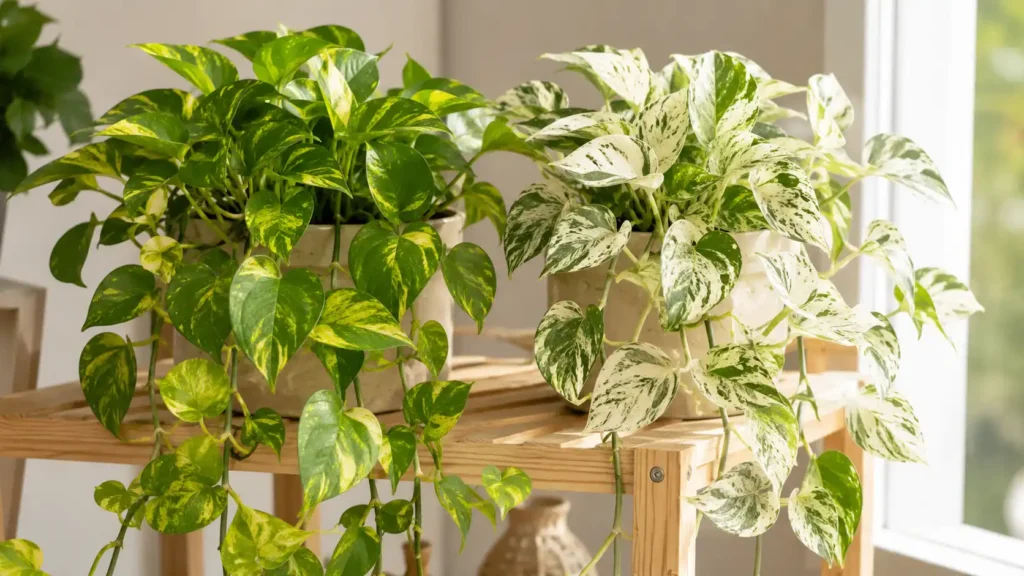
Golden pothos and Marble Queen are both cultivars of Epipremnum aureum, but Marble Queen has heavier white-cream marbling and less chlorophyll, making it grow slower and need brighter, indirect light. According to Manuela Nogueira, golden pothos tolerates low light and grows faster due to its more solid green-yellow foliage.
Both plants are toxic to cats and dogs if ingested and propagate readily from stem cuttings in water. Marble Queen specimens kept in insufficient light often revert to solid green as the plant compensates by producing more chlorophyll, and nurseries typically price Marble Queen higher because its variegated growth is slower and less predictable to propagate at scale.
This comparison is part of our broader Indoor Green Living Hub, where we cover the care fundamentals — light, water, humidity, and soil — that apply to pothos and every other easy-care aroid.
Quick Summary
- Golden Pothos has yellow-gold variegation and generally grows faster; Marble Queen has heavier cream-white variegation and usually grows more slowly.
- Marble Queen benefits from brighter indirect light because heavily variegated foliage has less green photosynthetic tissue.
- Both prefer well-draining soil and drying between waterings, but Golden Pothos tolerates less-than-ideal conditions more readily.
- Both are toxic to cats and dogs if chewed or swallowed because they contain insoluble calcium oxalates.
- Choose Golden Pothos for greater light tolerance and faster filling; choose Marble Queen for stronger white-and-green foliage contrast.
What’s the Difference Between Golden Pothos and Marble Queen?
Golden Pothos and Marble Queen are forms of the same species, Epipremnum aureum, but Golden Pothos has yellow-gold variegation while Marble Queen is characterized by much heavier white or cream marbling. Their basic growth habit and general care are similar, but Marble Queen usually demands brighter light and grows more slowly.
Both plants belong to the arum family, Araceae, and develop flexible vines that can trail from a container or climb a support using aerial roots. The species is commonly known as pothos or Devil’s Ivy and is widely grown as an indoor ornamental vine.
The important differences are concentrated in four areas:
- Leaf coloration: Golden Pothos is green with yellow or golden markings; Marble Queen is green with cream-white marbling.
- Variegation density: Marble Queen normally has substantially more pale tissue.
- Growth speed: Golden Pothos usually produces new growth more readily under comparable conditions.
- Light tolerance: Golden Pothos handles lower light better, whereas Marble Queen needs stronger indirect light to maintain attractive variegation.
Leaf Color and Variegation Patterns
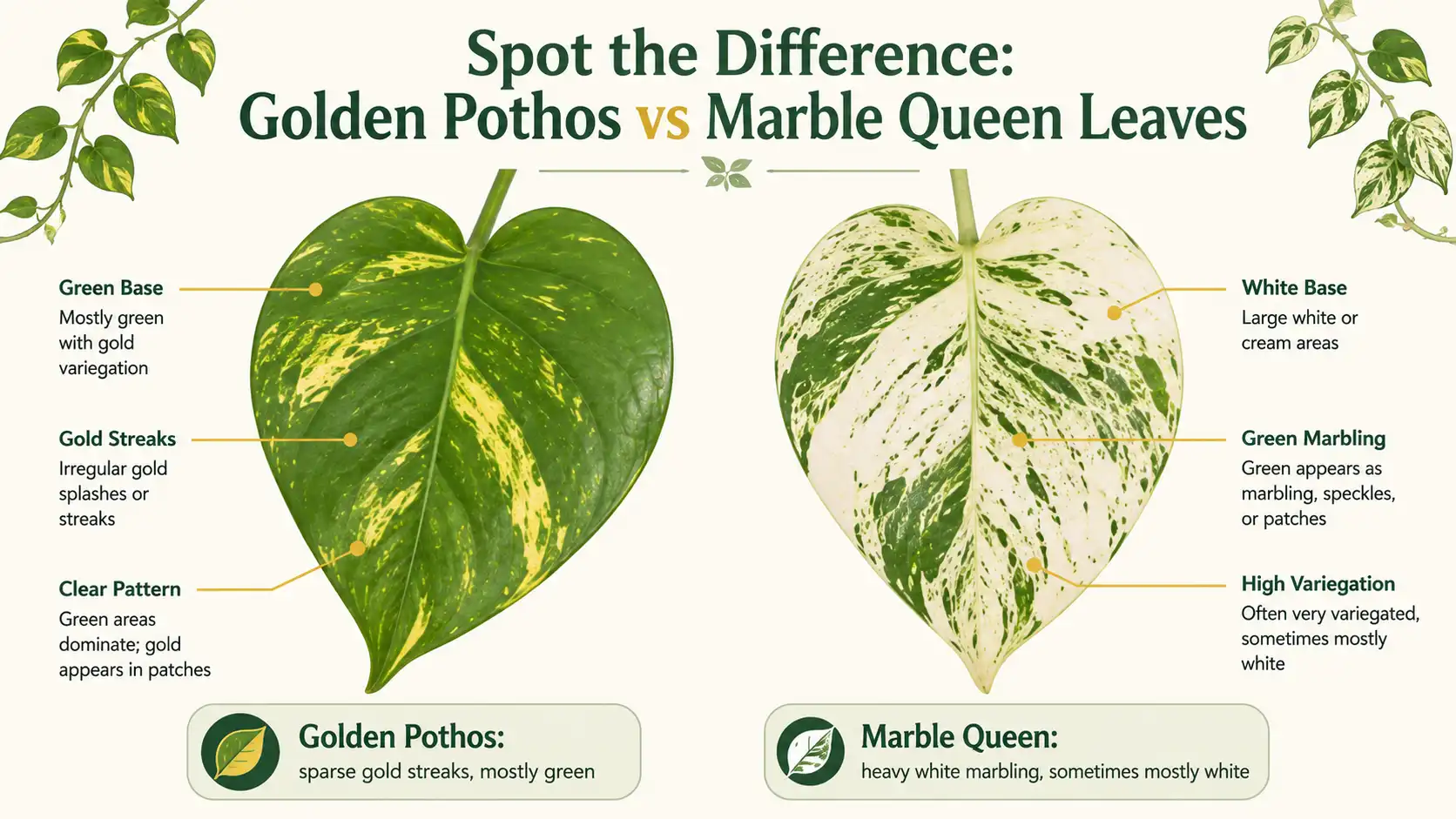
Golden Pothos typically has medium- to dark-green leaves with irregular yellow, gold, or cream streaks and splashes. The green background remains visually dominant on many leaves, which gives the plant a relatively stable green-and-gold appearance.
Marble Queen has a more irregular green, cream, and white marbled pattern. Individual leaves can vary substantially, with some carrying more green and others showing extensive pale areas. This variation is normal and partly explains why two Marble Queen plants may look noticeably different even though they are the same cultivar.
| Visual trait | Golden Pothos | Marble Queen |
| Base leaf color | Green | Green |
| Main variegation | Yellow/gold | Cream/white |
| Typical pattern | Streaks, splashes, patches | Marbling, streaking, patches |
| Overall contrast | Green-and-gold | Green-and-white |
| Variegation intensity | Moderate | Usually heavier |
Light affects how strongly variegation is expressed. Low light can encourage greener growth, particularly in strongly variegated cultivars. North Carolina Extension specifically notes that low light can cause loss of variegation in pothos.
When people search for golden pothos vs marble queen pictures, the easiest visual cue is the dominant pale color: look for yellow-gold markings on Golden Pothos and cream-white marbling on Marble Queen.
The question of which is the “prettiest” is subjective. Marble Queen generally creates a higher-contrast, more heavily patterned appearance, while Golden Pothos provides warmer yellow-green color and often fills space faster.
Growth Habit and Shared Origin
Both cultivars share the same basic vining habit. They can be used as:
- Trailing plants in hanging baskets
- Cascading plants on shelves
- Climbers on moss poles or other supports
- Indoor foliage plants trained vertically
Pothos is naturally a climbing vine. When given support, it can produce larger, more mature foliage than a plant continuously kept in a hanging or trailing form. Container-grown indoor plants commonly remain in the juvenile form, while climbing specimens can become substantially more vigorous.
Golden Pothos is also widely associated with the popular “air-purifying plant” label. This reputation applies to pothos as a species rather than being a unique advantage of Golden Pothos over Marble Queen. For ordinary homes, good ventilation remains more important than relying on a houseplant as an air-cleaning system.
Golden Pothos vs Marble Queen: Full Comparison Table
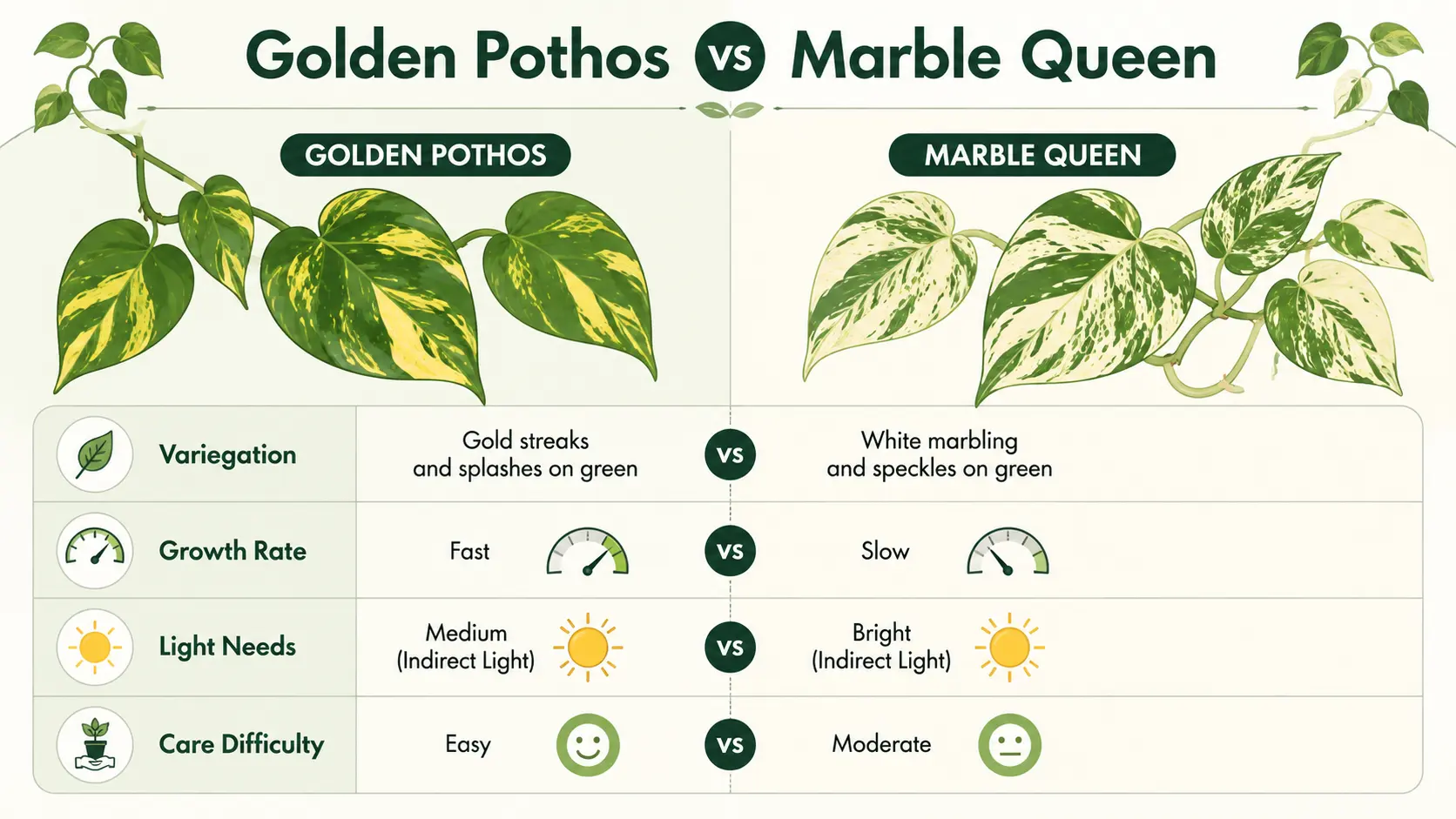
The most useful way to compare the two is to separate appearance from practical care. Both are forgiving pothos, but their variegation creates meaningful differences in light and growth.
| Attribute | Golden Pothos | Marble Queen |
| Botanical identity | Epipremnum aureum | Epipremnum aureum ‘Marble Queen’ |
| Variegation | Yellow/gold streaks and splashes | Cream-white marbling |
| Variegation intensity | Moderate | Usually high |
| Growth rate | Faster | Slower |
| Light requirement | Medium to bright indirect; tolerates lower light | Bright, indirect light preferred |
| Low-light performance | Better | More likely to become greener and grow slowly |
| Cold/chilling tolerance | Warm-loving; somewhat forgiving | Warm-loving; heavy variegation can make stress more noticeable |
| Care difficulty | Very easy | Easy, with greater attention to light |
| Availability | Very common | Common, but highly variegated specimens may vary in price |
| Typical use | Hanging, trailing, climbing | Hanging, trailing, climbing |
| Best advantage | Speed and adaptability | High-contrast variegated foliage |
The key takeaway is that Golden Pothos is generally the easier choice for imperfect indoor conditions, while Marble Queen is the better fit when foliage pattern and bright indirect light are priorities.
Plant Size
Golden Pothos and Marble Queen can both become long, substantial vines when grown well, but indoor container plants normally remain much smaller than established outdoor or climbing specimens. North Carolina Extension notes that pothos vines can become extremely long when allowed to trail or climb, while container-grown plants generally retain their juvenile foliage.
For indoor growing, mature size depends heavily on:
- Light intensity and duration
- Pot size and root health
- Nutrient availability
- Watering consistency
- Pruning frequency
- Whether the vine is allowed to climb
A hanging plant may develop long cascading stems without becoming especially bushy. A plant trained upward can direct growth toward a support and potentially produce larger leaves as it matures.
Outdoor conditions can produce much larger growth where temperatures remain warm year-round. The species is tropical and does not behave like a cold-hardy perennial in temperate climates. Clemson Extension recommends warm growing conditions, with approximately 70–85°F daytime temperatures and 60–70°F nights for indoor production.
Growth Rate
Golden Pothos generally grows faster than Marble Queen because Golden Pothos has a larger proportion of green, chlorophyll-containing tissue available for photosynthesis. Marble Queen’s extensive white or cream variegation means that a greater portion of the leaf is less photosynthetically active, so the plant commonly grows more slowly under comparable conditions.
This difference is particularly noticeable when both cultivars are placed in the same room and given similar care. Golden Pothos may produce longer vines and new leaves sooner, whereas Marble Queen can take longer to extend between nodes. Research from the University of Florida IFAS Center confirms that higher variegation in Marble Queen correlates with slower growth and greater cold sensitivity.
Growth is also seasonal. Both plants normally grow more actively during warmer, brighter periods and slow when light and temperature decrease.
A useful comparison is:
Golden Pothos = faster, more vigorous fill-in.
Marble Queen = slower growth with heavier variegation.
The slower growth of Marble Queen does not mean it is unhealthy. Slow development can be completely normal for a highly variegated plant.
There is no fixed universal lifespan for pothos. With suitable care, individual plants can remain productive for many years. Old or declining vines are also easy to replace through stem propagation, so pothos is commonly maintained through pruning and propagation rather than being treated as a short-lived houseplant.
Care Guide
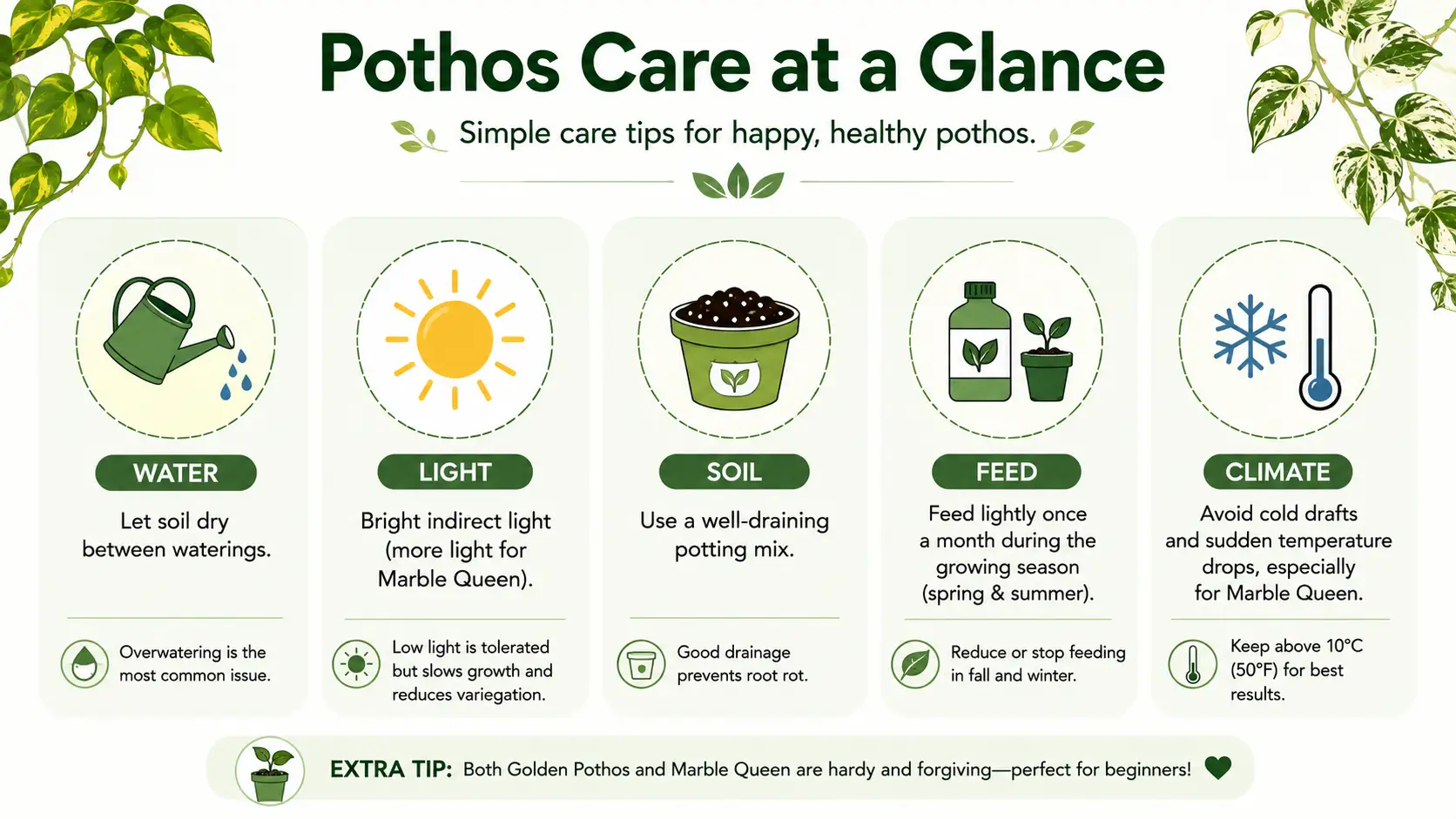
Golden Pothos and Marble Queen have substantially overlapping care requirements. The main difference is that Marble Queen needs stronger indirect light to sustain its heavier variegation.
Pothos generally prefers bright, indirect light, but it can tolerate lower levels. Clemson Extension specifically identifies Marble Queen as a cultivar that requires bright indirect light and notes that pothos overall can tolerate lower light.
Core care requirements include:
- Water: Allow the growing medium to dry between waterings rather than keeping it constantly wet.
- Light: Give Golden Pothos moderate to bright indirect light; provide Marble Queen with brighter indirect light.
- Soil: Use a loose, well-draining, aerated potting mixture.
- Fertilizer: Feed lightly during active growth rather than repeatedly applying heavy fertilizer.
- Temperature: Keep both warm and away from cold drafts.
- Pruning: Trim long or bare vines regularly to encourage a fuller appearance.
Overwatering is more dangerous than allowing the plant to become slightly dry. North Carolina Extension identifies root rot as a problem associated with overwatering and notes that low light can contribute to loss of variegation.
How Often Should I Water My Marble Queen Pothos?
Water Marble Queen when the upper portion of its potting mix has dried rather than following a rigid calendar schedule. A practical starting point is to check the top 1–2 inches of soil before watering, then adjust according to pot size, light, temperature, humidity, and season.
The same basic method works for Golden Pothos. The plant does not need permanently moist soil.
Marble Queen may use water more slowly when it is growing slowly or receiving less light, so watering every set number of days can cause accidental overwatering. Clemson Extension likewise recommends allowing pothos soil to dry completely before watering.
For marble queen pothos care and golden pothos vs marble queen care, the biggest practical distinction is therefore not a completely different watering method. It is the amount of light needed to maintain healthy, attractive growth and stable variegation.
Which Pothos Is Easier to Grow?
Golden Pothos is generally the easier cultivar to grow because it tolerates a wider range of indoor light conditions and tends to grow more vigorously. Marble Queen is still beginner-friendly, but its heavier variegation makes adequate light more important.
Pothos as a group is considered easy to grow, and extension guidance describes the plant as low-maintenance and capable of surviving periods of low light. New to growing pothos altogether? Our Pothos Care for Beginners guide covers the fundamentals both cultivars share.
The difference becomes clearer when conditions are less than ideal:
- Dim room: Golden Pothos usually copes better.
- Bright indirect light: Both perform well.
- Need for rapid vine growth: Golden Pothos usually wins.
- Need for strong white-and-green patterning: Marble Queen wins.
- Beginner plant: Both are suitable.
- Forgetful watering: Neither benefits from chronic overwatering, but Golden Pothos generally handles occasional inconsistency better.
So, are pothos hard to keep alive? Usually not. The most common failures come from excessive watering, inadequate drainage, severe environmental stress, or prolonged unsuitable light rather than from the basic difficulty of the plant.
Common Problems and Downsides (Problem–Solution Coverage)
The main downside of Golden Pothos is its vigor. A healthy plant can quickly become long or sparse if vines are not trimmed. Its ability to spread rapidly can also become inconvenient in small spaces. Beyond overwatering, pests like aphids can also affect pothos health — here’s how to identify and remove aphids on houseplants if you spot them.
Marble Queen’s main challenge is the opposite: it can grow slowly and lose some of its dramatic variegation under inadequate light.
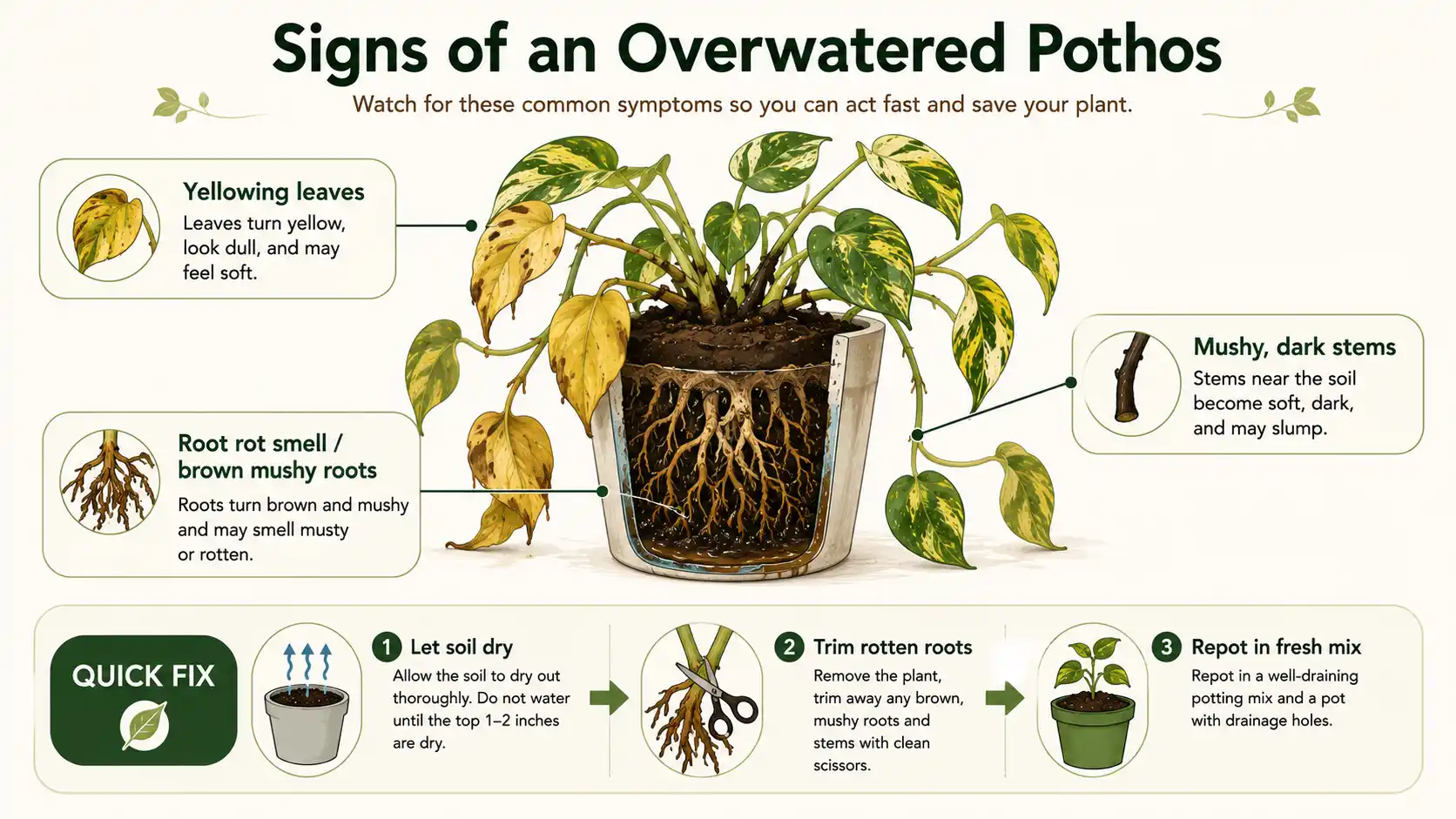
Overwatered Pothos
An overwatered pothos may show:
- Yellowing leaves
- Soft or collapsing stems
- Persistently wet soil
- Root deterioration or an unpleasant odor
- Blackened or declining roots
The underlying problem is usually soil remaining wet for too long. Poor drainage, oversized pots, and frequent watering increase the risk. North Carolina Extension specifically identifies root rot and blackened leaf margins as problems associated with overwatering.
The solution is to stop watering until the medium has dried appropriately, inspect the roots when rot is suspected, remove severely damaged roots, and repot into a fresh, well-draining medium when necessary.
Prevention is simpler: use a pot with drainage holes and water according to soil moisture rather than a fixed schedule.
Marble Queen Turning Green
Marble Queen can produce greener new growth when light is insufficient. This is not necessarily a disease; it can be a response that gives the plant more photosynthetically active tissue.
Move the plant gradually toward brighter indirect light rather than placing it suddenly in harsh direct sunlight. New growth is more useful for assessing the current light level than older leaves that formed under different conditions. Clemson Extension notes that low light can result in loss of variegation.
How to Perk Up a Pothos Plant
First inspect the plant rather than immediately adding fertilizer or water.
Check:
- Soil moisture
- Root condition if symptoms are severe
- Available light
- Cold drafts or temperature stress
- Damaged or excessively long stems
Remove badly damaged foliage, correct the environmental problem, and return to consistent care. Sudden changes are usually less helpful than correcting the underlying cause.
Ideal Growing Conditions
Both cultivars perform best in warm indoor conditions with bright, indirect light, moderate humidity, and a porous growing medium. Clemson Extension recommends warm temperatures and notes that pothos naturally grows as a tropical understory vine.
Do Pothos Prefer to Climb or Hang?
Pothos can both climb and hang. A hanging basket emphasizes long trailing vines, while a climbing support encourages the plant to grow vertically and can promote larger, more mature foliage.
For a fuller hanging plant, pruning is more important than simply giving the plant additional space.
Do Pothos Like Big Pots or Small Pots?
Pothos generally performs better in a pot that is appropriately sized for its root system rather than an unnecessarily large container. Oversized pots can retain moisture for longer and increase the risk of root problems.
Repot when roots substantially fill the container, drainage becomes poor, or the plant has clearly outgrown its existing root space. Pot size affects more than just root space — it can directly change how quickly your pothos grows. Read more in our guide on does pot size affect how fast a plant grows.
Do Pothos Like to Be Crowded?
They can tolerate being somewhat snug in a container, and mild root restriction is generally less problematic than placing the plant in an oversized pot full of wet soil.
That does not mean a severely root-bound plant should never be repotted. The goal is balanced root space, not maximum pot volume.
Where Should I Put Pothos in My House?
A bright spot with indirect or filtered light is the safest general placement. Avoid prolonged exposure to intense, unfiltered midday sunlight, especially through hot glass.
For golden pothos vs marble queen indoors, the important distinction is placement within the brighter part of that range. Marble Queen should generally receive the brighter position so its white variegation and growth remain strong.
Pruning and Bushiness
Yes, you can cut pothos vines, and regular pruning is one of the easiest ways to control length and encourage a fuller-looking plant.
Should I Cut the Vines Off My Pothos?
Cut back excessively long, bare, damaged, or unwanted vines with clean pruning shears. Pruning also allows you to use healthy cuttings for propagation. For the exact nodes to cut and how to encourage new branching, see our full guide on where to cut pothos to encourage growth.
How Do I Make My Pothos More Bushy?
Trim a vine just above a healthy node. New growth can develop from nodes below the cut, helping fill gaps and create branching.
For a fuller appearance, avoid allowing every vine to grow uninterrupted to the floor. Strategic trimming encourages the plant to produce growth from several points rather than relying entirely on one long stem.
What to Do When Pothos Gets Too Long?
Cut the vine back to the desired length and remove weak sections. Healthy cuttings with suitable nodes can be rooted in water or an appropriate growing medium and later returned to the original pot to increase density.
Golden Pothos may need this maintenance more frequently because it tends to grow faster. Marble Queen generally requires less frequent length control but still benefits from pruning when stems become sparse.
Safety: Toxicity, Touch, and Bedroom Placement
Both Golden Pothos and Marble Queen contain insoluble calcium oxalates and are considered toxic to cats and dogs if ingested. ASPCA lists Golden Pothos as Epipremnum aureum and identifies insoluble calcium oxalates as its toxic principle; its Marble Queen listing likewise identifies calcium oxalate crystals.
The important safety distinction is ingestion, not simply having the plant in the room. For a full list of plants toxic to pets, the ASPCA’s toxic and non-toxic plant database is a reliable reference.
Is Pothos More Toxic Than Other Houseplants?
Pothos is not uniquely toxic among common houseplants. Other aroids, including philodendrons and several related ornamental plants, also contain insoluble calcium oxalates. Chewing can cause oral irritation, drooling, vomiting, and difficulty swallowing.
Is It Okay to Touch Pothos?
Simply touching an intact pothos leaf is generally not the main hazard. The significant concern is chewing or swallowing plant material. Handle broken stems and plant material normally with good hygiene, and keep the plant away from pets or children who may chew it.
Is It Safe to Keep Pothos in the Bedroom?
Yes, pothos can be kept in a bedroom from an ordinary plant-placement perspective. The critical consideration is keeping it inaccessible to pets or young children who may chew the foliage.
Rarity and Value
Marble Queen is not generally a rare pothos cultivar. It is an established and widely cultivated form of Epipremnum aureum. Clemson Extension lists Marble Queen among the common cultivars available for indoor growing.
However, individual plants can vary in appearance and perceived value. A highly variegated Marble Queen with extensive stable cream-white patterning may command more interest than a plant with mostly green leaves.
Value is influenced by:
- Cultivar availability
- Degree of variegation
- Plant size
- Propagation source
- Local nursery market
- Overall plant condition
The broadest answer to “What is the most expensive pothos?” is that no permanent single cultivar holds that position. Specialty or unusually rare variegated forms generally attract higher prices than widely propagated Golden Pothos or standard Marble Queen.
Pothos vs Philodendron and Common Lookalikes (Differentiation Section)
Pothos and heartleaf philodendron are frequently confused because both can have heart-shaped leaves, flexible vines, and similar indoor-care requirements.
Is Pothos or Philodendron Better?
Neither is universally better. Pothos generally offers very forgiving care and thick, glossy foliage, while philodendrons include many species and cultivars with different leaf forms and growth characteristics.
The better choice depends on the desired growth habit and environmental conditions rather than a universal hierarchy.
One important identification point is that Golden Pothos and Marble Queen are both Epipremnum aureum. Marble Queen is a cultivar, not a different species. North Carolina Extension lists Golden Pothos, Marble Queen, Jade, Neon, Pearls and Jade, Snow Queen, and other forms under Epipremnum aureum.
What Plant Is Mistaken for Pothos?
Philodendron is one of the most common visual mix-ups. Other pothos cultivars can also be confused with Marble Queen.
Snow Queen is particularly relevant because its pale foliage can resemble a highly variegated Marble Queen. The most useful identification clue is the overall ratio and pattern of green to cream-white tissue rather than one leaf viewed in isolation. Marble Queen is also frequently confused with Manjula and Snow Queen pothos — see our breakdown of Manjula Pothos vs Snow Queen for a closer look at those differences.
Mixing Pothos Varieties in One Pot
Yes, Golden Pothos and Marble Queen can be grown together in the same container because they are cultivars of the same species and have broadly compatible environmental requirements.
A mixed pot can combine:
- Golden-yellow splashes from Golden Pothos
- Cream-white marbling from Marble Queen
- Different leaf patterns within the same species
- Contrasting growth densities
The main maintenance issue is uneven growth speed. Golden Pothos generally grows faster, so it may eventually dominate the container and shade the slower Marble Queen.
To maintain balance, prune the Golden Pothos more aggressively and allow Marble Queen sufficient access to light. Avoid placing a rapidly expanding vine over the leaves of the slower cultivar.
Beginner Mistakes and Growing Myths
Some pothos care advice sounds practical but can create more problems than it solves.
Do Coffee Grounds Help Pothos Grow?
Used coffee grounds are not a substitute for a balanced fertilizer. Fresh grounds added heavily to a houseplant pot can alter the growing medium and contribute to moisture or pest-management problems.
A better approach is to use a suitable potting mix and a diluted, balanced houseplant fertilizer during active growth.
Does Vinegar Help Pothos?
No. Vinegar is not a routine fertilizer or watering treatment for pothos. Its acidity can damage plant tissue and roots if applied improperly, so it has no sound role in regular pothos feeding or irrigation.
Common Beginner Mistakes
The most important mistakes to avoid are:
- Overwatering: Watering on a rigid schedule even when the soil is still wet can lead to root problems.
- No drainage: A decorative container without adequate drainage can keep roots saturated.
- Treating Marble Queen like Golden Pothos: Marble Queen generally needs a brighter location to maintain strong variegation.
- Ignoring greener new growth: Increased green coloration can signal insufficient light rather than being purely cosmetic.
- Using harsh direct sun: Moving a low-light plant abruptly into intense sun can scorch foliage.
- Over-fertilizing: More fertilizer does not automatically mean faster or healthier growth.
- Never pruning: Long, unbranched vines can make a healthy pothos appear thin or sparse.
The simplest reliable routine is to provide appropriate indirect light, use a draining potting medium, check soil moisture before watering, and prune when growth becomes excessively long.
Conclusion
Golden Pothos and Marble Queen are closely related because both are cultivars of Epipremnum aureum, but their different variegation creates meaningful horticultural differences. Golden Pothos has yellow-gold markings, grows more vigorously, and generally tolerates lower light better. Marble Queen has heavier cream-white marbling, grows more slowly, and performs best in brighter indirect light.
For golden pothos vs marble queen, the clearest decision is therefore practical: choose Golden Pothos when speed, resilience, and broader light tolerance matter most. Choose Marble Queen when high-contrast white-and-green foliage is the priority and you can provide stronger indirect light.
Both remain beginner-friendly when grown in well-draining soil, watered according to soil dryness, kept warm, and protected from prolonged environmental stress. Because both contain insoluble calcium oxalates, they should also be kept away from pets and children who may chew them. This comparison is part of our complete guide to Plants: Benefits and Guides, covering care, types, and growing tips for houseplants of every kind.
FAQs
Can Golden Pothos and Marble Queen Pothos Grow in the Same Pot?
Yes. Golden Pothos and Marble Queen can share a pot because both are cultivars of Epipremnum aureum with similar basic care requirements. Golden Pothos may eventually grow faster and need more pruning to prevent it from dominating the container.
Why Is My Marble Queen Pothos Turning Green?
Marble Queen often produces greener growth when light is insufficient. Move it gradually toward brighter indirect light, because adequate light helps the plant maintain its characteristic variegation. Low light is documented as a cause of reduced variegation in pothos.
How Can You Tell Golden Pothos and Marble Queen Apart When They’re Small Seedlings?
Young Golden Pothos usually shows yellow or golden variegation against green leaves, while Marble Queen shows cream-white marbling. Because early leaves can vary, identification becomes easier as several leaves develop and the characteristic pattern becomes clearer.
Is Marble Queen Pothos Slower-Growing Than Golden Pothos?
Yes. Marble Queen generally grows more slowly than Golden Pothos because its heavier variegation provides less green photosynthetic tissue. Golden Pothos therefore tends to produce longer vines and fill containers more quickly under similar conditions.
Which Pothos Variety Is Better for a Low-Light Room?
Golden Pothos is generally better for a low-light room. It tolerates lower light more readily than Marble Queen, while Marble Queen benefits from brighter indirect light to maintain its variegation.
Do Golden Pothos and Marble Queen Need Different Amounts of Water?
They do not require fundamentally different watering methods. Both should be watered according to soil dryness rather than a fixed schedule. Allow the growing medium to dry between waterings and avoid keeping the roots continuously wet.



2 Responses