
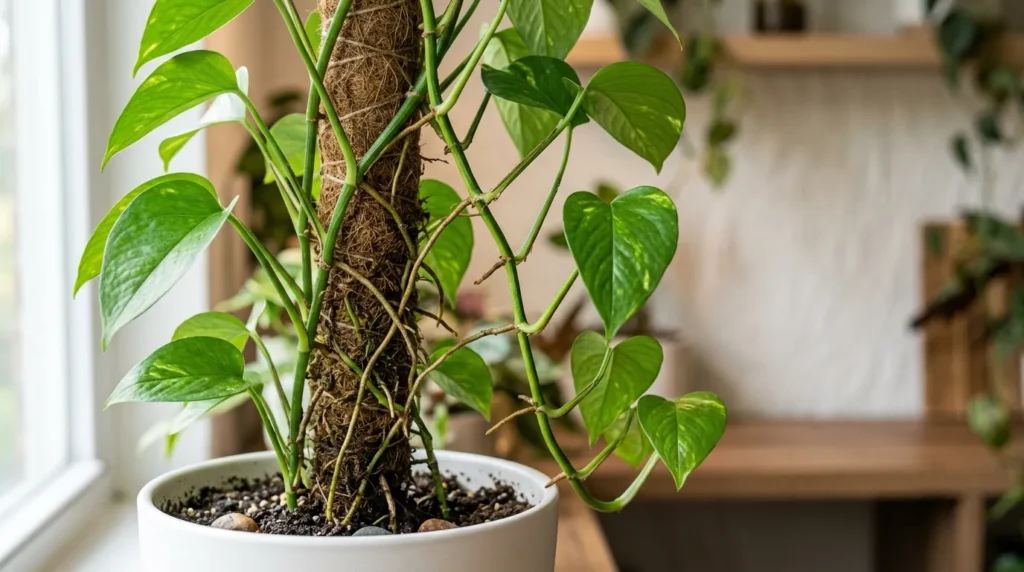
Introduction
Pothos aerial roots propagation is a simple way to grow new pothos plants from healthy vines by using stem cuttings that contain nodes and, ideally, aerial roots. Pothos plants, scientifically known as Epipremnum aureum, develop aerial roots along their stems to help them climb, attach to surfaces, and absorb moisture from their surroundings. Understanding these roots makes propagating pothos, also called devil’s ivy propagation, easier and more successful. This guide explains how aerial roots work, where to cut pothos vines, and how to root cuttings in both water and soil using reliable propagation methods. Understanding proper propagation techniques is an important part of successful houseplant care, and broader plant guides can help growers learn about different species, care requirements, and growing methods.
Quick Summary
- Pothos (devil’s ivy) propagates easily from stem cuttings containing at least one node and preferably an aerial root.
- Cuttings can be rooted in water or soil; water propagation is easier to monitor, while soil propagation creates stronger long-term roots.
- Pothos roots should generally reach 1–2 inches long before transplanting water-grown cuttings into soil.
- Aerial roots help pothos cuttings anchor and absorb moisture but are not required for successful propagation.
- Healthy propagation depends on proper cutting placement, moisture control, warmth, and adequate indirect light.
What Are Aerial Roots on a Pothos Plant?
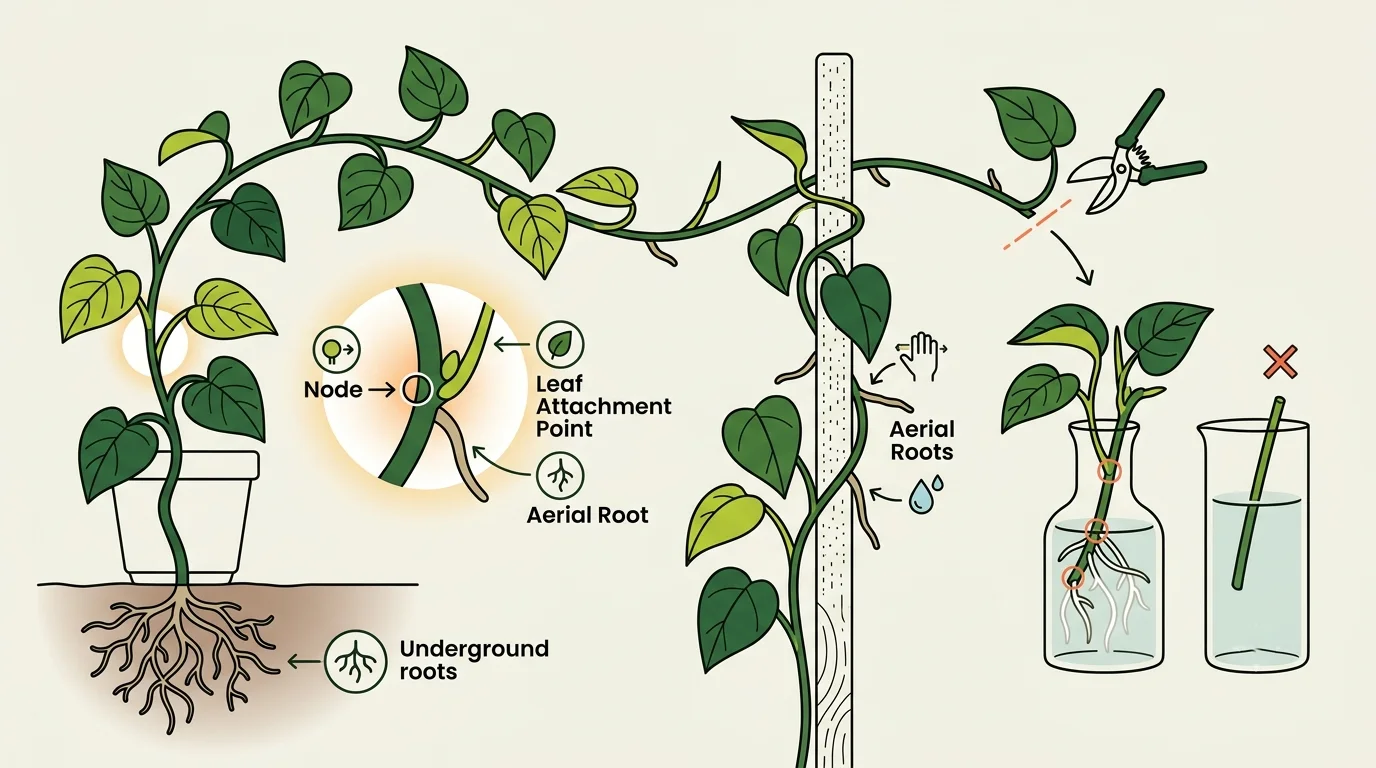
Aerial roots on a pothos plant are specialized roots that grow above the soil along the stem. Unlike underground roots that mainly absorb water and nutrients from soil, pothos aerial roots help the plant attach to surfaces and climb in its natural tropical environment. These roots can also absorb moisture from humid air and may develop into functional soil roots when placed in contact with growing media.
Common pothos, scientifically known as Epipremnum aureum, is a tropical climbing species in the Araceae family with natural aerial root development.
Golden pothos aerial roots are commonly seen as small brown bumps, short spikes, or root-like structures growing from the vine near leaf nodes. These structures are a natural part of pothos growth and indicate that the plant has climbing capabilities.
Pothos plants belong to the family Araceae and naturally grow as climbing vines in tropical forests. In the wild, aerial roots allow the plant to attach to tree trunks and move upward toward better light exposure.
Indoor pothos may produce more aerial roots when they have:
- High humidity levels
- A nearby support structure such as a moss pole or trellis
- Mature, healthy vines
- Active growth conditions
Aerial roots and underground roots serve different purposes:
| Root Type | Main Function |
| Aerial roots | Climbing, anchoring, moisture absorption |
| Underground roots | Water and nutrient uptake from soil |
Although aerial roots are useful during propagation, the most important part of a pothos cutting is the node because it contains the growth tissue needed to produce new roots and shoots.
Do Pothos Prefer to Climb or Hang?
Pothos can naturally grow as both climbing and trailing plants, but their growth behavior depends on their environment. In tropical forests, pothos prefers to climb by attaching aerial roots to trees and other surfaces. Indoors, pothos commonly grows as a hanging plant because vines are allowed to trail freely from shelves or baskets.
When given support, pothos may produce stronger climbing growth because aerial roots can attach to surfaces. A moss pole, wooden support, or trellis can encourage larger leaves and more mature growth patterns.
Environmental factors that influence climbing behavior include:
- Higher humidity that supports aerial root development
- Physical surfaces for roots to attach to
- Bright indirect light that encourages active growth
- Consistent moisture without waterlogging
Trailing pothos vines can still produce healthy leaves and roots, but climbing conditions often encourage the plant to display its natural growth habit.
Will Aerial Roots Turn Into Regular Roots?
Yes, pothos aerial roots can develop into regular soil-absorbing roots when they are buried in a suitable growing medium. Once an aerial root contacts moist soil, it can adapt by producing additional root growth that functions similarly to underground roots.
This process occurs because plant roots are flexible structures that respond to environmental conditions. Aerial roots exposed to air focus on attachment and moisture collection, while roots surrounded by soil develop more absorption capacity.
During propagation, aerial roots can improve rooting success because they already contain active root tissue. However, a cutting without an aerial root can still propagate successfully if it includes a healthy node.
Where to Cut Pothos for Propagation
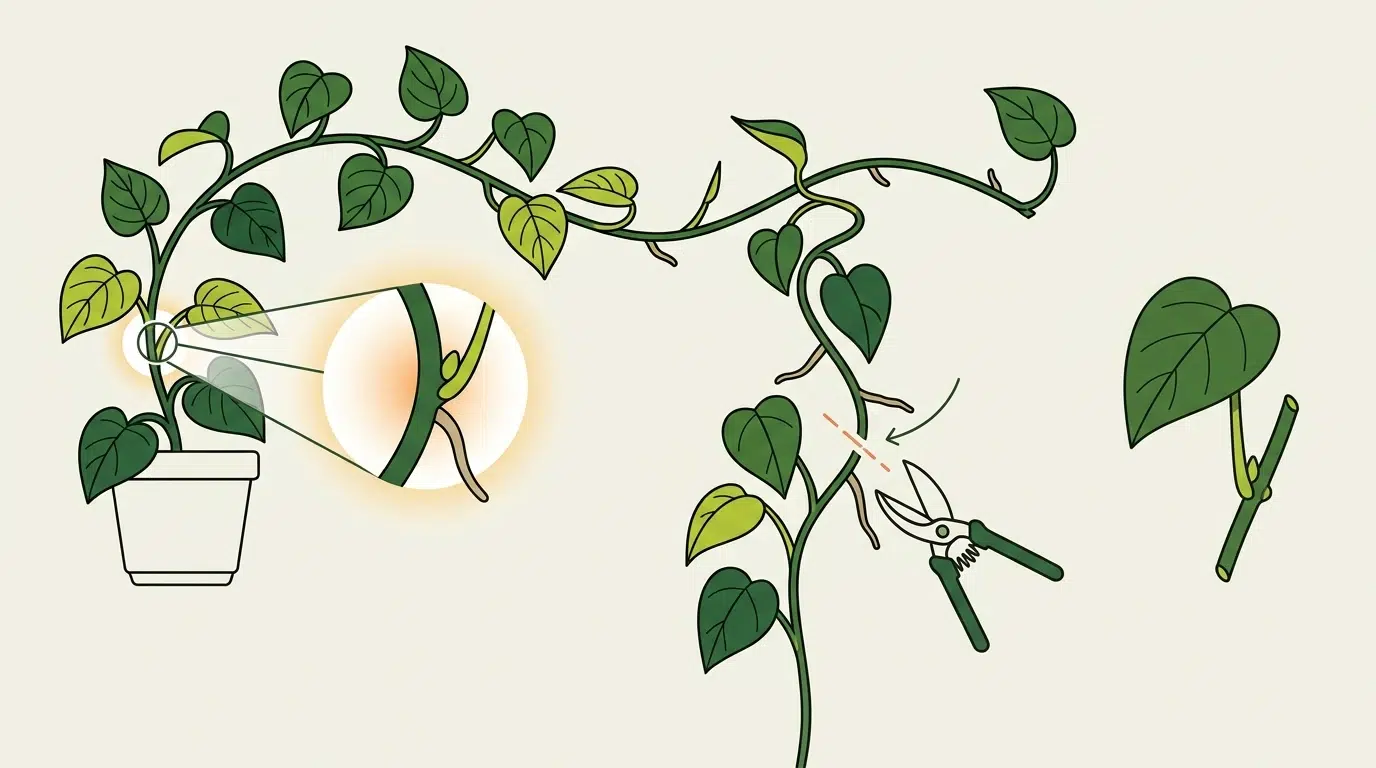
Knowing where to cut pothos is one of the most important steps for successful propagation. The ideal cutting location is just below a healthy node because the node contains the cells needed to produce new roots and future growth.
A pothos node appears as a small brown bump, slight swelling, or joint along the vine where leaves and aerial roots emerge. A cutting taken from the wrong location may survive temporarily but will not develop into a new plant.
For successful pothos propagation:
- Locate a node (small brown bump on the stem).
- Cut about 1/4 inch below the node.
- Include at least one leaf whenever possible to support photosynthesis.
- Use clean, sharp scissors or pruning shears to prevent infection.
- Choose healthy stems without signs of rot, pests, or damage.
The ideal pothos cutting usually contains:
- One or more nodes
- One healthy leaf
- An aerial root if available
When learning where to cut pothos for new growth, remember that the node—not the leaf—is the key propagation point. A leaf can provide energy, but only a node contains the growth structure needed for a new vine. Like pothos, other climbing houseplants such as Monstera also rely on healthy nodes for successful propagation, making node identification an essential skill for indoor plant propagation.
Can You Propagate Pothos Without a Node?
No, pothos cannot successfully propagate from a cutting without a node. The node contains meristematic tissue, which is responsible for producing new roots and stems. A leaf or section of stem without a node may remain green for a short time, but it cannot create a complete new pothos plant.
A pothos node contains:
- Growth points for new shoots
- Root-producing cells
- Connection points between leaves and stems
For this reason, when deciding where to cut pothos to propagate, always make sure each cutting includes at least one node.
Can You Propagate Pothos Without Leaves?
Yes, pothos can sometimes be propagated from node-only cuttings without leaves, but success rates are usually lower compared with leafy cuttings. A leaf provides energy through photosynthesis, helping the cutting produce roots and new growth more efficiently.
Leafless pothos stem propagation is commonly used when:
- A long vine is being divided into multiple sections
- The plant has damaged leaves
- A grower wants to maximize the number of cuttings
For better results with leafless cuttings:
- Keep at least one healthy node per section.
- Maintain warmth and humidity.
- Avoid overwatering.
- Provide bright indirect light.
A node without a leaf can still produce new growth, but it usually takes longer because the cutting must rely on stored energy until new leaves develop.
How to Propagate Pothos in Water
Propagating pothos in water is one of the easiest methods because the developing roots are visible and easy to monitor. This method is especially popular for beginners because it allows growers to observe root development before transferring the cutting into soil. Water propagation is also widely used for other vining houseplants, including silver satin pothos, which can develop roots through similar cutting methods.
To propagate pothos in water:
- Select a healthy stem cutting with at least one node.
- Place the node and aerial root under the water surface.
- Keep all leaves above the waterline to prevent rotting.
- Place the container in bright, indirect light.
- Replace the water every 5–7 days to maintain oxygen levels and reduce bacterial growth.
- Wait for roots to develop before planting.
Important water propagation conditions include:
- Clean water
- Stable room temperature
- Indirect sunlight
- Fresh water changes
Pothos aerial roots propagation in water often works well because existing aerial roots can begin adapting to the aquatic environment. New roots usually appear within 1–4 weeks depending on temperature, light, and cutting health.
Avoid placing water-propagated pothos in direct sunlight because intense light can heat the water and stress developing roots.
How Long Should Pothos Roots Be Before Planting?
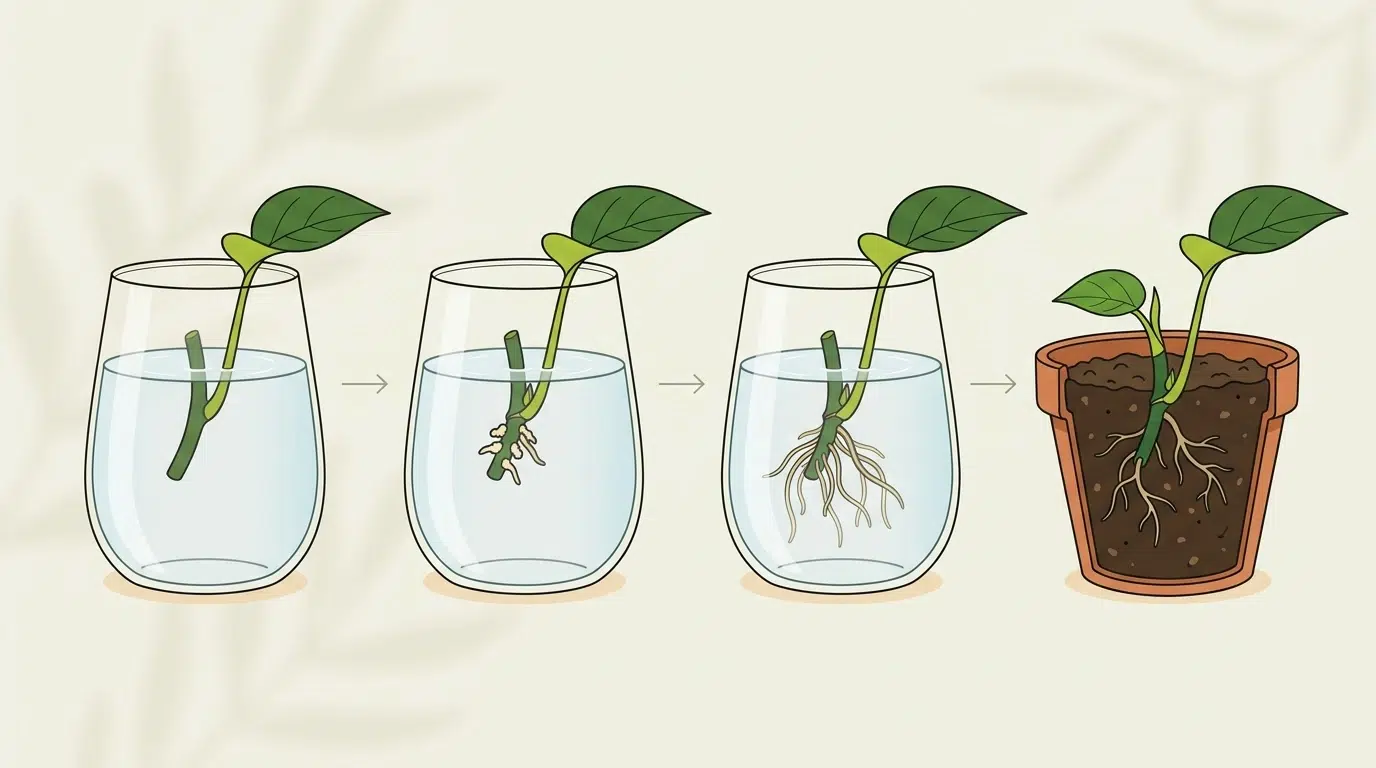
Pothos roots should generally be 1–2 inches long before planting into soil. This length provides enough root development for the cutting to transition successfully from water to a soil environment.
Before transplanting, look for:
- Several healthy white or cream-colored roots
- Root length of approximately 1–2 inches
- Signs of new root branching
Planting too early can cause stress because very young roots may not yet absorb enough moisture from soil. Waiting until roots are established increases the chance of successful transition.
How to Propagate Pothos in Soil
Propagating pothos in soil allows cuttings to develop roots directly in their final growing environment. Unlike water propagation, soil propagation avoids the need for transplanting and encourages roots to adapt immediately to soil conditions.
To propagate pothos in soil:
- Insert the cutting so the node is buried 1–2 inches deep.
- Keep the soil consistently moist but never soggy.
- Place the cutting in bright indirect light.
- Use a plastic bag or humidity dome to maintain moisture if indoor air is dry.
- Expect roots to establish in approximately 3–4 weeks.
A suitable soil mix should provide both moisture retention and drainage. A typical pothos propagation mix may include:
- Quality potting soil
- Perlite for airflow
- Coco coir or similar moisture-retaining material
Rooting hormone is optional. Pothos generally roots easily without it, but some growers use it to encourage faster root development on slower cuttings.
The biggest mistake with soil propagation is keeping the soil too wet. Pothos cuttings need moisture to grow roots, but excessive water reduces oxygen around the stem and increases the risk of rot.
Can I Root Pothos Cuttings Directly in Soil vs. Water First?
Pothos cuttings can be rooted directly in soil or started in water first, and both methods can produce healthy new plants. The better choice depends on whether you prefer easier monitoring or stronger root adaptation from the beginning. Direct soil propagation allows roots to develop naturally, while water propagation makes it easier to observe root growth before planting. Many vining houseplants follow similar propagation methods, including water and soil rooting techniques used for plants such as heartleaf philodendron.
Direct soil propagation is useful when:
- You want the cutting to establish in its permanent growing medium.
- You prefer fewer steps because no transplanting is required.
- You want roots that are already adapted to soil conditions.
Water-first propagation is useful when:
- You are a beginner learning how pothos roots develop.
- You want to monitor root growth visually.
- You are propagating cuttings with visible aerial roots.
Water-grown roots are often thinner and softer because they develop in a low-resistance environment. When transferred to soil, these roots need time to adjust. Soil-grown roots usually become stronger because they develop under conditions where they must absorb moisture and nutrients from a solid medium.
Both approaches work well if the cutting contains a healthy node, receives adequate indirect light, and is kept in suitable moisture conditions.
Water Propagation vs. Soil Propagation — Which Is Better?
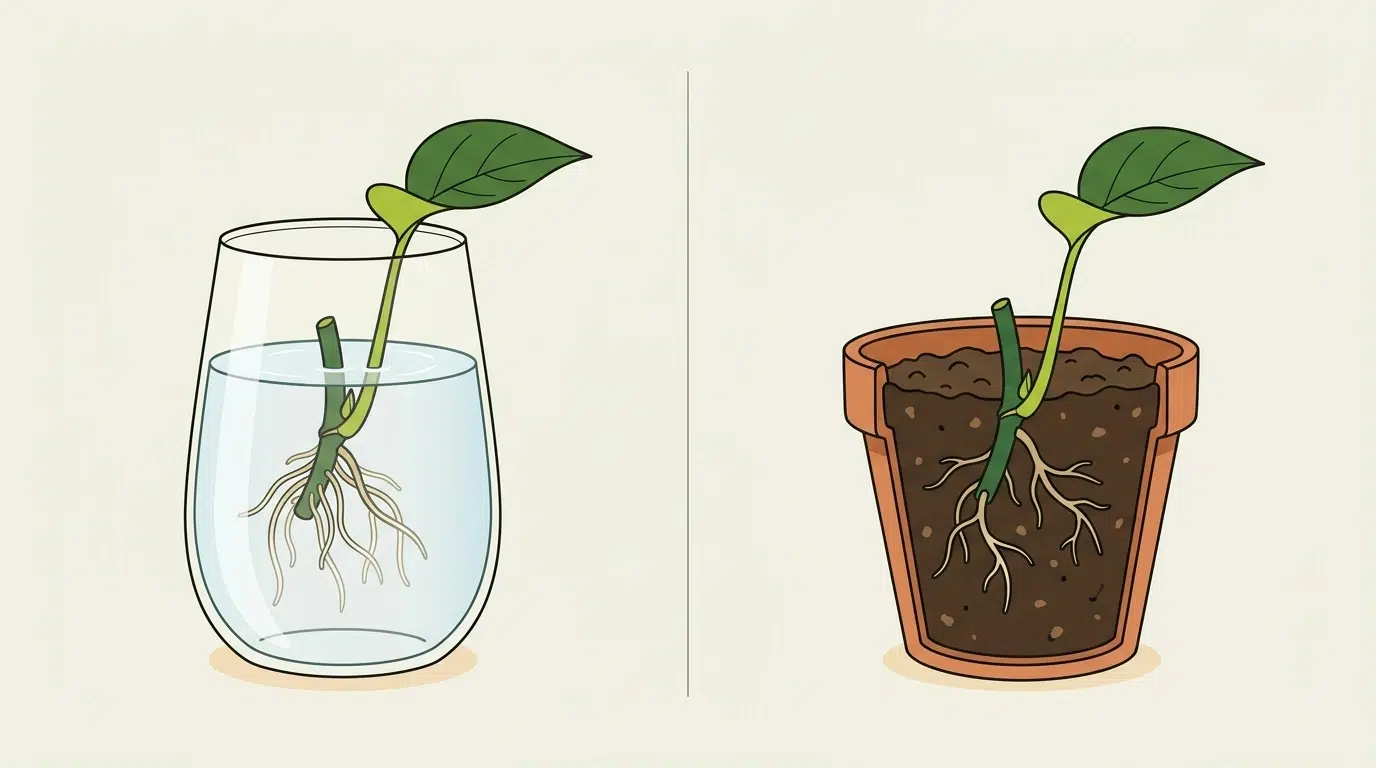
Water propagation and soil propagation are both effective methods for growing pothos, but they create slightly different rooting experiences. Water propagation is generally easier to observe, while soil propagation allows roots to develop directly in their long-term environment.
| Factor | Water Propagation | Soil Propagation |
| Root visibility | Easy to monitor | Not visible |
| Root type produced | Softer, water-adapted roots | Sturdier, soil-adapted roots |
| Transplant shock risk | Higher because roots must adjust | Lower because roots develop in soil |
| Best for | Beginners and visual learners | Long-term plant establishment |
For beginners, water propagation is often preferred because it provides clear feedback. Seeing new roots develop can help identify whether the cutting is healthy.
For long-term growth, soil propagation can be advantageous because the cutting develops roots that are immediately adapted to the growing environment.
The most important factor is not the propagation method itself but the quality of the cutting. A healthy node, proper moisture, warmth, and suitable light conditions have a greater impact on success than choosing water or soil.
When and How to Plant Propagated Pothos Cuttings
Propagated pothos cuttings should be planted when they have developed strong roots, usually when water-grown roots reach about 1–2 inches long and show some branching. This indicates that the cutting is ready to transition from propagation conditions into a potting environment.
To plant rooted pothos cuttings:
- Select a container with drainage holes.
- Fill the pot with a loose, well-draining potting mix.
- Create a small hole in the soil.
- Place the roots gently into the hole.
- Cover the roots and node with soil.
- Water lightly to settle the soil around the roots.
- Place the plant in bright indirect light.
After planting, the pothos may experience minor adjustment stress. This is normal because water-grown roots must adapt to absorbing moisture from soil.
Signs of successful transition include:
- New leaf growth
- Firm stems
- Healthy green leaves
- Continued root development
Avoid fertilizing immediately after planting. Newly rooted cuttings need time to establish before receiving additional nutrients.
Do Pothos Like Deep or Shallow Pots?
Pothos generally prefers moderately sized pots with good drainage rather than very deep containers. The plant has a relatively fine root system that spreads through the upper layers of soil, so an oversized pot can retain excess moisture and increase the risk of root rot.
A suitable pothos pot should:
- Be slightly larger than the root system
- Have drainage holes
- Allow airflow around the roots
- Prevent water from collecting at the bottom
A shallow-to-medium depth pot is often appropriate for young propagated cuttings. As the plant grows, it can be moved into a larger container when roots become crowded.
Common signs that a pothos needs repotting include:
- Roots growing through drainage holes
- Slow growth despite proper care
- Soil drying unusually quickly
- The plant becoming unstable in its container
Common Pothos Propagation Mistakes
Many pothos propagation failures happen because of incorrect cutting techniques, poor moisture control, or unsuitable growing conditions. Understanding common mistakes helps improve success rates when propagating pothos from aerial roots or stem cuttings.
Overwatering Cuttings
Overwatering is one of the most common pothos propagation mistakes because growers often assume more moisture encourages faster rooting. However, constantly wet conditions can reduce oxygen around the cutting and cause the stem to rot.
To prevent overwatering:
- Keep soil lightly moist rather than saturated.
- Use containers with drainage holes.
- Allow excess water to escape.
- Remove any soft, dark, or mushy stem sections.
If a cutting begins to rot, remove the damaged portion and restart propagation using a healthy node.
Cutting Without a Node
A pothos cutting without a node will not produce a new plant because it lacks the growth tissue required for root and stem development.
A leaf alone cannot create a complete pothos plant. Before cutting, always confirm that the section includes:
- A visible node
- Healthy stem tissue
- A leaf if possible
Checking the node before propagation is one of the simplest ways to avoid failed cuttings.
Insufficient Light During Rooting
Pothos cuttings need light to support energy production, even before new growth appears. Keeping cuttings in dark areas can slow root development and weaken the plant. Providing the correct lighting conditions is important for pothos propagation because inadequate light can slow root development and future growth.
The ideal lighting condition is:
- Bright indirect light
- No harsh direct afternoon sun
- Consistent daily exposure
If rooting is slow, move the cutting closer to a suitable light source rather than increasing water or fertilizer.
Transplanting Too Early
Moving a cutting into soil before roots are developed enough can cause stress and slow growth. Very short roots may struggle to absorb enough moisture from soil.
To reduce transplant problems:
- Wait until roots are approximately 1–2 inches long.
- Look for multiple roots rather than a single tiny root.
- Handle roots gently during planting.
Propagated Pothos Not Growing
A propagated pothos may stop growing temporarily after rooting because it is adjusting to new conditions. However, prolonged lack of growth may indicate an environmental issue.
Common causes include:
- Weak lighting
- Root damage
- Excess moisture
- Lack of warmth
- Insufficient nutrients after establishment
Solutions include:
- Moving the plant to brighter indirect light
- Checking for root rot
- Allowing soil to dry slightly between watering
- Providing balanced fertilizer only after active growth begins
Can Aerial Roots Alone Sustain a Pothos Cutting?
Aerial roots alone cannot usually sustain a pothos cutting because they do not contain the complete growth structure needed to produce a new plant. A successful cutting requires at least one healthy node, which contains the cells responsible for creating new roots and shoots.
An aerial root may help a cutting establish faster because it can absorb moisture and adapt to soil, but it cannot replace the role of the node.
For successful pothos aerial roots propagation, the ideal cutting includes:
- One or more nodes
- A healthy stem section
- At least one leaf when available
- An aerial root if present
Will Aerial Roots Grow Back If Cut?
Yes, pothos aerial roots can grow back after being removed if the plant remains healthy. New aerial roots may develop from nearby nodes as the vine continues growing.
Removing aerial roots is generally not harmful, but frequent removal may reduce the plant’s natural ability to climb and attach to surfaces.
Aerial roots may regrow faster when:
- Humidity is higher
- The plant is actively growing
- Nodes remain healthy
- The vine receives sufficient light
Can I Cut Pothos Roots If They’re Too Long?
Yes, pothos roots can be trimmed if they become excessively long, tangled, or difficult to place in a pot. However, unnecessary root cutting should be avoided because roots help the plant absorb water and nutrients.
When trimming pothos roots:
- Use clean scissors or pruning tools.
- Remove only damaged, dead, or excessively long roots.
- Avoid cutting large amounts of healthy roots at once.
- Replant immediately after trimming.
For propagated cuttings, it is usually better to guide long roots into soil rather than cutting them unless they prevent proper planting.
Why Is Pothos Called “Devil’s Ivy”?
Pothos is commonly called “devil’s ivy” because it is extremely hardy and remains green even under conditions where many houseplants struggle. The nickname refers to its ability to survive low light, irregular watering, and indoor environments while continuing to grow.
The scientific name of common pothos is Epipremnum aureum. It is a tropical climbing plant in the Araceae family and is known for its trailing vines, heart-shaped leaves, and adaptable growth habits.
The term devil’s ivy propagation refers to the same propagation methods used for pothos, including:
- Stem cuttings with nodes
- Water propagation
- Soil propagation
- Cuttings containing aerial roots
Despite its tough reputation, pothos still grows best with appropriate light, moisture, and healthy propagation practices.
Legal Considerations When Propagating Pothos
Propagating pothos for personal use is generally acceptable, but certain patented or protected plant varieties may have restrictions when propagated for commercial purposes. Some newer ornamental cultivars are developed and legally protected by breeders, meaning unauthorized propagation and selling may violate plant patent or licensing rules. Different pothos cultivars can vary in appearance, growth patterns, and propagation considerations, especially when comparing popular variegated varieties.
For example, a grower may legally root a pothos cutting to grow at home, but selling large quantities of a protected cultivar may require permission from the rights holder.
When propagating pothos:
- Personal propagation is generally allowed for many common varieties.
- Commercial resale of protected cultivars may have restrictions.
- Plant labels and breeder information can help identify protected varieties.
Questions such as “which pothos are illegal to propagate” or “is it illegal to propagate plants from Home Depot” usually depend on the specific plant variety and the purpose of propagation. Growing a cutting for personal enjoyment is different from producing plants for commercial sale.
Conclusion
Pothos aerial roots propagation is a reliable way to grow new pothos plants when combined with proper node identification, suitable cutting techniques, and correct rooting conditions. Aerial roots can improve propagation success by helping the cutting anchor and absorb moisture, but the node remains the most important part because it contains the growth tissue needed for new roots and shoots.
Whether you choose water or soil propagation, healthy cuttings should be monitored carefully and planted when roots reach around 1–2 inches long. Check your pothos vine for healthy nodes, select your preferred propagation method, and monitor root development to create strong new plants.
FAQs
How long should pothos roots be before planting in soil?
Pothos roots should generally be 1–2 inches long before planting in soil. Roots at this stage are usually developed enough to transition from water into a soil environment successfully.
Can aerial roots be propagated directly, or do you need a node?
Aerial roots cannot replace a node during pothos propagation. A successful cutting needs at least one node because the node contains the growth tissue required for producing new roots and stems.
Do pothos propagate easily compared to other houseplants?
Yes, pothos is considered one of the easiest houseplants to propagate because its stems naturally contain nodes that can produce new roots in water or soil with minimal care.
Will aerial roots turn into normal roots after planting?
Yes, pothos aerial roots can adapt and develop into soil-absorbing roots when they are placed in contact with moist growing media.
Is it illegal to propagate certain pothos varieties?
Some patented pothos cultivars may have restrictions on commercial propagation and resale, but growing common pothos cuttings for personal use is generally acceptable.
Why is my propagated pothos cutting not growing roots?
A propagated pothos cutting may fail to grow roots because it lacks a node, receives insufficient light, has excess moisture, or was taken from unhealthy plant material. Checking the cutting and improving conditions can help restart growth.