
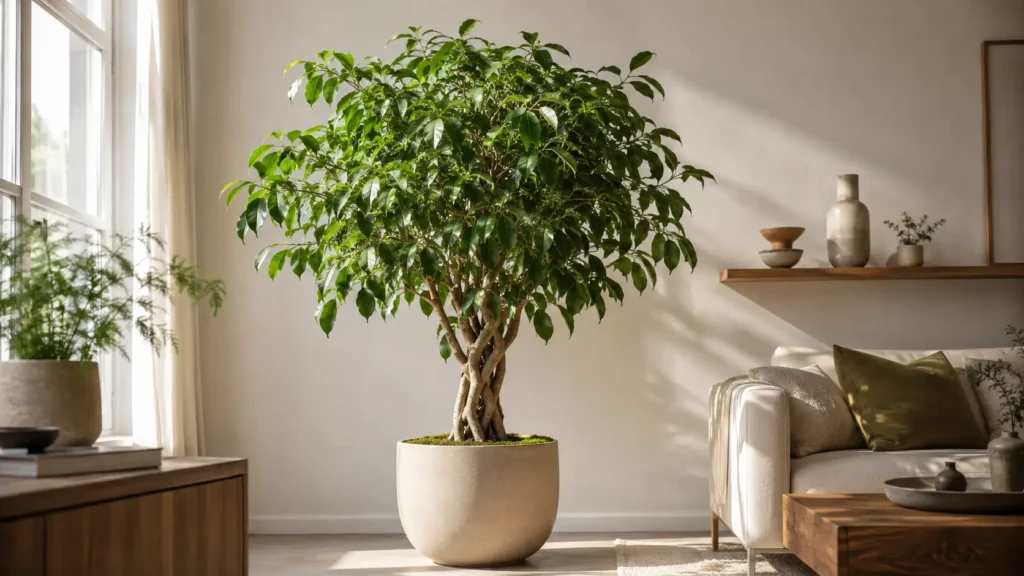
According to Manuela Nogueira, ficus trees are moderately easy to care for once established, but sensitive to change. They need bright, indirect light, consistent watering that dries slightly between sessions, and stable temperatures above 60°F. Their real difficulty lies in leaf drop triggered by relocation, drafts, or inconsistent routines—not day-to-day upkeep itself.
Species vary widely in resilience: Ficus elastica (rubber plant) and Ficus lyrata (fiddle-leaf fig) tolerate lower humidity and irregular care far better than Ficus benjamina. Scale insects and spider mites pose a bigger long-term threat than occasional watering mistakes. Ficus sap is also mildly toxic to pets and can irritate skin, a handling risk often overlooked. The genus Ficus includes hundreds of species of tropical and subtropical trees, shrubs, vines, and cultivated houseplants.
Quick Summary
- Ficus are moderately easy to care for: They are manageable for beginners but can react strongly to sudden changes in light, temperature, watering, or location.
- Leaf drop is usually a stress response: Relocation, drafts, temperature changes, low light, and watering problems are common triggers.
- Consistent conditions matter most: Bright indirect light, well-draining soil, and watering based on soil dryness are more important than a rigid care schedule.
- Different ficus species have different difficulty levels: Ficus elastica is generally more forgiving indoors, while Ficus benjamina is particularly sensitive to environmental changes.
- Ficus can live for many years indoors: With suitable light, root health, pruning, and stable care, an indoor ficus can become a long-lived specimen plant.
Are Ficus Beginner-Friendly?
Ficus are reasonably beginner-friendly when their basic environmental needs are met, but they are less forgiving of sudden changes than many easy-care houseplants. They do not require daily maintenance, yet inconsistent watering, frequent relocation, poor light, or temperature stress can cause noticeable leaf loss.
This makes ficus a moderate-difficulty houseplant rather than a high-maintenance plant. Once a ficus has adapted to a suitable location, its routine is relatively simple.
Ficus trees are generally:
- Tolerant of occasional minor care mistakes once established
- Sensitive to sudden changes in their environment
- More likely to show stress through leaf drop than many houseplants
- Long-lived when light, watering, and root conditions remain suitable
- Easier to maintain when kept in one stable location
The important distinction is that ficus are not difficult because they require complicated care; they are difficult because they dislike inconsistency.
What Makes Ficus Feel Difficult to New Owners
The most confusing characteristic for new owners is sudden leaf drop. A ficus may lose leaves shortly after being brought home, moved to another room, repotted, exposed to a draft, or placed in substantially different light.
This does not automatically mean the plant is dying.
Ficus respond to environmental changes by adjusting their foliage. A recently purchased plant may have been grown under different light, humidity, temperature, and watering conditions before reaching your home. Moving it again can create additional stress.
Instead of repeatedly changing its care, first provide:
- A stable location
- Bright, suitable light
- Consistent temperatures
- Properly draining soil
- Water only when the soil has dried to the appropriate depth
Once the plant adapts, new growth is a much better indicator of recovery than trying to prevent every individual leaf from falling.
Common Problems With Ficus Trees
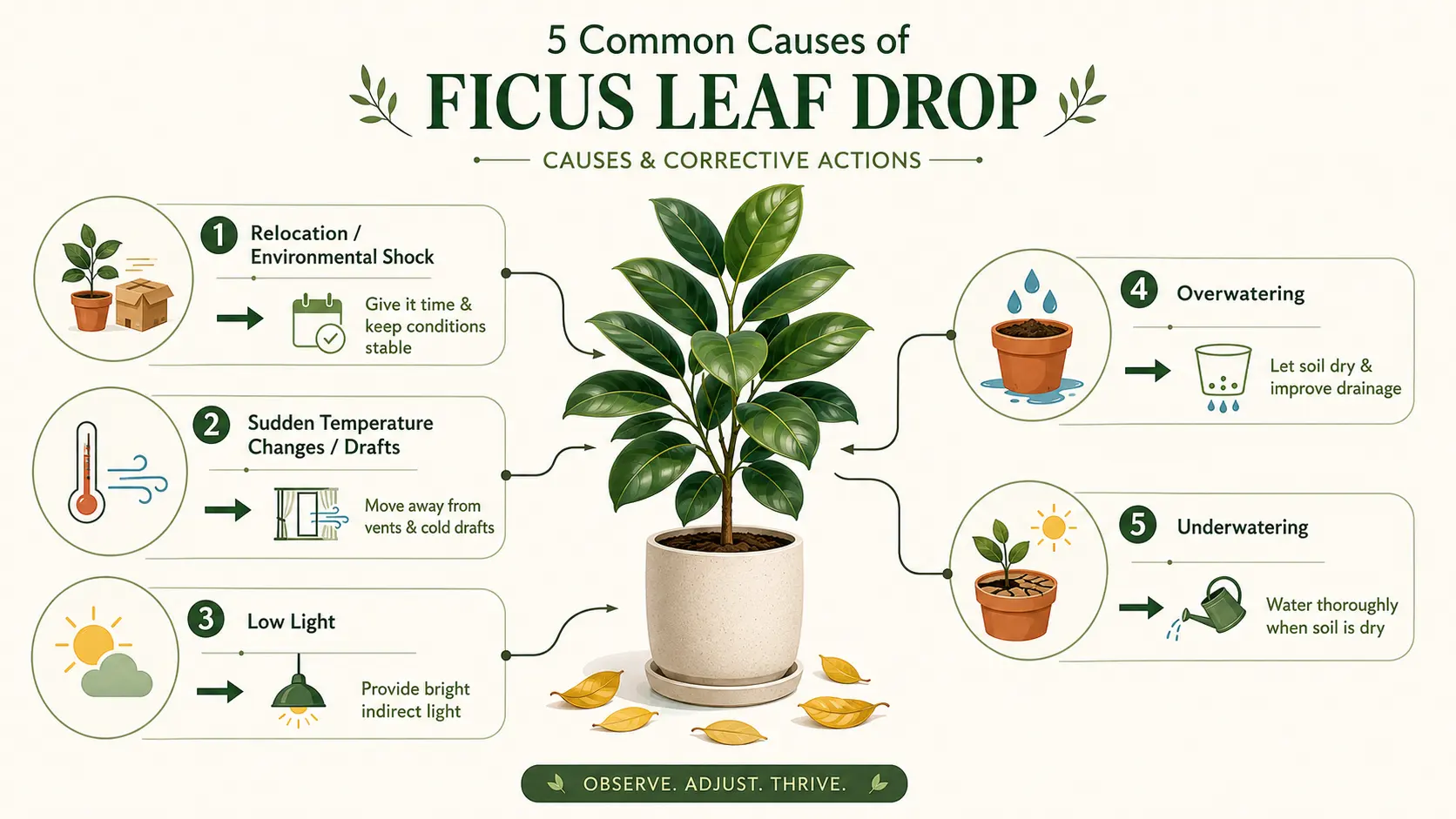
The most common ficus problems are yellow leaves, sudden leaf drop, weak growth, pests, and root problems, and most are linked to watering, light, environmental stress, or poor drainage. Identifying the underlying cause is more effective than treating the visible symptom alone.
Leaves Turning Yellow
Yellow leaves on a ficus commonly indicate watering stress, especially consistently wet soil, although insufficient light, natural aging, nutrient problems, or root damage can also contribute.
Check the soil before adding more water. If it remains wet for a prolonged period, frequent watering may be restricting oxygen around the roots. For another common Ficus symptom related to watering and environmental stress, see Rubber Plant Leaves Drooping: Causes and Fixes.
What to do:
- Check soil moisture below the surface.
- Make sure the pot has drainage holes.
- Move the plant to brighter suitable light if it is receiving very little light.
- Allow the appropriate portion of soil to dry before watering again.
- Inspect the roots if the soil stays wet for unusually long periods.
One yellowing older leaf is not necessarily a serious problem. Widespread yellowing combined with soft stems, persistent wet soil, or leaf drop requires closer attention.
Sudden Leaf Drop
Sudden leaf drop is one of the most recognizable ficus stress responses.
Common causes include:
- Moving the plant
- Sudden changes in light
- Cold or hot drafts
- Temperature fluctuations
- Overwatering
- Underwatering
- Insufficient light
- Significant changes in humidity or growing conditions
The first step is to identify what changed recently. If the ficus was moved, avoid repeatedly relocating it in an attempt to correct the problem.
Keep conditions stable and monitor new growth. A ficus that still has healthy, flexible stems and viable buds may recover even after substantial foliage loss.
Ficus Showing Too Little Growth
Slow or stunted ficus growth is usually associated with insufficient light, poor root conditions, inadequate watering, or seasonal dormancy rather than an inherently slow plant.
Indoor plants often grow more slowly than outdoor specimens because they receive less light.
Possible causes include:
- Low light intensity
- Short winter day length
- Severely root-bound conditions
- Damaged roots
- Inconsistent watering
- Lack of nutrients during active growth
- Temperatures outside the plant’s preferred range
If the plant is otherwise healthy, gradual growth during the growing season is normal.
Pests
Common ficus pests include scale insects, mealybugs, and spider mites.
Look for:
- Sticky residue on leaves or nearby surfaces
- White cotton-like material
- Small bumps attached to stems or leaves
- Fine webbing
- Speckled or bronzed foliage
For a manageable infestation, physically remove visible pests and isolate the affected plant from other houseplants. Depending on the pest, repeated applications of an appropriate horticultural treatment may be necessary because eggs or immature stages can survive an initial treatment.
Regularly inspecting the undersides of leaves and stems helps detect infestations early.
Root Rot
Root rot develops when roots remain excessively wet and oxygen-starved, often because of overwatering, poor drainage, compacted soil, or a pot that is too large for the root system.
Warning signs can include:
- Persistently wet soil
- Yellowing leaves
- Wilting despite wet soil
- Foul-smelling soil
- Dark, soft, or decaying roots
If root rot is suspected, remove the plant carefully, inspect the roots, remove severely damaged tissue with clean tools, and repot into fresh, well-draining growing media. Correcting the watering and drainage problem is essential; simply replacing the soil without changing the cause will not prevent recurrence.
Can a Ficus Come Back After Losing All Its Leaves?
Yes, a ficus can sometimes recover after losing all its leaves if its stems and roots remain alive. Leaf loss alone does not prove that the plant is dead. Flexible stems, viable buds, and healthy roots are better signs of recovery potential than the amount of foliage remaining.
During recovery:
- Keep the plant in suitable bright light.
- Do not dramatically increase watering because it has lost leaves.
- Check the soil before watering.
- Avoid fertilizer while the plant is severely stressed or not actively growing.
- Keep temperature and placement stable.
- Look for swelling buds or new shoots.
Recovery time varies widely because it depends on the species, season, root health, remaining viable tissue, and severity of the original stress.
How to Care for a Ficus Tree
The basic ficus tree care routine is simple: provide bright light, water according to soil dryness, use well-draining soil, maintain stable temperatures, and avoid unnecessary relocation. Ficus generally perform better with consistent conditions than with frequent adjustments.
Light Requirements
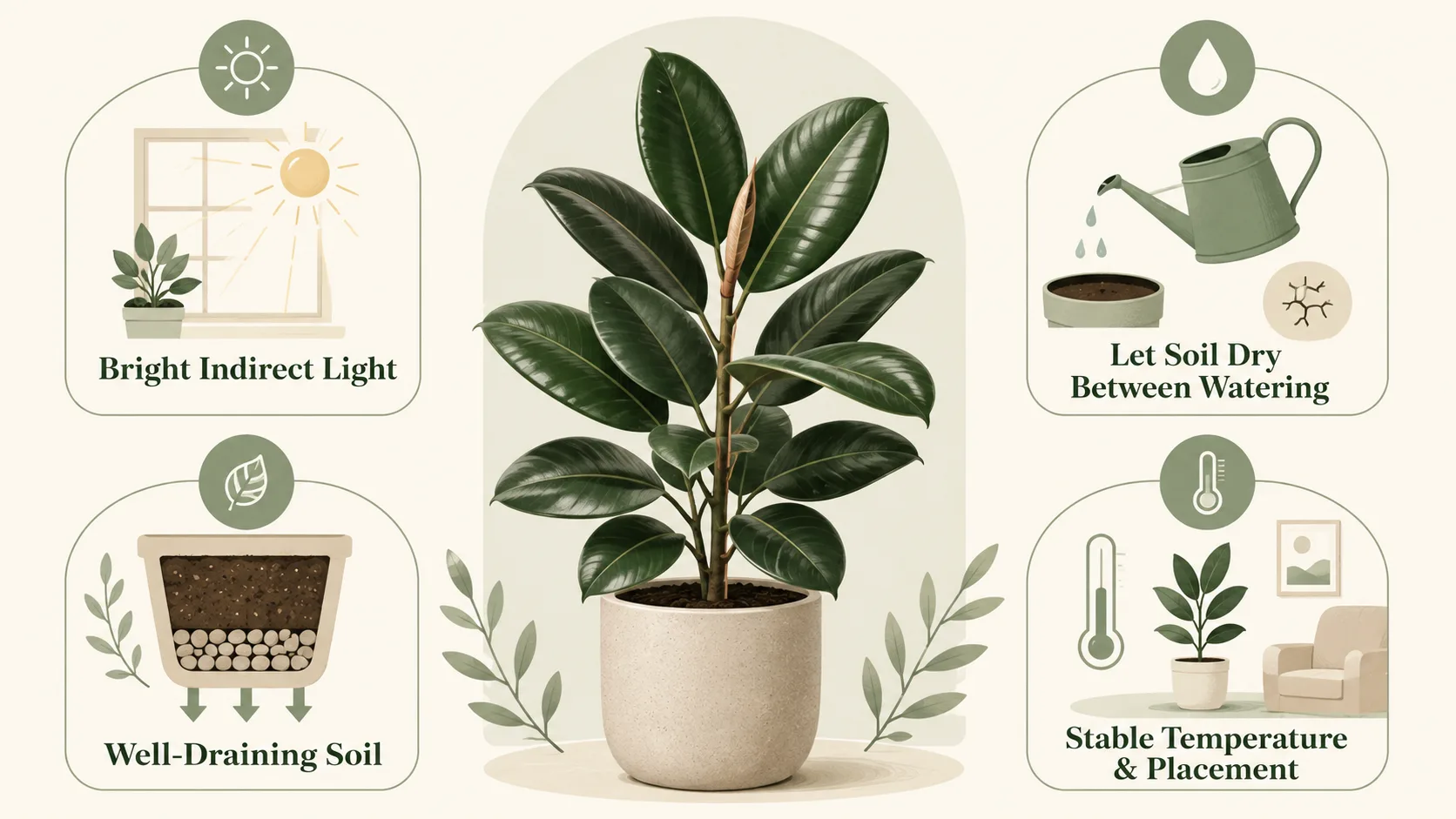
Ficus generally grow best in bright, indirect light indoors, although the exact tolerance varies by species.
Place an indoor ficus near a bright window where it receives substantial natural light without prolonged exposure to harsh, scorching midday sun through glass.
Insufficient light can result in:
- Weak or elongated growth
- Smaller new leaves
- Slow growth
- Increased leaf loss
- Poor overall density
Ficus elastica can adapt to somewhat lower indoor light than some ficus species, but brighter conditions generally support stronger growth.
When increasing light significantly, acclimate the plant gradually if necessary to reduce the risk of leaf or sun damage.
Watering Needs
Water a ficus when the appropriate upper portion of the soil has dried rather than following a fixed calendar schedule. The exact interval varies with pot size, soil composition, light, temperature, humidity, and season.
For many indoor ficus plants, allowing the upper layer of soil to dry before watering is a useful starting point.
A practical approach is:
- Check the soil with your finger or a moisture meter.
- If the surface is still clearly moist, wait.
- When the appropriate upper layer has dried, water thoroughly.
- Allow excess water to drain from the pot.
- Empty standing water from a saucer or decorative container.
Overwatering is generally more dangerous than slightly delayed watering because continuously saturated soil reduces oxygen availability around roots.
Do ficus like to be bottom watered? Ficus can be bottom-watered, but it is not inherently better than watering from the top. Bottom watering can help thoroughly moisten dry potting media, but the pot must still have drainage, and the plant should not remain standing in water indefinitely.
Soil & Fertilization
Ficus prefer a well-draining growing medium that retains some moisture without becoming waterlogged.
A suitable indoor mix may contain:
- Quality indoor potting mix
- Bark or another coarse organic component
- Perlite or another material that improves drainage
The goal is an aerated root environment rather than a dense, permanently wet medium.
During active growth, ficus can benefit from a balanced houseplant fertilizer applied according to the product instructions. Feeding should generally be reduced or stopped when growth naturally slows.
Are coffee grounds good for ficus? Directly adding large amounts of used coffee grounds to the pot is not a reliable fertilizer strategy. Coffee grounds can contribute organic matter when properly composted, but concentrated additions can alter soil structure and moisture behavior. A formulated houseplant fertilizer provides more predictable nutrition.
Climate & Placement
The best indoor location for most ficus is a bright, stable area away from strong drafts and sudden temperature changes.
Avoid placing ficus directly beside:
- Frequently opened exterior doors
- Strong heating vents
- Air-conditioning outlets
- Cold windows during winter
- Locations with large day-to-night temperature swings
Humidity can influence plant comfort, but stable temperature, suitable light, watering, and root health generally have a greater impact on ficus performance than trying to create extremely humid conditions.
Pruning
Pruning ficus helps control size, improve shape, and remove damaged or poorly positioned growth.
For indoor plants:
- Remove dead or damaged branches first.
- Make clean cuts with sanitized pruning tools.
- Prune during active growth when possible.
- Avoid removing an excessive amount of foliage at once.
- Consider the plant’s natural growth habit when shaping it.
Many ficus produce a milky latex sap when cut. This sap can irritate skin and may be harmful if ingested, so wear gloves and keep pruning debris away from children and pets.
Ficus Size, Growth Rate & Lifespan
Ficus size varies dramatically by species and growing conditions. A ficus sold as a compact indoor plant may eventually become a substantial tree when grown outdoors in a suitable climate.
Typical Mature Size (Indoor vs Outdoor)
Indoor size is primarily limited by light, container size, pruning, root space, and the plant’s species.
| Ficus type | Typical indoor use | Outdoor potential |
| Ficus benjamina | Medium to large indoor tree | Large tree in suitable climates |
| Ficus elastica | Medium to large houseplant | Large tree in tropical/subtropical climates |
| Ficus benghalensis | Large specimen houseplant | Very large tree in suitable climates |
| Ficus microcarpa | Houseplant or bonsai | Large tree in warm climates |
Outdoor dimensions should not be confused with indoor expectations. Some ficus species can become enormous in frost-free landscapes because their root systems, light exposure, and growing season are far greater than those available in a container indoors.
Growth Rate & Seasonal Patterns
Ficus generally grow faster when they receive strong suitable light, adequate water, warmth, and sufficient nutrition during active growth.
Indoor growth commonly slows during periods of:
- Reduced winter light
- Cooler temperatures
- Shorter days
- Root stress
- Low-light placement
A plant that produces little new growth during winter may simply be responding to seasonal conditions rather than suffering from a serious problem.
Indoor Lifespan Expectations
A healthy ficus can remain indoors for many years and potentially decades when its environmental and root requirements are maintained.
Longevity depends more on sustained growing conditions than on a fixed lifespan. Factors such as chronic root damage, repeated severe stress, insufficient light, and poor watering practices can substantially shorten a plant’s useful indoor life.
Ficus in Pots — What to Know
Ficus can grow successfully in pots for many years, provided the container drains well and the root system has enough space without being surrounded by excessive wet soil.
Container growing also makes size management easier because pruning and root restriction naturally limit the plant compared with open-ground cultivation.
Key container considerations include:
- Always use a pot with drainage holes.
- Avoid dramatically oversized containers.
- Use an aerated, well-draining potting mix.
- Repot when roots have substantially filled the container or the growing medium has deteriorated.
- Move up only one appropriate pot size at a time when possible.
- Monitor watering after repotting because larger volumes of soil dry more slowly.
A mildly root-bound ficus may continue growing, but severe root restriction can eventually reduce water and nutrient uptake.
Repotting should not be treated as an automatic annual requirement. The plant’s roots, soil condition, growth, and container size should determine when intervention is necessary.
Types of Ficus Compared (Which Is Easiest to Care For?)
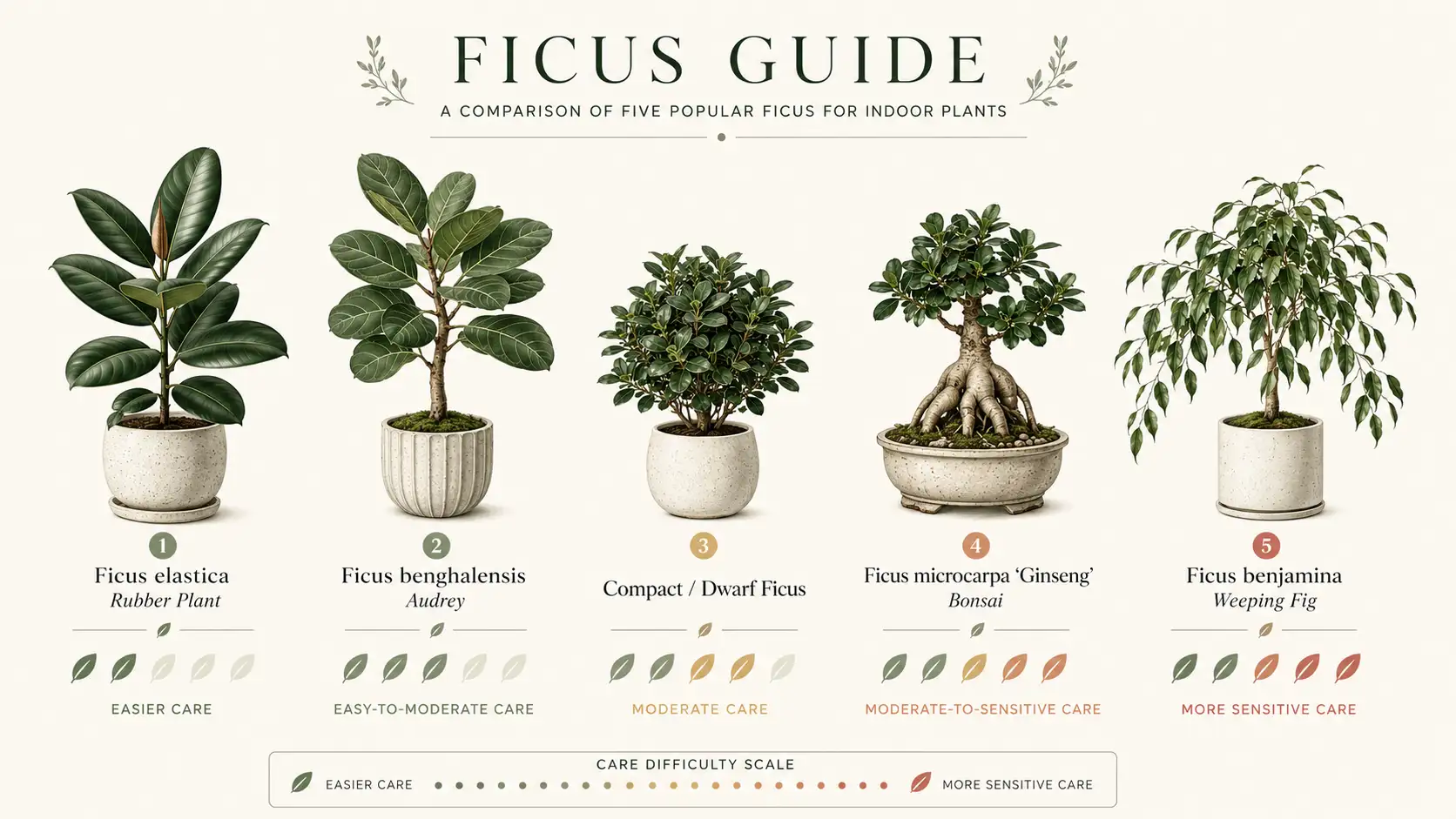
Ficus species differ considerably in their indoor behavior. For beginners, Ficus elastica is generally one of the more forgiving choices, while Ficus benjamina is better suited to growers who can maintain stable conditions. If you choose Ficus elastica as a beginner-friendly option, see our Caring for a Ficus Elastica: Complete Indoor Care Guide for more detailed indoor care requirements.
| Ficus Type | Care Difficulty | Best For | Important Notes |
| Ficus benjamina (Weeping Fig) | Moderate | Experienced beginners | Particularly prone to leaf drop after environmental changes |
| Ficus elastica (Rubber Plant) | Easy–Moderate | Beginners | Generally adaptable and has sturdy foliage |
| Ficus benghalensis (Audrey) | Easy–Moderate | Beginners wanting a larger specimen | Needs strong light for vigorous indoor growth |
| Dwarf or compact Ficus cultivars | Moderate | Small spaces | Compact size does not eliminate ficus sensitivity |
| Ficus microcarpa ‘Ginseng’ | Moderate | Bonsai beginners | Thickened roots/trunk and compact growth make it popular for bonsai |
The phrase “baby ficus” is not a single standardized botanical species. It may refer to a young ficus plant or a compact cultivar, so care requirements should ultimately be based on the plant’s actual species or cultivar. Fiddle leaf fig is another popular Ficus houseplant with its own specific requirements; our How to Take Care of Fiddle Leaf Fig: Complete Indoor Care Guide covers its indoor care in greater detail.
Ginseng Ficus Bonsai Care Basics
Ginseng ficus bonsai is commonly based on Ficus microcarpa and is relatively approachable for bonsai beginners because it tolerates pruning and can adapt well to indoor growing when provided with strong light. For a more detailed look at this bonsai form, see our Ficus Ginseng Bonsai Care, Growth & Meaning guide, which covers its care, growth, and distinctive characteristics.
Its swollen trunk and exposed root structure are characteristic features created through cultivation and selection rather than evidence that it requires less care in every respect.
For healthy growth, provide:
- Bright light
- Careful watering without prolonged saturation
- Fast-draining bonsai soil
- Regular pruning to maintain the desired form
- Stable temperatures
- Periodic feeding during active growth
Although its thickened trunk can store water, this does not make the plant immune to root rot. The bonsai still needs appropriate drainage and watering based on actual soil conditions.
Benefits of Growing a Ficus (Why It’s Worth the Effort)
Ficus are popular because they combine attractive foliage, long-term growth potential, and considerable variety in form.
Potential benefits include:
- Long-term indoor growth: Many ficus can remain attractive houseplants for years with suitable care.
- Architectural appearance: Tree-like stems and substantial foliage can create a strong visual structure indoors.
- Variety: The genus includes rubber plants, weeping figs, bonsai forms, and many other species.
- Adaptability: Several ficus species can adapt to container culture and indoor conditions.
- Bonsai potential: Species such as Ficus microcarpa are widely cultivated as bonsai.
Ficus are also frequently described as air-purifying plants because laboratory studies have demonstrated that some houseplants can remove certain pollutants under controlled conditions. However, these findings should not be interpreted as evidence that a few houseplants can replace ventilation or substantially purify ordinary household air. Ficus is one example of how choosing the right plant and understanding its growing requirements can make long-term plant care easier; explore our Plants: Benefits and Guides (Complete Care, Types & Growing Tips) for broader plant-care information.
Ficus Indoors vs Outdoors
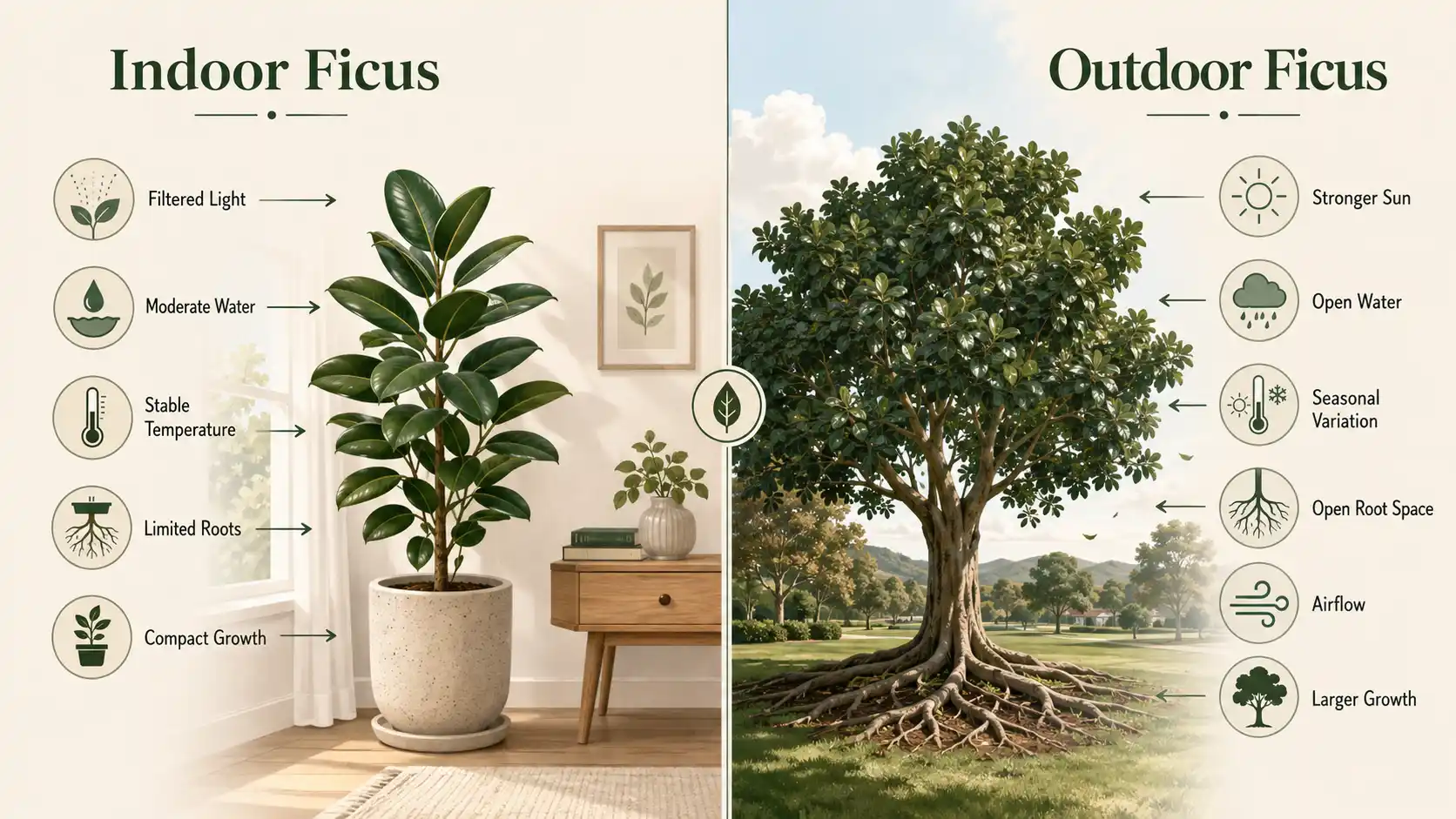
Ficus care changes significantly between indoor containers and outdoor landscapes. Outdoor ficus generally receive more intense light, greater airflow, more root space, and larger seasonal changes than indoor plants, so their watering, growth, and size can differ substantially.
Key Differences in Care Requirements
| Factor | Indoors | Outdoors |
| Light | Usually bright indirect or filtered light | Often much stronger natural light |
| Watering | Less frequent depending on season and indoor conditions | Can be more frequent during heat |
| Root space | Restricted by container | Potentially extensive |
| Temperature | Usually controlled | Dependent on local climate |
| Wind | Limited | Can cause drying or physical stress |
| Growth | Usually slower | Often faster in warm, suitable conditions |
| Cold exposure | Usually avoidable | Can be a major limiting factor |
Outdoor cultivation is species-dependent. Tropical and subtropical ficus may suffer severe damage from freezing temperatures, while mature specimens in suitable climates can become very large.
A ficus moved from indoors to outdoor sunlight should also be acclimated gradually. Abrupt exposure to intense sun can damage leaves that developed under lower indoor light.
Disadvantages of Ficus Trees
Ficus are attractive and long-lived, but they have several disadvantages that are important to understand before choosing one.
Leaf Drop Sensitivity
The most noticeable disadvantage is environmental sensitivity. Ficus benjamina in particular can respond dramatically to changes in light, location, temperature, or watering.
This does not necessarily make it unhealthy, but it can make the plant frustrating for owners expecting an unchanged appearance after relocation.
Sap and Toxicity Concerns
Many ficus produce milky latex sap that can irritate the skin. Some ficus are also considered toxic to pets if plant material is ingested, potentially causing gastrointestinal irritation and other symptoms.
Because sensitivity varies by species, identify the exact ficus before assuming that all species have identical toxicity profiles.
Size Management
A ficus that begins as a manageable indoor plant can eventually become too large for its original location.
Regular pruning and appropriate container management may therefore become necessary as the plant matures.
Variable Light Tolerance
Ficus generally perform best with good light. A plant may survive in lower light while showing slower growth, sparse foliage, or greater stress.
This is an important distinction: surviving in low light is not the same as thriving in low light.
Beginner Mistakes to Avoid With Ficus
Many ficus problems are caused by well-intentioned but inconsistent care.
Avoid these common mistakes:
- Watering on a fixed calendar: Soil dries at different rates depending on light, temperature, pot size, and season.
- Moving the plant repeatedly: Frequent relocation can trigger repeated stress and leaf drop.
- Overreacting to leaf loss: Removing or changing everything at once can make the original problem worse.
- Keeping soil constantly wet: Ficus roots require oxygen and can suffer when the growing medium remains saturated.
- Placing the plant in a dark corner: Surviving does not mean thriving.
- Ignoring drafts: Sudden temperature changes can contribute to leaf drop.
- Using a decorative pot without drainage: Excess water has nowhere to escape.
- Fertilizing a severely stressed plant: Fertilizer does not fix root damage, drought stress, or environmental shock.
The most effective beginner habit is simple: check the plant and soil before changing the routine.
How to Make Your Ficus Thrive
To make a ficus thrive, prioritize consistency rather than intensive maintenance. Give it strong suitable light, water when the soil has dried appropriately, maintain good drainage, and keep the plant away from abrupt environmental changes.
A practical routine includes:
- Check soil moisture before watering.
- Keep the plant in a stable, bright location.
- Rotate the pot occasionally if balanced growth is desired.
- Inspect leaves and stems regularly for pests.
- Remove dead or damaged foliage.
- Feed during active growth according to fertilizer instructions.
- Clean dusty leaves gently when necessary.
- Prune gradually rather than removing large amounts of foliage at once.
- Monitor seasonal changes in watering needs.
Leaf dusting can improve the cleanliness of broad leaves and make pest inspection easier. Misting, however, is not a substitute for proper watering, humidity management, or good airflow.
The best indicator of successful ficus plant care is not the absence of every dropped leaf. Look for healthy new growth, firm stems, appropriate soil moisture, and stable foliage over time. Because ficus have broad leaves that collect dust indoors, our How to Clean Plant Leaves for Healthy Houseplants guide explains practical ways to clean foliage without damaging it.
Conclusion
Ficus are not inherently difficult to take care of. Most are moderately easy once their environmental preferences are understood, but they can be less forgiving of sudden changes than exceptionally hardy houseplants. The biggest challenges are usually leaf drop, inconsistent watering, inadequate light, temperature fluctuations, and poor drainage.
Good ficus tree care depends on maintaining a stable environment rather than constantly adjusting the plant. Choose a suitable species, provide bright light, water according to soil conditions, use well-draining soil, and avoid unnecessary relocation. With consistent ficus plant care, many species can become attractive, long-lived indoor plants.
FAQs
Is Ficus easy to care for indoors?
Ficus is generally moderately easy to care for indoors. Most species need bright light, appropriate watering, good drainage, and stable temperatures. They are manageable for beginners but can respond to sudden environmental changes with leaf drop.
Are ficus trees high maintenance?
Ficus trees are not usually high maintenance, but they are sensitive to inconsistent conditions. They do not require daily attention, although they perform best when watering, lighting, temperature, and placement remain relatively consistent.
What are the signs of an unhealthy Ficus?
Common signs of an unhealthy ficus include widespread yellowing, sudden leaf drop, persistent wilting, weak growth, pest activity, and root problems. The combination of symptoms and growing conditions is more useful for diagnosis than any single symptom.
How often should I water my Ficus?
Water a ficus when the appropriate upper portion of its soil has dried rather than according to a fixed weekly schedule. Indoor conditions vary, so check soil moisture before watering and allow excess water to drain completely.
Can a ficus come back after losing all its leaves?
A ficus can sometimes recover after losing all its leaves if its roots and stems remain alive. Flexible stems, viable buds, and healthy roots indicate better recovery potential. Keep conditions stable and avoid excessive watering while waiting for new growth.
Which type of ficus is best for beginners?
Ficus elastica, commonly called the rubber plant, is generally one of the easier ficus choices for beginners. It typically has sturdier foliage and is less prone to dramatic leaf drop than Ficus benjamina, although it still requires suitable light and watering.