
Introduction
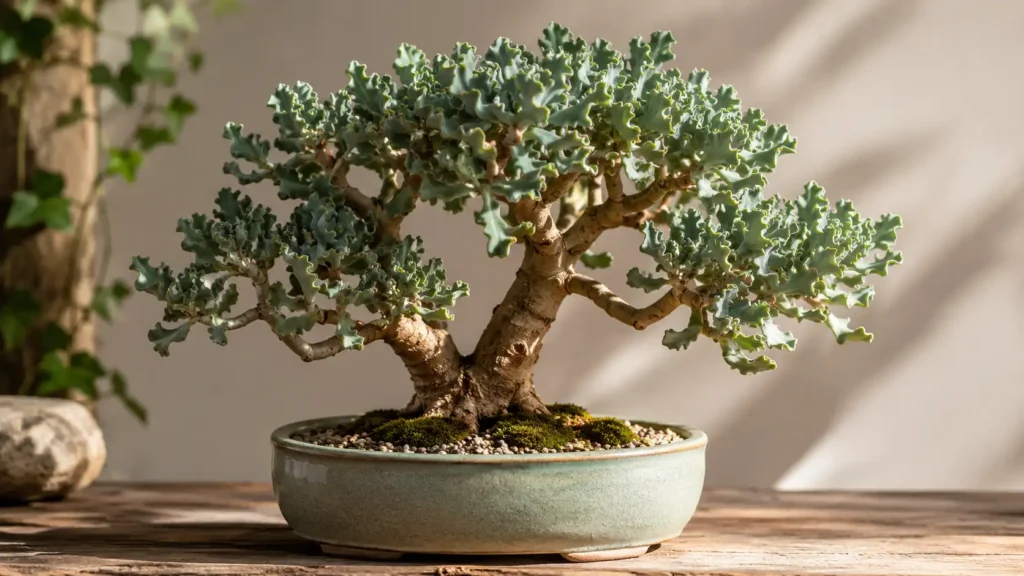
A ripple jade bonsai is a bonsai-trained form of Crassula arborescens undulatifolia, commonly called crassula ripple jade or ripple jade succulent. It is recognized by its thick, blue-green leaves with distinctive curly, wavy edges that create a textured appearance compared with standard jade plants. This succulent bonsai is popular because it combines drought tolerance, attractive foliage, and manageable growth for indoor displays. Understanding what makes a ripple jade different, along with its care requirements, pruning methods, growth habits, and common problems, helps growers maintain a healthy and well-shaped bonsai specimen. ucculent bonsai plants like ripple jade are part of a broader group of easy-care plants that require understanding of light, watering, soil, and growth habits. Explore more plant care information in our complete Plants: Benefits and Guides.
Quick Summary
- Ripple jade bonsai is a slow-to-moderate growing succulent suitable for beginner and intermediate bonsai growers.
- It prefers bright light, well-draining soil, and careful watering because it stores moisture in its leaves.
- The plant can grow indoors or outdoors in suitable climates with protection from frost.
- Regular pruning helps maintain a compact bonsai form and encourages stronger branch structure.
- Its curly foliage and thick trunk development make it a distinctive choice among jade bonsai varieties.
What Is a Ripple Jade Bonsai?
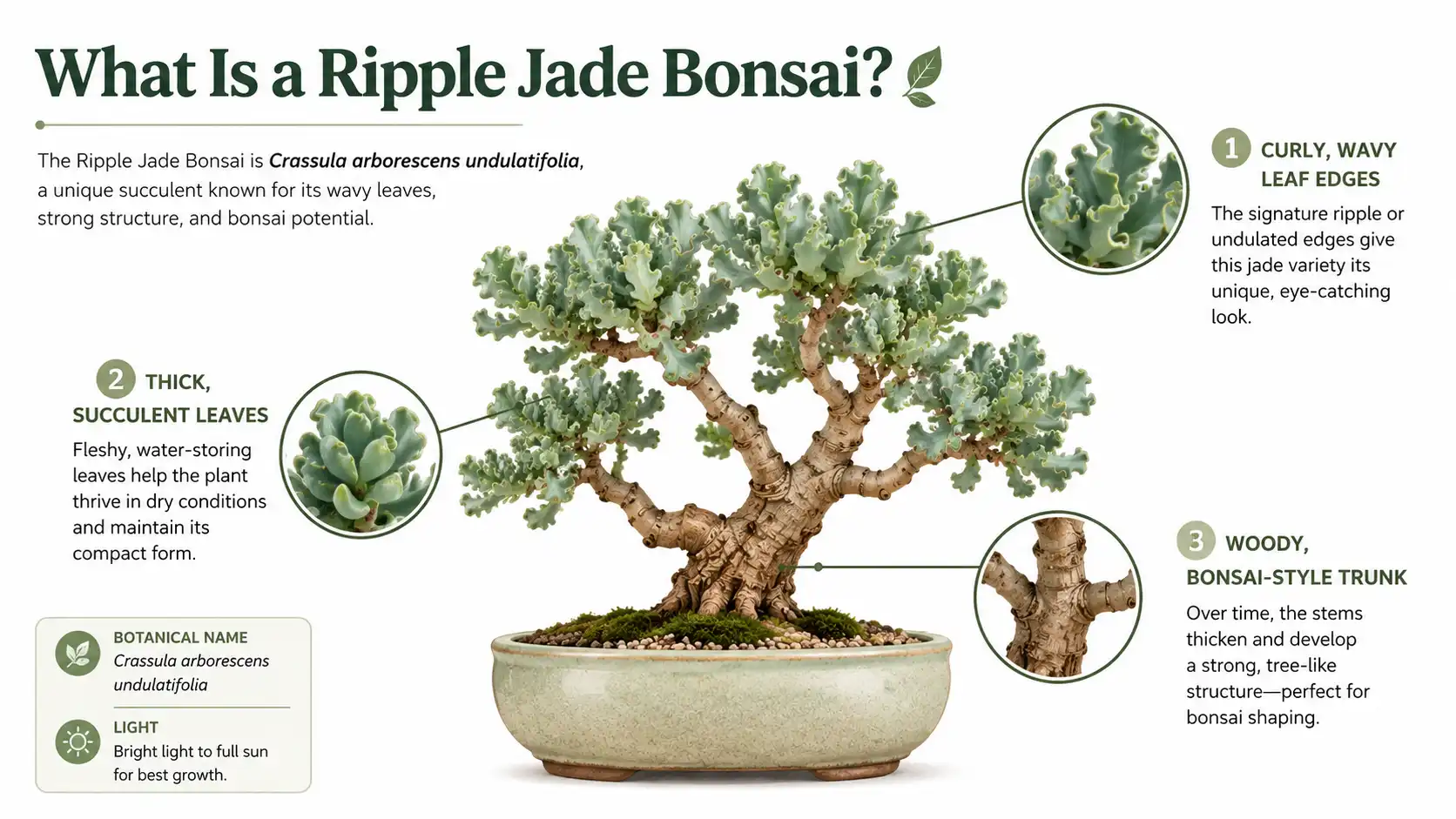
A ripple jade bonsai is a miniature, bonsai-trained version of Crassula arborescens undulatifolia, a succulent species known for its rippled or curled leaf margins. The plant belongs to the jade family of succulents and develops thick stems, fleshy leaves, and a woody trunk over time, making it suitable for bonsai styling.
The botanical name Crassula arborescens undulatifolia refers to a cultivar or form of the silver jade plant (Crassula arborescens) that produces uniquely shaped leaves. Unlike ordinary jade plants with smooth, oval leaves, ripple jade has decorative foliage with folded, wavy edges. Like other popular indoor bonsai species, ripple jade requires careful attention to pruning, root management, and environmental conditions. A similar approach can be seen in Ficus Ginseng Bonsai Care, another commonly grown indoor bonsai variety.
Key identifying features of ripple jade bonsai include:
- Thick, water-storing succulent leaves
- Blue-green foliage with curled or undulating margins
- Woody stems that become trunk-like with age
- Compact growth suitable for container cultivation
- Strong response to pruning and shaping
The terms ripple jade plant, curly jade succulent, and crassula arborescens ripple jade generally refer to this same distinctive jade variety. It is often selected for bonsai because its natural growth pattern allows growers to create miniature tree forms with dense foliage and interesting branch structures.
Ripple Jade vs. Standard Jade Plant
A ripple jade and a standard jade plant are closely related but differ mainly in leaf appearance, growth characteristics, and bonsai styling potential.
| Feature | Ripple Jade Bonsai | Standard Jade Plant |
| Scientific classification | Crassula arborescens undulatifolia | Usually Crassula ovata |
| Leaf shape | Curly, wavy-edged leaves | Smooth, oval leaves |
| Growth habit | Compact and textured | More upright and tree-like |
| Bonsai suitability | Excellent due to unique foliage and branching | Excellent due to thick trunk development |
| Appearance | Decorative, sculptural foliage | Classic succulent tree appearance |
Can a jade plant be bonsai? Yes, jade plants can be grown as bonsai because their woody stems, thick trunks, and ability to tolerate pruning allow them to be trained into miniature tree shapes. Both Crassula ovata and ripple jade (Crassula arborescens undulatifolia) are commonly used for succulent bonsai designs.
Ripple jade is especially valued by bonsai enthusiasts because its unusual leaf texture adds visual interest even when the plant is kept small.
Botanical Classification
Ripple jade belongs to the genus Crassula, a large group of succulent plants known for their drought-resistant characteristics. Its classification helps distinguish it from other plants that are commonly called jade. Ripple jade belongs to the Crassula genus of succulent plants. For additional botanical background, you can learn more about the species classification of Crassula arborescens.
| Classification | Details |
| Family | Crassulaceae |
| Genus | Crassula |
| Species group | Crassula arborescens |
| Cultivar/form | Crassula arborescens undulatifolia |
Several related names can create confusion:
- Crassula argentea is an older name historically used for what is now commonly classified as Crassula ovata.
- Crassula ovata bonsai usually refers to the common jade plant trained into bonsai form, not ripple jade.
- Portulacaria afra, often called elephant bush or dwarf jade, is a separate species that is sometimes used for bonsai but is not a true Crassula jade.
- Bonsai portulacaria refers to bonsai created from Portulacaria afra, which has smaller leaves and different growth characteristics.
Understanding these differences helps prevent confusion when searching for terms such as crassula arborescens curly, crassula ovata bonsai, or bonsai portulacaria.
How Big Does Ripple Jade Get?
A full-grown ripple jade can become a medium-sized succulent shrub, but its final size depends heavily on growing conditions, container size, pruning frequency, and whether it is grown indoors or outdoors. When trained as a bonsai, its size is intentionally restricted through shallow containers and regular shaping.
Typical mature size:
- Outdoor plants can reach approximately 3–5 feet (0.9–1.5 meters) tall when grown freely.
- Mature width may spread several feet depending on available space.
- Indoor ripple jade bonsai usually remains much smaller, often between 1–3 feet (30–90 cm).
- Bonsai specimens can be maintained at smaller sizes through pruning and root management.
The phrase full grown ripple jade usually refers to a naturally mature plant rather than a bonsai-trained specimen. Bonsai cultivation focuses more on proportion, trunk thickness, and branch structure than maximum height.
Indoor vs. Outdoor Size Differences
Indoor ripple jade plants typically remain smaller because they receive less intense light and have restricted root space. Outdoor plants in warm climates usually grow larger because they receive stronger sunlight, greater airflow, and more space for root expansion.
| Growing Location | Typical Growth Pattern |
| Indoor bonsai | Compact growth with controlled height |
| Outdoor container | Larger branches and faster development |
| Outdoor ground planting | Maximum natural size |
Ripple jade can be grown outdoors year-round only in climates without frost. Temperatures below freezing can damage its leaves and stems because it is a warm-climate succulent.
Environmental Factors Affecting Size
Several conditions influence how large a ripple jade becomes:
- Light availability: More sunlight usually encourages stronger stems and healthier growth.
- Container size: Small pots limit root expansion and help maintain bonsai proportions.
- Watering habits: Proper watering supports steady growth, while excess water can weaken roots.
- Pruning frequency: Regular trimming keeps the plant compact.
- Temperature: Warm growing conditions encourage active growth, while cold conditions slow development.
Ripple jade generally prefers smaller containers rather than oversized pots. Large pots hold more moisture, increasing the risk of root problems. A well-sized bonsai pot allows enough room for roots while maintaining good drainage.
Growth Rate of Ripple Jade Bonsai
The ripple jade bonsai growth rate is considered slow to moderate compared with many other houseplants. Like most succulents, Crassula arborescens undulatifolia stores water in its thick leaves and grows steadily rather than rapidly. Its growth speed depends mainly on light exposure, temperature, watering habits, and seasonal changes.
Key growth characteristics include:
- Slow-to-moderate growth: Ripple jade develops gradually, especially when maintained as a bonsai.
- Active growth season: Growth is strongest during spring and summer when temperatures and sunlight increase.
- Winter dormancy: Growth often slows significantly during colder months or lower-light periods.
- Light influence: Bright sunlight encourages stronger stems, thicker leaves, and healthier branching.
- Temperature influence: Warm conditions support growth, while cold temperatures reduce activity.
Indoor ripple jade bonsai plants may grow slower than outdoor plants because indoor environments usually provide less intense sunlight. However, controlled indoor conditions can help maintain a compact bonsai shape.
How to Care for a Ripple Jade Bonsai Tree
Proper ripple jade plant care focuses on balancing sunlight, watering, soil drainage, and controlled growth. Since ripple jade is a drought-tolerant succulent, the main goal is to avoid excess moisture while providing enough light for healthy development.
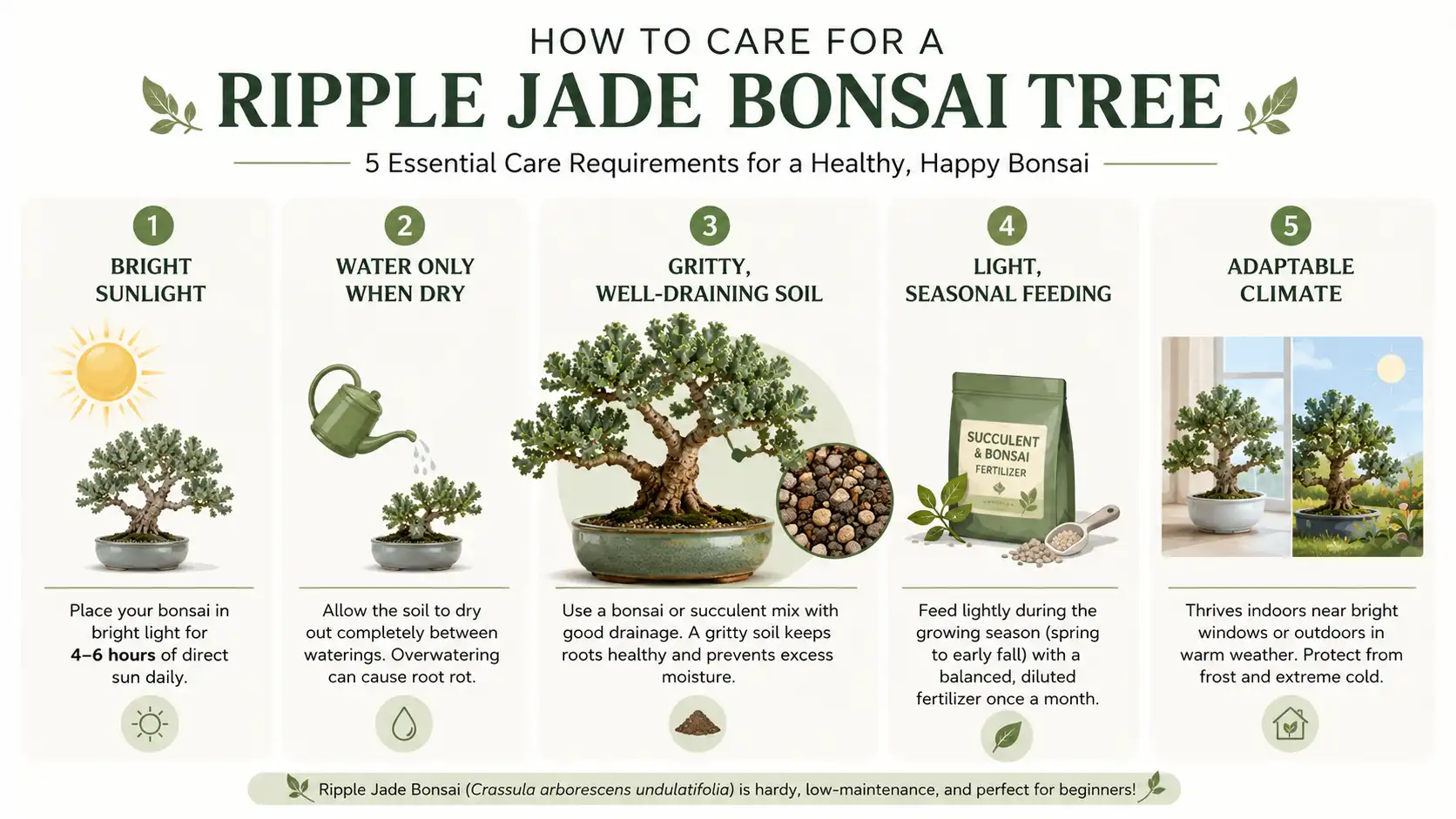
Core care requirements include:
- Light: Provide bright light with several hours of direct or indirect sunlight daily. Around 4–6 hours of strong light helps maintain compact growth and vibrant foliage.
- Watering: Allow the soil to dry between waterings. Ripple jade stores water in its leaves, making it more tolerant of drought than overwatering.
- Soil: Use a fast-draining succulent or cactus mix containing materials such as perlite, pumice, or coarse sand.
- Fertilization: Feed lightly during the active growing season, usually spring and summer. Avoid heavy fertilizing because excessive nutrients can create weak growth.
- Climate tolerance: Ripple jade can grow indoors or outdoors in warm climates but should be protected from frost and prolonged cold temperatures.
A practical watering approach is to check the soil moisture before watering. The top layer may appear dry while deeper soil remains wet, so growers should avoid watering on a fixed daily schedule. Because overwatering is one of the most common causes of jade problems, learning how to identify when plants actually need water is essential. Our guide on How to Check If Indoor Plant Needs Water explains practical moisture-checking methods.
Common beginner mistakes include:
- Watering before the soil has dried completely
- Keeping the plant in low light
- Using heavy soil that retains moisture
- Placing the bonsai in a pot without drainage holes
Do Coffee Grounds Help Jade Plants?
Coffee grounds do not provide a major benefit for jade plants when added directly to the soil. While used coffee grounds contain small amounts of organic material and nutrients, applying them heavily can increase moisture retention and create unsuitable soil conditions for succulents.
For ripple jade bonsai, better soil amendments include:
- Perlite for improved drainage
- Pumice for airflow around roots
- Coarse sand for a gritty texture
- Proper succulent compost mixes
Small amounts of composted organic material can support plant health, but fresh coffee grounds should not be used as a primary fertilizer or soil amendment for jade plants.
Can Jade Bonsai Be Kept Indoors?
Yes, jade bonsai can be kept indoors if it receives enough light and proper care. Ripple jade is one of the more adaptable bonsai succulents because it tolerates dry indoor conditions better than many tropical bonsai species. Many people grow jade bonsai indoors not only for their decorative value but also because bonsai plants are often associated with symbolism and traditional beliefs. Learn more about bonsai symbolism in our guide to Are Bonsai Trees Good Luck? Meaning & Feng Shui Guide.
Indoor care requirements include:
- Place the plant near a bright south-facing or west-facing window when possible.
- Provide several hours of sunlight daily.
- Avoid dark corners or rooms with limited natural light.
- Keep the plant away from cold drafts and heating vents.
- Ensure good air circulation around the foliage.
Indoor humidity is usually not a major concern because ripple jade naturally adapts to dry environments. The main challenge indoors is insufficient light, which can lead to stretched stems and weak growth.
Ripple Jade Bonsai Care at a Glance
| Factor | Requirement |
| Light | Bright, 4–6 hrs sun |
| Water | Low; dry between waterings |
| Soil | Well-draining, gritty |
| Pot Size | Small/shallow (bonsai-style) |
| Climate | Indoor or mild outdoor |
Pruning Ripple Jade Bonsai
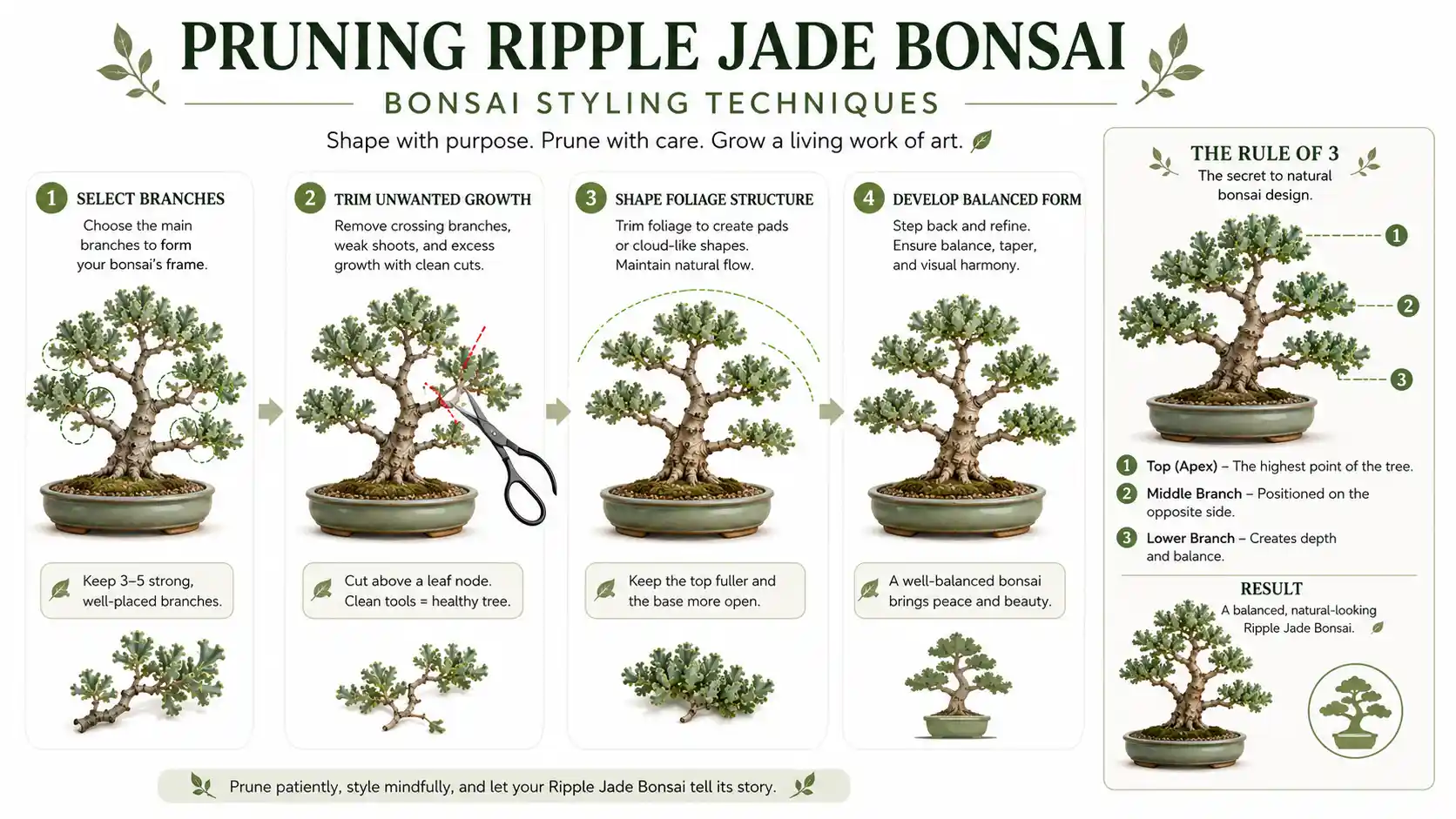
How to prune ripple jade? Ripple jade should be pruned by removing unwanted growth, shaping branches, and encouraging a stronger bonsai structure. Pruning is usually best performed during active growth periods when the plant can recover quickly.
Steps for ripple jade pruning:
- Choose the right time: Prune during spring or summer when the plant is actively growing.
- Use clean tools: Sterilized pruning scissors or bonsai shears reduce the risk of infection.
- Remove unwanted branches: Cut weak, crossing, or overcrowded stems to improve structure.
- Shape the foliage: Trim longer branches to maintain the desired bonsai silhouette.
- Encourage trunk development: Allow selected branches to grow longer before trimming them back to strengthen the trunk and primary structure.
Ripple jade responds well to pruning because it can produce new growth from areas near cuts. Avoid removing too much foliage at once because leaves store the plant’s water reserves.
Bonsai Styling Techniques for Jade
Jade bonsai design focuses on creating a miniature tree appearance while maintaining the natural succulent characteristics of the plant. Ripple jade’s thick stems and textured leaves make it suitable for several bonsai styles.
Common jade bonsai styles include:
- Informal upright style: A naturally curved trunk with balanced branching.
- Slanting style: The trunk grows at an angle to create movement.
- Cascade style: Branches extend downward, resembling plants growing over cliffs.
- Compact shrub style: Multiple branches create a dense, rounded appearance.
A key concept in bonsai is the rule of 3 in bonsai, which refers to creating visual balance through groups of three main structural elements. This often involves arranging the trunk, primary branches, and foliage masses so the design appears natural and harmonious.
The rule of 3 helps growers avoid overcrowded designs by focusing on:
- A clear main trunk line
- Balanced primary branches
- Open spaces between foliage sections
For ripple jade, careful pruning rather than aggressive wiring is often preferred because succulent branches can be brittle and may break easily.
Common Ripple Jade Bonsai Problems (Problem-Solution Section)
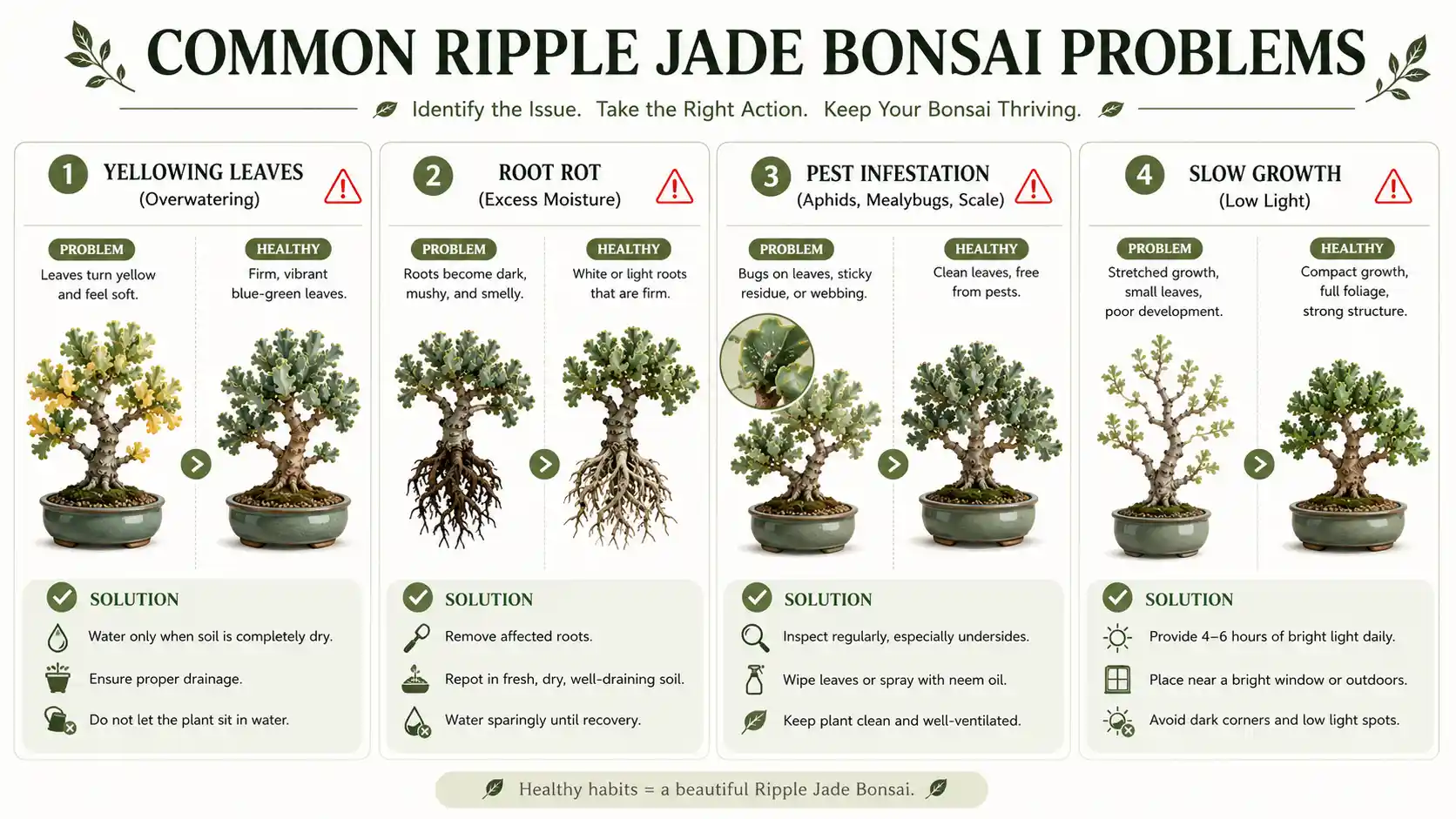
Ripple jade bonsai is generally a low-maintenance succulent, but incorrect watering, insufficient light, and poor soil conditions can create common problems. Understanding the cause of each issue helps growers correct problems early and prevent long-term damage.
Yellowing Leaves
Yellowing leaves on ripple jade bonsai are usually caused by watering problems, environmental stress, or insufficient light. Healthy ripple jade leaves are typically blue-green, so noticeable yellowing often indicates that the plant is experiencing stress.
Common causes include:
- Overwatering: Excess moisture prevents roots from absorbing oxygen and can lead to root stress.
- Poor drainage: Heavy soil or containers without drainage holes may keep roots wet for too long.
- Light stress: Very low light can weaken the plant and affect leaf health.
- Natural aging: Older leaves may occasionally turn yellow and drop as part of normal growth.
Solutions:
- Allow the soil to dry completely before watering again.
- Move the plant to a brighter location with better airflow.
- Replace compacted soil with a well-draining succulent mix.
- Remove severely damaged leaves to maintain plant health.
Prevention:
- Check soil moisture before watering.
- Use a pot with drainage holes.
- Avoid keeping ripple jade in consistently damp soil.
Overwatering Issues
Overwatering is one of the most common problems affecting ripple jade bonsai. Because ripple jade is a succulent, its leaves and stems already store water, meaning it requires less frequent watering than many indoor plants.
Signs of overwatering include:
- Soft or mushy leaves
- Yellowing foliage
- Dropping leaves
- Darkened stems
- A musty smell from the soil
- Root rot development
Root rot occurs when excess moisture creates conditions where roots cannot receive enough oxygen. Damaged roots become unable to support healthy growth.
How to fix overwatering:
- Stop watering until the soil dries.
- Remove the plant carefully and inspect the roots if rot is suspected.
- Cut away black or mushy roots using clean tools.
- Repot in fresh, fast-draining soil.
Prevention:
- Water only when the soil is completely dry.
- Use gritty soil designed for succulents.
- Avoid oversized pots that retain unnecessary moisture.
Pest Infestations
Ripple jade bonsai can occasionally experience pest problems, especially when grown indoors with poor airflow or stressed growing conditions.
Common pests include:
- Mealybugs: Small white insects that gather around stems, leaf joints, and undersides of leaves.
- Scale insects: Hard, shell-like pests that attach to stems and foliage.
- Spider mites: Tiny pests that may appear in dry conditions and cause leaf damage.
Treatment methods:
- Remove visible pests using a cotton swab dipped in rubbing alcohol.
- Clean leaves gently to remove insects.
- Use appropriate insecticidal soap if infestations persist.
- Isolate affected plants to prevent spreading.
Prevention:
- Inspect new plants before introducing them indoors.
- Maintain good airflow.
- Avoid excessive watering, which can weaken the plant.
Regularly cleaning plant leaves can help remove dust, improve appearance, and make it easier to identify pests early. Learn more about proper leaf maintenance in How to Clean Plant Leaves for Healthy Houseplants.
Slow or Stunted Growth
Slow growth is normal for ripple jade bonsai because it is naturally a slow-to-moderate growing succulent. However, extremely slow or stalled growth may indicate environmental problems.
Common causes include:
- Insufficient sunlight
- Poor soil quality
- Lack of nutrients
- Cold temperatures
- Root problems
Solutions:
- Increase exposure to bright light gradually.
- Repot if the soil has become compacted.
- Apply a balanced succulent fertilizer during active growth.
- Protect the plant from cold temperatures.
Healthy ripple jade does not need rapid growth. Bonsai cultivation often encourages controlled growth to maintain shape and develop a thicker trunk.
What Not to Do With a Jade Plant (Beginner Mistakes)
Many jade bonsai problems happen because beginners treat succulents like regular houseplants. Ripple jade requires a different care approach because it stores water and prefers drier conditions.
Common mistakes include:
- Overwatering frequently: The most common mistake that can cause root rot.
- Using large pots: Oversized containers hold extra moisture and can damage roots.
- Using heavy garden soil: Poor drainage prevents healthy root development.
- Keeping the plant in low light: Insufficient light causes weak, stretched growth.
- Ignoring seasonal changes: Ripple jade grows slower during winter and needs less water.
- Pruning too aggressively: Removing too much foliage can reduce the plant’s ability to store energy.
What is the one mistake all bonsai beginners make? The most common mistake is overwatering because many beginners assume frequent watering keeps bonsai plants healthier. In reality, bonsai plants require careful moisture management based on species, soil, and environmental conditions.
Disadvantages of Jade Plants
Jade plants are popular because they are attractive and easy to maintain, but they also have some disadvantages that growers should consider.
Potential disadvantages include:
- Slow bonsai development: Creating a mature-looking bonsai with a thick trunk can take many years.
- Overwatering sensitivity: Although drought-tolerant, jade plants can quickly suffer from excess moisture.
- Toxicity concerns: Jade plants may be harmful if consumed by pets.
- Branch fragility: Succulent branches can break if handled roughly.
- Limited cold tolerance: They require protection from freezing temperatures.
These disadvantages do not make ripple jade unsuitable for bonsai, but they highlight the importance of proper care and realistic growth expectations.
Is Ripple Jade Toxic?
Ripple jade is considered potentially toxic to pets if ingested. While the level of toxicity may vary, eating parts of the plant can cause digestive upset or other symptoms in animals.
Pet owners should:
- Keep ripple jade bonsai away from curious cats, dogs, and small children.
- Place plants on stable surfaces where accidental ingestion is less likely.
- Seek veterinary advice if a pet consumes a significant amount of plant material.
Because ripple jade is grown mainly as an ornamental succulent, safe placement is the best prevention method.
Propagating Ripple Jade
Can you propagate ripple jade? Yes, ripple jade can be propagated successfully through stem cuttings and, in some cases, leaf cuttings. Stem propagation is usually the most reliable method because it creates a stronger new plant with established growth points. Propagation methods vary between plant types, but many houseplants can be multiplied through cuttings or division. For comparison, see our guide on How to Propagate a Prayer Plant.
The process for ripple jade plant propagation includes:
- Select a healthy cutting: Choose a mature stem with several leaves.
- Make a clean cut: Use sterilized scissors or pruning shears.
- Allow the cutting to dry: Let the cut end form a protective callus for several days.
- Plant in suitable soil: Place the cutting in a well-draining succulent mix.
- Provide proper conditions: Keep it in bright indirect light and avoid excessive watering.
For Crassula arborescens propagation, rooting usually depends on temperature, moisture levels, and growing conditions.
Propagation timeline:
- Stem cuttings may begin producing roots within a few weeks.
- New growth appears after successful root development.
- Cooler conditions may slow the process.
Propagation tips:
- Avoid placing fresh cuttings into wet soil immediately.
- Do not overwater young cuttings.
- Spring and summer are usually the best propagation periods.
Does Ripple Jade Flower?
A ripple jade flower refers to the small clusters of flowers produced by Crassula arborescens undulatifolia under suitable conditions. Ripple jade can flower, but indoor bonsai specimens rarely bloom because flowering usually requires mature growth, strong light exposure, and seasonal environmental changes.
When ripple jade flowers, the blooms are typically:
- Small, star-shaped flowers
- White to pale pink in color
- Produced in clusters above the foliage
- More common during cooler seasons after a period of reduced growth
Factors that encourage flowering include:
- A mature plant with established growth
- Plenty of bright sunlight during the growing season
- Proper watering cycles with a drier rest period
- Cooler temperatures during winter dormancy
- Avoiding excessive nitrogen fertilizer
Indoor ripple jade bonsai plants often focus energy on maintaining foliage and structure rather than producing flowers. Lack of blooming does not indicate poor health because many healthy bonsai specimens never flower indoors.
Ripple Jade vs. Other Jade Bonsai Varieties (Differentiation Section)
Jade plants include several related and unrelated succulent species that are commonly trained as bonsai. Understanding the differences between varieties helps growers choose the right plant based on leaf shape, growth habit, and styling goals.
Ripple Jade vs. Dwarf Jade / Mini Jade
Ripple jade and dwarf jade are often confused because both can be grown as small bonsai trees. However, they belong to different plant groups.
| Feature | Ripple Jade | Dwarf Jade / Mini Jade |
| Scientific name | Crassula arborescens undulatifolia | Portulacaria afra |
| Leaf appearance | Thick, wavy-edged leaves | Small, rounded leaves |
| Growth habit | Succulent shrub with textured foliage | Dense branching shrub |
| Bonsai use | Decorative foliage-focused bonsai | Excellent for compact bonsai designs |
| Water needs | Low | Low |
Dwarf jade, also called elephant bush, is not a true Crassula jade. It is a separate species that is widely used in bonsai because it develops fine branching and responds well to pruning.
Ripple jade is preferred by some growers because its curly leaves create a unique visual texture that differs from traditional bonsai foliage.
Ripple Jade vs. Elephant Jade
Elephant jade usually refers to Portulacaria afra, also known as elephant bush or dwarf jade. Although it shares similarities with ripple jade, including drought tolerance and bonsai suitability, the plants have different botanical identities.
Key differences:
| Feature | Ripple Jade | Elephant Jade |
| Botanical family | Crassulaceae | Didiereaceae |
| Leaf texture | Thick and rippled | Smaller and smoother |
| Growth style | More succulent-like | More shrub-like |
| Trunk development | Moderate | Strong branching ability |
| Bonsai maintenance | Requires careful pruning | Handles frequent trimming well |
Both plants are excellent choices for succulent bonsai, but ripple jade is usually selected for its unusual leaf structure, while elephant jade is valued for its small leaves and easy branch development.
Ripple Jade vs. Crassula Ovata Bonsai
Crassula ovata is the classic jade plant commonly trained as bonsai. Ripple jade belongs to a different species group but shares many care requirements.
| Feature | Ripple Jade Bonsai | Crassula Ovata Bonsai |
| Leaf shape | Curled, wavy margins | Smooth oval leaves |
| Common name | Ripple jade | Common jade plant |
| Appearance | Textured and unusual | Traditional jade tree look |
| Bonsai style | Foliage-focused designs | Trunk and branch-focused designs |
| Growth speed | Slow to moderate | Moderate under good conditions |
Both varieties prefer:
- Bright light
- Well-draining soil
- Infrequent watering
- Careful pruning
The main difference is visual character. Ripple jade provides a more sculptural appearance because of its curled foliage, while Crassula ovata offers the classic miniature tree appearance associated with jade bonsai.
Rare or Uncommon Jade Varieties
Beyond ripple jade and standard jade, several uncommon jade varieties are collected by succulent enthusiasts because of their unusual foliage or growth patterns.
Examples include:
- Gollum jade (Crassula ovata ‘Gollum’): Known for tubular, finger-like leaves.
- Hobbit jade (Crassula ovata ‘Hobbit’): Produces curled leaves with unusual shapes.
- Variegated jade: Features cream or yellow patterns on green leaves.
- Silver jade (Crassula arborescens): Known for blue-gray leaves.
Ripple jade is considered distinctive because its leaf margins naturally create a wavy texture without requiring unusual mutations or variegation.
Conclusion
A ripple jade bonsai is a visually distinctive succulent bonsai created from Crassula arborescens undulatifolia, recognized for its curly, wavy-edged leaves and compact growth habit. Its drought tolerance, manageable size, and ability to respond well to pruning make it a suitable choice for beginner and experienced bonsai growers.
Successful ripple jade care depends on providing bright light, fast-draining soil, controlled watering, and regular shaping. Unlike standard jade plants, ripple jade offers unique foliage that adds texture and character to bonsai displays. With proper care and patience, this slow-to-moderate growing succulent can develop into a healthy miniature tree with strong structure and long-term ornamental value.
FAQs
How do you care for a ripple jade bonsai tree?
A ripple jade bonsai requires bright light, well-draining succulent soil, and infrequent watering. Allow the soil to dry between waterings because the plant stores water in its leaves and is sensitive to excess moisture. Light pruning during the growing season helps maintain its bonsai shape.
Can a jade plant be bonsai?
Yes, jade plants can be grown as bonsai because they develop woody stems, thick trunks, and respond well to pruning. Both ripple jade (Crassula arborescens undulatifolia) and common jade (Crassula ovata) are suitable choices for bonsai training.
How big does ripple jade get?
Ripple jade can grow several feet tall when planted outdoors in ideal conditions, but bonsai specimens are kept much smaller through container size control, pruning, and root management. Indoor bonsai plants commonly remain between 1 and 3 feet tall.
Do jade plants like big or small pots?
Jade plants generally prefer smaller pots with good drainage because compact containers help prevent excess moisture. Large pots can hold too much water and increase the risk of root rot, especially for succulent bonsai varieties.
Can jade bonsai be kept indoors?
Yes, jade bonsai can be kept indoors if they receive enough bright light. A sunny window, proper drainage, and careful watering are essential for healthy indoor growth. Low-light conditions are one of the main causes of weak or stretched growth.
Can you propagate ripple jade?
Yes, ripple jade can be propagated through stem cuttings and sometimes leaf cuttings. Stem cuttings are the most reliable method because they contain established growth points. Allow cuttings to dry before planting them in a well-draining succulent mix.