
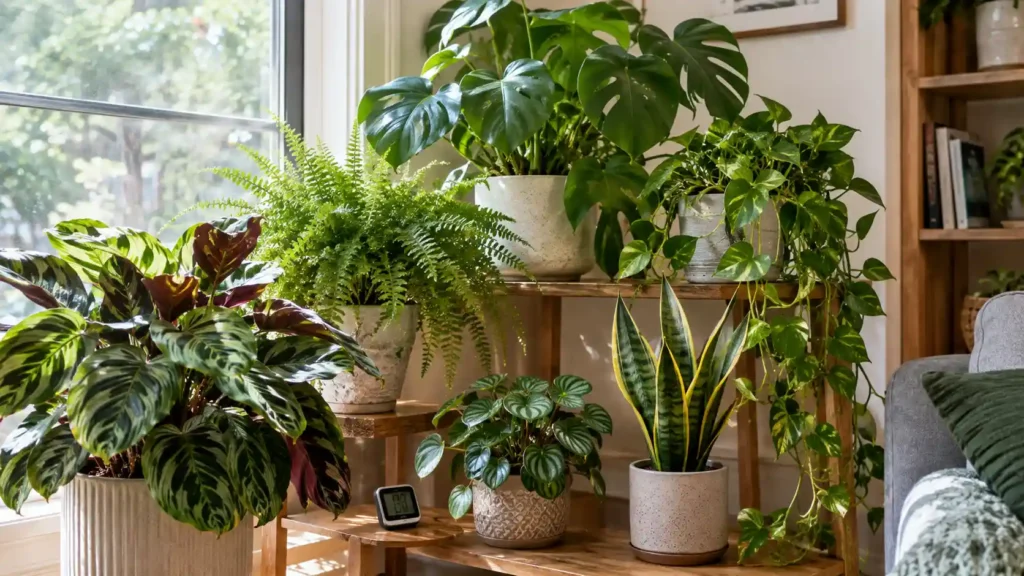
A houseplant humidity chart helps you match a plant with the amount of moisture in the air it can comfortably handle. If a calathea develops crispy tips or a fern curls and dries, check humidity alongside watering rather than assuming one cause. Relative humidity (RH) is the percentage of moisture in the air compared with the maximum amount the air could hold at that temperature. The chart below groups common houseplants into four practical humidity tiers, from low-humidity succulents to moisture-loving calatheas and ferns. For broader plant-care fundamentals, see Greenery Nest’s Plants: Benefits and Guides pillar.
Quick Summary
- Many common houseplants are comfortable around 40–60% RH, while tropical humidity-loving plants may benefit from 60–80%.
- Brown tips can indicate low humidity, but underwatering, fertiliser salts and water quality can cause similar damage.
- Measure RH near the foliage, away from heaters, vents and direct sun.
- A humidifier gives the most controllable increase; grouping plants can help, while misting usually produces only a brief change.
Why Do Humidity Recommendations Conflict?
Humidity advice conflicts because sources may be describing different goals. A range that is adequate for surviving indoors is not necessarily the range that produces the best foliage or fastest growth. Plant species also differ greatly in their natural environments and ability to conserve water.
Comfort vs. Thriving vs. Survival Levels
A useful way to interpret conflicting numbers is:
- 40–60% RH: a broad practical range used for many common houseplants.
- 60–80% RH: a higher range that can suit many tropical species, especially humidity-sensitive foliage plants. (UNH Extension)
- Around 45% RH: useful as a management threshold for a humidity-sensitive plant, but not a biological survival limit.
That distinction matters. A calathea may remain alive below its preferred humidity while producing more brown edges and curled leaves. Conversely, a ZZ plant can remain perfectly comfortable in ordinary household humidity. RHS describes ZZ plants as adaptable to average household humidity, while calatheas are specifically described as liking high humidity.
Plant Origin and Leaf Thickness
Plant origin explains much of the difference. Tropical understory plants evolved where atmospheric moisture is often higher and drying winds are less common. Succulents and other drought-adapted plants evolved with different water-conservation strategies.
Leaf thickness also matters, but it is not the whole explanation. Thick or waxy foliage can store water or reduce water loss, whereas some thin-leaved plants lose water more readily. The cuticle, stomata, roots, temperature, light and airflow also influence how a plant responds to dry air.
Houseplant Humidity Chart: Ideal Humidity by Plant Tier
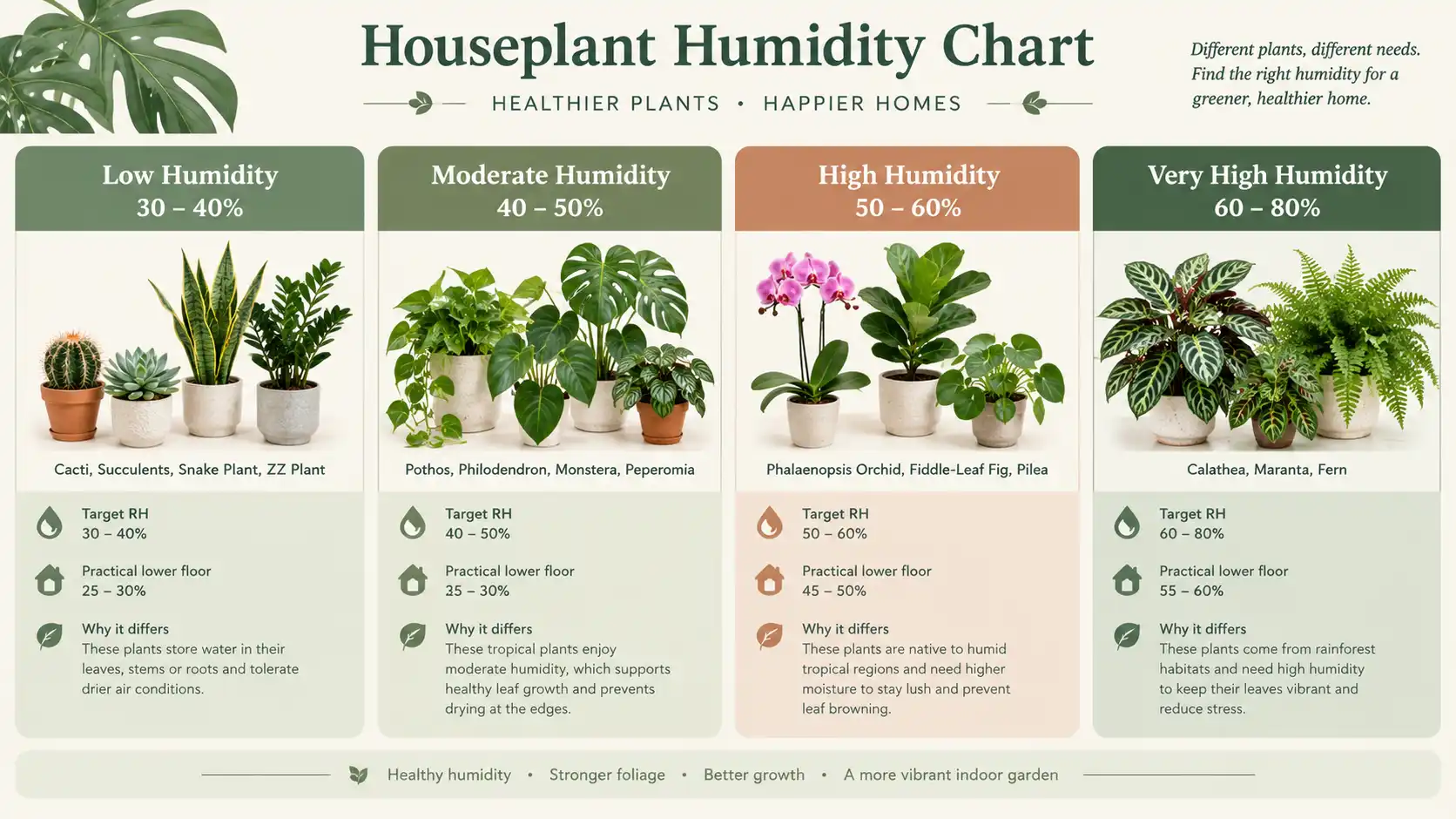
The table below is a practical indoor-growing framework, not a set of universal biological thresholds. The “minimum survivable” figure should be read as a practical lower floor for continued indoor culture, not the humidity at which every plant of that type will die.
| Tier | Target RH | Minimum survivable RH* | Example plants | Why |
| Low | 30–40% | ~25% | Cacti, succulents, snake plant, ZZ plant | Water-storing or drought-adapted foliage generally tolerates dry air |
| Moderate | 40–50% | ~30% | Pothos, philodendron, monstera, peperomia | Many common indoor plants adapt reasonably well to normal household conditions |
| High | 50–60% | ~40% | Phalaenopsis orchids, fiddle-leaf fig, pilea | Higher RH helps reduce moisture stress in many tropical/subtropical foliage plants |
| Very High | 60–80% | ~50–60% | Calathea, Maranta, many ferns | Moisture-loving species can show foliage stress when indoor air becomes very dry |
*These are practical management floors, not species-specific death thresholds. Individual cultivars and growing conditions can vary. General extension guidance places many houseplants around 40–60% RH, while tropical species may perform better at 70–80%; RHS specifically identifies high humidity as important for calatheas, while snake plants and ZZ plants tolerate much drier household conditions.
Low Humidity Tier
Cacti, succulents, snake plants and ZZ plants are among the better choices for dry indoor air. Snake plants have fleshy, succulent leaves and are specifically described by RHS as plants that prefer low humidity. ZZ plants store water in rhizomes and adapt to variable indoor humidity.
Moderate Humidity Tier
Pothos, philodendrons, monsteras and many peperomias fit the middle of the chart. They are not necessarily “dry-air plants,” but they are generally more adaptable than humidity-sensitive rainforest understory species. For a species-level example, see our Peperomia Rotundifolia care guide.
High Humidity Tier
Some popular orchids and tropical foliage plants perform better when RH stays comfortably above average winter-room levels. Orchids should still be judged by genus and species rather than assuming every orchid has identical requirements; Phalaenopsis is the common indoor example.
Very High Humidity Tier
Calatheas, Marantas and many ferns are the plants most likely to expose a dry-house problem. RHS recommends warm, humid conditions for calatheas, while its fern guidance likewise describes high humidity as beneficial. A useful deeper comparison is our Calathea vs. Maranta guide.
Calathea vs. Peperomia
| Factor | Calathea | Peperomia |
| Target RH | About 60%+ for sensitive varieties | Roughly 40–50% is a more forgiving starting point |
| Leaf type | Broad, patterned foliage; less drought-adapted | Often thicker or more succulent foliage |
| When dry | Crispy tips, curling and edge browning | May show wilting, shrivelling or slower growth |
| Average room sufficient? | Sometimes, but sensitive varieties may struggle | Often, provided watering and light are appropriate |
How to Measure Humidity for Houseplants
The simplest method is a digital hygrometer. Place it where the plant actually experiences the air rather than assuming the reading on the opposite side of the room applies equally.
Where to Place a Hygrometer
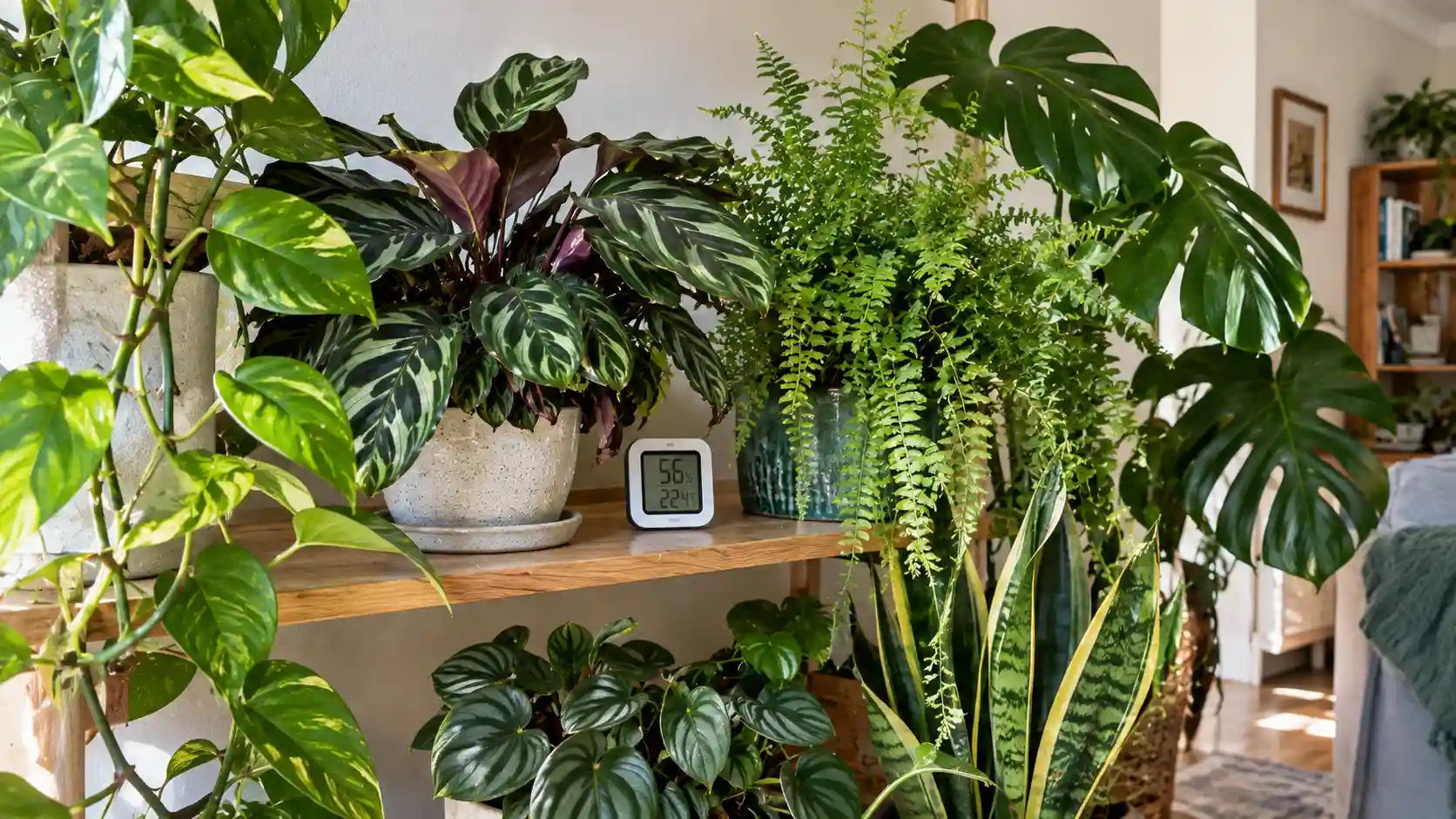
Put the sensor roughly at leaf height, close enough to represent the plant’s microclimate but not touching the foliage. Keep it away from heating vents, air-conditioner outlets, radiators, direct sunlight and other places that create unusually warm or cool air.
For Australian homes, this matters because the same room can contain noticeably different microclimates around windows, reverse-cycle heating outlets, plant shelves and bathrooms. A single reading from a central wall may not describe what a plant experiences.
Room Humidity vs. Humidity at the Plant
Plants can create small microclimates around their foliage. Grouping several plants together can increase local humidity, particularly in a smaller room with limited airflow. UNH Extension notes that this effect depends on the number of plants, room size and air movement.
Relative Humidity vs. Temperature
RH is temperature-dependent. NOAA defines relative humidity as a percentage based partly on how much moisture the air could hold at its current temperature.
That is why heated winter air can suddenly produce a much lower RH reading. When air is warmed without enough additional moisture, its relative humidity falls. Penn State Extension notes that indoor RH can drop below 30% during winter heating periods.
Is It Low Humidity or Something Else?
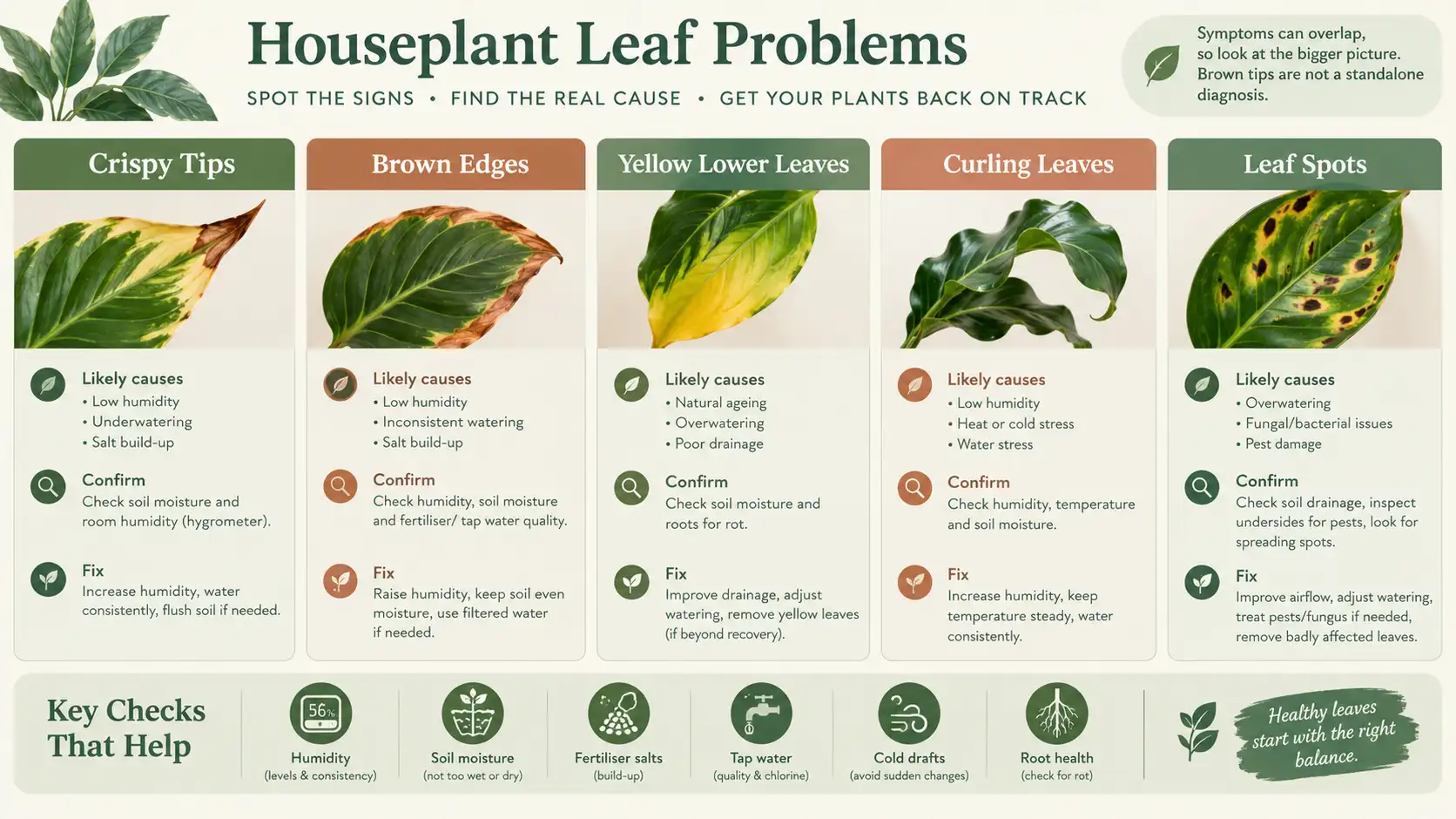
Brown tips are a useful clue, but they are not a diagnosis by themselves. Iowa State Extension lists low humidity, inconsistent watering, fertiliser salts and water quality among the possible causes of brown leaf tips and edges.
| Symptom | Likely cause | How to confirm | Fix |
| Crispy tips | Low RH, salts, underwatering | Check RH and soil together | Raise RH if low; correct watering |
| Brown edges | Low RH, inconsistent watering, salts | Inspect pattern and soil moisture | Correct the underlying cause |
| Yellow lower leaves | Overwatering/root stress or ageing | Check wet soil and roots | Improve drainage and watering |
| Curling leaves | Dry air, underwatering, heat/cold stress | Check RH, soil and drafts | Stabilise moisture and environment |
| Spots | Disease, chemical injury, sun or watering stress | Inspect spot pattern and foliage | Improve diagnosis before treating |
Other Causes That Mimic Dry Air
Fertiliser salt buildup: Repeated fertilising can leave soluble salts in the potting mix. Flush appropriately and reduce excessive feeding; prevent recurrence with a measured fertiliser routine.
Tap-water minerals: Sensitive plants such as calatheas and dracaenas can develop tip damage associated with water chemistry. Where this is suspected, use an appropriate alternative water source and avoid allowing salts to accumulate.
Cold drafts: A plant near a cold window, open door or strong air outlet can suffer environmental stress even when the room’s average RH looks acceptable. Move it to a more stable position.
Root problems: A plant can wilt despite wet soil if root rot has impaired water uptake. Check drainage and root condition before simply watering more.
For a focused calathea example, see our Calathea Brown Leaf Tips guide.
How to Raise Houseplant Humidity: What Works and What Doesn’t
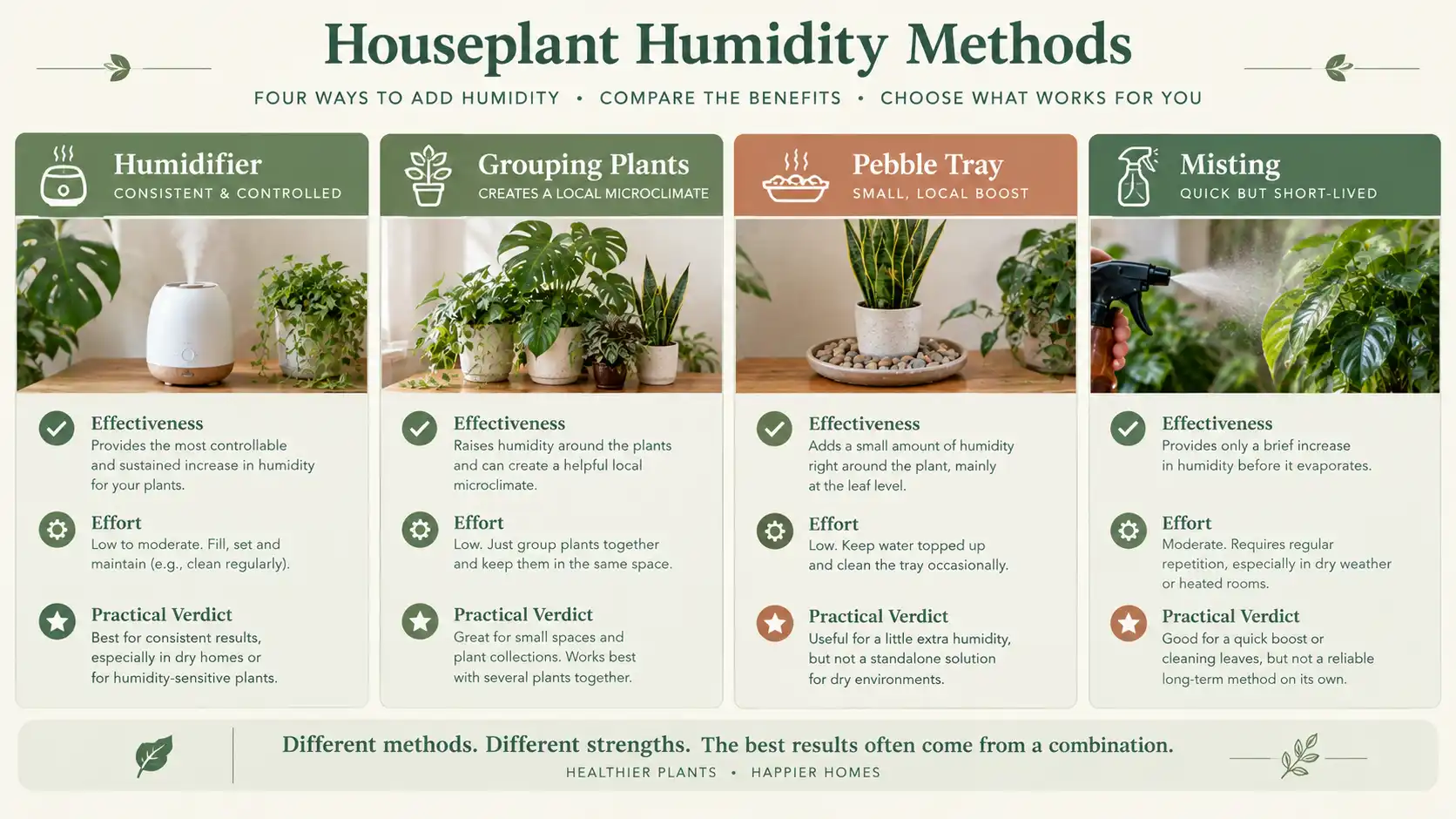
The most useful distinction is between methods that raise RH consistently and methods that only wet a surface temporarily.
| Method | Effectiveness | Effort | Verdict |
| Humidifier | High and controllable | Moderate | Worth it |
| Grouping plants | Moderate, variable | Low | Worth trying |
| Pebble tray | Small/localised effect | Low | Limited |
| Misting | Very short-lived | High if repeated | Waste as a primary fix |
Penn State Extension reports that misting raises humidity only until the water evaporates, which may take minutes, while Illinois Extension likewise describes the effect as short-lived.
Humidifier
A humidifier is the easiest way to make a measurable adjustment because it adds moisture continuously rather than relying on a brief evaporation pulse. UNH Extension recommends monitoring RH with a hygrometer while using one and keeping the unit positioned so the added moisture benefits the plant area without blasting foliage directly.
Grouping Plants
Grouping plants creates a small, humid microclimate through transpiration and evaporation. It works best when several plants are grouped in a relatively compact area rather than spread across a large, ventilated room.
For additional practical options, see our guide to increasing indoor humidity without a humidifier.
Pebble Trays
A pebble tray can provide a small local benefit, but it should not be treated as equivalent to a humidifier. Keep the pot above the water rather than allowing the container to sit directly in water.
Misting
Misting can temporarily raise the moisture immediately around foliage, but the effect disappears quickly as the water evaporates. It is therefore a poor substitute for sustained humidity control.
Can Houseplants Get Too Much Humidity?
Yes. Constantly high humidity combined with poor airflow can favour problems such as grey mould and leaf disease, while dry-climate plants such as succulents can be harmed by persistently wet conditions. RHS specifically notes grey mould and stem rots as potential problems where conditions are too moist.
The goal is appropriate humidity plus airflow, not the highest possible RH.
How to Keep Humidity Stable in Winter
Aim for a steady range rather than dramatic humidity spikes.
- Keep plants away from heating vents, radiators and strong air-conditioning outlets.
- Cluster humidity-loving plants together.
- Use a humidifier on a schedule when readings consistently fall below your plant’s target.
- Recheck the hygrometer regularly rather than guessing.
Common beginner mistakes: using misting as the main fix; measuring RH in the wrong part of the room; treating every tropical plant identically; and mistaking underwatering or root damage for humidity stress.
Conclusion
Use a houseplant humidity chart as a starting point, not a rigid rule. Match the plant to a practical RH tier, measure conditions near its foliage, check watering and roots before treating symptoms, and use methods that create lasting humidity. The clearest takeaway: measure first, diagnose second, then adjust humidity only as much as the plant actually needs.
Frequently Asked Questions
What is the ideal humidity for most houseplants?
A practical starting range for many common houseplants is 40–60% RH. Tropical species such as calatheas and some ferns often benefit from higher humidity.
What is the minimum humidity houseplants can tolerate?
There is no universal minimum. Hardy plants may tolerate around 30% or lower, while humidity-sensitive tropicals can show stress well before that point.
Do I need a hygrometer to measure plant humidity?
You do not need one for every plant, but a hygrometer is extremely useful when diagnosing dry-air problems or caring for humidity-sensitive species.
Does misting increase humidity for houseplants?
Yes, briefly. The moisture evaporates quickly, so misting does not provide a stable increase in room or plant-level RH.
How can I tell if brown tips are from humidity or underwatering?
Check both RH and soil moisture. Brown tips can result from low humidity, excessive soil dryness, salts or water-quality problems, so the symptom alone is insufficient.
Which houseplants prefer low humidity?
Cacti, succulents and snake plants generally cope well with dry indoor air. ZZ plants are also notably adaptable to average household humidity.
Does heating in winter lower humidity for plants?
Yes. Heating can produce much lower indoor RH, especially when outdoor air is cold and the home is heated. A hygrometer shows the actual conditions around your plants.