
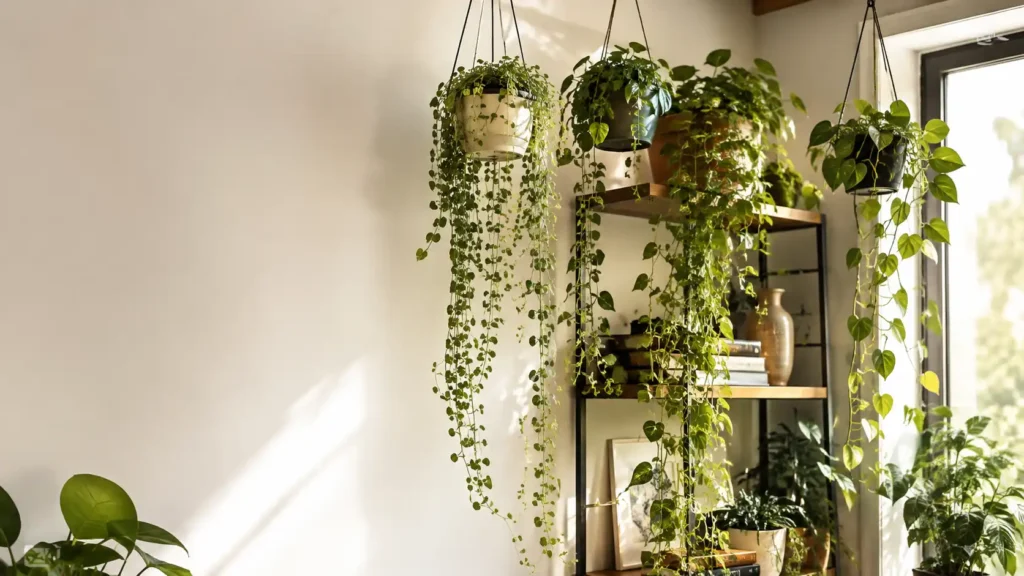
What Does ‘Trailing’ MeanIf you’ve ever seen a plant labeled “trailing” at a nursery or scrolling through Instagram and wondered whether that just means it hangs, dangles, or climbs, you’re not alone. Most plant guides use the word without ever explaining it — they jump straight to “top 10 trailing plants” lists and assume you already know what makes a plant trail in the first place.
That gap matters more than it seems. Buy a plant expecting it to climb a trellis when it’s actually a true trailer, and you’ll be disappointed when it never grips the support. Buy a “climber” for a hanging basket, and you may end up with bare, leggy growth reaching for something to hold onto. Knowing the difference — and knowing why it exists — helps you pick the right plant for your space, your shelf, your pot, and your patience level.
This guide covers what actually makes a plant trailing (not just what it looks like), how trailing differs from climbing and from simply “hanging,” why some plants can do more than one of these depending on how you grow them, and how to care for and style trailing plants so they stay full instead of sparse. From there, you can dive deeper into the three major trailing plant families — Hoyas, string and vine succulents, and ivies — through the dedicated guides linked throughout this article.
Quick Summary
- Trailing houseplants have stems that grow downward or outward under their own weight, rather than growing upright — roots typically form only at the base, not along the stem.
- Trailing is not the same as climbing. Climbing plants attach to a support using aerial roots or tendrils; trailing plants simply drape.
- Trailing is not the same as hanging. “Hanging” describes how you display a plant (in a basket, on a shelf); trailing describes how the plant naturally grows.
- Most trailing houseplants are beginner-friendly, tolerate a range of light levels, and are easy to propagate from stem cuttings.
- The three major trailing plant families are Hoyas, string and vine succulents, and ivies and ground-trailing vines — each with different light, water, and care needs.
What Does “Trailing” Mean in Houseplants?
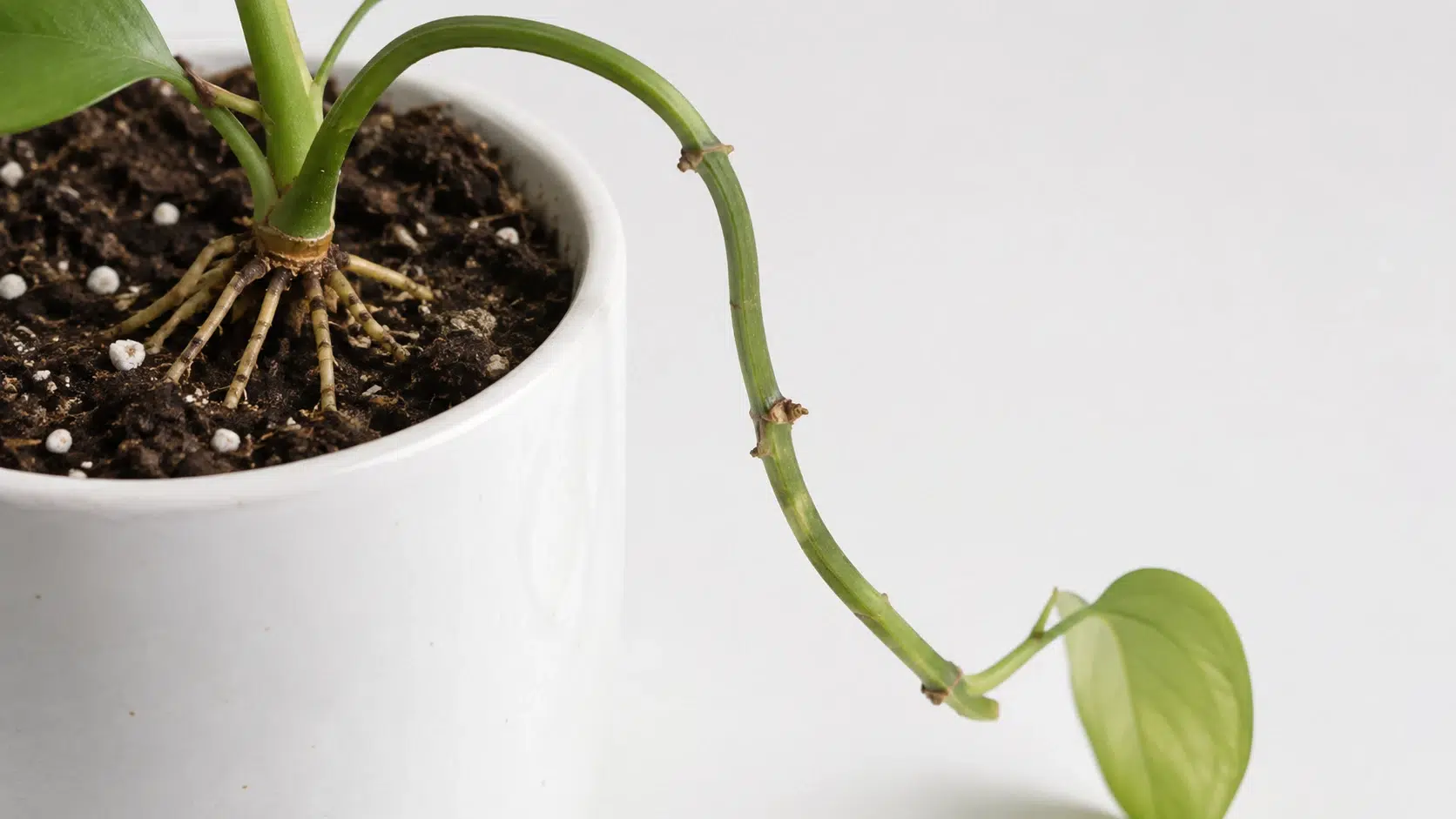
A trailing houseplant is one whose stems grow outward and then downward under their own weight, rather than growing upright toward a support. The stems drape over the edge of a pot, shelf, or basket, and — unlike climbing plants — they don’t use aerial roots, tendrils, or twining stems to attach to anything. Left alone, a trailing plant simply cascades; it doesn’t climb.
A key structural detail that most plant guides skip: in true trailing species, roots typically form only at the base of the plant, where it meets the soil, not along the length of the trailing stem. This is part of what separates a “trailer” from a “climber” — climbing plants regularly produce roots or root-like structures along the stem specifically to grip a surface.
It’s worth distinguishing “trailing” from the broader term “vine.” A vine is any plant with a long, flexible stem instead of a woody or upright one — vines can be trailing, climbing, or both. Trailing is a type of vining habit, not a synonym for it.
Why Do Some Plants Trail? The Growth Mechanism Explained
The trailing habit isn’t random — it’s the result of a few specific biological factors working together.
Stem flexibility and weight distribution. Trailing plants tend to have long, thin, flexible stems with leaves spaced in a way that doesn’t provide enough structural support for upright growth once the stem reaches a certain length. Once the stem’s weight exceeds what it can hold upright, gravity takes over and the stem begins to drape.
Node behavior. Every stem has nodes — the points where leaves, roots, or new growth can emerge. In climbing plants, nodes along the stem are triggered to produce aerial roots when they contact a solid surface (a phenomenon called thigmotropism). In true trailing plants, nodes rarely produce roots unless the stem is in direct, prolonged contact with soil or water, which is why trailing stems can hang for months without rooting into anything.
Light-seeking growth (phototropism). Trailing stems still grow toward available light, which is why a trailing plant in a hanging basket often grows longer on the side facing a window. This same light-seeking behavior is responsible for “leggy” growth when a plant isn’t getting enough light — the stem stretches toward the nearest light source instead of branching out.
Together, these three factors explain what most competitor articles get wrong: trailing isn’t just “a plant that hangs.” It’s a specific combination of stem structure, root behavior, and growth response that determines how a plant will behave in your home.
Trailing vs. Climbing vs. Hanging: What’s the Difference?
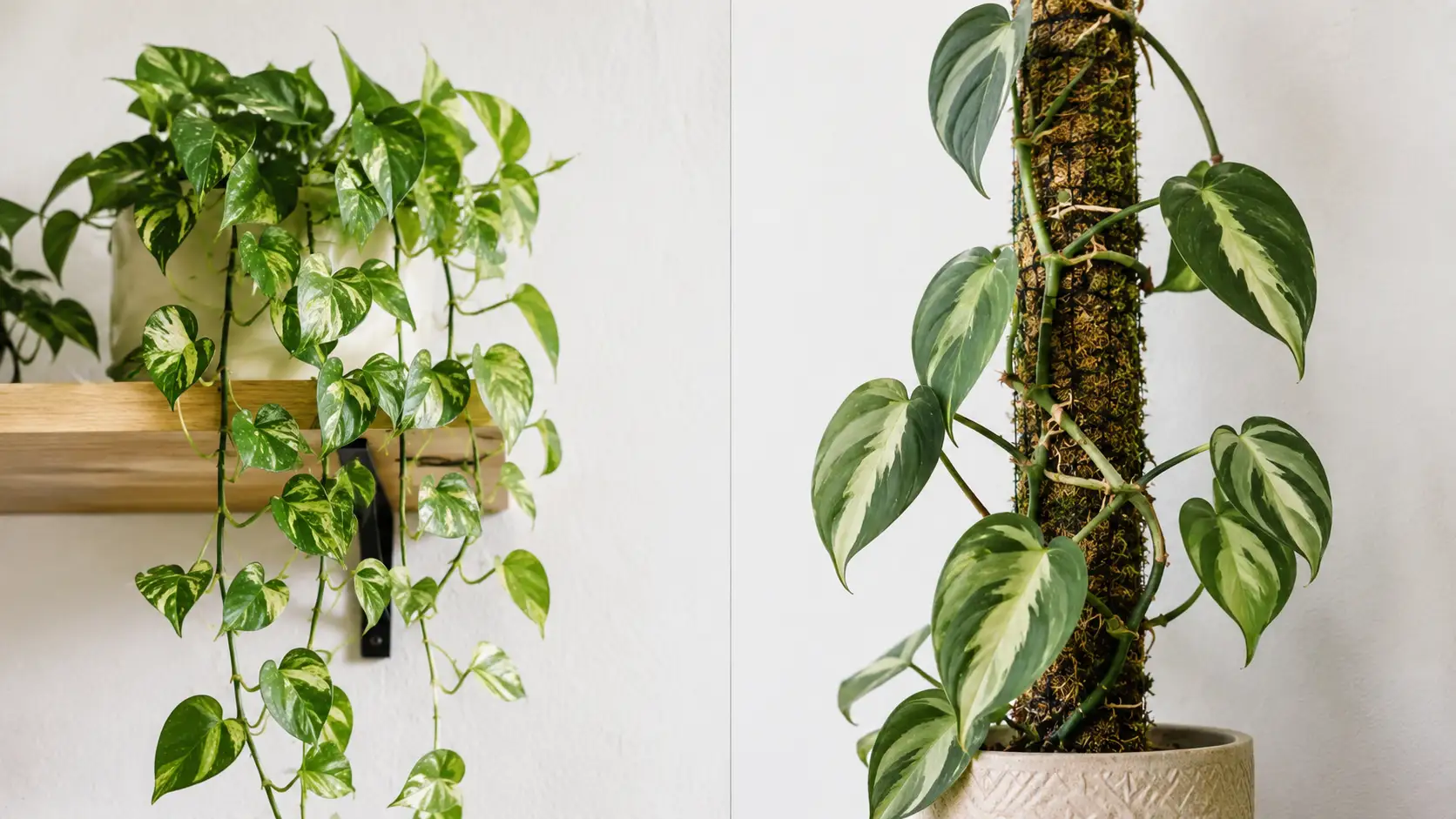
These three terms get used interchangeably online, but they describe three different things — two growth habits and one display method.
| Term | What It Describes | Key Trait |
| Trailing | A growth habit | Stems drape downward/outward due to gravity; no clinging structures |
| Climbing | A growth habit | Stems attach to a support using aerial roots, tendrils, or twining growth |
| Hanging / Cascading | A display method | How you choose to display a plant — any trailing plant can be “hung,” but hanging isn’t itself a growth type |
In other words: a plant is trailing or climbing by nature, and hanging is simply one way to show it off. You could put a trailing plant on a tall bookshelf instead of a hanging basket and it would still be trailing — it just wouldn’t be “hanging” in the display sense. According to the Royal Horticultural Society, climbers cling on using tendrils, twining stems, aerial roots, or sticky pads — mechanisms true trailing plants simply don’t rely on.
Some of the clearest real-world examples of the trailing-versus-climbing distinction show up in ivy species, where certain varieties will trail loosely along a shelf while others actively grip a moss pole or wall using aerial roots. For a closer look at how these growth patterns play out across different ivy types, see our guide to ivy and ground-trailing vines.
Can the Same Plant Trail and Climb?
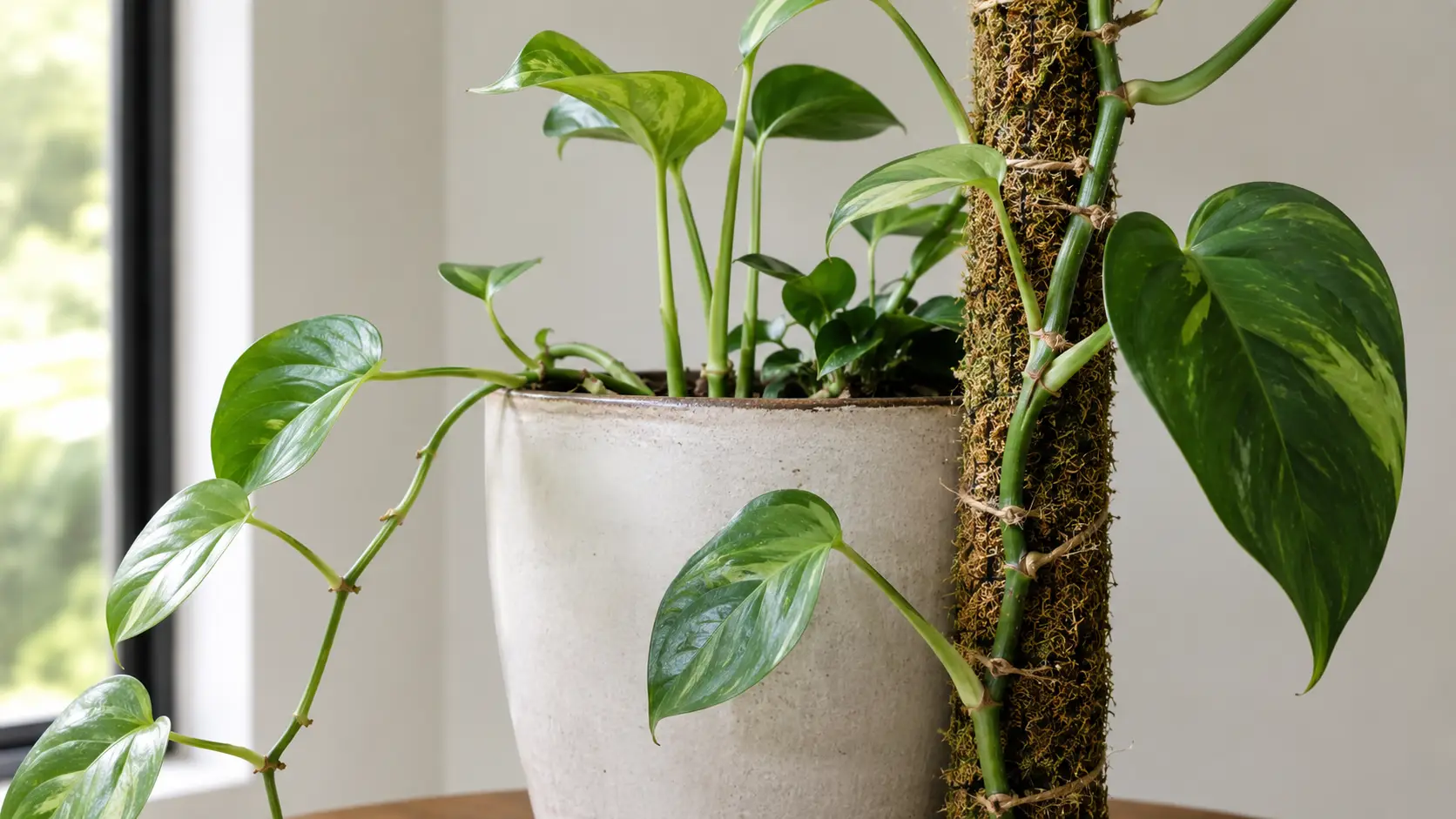
Yes — and this is one of the most misunderstood aspects of trailing plants. Many popular houseplants (classic examples include pothos and philodendron-type plants) will trail naturally when left in a hanging pot, but will climb if given a moss pole, trellis, or wall to grow against.
This happens because the stem’s nodes are capable of producing aerial roots when they make physical contact with a surface — the plant isn’t “deciding” to climb, it’s responding to a stimulus. Without that contact, the same node stays dormant and the stem simply continues trailing.
Not every trailing plant behaves this way, though. Most true string-type succulents (like string of pearls) and many Hoyas trail without ever developing this dual behavior, because their stems and root structures aren’t built for gripping surfaces the same way. That said, several rare Hoya varieties do show a similar dual growth pattern, trailing freely in a hanging pot but producing light aerial roots when given something to climb — a nuance worth understanding if you’re choosing between Hoya varieties for a specific display style. You can explore this in more depth in our guide to rare Hoya varieties.
Are Trailing Houseplants Good for Beginners?
Generally, yes. Trailing houseplants tend to be forgiving for a few practical reasons:
- Visible feedback. Drooping or shriveling stems are an easy, visible signal that a plant needs water or more light — much harder to miss than subtle changes in an upright plant.
- Tolerant light ranges. Many trailing species (though not all) tolerate a range of light conditions, from bright indirect light to moderate indoor light.
- Easy propagation. Most trailing plants root readily from stem cuttings, so mistakes are recoverable — you can always start a new plant from a healthy cutting if the original struggles.
That said, “trailing” doesn’t automatically mean “easy.” Difficulty still depends heavily on genus — succulent-type trailers are more sensitive to overwatering, while tropical trailers are more sensitive to low humidity and inconsistent light. Hoyas, for instance, are a genuinely beginner-friendly entry point into trailing plants once you understand their basic light and watering rhythm — our Hoya care for beginners guide breaks this down step by step.
General Care Principles for Trailing Houseplants
Because trailing houseplants span several very different plant families, care needs vary — but a few general principles apply broadly:
Light. Most trailing houseplants prefer bright, indirect light. As a rule of thumb, trailing succulents (like string-of-pearls types) tolerate and often need more direct light than trailing tropicals like Hoyas or ivies, which can scorch in direct sun.
Watering. Succulent-type trailers store water in their leaves and need the soil to dry out fully between waterings. Tropical trailers (Hoyas, ivies, pothos-types) generally prefer soil that dries partially, but not completely, between waterings. Overwatering is the single most common cause of trailing plant decline across nearly every family.
Humidity. Tropical trailing plants generally appreciate higher humidity than succulent trailers, which are adapted to drier conditions. This is one reason why some trailing plants — like Purple Heart — do particularly well in average indoor humidity while also offering air-quality benefits worth knowing about if you’re choosing plants for a specific room. See our breakdown of Purple Heart’s indoor benefits for more on this. As University of Missouri Extension notes, average home humidity in winter can drop lower than the Sahara Desert — a major stress factor for tropical trailing plants like Hoyas and ivies.
Pruning. Regular light pruning encourages branching and fullness rather than one long, sparse stem. Left unpruned, most trailing plants will keep growing longer without filling out — which is the root cause of the “leggy” look many owners struggle with.
Legginess. Legginess is usually a light problem, not a watering problem. When a plant doesn’t get enough light, it stretches toward the nearest light source (phototropism) instead of producing new branching growth, leading to long, sparse stems with leaves spaced far apart.
How to Keep a Trailing Plant Full, Not Leggy
A few practical techniques prevent — or reverse — the sparse, leggy look:
- Pinch or trim growing tips regularly. Removing the newest growth encourages the plant to branch from lower nodes instead of continuing to elongate.
- Propagate cuttings back into the same pot. Rather than discarding trimmed stems, root them and tuck them back into the base of the same plant. This is one of the fastest ways to add visual fullness without buying a new plant.
- Rotate the pot periodically. Uneven light exposure causes uneven growth; rotating every few weeks keeps growth balanced on all sides.
Different trailing plants respond to slightly different propagation methods. For a walkthrough of getting cuttings to root reliably, see our guides on propagating String of Pearls and String of Hearts propagation — both illustrate the cutting-and-repotting technique in more detail than a general overview can cover.
Where to Place Trailing Houseplants (Styling & Decision Framework)
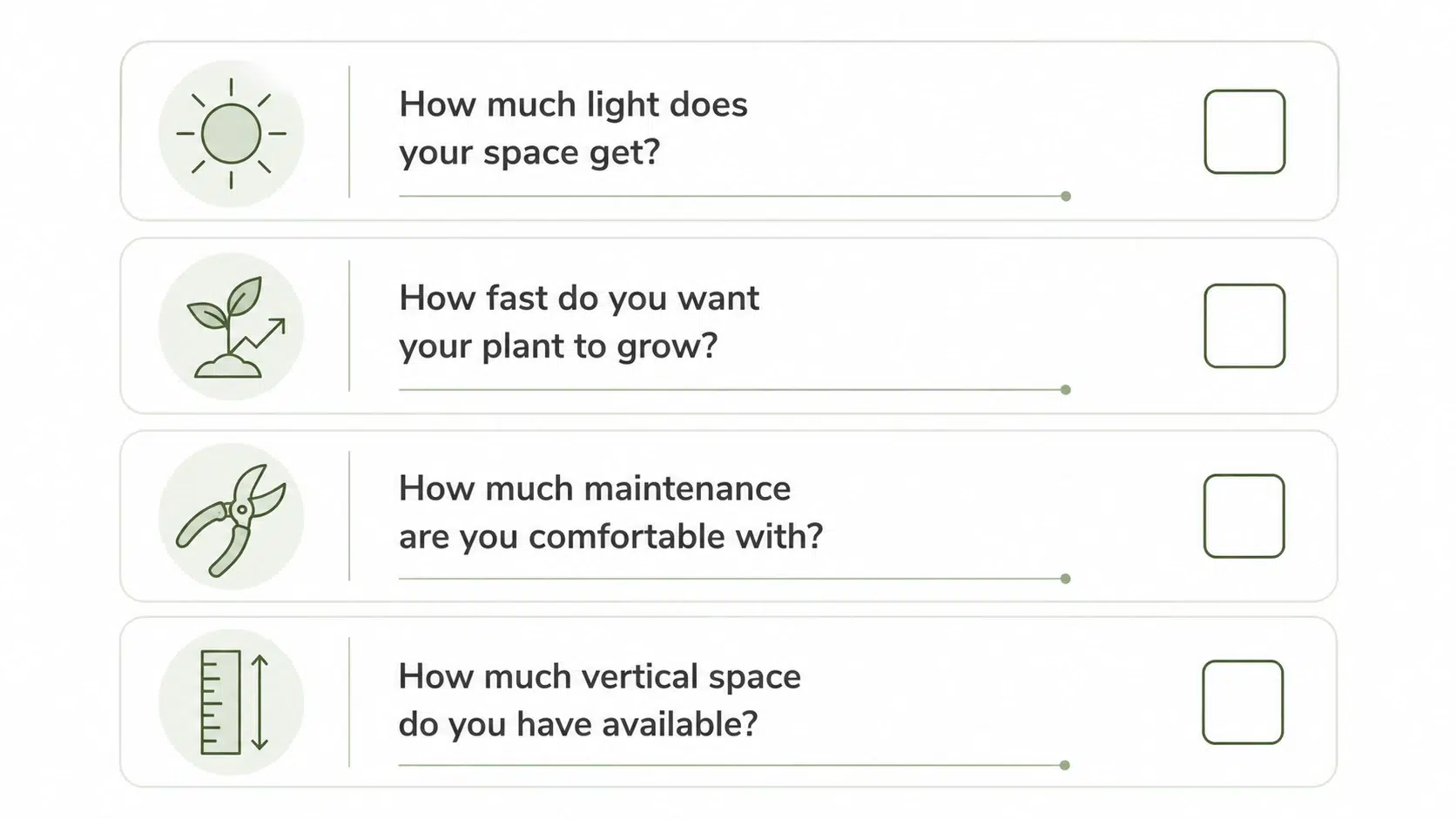
Choosing where to put a trailing plant is really a question of drop space, light access, and how much growth you’re willing to manage.
A few common placement styles:
- Hanging baskets — best for plants that need to cascade freely without touching a surface; ideal for tropical trailers that appreciate airflow around the foliage.
- Open shelves or bookcases — a good middle ground; allows trailing growth to drape over the edge while staying accessible for watering and pruning.
- Trellis or moss-pole trained — appropriate for plants capable of climbing (see the trailing-vs-climbing section above); turns a trailing habit into a vertical display.
- Tabletop with cascade room — works for smaller or slower-growing trailers where a dramatic multi-foot drape isn’t the goal.
A quick “Is this plant right for my space?” checklist:
- Light available: Is the spot bright indirect light, direct sun, or lower light? Match this to the plant family before choosing a placement.
- Growth speed tolerance: Fast growers (many pothos-types, string succulents) need more frequent pruning and repositioning; slower growers (some Hoyas) need less maintenance but more patience.
- Pruning willingness: If you don’t want to trim regularly, choose a naturally compact or slow-trailing variety over a vigorous grower.
- Vertical/drop space: Measure the actual space below the pot — a plant that outgrows its display spot quickly becomes a maintenance burden rather than a design feature.
Types of Trailing Houseplants (Overview by Category)
Trailing houseplants aren’t one uniform group — they span several plant families with distinct care needs, growth rates, and appearances. Here’s a broad overview of the three major categories, each covered in more depth in its own dedicated guide.
Trailing Hoyas
Hoyas are semi-succulent vining plants known for thick, often waxy leaves and clusters of star-shaped, fragrant flowers. Many Hoya species trail naturally and are prized as much for their foliage variety (including variegated forms) as for their blooms. Because Hoya leaves store some water, they’re more forgiving of inconsistent watering than many other tropical trailers. To see the full range of Hoya foliage and flower variety available to trailing-plant collectors, explore our guide to rare Hoya varieties.
String & Vine Succulents
This category includes trailing succulents like string-of-pearls-type plants, along with related trailing plants such as Purple Heart and Purple Bridal Veil. These plants generally need more direct light than tropical trailers and require soil to dry out fully between waterings. They tend to grow quickly and propagate easily, making them popular for filling out hanging displays fast. For a full breakdown of care, propagation, and variety comparisons within this category, see our guide to string and vine succulents.
Ivy & Ground-Trailing Vines
Ivies are some of the most classic trailing (and, in some varieties, climbing) houseplants, valued for dense foliage and — in many cultivars — striking variegation patterns. Unlike succulent trailers, ivies generally prefer more consistent moisture and appreciate higher humidity. Their versatility as both ground cover and trailing display plants makes them a common entry point for new trailing-plant owners. Learn more in our guide to ivy and ground-trailing vines.
Common Mistakes When Growing Trailing Houseplants
Even experienced plant owners run into a few recurring issues with trailing plants:
- Overwatering succulent-type trailers. Because these plants store water in their leaves, waterlogged soil leads quickly to root rot. This is an especially common issue with delicate string-type succulents — String of Tears, for example, is particularly prone to stress and dieback from overwatering, as covered in our String of Tears care guide.
- Insufficient light causing legginess. As covered above, sparse growth is almost always a light issue rather than a watering issue.
- Ignoring pruning until the crown is bare. Waiting too long to prune often means the base of the plant is left leafless while all the growth happens at the tips — much harder to reverse than preventing it in the first place.
- Using a pot that’s too small for root health. Trailing plants still need adequate root space at the base even though the visual interest is in the draping stems above.
Conclusion
At its core, a trailing houseplant is defined by how it grows — stems that drape under their own weight rather than climbing or standing upright — not by where you put it. Understanding that distinction, along with how trailing differs from climbing and from simple “hanging” display, makes it much easier to choose the right plant for your space and set realistic expectations for how it will grow.
From here, where you go next depends on what kind of trailing plant appeals to you. If you’re drawn to sculptural, semi-succulent vines with striking foliage and blooms, start with our guide to rare Hoya varieties. If you want fast growth and easy propagation, string and vine succulents are an excellent fit. And if you’re after classic, dense ground-cover-style trailers, explore our guide to ivy and ground-trailing vines.
Frequently Asked Questions
What is the difference between a trailing plant and a climbing plant?
Trailing plants let their stems drape downward or outward due to gravity and don’t attach to surfaces. Climbing plants use aerial roots, tendrils, or twining stems to grip and grow up a support.
Do trailing houseplants need to be in a hanging pot?
No. Hanging is just one display option. Trailing plants can also be placed on shelves, bookcases, or tabletops where their stems have room to cascade over the edge.
Can a trailing plant become a climbing plant if given support?
Some can. Certain species (notably pothos and philodendron-types, and a few rare Hoyas) will produce aerial roots and climb if given a moss pole or trellis, even though they trail without one. Not all trailing plants have this ability.
Are trailing houseplants low-maintenance?
Many are relatively forgiving, especially for beginners, but “trailing” doesn’t guarantee low maintenance — succulent-type trailers need very different watering care than tropical trailers, and both need regular pruning to avoid legginess.
Why is my trailing plant leggy or sparse?
Legginess is almost always caused by insufficient light, which triggers the stem to stretch toward available light instead of branching out. Increasing light and pruning regularly usually resolves it over time.
How much light do trailing houseplants need?
Most prefer bright, indirect light, though trailing succulents typically tolerate and often need more direct sun than tropical trailers like Hoyas and ivies.
What are the most common types of trailing houseplants?
The three broad categories are trailing Hoyas, string and vine succulents, and ivies/ground-trailing vines — each with distinct light, water, and humidity needs.
How often should I prune a trailing plant to keep it full?
There’s no fixed schedule, but light, regular trimming of the newest growth tips (rather than infrequent heavy pruning) generally produces fuller, more even growth over time.



2 Responses