
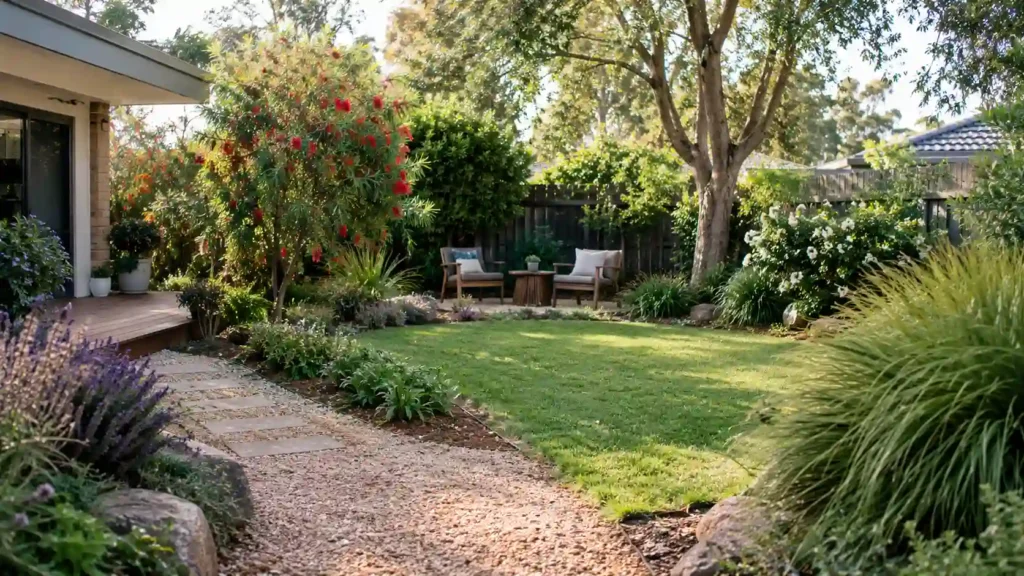
The best outdoor garden inspirations hub should do more than show attractive gardens. It should help you decide which ideas will actually work in your space. The right garden depends on available space, sunlight, climate, budget, desired maintenance level, and how you intend to use the area. A small Melbourne courtyard, a sunny Adelaide yard, a subtropical Brisbane garden and a coastal Western Australian property may all need very different planting and layout decisions. This guide brings those decisions together, covering garden styles, space-saving ideas, Australian native plants, flowering schemes, practical features, budgeting priorities and a simple step-by-step planning process.
Quick Summary
- Choose outdoor garden ideas according to space, sunlight, climate, budget and maintenance rather than appearance alone.
- Small gardens benefit from vertical planting, containers, compact shrubs, layered beds and carefully selected focal points.
- Australian native plants can be excellent landscape choices, but the best results come from matching species to local conditions rather than assuming every native is low-water or low-maintenance.
- Garden style should support both the appearance of your home and the way you use the outdoor space.
- Year-round interest comes from combining different plant forms, foliage, flowering periods and structural features rather than relying on one peak flowering season.
- The simplest garden makeovers usually succeed by improving the site first, choosing plants second and adding decorative features last.
How to Choose the Right Outdoor Garden Idea for Your Space
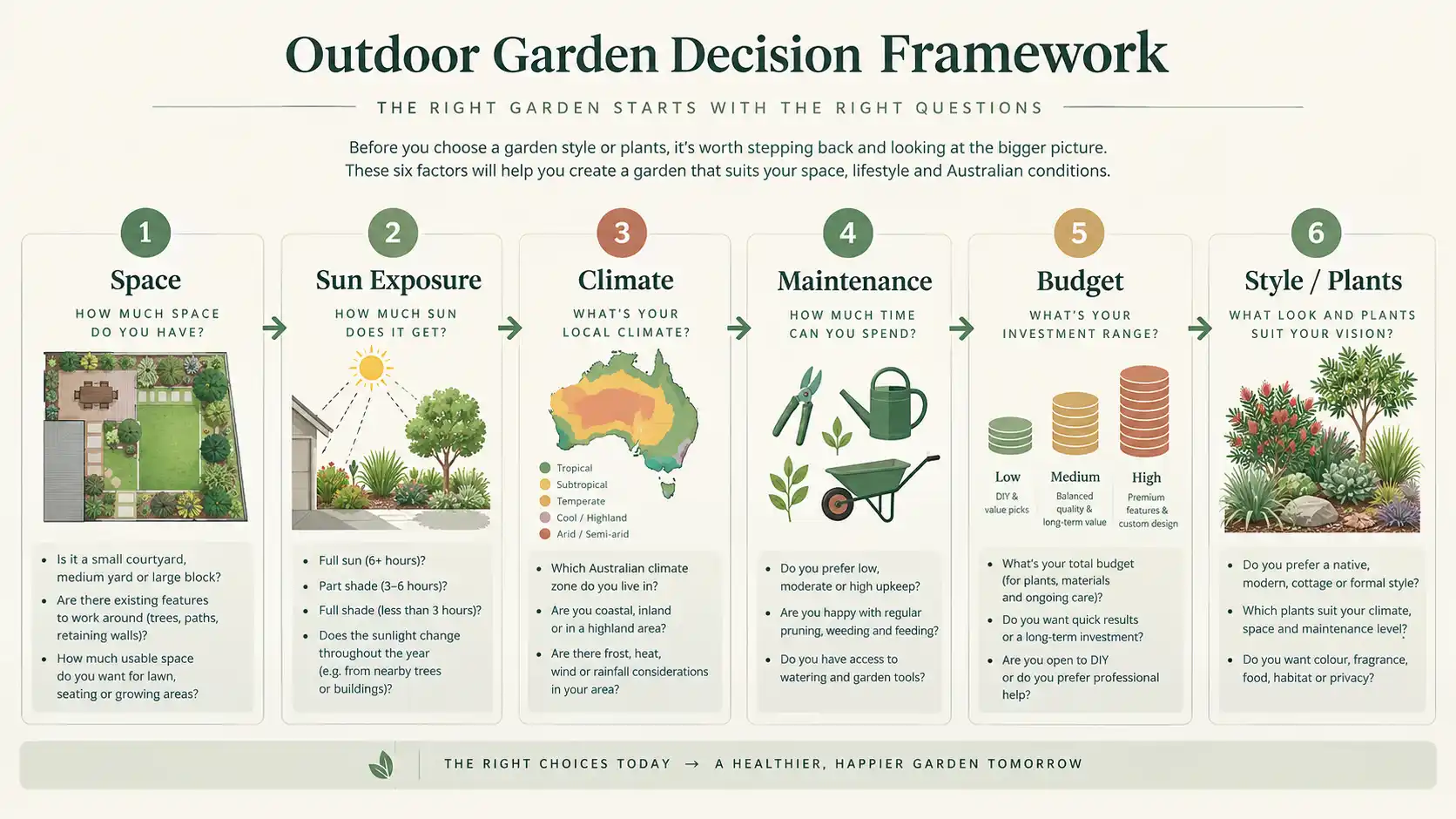
The biggest garden-design mistake is starting with a plant or feature before deciding what the site can support. Begin with the conditions you cannot easily change, then choose the style and plants around them.
Space
Start by measuring the area you actually intend to use. A narrow side garden has different priorities from a large backyard, just as a balcony has different limits from a courtyard.
Think about:
- Available planting width and depth
- Existing paths and access points
- Outdoor entertaining areas
- Privacy requirements
- Views you want to preserve
- Utility access, drainage and structures
- Mature plant size rather than nursery-plant size
A small garden often performs better with fewer, well-chosen plants than a crowded collection of specimens. In compact spaces, vertical structure can be especially valuable because screening plants, climbers and raised features can add interest without consuming large amounts of ground area.
For more compact inspiration, see Greenery Nest’s small native garden ideas in Australia.
Sun Exposure
Record how much direct sunlight reaches each part of the garden rather than labelling the whole property simply “sunny” or “shady”.
Observe:
- Full sun
- Morning sun and afternoon shade
- Filtered light
- Bright shade
- Deep shade
Sun exposure can change substantially between summer and winter as the angle of the sun shifts and neighbouring trees change their shadow patterns. A plant that receives several hours of winter sun may receive much less once summer foliage develops overhead.
Maintenance Level
Be realistic about how often you want to prune, weed, water, fertilise, mow and replace plants.
| Garden goal | Design emphasis |
| Very low maintenance | Hardy plants, simple beds, mulch, efficient irrigation, fewer plant types |
| Moderate maintenance | More seasonal colour and mixed planting |
| High involvement | Formal hedges, intensive flower beds, productive gardens, frequent pruning |
A lower-maintenance garden is not necessarily a plant-free garden. It is a garden designed so routine jobs are fewer, predictable and appropriate to the site.
Budget
Rather than setting a budget only by how much you can spend on plants, divide the project into priorities.
A practical order is:
- Fix drainage and access problems.
- Improve the planting area where necessary.
- Establish paths, edging or major structures.
- Install or improve irrigation.
- Buy plants according to the final layout.
- Add decorative features and furnishings.
This approach helps avoid spending heavily on plants that later need to be moved because the bed, path or irrigation system was never planned first.
Climate and Plant Selection
Australia contains tropical, subtropical, temperate, desert and other climatic conditions, so a plant that thrives in Brisbane may not be the right choice for Melbourne, Adelaide Hills, Hobart or an inland frost-prone site. The Bureau of Meteorology explains that Australian climate patterns vary with latitude, rainfall, topography and distance from the coast. Australia has major regional differences in temperature, rainfall and growing conditions, so garden planning should begin with the local climate rather than a one-size-fits-all plant list. The Bureau of Meteorology’s Australian climate zones explains how tropical, subtropical, temperate, desert and other regional conditions shape Australia’s landscapes and climate.
Use local climate as a filter before you use colour or style as a filter. Greenery Nest’s Australian native garden plants guide is a useful next step when you want to compare native plant groups, site conditions and garden applications.
Outdoor Garden Ideas by Space
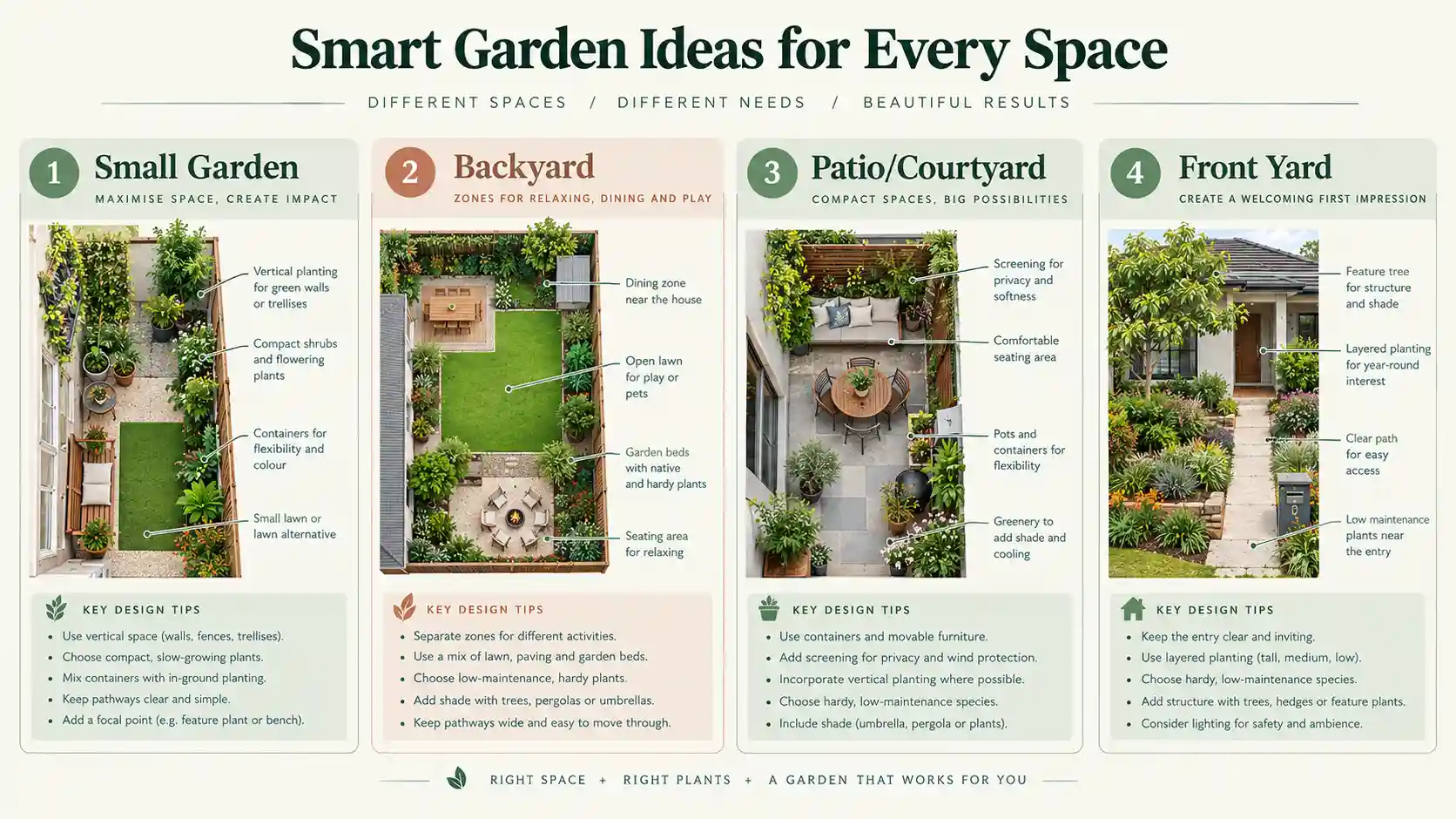
The same garden style can work very differently depending on how much room you have. Choose ideas according to the physical constraints of the site rather than trying to reproduce a large landscape in miniature.
Small Outdoor Garden Ideas
Small outdoor gardens benefit from visual layering and controlled repetition.
Useful ideas include:
- Container groupings
- Narrow raised beds
- Vertical planting
- Compact native shrubs
- Climbers on trellises
- A single statement plant
- Built-in seating with integrated planting
- Light-coloured paving or gravel where appropriate
The key is to avoid filling every available gap immediately. Plants need room to mature, and overcrowding can increase maintenance while reducing the visual clarity of the design.
For Australian-focused compact planting, the Greenery Nest guide to small native garden ideas explores layered beds, raised beds and space-efficient native planting.
Backyard Garden Inspiration
Backyards usually offer enough room to divide the garden into functional zones.
Consider combining:
- An entertainment area
- A lawn or lawn alternative
- A flowering border
- Screening or privacy planting
- A productive garden
- A quiet seating area
- A children- or pet-friendly open zone where appropriate
The strongest backyard layouts usually have a clear relationship between these zones. A path, change in paving, planting band or low hedge can define the transition without making every area feel completely separate.
Patio and Courtyard Garden Ideas
Patios and courtyards rely heavily on containers, vertical elements and plants that tolerate reflected heat or restricted root space.
Useful choices may include:
- Large containers rather than many small pots
- Narrow screening plants
- Trellis-mounted climbers
- Repeated foliage shapes
- Raised planters
- Bench seating
- Decorative gravel
- One larger structural plant instead of many competing specimens
Container gardens also need close attention to drainage because pots can dry rapidly in hot weather but can remain saturated during cool, wet periods.
Front Yard Garden Inspiration
A front garden needs to work from both the street and the home’s entrance.
Useful priorities include:
- Clear access to the front door
- Plants that fit the mature scale of the property
- Simple seasonal colour
- Screening where privacy is genuinely needed
- Low-maintenance edges
- A planting palette that complements the building
Australian native planting can work particularly well in front gardens when species are chosen for the local climate rather than selected simply because they are native.
Popular Outdoor Garden Styles to Inspire Your Design
Style should guide the visual language of the garden, but it should not override environmental reality. A beautiful concept becomes a poor garden when its plants cannot cope with the site.
Australian Native Garden Style
An Australian native garden can combine flowering shrubs, grasses, groundcovers, trees and other regionally appropriate plants with natural-looking structural elements.
The main advantages are not that every native plant is automatically easier or more drought tolerant. Instead, locally suited plants can be a strong fit because they evolved within particular Australian environmental conditions. Choosing native plants works best when species are matched to the conditions of the garden and their intended landscape role. The Australian National Botanic Gardens’ guide to growing native plants provides species information and horticultural guidance for Australian plant groups including Banksia, Acacia, Bottlebrush and Kangaroo Paw.
The Australian National Botanic Gardens maintains collections from across Australia and provides growing information for native plant groups including Banksia, Acacia, Waratah, Bottlebrush and Kangaroo Paw.
For broader selection guidance, see Australian native garden plants.
Regional context matters. A plant adapted to coastal Western Australia may not be the best choice for a frost-prone inland garden, while a plant comfortable in temperate southern Australia may struggle with tropical heat and humidity.
For additional Australian flower references, Greenery Nest’s Australian flower names and native flower guide provides examples organised by colour, plant group and habitat.
Modern Outdoor Garden Design
Modern gardens generally rely on restraint.
Common elements include:
- Clean planting lines
- Repeated plant forms
- Strong geometric edges
- Limited colour palettes
- Gravel, stone, timber or concrete
- Structured shrubs and grasses
- A deliberate relationship between hardscape and planting
The modern look works best when repetition creates continuity. Choosing six unrelated plants and scattering them randomly usually looks less modern than repeating two or three compatible forms.
Cottage Garden Style
Cottage gardens are intentionally softer and more informal, with layered planting, seasonal flowers and less rigid visual structure.
An Australian cottage garden needs to be adapted to local conditions rather than copying a wet English planting scheme. Greenery Nest’s Australian cottage garden design guide covers informal layouts, layered planting and climate-conscious design.
The most practical approach is to keep the informal abundance while selecting plants able to handle the property’s actual climate, soil and maintenance capacity.
Low Maintenance Garden Style
A low-maintenance garden focuses on reducing recurring work rather than eliminating care altogether. A low-maintenance garden is easier to manage when plants are grouped according to similar water requirements and the design responds to local environmental conditions. Water Corporation’s low-maintenance garden guidance explains practical approaches such as hydrozoning and seasonal irrigation adjustment.
The most useful design principles are:
- Match plants to the site
- Group plants with similar water requirements
- Use mulch appropriately
- Reduce unnecessary lawn
- Limit high-pruning hedges
- Simplify the planting palette
- Make irrigation easy to inspect and adjust
Water Corporation’s guidance similarly recommends choosing plants suited to the local climate, grouping plants with similar water needs and designing around environmental conditions.
Greenery Nest’s low maintenance Australian native plants guide can help with plant-group ideas, while the Australian National Botanic Gardens also maintains a list of drought-tolerant native plants grown successfully under low-irrigation conditions at the Gardens.
Outdoor Garden Ideas Based on Maintenance Level
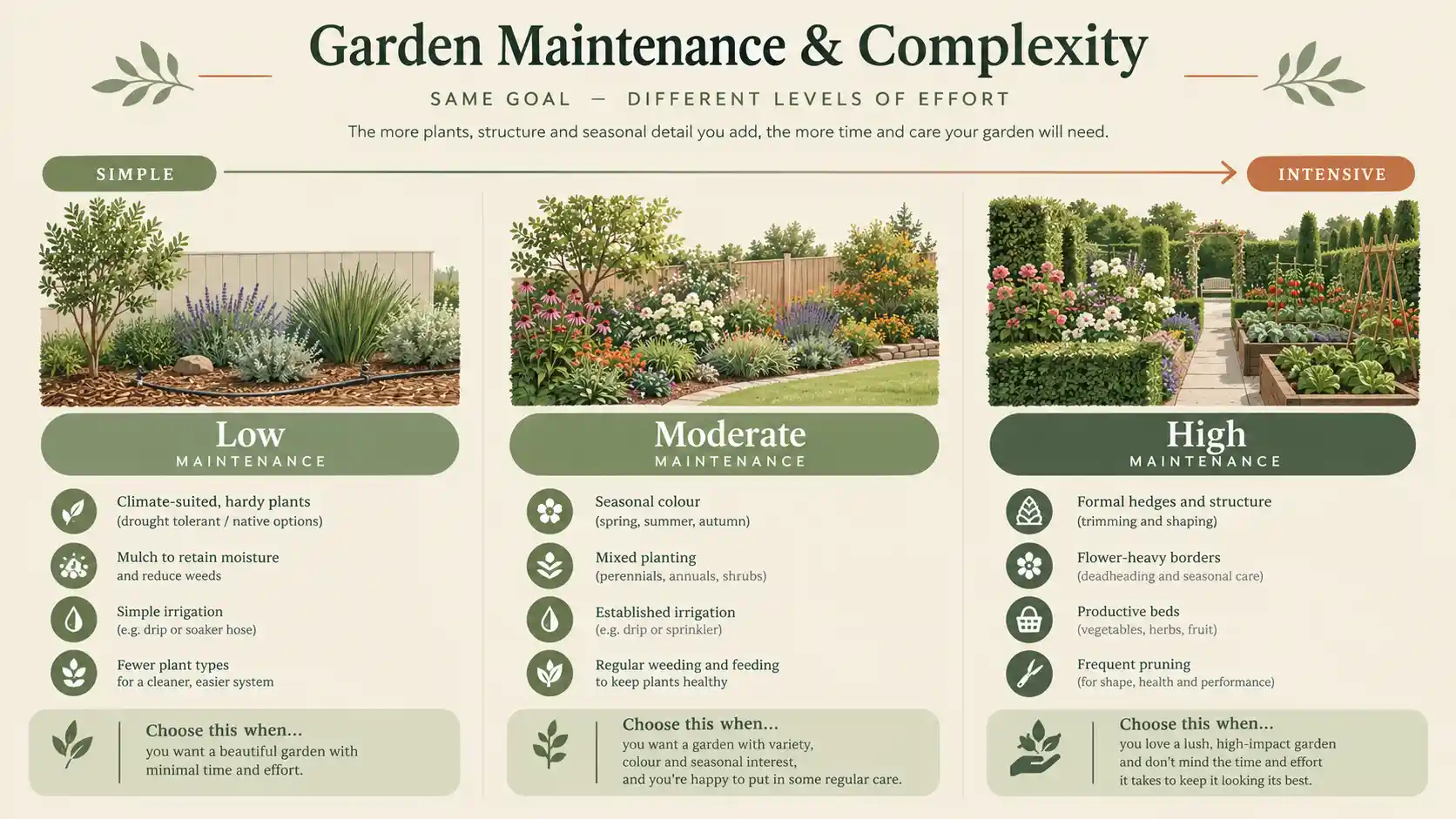
Maintenance level should be chosen before planting because it affects both the plant palette and the physical layout.
Low Maintenance Outdoor Gardens
The easiest low-maintenance garden is usually one where the plants are compatible with the site from the beginning.
Prioritise:
- Climate-suitable plants
- Simple bed shapes
- Mulched planting areas
- Efficient irrigation
- Plants with compatible water needs
- Fewer high-maintenance seasonal displays
Do not assume “native” automatically means “no water”. Newly planted natives still need establishment care, and some species are naturally suited to moist habitats rather than dry landscapes.
For a flowering focal point, Kangaroo Paw care tips explain the growing conditions needed for reliable performance. Kangaroo paw can work well in suitable sunny, well-drained locations, but individual cultivars differ.
Gardens for Beginner Gardeners
Beginner-friendly gardens usually have three characteristics:
- A small number of plant types.
- Straightforward watering requirements.
- A layout that leaves enough access for maintenance.
Rather than starting with a large plant collection, begin with one structural plant group, one supporting shrub or grass group, and a limited flowering layer.
This makes problems easier to diagnose because you can identify which plant needs attention rather than managing dozens of unrelated species.
High Impact Gardens That Need More Care
High-impact gardens can include:
- Flower-heavy borders
- Formal hedges
- Topiary
- Large seasonal containers
- Intensive vegetable beds
- Carefully staged colour combinations
These designs can be spectacular, but they require more observation and intervention. The extra maintenance comes from pruning, deadheading, replacing seasonal plants, managing irrigation and preventing fast-growing plants from overwhelming slower companions.
Australian Native Flowers and Plants for Outdoor Garden Inspiration
Plants are one of the strongest tools for shaping garden identity, but the right plant should be selected by function as well as appearance.
Native Flowers for Different Garden Looks
Start with the visual effect you want:
| Garden look | Useful plant characteristics |
| Bright feature garden | Strong flower colour and clear focal plants |
| Wildlife garden | Nectar, food or habitat value appropriate to local fauna |
| Soft cottage look | Layered flowering plants and informal forms |
| Modern garden | Repeated forms, structural foliage and limited colour |
| Low-water garden | Species suited to the site’s rainfall, soil and irrigation limits |
Colour is useful for narrowing the field, but mature size, climate and soil drainage are still more important long-term filters.
Pink Native Flowers
Pink blooms can soften hard landscaping and work well in cottage-style or mixed borders. Greenery Nest’s pink Australian native flowers guide covers native pink flowering shrubs, groundcovers and other plant forms.
Purple Native Flowers
Purple flowers can provide contrast against grey-green foliage and work particularly well in contemporary or mixed-colour planting.
Explore Greenery Nest’s purple native flowers Australia guide for additional colour-based inspiration.
White Native Flowers
White flowers are useful for softening stronger colour schemes and can be particularly effective near seating areas or paths where evening visibility matters.
See white native flowers Australia for further plant-group ideas.
Red Native Flowers
Red native flowers create strong focal points and can be paired with quieter foliage or yellow and white flowering plants.
Greenery Nest’s red Australian native flowers guide explores red-flowering trees, shrubs and groundcovers.
Yellow Native Flowers
Yellow flowers provide strong visual energy and can work particularly well with green or silver foliage. Greenery Nest’s yellow Australian native flowers guide covers yellow-flowering trees, shrubs, groundcovers and perennials.
Flowering Plants That Add Year-Round Interest
No single plant needs to flower continuously for a garden to look good throughout the year.
Instead, build seasonal interest from:
- Evergreen foliage
- Different flowering periods
- Bark and branch structure
- Grasses and seed heads
- Repeating foliage textures
- Fruit or other seasonal features where appropriate
- Plants that peak at different times
This is particularly important in Australia because flowering calendars differ considerably between regions and climates. The same month can feel very different in tropical, subtropical, temperate, alpine and arid landscapes.
The Bureau of Meteorology’s climate-zone guidance is a useful reminder that broad national planting calendars have limits: climate, rainfall and local geography influence what grows and flowers successfully in different areas.
Feature Ideas to Transform Outdoor Garden Spaces
Plants create the living structure of a garden, but features determine how people experience the space.
Outdoor Seating Areas
A seating zone should be positioned according to how the space will actually be used.
Consider:
- Morning or afternoon sun
- Summer shade
- Wind direction
- Privacy
- Distance from the kitchen or entertaining area
- Relationship to paths
- Views through the garden
Planting around seating can create enclosure without requiring a solid screen. Low shrubs can define edges while taller plants can frame sight lines.
Garden Paths and Walkways
A path should serve a practical function before it becomes a decorative feature.
Think about:
- The route between frequently used areas
- Surface drainage
- Slip resistance
- Wheelbarrow or equipment access
- Width
- Maintenance at the edges
Curved paths tend to create a softer visual experience, while straight paths can suit modern, formal or highly structured gardens.
The Australian National Botanic Gardens demonstrates how planting and landscape form can work together; its landscaping principles include using site contours to maximise space and reduce runoff.
Water Features and Decorative Elements
Water features can create a focal point, but they also introduce maintenance requirements.
Before adding one, consider:
- Cleaning
- Pump access
- Water evaporation
- Child safety
- Wildlife interactions
- Electrical safety
- Mosquito management
- Ongoing water availability
In a small garden, a simple basin, bird bath or contained water element may achieve the visual effect without the complexity of a large pond.
Raised Beds and Vegetable Gardens
Raised beds can be useful when:
- Existing soil is difficult to manage
- Drainage needs improvement
- Access is limited
- You want clear separation between edible crops and ornamental beds
- You want a defined growing area
Do not assume every raised bed needs imported soil or a particular mix. The correct approach depends on the existing soil, drainage and plants being grown.
A productive garden can also become part of the garden’s visual design by integrating herbs, vegetables, edible flowers and fruit plants with ornamental planting rather than hiding food production in a separate corner.
Popular Native Flowering Plants for Garden Inspiration
Specific plants should be selected according to function, mature size and local suitability. The following groups illustrate how native flowering plants can play different roles without turning this pillar into individual care guides.
Grevillea Garden Ideas
Grevilleas can fill several design roles, including shrubs, screening plants, flowering features and tree-form specimens.
For a broader look at different options, Greenery Nest has dedicated guides to Dorothy Gordon Grevillea, standard Grevillea plants, Olive Grevillea and orange flowering Grevillea.
The important design distinction is growth habit. A low-growing form can work near paths or borders, while an upright or tree-form plant may function as a focal point. Mature size should determine placement, not the dimensions of the plant at purchase.
Banksia Garden Ideas
Banksias can provide strong structural value as well as distinctive flowers, but different species and cultivars occupy very different amounts of space.
Compact options are useful in smaller landscapes. For example, Greenery Nest’s Banksia Little Eric guide focuses on a compact Banksia ericifolia cultivar.
For a much narrower vertical planting role, the Sentinel Banksia guide covers a columnar form of Banksia integrifolia suited to specific landscape situations.
The lesson is broader than either plant: never choose a Banksia from the flower image alone. Check final height, width, root space, soil drainage, climate suitability and the garden’s intended function.
Kangaroo Paw Garden Ideas
Kangaroo paw can bring strong vertical flower stems and an unmistakably Australian visual identity to a garden.
Use it:
- As a repeated border plant
- In a gravel or native-style bed
- In containers where compact cultivars are suitable
- As a vertical accent among lower plants
- Along paths where flower stems can remain visible
For colour-led planting, Greenery Nest’s guides to yellow kangaroo paw and blue kangaroo paw show how different colour forms can create very different visual effects.
Again, the design choice should follow the conditions of the site. Full sun and good drainage are important for many kangaroo paw forms, while individual cultivars can differ in size and performance.
Outdoor Garden Planning Guide: Where to Start
A garden makeover becomes much easier when broken into a sequence instead of treating the whole property as one project.
Step 1: Evaluate Your Space
Measure:
- Garden beds
- Paths
- Existing lawn
- Outdoor living areas
- Available planting depth
- Large trees and their shade
- Drainage patterns
Then observe the site over several days rather than relying on one snapshot.
Record where water collects, where the strongest afternoon sun falls and which areas remain shaded.
Step 2: Choose Your Garden Style
Choose style according to how you live.
A family entertaining outdoors frequently may prioritise lawn, seating and shade. Someone focused on wildlife may prioritise layered planting and habitat value. A busy household may prefer a simpler low-maintenance palette.
This is the point where you decide whether the garden should feel:
- Native and naturalistic
- Modern and structured
- Cottage-like and informal
- Minimal and low-maintenance
- Productive and edible
- A combination of styles
A successful garden does not need to fit one category perfectly.
Step 3: Select Plants and Features
Now match plants to:
- Sun
- Soil
- Drainage
- Climate
- Mature size
- Water requirements
- Maintenance expectations
The Australian National Botanic Gardens’ horticultural resources provide plant-specific information for multiple native plant groups and explain how native plants are grown and used in horticulture.
When planning a water-efficient garden, group plants according to similar watering requirements rather than mixing plants with radically different needs throughout the same irrigation zone. Water Corporation specifically recommends this approach, known as hydrozoning.
Step 4: Build in Stages
A staged garden can be easier to manage than a complete one-weekend transformation.
A useful sequence is:
Stage 1: Site preparation, drainage and access
Stage 2: Major structures, paths and irrigation
Stage 3: Trees and larger structural plants
Stage 4: Shrubs, grasses and groundcovers
Stage 5: Seasonal colour and finishing details
Building in stages also reveals how the garden behaves over time. You can observe what thrives before committing money and space to additional planting.
Common Outdoor Garden Design Mistakes to Avoid
Many garden problems begin before the plants ever enter the soil.
Choosing Unsuitable Plants
A plant can be attractive, locally available and still wrong for your site.
Check climate, drainage, sun exposure and mature size before buying.
Ignoring Sunlight
A garden bed that receives several hours of afternoon sun can be dramatically different from one under evergreen canopy. Reassess shade as nearby plants grow.
Overplanting
Young plants create the temptation to fill gaps immediately. Leave enough space for the mature canopy, especially when combining shrubs, trees and groundcovers.
Overplanting creates competition, pruning problems and poorer airflow.
Poor Drainage
Waterlogging is a site problem, not simply a watering problem. The Australian National Botanic Gardens notes that its own varied soils require different approaches to drainage and, in some areas, replacement or modification of soil to improve conditions.
Before adding more water or more fertiliser to a struggling plant, determine whether the roots are actually receiving the conditions they need.
Designing Without Maintenance Planning
A garden may look beautiful in its first month while quietly creating a long-term workload.
Before installing a feature or plant, ask:
- How often will it need pruning?
- Can I reach it safely?
- How will it be watered?
- How much seasonal cleanup will it create?
- Will its mature size eventually interfere with paths, windows or other plants?
The best garden is not the one that requires the least care at the beginning. It is the one whose long-term maintenance matches the gardener’s available time.
Seasonal Outdoor Garden Inspiration
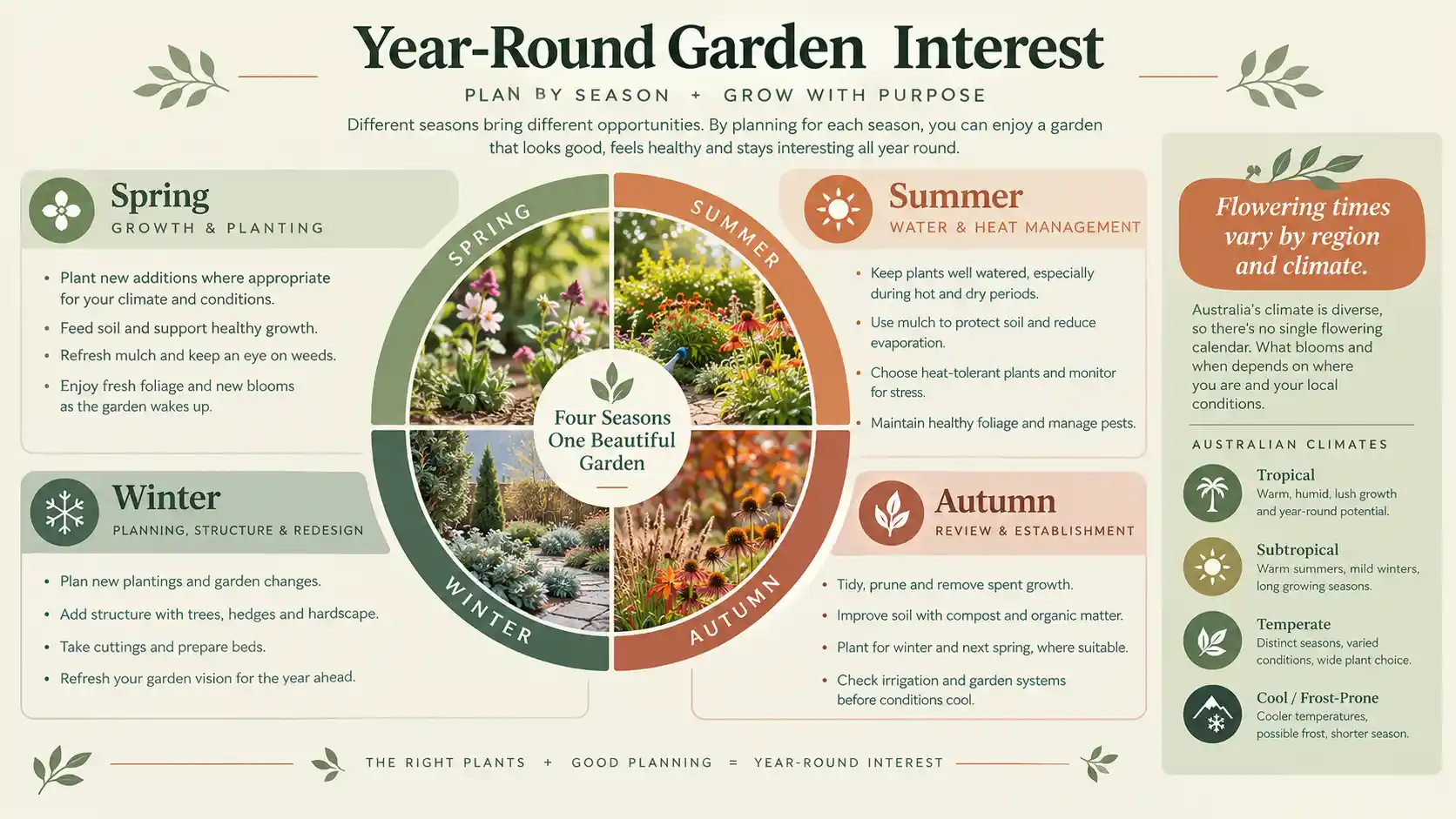
Garden design should change subtly through the year rather than rely on one period of peak colour.
Spring
Spring is often a strong period for:
- New growth
- Flowering displays
- Planting in suitable regions
- Garden-bed renovation
- Mulch renewal
- Pruning of plants that have finished flowering, where appropriate
Summer
Summer planning should focus heavily on:
- Water efficiency
- Heat exposure
- Mulch condition
- Irrigation performance
- Protecting newly established plants
- Managing fast growth
In hot regions, especially inland, arid and subtropical areas, plant selection made months earlier becomes highly visible during summer stress.
Autumn
Autumn can be a useful transition period for:
- Planting climate-suitable specimens
- Reassessing the garden after summer
- Replacing plants that repeatedly fail
- Dividing or relocating suitable plants
- Preparing soil and beds for winter
Winter
Winter is often the best time to step back and redesign rather than constantly add new plants.
Look for:
- Bare gaps
- Drainage problems
- Poor paths
- Overgrown shrubs
- Areas that receive very little winter sun
- Plants that are becoming too large for the space
For flowering references and regional Australian examples, Greenery Nest’s Australian native flower reference guide can help you explore different flowering groups and habitats.
Australian seasons cannot be treated as one universal flowering timetable. Tropical north, subtropical Brisbane, temperate Melbourne and cooler or alpine locations experience very different growing conditions. The Bureau of Meteorology’s Australian climate-zone overview explains why regional climate should be considered before applying a generic national gardening schedule.
The best approach to year-round garden interest is therefore to plan a succession of foliage, structure and flowering periods suited to your own region.
A beautiful outdoor garden is ultimately less about copying a photograph and more about making a sequence of good decisions. Start with the space, understand the climate and sunlight, choose a realistic maintenance level, then select plants and features that reinforce those conditions. For Australian gardeners, locally appropriate native plants can be a powerful part of that strategy, but successful gardens still depend on matching each species to its actual site. Start small, build in stages and allow the garden to develop rather than trying to complete everything at once.
Conclusion
The best outdoor garden is not necessarily the largest, most expensive or most elaborate. It is the one that fits your space, climate, lifestyle, budget and willingness to maintain it. Start by understanding sunlight, drainage and available space, then choose a garden style and plant palette that can realistically thrive there.
For Australian gardens, locally suitable native plants can add seasonal colour, structure and wildlife value, but plant choice still needs to match regional conditions and the specific site. Build the garden in stages, prioritise practical foundations such as drainage and access, and allow enough room for plants to mature.
Once the overall design is established, explore individual plant guides, native flower ideas and seasonal resources to refine your planting choices. A well-planned garden should become easier to manage and more enjoyable as it matures.
Frequently Asked Questions
What are the best outdoor garden ideas for beginners?
The best beginner garden ideas are usually simple, manageable designs with a limited number of plant types. Start with a clearly defined planting area, choose plants suited to your sunlight and climate, and use straightforward features such as mulch, paths, containers or a small seating zone. Avoid overplanting at the beginning because young plants often need more space than they appear to require.
How do I choose an outdoor garden style?
Choose a garden style by combining appearance with practical requirements. Consider how you use the space, how much maintenance you can handle, your home’s architecture, local climate and the amount of available sunlight. A modern garden may suit a structured outdoor area, while a native or informal style may better suit a naturalistic planting scheme. You can also combine elements from several styles rather than following one style strictly.
What plants are best for Australian outdoor gardens?
The best plants depend on your Australian region, soil, drainage, sunlight and water availability. Australian native plants can be excellent choices when they are matched to the local environment, but not every native plant suits every part of the country. Plants appropriate for tropical, subtropical, temperate, cool or arid conditions can differ substantially, so regional suitability should be checked before planting.
How can I create a low-maintenance outdoor garden?
Start by choosing plants that naturally suit your site’s conditions rather than trying to compensate for unsuitable plants with extra watering or pruning. Group plants with similar water needs, use mulch where appropriate, simplify the planting palette and reduce features that require frequent attention. Efficient irrigation and sufficient access for maintenance can also make a major difference.
What are the best garden ideas for small spaces?
Small gardens benefit from vertical planting, containers, compact shrubs, raised beds, narrow screening plants and carefully selected focal points. Repeating a few compatible plant types often creates a stronger result than using many unrelated species. Keep paths and access clear, and consider mature plant size before filling every available space.
How do I plan an outdoor garden makeover?
Begin by measuring the site and observing sunlight, drainage, existing plants and access. Next, decide how you want to use the garden and choose an appropriate style and maintenance level. Plan major paths, structures and irrigation before buying large numbers of plants. Then install structural plants first, followed by shrubs, groundcovers and seasonal colour. Building in stages lets you assess what works before expanding the design.
Are Australian native plants good for home gardens?
Yes, many Australian native plants can perform very well in home gardens, particularly when species are matched to the local climate, soil and garden conditions. They can provide distinctive flowers, foliage, habitat and regional character. However, “native” does not automatically mean drought-proof or maintenance-free. Newly planted specimens still need appropriate establishment care, and individual species have different environmental requirements.
How can I keep my garden flowering throughout the year?
Rather than relying on one plant to flower continuously, combine plants with different flowering periods and include evergreen foliage, grasses, structural branches and other seasonal features. Select plants appropriate to your region because flowering times vary across Australia’s tropical, subtropical, temperate, cool and arid climates. A layered planting scheme usually creates more consistent year-round interest than a garden built around a single flowering season.