
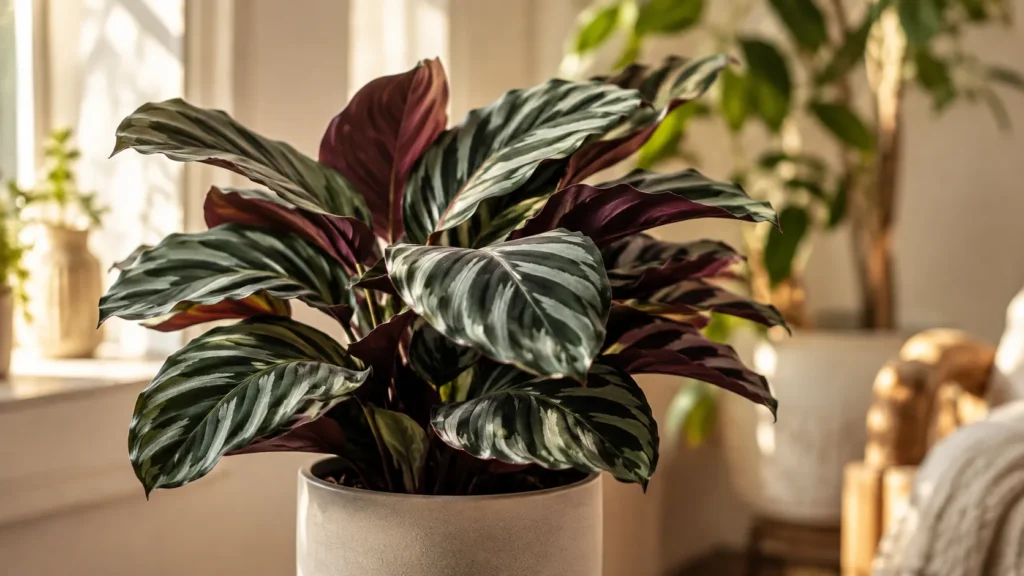
When you see a plant whose foliage is almost painted on with a tinge of silver, pink or purple, and its leaves fold up each night as though in prayer, it is likely a calathea. People get taken in by it before they even know what it’s called, which is why it’s a popular plant to get at a new home.
There’s some understandable confusion. Plant same tree as “calathea” one week and “Goeppertia” the next in the nursery. In care blogs, prayer plant refers to calathea and/or maranta. Online, calathea has acquired a certain reputation — beautiful, yet prone to being temperamental.
This guide answers all that and more: What a calathea is, why the leaves move, why the scientific name changes so often, if it’s really as picky as it’s made out to be, and how to distinguish the many dozens of varieties that are sold under the common name ‘calathea. For the gist of things, read the quick summary below. For those wishing to dive deeper, we will also direct you to complete guides to propagation, troubleshooting and propagation for each popular variety throughout the process.
Quick summary
- What it is: A tropical foliage houseplant in the family Marantaceae, grown for its patterned leaves rather than its flowers.
- Native to: Tropical regions of the Americas, primarily Brazil.
- Naming note: Many species once classified as Calathea were moved to the genus Goeppertia in 2012. Both names are still used interchangeably by growers, retailers, and plant tags.
- Nickname: “Prayer plant,” because its leaves rise at night and lower during the day — a movement called nyctinasty, also seen in the closely related genus Maranta.
- Difficulty: Moderate. Calathea is sensitive to humidity, water quality, and direct light, but it’s manageable once you understand what it actually needs.
- Pet safety: Non-toxic to cats and dogs.
- Flowering: Possible indoors, though uncommon — most people grow calathea for its foliage, not its blooms.
- Popular varieties: Warscewiczii, Zebrina, Medallion, Orbifolia, Peacock, Flamestar, White Star, and more.
What Is a Calathea, Exactly?
Calathea are tropical foliage plants, usually grown for their wonderfully patterned leaves, stripes, feathery, brush-stroked coloring and deep, contrasting purple undersides. It is a member of the plant family Marantaceae and is native to the tropical forests of the Americas, especially Brazil, where it is found growing under a dense forest canopy in warm, humid, low light conditions.
Calathea is not a plant that is grown for its flowers, as many popular houseplants are. Most people don’t bother with it blooming inside, which is a good thing because the leaves are the main attraction. This signature pattern is what makes calathea popular among collectors and so popular to have more than one variety together.
This forest floor origin story is more significant than you may think. It provides almost all the answers to calathea’s houseplant needs: Light – it does not tolerate direct sun, Soil – it has to be kept moist, but not soggy, and Houseplant Air – it is sensitive to dry indoor air. With that in mind, it’s a little easier to understand calathea care.
Calathea Identity Cheat Sheet
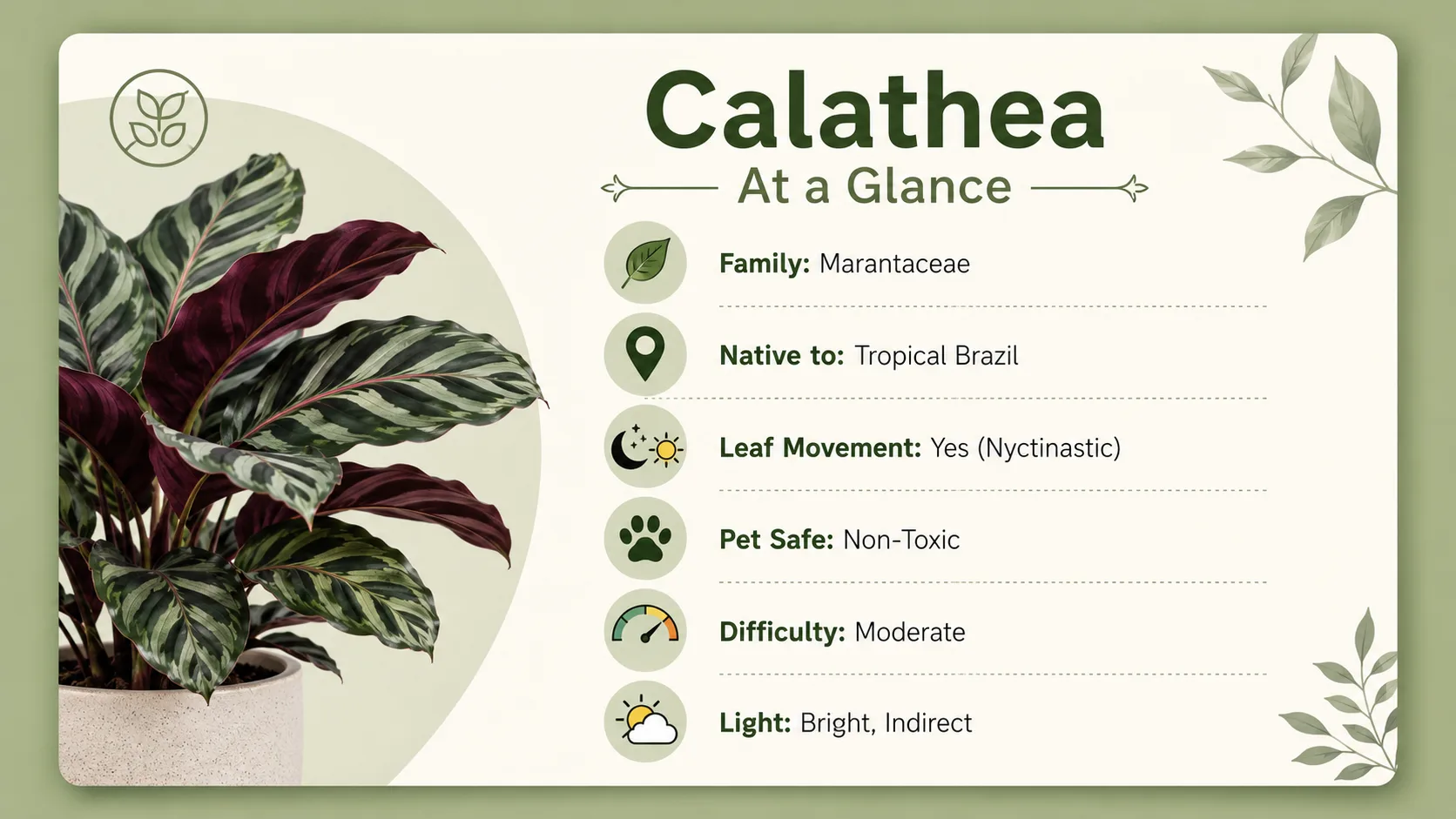
| Trait | Detail |
| Common name | Calathea (also sold as prayer plant) |
| Botanical name | Calathea / Goeppertia (see below) |
| Family | Marantaceae |
| Native habitat | Tropical Americas, primarily Brazil |
| Leaf movement | Yes — nyctinastic (rises at night, lowers by day) |
| Toxicity | Non-toxic to cats and dogs |
| Difficulty | Moderate — humidity-sensitive |
| Light needs | Bright, indirect light |
Calathea vs. Goeppertia — Which Name Is Correct?
If you’ve seen the same plant labeled “Calathea” at one store and “Goeppertia” at another, you’re not imagining things, and neither store is wrong.
In 2012, botanists, with the latest research into the plant’s relationships, reclassified many species that had previously been classified in the genus Calathea into a new genus called Goeppertia. For instance, Calathea orbifolia and Calathea makoyana are now formally known as Goeppertia orbifolia and Goeppertia makoyana, respectively. This shift is documented in detail on the plant’s taxonomic entry for Calathea, which tracks how roughly 200 former Calathea species now fall under Goeppertia.
However, in the field “calathea” has been retained as the common name, almost universally outside of the world of academic botany. Nurseries, plant tags, online retailers and most care guides, such as this one, still use “calathea,” because people search for it and it’s sold under this name. Occasionally, both names will be used for the same plant, sometimes even on the same tag.
The good news is that the name change does not affect the way you can care for the plant. The two species Goeppertia orbifolia and “Calathea orbifolia” can also be used to name the same plant, as they have the same requirements. When purchasing a product at a nursery, you can feel good if you see either of these names.
Why Do Calathea Leaves Move? (Nyctinasty Explained)
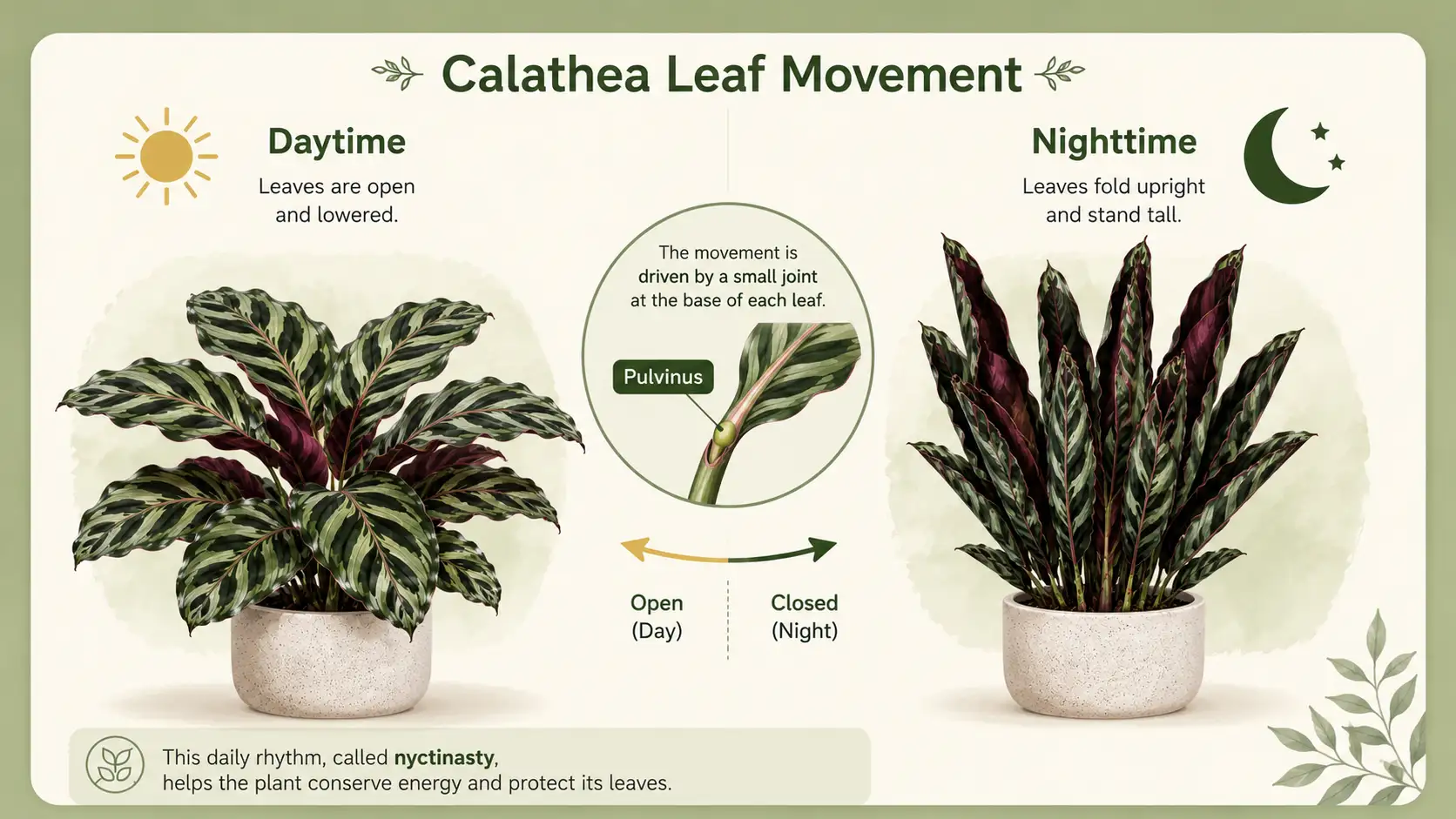
One of the first things new owners notice is that a calathea’s leaves aren’t static — they visibly rise and fold upward in the evening, then lower and spread open again during the day. This daily movement is called nyctinasty, and it’s one of calathea’s most recognizable traits (and the reason it’s nicknamed a “prayer plant” in the first place). This structure, called a pulvinus, works like a small hinge, using shifts in internal water pressure to physically raise and lower the leaf.
The mechanism behind it is fairly simple. At the base of each leaf is a small, specialized joint called a pulvinus. Changes in light and internal water pressure within this joint cause the leaf to physically move — rising as light fades in the evening and relaxing back down as light returns in the morning. It’s not decorative or random; it’s a genuine physiological response, similar to how some other plants react to touch or temperature.
This is also where a lot of naming confusion starts. Nyctinasty isn’t unique to calathea — it’s shared by the closely related genus Maranta, which is why both plants get called “prayer plants,” and why people frequently assume they’re looking at the same species when they’re not. If you want to understand exactly what separates the two, see our full breakdown of the differences between calathea and maranta.
Calathea vs. Maranta vs. “Prayer Plant” — Clearing Up the Confusion
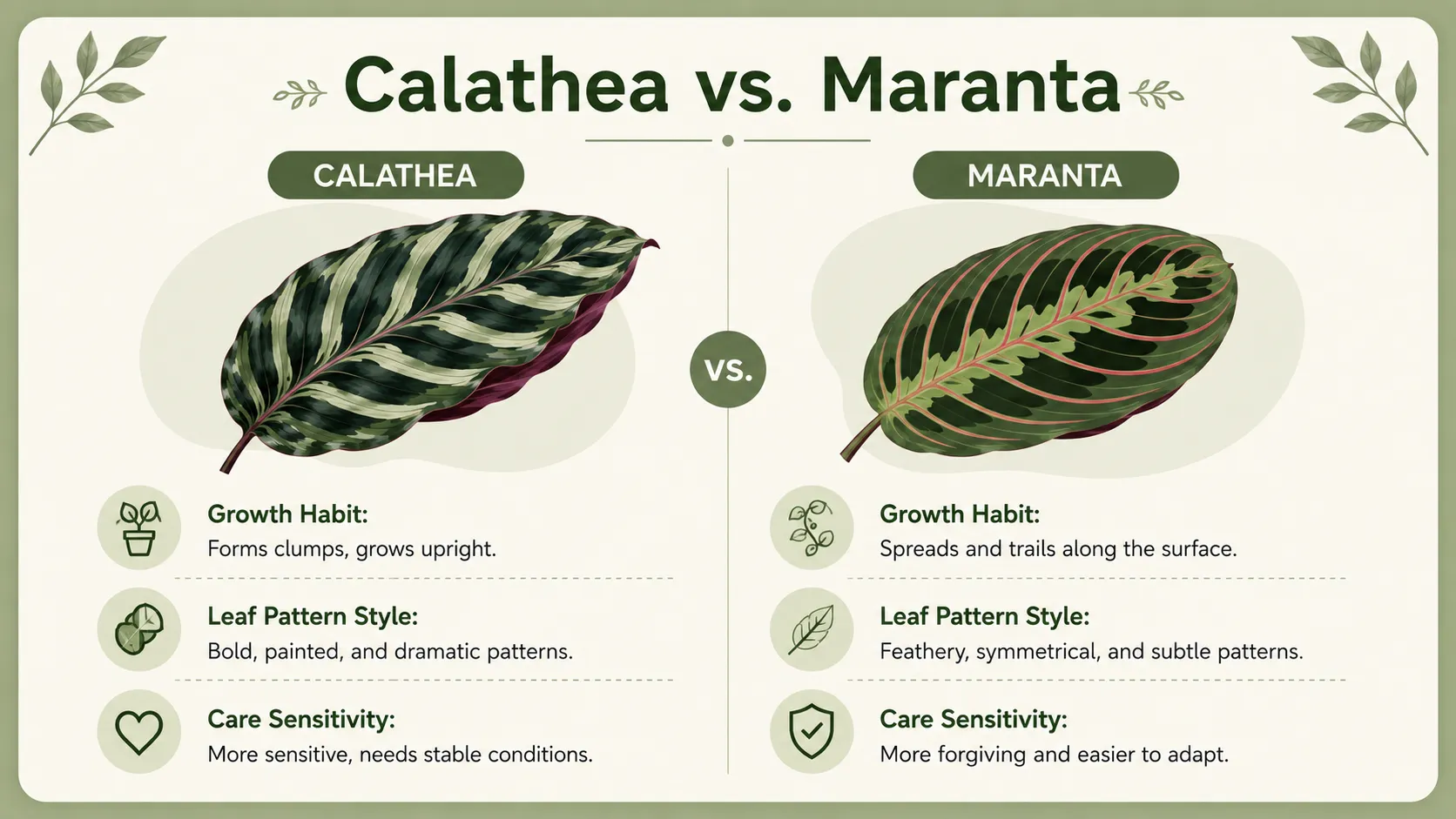
Here’s where most articles either oversimplify or skip the explanation entirely: “prayer plant” isn’t a scientific term. It’s a nickname loosely applied to plants in two different (but closely related) genera — Calathea (including Goeppertia) and Maranta — because both fold their leaves upward at night.
Both genera belong to the same plant family, Marantaceae, which is why they look and behave so similarly at a glance. But they’re not the same plant, and the differences matter if you’re trying to identify what you actually own or decide what to buy next:
- Growth habit: Maranta tends to grow lower and spread more, often described as trailing or mounding, while calathea generally grows more upright.
- Leaf patterning style: Both have striking foliage, but the specific patterns, colors, and vein structures differ species by species, and there are recognizable stylistic tendencies between the two genera.
- Care sensitivity: Calathea has a reputation for being somewhat fussier about humidity and water quality than many Maranta varieties, though both prefer similar bright, indirect light and consistent moisture.
If you’re not sure which one you’re holding — or you’re comparing the two before buying — our full calathea vs. maranta comparison walks through the visual differences and care distinctions in detail.
Is Calathea a Good Plant for Beginners?
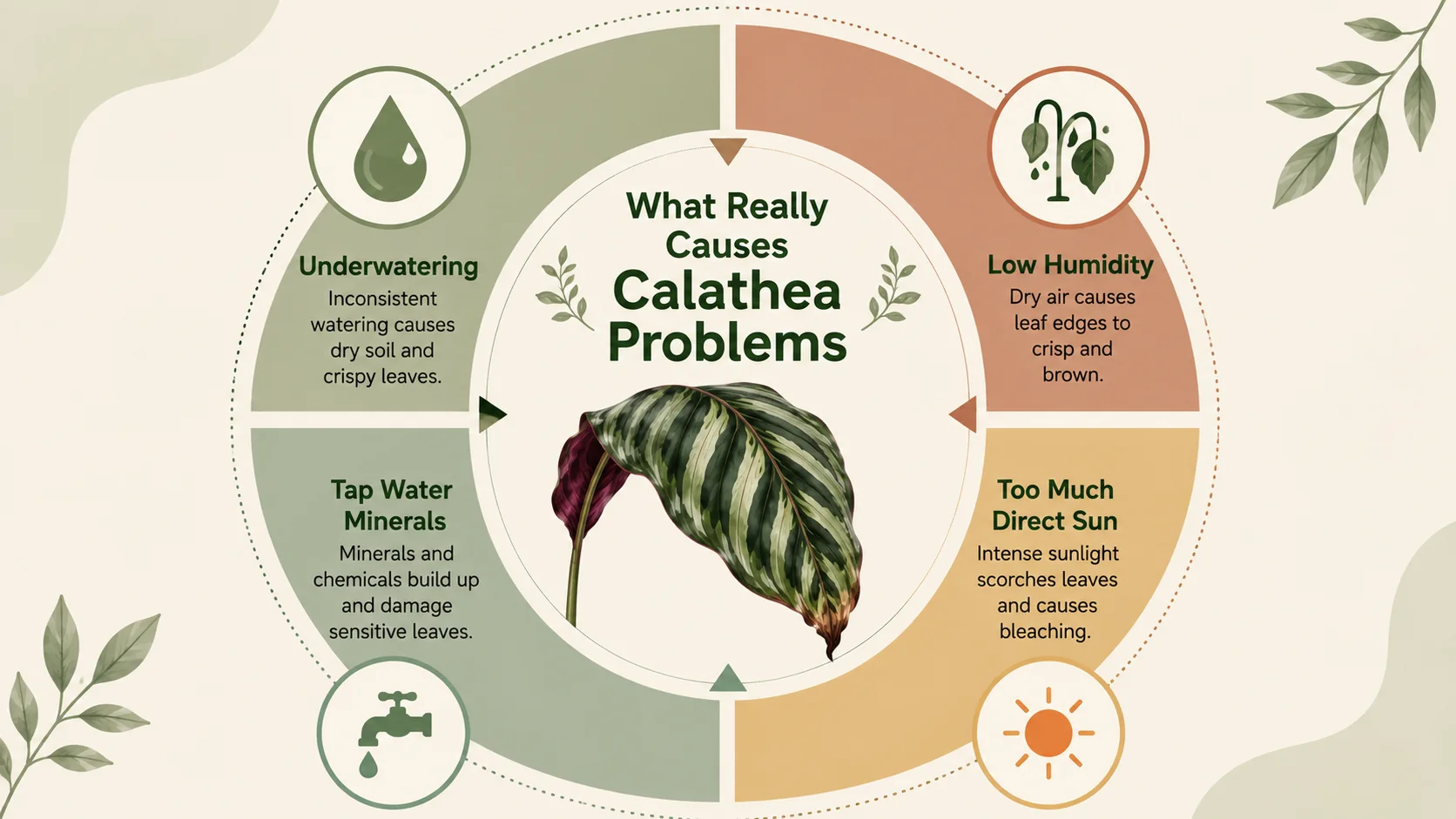
Calathea is a moderate-difficulty houseplant. It’s not the best first plant for someone who forgets to water for weeks at a time or lives in a very dry climate with no intention of adjusting humidity. But it’s also not the delicate diva its reputation suggests. Most of the frustration people report — curling edges, crispy brown tips, dramatic drooping — comes down to a small handful of fixable causes, not some inherent fragility in the plant itself.
What actually causes the “diva” reputation:
- Underwatering or inconsistent watering — calathea wants evenly moist soil, not a dry-out-then-drench cycle.
- Low humidity — dry indoor air, especially from heating or air conditioning, is one of the biggest stressors.
- Tap water minerals — calathea can be sensitive to the chlorine, fluoride, and salts found in some tap water, which shows up as leaf tip browning over time.
- Too much direct sun — bright, indirect light is ideal; harsh direct sun scorches the leaves.
What’s largely myth: the idea that calathea will die if you look at it wrong. In reality, most calathea problems are humidity- and watering-related, and they’re both preventable and reversible once identified. If you’re already noticing crispy or browning edges, our guide on common causes of brown, crispy leaf tips breaks down exactly what’s causing it and how to fix it.
Calathea Care at a Glance
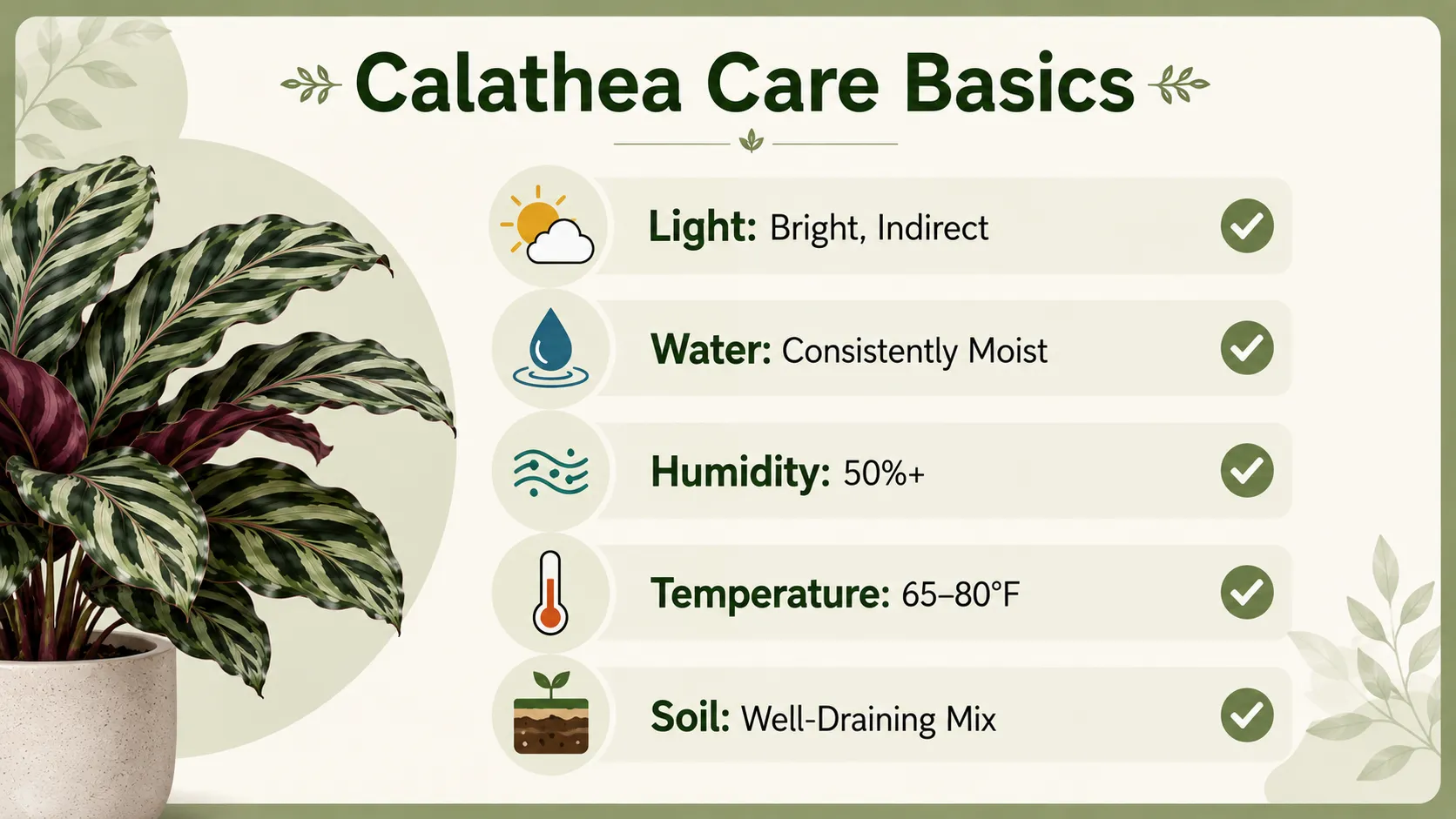
This is a snapshot, not a full care manual — think of it as enough to orient you before you dive into variety-specific guides further down.
- Light: Bright, indirect light. Avoid direct sun, which can scorch or fade the leaf pattern. Calathea also tolerates lower light better than many houseplants, given its forest-floor origins — see how much light calathea really needs for a full breakdown.
- Water: Keep soil consistently moist, never soggy or bone-dry. Filtered or distilled water is often recommended over tap water for sensitive varieties.
- Humidity: Calathea prefers humidity of 50% or higher. This is one of the most important — and most commonly overlooked — factors in healthy growth.
- Temperature: Warm and stable, ideally between 65–80°F (18–27°C), away from cold drafts, vents, and drafty windows.
- Soil: A well-draining but moisture-retentive potting mix, often amended with peat or coco coir to hold humidity around the roots.
Does Calathea Flower Indoors?
Yes — some calathea species can flower indoors, though it’s uncommon and not the reason most people grow this plant. Blooms tend to be small and understated compared to the leaves, which remain the main attraction year-round. If your calathea never flowers, that’s completely normal; it’s not a sign of poor care.
Is Calathea Toxic to Pets?
Calathea is classified as non-toxic to both cats and dogs. That makes it a solid choice for plant owners sharing a home with curious pets. That said, ingesting any plant material in large quantities can cause mild stomach upset in pets, so it’s still worth discouraging chewing where possible — not because the plant is poisonous, but because plant matter in general isn’t meant to be a pet’s diet. This is confirmed by the ASPCA’s plant toxicity database, which lists calathea as non-toxic to both dogs and cats.
How to Propagate a Calathea
Calathea isn’t typically propagated from stem cuttings the way many houseplants are — instead, the standard and most reliable method is division, where an established plant is separated into smaller sections, each with its own roots and growth points.
The best time to divide a calathea is during repotting, ideally while the plant is actively growing (spring or summer), when it recovers from the disruption fastest. Done carefully, division lets you turn one mature plant into several new ones without stressing it unnecessarily.
If you want the full step-by-step process — including how to separate root sections without damaging them and how to help new divisions establish — see our complete step-by-step guide to propagating a prayer plant.
Popular Calathea Varieties (Identification Guide)
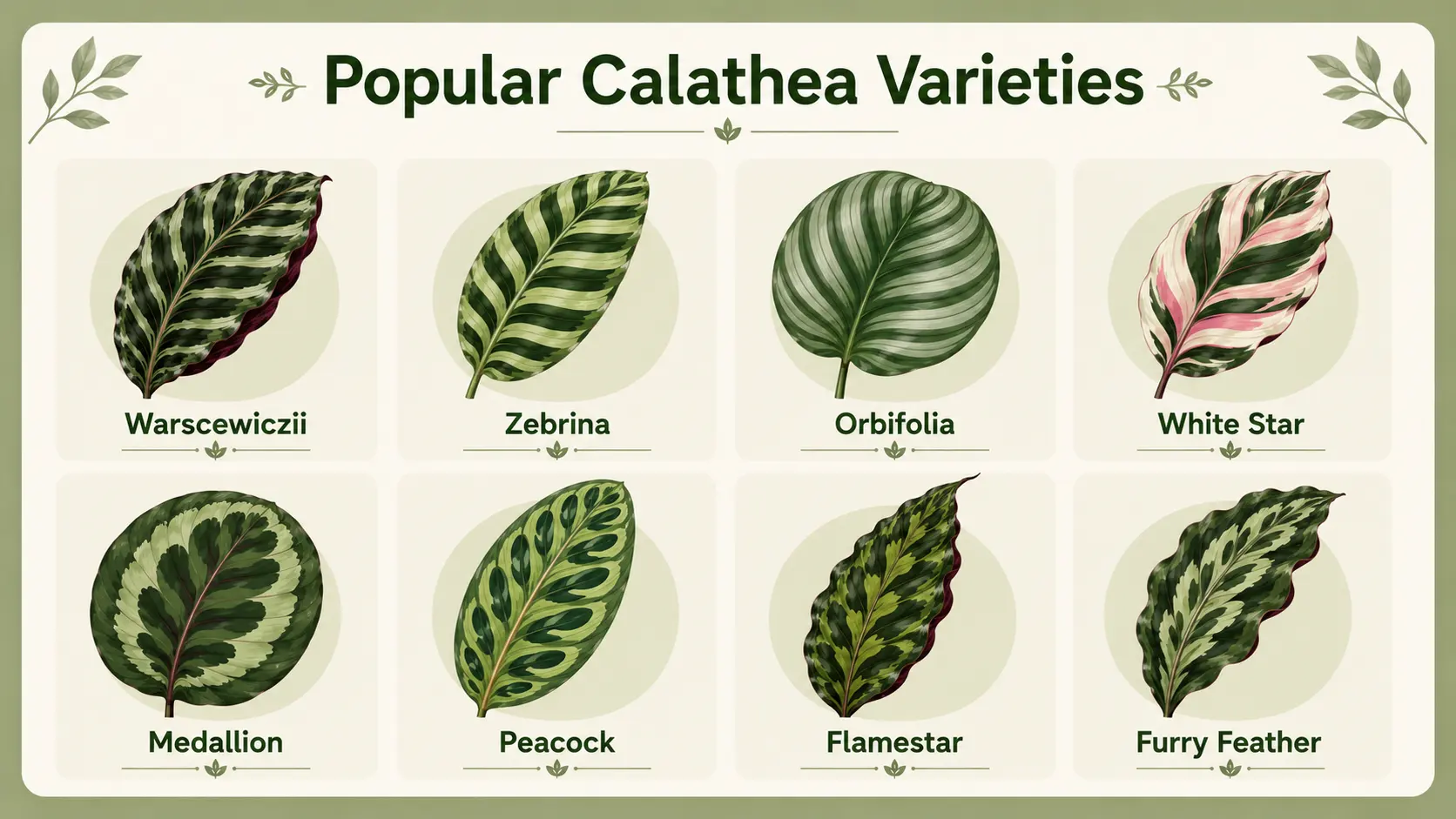
Calathea includes hundreds of species and cultivars, but a handful show up again and again at nurseries and plant shops. If you’re trying to identify what you already own — or decide which one to add to your collection next — here’s a quick-reference guide to the most popular varieties.
| Variety | Standout Leaf Pattern | Full Care Guide |
| Calathea Warscewiczii | Velvety, dark green leaves with a feather-like pattern and a deep purple underside | Calathea Warscewiczii Care |
| Calathea Zebrina | Bold, zebra-like stripes on soft, velvety leaves | Calathea Zebrina Care |
| Furry Feather Calathea | Wavy-edged leaves with a delicate, feathered pattern | Furry Feather Calathea Care |
| Calathea Flamestar | Compact growth with a flame-like pattern in varying shades of green | Calathea Flamestar |
| Calathea White Star (Majestica) | Striking pink-and-white striped variegation over green | Calathea Majestica White Star |
| Calathea Medallion (Roseopicta) | Round leaves with a medallion-style pattern and a deep purple underside | Calathea Roseopicta Medallion |
| Calathea Orbifolia | Large, rounded leaves with soft silver striping | How to Care for Calathea Orbifolia |
| Calathea Peacock | Translucent, feather-like pattern reminiscent of a peacock’s tail | Calathea Peacock Plant Care |
Each of these varieties shares the general care needs outlined above — bright indirect light, consistent moisture, and higher humidity — but has its own quirks worth knowing before you commit. Click through to any variety above for a complete, plant-specific care guide.
Calathea’s Close Cousin: Maranta Red
If you’ve fallen for calathea’s patterned leaves and nightly movement, it’s worth knowing about its close relative in the same plant family: Maranta, often called the “true” prayer plant. One of the most popular Maranta varieties is Maranta Red, prized for its bold red veining against deep green leaves — a similar aesthetic to calathea, with its own distinct care profile.
If you’re building out a Marantaceae collection or just curious what else is out there in this plant family, see the full Maranta Red care guide.
Conclusion
At its core, a calathea is a tropical foliage plant from the family Marantaceae, grown for its patterned leaves and its distinctive nightly leaf movement — and whether you see it labeled “Calathea” or “Goeppertia,” you’re looking at the same plant. It has a reputation for being fussy, but in practice, most calathea struggles trace back to a few fixable factors: humidity, watering consistency, and water quality.
Where you go from here depends on where you’re starting:
- Still not sure whether you have a calathea or a true prayer plant? Start with the calathea vs. maranta comparison.
- Already know your variety? Jump to its dedicated care guide above for everything specific to that plant.
- Dealing with browning or crispy leaves right now? Head to common causes of brown leaf tips to diagnose and fix it.
- Ready to grow your collection? Our propagation guide walks you through dividing your plant into new ones.
However you got here — a nursery tag, a gift, or a scroll through plant photos online — calathea is one of the most rewarding houseplants to get to know once you understand what it actually needs.
Frequently Asked Questions
Is calathea the same as a prayer plant?
“Prayer plant” is a nickname used for both calathea and true Maranta plants, since both fold their leaves upward at night. They’re closely related — both in the family Marantaceae — but they’re not the same genus. See our calathea vs. maranta comparison for the full breakdown.
What is the difference between Calathea and Goeppertia?
Goeppertia is the updated scientific genus name for many plants formerly classified as Calathea, following a 2012 taxonomic revision. “Calathea” remains the common name used by most nurseries and retailers, and the two names refer to the same plants — the reclassification doesn’t change how you care for them.
Why do calathea leaves move up and down?
This movement, called nyctinasty, happens because of a small joint at the base of each leaf (the pulvinus) that responds to changes in light. Leaves rise in the evening and lower again during the day.
Are calatheas easy to take care of for beginners?
Calathea is a moderate-difficulty plant — not the easiest houseplant, but manageable once you understand its main needs: consistent moisture, higher humidity, and protection from direct sun and tap water minerals.
Are calatheas toxic to cats or dogs?
No. Calathea is classified as non-toxic to both cats and dogs, though eating large amounts of any plant material can cause mild stomach upset.
Do calatheas flower indoors?
Some species can flower indoors, though it’s uncommon and the blooms are modest compared to the foliage. Calathea is grown primarily for its leaves, not its flowers.
How many varieties of calathea are there?
There are hundreds of calathea species and cultivars, though a relatively small number — like Medallion, Orbifolia, Zebrina, and Peacock — make up most of what’s commonly sold in nurseries and plant shops.
Is calathea an indoor or outdoor plant?
Calathea is grown almost exclusively as an indoor houseplant in most climates, since it needs warm, humid, low-light conditions similar to its native tropical forest floor habitat. It can be grown outdoors only in consistently warm, humid, frost-free climates.