
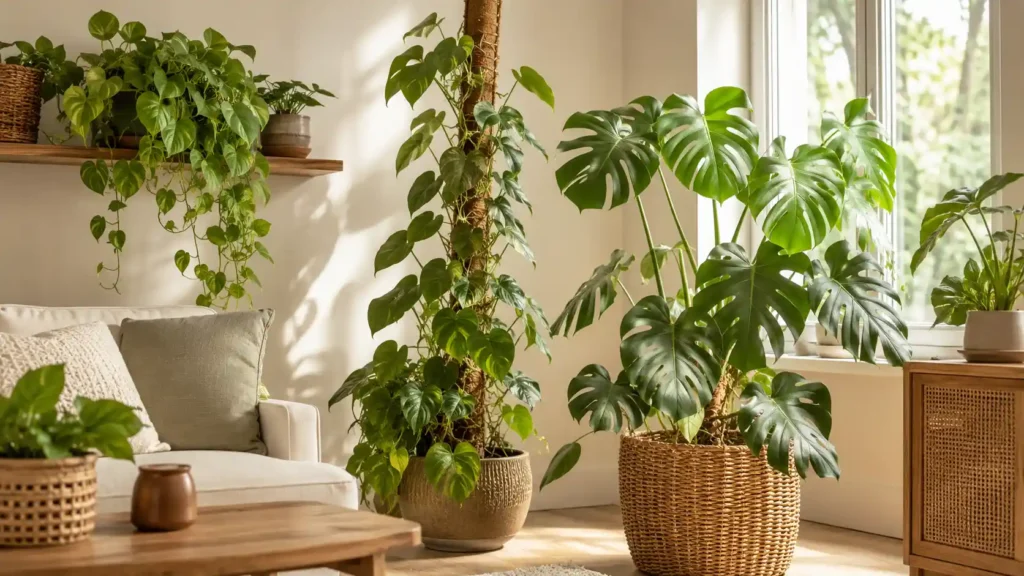
Somewhere between “I want my home to feel more alive” and “I killed another plant,” most people give up on indoor greenery before they ever find their footing. Not because houseplants are hard — but because the advice around them is scattered across a hundred different blog posts, each covering one plant, one problem, or one propagation trick, with nothing tying it together.
This guide is that missing piece. It’s the single resource that explains what an indoor green living hub actually is, how plant care works at a foundational level, and how to build a collection — starting with the two easiest, most rewarding plant families for beginners: Pothos and Syngonium, and Philodendron and Monstera. Once you understand the fundamentals here, every specific care question you have (light needs for a particular variety, how to propagate a particular cutting, which of two look-alike plants you actually own) is answered in depth in the linked guides throughout this article.
Indoor plants matter for more than decoration. A well-planned green space improves the humidity and visual warmth of a room, gives you a low-cost creative outlet, and — for a lot of people — becomes a genuinely calming daily ritual. None of that requires a greenhouse or a horticulture degree. It requires a handful of principles applied consistently, and a starting point that doesn’t overwhelm you. That’s what this page is for.
Quick Summary
- An indoor green living hub is a curated collection of easy-care houseplants — usually built around trailing and climbing aroids — chosen and arranged to fit your home’s light, space, and lifestyle.
- Nearly all popular indoor plants share five care fundamentals: light, water, humidity, soil/drainage, and feeding. Master these five and you can grow almost anything.
- The two easiest, most beginner-friendly plant families to start with are Pothos and Syngonium (fast, forgiving trailers) and Philodendron and Monstera (bold-leaved climbers).
- Propagation — growing new plants from cuttings — is the cheapest way to expand your collection and is one of the most reliable “wins” for a new plant owner.
- Most care problems (yellow leaves, slow growth, leggy stems) trace back to one of the five fundamentals, not a mysterious plant illness.
- Once you’re comfortable with the basics below, deeper guides on specific plants, cultivars, and propagation methods are linked throughout this article.
What Is an Indoor Green Living Hub?
An indoor green living hub is a home or living space that’s intentionally organized around a core group of houseplants — chosen for how well they tolerate real indoor conditions, how visually cohesive they are together, and how easily they can be propagated and expanded over time. It’s less about owning a lot of plants and more about owning the right plants for your space, arranged so that caring for them becomes routine rather than reactive.
This is a meaningful distinction. “Plant collecting” often means chasing rare or difficult species one at a time, reacting to problems as they show up. A green living hub works the opposite way: you start with a small set of resilient, well-understood plants, learn their patterns, and grow outward — adding new plants, new cuttings, and new display ideas as your confidence builds.
The concept has grown alongside a broader shift toward biophilic design — bringing natural elements into built environments — and the practical reality that a huge number of people now live in apartments, rentals, or smaller homes where a few well-chosen plants do more for a room than furniture or paint ever could.
Why Build an Indoor Plant Space?
Before getting into the mechanics of plant care, it’s worth being clear-eyed about what you’re actually getting out of this, because the motivation is what keeps a collection alive past the first few weeks.
Air quality and humidity. Houseplants release moisture through their leaves as part of normal transpiration, which can measurably soften the dry air common in heated or air-conditioned homes. This isn’t a replacement for ventilation, but it’s a real, cumulative effect in a room with several plants.
Mental wellbeing. The research on biophilia — our innate response to natural forms and greenery — consistently links visible plant life to lower reported stress and improved focus. You don’t need a scientific citation to notice this yourself: rooms with healthy plants simply feel calmer to be in.
Aesthetic and design value. Plants add texture, color, and vertical or trailing movement that furniture can’t replicate. A single well-placed climbing Philodendron or a trailing Pothos on a shelf does more visual work than most decor purchases at a fraction of the cost.
Low ongoing cost. Once you own a healthy plant, propagation means you rarely need to buy another one. A single Pothos or Philodendron cutting can become five plants within a year.
Renter- and small-space-friendly. Most of the plants covered in this hub — Pothos, Syngonium, Philodendron, Monstera — grow well in pots, climb or trail rather than sprawl, and don’t require structural changes to your home. They’re some of the most space-efficient ways to add greenery to an apartment.
Foundations of Indoor Plant Care
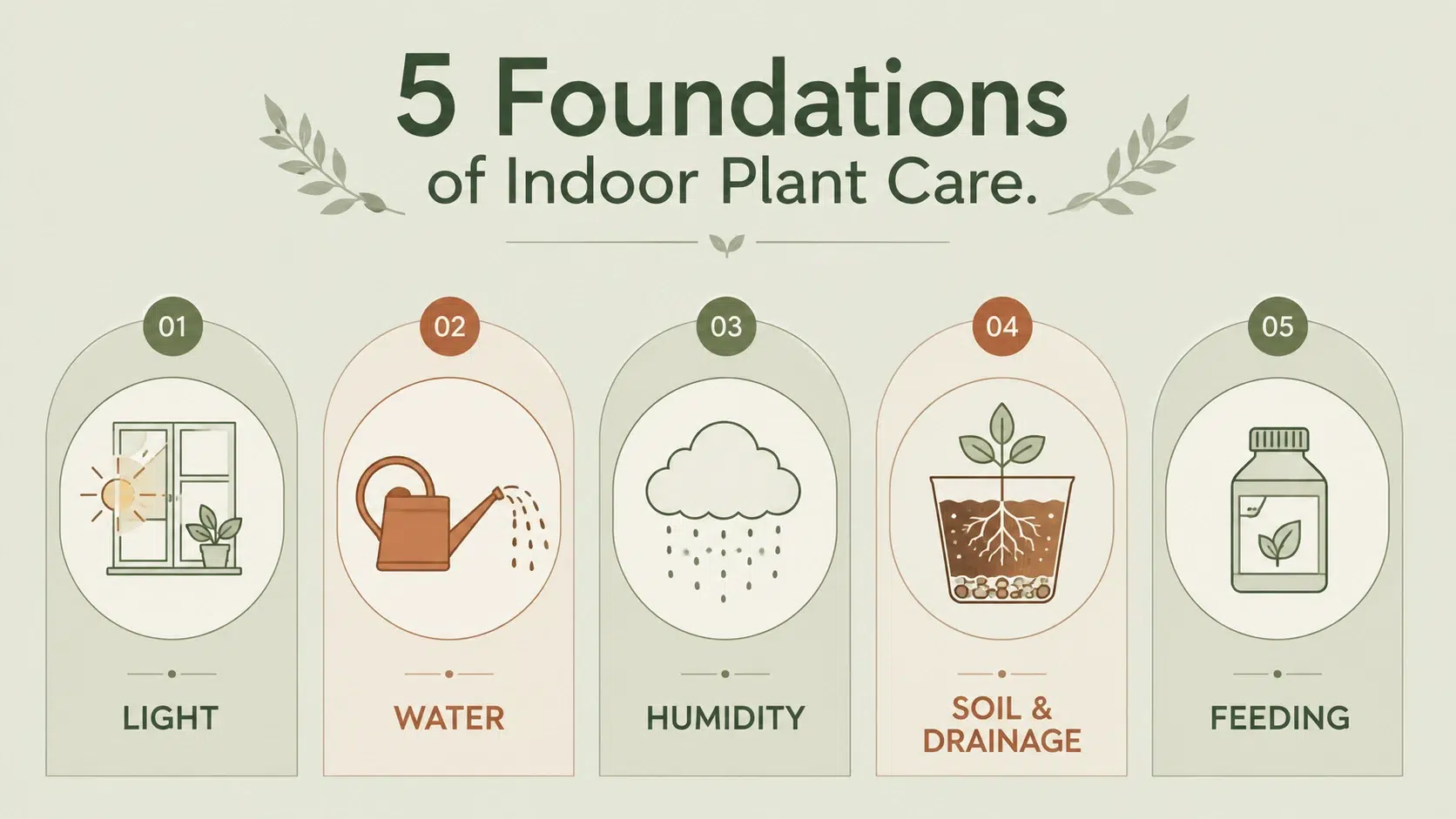
Nearly every houseplant problem — and nearly every houseplant success — comes down to five variables. Get these right for the general category of plant you’re growing (in this case, tropical climbing and trailing aroids), and specific care questions become much easier to answer.
Light Requirements
Direct answer: Most popular indoor aroids, including Pothos, Syngonium, Philodendron, and Monstera, grow best in bright, indirect light — close to a window but out of direct, intense sun for most of the day.
In practice, this means:
- Bright indirect light is what you get a few feet back from an east- or west-facing window, or right beside (not directly in front of) a south-facing window. This is the sweet spot for almost every plant discussed in this guide.
- Low light areas — a few feet from a north-facing window, or a room with limited natural light — can still support many Pothos and some Philodendron varieties, though growth will slow and variegation (light patterning on leaves) may fade.
- Direct sun, especially through an unfiltered south- or west-facing window in summer, can scorch the leaves of most aroids and should generally be avoided or filtered with a sheer curtain.
Signs your plant needs more light: leggy stems with large gaps between leaves, loss of variegation, and slowed or stalled growth. Signs it’s getting too much: crispy brown patches, bleached-looking leaves, or curling. Different varieties tolerate this range differently — for example, variegated cultivars generally need more light than solid green ones to maintain their patterning, which is worth understanding in more detail if you’re growing a specific light-sensitive variety like Neon Pothos.
Watering Basics
Water most aroids when the top 1–2 inches of soil feel dry, rather than on a fixed schedule.
The single most common houseplant mistake is watering on a calendar instead of watering based on the plant’s actual condition. Light, temperature, humidity, pot size, and season all change how quickly soil dries out, so “every Sunday” is a weaker rule than “check the soil, then decide.”
As University of Illinois Extension horticulturists note, the most reliable method is testing the soil directly rather than sticking to a fixed day each week.
- Underwatering shows up as crispy leaf edges, drooping that recovers quickly after watering, and dry, pulling-away soil.
- Overwatering shows up as yellowing lower leaves, soft or mushy stems, a persistently wet or sour-smelling soil, and — in severe cases — root rot.
- Water quality matters less than people assume for most common aroids; tap water left to sit for a few hours (to let chlorine dissipate) is fine for the vast majority of home growers.
- Reduce watering frequency in fall and winter, when growth naturally slows and the soil stays wet longer between waterings.
Humidity and Temperature
Most tropical aroids prefer humidity above 40–50% and stable indoor temperatures between roughly 65–80°F (18–27°C).
You don’t need a rainforest in your living room. Average home humidity is usually tolerable for Pothos and many Philodendron varieties; Monstera and some more delicate Philodendron species appreciate a boost. Simple, low-effort ways to raise humidity include grouping plants together (they humidify each other through transpiration), using a pebble tray with water beneath the pot, or running a small humidifier nearby. Avoid placing plants near heating vents, cold drafty windows, or exterior doors, since sudden temperature swings stress most tropical species more than a stable, slightly-off temperature does.
Soil, Pots, and Drainage
Aroids need a light, well-draining mix and a pot with drainage holes — standard dense potting soil retains too much water for most of these plants.
A good baseline aroid mix combines a standard potting soil with chunkier materials — orchid bark, perlite, or coco coir — to create air pockets that let excess water escape and roots breathe. Pot material matters less than drainage: terracotta dries out faster and forgives overwatering more easily, while plastic or glazed ceramic holds moisture longer and suits people who tend to underwater.
Repot when you see roots circling the bottom of the pot, water running straight through without being absorbed, or growth that’s stalled despite otherwise good care. Most aroids in this guide are comfortable being slightly pot-bound and don’t need repotting more than once every 1–2 years.
Feeding and Seasonal Care
Feed actively growing aroids every 4–6 weeks during spring and summer with a balanced, diluted liquid houseplant fertilizer, and reduce or stop feeding in fall and winter.
Fertilizer isn’t a rescue tool for a struggling plant — it’s a supplement for a plant that’s already healthy and actively growing. Over-fertilizing is more likely to cause damage (salt buildup, leaf burn) than under-fertilizing. If you’re ever unsure, diluting fertilizer to half the recommended strength is a safer default than following the label exactly.
Choosing the Right Plants for Your Space
With the fundamentals in place, the next decision is which plants actually make sense for your home. This comes down to four practical questions:
How much light does your space get?
If you have one bright window and the rest of the room is dim, prioritize plants known to tolerate lower light, and place your more light-hungry plants closest to that window.
How much space do you have, and what shape do you want to fill?
Trailing plants (most Pothos, Syngonium, Heartleaf Philodendron) work well on shelves or in hanging planters. Climbing plants (many Philodendron and Monstera varieties) work well with a moss pole or trellis and fill vertical space. Upright, bushy plants fill floor or tabletop space.
How much hands-on time do you want to spend?
Pothos and Syngonium are generally the most forgiving of inconsistent watering and lower light — a strong choice if you want low-maintenance greenery. Philodendron and Monstera reward slightly more attentive care with faster, more dramatic growth.
Do you have pets?
This matters more than most beginner guides mention: Pothos, Syngonium, Philodendron, and Monstera are all mildly to moderately toxic if chewed or ingested by cats, dogs, or small children. This doesn’t mean you can’t own them — most households do — but it’s worth placing them out of easy reach and being aware of the risk rather than discovering it after the fact. This doesn’t mean you can’t own them — most households do — but it’s worth checking the ASPCA’s toxic and non-toxic plant list and placing them out of easy reach rather than discovering the risk after the fact.”
Two of the most popular and beginner-friendly houseplant families for an indoor green living hub are Pothos and Syngonium and Philodendron and Monstera — both covered in full depth in our dedicated guides:
The rest of this section gives you a working overview of both so you can decide where to start.
Popular Plant Families for Indoor Green Living
Pothos and Syngonium: Easy Climbers and Trailers
Pothos and Syngonium are frequently recommended as the first plant for new owners, and for good reason: both are vining aroids that tolerate a wide range of light conditions, bounce back quickly from missed waterings, and root from cuttings with almost no special equipment. They’re visually similar at a glance — heart-shaped or arrow-shaped leaves on trailing or climbing stems — but come in a wide range of colors and patterns, from the classic solid green of a standard Pothos to the bold variegation of a Manjula or the near-black foliage of Syngonium Black Panther.
If you’re picking your very first plant, start with our Pothos care for beginners guide — it walks through exactly what a new Pothos owner needs to know in the first few months.
For the full breakdown of how these two closely related plant types compare and where each one shines, see our complete Pothos and Syngonium guide.
Philodendron and Monstera: Bold Foliage and Climbing Growth
Philodendron and Monstera are the plants most people picture when they imagine a lush, “statement” indoor jungle. Both are climbing aroids in the wild, using aerial roots to grip trees and grow upward — a habit you can recreate indoors with a moss pole or trellis. Monstera is best known for its dramatic leaf fenestrations (the natural splits and holes that develop as leaves mature), while Philodendron spans an enormous range of leaf shapes, sizes, and colors, from the compact, heart-leaved Philodendron Scandens to the large, textured Philodendron Gloriosum.
If you’re not yet sure what separates a Philodendron from other aroids, our What Is a Philodendron guide is the right starting point. Once you’re ready to pick your first Monstera, Best Monstera Varieties for Beginners breaks down which types are easiest to start with.
How These Families Compare
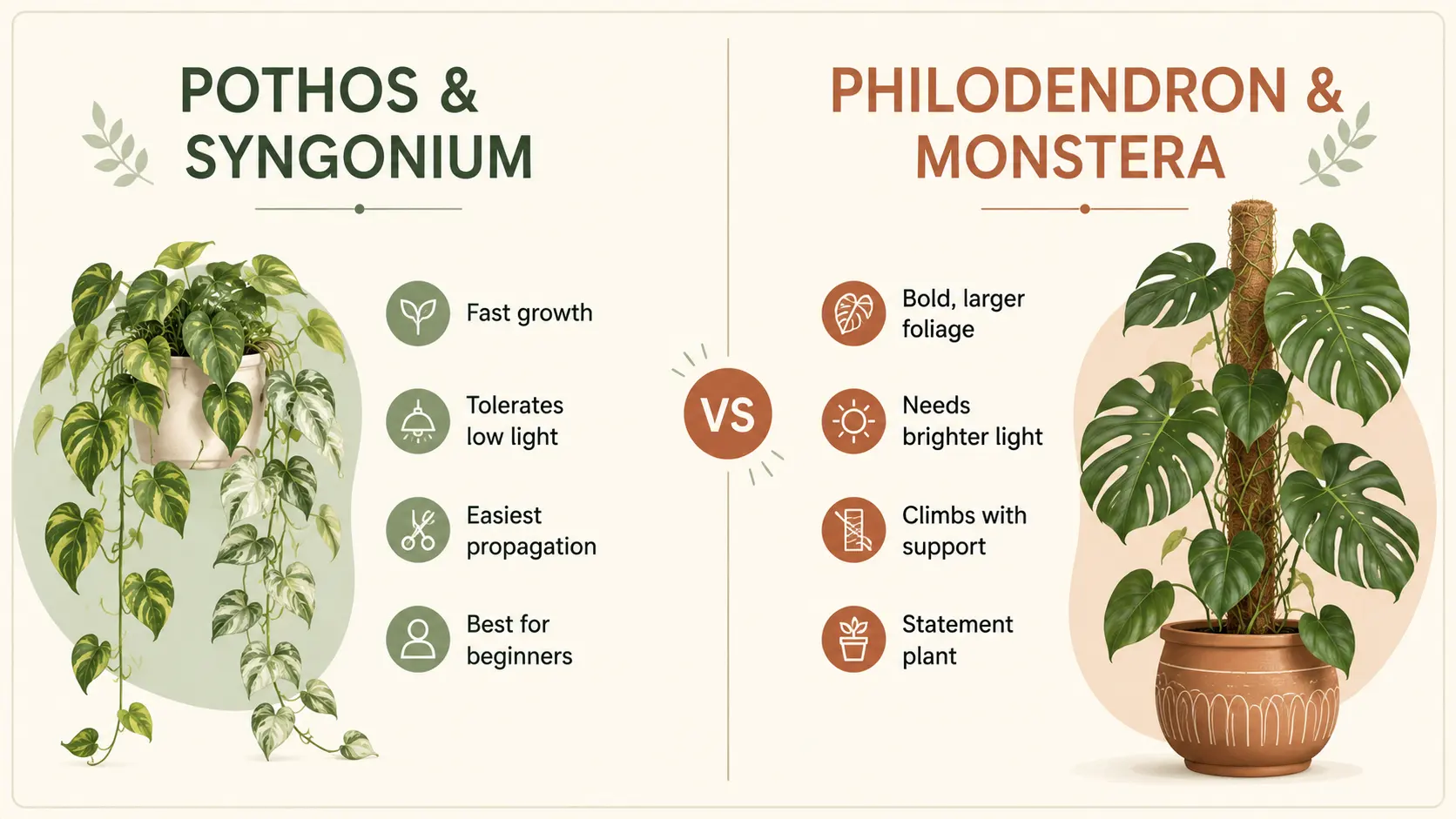
At a glance: Pothos and Syngonium tend to grow faster in low light, propagate more forgivingly, and stay smaller and more trailing by default. Philodendron and Monstera generally have bolder, larger foliage, benefit more from consistent bright light and humidity, and reward patience with more architectural, climbing growth. Neither family is objectively “better” — they solve different problems in a room, and most well-built indoor green living hubs end up with plants from both.
For a full side-by-side comparison of care needs, growth habits, and appearance, see Monstera vs Philodendron.
Propagation: Growing Your Collection
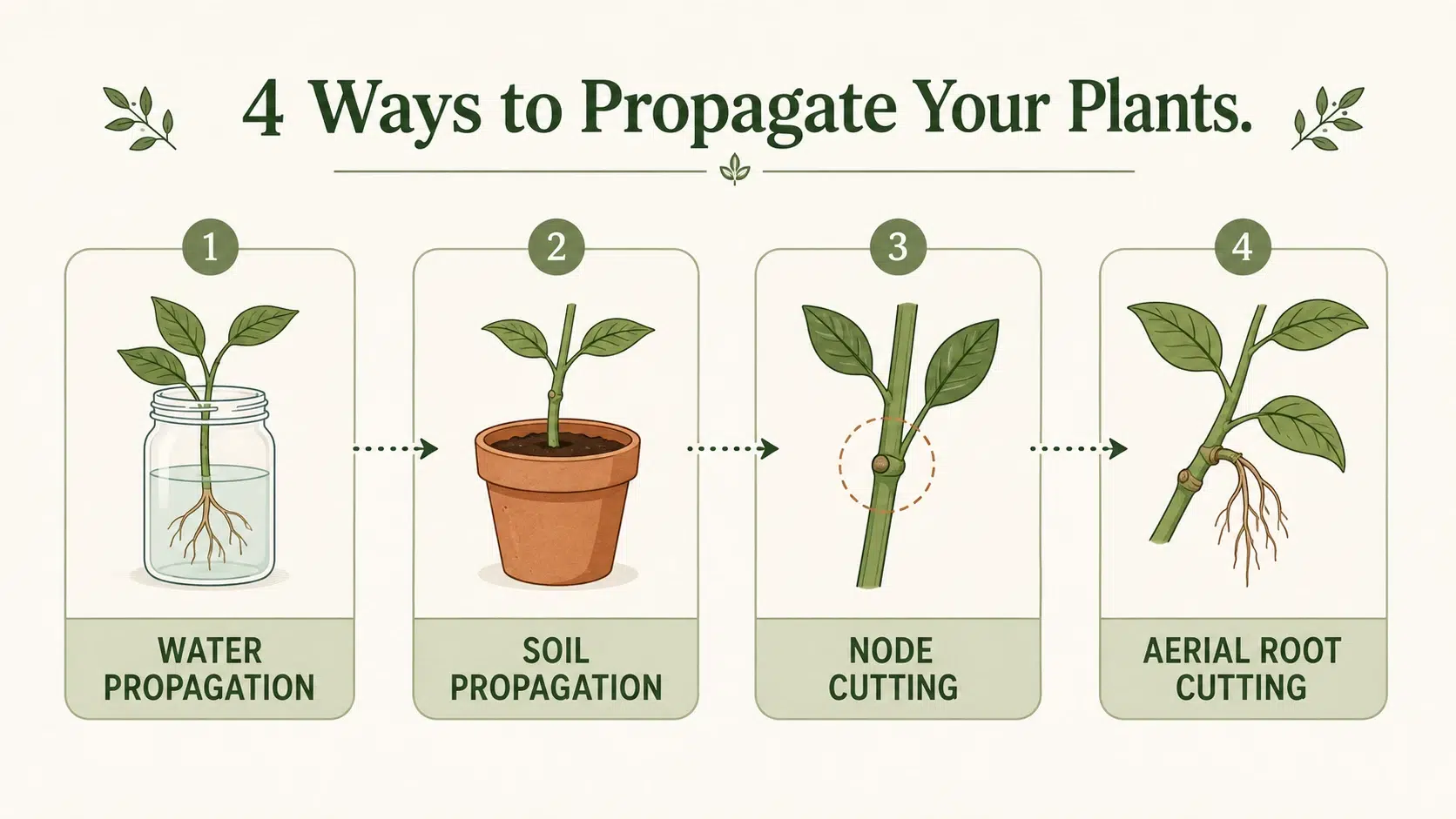
Propagation — creating new plants from cuttings of an existing one — is where an indoor green living hub really starts to compound in value. A single healthy vine can become several new plants, gifts for friends, or backup copies of a favorite variety, usually for the cost of a glass of water and a pair of clean scissors.
At a high level, most aroids in this guide propagate through one of a few methods:
- Water propagation — placing a stem cutting with at least one node in water until roots develop, then potting it up.
- Soil propagation — planting a cutting directly into a well-draining mix, often with a plastic cover to maintain humidity while roots establish.
- Node cuttings — the node (the small bump on a stem where a leaf or aerial root emerges) is the single point from which new roots and growth appear; understanding it is the foundation of nearly every propagation method. For the underlying science of why nodes matter — and general best practices that apply across almost any houseplant — Illinois Extension’s guide to stem cuttings is a solid reference point before trying species-specific methods.
- Aerial root cuttings — some plants, especially climbing Philodendron and Monstera, produce visible aerial roots along the stem that can be used to speed up propagation.
Exact timing, ideal cutting length, and success rates vary by species, so once you’re ready to try it, these dedicated guides walk through the specifics:
- Manjula Pothos Propagation
- Silver Satin Pothos Propagation
- Pothos Aerial Roots Propagation
- How to Propagate Syngonium
- Can Syngonium Grow in Water?
- Philodendron Melanochrysum Propagation
- How to Propagate a Philodendron Birkin
- Heartleaf Philodendron Propagation
- Philodendron Gloriosum Propagation
- Propagate Monstera Peru
Pruning, Training, and Shaping Growth
Left alone, most climbing and trailing aroids will grow — but not necessarily in the shape you want. Pruning and training are how you turn a leggy vine into a full, healthy-looking plant, or a sprawling stem into a climbing centerpiece.
Pruning for fullness. Cutting a stem just above a node encourages the plant to branch out from that point rather than continuing in one direction, which is the basic technique behind making a trailing Pothos look fuller over time. The specific cut points that produce the best results are covered in Where to Cut Pothos to Encourage Growth.
Training climbers. Plants like Philodendron, Monstera, and some Syngonium naturally want to climb using aerial roots, and giving them a moss pole or trellis to grip produces larger, more mature leaves than letting the same plant trail. For a real-world example of training a naturally trailing plant to climb instead, see NJoy Pothos Climbing.
Related climbing aroid care. Syngonium podophyllum ‘Monkey Mask,’ sometimes grown as a smaller, more compact climber, follows similar training principles — see Monkey Mask Plant Care for specifics.
Styling with growth habit. Once a plant is established, how you display it — trailing from a shelf, climbing a pole, or hanging in a basket — becomes part of your design, not just its care. Hanging Monstera covers one popular display approach.
Understanding nodes. Every pruning and propagation decision comes back to the node — the point on a stem where new growth originates. If you want a deeper technical understanding of where nodes appear and why they matter, Monstera Plant Node breaks it down clearly.
Common Problems and Troubleshooting
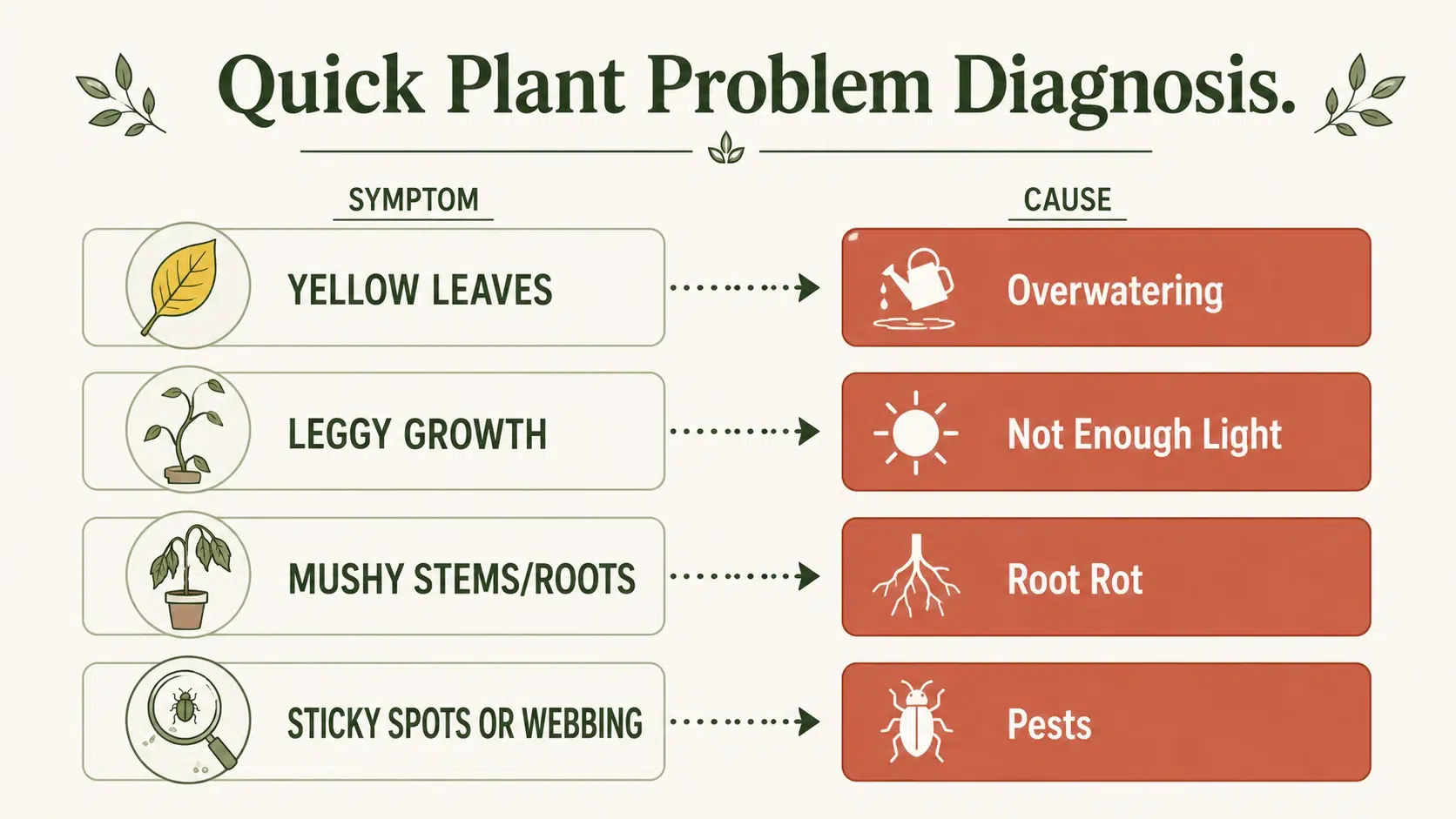
Most houseplant problems trace back to one of the five foundations covered earlier, not a mysterious disease. A quick diagnostic approach:
Yellowing leaves. Usually overwatering, especially if it starts with lower or older leaves and the soil feels consistently wet. Occasionally it’s simply natural leaf aging — one or two yellow leaves at a time on an otherwise healthy plant is normal, not a crisis.
Leggy or slow growth. Almost always a light issue, sometimes compounded by a lack of feeding during the growing season. Moving a plant closer to a bright window is usually the first fix to try before assuming something more serious is wrong.
Root rot. The most serious common issue, caused by prolonged overly wet soil, often from a pot without drainage or a watering schedule that doesn’t account for season. Mushy, dark, foul-smelling roots at the base of the plant confirm the diagnosis; the fix is removing affected roots and repotting into fresh, well-draining soil.
Pests. Spider mites, mealybugs, and fungus gnats are the most common indoor pests on aroids, generally arriving on a new plant or in overly damp soil. Regularly checking leaf undersides and isolating new plants for a week or two before placing them near your existing collection prevents most infestations before they start.
If a specific plant has stopped growing despite seemingly correct care, it’s worth checking whether the issue is unique to that variety — for example, Monstera Siltepecana Not Growing walks through a documented case and its likely causes.
Comparing Similar Varieties (When Plants Look Alike)
One of the most common questions in any indoor green living hub isn’t “how do I care for this plant” — it’s “which plant do I actually have?” Aroids are notorious for producing similar-looking cultivars with different names, different variegation patterns, and sometimes meaningfully different care needs. Rather than attempt every comparison here, these dedicated guides settle the most common mix-ups:
- Golden Pothos vs Marble Queen
- Manjula Pothos vs Snow Queen
- Monstera Siltepecana vs Cebu Blue
- Monstera Esqueleto vs Obliqua
If you’re trying to identify a darker, moodier-leaved plant that might be a Syngonium rather than a Philodendron or Pothos, Syngonium Black Panther covers its distinctive appearance and care.
Styling Your Indoor Green Living Space
Care is only half the picture — the other half is arranging what you grow so it actually reads as a cohesive space rather than a random collection of pots.
Layer by growth habit. Combine trailing plants (on shelves or in hanging planters), climbing plants (on moss poles or trellises), and upright plants (on the floor or a plant stand) to create visual depth rather than a flat row of identical pots at the same height.
Use variegation as a focal point. A single strongly variegated plant — a Variegated Monstera Deliciosa is a striking example — draws the eye and works well as a centerpiece surrounded by simpler, solid-green plants rather than competing with several other variegated specimens.
Group by care needs, not just looks. Plants with similar light and watering requirements are easier to maintain when placed together, since you can water and check on a whole grouping in one pass rather than tracking a dozen individual schedules.
Display, don’t just place. Something as simple as letting a Monstera trail from a high shelf — see Hanging Monstera for one approach — turns a plant that might otherwise sit awkwardly on the floor into an intentional design feature.
Building Your Beginner Plant Collection: A Starter Path
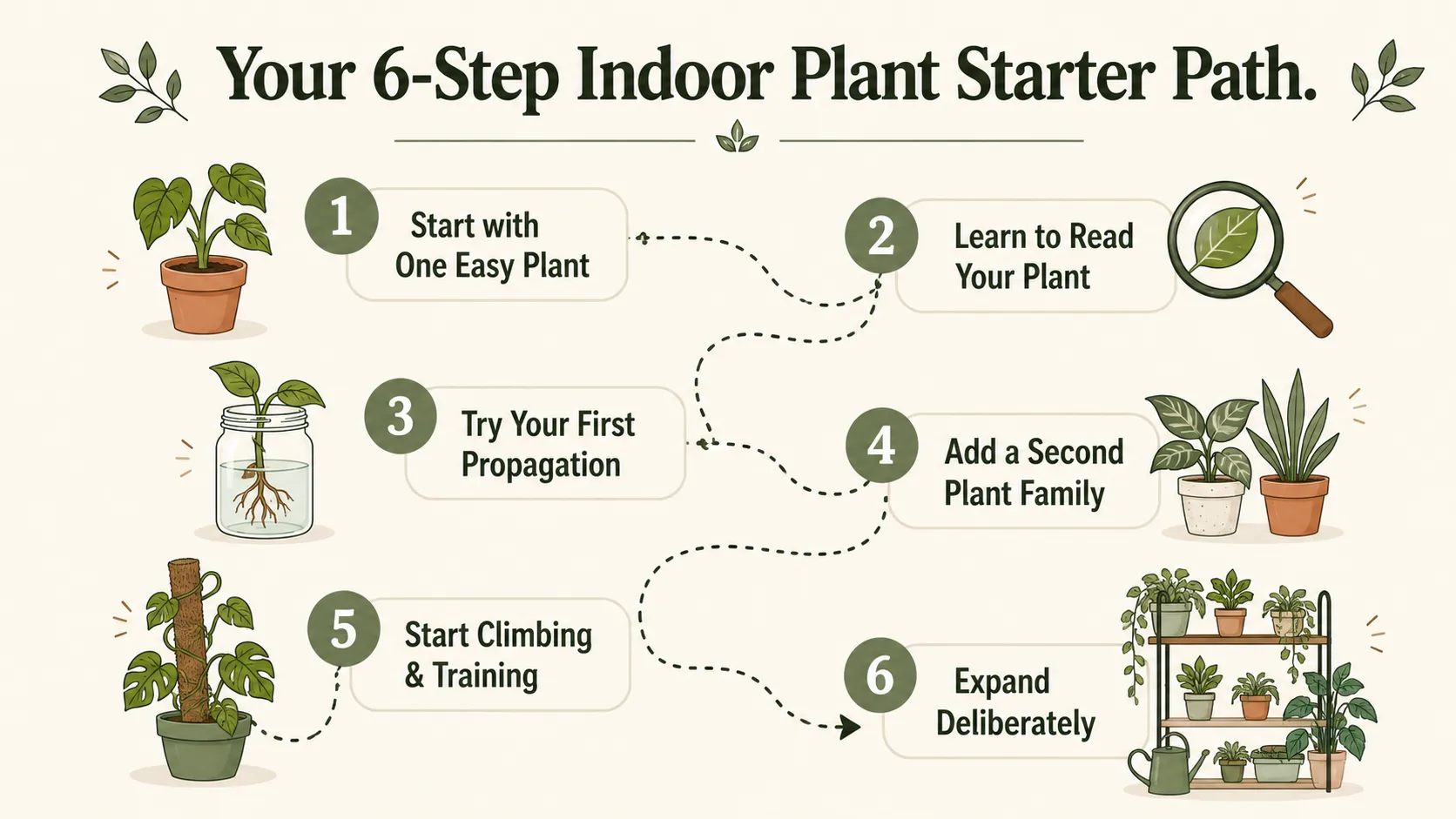
If you’re starting from zero, this is the order that tends to produce the fastest wins and the least frustration:
- Start with one easy plant. A standard Pothos is close to foolproof and gives you a low-stakes way to learn watering and light before investing in anything harder to replace. See Pothos Care for Beginners.
- Learn to read your plant, not the calendar. Spend the first month checking soil moisture by hand rather than watering on a schedule — this single habit prevents most early plant deaths.
- Try your first propagation. Once your first plant is established, take a single cutting and propagate it in water. This builds confidence and gives you a second plant for free.
- Add a second family. Once Pothos feels routine, introduce a Philodendron or a beginner-friendly Monstera to diversify leaf shape and growth habit. See Best Monstera Varieties for Beginners.
- Branch into climbing and training. With two plant families established, start training a climber onto a moss pole and experiment with pruning for fullness.
- Expand deliberately, not impulsively. Add new plants based on the light and space you actually have available, not just what looks appealing in the moment — this is what separates a thriving green living hub from a collection of struggling plants.
Conclusion
Building an indoor green living hub isn’t about acquiring a lot of plants quickly — it’s about understanding a small set of care fundamentals well enough that they apply to almost anything you bring home. Light, water, humidity, soil, and feeding solve the vast majority of problems you’ll ever run into. From there, choosing an easy starting family — Pothos and Syngonium for fast, forgiving growth, or Philodendron and Monstera for bolder, climbing statement plants — gives you a foundation to expand from through propagation, pruning, and intentional styling.
If you’re ready to go deeper, the two sub-pillars linked throughout this guide are the best next step: explore the full Pothos and Syngonium guide for everything on that plant family, or dive into the complete Monstera vs Philodendron comparison if bold, climbing foliage is more your style. Bookmark this page as your home base — as your collection grows, the specific care, propagation, and identification guides linked throughout this article will be here to answer whatever comes next.
Frequently Asked Questions
What is the easiest indoor plant for beginners to start an indoor green living hub with?
A standard Pothos is generally considered the most forgiving starting point — it tolerates a wide range of light conditions, recovers quickly from missed waterings, and propagates easily.
How much light do most indoor houseplants need?
Most popular indoor aroids, including Pothos, Syngonium, Philodendron, and Monstera, do best in bright, indirect light — near a window but out of prolonged direct sun.
How often should I water my indoor plants?
Rather than a fixed schedule, water when the top 1–2 inches of soil feel dry to the touch. This varies by season, light, and pot size, so checking the soil directly is more reliable than watering on a set day.
Are Pothos, Philodendron, and Monstera safe around pets?
No — all of these plants are mildly to moderately toxic if chewed or ingested by cats, dogs, or small children. They’re commonly kept in pet-owning households, but should be placed out of easy reach.
What’s the difference between Pothos, Philodendron, and Monstera at a glance?
Pothos and Syngonium are typically smaller-leaved, faster-growing trailers that tolerate lower light. Philodendron spans a wide range of shapes and sizes. Monstera is known for large leaves that develop natural splits and holes as they mature, and generally benefits from more light and humidity than Pothos.
How do I know when to repot an indoor plant?
Repot when you notice roots circling the bottom of the pot, water running straight through without being absorbed, or growth that has stalled despite otherwise good care — typically once every 1–2 years for most aroids in this guide.
Can I propagate most indoor plants the same way?
The general principle — using a stem cutting with at least one node, rooted in water or soil — applies broadly across Pothos, Syngonium, Philodendron, and Monstera, though exact timing and success rates vary by species.
How many plants do I need to start noticing air quality or wellbeing benefits?
There’s no fixed number, but most people notice a difference once they have several mature plants actively growing in a room, rather than one or two small specimens — a strong argument for expanding gradually through propagation.



3 Responses